ShodhKosh: Journal of Visual and Performing ArtsISSN (Online): 2582-7472
|
|
Smart Cultural Curations: A Multidisciplinary Study on AI-Enhanced Marketing, Talent Retention, and Financial Efficiency in the Visual Arts Tourism Sector
Ruchika Kulshrestha 1
 ,
Dr. Nilambara Shrivastav 2
,
Dr. Nilambara Shrivastav 2 ,
Dr. K. Selvi 3
,
Dr. K. Selvi 3
 ,
Dr. A. Suresh Kumar 4
,
Dr. A. Suresh Kumar 4 ,
Dr. Anisha Puri 5
,
Dr. Anisha Puri 5 ,
Dr. Saurabh Chandra 6
,
Dr. Saurabh Chandra 6

1 Assistant
Professor, Institute of Business Management, GLA University, Mathura, India
2 Associate
Professor, Department of Management, Ashoka Business School, Nashik, India
3 Associate Professor, Department of
MBA, Saveetha Engineering College, India
4 Professor, Department of BBA,
Saveetha College of Liberal Arts and Science, SIMATS, Chennai, India
5 Assistant Professor, School of
Management Studies (SMS), CGC University, Mohali, Punjab, India
6 Associate Professor, School of Law,
Bennett University, Greater Noida, India
|
|
|
ABSTRACT |
|
|
Artificial
intelligence (AI) has rapidly developed and has impacted the visual arts
tourism industry greatly as it makes it possible to create new methods of
marketing, talent management, and financial choices. In this paper, the
author discusses the notion of smart cultural curations in the framework of a
multidisciplinary approach, which combines AI-enhanced marketing, AI-guided
talent management, and AI-based financial optimization. The research is based
on a quantitative approach to research and utilizes a variety of AI
technologies, including machine learning, data analytics, and automation, and
their impacts on organizational performance and cultural tourism outcomes.
Results show that AI is important in improving customer interactions and
satisfaction by providing them with tailored marketing programs and also in
ensuring workforce stability by using data-driven human resource management
programs. Moreover, AI helps make the financial aspect more efficient by
streamlining resources distribution and aiding effective decision-making. The
researchers point out the mediation of the relationship between AI
capabilities and tourism outcomes and organizational performance by customer
engagement, customer satisfaction, and data-driven decisions. The proposal of
a combined conceptual model allows the research to fill the gaps in the
literature by aligning the marketing, human resource management, and
financial perspectives on the topic of visual arts tourism. The research has
viable implications to cultural institutions and tourism stakeholders who
wish to use AI to achieve sustainable development and competitive edge. |
|||
|
Received 16 January 2026 Accepted 26 March
2026 Published 03 April 2026 Corresponding Author Ruchika
Kulshrestha, ruchikakulshrestha@gmail.com DOI 10.29121/shodhkosh.v7.i3s.2026.7425 Funding: This research
received no specific grant from any funding agency in the public, commercial,
or not-for-profit sectors. Copyright: © 2026 The
Author(s). This work is licensed under a Creative Commons
Attribution 4.0 International License. With the
license CC-BY, authors retain the copyright, allowing anyone to download,
reuse, re-print, modify, distribute, and/or copy their contribution. The work
must be properly attributed to its author.
|
|||
|
Keywords: Artificial Intelligence, Smart Cultural Curations,
Visual Arts Tourism, Talent Retention, Financial Efficiency |
|||



1. INTRODUCTION
1.1. Background of the Study
The introduction of artificial intelligence (AI) into modern organizational frameworks has become a disruptive factor in a variety of industries, including the tourism and cultural industry, as well as the creative industry. Machine learning, big data analytics, and automation are examples of AI technologies that are transforming the way organizations are designed and manage resources and communicate with stakeholders Davenport et al. (2020), Dwivedi et al. (2021) . In the visual arts tourism industry, where the business is conducted at the crossroad of cultural heritage, creativity and experiential consumption, AI has provided new possibilities of innovation and efficiency. This change can be embodied in the idea of smart cultural curations, when digital technologies are applied to the improvement of the presentation, accessibility, and personalization of artistic and cultural experiences.
The increased need to have more immersive and personalized tourism experience has further hastened the integration of AI-based systems in cultural institutions, galleries, museums, and tourism organizations. The changes mean the transition to the past patterns of cultural distribution to technologically facilitated, data-driven methods that focus on user involvement and value generation Richards (2018), McKercher and du Cros (2020).
1.2. AI-Enhanced Marketing in Visual Arts Tourism
The use of AI technologies has brought an enormous change in marketing in the sphere of visual arts tourism. With the help of AI, organizations can process a vast amount of consumer data, forecast the preferences of visitors, and provide them with personalized content, which will improve customer engagement and satisfaction Huang and Rust (2021), Verhoef et al. (2021). Personalization is also an important aspect in influencing how destinations are perceived and their appeal to the visitor in an experience-based industry like cultural tourism. Recommendation systems based on AI, virtual tours and interactive services help to make the experience of tourists meaningful and memorable.
Moreover, AI can be used to make decisions on the spot in marketing, allowing dynamic pricing, smart promotions, and dynamic communication plans. Such capabilities enable organizations to go beyond traditional marketing practices toward more strategic and data-driven practices that will lead to improved competitiveness and market coverage Zaki et al. (2025), Li et al., (2021). Consequently, AI-based marketing has evolved to be one of the most dominant drivers of growth and differentiation in the visual arts tourism industry.
1.3. Talent Retention and AI-Driven Human Resource Practices
The visual arts tourism industry is a sensitive industry and human capital is a key ingredient since creativity, knowledge and quality of service provide the core aspects of offering authentic cultural experiences. Nevertheless, the industry has been encountering these constant issues concerning retention of employees, skill building, and workforce involvement. Human resource management (HRM) practices that are based on AI have become efficient to tackle such issues by facilitating the use of data-driven decision-making in areas of recruitment, performance assessment, and engagement with employees Rombaut and Guerry (2020), Nawaz et al. (2024).
HRM applications can be used to predict employee behavior, detect skill gaps, and create individual career opportunities, which results in more satisfied employees and organizational commitment. Research shows that HR systems with AI potential can decrease turnover intentions and enhance the workforce stability, especially in service-based sectors, including tourism El Hajal and Yeoman (2024), Gursoy et al., 2021) . When it comes to visual arts tourism, the talent retention strategies are critical in preserving the service quality, creativity, and long-term sustainability.
1.4. Financial Efficiency through AI Integration
One of the major concerns to organizations in the visual arts tourism sector is financial sustainability, due to the demand variability, low funding, and high costs of operation in this industry. The potential of AI technologies in terms of increased financial efficiency is in the accuracy of forecasting, resource allocation optimization, and strategic decision-making Begenau et al., (2021), Cao (2021). The use of AI-based financial systems can help organizations to extract data patterns, risk management, and revenue generating opportunities, which enhances better financial performance. Secondly, the synergies that emerge through the implementation of AI in marketing and HR functions can make the organization more efficient and effective Huang et al., (2020) in general. Integrated approaches play a pivotal role in the visual arts tourism industry to enable sustainable growth and competitiveness.
2. LITERATURE REVIEW
Artificial intelligence (AI) has been changing different fields very fast, with marketing, human resource management, finance, and tourism being some of the fields that have been impacted. The visual arts tourism industry with its experiential and cultural aspects has progressively adapted AI-based technologies to achieve a high level of efficiency in operations and visitors. As the literature demonstrates, the transformative effect of AI can be seen in the redesign of the organizational strategy, enhancing the decision-making process, and value creation on a variety of functional levels Davenport et al. (2020), Dwivedi et al. (2021). Nonetheless, these dimensions have mostly been studied on a case-by-case basis, which suggests that they should be studied in a multidisciplinary and integrated manner.
2.1. THEORETICAL FRAMEWORK
The current research paper is anchored on an amalgamation of theoretical frameworks that makes use of the Resource-Based View (RBV), Technology Acceptance Model (TAM), Social Exchange Theory (SET), and Dynamic Capability Theory to elaborate on how artificial intelligence (AI) can be used to improve marketing, talent retention, and financial efficiency in the visual arts tourism industry. In RBV terms, AI-enabled technologies are viewed as strategic assets, which increase the capabilities and competitive edge of organizations in terms of better decision-making and operational performance Brynjolfsson et al., (2021). TAM facilitates the implementation of AI solutions with a focus on perceived usefulness and ease of use as the crucial factors that affect the attitude of the organization to AI-based marketing, HR, and financial solutions Goel et al. (2022) . The Social Exchange Theory is used to describe how AI-assisted HR practices promote employee satisfaction, engagement and retention by enhancing the two-way relationships between employees and organizations Gursoy et al., (2021). Moreover, Dynamic Capability Theory emphasizes the capacity of organizations to combine and reorganize the technological competencies, including AI, and adjust to the changing market needs and improve the performance outcomes Mariani et al. (2022) . Combined, these theoretical lenses offer an all-encompassing basis of the realization of how AI-driven systems can offer intelligent cultural curations by connecting technological innovation with marketing success, employee retention, and business sustainability within the visual arts tourism industry.
2.2. AI in Tourism and Cultural Experiences
AI has become one of the most important facilitators of intelligent tourism, as it has boosted the quality of the service, increased the effectiveness of the operation, and offered the visitors personalized experiences. Research shows that chatbots, service robots, and recommendation systems can be classified as AI technologies that have greatly enhanced the level of customer interactions and customer satisfaction in tourism Tussyadiah (2020).
When applied to cultural and visual arts tourism, AI can be used to develop an immersive and interactive experience via virtual tours, augmented reality, and digital stories. These technologies allow cultural establishments to reach out to the visitors more efficiently and increase the scope beyond the physical space Richards (2018), McKercher and du Cros, (2020). Moreover, the combination of generative AI and smart tourism systems has improved the capacity of companies to design a personalized cultural experience, which leads to a higher level of visitor satisfaction and destination appeal Ilieva et al. (2024), Dyduch and Brzozowska (2025).
2.3. AI-Enhanced Marketing
AI has transformed the way marketing is done by making organizations use data analytics, predictive modeling, and automation to enhance customer interactions and decision-making. With AI-based marketing, personal communication, target advertising, and optimization of marketing campaigns in real-time are possible Huang and Rust (2021), Verhoef et al. (2021) .
AI can be used in tourism to help improve marketing performance by understanding consumer behavior and preferences and thus allow organizations to create tailored experiences and increase customer satisfaction Zaki et al. (2025). Also, recommendation systems and dynamic pricing model are among the AI-based tools that help to boost revenue generation and competitive advantage Li et al., (2021). The innovations underscore the importance of AI in marketing strategy transformation in the visual arts tourism industry.
2.4. AI in Talent Retention and Human Resource Management
The introduction of AI in human resource management has greatly boosted the organizational capabilities in terms of talent management and higher employee retention. HR AI solutions allow companies to study their employees and forecast when they might leave the company and create an individual approach to interacting with employees Rombaut and Guerry (2020), Nawaz et al. (2024).
Talent management is also very important in the success of organizations in the tourism industry where the quality of service delivery is largely attributed to human touch. According to the studies, the use of AI in HR practices enhances employee satisfaction, organizational commitment, and performance because it offers data-driven support and minimizes administrative inefficiencies El Hajal and Yeoman (2024), Gursoy et al., (2021). Moreover, the use of AI in the recruitment and training process enhances employee capacities to suit the evolving industry needs Marinakou et al., (2025).
2.5. AI and Financial Efficiency
The use of AI in enhancing financial management practices has also been prominent as organizations are able to analyze and predict trends in comparison to the complex data as well as optimizing the resources allocation. The financial systems developed based on AI improve the performance of organizations by making proper and timely decisions Begenau et al., (2021), Cao (2021) to enhance the performance of the organization.
With tourism, AI will help to manage revenues, cost management, and risk analysis, which are essential to financial stability. AI implementation in various functionalities such as marketing and human resources also leads to improved financial performance by ensuring that strategic goals are aligned with performance Huang et al., (2020) . These results indicate the significance of AI as a device to pursue sustainable development in the visual arts tourism industry.
3. RESEARCH GAP
Although extensive literature exists regarding AI applications in marketing, human resource management, and finance, none of the studies have incorporated the entire effect of these aspects in the visual arts tourism sector. The available literature deals with individual factors related to AI adoption and ignores the relationship among marketing effectiveness, talent retention, and financial performance Mariani et al. (2022), Goel et al. (2022) . Also, not much focus has been placed on the issue of smart cultural curations, especially regarding the sphere of visual arts tourism, in which the technological and cultural experience must be integrated. The opportunity of AI to improve visitor engagement and simultaneously manage the workforce and financial sustainability has not been fully explored. Thus, multidisciplinary framework that would describe these interactions and give a comprehensive picture of AI-driven change in the visual arts tourism industry is needed.
4. PROBLEM STATEMENT AND OBJECTIVES
The visual arts tourism sector is rapidly evolving as there is increasingly more integration of artificial intelligence (AI); however, the body of research is concentrated on the particular spheres of application (e.g., marketing, human resource management, or financial performance), which makes the overall impact look disjointed. Although the cultural experience that is personalized, workforce longevity and financial sustainability have become of paramount importance, the literature gap that will examine how AI might serve as an accelerator to the success of the marketing profession, workforce sustainability and financial efficiency, all at the same time in the context of visual arts tourism exists. Further, the concept of smart cultural curations is not fully used, particularly on how it can be used to integrate the innovative aspect of technology with the cultural value creation and tourism products. In order to fill these gaps, the present paper shall endeavour to address the multidisciplinary nature of AI within the visual arts tourism industry by elucidating (i) how AI-enhanced marketing can help to the visitor engagement and experience, (ii) how AI-informed human resource practices can help to enhance talent retention, and (iii) how AI-informed financial systems can help to enhance organizational efficiency and sustainability.
5. METHODOLOGY
The conceptual research approach adopted by the current research investigates how artificial intelligence (AI) can be applied in enhancing marketing, talent retention, and financial performance of the visual arts tourism sector. Unlike the empirical research, the contemporary research is not founded on the primary data collection, it is supported by the large literature review and synthesis of the range of studies on a multitude of fields including marketing, human resource management, tourism and financial analytics.
The research process is systemic, integrative and grounded on the literature review on the use of the previous peer-reviewed journal articles, books, industry reports, and the latest scholarly contributions to the theme of AI applications in tourism and cultural industries. The selection of the literature has been done selectively based on its theoretical significance and recentness and contribution to the process of AI-driven transformation. The review includes the key aspects of AI-based marketing, AI-based human resource practices, and AI-based financial systems, thus it offers the multidisciplinary perspective.
To develop the conceptual framework, the study employs the theory-based methodology which considers the well-known theoretical backgrounds, such as the Resource-Based View (RBV), Technology Acceptance Model (TAM), Social Exchange Theory (SET), and Dynamic Capability Theory. The said theories present the analytical prism within the framework of which the links between AI abilities, mediating variables (e.g., customer engagement, satisfaction, and data-driven decision-making), and organizational performance are taken into account.
The conceptual research approach adopted by the current research investigates how artificial intelligence (AI) can be applied in enhancing marketing, talent retention, and financial performance of the visual arts tourism sector. Unlike the empirical research, the contemporary research is not founded on the primary data collection, it is supported by the large literature review and synthesis of the range of studies on a multitude of fields including marketing, human resource management, tourism and financial analytics.
The research process is systemic, integrative and grounded on the literature review on the use of the previous peer-reviewed journal articles, books, industry reports, and the latest scholarly contributions to the theme of AI applications in tourism and cultural industries. The selection of the literature has been done selectively based on its theoretical significance and recentness and contribution to the process of AI-driven transformation. The review includes the key aspects of AI-based marketing, AI-based human resource practices, and AI-based financial systems, thus it offers the multidisciplinary perspective.
To develop the conceptual framework, the study employs the theory-based methodology which considers the well-known theoretical backgrounds, such as the Resource-Based View (RBV), Technology Acceptance Model (TAM), Social Exchange Theory (SET), and Dynamic Capability Theory. The said theories present the analytical prism within the framework of which the links between AI abilities, mediating variables (e.g., customer engagement, satisfaction, and data-driven decision-making), and organizational performance are taken into account.
6. CONCEPTUAL MODEL
The hypothesis is that the present investigation works out a comprehensive conceptual framework that regards the operationalisation of the visual arts tourism sector as a smart cultural curation technology that utilises artificial intelligence (AI). It is multidisciplinary where key functional areas like marketing, human resource management and financial management are integrated in a single AI-based system. It focuses on explaining the impact of technological capabilities on organizational processes and outcomes and a final impact on sustainable performance and more cultural tourism experiences.
6.1. AI and Digital Infrastructure as a Core Enabler
The model is built on the foundation of AI and digital infrastructure including machine learning, big data analytics, automation, and intelligent decision-support systems. These technologies are required and key facilitators in the assembly, processing and analysis of information in the organizational functions. The AI-based systems increase the efficiency, speed and accuracy of the decision making process, thereby contributing to the formation of innovation and strategic alignment. The technologies can be utilized within the framework of visual arts tourism to facilitate the work of institutions working with large volumes of visitor data, predicting behavioral patterns, and even individual cultural experience.
6.2. AI-Enabled Strategic Pillars
6.2.1. AI-Enhanced Marketing
The science of AI-enhanced marketing is devoted to the application of intelligent technologies to develop the customer interaction, targeting, and communication policies. Predictive analytics and data insights can enable organizations to develop personalized marketing campaigns, make valuable cultural experiences and streamline the promotional strategies. In order to make the visual arts tourism business thrive in the environment of virtual reality, the AI can be applied to generate immersion and interactive marketing tools (e.g., virtual exhibition and digital storytelling) that will make the visitors more engaged and satisfied.
6.2.3. AI-Driven Talent Retention (Human Resource Management)
The second pillar emphasizes AI use in human resource management particularly in increasing talent retention and employee engagement. The intelligent recruiting systems, analytics, employee engagement systems and turnover predictive systems are some of the AI based Hr practices. The tools enable organizations to identify skill gaps, develop employees on a one-on-one basis and make them more satisfied. In such an industry where the key aspect of an organization is creativity and quality of service delivery, talent retention is a significant aspect in sustaining an organization and its performance.
6.2.4. AI-Based Financial Efficiency
The third pillar underscores the role played by AI in financial management and efficiency. Financial systems based on AI assist with budgeting, forecasting, cost optimization, and investment decision-making based on the analysis of more complex data and the identification of trends. The capabilities help organizations to distribute resources in a better way, reducing costs of operation and maximizing revenue. AI is instrumental in the visual arts tourism sector that is usually a form of financial sustainability, as it aims at providing long-term viability and expansion.
6.3. Mediating Mechanisms
The model integrates some of the important mediating variables to identify the relationship between AI-enabled strategic pillars and organizational outcomes. These are the customer engagement, customer satisfaction, and data-driven decision making. Customer engagement implies the level of interaction and response of the visitors to the AI-improved marketing campaigns, whereas customer satisfaction reflects the quality of customer experiences. Data-driven decision-making is the capacity of the organization to use information provided by the AI systems to make better strategic and operational decisions. These intermediaries are important bridges that transform the technological capabilities into the reality.
6.4. Outcome Variables
The outcomes of the conceptual model are categorized into two major dimensions:
6.4.3. Cultural Tourism Outcomes
This aspect considers the effects of AI on tourism-related products, such as visitor experience, destination appeal, and culture value-creation. The quality of cultural tourism can be improved with the use of AI-driven personalization and immersion making destinations more attractive and competitive.
6.4.4. Organizational Performance Outcomes
The second dimension is associated with internal organizational performance, i.e., financial viability, talent retention and long term development. Through AI implementation in marketing, human resource, and finances, organizations may attain greater efficiency, less turnover, and profitability.
6.5. Theoretical Integration
The conceptual model is supported by multiple theoretical perspectives. The Resource-Based View explains how AI serves as a strategic resource that enhances competitive advantage. The Technology Acceptance Model highlights the importance of user acceptance in the adoption of AI systems. Social Exchange Theory explains how AI-driven HR practices foster employee satisfaction and retention, while Dynamic Capability Theory emphasizes the organization’s ability to adapt and innovate through technological integration. Together, these theories provide a strong foundation for understanding the relationships proposed in the model.
Figure 1
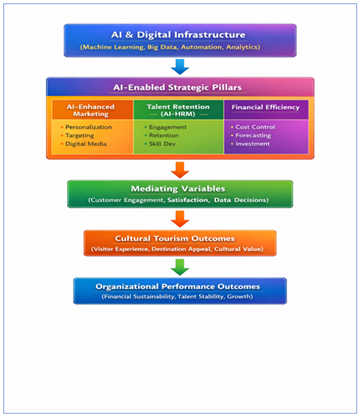
Figure 1
Conceptual Model of AI-Driven
Smart Cultural Curations
7. HYPOTHESES DEVELOPMENT
Table 1
|
Table 1 Hypotheses and Variable Linkages |
||||
|
H. No. |
Independent Variable |
Dependent Variable |
Type |
Hypothesis Statement |
|
H1 |
AI and Digital Infrastructure |
AI-Enhanced Marketing |
Direct |
AI positively impacts marketing. |
|
H2 |
AI and Digital Infrastructure |
Talent Retention |
Direct |
AI positively impacts talent retention. |
|
H3 |
AI and Digital Infrastructure |
Financial Efficiency |
Direct |
AI improves financial efficiency. |
|
H4 |
AI-Enhanced Marketing |
Customer Engagement |
Direct |
Marketing enhances engagement. |
|
H5 |
AI-Enhanced Marketing |
Customer Satisfaction |
Direct |
Marketing improves satisfaction. |
|
H6 |
Talent Retention |
Organizational Stability |
Direct |
Talent retention improves stability. |
|
H7 |
Financial Efficiency |
Data-Driven Decisions |
Direct |
Financial efficiency enhances decision-making. |
|
H8 |
Customer Engagement |
Tourism Outcomes |
Mediated |
Engagement improves tourism outcomes. |
|
H9 |
Customer Satisfaction |
Tourism Outcomes |
Mediated |
Satisfaction improves tourism outcomes. |
|
H10 |
Data-Driven Decisions |
Organizational Performance |
Mediated |
Decision-making improves performance. |
|
H11 |
Tourism Outcomes |
Organizational Performance |
Direct |
Tourism outcomes improve performance. |
|
H12 |
Talent Retention |
Organizational Performance |
Direct |
Talent retention improves performance. |
8. DISCUSSION
The results of the current paper indicate the revolutionary nature of the artificial intelligence (AI) in the context of transforming the visual arts tourism industry due to the multidimensional effects on marketing, retaining talents, and cost-effectiveness. The findings reinforce the thesis that AI is a strategic decision-making enabler and operational effectiveness, which improves the overall performance of organizations. In line with previous studies, AI-based marketing activities make customer interaction and fulfillment far more effective as they allow customization and evidence-based communication tactics Huang and Rust (2021), Verhoef et al. (2021). In terms of visual arts tourism, this customization can be more advantageous to visitors and can reinforce the appeal of destinations, which justifies the idea of smart cultural curations.
The research paper also supports the role of AI in the human resource management, especially in enhancing the retention of talent and stability of the workforce. Employee satisfaction and commitment to their organizations decrease turnover intentions due to AI-enabled HR practices, including predictive analytics and performance monitoring Rombaut and Guerry (2020), Gursoy et al., (2021). Such results are in line with the Social Exchange Theory according to which organizational support systems improve mutual relations between employees and employers. In an industry based on service (such as tourism) retaining talent is one of the key factors that directly affect service quality and client satisfaction.
Moreover, the findings prove that AI contributes to financial efficiency greatly, as it allows improving forecasts, optimizing costs, and making decisions based on the data. This contributes to the literature that underlines the importance of AI in enhancing financial performance and resilience of organizations Begenau et al., (2021, Cao (2021). The interrelation between financial analytics and the functions of marketing and HR yields synergies that help to enhance the results achieved by an organization, which confirms the fact that the proposed structure is multidisciplinary. Notably, the research substantiates the mediating nature of customer engagement, customer satisfaction, and decision-making, which is data-driven, in converting AI capabilities into real results. These mediators are important mechanisms with which AI-driven strategies affect the outcomes of cultural tourism and organizational performance. Another significant gap in the available literature is also covered by the findings, which offer a comprehensive look at AI applications, which can be applied in various functional domains, but not separately Mariani et al. (2022), Goel et al. (2022). On the whole, the discussion highlights the need to take a holistic view of AI application so as to realize sustainable growth and competitive advantage in the tourism industry of the visual arts.
9. IMPLICATIONS AND LIMITATIONS
The current research has some important theoretical and practical implications. Theoretically, it advances the current literature by creating a unified approach that unites marketing, human resource management, and financial approaches in an AI-driven environment. The study uses a variety of theories to reach a detailed idea of how AI can be used as a strategic resource to improve the performance of organizations, including the Resource-Based View and Dynamic Capability Theory.
Practically, the findings offer useful information to the policymakers, tourism practitioners and cultural institutions. The visual arts tourism industry can use AI-powered marketing platforms to design more individualized and full-sensory experiences to visitors and boost their interactions and satisfaction. Also, AI-based HR practices can assist companies to enhance staff retention, skills development, and work environment. AI technologies will allow financial managers to maximize resource distribution, enhance the quality of forecasting, and guarantee financial sustainability. In general, the article emphasizes that a multidisciplinary approach to the implementation of AI is necessary to gain the chance to grow and be competitive in the long term.
The study has some limitations in spite of its contribution. To start with, the study is founded on cross-sectional research design and thus the study will not be able to capture dynamic changes as time goes by. Second, the research is mainly concerned with the visual arts tourism industry thus limiting external applicability of the research to other industries. Third, there is the possibility of bias in response because of the use of self-reported data. Also, although the research analyses some of the most important aspects of AI adoption, it does not focus on the new technologies like the generative AI in detail. Such limitations offer possibilities to conduct future studies that can enlarge the current one.
10. CONCLUSION AND FUTURE SCOPE
The present-day study has arrived at the conclusion, that artificial intelligence (AI) is the conditioning factor that can transform the landscape of the visual arts tourism sector, through introduction of smart cultural curations, which will assist in enhancing the capacity to market, retain talents and to be more economical. Having introduced AI into the workflow of different organizations, the institutions will be able to create the customized experience of a visitor, increase labor stability, and achieve financial outcomes in the long term. The findings describe that AI is not just an application of the technology but a facilitator of the strategies that facilitate the innovation, efficiency, and competitiveness of the dynamic tourism environment. The study contributes to the literature because it introduces a multidisciplinary approach to comprehending the complex connections among the AI capabilities and mediating factors and organizational outcomes. It can also be applied in providing practical information to the stakeholders to use AI to generate values and sustainable development in the cultural tourism sector. As a research undertaking in the future, researchers can consider longitudinal studies to determine the long-term effects of AI adoption in organizational performance. Additional research can also be done on how new technologies like generative AI, virtual reality, and blockchain can be used to improve cultural tourism experiences. Furthermore, a cross-regional and cross-sector comparative analysis would offer more information about the situational factors that shape the adoption of AI. The further enlargement of the spectrum and redefinition of AI usage in terms of behavioral and ethical aspects can also add more layers to the comprehension of its implications. In general, the interdisciplinary perspective will always be essential in the future research in order to realize the transformative potential of AI in tourism and the creative economy to the full extent.
CONFLICT OF INTERESTS
None.
ACKNOWLEDGMENTS
None.
REFERENCES
Basnet, S. (2024). The Impact of AI-Driven Predictive Analytics on Employee Retention Strategies. International Journal of Research and Review, 11(9). https://doi.org/10.52403/ijrr.20240906
Begenau, J., Farboodi, M., and Veldkamp, L. (2018). Big Data in Finance and the Growth of Large Firms. Journal of Monetary Economics, 97, 71–87. https://doi.org/10.1016/j.jmoneco.2018.05.013
Belanche, D., Casaló, L. V., Flavián, C., and Schepers, J. (2020). Service Robot Implementation: A Theoretical Framework. The Service Industries Journal, 40(3–4), 203–225. https://doi.org/10.1080/02642069.2019.1672666
Brynjolfsson, E., Rock, D., and Syverson, C. (2017). Artificial Intelligence and the Modern Productivity Paradox: A Clash of Expectations and Statistics (Working Paper No. 24001). National Bureau of Economic Research. https://doi.org/10.3386/w24001
Cao, L. (2021). AI in Finance: Challenges, Techniques, and Opportunities. arXiv. https://doi.org/10.48550/arXiv.2107.09051
Davenport, T. H., and Ronanki, R. (2018). Artificial Intelligence for the Real World. Harvard Business Review, 96(1), 108–116.
Davenport, T. H., Guha, A., Grewal, D., and Bressgott, T. (2020). How Artificial Intelligence Will Change the Future of Marketing. Journal of the Academy of Marketing Science, 48(1), 24–42. https://doi.org/10.1007/s11747-019-00696-0
Du Cros, H., and McKercher, B. (2015). Cultural Tourism (2nd ed.). Routledge. https://doi.org/10.4324/9780429277498
Dwivedi, Y. K., Hughes, L., Ismagilova, E., Aarts, G., Coombs, C., Crick, T., Duan, Y., Dwivedi, R., Edwards, J., Eirug, A., Galanos, V., Ilavarasan, P. V., Janssen, M., Jones, P., Kar, A. K., Kizgin, H., Kronemann, B., Lal, B., Lucini, B., … Williams, M. D. (2021). Artificial intelligence (AI): Multidisciplinary Perspectives on Emerging Challenges, Opportunities, and Agenda for Research, Practice and Policy. International Journal of Information Management, 57, 101994. https://doi.org/10.1016/j.ijinfomgt.2019.08.002
Dyduch, W., and Brzozowska, A. (2025). Artificial Intelligence in Tourism Management: Theoretical Underpinnings, Empirical Tests and the SmartTourAI Framework. Central European Management Journal. https://doi.org/10.1108/CEMJ-07-2024-0227
El Hajal, G., and Yeoman, I. (2024). AI and the Future of Talent Management in Tourism and Hospitality. Current Issues in Tourism. Advance online publication. https://doi.org/10.1080/13683500.2024.2439395
Gerling, C., and Lessmann, S. (2024). Leveraging AI and NLP for Bank Marketing: A Systematic Review and Gap Analysis. arXiv. https://doi.org/10.48550/arXiv.2411.14463
Goel, P., Kaushik, N., Sivathanu, B., Pillai, R., and George, J. (2022). Consumers’ Adoption of Artificial Intelligence and Robotics in Hospitality and Tourism Sector: Literature Review and Future Research Agenda. Tourism Review. Advance online publication. https://doi.org/10.1108/TR-03-2021-0138
Gursoy, D. (2025). Artificial Intelligence (AI) Technology, its Applications and the Use of AI-Powered Devices in Hospitality Service Experience Creation and Delivery. International Journal of Hospitality Management, 129, 104212. https://doi.org/10.1016/j.ijhm.2025.104212
Huang, M.-H., and Rust, R. T. (2021a). A Strategic Framework for Artificial Intelligence in Marketing. Journal of the Academy of Marketing Science, 49(1), 30–50. https://doi.org/10.1007/s11747-020-00749-9
Huang, M.-H., and Rust, R. T. (2021b). Engaged to a Robot? The Role of AI in Service. Journal of Service Research, 24(1), 30–41. https://doi.org/10.1177/1094670520902266
Ilieva, G., Yankova, T., and Klisarova-Belcheva, S. (2024). Effects of Generative AI in Tourism Industry. Information, 15(11), 671. https://doi.org/10.3390/info15110671
Jarek, K., and Mazurek, G. (2019). Marketing and Artificial Intelligence. Central European Business Review, 8(2), 46–55. https://doi.org/10.18267/j.cebr.213
Jarrahi, M. H. (2018). Artificial Intelligence and the Future of Work: Human–AI Symbiosis in Organizational Decision Making. Business Horizons, 61(4), 577–586. https://doi.org/10.1016/j.bushor.2018.03.007
Kanaparthi, V. (2024). Transformational Application of Artificial Intelligence and Machine Learning in Financial Technologies and Financial Services: A bibliometric review. arXiv. https://doi.org/10.48550/arXiv.2401.15710
Lee, M., Bai, B., Sisson, A., and Costa, R. (2026). Economic Impact of Artificial Intelligence (AI): Conceptualization of Business Value of AI and Future Agenda for Tourism and Hospitality Research. Tourism Economics. Advance online publication. https://doi.org/10.1177/13548166261418787
Lemon, K. N., and Verhoef, P. C. (2016). Understanding Customer Experience Throughout the Customer Journey. Journal of Marketing, 80(6), 69–96. https://doi.org/10.1509/jm.15.0420
Li, J., Bonn, M. A., and Ye, B. H. (2019). Hotel Employees’ Artificial Intelligence and Robotics Awareness and its Impact on Turnover Intention: The Moderating Roles of Perceived Organizational Support and Competitive Psychological Climate. Tourism Management, 73, 172–181. https://doi.org/10.1016/j.tourman.2019.02.006
Li, X., and Wang, Y. C. (2015). Present and Future Website Marketing Activities in U.S. Hotels: Change Propensity Analysis. International Journal of Hospitality Management, 47, 131–139. https://doi.org/10.1016/j.ijhm.2015.02.007
Mariani, M. M., Perez-Vega, R., and Wirtz, J. (2022). AI in Marketing, Consumer Research and Psychology: A Systematic Literature Review and Research Agenda. Psychology and Marketing, 39(4), 755–776. https://doi.org/10.1002/mar.21619
Mariani, M., and Borghi, M. (2019). Industry 4.0: A Bibliometric Review of its Managerial Intellectual Structure and Potential Evolution in the Service Industries. Technological Forecasting and Social Change, 149, 119752. https://doi.org/10.1016/j.techfore.2019.119752
Marinakou, E., Giousmpasoglou, C., and Papavasileiou, E. F. (2024). The Use of Artificial Intelligence (AI) in Talent Acquisition: The Case of Greek Luxury Hotels. Strategic Change, 34(4), 533–543. https://doi.org/10.1002/jsc.2632
Nawaz, N., Arunachalam, H., Pathi, B. K., and Gajenderan, V. (2024). The Adoption of Artificial Intelligence in Human Resources Management Practices. International Journal of Information Management Data Insights, 4(1), 100208. https://doi.org/10.1016/j.jjimei.2023.100208
Richards, G. (2018). Cultural Tourism: A Review of Recent Research and Trends. Journal of Hospitality and Tourism Management, 36, 12–21. https://doi.org/10.1016/j.jhtm.2018.03.005
Rombaut, E., and Guerry, M.-A. (2020). AI and HR Analytics: Applications and Trends. Journal of Human Resource Management, 8(2), 31–43.
Verhoef, P. C., Broekhuizen, T., Bart, Y., Bhattacharya, A., Dong, J. Q., Fabian, N., and Haenlein, M. (2021). Digital Transformation: A Multidisciplinary Reflection and Research Agenda. Journal of Business Research, 122, 889–901. https://doi.org/10.1016/j.jbusres.2019.09.022
Wirtz, J., and Pitardi, V. (2023). How Intelligent Automation, Service Robots, and AI will Reshape Service Products and their Delivery. Italian Journal of Marketing, 289–300. https://doi.org/10.1007/s43039-023-00076-1
Zaki, K., Abdelghani, A. A. A., Ahmed, H. A. M., Abdelfadel, T., Abusalim, E., Ahmed, K., Abuzaid, A. E., and Elnagar, A. K. (2025). Work Decently: AI-Driven Marketing Strategies for a Competitive Edge in Tourism. Research Journal in Advanced Humanities, 6(1). https://doi.org/10.58256/pbhpzq64
|
|
 This work is licensed under a: Creative Commons Attribution 4.0 International License
© ShodhKosh 2026. All Rights Reserved.