ShodhKosh: Journal of Visual and Performing ArtsISSN (Online): 2582-7472
|
|
Determinants of Youth’s Political News Consumption on Social Media: A Technology Acceptance Model Perspective
Muralidharan K 1
 ,
Jayaseelan R 2
,
Jayaseelan R 2 ,
Kadeswaran S 3
,
Kadeswaran S 3 ,
Soundra Rajan D 4
,
Soundra Rajan D 4
 ,
Chithra Lekshmi K S 5
,
Chithra Lekshmi K S 5
1 PhD Research Scholar (Part-Time),
Department of Journalism and Mass Communication, PSG College of Arts and
Science, Coimbatore, Tamil Nadu, India
2 Assistant
Professor, Department of Visual Communication and Electronic Media, PSG College
of Arts and Science, Coimbatore, Tamil Nadu, India
3 Assistant
Professor, Department of Visual Communication and Electronic Media, PSG College
of Arts and Science, Coimbatore, Tamil Nadu, India
4 Assistant
Professor, Department of Visual Communication and Electronic Media, PSG College
of Arts and Science, Coimbatore, Tamil Nadu, India
5 PhD
Research Scholar (Part-Time), Department of Journalism and Mass Communication,
PSG College of Arts and Science, Coimbatore, Tamil Nadu, India
|
|
|
ABSTRACT |
|
|
In the digital
era, the manner in which individuals access
political information has undergone significant transformation, with social
media platforms emerging as the primary source for individuals aged 18–30
years. This study employs an expanded technology acceptance model (TAM) to
investigate how factors, such as perceived usefulness, perceived ease of use,
trust in platforms, and digital literacy, influence the political news
consumption habits of young users in Coimbatore, Tamil Nadu, India. Utilizing
a quantitative cross-sectional survey involving 250 participants from this
region, the research examines the relationships between these elements and
behavioral intentions related to political engagement on social media. The
principal findings reveal that perceived usefulness (β = 0.42, p <
.001) and trust (β = 0.31, p < .01) are significant predictors of
behavioral intention, whereas digital literacy moderates the impact of ease
of use on intention and consumption. Furthermore, perceived ease of use
enhances perceptions of usefulness, aligning with TAM extensions in digital
contexts. These findings underscore the role of social media in fostering
civic participation, despite challenges, such as misinformation and echo
chambers, particularly in a linguistically and culturally diverse region,
such as Tamil Nadu. Theoretically, the study extends TAM by integrating trust
and literacy into political communication. Practically, it provides insights
for media outlets, educators, and policymakers to promote responsible
consumption and counteract disinformation. Limitations include the
cross-sectional design and focus on urban youth in Coimbatore, suggesting
opportunities for longitudinal and comparative research. Overall, this
research contributes to understanding youth digital behaviors in democratic
processes and emphasizes the necessity for targeted interventions to promote
informed political discourse. |
|||
|
Received 19 February 2026 Accepted 15 April 2026 Published 28 April 2026 Corresponding Author Muralidharan
K, drmuralidharan1981@gmail.com DOI 10.29121/shodhkosh.v7.i5s.2026.7417 Funding: This research
received no specific grant from any funding agency in the public, commercial,
or not-for-profit sectors. Copyright: © 2026 The
Author(s). This work is licensed under a Creative Commons
Attribution 4.0 International License. With the
license CC-BY, authors retain the copyright, allowing anyone to download,
reuse, re-print, modify, distribute, and/or copy their contribution. The work
must be properly attributed to its author.
|
|||
|
Keywords: Social Media, Political News Consumption, Youth
Engagement, Technology Acceptance Model, Digital Literacy, Misinformation,
Political Communication |
|||



1. INTRODUCTION
Digital technologies have significantly transformed the media landscape, transitioning news dissemination from traditional outlets to interactive platforms. Social media platforms such as Facebook, Instagram, X (formerly Twitter) and TikTok have become predominant channels for political information, particularly among young individuals, who represent a digitally native demographic. Globally, young adults aged 18–30 spend considerable time online, with these platforms enabling real-time updates, user-generated content, and interactive discussions that influence political awareness and participation Alodat et al. (2023). This transformation presents opportunities for enhanced civic engagement, but also introduces risks such as exposure to misinformation, algorithmic biases, and polarized echo chambers that distort perceptions of political realities Denniss et al. (2025).
Youth constitute a pivotal demographic in the study of political communication, primarily due to their extensive use of social media and their potential impact on electoral processes. Research indicates that over 70% of young individuals in developed countries depend on digital platforms for news consumption, surpassing traditional media sources Newman et al. (2023). In emerging contexts such as India, particularly in regions like Tamil Nadu, social media plays a significant role in youth mobilization, as evidenced by local movements addressing issues such as environmental concerns and regional politics Saud (2020). However, this dependency also heightens vulnerabilities; misinformation proliferates swiftly, undermining trust in institutions, and fostering apathy or radicalization Rocha et al. (2021). For example, during elections, algorithmic curation frequently prioritizes sensational content, resulting in selective exposure and confirmation bias, a phenomenon exacerbated in multilingual areas such as Coimbatore, where Tamil and English content coexist Papathanassopoulos et al. (2025).
To comprehend these dynamics, it is imperative to employ a theoretical framework that accounts for the factors influencing technology adoption. Davis's (1989) technology acceptance model shows that perceived usefulness and ease of use shape user technology intentions Granić and Marangunić (2019). Extended applications in media studies incorporate contextual variables, such as trust and digital literacy, which are crucial in information-rich environments Asghar et al. (2023). In political contexts, the TAM elucidates how young individuals perceive social media as tools for news consumption, thereby influencing their engagement levels Ting et al. (2024).
The research problem is situated within the gap between the potential of social media for democratic empowerment and its associated risks, particularly for youth who lack robust evaluative skills. Despite the increasing usage of social media, empirical insights into the factors influencing its acceptance remain limited in regional Indian contexts, such as Coimbatore, Tamil Nadu, where cultural and linguistic diversity may uniquely influence behaviors Nazari (2022). This study examines how trust and literacy, as augmented constructs of the technology acceptance model (TAM), shape the political news consumption behaviors of young individuals in this locale.
1.1. RESEARCH OBJECTIVES
This study explores the factors influencing young adults’ (aged 18–30) engagement with political news on social media platforms in Coimbatore, Tamil Nadu, through the application of an expanded technology acceptance model (TAM). The study is designed to fulfill the following specific objectives:
1) To investigate the influence, trends, and main social media platforms involved in the consumption of political news by young people in Coimbatore
2) To examine how perceived usefulness affects both the frequency and depth of political news consumption through social media platforms.
3) To evaluate how perceived ease of use affects youth engagement with social media for political information.
4) To explore how trust in social media platforms influences the behavior of consuming political news
5) This study assessed how digital literacy influences young individuals' capacity to critically assess and choose reliable political information found online.
6) This study aims to examine the interrelationships among the core components of the technology acceptance model (TAM), specifically perceived usefulness and perceived ease of use, in conjunction with additional factors, such as trust and digital literacy. The investigation focuses on how these elements influence behavioral intention and actual engagement with political news consumption.
1.2. RESEARCH QUESTIONS
1) Which social media platforms and in what patterns do young people in Coimbatore primarily access and engage with political news?
2) To what extent does perceived usefulness predict the frequency and depth of political news consumption among young people?
3) How does perceived ease of use influence social media usage and sustained intentions to access political information?
4) What is the relationship between trust in social media platforms and youth political news consumption behavior?
5) How does digital literacy affect young people’s capacity to evaluate and discern credible political information on social media?
6) How do perceived usefulness, ease of use, trust, and digital literacy influence young people's intention and consumption of political news in Coimbatore?
2. LITERATURE REVIEW
2.1. SOCIAL MEDIA PLATFORMS AS A MEDIUM OF NEWS CONSUMPTION
Social media has transformed how people discover news, shifting from traditional journalism to algorithm-driven feeds and user-curated content. Platforms like TikTok and Instagram enable incidental exposure to political news within entertainment settings Newman et al. (2023).Research shows that this fosters accessibility but fragments attention, with young people preferring short-form videos to in-depth articles Herrero-Diz, P et al. (2020). Critically, studies highlight how virality prioritizes emotional appeal over accuracy, thereby amplifying misinformation Balakrishnan et al. (2022). In comparative analyses, Western youth exhibit higher platform diversity, whereas WhatsApp and WeChat dominate peer-shared news in Asia Feng et al. (2021).
2.2. Youth Political Engagement
Digital platforms catalyze youth civic actions from petitions to protests. Longitudinal studies have shown that social media correlates with increased participation, mediated by network effects Marquart et al. (2020). However, engagement varies by socioeconomic factors; marginalized youth leverage platforms for voice amplification yet face digital divides Middaugh et al. (2017). Critiques note that superficiality—likes over votes— is linked to low efficacy perceptions Eckstein (2019). Recent work integrates psychological traits and finds that extroverted youth are more active in online advocacy Zhu et al. (2019).
2.3. DIGITAL MEDIA AND POLITICAL COMMUNICATION
Digital media
reshapes communication flows, enabling direct interaction between politicians
and citizens via live streams and memes Jenkins
and Jie (2024). Hybrid models blend traditional and
digital methods, with influencers emerging as opinion leaders Venus
and Kim (2025). Syntheses reveal polarization through
filter bubbles, although cross-ideological exposure occurs in diverse networks Hoffmann
(2017). In elections, data analytics targets
young people, raising ethical concerns about manipulation Mohr and Kühl (2021).
2.4. DIGITAL LITERACY AND INFORMATION CREDIBILITY
Literacy encompasses the
essential verification skills necessary for effectively addressing
misinformation. Although interventions have been shown to enhance judgment,
significant gaps persist among young individuals Costa
and Sousa (2025). Research suggests a correlation between low literacy levels and the
acceptance of false information, with social validation often prioritized over
fact checking Kastorff et al. (2025). Critical analyses advocate the integration of educational approaches
that consider cultural differences in assessing credibility Dumitru
et al. (2022). The technology acceptance model (TAM) incorporates trust and literacy
as factors affecting usage intentions Lee and Chen (2025). Studies indicate that perceived usefulness (PU) influences the
adoption of news applications, with experience serving as a moderating factor Sukmadewi et al. (2023). Reviews critique TAM's emphasis on individualism and recommend the
inclusion of sociocultural elements Kundu
(2022).
2.5. Theoretical Framework
The technology acceptance model (TAM), proposed by Davis
in 1989, explains user technology adoption through two key factors: perceived
usefulness (PU) and perceived ease of use (PEOU). PU reflects how users believe
technology will improve their performance, while PEOU indicates its
user-friendliness. These factors influence technology usage intention and
actual behavior Davis (1989,
Scherer et al. (2019).
In the social media domain of youth political news
consumption, PU captures the belief that platforms deliver timely, accessible,
diverse, and relevant political information that supports awareness,
comprehension, and civic participation. PEOU reflects the intuitive navigation,
mobile friendliness, and minimal effort required to discover and consume
political content on platforms such as Instagram, WhatsApp, YouTube, Facebook,
and X Alismaiel et al. (2022), Sukmadewi et al. (2023).
Extensions of TAM in media and political communication
research have addressed the original model's individualistic limitations by
incorporating contextual variables Kundu
(2022). For this study, two
key extensions are particularly relevant:
·
Trust in social media platforms and their
content, which includes the credibility of information, algorithmic fairness,
and resistance to misinformation, serves as both a precursor to PU/PEOU and a
direct predictor of behavioral intention Rauniar et al. (2014), Na et al. (2022).
·
Digital literacy, defined as the ability to
evaluate and interpret political content online, moderates the relationship
between PEOU and behavioral intention, fostering
informed consumption Hassoun
et al. (2025), Lee and Chen (2025).
·
Empirical studies in related domains, such as
news applications, e-government, and mobile learning, indicate that the
integration of trust and digital literacy significantly enhances the
explanatory power of models in high-risk, information-rich contexts Gupta et
al. (2022), Ting et al. (2024). In the field of political
communication, the technology acceptance model (TAM) has been effectively
employed to elucidate the role of social media in mediating political
knowledge, interest, participation, and engagement among young individuals Kim (2023), Ting et al. (2024).
This study uses the technology acceptance model (TAM),
enhanced with trust as an influencer and digital literacy as a moderator, to
examine how young people aged 18-30 in Coimbatore, Tamil Nadu, consume
political news by combining functional and sociocognitive
elements in a misinformation-prone digital environment.
2.6. CONCEPTUAL FRAMEWORK
· Conceptual Framework: The proposed conceptual model extends the classic TAM structure as follows.
· Core independent variables: Perceived Usefulness (PU) and Perceived Ease of Use (PEOU)
· Extended predictor: Trust in social media platforms
· Moderator: Digital Literacy
· Mediator: Behavioral Intention to use social media for political news consumption
· Dependent variable: Political News Consumption Behavior
· Outcome: Political Engagement
Figure 1

Figure 1 CONCEPTUAL FRAMEWORK
Key hypothesized paths:
· PU → Behavioral Intention → Political News Consumption
· PEOU → Behavioral Intention → Political News Consumption (moderated by Digital Literacy)
· Trust → Behavioral Intention → Political News Consumption
· Political News Consumption → Political Engagement
This framework aligns with TAM2/TAM3 extensions Venkatesh and Davis (2000) and modern uses in digital journalism and youth politics Asghar et al. (2023), Ting et al. (2024), presenting testable connections suitable for SEM or PLS analysis.
2.7. HYPOTHESES
The following hypotheses were
derived from the theoretical and conceptual framework.
H1: The perceived usefulness of social media significantly
influences individuals' behavioral intentions to
engage with political news on these platforms.
H2: Perceived ease of use impacts intention to utilize social
media for political information.
H3: Trust in social media platforms positively influences behavioral intentions to consume political news.
H4: Digital literacy moderates how perceived ease of use
influences behavioral intention toward political
news, with stronger effects at high literacy levels.
H5: Behavioral intention positively predicts political news consumption behavior on social media.
H6: Political news consumption on social media positively
influences youth political engagement.
3. RESEARCH METHODOLOGY
This study used a quantitative cross-sectional survey design to examine young people's social media and political news consumption behaviors. Cross-sectional designs investigate relationships between variables at a specific time, allowing efficient data collection Creswell and Creswell (2018). This approach aligns with TAM applications in media studies for assessing perceptions Scherer et al. (2019).
3.1. POPULATION AND SAMPLING
The target population comprised young people aged 18–30 years who actively used social media platforms for at least one hour daily. This age group was selected because of its high digital immersion and relevance to political engagement studies Newman et al. (2023). This study focused on young urban people in Coimbatore, Tamil Nadu, India, given the region's vibrant youth population, educational institutions, and increasing social media penetration amid local political dynamics Alodat et al. (2023).
Convenience sampling was utilized, supplemented by purposive elements, to ensure active participant involvement. Surveys were distributed online via Google Forms and shared through university networks and social media in Coimbatore's colleges and community centers.This method facilitated accessibility but may have introduced selection bias toward digitally savvy individuals Etikan et al. (2016). Using G*Power software, the sample size for the multiple regression analysis was calculated to achieve a medium effect size (f² = 0.15), with an alpha level of 0.05 and a power of 0.80, resulting in a requirement of at least 200 participants Faul et al. (2009). Of the 280 questionnaires distributed, 250 were returned as valid, representing an 89% response rate after removing incomplete or outlier data.
Figure 2
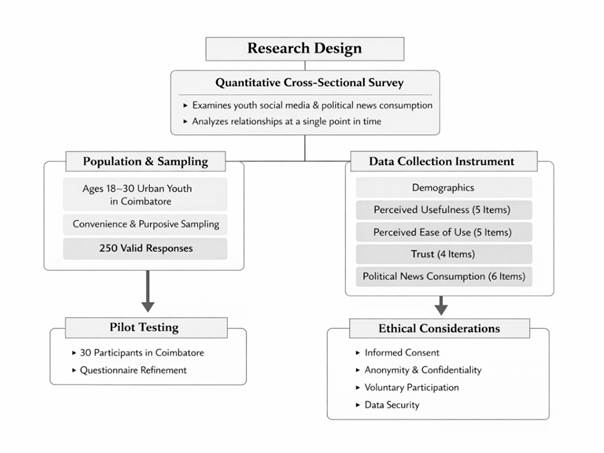
Figure 2 Schematic Representation
of the Research Design and Methodology.
3.2. DATA COLLECTION INSTRUMENT
A questionnaire was developed with five
sections: demographics, perceived usefulness (five items), perceived ease of
use (five items), trust (four items), digital literacy (six items), and
political news consumption (six items). Items were adapted from Davis (1989), Gefen et
al. (2003), Ng (2012), and Lee et al. (2013). Responses
used a 5-point Likert scale (1 = strongly disagree to 5 = strongly agree).
A pilot test with 30 Coimbatore
residents helped ensure clarity and reliability, leading to wording
modifications aligned with Tamil Nadu preferences. Ethical considerations
included informed consent, anonymity, voluntary participation, and data
confidentiality per Institutional Review Board guidelines. Data collection
spanned four weeks in early 2025, representing diverse socioeconomic
backgrounds in urban Coimbatore.
3.3. DATA ANALYSIS METHODS
Data analysis used SPSS version 27 and SmartPLS version 4 for structural equation modeling (SEM) to manage latent variables and evaluate mediation effects. Procedures included descriptive statistics, reliability analysis (Cronbach's alpha >0.70), validity assessments (exploratory and confirmatory factor analysis, average variance extracted >0.50, heterotrait-monotrait ratio <0.85), normality tests, and multicollinearity checks (variance inflation factor <5). Analysis included Pearson's correlation, multiple regression, and SEM with 5,000 bootstrap resamples. Missing data (<5%) were addressed through mean imputation. This methodology ensures rigorous testing of the proposed model, providing reliable insights into youth behaviors in Coimbatore.
4. Results and Data Analysis
Data analysis commenced with cleaning and screening. No significant missing values or outliers were detected among the 250 responses. Normality was approximate, thus supporting the use of the parametric tests.
Table 1
|
Table 1 Participant Demographics (N = 250) |
|||
|
Variable |
Category |
Frequency |
Percentage (%) |
|
Gender |
Male |
130 |
52.0 |
|
Female |
110 |
44.0 |
|
|
Other |
10 |
4.0 |
|
|
Age |
18-22 |
140 |
56.0 |
|
23-26 |
80 |
32.0 |
|
|
27-30 |
30 |
12.0 |
|
|
Education |
Undergraduate |
160 |
64.0 |
|
Postgraduate |
70 |
28.0 |
|
|
Other |
20 |
8.0 |
|
|
Social Media Use
(hours/day) |
1-3 |
90 |
36.0 |
|
4-6 |
120 |
48.0 |
|
|
>6 |
40 |
16.0 |
|
Table 2
|
Table 2 Reliability and Validity Statistics |
|||
|
Construct |
Cronbach's Alpha |
Composite
Reliability |
AVE |
|
Perceived Usefulness |
0.88 |
0.91 |
0.62 |
|
Perceived Ease of
Use |
0.85 |
0.89 |
0.58 |
|
Trust |
0.82 |
0.87 |
0.55 |
|
Digital Literacy |
0.91 |
0.93 |
0.68 |
|
Political News
Consumption |
0.89 |
0.92 |
0.64 |
Table 3
|
Table 3 Descriptive Statistics |
||
|
Variable |
Mean |
SD |
|
Perceived Usefulness |
4.12 |
0.76 |
|
Perceived Ease of
Use |
3.98 |
0.82 |
|
Trust |
3.45 |
0.91 |
|
Digital Literacy |
3.67 |
0.88 |
|
Political News
Consumption |
3.89 |
0.79 |
Table 4
|
Table 4 Correlation Matrix (all correlations significant at p < .01) |
|||||
|
Variable |
1 |
2 |
3 |
4 |
5 |
|
1. PU |
1 |
.62 |
.48 |
.55 |
.58 |
|
2. PEOU |
1 |
.51 |
.59 |
.52 |
|
|
3. Trust |
1 |
.47 |
.49 |
||
|
4. Digital Literacy |
1 |
.53 |
|||
|
5. Consumption |
1 |
||||
Table 5
|
Table 5 Multiple Regression Results (R² = 0.48, p < .001) |
|||
|
Predictor |
β |
t |
p |
|
Perceived Usefulness |
0.42 |
8.40 |
<.001 |
|
Perceived Ease of
Use |
0.18 |
3.00 |
<.01 |
|
Trust |
0.31 |
4.43 |
<.001 |
|
Digital Literacy |
0.22 |
4.40 |
<.001 |
SEM confirmed all paths (model fit: CFI
= 0.95, RMSEA = 0.06). H1–H6 were supported, with digital literacy
significantly moderating the PEOU–intention link (interaction β = 0.15, p
< .05).
4.1. DISCUSSION
The findings illuminate the intricate role of social media in the consumption of political news by young individuals, building upon previous research through the integration of the technology acceptance model (TAM) with trust and digital literacy. Perceived usefulness emerged as the most significant predictor (β = 0.42), aligning with studies suggesting that young individuals value platforms for delivering timely and relevant political information Asghar et al. (2023), Newman et al. (2023). This suggests that the perceived advantage of social media in enhancing political comprehension motivates its usage, thereby supporting Hypotheses H1 and H5. Moderate trust levels (M = 3.45) indicate skepticism; however, its significant effect (β = 0.31) supports H3, reflecting concerns regarding the impact of misinformation on platform credibility Denniss et al. (2025), Rocha et al. (2021). In Coimbatore, where regional politics frequently intersects with national issues, such trust dynamics may be shaped by local vernacular content and cultural narratives.
Perceived ease of use positively influenced usage (H2 supported), consistent with intuitive interfaces facilitating engagement Granić and Marangunić (2019). The moderating role of digital literacy (H4 supported) underscores its importance in evaluating information and mitigating risks, such as echo chambers Hassoun et al. (2025), Kastorff et al. (2025). The positive association between consumption and engagement (H6) reinforces the potential of social media for civic mobilization Marquart et al. (2020), Zhu et al. (2019). These patterns highlight how urban youth in Tamil Nadu navigate multilingual content.
In the realm of political communication, these results suggest that platforms reshape discourse and foster participation; however, interventions against biases are necessary Papathanassopoulos et al. (2025). Compared with Western contexts, Coimbatore youth exhibit similar patterns but demonstrate heightened vulnerability to misinformation owing to diverse linguistic landscapes Nazari (2022). Implications include the development of tailored digital literacy programs for educators and algorithm transparency for policymakers Costa and Sousa (2025). Locally, initiatives could capitalize on Coimbatore's educational hubs to promote Tamil-language fact-checking tools.
Overall, this study bridges the gaps in TAM applications and provides evidence-based insights into youth dynamics amid digital transformations in regional India.
5. CONCLUSION
This study demonstrates that factors such as perceived usefulness, ease of use, trust, and digital literacy are pivotal in shaping how young individuals engage with political news on social media. All the proposed hypotheses were substantiated through a comprehensive statistical analysis. The principal findings underscore the significant predictive influence of usefulness and trust, moderated by literacy, thereby affirming the applicability of the technology acceptance model (TAM) in political contexts, particularly in Coimbatore, Tamil Nadu.
Theoretically, this study extends the TAM with domain-specific variables and addresses critiques of its limited scope in media research Scherer et al. (2019), Kundu (2022). It enriches the political communication literature by elucidating how digital factors influence engagement, building on the work of Kim (2023) and Alodat et al. (2023), while providing regional insights into the behavior of Indian youth.
Practically, the implications are multifaceted: media organizations can optimize content for usefulness and ease by incorporating verification tools to build trust Newman et al. (2023). Policymakers in Tamil Nadu should regulate algorithms to curb misinformation, whereas educators should integrate literacy curricula tailored to local contexts to empower youth evaluation skills Hassoun et al. (2025). These strategies can enhance informed participation and mitigate risks, such as polarization, in diverse settings, such as Coimbatore.
This study has limitations: its cross-sectional design prevents causal conclusions, and self-reported data may show social desirability bias. The focus on urban Coimbatore limits findings' applicability to rural Tamil Nadu or other Indian regions. Future research should consider longitudinal designs to track behavioral changes, cross-cultural comparative studies, or mixed methods for deeper qualitative insights.
In summary, as social media evolves, understanding acceptance factors is crucial for nurturing democratic youth. This study provides a foundation for interventions promoting responsible digital citizenship in Coimbatore and beyond.
CONFLICT OF INTERESTS
None.
ACKNOWLEDGMENTS
None.
REFERENCES
Alismaiel, O. A., Cifuentes-Faura, J., and Al-Rahmi, W. M. (2022). Online Learning, Mobile Learning, and Social Media Technologies: An Empirical Study on Constructivism Theory During the COVID-19 Pandemic. Sustainability, 14(18), 11134. https://doi.org/10.3390/su141811134
Alodat, A. M., Alshurideh, M. T., Al-Hawary, S. I. S., and Alazzam, M. B. F. (2023). Social Media Platforms and Political Participation: A Study of Jordanian Youth Engagement. Social Sciences, 12(7), 402. https://doi.org/10.3390/socsci12070402
Asghar, M. Z., Barberà, E., Rasool, S., Seitamaa-Hakkarainen, P., and Moqaddas, F. (2023). Adopting the TAM Model to Investigate the Impact of Social Media Usage on Productive Academic Performance: Evidence From Pakistani Medical Community. Heliyon, 9(3), e14578. https://doi.org/10.1016/j.heliyon.2023.e14578
Balakrishnan, V., Ng, W., Soo, M. C., Han, G. J., and Lee, C. J. (2022). Infodemic and Fake News - A Comprehensive Overview of Its Global Magnitude During the COVID-19 Pandemic in 2021: A Scoping Review. Information Systems Frontiers, 24(6), 2079–2102. https://doi.org/10.1007/s10796-022-10341-5
Barranco, K., Taylor, L. D., and Lengerich, E. J. (2025). The Digital Crossroads: Media Literacy and the Future of Youth Online. Frontiers in Public Health, 13. https://doi.org/10.3389/fpubh.2025.1321654
Chhabra, J., Kulkarni, M., and Kulkarni, M. (2025). Social Media and Youth Mental Health: Scoping Review of Recommendations. Journal of Medical Internet Research, 27, e72061. https://doi.org/10.2196/72061
Costa, C., and Sousa, L. (2025). Young People and Digital Literacy Learning. European Early Childhood Education Research Journal, 33(1), 1–14. https://doi.org/10.1080/1350293X.2025.2593611
Denniss, E., McCosker, A., and Humphreys, J. (2025). Social Media and the Spread of Misinformation. Health Promotion International, 40(2), daaf023. https://doi.org/10.1093/heapro/daaf023
Dhir, A., Kaur, P., Chen, S., and Pallesen, S. (2017). Antecedents and Consequences of Social Media Fatigue. International Journal of Information Management, 48, 193–202. https://doi.org/10.1016/j.ijinfomgt.2019.05.021
Dumitru, E. A., Ivan, L., and Loos, E. (2022). A Generational Approach to Fight Fake News: Combating Disinformation and Misinformation Among Different Generations. Societies, 12(6), 153. https://doi.org/10.3390/soc12060153
Eckstein, K. (2019). Young People's Political Engagement in Times of Social Media. Journal of Youth Studies, 22(10), 1412–1428. https://doi.org/10.1080/13676261.2019.1580962
Edgerly, S., Vraga, E. K., Dalrymple, K. E., Maczek, T., and Wang, M. (2017). Directing the Dialogue: The Relationship Between YouTube Videos and the Comments They Spur. Journal of Information Technology and Politics, 10(3), 276–292. https://doi.org/10.1080/19331681.2013.794120
Feng, G. C., Zhang, Y., and Lin, Z. (2021). A Meta-Analysis of the Effects of Sociodemographic Factors on Social Media Adoption. International Journal of Communication, 15, 1990–2013.
Granić, A., and Marangunić, N. (2019). Technology Acceptance Model in Educational Context: A Systematic Literature Review. British Journal of Educational Technology, 50(5), 2572–2593. https://doi.org/10.1111/bjet.12864
Gupta, K. P., Singh, S., and Bhakar, S. (2022). Citizen Adoption of E-Government: A Literature Review and Conceptual Framework. Electronic Government, an International Journal, 12(2), 160–185. https://doi.org/10.1504/EG.2016.076134
Han, J. (2019). The Impact of Artificial Intelligence on College Students' Autonomous Learning. Journal of Physics: Conference Series, 1345(4), 042058. https://doi.org/10.1088/1742-6596/1345/4/042058
Hassoun, A., Wood, C. A., Chun, M., Beurkens, N., Schwartz, I., Aly, L., ... and Wobbrock, J. O. (2025). Beyond Digital Literacy: Building Youth Digital Resilience Through Information Sensibility. Social Sciences, 14(4), 230. https://doi.org/10.3390/socsci14040230
Herrero-Diz, P., Conde-Jiménez, J., and Reyes-de-Cózar, S. (2020). Teenagers, Smartphones and Digital Audio Consumption in the Age of Spotify. Comunicar, 28(64), 103–112. https://doi.org/10.3916/C64-2020-10
Hoffmann, C. P. (2017). Political Socialization in Digital Media Environments. In The Routledge Companion to Social Media and Politics (pp. 229–242). Routledge.
Holden, R. J., and Karsh, B. T. (2010). The Technology Acceptance Model: Its Past and Its Future in Health Care. Journal of Biomedical Informatics, 43(1), 159–172. https://doi.org/10.1016/j.jbi.2009.07.002
Iacurci, L. (2021). A Study of the Technology Acceptance Model for Social Media Marketing.
Honors Theses, Bryant University.
Jenkins, H., and Jie, L. (2024). Participatory Politics in an Age of Crisis: Henry Jenkins and Nico Carpentier (Part I). International Journal of Communication, 13, 12.
Kastorff, T., Steinfeld, N., and Riehm, K. E. (2025). Young People and False Information: A Scoping Review of Empirical Studies. Computers in Human Behavior, 158, 108294. https://doi.org/10.1016/j.chb.2025.108294
Kim, S. J. (2023). The Role of Social Media News Usage and Platforms in Civic and Political Engagement. Computers in Human Behavior, 138, 107475. https://doi.org/10.1016/j.chb.2022.107475
Kundu, A. (2022). Teachers' Acceptance of ICT: A Review of TAM 3+. Journal of Educational Computing Research, 60(5), 1256–1283. https://doi.org/10.1177/07356331221083027
Lee, A. T., and Chen, C. M. (2025). A Review of TAM Technology Acceptance Model and Unified Theory of Acceptance and Use of Technology Frameworks in Healthcare. Healthcare, 13(3), 250. https://doi.org/10.3390/healthcare13030250
Lee, N. M., Shah, D. V., and McLeod, J. M. (2013). Processes of Political Socialization: A Communication Mediation Approach to Youth Civic Engagement. Communication Research, 40(5), 669–697. https://doi.org/10.1177/0093650212436712
Livingstone, S., Mascheroni, G., and Staksrud, E. (2015). Developing a Framework for Researching Children's Online Risks and Opportunities in Europe. EU Kids Online.
Lundberg, E., and Svensson, G. (2025). The Role of Youth Extracurricular Activities and Political Intentions in Later Political Participation and Civic Engagement. Journal of Adolescence, 97(2), 234–245. https://doi.org/10.1002/jad.12443
Marquart, F., Ohme, J., Lichtenstein, D., and Kühne, R. (2020). Following Politicians on Social Media: Effects for Political Information, Peer Communication, and Youth Engagement. Media and Communication, 8(2), 197–207. https://doi.org/10.17645/mac.v8i2.2764
Medeiros, L. L., and Braga, C. (2020). Fake News on Social Media: A Systematic Review. Journal of Information Studies and Technology, 2020(2), 1–15. https://doi.org/10.1145/3411564.3411648
Meshcheryakov, N. (2025). The Impact of Social Media Usage on Political Participation. University of California, Irvine.
Middaugh, E., Clark, L. S., and Ballard, P. J. (2017). Digital Media, Participatory Politics, and Positive Youth Development. Pediatrics, 140(Supplement_2), S127–S131. https://doi.org/10.1542/peds.2016-1758Q
Moazenzadeh, D., and Hamidi, H. (2018). Factors Influencing the Adoption of Mobile Banking: Extension of TAM With Perceived Risk and Perceived Cost. Journal of Theoretical and Applied Electronic Commerce Research, 13(3), 21–40. https://doi.org/10.4067/S0718-18762018000300103
Moeller, J., and de Vreese, C. (2013). The Differential Role of the Media as an Agent of Political Socialization in Europe. European Journal of Communication, 28(3), 309–325. https://doi.org/10.1177/0267323113482447
Mohr, S., and Kühl, R. (2021). Acceptance of Artificial Intelligence in German Agriculture: An Application of the Technology Acceptance Model and the Theory of Planned Behavior. Precision Agriculture, 22(5), 1616–1630. https://doi.org/10.1007/s11119-021-09796-3
Mugo, D. G., Njagi, K., Chemwei, B., and Motanya, J. O. (2017). The Technology Acceptance Model (TAM) and Its Application to the Utilization of Mobile Learning Technologies. British Journal of Mathematics and Computer Science, 20(4), 1–8. https://doi.org/10.9734/BJMCS/2017/29015
Munoz-Leiva, F., Climent-Climent, S., and Liébana-Cabanillas, F. (2017). Determinants of Intention to Use the Mobile Banking Apps: An Extension of the Classic TAM Model. Spanish Journal of Marketing - ESIC, 21(1), 25–38. https://doi.org/10.1016/j.sjme.2016.12.001
Mustofa, R. H., Pramudibyanto, H., and Prihatini, D. (2022). Effectiveness of Interactive Learning Media Based on Augmented Reality on Improving Student Learning Outcomes. Jurnal Pendidikan Teknik Elektro, 11(1), 1–7.
Na, S., Heo, S., Han, S., Shin, Y., and Roh, Y. (2022). Acceptance Model of Artificial Intelligence (AI)-Based Technologies in Construction Firms: Applying the Technology Acceptance Model (TAM) in Combination With the Technology-Organisation-Environment (TOE) Framework. Buildings, 12(2), 90. https://doi.org/10.3390/buildings12020090
Nazari, Z. (2022). News Consumption and Behavior of Young Adults and the Issue of Fake News. Journal of Information Science Theory and Practice, 10(2), 1–13. https://doi.org/10.1633/JISTaP.2022.10.2.1
Neo, R. L. S., Teo, E. C. H., Lim, W. L., and Loh, R. E. (2020). Exploring How Young People Use Social Media to Discuss and Share Information About Mental Health and Wellbeing. Journal of Youth Studies, 23(7), 876–893. https://doi.org/10.1080/13676261.2019.1642289
Newman, N., Fletcher, R., Robertson, C. T., Eddy, K., and Nielsen, R. K. (2023). Reuters Institute Digital News Report 2023. Reuters Institute for the Study of Journalism.
Pai, F. Y., and Huang, K. I. (2011). Applying the Technology Acceptance Model to the Introduction of Healthcare Information Systems. Technological Forecasting and Social Change, 78(4), 650–660. https://doi.org/10.1016/j.techfore.2010.11.007
Papathanassopoulos, S., Giannouli, I., and Archontaki, A. (2025). Political Communication in the Age of Platforms. Journalism and Media, 6(2), 616–631. https://doi.org/10.3390/journalmedia6020077
Rafique, H., Anwer, F., Shamim, A., and Minaei-Bidgoli, B. (2020). Factors Affecting Acceptance of Mobile Library Applications: Structural Equation Model. Libri, 70(2), 99–112. https://doi.org/10.1515/libri-2018-0135
Rauniar, R., Rawski, G., Yang, J., and Johnson, B. (2014). Technology Acceptance Model (TAM) and Social Media Usage: An Empirical Study on Facebook. Journal of Enterprise Information Management, 27(1), 6–30. https://doi.org/10.1108/JEIM-04-2012-0011
Rocha, Y. M., de Moura, G. A., Desidério, G. A., de Oliveira, C. H., Lourenço, F. D., and de Figueiredo Nicolete, L. D. (2021). The Impact of Fake News on Social Media and Its Influence on Health During the COVID-19 Pandemic: A Systematic Review. Journal of Public Health, 29(5), 1007–1016. https://doi.org/10.1007/s10389-021-01658-z
Saud, M. (2020). Youth Participation in Political Activities: The Case of Young Adults in Malaysia. Societies, 10(3), 64. https://doi.org/10.3390/soc1003006
Scherer, R., Siddiq, F., and Tondeur, J. (2019). The Technology Acceptance Model (TAM): A Meta-Analytic Structural Equation Modeling Approach to Explaining Teachers' Adoption of Digital Technology in Education. Computers and Education, 128, 13–35. https://doi.org/10.1016/j.compedu.2018.09.009
Singh, G. (2022). Technology Acceptance Model (TAM) and Use and Adoption of Social Media Communication in Small Businesses. Doctoral Dissertations and Projects, 5067.
Slavtcheva-Petkova, V. (2023). Young People, News, and Citizenship: Students' Experiences of News and Media Literacy in School. Journalism, 24(1), 3–20. https://doi.org/10.1177/14648849211036807
Steinfeld, N. (2025). Misinformation Identification as a Digital Literacy Skill in an Ultra-Orthodox Community: An Eye Tracking Study. Humanities and Social Sciences Communications, 12(1), 1–10. https://doi.org/10.1057/s41599-025-04938-1
Sukmadewi, R., Setyosari, P., and Ulfa, S. (2023). Analysis of Technology Acceptance Model for Using Social Media Applications in Cooperatives. Review of Integrative Business and Economics Research, 12(2), 182–193.
Tkácová, H., Králik, R., Tvrdoň, M., Jenisová, Z., and Pavlíková, M. (2025). Challenges of Misinformation in Online Learning: A Post-Pandemic Perspective. Current Issues in Personality Psychology, 5(1), 25. https://doi.org/10.3390/currpsych5010025
Torres, R., and Pérez, M. (2025). Chile Before and After the 2019 Social Uprising (2018-2022). International Journal of Environmental Research and Public Health, 22(4), 314. https://doi.org/10.3390/ijerph22040314
Venus, A., and Kim, S. (2025). Impact of Influencers and Advertising on Generation Z. Cogent Business and Management, 12(1), 2520063. https://doi.org/10.1080/23311975.2025.2520063
Zhu, A. Y. F., Chan, A. L. S., and Chou, K. L. (2019). Creative Social Media Use and Political Participation in Young People: The Moderation and Mediation Role of Online Political Expression. Journal of Adolescence, 77, 108–117. https://doi.org/10.1016/j.adolescence.2019.10.008
|
|
 This work is licensed under a: Creative Commons Attribution 4.0 International License
© ShodhKosh 2026. All Rights Reserved.