ShodhKosh: Journal of Visual and Performing ArtsISSN (Online): 2582-7472
|
|
DR. N RAJAM, VIOLINIST - THE RARE MUSICAL GENIUS
Vinayak
Seth 1 , Dr. Aishwarya Bhatt 2

1 PhD
Research Scholar, Banasthali Vidyapith, Rajasthan,
India
2 Assistant
Professor, Department
of Performing Arts, Banasthali Vidyapith, Rajasthan,
India
|
|
|
ABSTRACT |
|
|
With the
technological revolution breaking all cultural barriers, the innovations in
Art and Music are no longer localized or limited to one nation, but is
influencing and impacting the cultures of the whole globe. A musical
instrument, violin, popular in the Western world has been showing its
increasing prominence in the music world of India also since the last more
than two centuries and the proponents of violin in India have played a
crucial role in bringing forth its potentiality and versatility. Dr N Rajam,
a rare musical genius of Tamil Nadu in South India well versed in the
Carnatic Musical system of violin-playing stretched the limits of the
creative imagination and brought into action a violin technique in the
Hindustani Classical Music of North India called the ‘Khayal Gayaki Ang’, adapting the vocal style of Carnatic music
on the Hindustani violin. This innovation largely changed and added to the
prevailing violin- playing
style of North India and had universal appeal, as the outcome
of this experiment was the ‘singing violin’, which had a national and a
global impact. The aim of this article is to study her life and works in
depth to analyze and highlight the factors contributing to her astounding
success and the lessons to be learnt from her life and intense ‘sadhana’
which is beneficial to all humanity for there is a dire need of good music in
these pressing times. |
|||
|
Received 22 January 2026 Accepted 26 March
2026 Published 17 April 2026 Corresponding Author Vinayak
Seth, vinayakseth23@gmail.com DOI 10.29121/shodhkosh.v7.i5s.2026.7412 Funding: This research
received no specific grant from any funding agency in the public, commercial,
or not-for-profit sectors. Copyright: © 2026 The
Author(s). This work is licensed under a Creative Commons
Attribution 4.0 International License. With the
license CC-BY, authors retain the copyright, allowing anyone to download,
reuse, re-print, modify, distribute, and/or copy their contribution. The work
must be properly attributed to its author.
|
|||
|
Keywords: N Rajam, Violin, Violinist, Gayaki
Ang |
|||



1. INTRODUCTION
Dr N Rajam was my childhood idol and role model during my growing years – while training as a violinist and continues to be my inspiration. I had the good fortune of being blessed by her as a teenager, when she visited Jaipur for one of her performances.
She witnessed my playing and encouraged me to continue with my efforts as a violinist. She also advised me at the same time not to neglect my academic studies. I am attaching photographs taken with her (in Jaipur).
Dr N Rajam’s very name symbolizes all that is precious and unique in India’s adoption of the violin and the path-breaking success achieved by her in bringing the violin to the forefront of classical musical instruments in North India and giving it a global recognition. The extraordinary accomplishments of Dr Rajam in changing the musical landscape of India is undeniable; her journey as a violinist since the tender age of three to the conferment of the ‘Padma Vibhushan’ award 2026, is magnificent.
India is proud in having a violinist par excellence - that too a lady - who broke all societal, cultural and language barriers and carved a niche for herself due to her consistent, painstaking and intense sadhana (askesis) to evolve as one of the topmost classical instrumental musician of India – a rarity and role model for all aspiring violinists. Her simplicity and depth of personality is exemplary.
It was a proud moment for the ‘Music and Art World’, when she was deservedly awarded the ‘Padma Vibhushan’ in 2026– the second highest civilian award of the country. This award marks another milestone in her long musical journey marked by significant breakthroughs and innovations.
Her own creative genius and arduous training under the tutelage of the doyen of Hindustani classical vocal music - Pandit Omkar Nath Thakur of the Gwalior gharana – enabled her to achieve a revolution in the style and techniques of violin playing, which was an addition to the then prevalent style in North India in the second half of the twentieth century.
The beautiful violin renditions thereafter presented by
her, left her audiences spell bound and the position of the violin as a musical
instrument got strongly entrenched in the classical music world of India.
Image 1
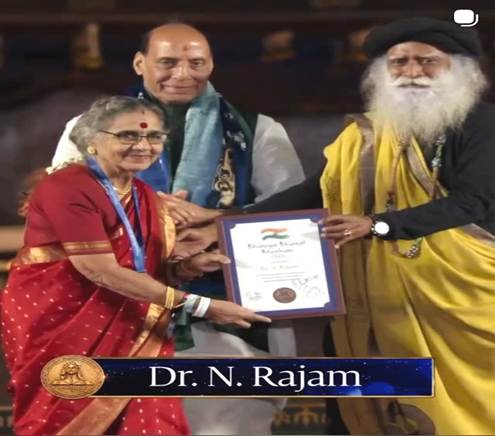
Image 1 Dr N Rajam Receiving the ‘Bhavya Bharat Bhushan’ Award 2026 - ‘Isha Foundation’
https://www.instagram.com/reel/DUydNQ7jMkk/
2. PRELIMNARY TRAINING IN CARNATIC MUSIC
The different stages of her learning was with various mentors.
In the early formative part of her life, for 10-12 years, she mastered the intricacies of Carnatic classical music on the violin and gained perfection in it. In this she received rigorous training from her late father Vidwan A Narayana Iyer and later from Musiri Subramania Iyer – an eminent vocalist and lakshana vidwan. With a strongly founded background in Carnatic music, at a very young age, she became a notable Carnatic violinist; and, even gave violin accompaniment to Bharat Ratna M S Subbalakshmi, when she was only 12-13 years and travelled with her to different cities in India. This gave her further exposure and added to her experience in giving stage performances.
The extent of her intensity and passion for music can be reproduced in her own words, in her presidential address at the Sadas of the Music Academy, Madras on 1st January 2026, wherein, she described her experiences as a 9-10 year old, attending the Music Academy festivals every year “and trying to keenly observe and absorb the styles of veteran performers of yester years - rendering the difficult and complicated ragam-tanam-pallavi section of the concert. My takeaway from the concerts would be the pallavi line and its anulomam and pratilomum rendered immaculately by the veterans.” [1]After the concert, she would repeat accurately the same – before her father and would be satisfied only after he endorsed it, thus getting it confirmed to herself that she had imbibed it correctly. This passion on her part, is inspirational for all aspiring musicians. Her focused energy and perseverance is indeed remarkable and a major contributor to her success as a musical genius.
Image 2
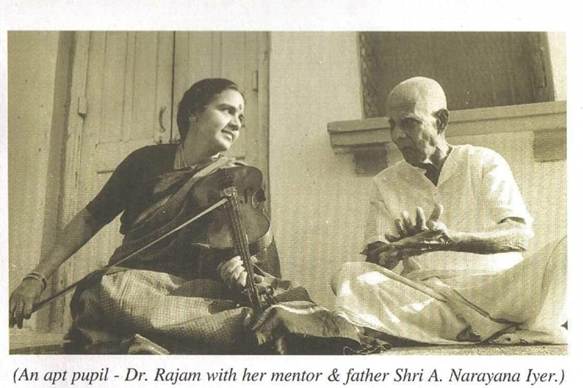
Image 2
(Gallery, nrajam.com)
3. HER ASSOCIATION WITH HINDUSTANI CLASSICAL MUSIC
As a 12 year old , N Rajam listened to Hindustani Classical music concerts on radio and to RPM (Revolutions Per Minute) records of Pt Omkarnath Thakur and was fascinated by the said music. While in Madras, she had the opportunity to learn Hindustani classical music from Shri L R Kelkar, who happened to be a student of Pt Omkarnath Thakur, so unconsciously she was continuously imbibing the Gwalior gharana style. The association with Hindustani Classical music became stronger when the family moved to Bombay. Her father had interest in Hindustani Classical music and used to visit Pt Vishnu Digambar Paluskar and encouraged her to learn Hindustani classical music.
To continue her education, she joined Banaras Hindu University (BHU), as a private candidate and took Hindustani classical music as one of the subjects. She did her graduation and post graduation in BHU and did her PhD in Music on the topic ‘A comparative study of Hindustani and Carnatic Music’ under Dr Premlata Sharma, the eminent Hindustani Classical music vocalist.
It was in Banaras that she met her music Guru and mentor, Pt Omkarnath Thakur of the Gwalior Gharana - who was Founder-Principal of the Faculty of Performing Arts, BHU. Pt Thakur, after listening to her violin-playing, willingly accepted her as his disciple. He relentlessly worked upon her, teaching her - phrase by phrase - the nuances of Hindustani classical music. She learnt - by replicating on the violin, whatever he sang - and thus acquired the capability of reproducing instrumentally - any vocal phrase. Thus, before long, by accompanying Pt Omkar Nath, Dr Rajam was able to absorb the essence of Hindustani music and, soon became one of his best students. She gave violin accompaniment to the numerous vocal renditions by her teacher and thus attained a marvellous mastery in the ‘Khayal Gayaki Ang’ on the violin. This intensive training alongwith her own prodigious work and musical flair, facilitated her in evolving as one of the top most solo-violinist in Hindustani classical music in India.
She was offered the job as music lecturer in Banaras Hindu University in 1959. So committed and enthusiastic was her musical teaching proclivity, that she continued as music faculty at BHU for four decades, becoming HOD and Dean of the Faculty of Performing Arts and retiring in 1997.
She also learned the niceties of the Thumri tradition at Banaras, from her mentor Pt Mahadev Prasad Mishra, thus revealing her zeal and determination to expand her music skills and competencies.
Thus, destiny brought her to North India – where her extraordinary talent and love for Hindustani Classical music - exhibited her uniqueness as a musician - and resulted in bringing about a transformation in the technique of playing the violin (a bowed string instrument), in North India. The 12 years of Carnatic music training equipped her with the practice of swara, tala, laya and improvisation, since only vocal music is played on the violin in the Carnatic system of Indian Classical music. Till then, the largely prevalent style in Hindustani music was Tantrakari ang wherein the violin was played upon akin to the sitar or the sarod which are ‘plucked’ string instruments.
Image 3
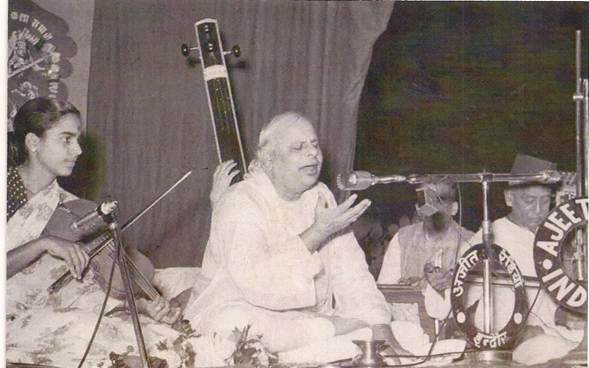
Image 3
Dr N Rajam giving
accompaniment – Pt Omkar Nath Thakur
(Gallery, nrajam.com)
4. DEVELOPING THE ‘GAYAKI ANG’ TECHNIQUE ON VIOLIN
Before her, some Hindustani classical violinists were playing the ‘Gayaki Ang’ off and on, but tantrakari/instrumental style of playing was more prevalent.
This violin playing style was more inspired by Sitar/Sarod, wherein the notes were plucked on the strings and hence the same reproduction was attempted on the violin, resulting in more direct/ and staccato style of playing, wherein swaras were played by direct application of the finger on each note and lifting of fingers between each note and switching between strings rather than single string playing. This would result in a pluckier instrumental sound rather than smooth flow of the notes as visible in vocal music.
Dr Rajam totally changed the style of violin-playing by completely adopting the ‘Khayal Gayaki Ang’ on the violin in Hindustani Classical music. It took her 15 years of long research and hard work to evolve a meticulous bowing and fingering style for creating the Gayaki technique for use in Hindustani Classical violin as was then prevalent in Carnatic music.
The foundation of ‘Gayaki ang’ reproduction on the violin was the direct result of her intensive Carnatic training, wherein the skillful use of fingers to play all notes in an octave on a single string, This facilitated long gliding movements of the fingers on the same string and resulted in reproduction of meend/aalaps and gamakas effectively. This is coupled with the seamless use of the bow between strings and using the flow spectrum of the bow, while playing the notes which resulted in an almost perfect reproduction of the vocal sounds.
In this, she was supported by her Guru, Pandit Omkar Nath Thakur who gave her autonomy to experiment which she did, at the same time maintaining the basic features of Gwalior Gharana in her playing style.
Dr Rajam’s outlook is open and liberal, and she believes that since one can hear all styles of music today, it is not at all obligatory to confine oneself to one gharana only.
Rajam’s own reply to a question on the Gayaki Ang – “in Hindustani Music, there is a separate style for instrumental music, known as Tantrakari or Gatkari. Sitar and Sarod, being strumming instruments have side strings to create an effect. The music has no resemblance to vocal music. As the violin is a bowed instrument, there is continuity of tone, so that vocal effect can be produced faithfully. Samudri (2020).
5. HER ACCOMPLISHMENTS AS A HINDUSTANI SOLOIST VIOLINIST
In her more than seven decades of playing Hindustani classical music on the violin, Dr N Rajam brought out the full potential and attributes of this ‘Queen of Instruments’ –as referred by her to the violin in her interview at Jashn-e-Deccan 1363, (2016), which like the flute and shehnai has continuity of notes. It is, thus, very appropriate for playing vocal music on it as is done in Carnatic music. In praise of the violin - she regards it as a complete instrument, upon which, mastering the ‘left-handed’ technique - is a must. She also made special efforts to master the Hindustani Tala system which is quite different from the Carnatic Tala system and achieved proficiency in it.
What is most remarkable about Dr N Rajam is that, though brought up in the Carnatic system of music, she achieved proficiency in every facet of Hindustani music – the Dhrupad, Khayal, Thumri, Bhajan, Natyasangeet and Tappa – thus proving to the world the splendid versatility of this instrument. It was largely due to her pioneering efforts that violin attained the status of a major vocal-like solo classical music instrument in North India, rather than being only an accompanying instrument. In fact, she became well known for her ‘singing violin’.
In her own words, “Also, at that time, there was no
technique to play the ‘taans’ effectively. I worked a
lot on that with my father’s guidance. By constant playing, the music gained
polish and refinement and reached a high standard. So that was my contribution
to Hindustani violin. I could play any form – ‘dhrupad’, ‘dhamar’,
but I concentrated on ‘Khayal’ ”. Rajendran
(1994)
6. HER CONTRIBUTION TO MUSIC EDUCATION
Dr N Rajam, born 16th March 193, in Ernakulum (Kerala), hails from Tamil Nadu. She has a strong musical family background spanning seven generations. Her late brother, Vidwan T N Krishnan, was a noted Carnatic violinist. Uttar Pradesh (Banaras) in North India has been her ‘Karma Bhumi’ for four decades. Apart from being an excellent performer, her main contribution, she feels, is in being a Teacher. She has many students who are now successful violinists performing all over the globe.
Notable among her disciples is her daughter Dr Sangeeta Shankar, her granddaughters Ragini and Nandini Shankar, her niece Vidushi Kala Ramnath, Late Dr Swarna Khuntia BHU, Prof. V Balaji, Pranav Kumar, Dr Satya Prakash Mohanty, Jagan Rama Moorthy, Gouranga Maji, Dr Prashant Mishra and many others. Dr Prashant Mishra is currently a violin faculty at the ‘Rajasthan Sangeet Sansthan’, Jaipur. His PhD thesis was on Dr Rajam herself
Dr Rajam is currently teaching on-line in the ‘Rajam School of Violin’ along with her brother, Narain Ganesh, daughter and granddaughters. At the same time, she is reviving the ancient gurukula system in her own retreat ‘Swar Sadhana Tapovan’, near ‘Bengaluru (Karnataka). She holds at this ‘Gurukula’ periodic training sessions for her students - living with them and tutoring them – in keeping with the ancient ‘Guru-Shishya parampara’.
For her rare calibre. outstanding commitment and contribution to music, she has been conferred the title of ‘Emeritus Professor’ by the Banaras Hindu University.
In the field of music education, she has mentored several workshops including those at the prestigious ITC Sangeet Research, Kolkata and National Centre for Performing Arts, Mumbai.
She was chairperson of the Uttar Pradesh Sangeet Natak Academy and senior faculty at the ‘Gangubai Hangal Gurukula’, at Hubli, Karnataka.
Image 4
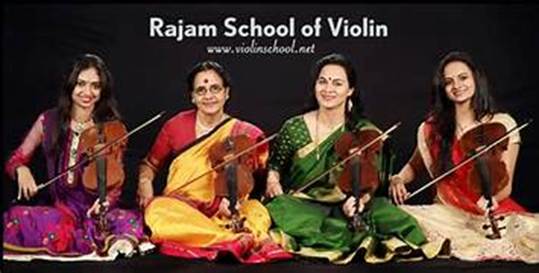
Image 4
Dr. N Rajam and
family
https://www.facebook.com/dr.nrajam/
7. HER PERFORMANCES AND AWARDS
Many music albums of her performances have been released and YouTube gives a wide collection of her recordings in India and abroad. Her performances and interviews are widely circulated in social media like ‘Facebook’ and ‘Instagram’. She has her own website nrajam.com.
Being a ‘Top Grade’ Akashwani artist, she has performed in numerous ‘Akashwani National Concerts’. Her major performances since 1960’s onwards have been in various SPIC MACAY events; Swara Samrat Festival 2021; Virasat 2024 (Dehradun); Violin Parampara Concert; Three Generation Family’ concerts, to name a few.
Her international performances were: Edinburgh International Festival 1963; UN General Assembly, New York (1966); Royal Albert Hall, London (192); Festival of India, Moscow (197); Bengal Classical Music Festival, Dhaka (2015). She has thus brought international presence to the Hindustani classical violin through her various concerts in USA, Canada, Russia, Czeckoslovakia, New Zealand, Australia, Germany, France, Holland, Switzerland and Italy.
Apart from solo performances, her jugalbandis with maestros Ustad Bismillah Khan, Pandit Ram Narayan, Pandit V G Jog, Pandit Hari Prasad Chaurasia, Vidwan T N Krishnan, N Ramani, the Carnatic flautist and Ustad Zakir Hussain, are indeed scintillating.
Dr Rajam has been the recipient of many prestigious awards namely Uttar Pradesh Sangeet Natak Academy award (197); Padma Shri (194), Malaviya award, BHU (196), Sangeet Natak Academy, award (1990), Padma Bhushan (2004), Puttaraja Samman (2004), Kalidas Samman (2009), Chowdiah award (2009), Sangeet Natak Academy fellowship award (2012), Bhavya Bharat Bhushan Award of Isha Foundation, Coimbatore (2026) and the Padma Vibhushan (2026).
8. HER VIRTUOSITY MAKES HER A RARE MUSICAL GENIUS
The old saying ‘Genius is 1% inspiration and 99% perspiration’ aptly applies to her. Her full-fledged involvement, creativity and deep immersion in her music sadhana is a ‘tapasya’ (askesis) worthy of emulation by every aspiring violinist. She, in all humility, considers herself still a student – ‘learning all the time’. She gives a message to all violin students not to lose focus and concentrate on striking the exact and perfect note in the precise place on the violin which in itself is the ultimate revelation and fulfillment for a violinist.
She is able to mesmerize audiences with the beauty, clarity and lilting sounds on the violin, which transport audiences to another dimension. Her music is played to soothe ailing patients for therapeutic effect, by some physicians who use ‘music-therapy’ as a supporting line of treatment.
She is a deeply spiritual person which accounts for the divine quality of her music. Firmly rooted and disciplined, she maintains a strict personal routine, which ensures her good health and physical fitness, even at the age of 7. She is a dignified person who speaks her mind freely, but with a balanced restraint.
Her ability for improvisation and composing bandishes on the spot makes her a preeminent musician. The secret of her musical genius lies as she says in her own words “My entire being gets involved when I am playing the violin.” The Hindu. (2021) Further she expresses music is a ‘mastery over the seven swaras’ and it requires single minded attention and concentration to play or sing the right note.
“Dr N Rajam is one of the very few instrumentalists who have made their ‘medium’ soulfully expressive. In her hands violin literally ‘sings’ and pours out emotions and ‘bhava’ with the same precision, as a vocalist with an evocative depth would do. It is no exaggeration that Rajam and ‘Gayaki Ang’ have become synonymous today with her basic mastery over the Karnataka medium and command over ‘Hindustani Shaily’, she has made it to the international classical music scene” Satyasheil (2010)
9. CONCLUSION
Thus, the musical genius of Dr N Rajam can be attributed to the sophistication, freshness and sweetness of her music and her innovative abilities in evolving a new style which has a global appeal. She also represents a cultural bridge between the North and South India and the two systems of music they represent - Hindustani and Carnatic systems of music, thus promoting national oneness and unity. Her life and works are indeed worthy of emulation.
“The magnitude of her pioneering efforts is compounded
by the fact that she arrived as an anomalous South-Indian woman in the 1950’s,
in a North Indian male dominated art form.” Khuntia (2018)
It is observed that seeing the example of Dr N Rajam, many women violinists have emerged confident and successful – for instance her own daughter and granddaughters, her niece, Vidushi Kala Ramnath, and late Dr Swarna Khuntia and Dr Pushpa Satyasheil. In many ways Dr N Rajam can be seen as a trendsetter and inspiration for women violinist also - to forge ahead, in the field of violin-playing.
CONFLICT OF INTERESTS
None.
ACKNOWLEDGMENTS
None.
REFERENCES
The Music Academy Madras. (n.d.). Vidushi N. Rajam’s presidential address at the Sadas.
Samudri, N. (2020, April–May). N. Rajam: Music is her world. Sruti, p. 2
Rajendran, S. (1994, July). Rajam and Gayaki ang. Shanmukha, 20, p. 23.
The Hindu. (2021). Rajam’s journey with the violin.
Satyasheil, P. (2010). Journey of violin
from West to East. Akanksha Publishing
House.
Khuntia, S. (2018). Violin and violinists
in Hindustani classical music. Akanksha Publishing House.
Kasliwal, S. (2001). Classical musical instruments. Rupa and Co.
N. Rajam Official Website. (n.d.).
Sangeet Natak Akademi. (n.d.).
Wikipedia contributors. (n.d.). N. Rajam.
YouTube. (n.d.). N. Rajam violin performance [Video].
|
|
 This work is licensed under a: Creative Commons Attribution 4.0 International License
© ShodhKosh 2026. All Rights Reserved.