ShodhKosh: Journal of Visual and Performing ArtsISSN (Online): 2582-7472
|
|
The Performance of Care: Ethno-Aesthetic Traditions and Sustainable Geriatric Wellbeing in Assam’s Cultural Landscape
Dimpy Pathak Das 1
 ,
Dr. Samannoy Baruah 2
,
Dr. Samannoy Baruah 2
1 Research Scholar, Faculty of Commerce and Management,
Assam down town University, Khankar Gaon, Assam, India
2 Associate Professor, Faculty of Commerce and Management,
Assam down town University, Khankar Gaon,
Assam, India
|
|
|
ABSTRACT |
|
|
The study
provides a conceptual investigation of the elderly care within the cultural
aesthetics and sustainability. Within the framework of a rapidly ageing
society and growing burden on institutional systems of care, especially in
culturally diverse areas such as Assam, the paper redefines care outside
clinical constructs. Although home-based healthcare is becoming more and more
cost-effective and is easily accessible, it may not bring an emotional
dimension, cultural sensitivity, and holistic involvement. The paper has
introduced the concept of performance of care in which ethno-aesthetic
traditions, including music, storytelling, folk practices and visual art, are
incorporated into geriatric care at home. Using the interdisciplinary
literature, the study establishes a conceptual framework within which the
engagement in aesthetics is related to better physical, emotional, and
cognitive wellbeing in the elderly. It also puts this model in a
sustainability paradigm, which focuses on economic viability, inclusion of
the social, and conservation of the local cultural legacy in the Assamese
environment. The paper suggests a solution to a more humane, culturally
embedded and sustainable approach to geriatric wellbeing by connecting
healthcare practices to cultural performance. The research provides rich
information to policymakers, caregivers and researchers who wish to come up
with inclusive and culture responsive elderly care models. |
|||
|
Received 21 December 2025 Accepted 26 March
2026 Published 03 April 2026 Corresponding Author Dimpy
Pathak Das, dr.dimpy2010@gmail.com DOI 10.29121/shodhkosh.v7.i3s.2026.7408 Funding: This research
received no specific grant from any funding agency in the public, commercial,
or not-for-profit sectors. Copyright: © 2026 The
Author(s). This work is licensed under a Creative Commons
Attribution 4.0 International License. With the
license CC-BY, authors retain the copyright, allowing anyone to download,
reuse, re-print, modify, distribute, and/or copy their contribution. The work
must be properly attributed to its author.
|
|||
|
Keywords: Aesthetic Healing, Home-based Healthcare, Elderly
Care, Sustainability, Assam Culture |
|||



1. INTRODUCTION
Global ageing is a major demographic change that has risen with a high percentage of geriatric people in both the developed and developing countries. World Health Organization. (2015) states that ageing populations will also put a significant pressure on healthcare systems and will require more sustainable and inclusive care models. To address these problems, home based healthcare has become a leading trend in the provision of alternative care to elderly people, as a substitute to institutional care, providing customized care that is readily available and at lower costs. Research reports that these models decreased the dependency on hospitals and enhanced the results of healthcare utilization Leff al. (2022), Kling et al. (2023).
The limitation of the available home based healthcare systems is usually critical despite these benefits, especially in meeting the emotional and cultural demands of the elderly people. Most of the care models are still largely clinical-based and do not address other issues like emotional health, cultural familiarity and psychosocial interactions. Such poor cultural assimilation may cause isolation, less life satisfaction, and low general well-being among the old people.
The main gap in the literature is the little incorporation of aesthetic and cultural healing practices into the home-based healthcare models. The majority of the present studies focus on medical efficiency and service delivery without focusing on the possibilities of visual and performing arts in improving holistic well-being. To fill this gap, the current paper seeks to theorize a model of sustainability combining home-based healthcare services and aesthetic healing practice to enhance comprehensive overall wellbeing of elderly in the culturally diverse environment of Assam.
2. Conceptual
Foundations
2.1. Home-Based Healthcare
Home-based healthcare has become an important aspect of contemporary healthcare systems especially in response to the needs of the ageing populations. It focuses on provision of medical and supportive services in a comfortable setting of an individual home, which enhances access to and affordability. It has been noted that home-based care has proven to be more cost-effective in terms of logistical considerations, as well as continuity of care, which is especially useful in the case of patients with mobility challenges Di et al. (2020), Mobasseri et al. (2024). More so, the home-based healthcare services are found to enhance patient satisfaction and decrease substantially hospital and institutional facilities. Such systems lead to more efficient delivery of healthcare because they reduce hospital admission and facilitate personalized care Syah et al. (2024). These benefits make home-based healthcare an alternative model of care that is deemed to be sustainable in comparison to traditional institutional healthcare models.
2.2. Aesthetic Healing
Aesthetic healing is a holistic medicine that incorporates visual and performing arts into the healthcare system to improve emotional, cognitive, and psychological health. Specifically, art therapy has been shown to help depressed elderly patients to feel better about themselves Ching-Teng et al. (2019). In addition to clinical, involvement in artistic activities promotes a feeling of purpose, creativity, and emotionality. An artistic involvement has also been associated with a better cognitive functioning and well-being among elderly people Cohen et al. (2006). Other practices like music, dancing, story telling, and the rite practices have not only therapeutic value but also help strengthen cultural identity and social links. In culturally diverse areas such as Assam, they are particularly important, as they appeal to the personal experiences of the older generation and their culture.
Therefore, aesthetic healing goes past therapy and becomes a cultural treatment, making a healthcare service a more human and satisfying experience.
2.3. Sustainability in Elderly
Care
The sustainability of the elderly care involves the economic, social, and cultural aspects that guarantee the economic and holistic well-being during the long-term. Economically, home-based healthcare can help decrease the cost by reducing hospitalizations and lowering the need to have an institutional infrastructure Kling et al. (2023). This renders it an economically viable system both to the family and health systems. Participation of the family members and the caregivers in the care process is a demonstration of social sustainability. This kind of involvement creates emotional support, promotes relationships, and improves the overall care experience of the elderly Norvilaitė et al. (2024). The home spaces offer familiarity and comfort which is very essential in emotional stability.
Cultural sustainability, specifically with regards to Assam, entails the conservation as well as incorporation of traditional value, values, and artistic expression, which are included in care systems. Healthcare services can encourage a sense of identity, belonging, and dignity by including cultural-related aspects like music, storytelling, and rituals to the elderly. This integration will guarantee that care is more effective, as well as culturally relevant and sustainable over time.
3. Cultural Context of Assam
The Assam, which is situated in the northeastern part of India, is a nation richly endowed with cultural heritage, which is very important in the lives and identities of the Assamese people. Certain forms of art and community practices are rooted in the social history and thus are extremely pertinent in the case of elderly care. Amidst them, the richness of the Assamese culture is displayed through Bihu music and dance which implies happiness, beat, and the change of the seasons. Participation in these performance arts may satisfy the emotional stimulus, and the feeling of belongingness among the aged individuals hence leading to their psychological well being.
The other relevant cultural aspect that has been useful in cognitive engagement and memory retention is folk storytelling. Oral traditions, which entails telling of myths, legends and personal histories, do not only help hold cultural knowledge but also to engage the older adults in actions and bring about mental stimulation. Likewise, crafts like weaving and handloom work can be done by employing creativity in crafts and evoking the use of motor skills that promote physical and emotional well-being.
Social inclusion is also improved through community rituals and festivals, which provide common space in which people interact and participate. Such group activities contribute to the minimization of isolation and strengthen social identity in the aged. Cultural familiarity, in this case, is a burning aspect to increase the effectiveness of care. According to Cohen et al. (2006), participating in culturally relevant artistic events makes a great difference in terms of cognitive performance and the affective state. Thus, home-based healthcare embracing of such cultural practices can improve emotional stability and cognitive focus, which makes care holistic and contextually relevant.
4. Literature Synthesis
The current literature on the issue of elderly care and home-based healthcare can be generally divided into four major themes, which outline major developments in the field, as well as identify the most essential gaps.
1)
Home-Based
Healthcare Systems
The literature about the home-based healthcare systems highlights the increasing significance of home-based healthcare systems regarding the needs of ageing populations. Cao et al. (2024) present an in-depth overview of the development of the home-based elderly care, which includes the importance of policy frameworks and service delivery mechanisms to enhance the accessibility of care. In the same way, the paper by Chua et al. (2021) also studies the perceptions of stakeholders on hospital-at-home models and shows that they are effective in terms of increasing patient satisfaction and decreasing institutional burden. The reasons as to why people adopt home- and community-based services are further mentioned by Gao and Tang (2025) as at the individual level, with a particular focus on demographic and socio-economic factors shaping the preference of care.
2)
Elderly
Experience and Satisfaction
Another important literature body dwells on the life experience and the level of satisfaction of the elderly involved in home-based care. Norvilaitė et al. (2024) address the qualitative experiences of older adults and present the information that emotional support and personalized care are the most important factors that can determine satisfaction. By building and testing a care perception questionnaire, Feng et al. (2025) add to this field, and emphasize the significance of perceived empathy and responsiveness in care provision. In a like manner, Yang et al. (2025) discuss the satisfaction with healthcare services in community settings revealing that the quality of services and their accessibility play a significant role in the overall well-being.
3)
Technology
and Innovation
Recently, as technologies of digital health and smart
technologies develop, the role of innovation in improving home-based care has
been discussed. Vrančić et al. (2024) also offer a
systematic overview of smart home technologies, focusing on their role in
assisting the elderly to live on their own and enhance their safety. Wang et al. (2025) also examine the
optimization of the home treatment environment, which is relevant to the
technical integration of the environment to enhance the efficiency and
effectiveness of care.
4)
Care
Perception and Quality
The other significant field of study is the aspect of care quality and patient satisfaction in the home-based healthcare framework. Syah et al. (2024) state that patient satisfaction is affected by such critical factors as reliability of the services provided, the competence of the caregiver, and emotional support. The authors, Pajalić et al. (2024), study the perceptions of older adults on welfare technologies, and the importance of user experience and subjective assessment in the determination of care outcomes.
4.1. Research
Gap
Although the available literature offers important information about home-based healthcare systems, experiences of the elderly, technological advances and quality of services, they are mostly based on the clinical, functional, and technological aspects of care. A significant gap in the literature on the combination of aesthetic and cultural healing practices into these models is present. In particular, the impact of visual and performing art, including music, narrative and cultural ceremonies, on improving the well-being of older people, has been underestimated. It is this gap that makes the need to adopt a more holistic and culturally based practice that the current study tries to fill by considering aesthetic healing as an integral component of sustainable home-based healthcare.
5. Conceptual Model
The current research offers a theoretical framework based on the combination of home-based healthcare services and the interventions used in the aesthetic healing to attain the sustainable results in elderly care. The model is based on the fact that in order to provide effective elderly care the treatment should not be, limited to clinical care but should also encompass emotional, cognitive and cultural aspects of health.
At the bottom level, home-based healthcare services include medical care, daily assisting, and applying supportive technologies. The services enhance access and continuity of care and patient satisfaction and lessen the reliance on institutional healthcare systems Di et al. (2020), Leff al. (2022), Mobasseri et al. (2024). Furthermore, efficiency and safety of the care are improved with the use of technological innovations like smart home systems and home treatment optimization Vrančić et al. (2024), Wang et al. (2025).
Elaborating on this background, the model proposes aesthetic healing interventions as an imperative integrative feature. These interventions involve participation in art, music, storytelling, and culturally oriented practices that have been demonstrated to have a substantial positive effect on the emotional well-being of elderly people and the symptoms of depression Ching-Teng et al. (2019). Moreover, involvement in culturally relevant artistic practices stimulates the cognitive functioning and sense of mission, and thus leads to the overall psychological health Cohen et al. (2006). Considering the Assam context, the practices are so integrated into the daily lives, that they are very effective and relevant to settings.
Combination of home-based care and aesthetic care results in enhancement of well-being in older adults, which is theorized in three dimensions of physical, emotional, and cognitive well-being. Physical health is provided by home-based healthcare based on medical assistance, whereas emotional stability and cognitive ability are improved by aesthetic interventions. Research has demonstrated that an individualized and holistic approach to care has a great impact on enhancing the total experience and satisfaction of older citizens Norvilaitė et al. (2024), Feng et al. (2025).
Such improvements eventually lead to a sustainable outcome, which is the improvement in the quality of life, lower healthcare expenditures, and social inclusion. Home-based care has a lower cost of admission and hospitalization, and it is economically viable Kling et al. (2023). Meanwhile, socialization and cultural involvement promote inclusion and community involvement, which both are fundamental to the long-term well-being Syah et al. (2024).
These relationships also have key moderating variables that are also included in the model. The cultural relevance especially in the Assamese setting is of significant relevance in the decision-making of the acceptability and the effects of the aesthetic interventions. Established cultural beliefs increase the interest and emotional appeal, which boosts the care performance. The other moderator that is essential is family support because family involvement offers emotional stability and strengthens caregiving activities Norvilaitė et al. (2024). Also, the viability and performance of home-based healthcare delivery is defined by the accessibility of services, such as access to resources and infrastructure Gao and Tang (2025).
Figure 1
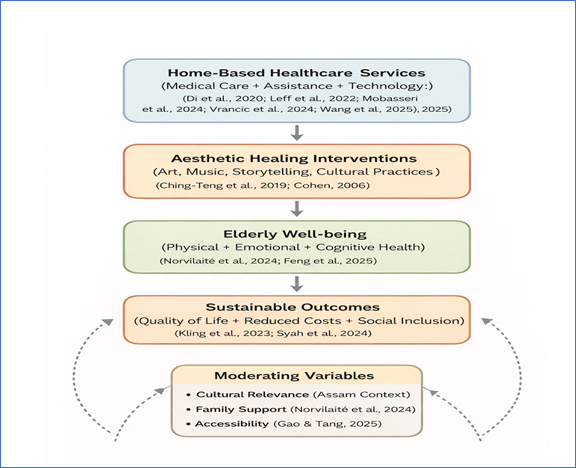
Figure 1 Conceptual Model of
Aesthetic Healing Integrated with Home-based Healthcare for Sustainable Elderly
Overall, the suggested conceptual model emphasises a comprehensive, culturally oriented approach to geriatric care by integrating clinical care with aesthetic healing practices. This integration not only improves an individual's well-being but also supports the sustainability of healthcare systems by promoting cost efficiency, social inclusion, and cultural continuity.
6. Propositions
The propositions made are as follows, based on the conceptual model and supporting literature:
P1: Home-based healthcare services have a positive effect on the well-being of the elderly through increasing access, continuity of care, and patient satisfaction Di et al. (2020), Leff al. (2022), Syah et al. (2024).
P2: Aesthetic healing methods such as art, music, storytelling, and cultural involvement produce great improvement in emotional stability and cognitive functioning of the ageing population Ching-Teng et al. (2019), Cohen et al. (2006).
P3: When care interventions are made culturally relevant, especially in local settings, like in Assam, the interventions become more effective since familiarity, identity, and emotional attachment are achieved.
P4: Aesthetic healing combined with home-based healthcare results in sustainable elderly care outcomes, such as an increase in the quality of life, a decrease in the healthcare cost, and an increase in social inclusion Kling et al. (2023).
P5: Home-based care systems powered by technology enhance the efficiency, safety, and overall care delivery for older adults Vrančić et al. (2024), Wang et al. (2025).
7. Discussion
The contemporary conceptual analysis points to the weaknesses of the traditional healthcare paradigm, which mostly focuses on clinical and functional facets of care, but does not address emotional and cultural ones. Regardless of the fact that home-based healthcare has become an efficient alternative to institutional care, it tends to be limited to medical assistance and convenience. This limited scope does not cater the overall needs of the aged people, especially their emotional health and culture. The incorporation of aesthetic healing as a part of home-based healthcare offers a paradigm shift to care that is not restricted to clinical care. Artistic and cultural activities like music, narration, traditional rites help in expression of emotions, thought stimulation and interaction. These factors are specifically important in societies with strong cultural heritage such as Assam where the culture is deeply rooted in everyday life.
The process of cultural integration is important to make the care models more sustainable. Healthcare services are more acceptable, meaningful, and effective when they are in line with the local traditions and values. With the help of current literature, cultural specific interventions increase engagement with patients and satisfaction Norvilaitė et al. (2024). Therefore, elderly care sustainability is social, cultural, and economic. All in all, the research supports the notion that healthcare per se cannot guarantee holistic well-being. Rather, it requires an incorporated multidisciplinary approach. Here, aesthetic healing changes the care approach to focus more on human beings and less on the clinical approach to care, and this is another way to provide elderly care as a more humane and holistic approach.
8. Implications
Academic
Implications
The research is an addition to the increasing interdisciplinary research field as it links together healthcare, sustainability, and visual and performing arts. It broadens the theoretical knowledge on elderly care through the inclusion of aesthetic healing as a fundamental element consequently creating new opportunities in exploring the subject of culturally embedded models of healthcare.
Practical
Implications
The results indicate that caregivers and healthcare providers should be trained on the art-based therapeutic practices in order to improve care delivery. The introduction of music, storytelling and traditional crafts into the everyday care will go a long way towards enhancing the emotional and cognitive well being of the elderly person. Also, culturally sensitive models of home-based care can be designed to enhance acceptability and effectiveness.
Policy Implications
The policymakers may also understand the need to incorporate cultural and artistic activities in healthcare systems. Institutional burden can be minimized by developing policies that foster home-based cultural healthcare programs which will provide holistic and sustainable elderly care especially in culturally diverse areas such as Assam.
9. Limitations
Although it has given its contributions, this research has some limitations. To begin with, it is conceptual and it lacks empirical confirmation of the proposed model. Second, the research is localized to Assam which can reduce the extrapolation of the results to other villages with differing cultural situations. The amalgamation of aesthetic healing is also theoretically explained and needs to be tested in practice to be able to be used more widely.
10. Conclusion
and Future Research
To sum up, aesthetic healing combined with home-based healthcare is a holistic and sustainable solution to the elderly care. This model means that in addition to fulfilling the physical needs of the elderly, the model will meet the emotional and cognitive stability of these people because it is done through the integration of medical support with cultural-based practices. Such an approach is especially significant in such environment, where culture is the main element of daily life, as it is observed in Assam, to make the care meaningful, inclusive, and meaningful to the context. Thus, aesthetic healing can be a viable and long-term ailing model, based on cultural foundations and emotions, to be incorporated into home-based healthcare. This conceptual framework can be developed in future by empirically testing the proposed model through quantitative and qualitative approaches. A comparative research on the various cultural settings would help in further understanding the use of cultural relevance in geriatric care. Also, the combination of digital technology and the use of art-based interventions could be a good step to improving home-based healthcare services, including virtual music therapy or digital storytelling.
CONFLICT OF INTERESTS
None.
ACKNOWLEDGMENTS
None.
REFERENCES
Beisland, E., Drageset, J., Blindheim, M., Jorem, G., and Moi, A. (2024). Children's and Parents' Experiences of Home Care Provided By Hospital Staff: A Scoping Review. Journal of Clinical Nursing. https://doi.org/10.1111/jocn.17109
Brewster, R., Day, T., Butler, A., Lin, E., Levine, D., and Berry, J. (2025). Family Perceptions of Pediatric Acute Hospital Care at Home in the United States: A Qualitative Analysis..Hospital Pediatrics. https://doi.org/10.1542/hpeds.2025-008334
Cao, R., Yusof, M., and Ali, I. (2024). Home‐Based Elderly Care Development in Hebei Province, China: A Systematic Literature Review. Asian Social Work and Policy Review. https://doi.org/10.1111/aswp.12327
Ching-Teng, Y., Ya-Ping, Y., and Yu-Chia, C. (2019).
Positive Effects of Art Therapy on Depression And Self-Esteem of Older Adults
In Nursing Homes. Social Work in Health Care, 58(3), 324–338. https://doi.org/10.1080/00981389.2018.1564108
Chua, C., Ko, S., Lai, Y., Lim, Y., and Shorey, S. (2021). Perceptions of Hospital-at-Home Among Stakeholders: a Meta-Synthesis. Journal of General Internal Medicine, 37, 637 - 650. https://doi.org/10.1007/s11606-021-07065-0
Cohen, G. D., Perlstein, S., Chapline, J., Kelly, J., Firth, K. M., and Simmens, S. (2006). The Impact of Professionally Conducted Cultural Programs on the Physical Health, Mental Health, and Social Functioning of Older Adults. The Gerontologist, 46(6), 726–734. https://doi.org/10.1093/geront/46.6.726
Di, X., Wang, L., Dai, X., and Yang, L. (2020). Assessing the Accessibility of Home-Based Healthcare Services for the Elderly: A Case from Shaanxi Province, China. International Journal of Environmental Research and Public Health, 17. https://doi.org/10.3390/ijerph17197168
Etemad-Sajadi, R., Heo, C., and Clergue, V. (2023). Instilling the Core Tenets of Hospitality in Healthcare Services: The Role of Service Assurance and Social Presence. International Journal of Hospitality Management. https://doi.org/10.1016/j.ijhm.2023.103492
Feng, M., Huang, L., Chen, Y., You, Y., Chang, H., Zhang, L., Zhang, F., and Liu, Y. (2025). Caring Perception Questionnaire of the Home-Dwelling Elderly: Development and Validation Study. BMC Geriatrics, 25. https://doi.org/10.1186/s12877-025-05785-0
Gao, X., and Tang, Y. (2025). Individual Factors Influencing the Use of Home- and Community-Based Care Services by Disabled Elderly Individuals in Urban Areas: Evidence from Beijing, China. Sustainability. https://doi.org/10.3390/su17020676
Kling, S., Garvert, D., Lessios, A., Yefimova, M., Martin, M., Sheffrin, M., and Winget, M. (2023). Home-Based Primary Care for Older Adults: Matched Case-Control Evaluation of Program’s Impact on Healthcare Utilization. Home Health Care Management and Practice, 35, 213 - 221. https://doi.org/10.1177/10848223231151975
Lai, Y., Lim, Y., Kuan, W., Goh, J., Soong, J., Shorey, S., and Ko, S.
(2021). Asian Attitudes and Perceptions Toward
Hospital-At-Home: A Cross-Sectional Study. Frontiers in Public Health,
9. https://doi.org/10.3389/fpubh.2021.704465
Leff, B., Ritchie, C., Ciemins, E., and Dunning, S. (2022). Prevalence Of Use And Characteristics of Users of Home‐Based Medical Care in Medicare Advantage. Journal of the American Geriatrics Society, 71, 455 - 462. https://doi.org/10.1111/jgs.18085
Martin,
L.G., Freedman, V. A., Schoeni, R. F., and Andreski, P. M. (2009). Health
and Functioning Among Baby Boomers Approaching 60, The Journals of
Gerontology: Series B, 64B(3), 369–377, https://doi.org/10.1093/geronb/gbn040
Mobasseri, K., Matlabi, H., Allahverdipour, H., and Kousha, A. (2024). Home-Based Supportive and Health Care Services Based on Functional Ability in Older Adults in Iran. Journal of Education and Health Promotion, 13. https://doi.org/10.4103/jehp.jehp_422_23
Norvilaitė, A., Newland, J., and Blaževičienė, A. (2024). Older People’s Experience And Related Factors While Receiving Home-Based Long-Term Care Services: A Qualitative Study. BMC Nursing, 23. https://doi.org/10.1186/s12912-024-02234-y
Pajalić, Z., Olsen, S., Hamre, A., Strøm, B., Clausen, C., Saplacan, D., and Kulla, G. (2024). Home Living Older Adults' Subjective Perceptions, Evaluation, and Interpretations of Various Welfare Technology: A Systematic Review of Qualitative Studies. Public Health in Practice, 7. https://doi.org/10.1016/j.puhip.2024.100470
Sixsmith, A., and Sixsmith, J. (2008). Ageing in Place in the United Kingdom. Ageing International, 32, 219–235. https://doi.org/10.1007/s12126-008-9019-y
Syah,
D., Yetti, K., Novieastari, E., Gayatri, D., and Nining, S.
(2024).
Factors Influencing Patient Satisfaction in Home Care Services: A Systematic
Review. F1000Research. https://doi.org/10.12688/f1000research.154937.1
Vrančić, A., Zadravec, H., and Orehovački, T. (2024). The Role of Smart Homes in Providing Care for Older Adults: A Systematic Literature Review from 2010 to 2023. Smart Cities. https://doi.org/10.3390/smartcities7040062
Wang, R., Ding, W., Zhou, Z., Li, X., and Zhang, Y. (2025). Optimizing Equipment Requirements And Configuration Rules for Elderly Home Treatment Environments: A Rough Set Analysis Framework. Frontiers in Medicine, 12. https://doi.org/10.3389/fmed.2025.1700646
World Health Organization. (2015). World Report on Ageing And Health.
https://doi.org/10.1016/S0140-6736(15)00516-4
Yang, J., Li, X., Liang, Z., Wei, R., and Liu, J. (2025). Community Based Healthcare Services Satisfaction Scale Among Older Adults Development and Psychometric Evaluation.. Journal of Evaluation in Clinical Practice, 31 5, e70201. https://doi.org/10.1111/jep.70201
Zhou, W., Zhang, X., and Lyu, X. (2025). Monitoring Utilisation Patterns of Home- And Community-Based Services
for Healthy Ageing: A Cross-Sectional Study. BMC Geriatrics, 25, 291.
https://doi.org/10.1186/s12877-025-05918-5
|
|
 This work is licensed under a: Creative Commons Attribution 4.0 International License
© ShodhKosh 2026. All Rights Reserved.