ShodhKosh: Journal of Visual and Performing ArtsISSN (Online): 2582-7472
|
|
Stratford to Bollywood: A Comparative Study of Shakespearean Plays and Their Indian Cinematic Adaptations
Trupti Vijay Jagtap 1 , Dr. Maroti Kendre 2
1 Research
Scholar, Faculty of Arts, Humanities and Sciences, Pimpri Chinchwad University,
Maval (PMRDA) Pune-412106 Maharashtra, India 412106
2 Assistant
Professor, Pimpri Chinchwad University, Pune, Maval (PMRDA) Dist. Pune-412106
Maharashtra, India 412106
|
|
|
ABSTRACT |
|
|
The plays of
William Shakespeare have cut across geographical and cultural boundaries and
come out as a major catalyst to literary and film adaptation all over the
world. This research work is called Stratford to Bollywood A Comparative
Study of Shakespearean Plays and their Indian Cinematic Adaptations, in which
the researcher analyzes the manner in which certain Shakespearean tragedy and
comedy plays were re-interpreted in the context of Indian cinema. Using a
qualitative comparative method, the study examines such important adaptations
as Haider (Hamlet), Maqbool (Macbeth), Omkara (Othello), Angoor (The Comedy
of Errors), and Ram-Leela (Romeo and Juliet). The paper aims at analyzing the
structural content of narration, the change in theme, characterization and
re-contextualizing culture in order to comprehend the dynamics of adaptation.
The results indicate that the main themes of Shakespeare like love, ambition,
jealousy, betrayal, and identity are carried over but their meanings have
been heavily transformed to suit the Indian socio-cultural, political, and
cinematographic settings. The examples of Bollywood adaptations show a change
of the individual-focused tragedy to the one rooted in the collective and
socio-political reality, that is, incorporating such factors as caste
relationships, political struggle, and customs. Moreover, the study
emphasizes the importance of cinematic features such as music, dance, and
symbolism as very vital elements in improving emotive intensity and viewer
involvement. This study, by bringing together classical literature and mass
media, will add to the body of work on the study of adaptation and film
studies, as well as cross-cultural literary studies, and will help us to
understand the timeless appeal of Shakespeare in modern Indian society. |
|||
|
Received 14 January 2026 Accepted 23March 2026 Published 03 April 2026 Corresponding Author Trupti
Vijay Jagtap, trupti.jagtap23@pcu.edu.in DOI 10.29121/shodhkosh.v7.i3s.2026.7404 Funding: This research
received no specific grant from any funding agency in the public, commercial,
or not-for-profit sectors. Copyright: © 2026 The
Author(s). This work is licensed under a Creative Commons
Attribution 4.0 International License. With the
license CC-BY, authors retain the copyright, allowing anyone to download,
reuse, re-print, modify, distribute, and/or copy their contribution. The work
must be properly attributed to its author.
|
|||
|
Keywords: Shakespearean Adaptation, Bollywood Cinema, Cultural
Recontextualization, Comparative Analysis, Adaptation Theory, Indianization,
Film Studies, Interculturalism, Narrative Transformation, Postcolonial
Studies |
|||



1. INTRODUCTION
The texts of William Shakespeare, born in into the cultural context of Stratford-upon-Avon in Elizabethan England, have cut across geographical, linguistic and temporal boundaries to become a staple of world literature. His plays, which have a universal theme like love, ambition, betrayal, power and identity, have continued to reverberate through the different cultures and artistic tradition. An Indian film industry and especially Bollywood is one of the most striking expressions of this international impact, in which Shakespearean plots have been rewritten, adapted, and localized to the norms of modern socio-cultural realities Nandi and Chakraborty (2025). The call of Stratford to Bollywood is not only a kind of adjustment, but a cultural dialogue between Western literary and Indian film culture. Indian filmmakers have extensively resorted to Shakespeare, adapting him into visual representations, high-impact emotive stories, and cultural underpinnings. The films like Maqbool (based on Macbeth), Omkara (Othello) and Haider (Hamlet), are the examples of such reinterpretation where classical tragedies are depicted as the redesign according to Indian socio-political realities, such as the aspects of caste, crime, corruption and political warfare. These are not simple adaptations, they are creative reinterpretations, which integrates poetic richness with popular elements of the cinema like music, dancing and melodrama Buckley (2025).
The importance of researching these adaptations is due to the fact that the process of cultural translation and cultural reinterpretation is studied. When placed in the Indian context, Shakespearean stories are heavily altered both in the plotline, characterization, emphasis on themes and style of narration. These changes are indicators of the bargaining between faithfulness to the original text and need of cultural relevance. Adapted into Bollywood, the storytelling traditions, dialects, and visuals that reflect the indigenous heritage of a nation are commonly adapted and, in such a way, they produce a hybrid narrative that conveys familiarity to the Indian audience, yet still preserves the primary spirit of the Shakespearean drama Singh (2024). Although the issue of Shakespeare presence in India has had increased academic attention in recent years, a certain gap can be observed in the systematic comparative studies between the original plays and their film versions. Although the adaptations at individual levels have been studied or the postcolonial interpretations have been examined, little has been done to comprehensively look at the changes in narrative structures, character lines and themes in the process of adapting the same. Furthermore, little research has been done on the influence of cinematic means of adaptation, including music, choreography, and visual narrative in these adaptations. In this study, the gap is filled by conducting a comparative study of the select Shakespearean plays and their Bollywood versions, with keeping in mind some of the major case studies such as Hamlet-Haider, Macbeth-Maqbool, and Othello-Omkara, as well as major comedies and romances. The paper will examine the localization of these works in Indian socio-cultural contexts, and it will also appraise what remains, changes or modifications and reinterpretation in the process. It also aims at exploring the greater implications of these adaptation in the conceptualization of the universality of Shakespeare topics and their applicability in modern Indian society Zaman (2025).
The theoretical frameworks used to guide the research are based on the adaptation theory, intertextuality, and postcolonial studies. Cultural hybridity and interculturalism are some of the concepts that offer critical methods of understanding how Shakespearean texts are remodelled in new culture. Adaptation here is considered not as a derivative process rather it is a transformative process of reinterpretation producing new meanings as it works with the original source. This study is limited to the few adaptations of Bollywood that have also attained critical as well as cultural prominence. The discussion is done at the level of text and film, there is no mention of stage changes or local cinema in order to preserve the quality and need of clarity. The question of focusing on major works and directors, specifically Vishal Bhardwaj, will guarantee a limited and significant comparative framework.
2. LITERATURE REVIEW
Shakespearean drama and Indian cinema have become the subject of growing scholarly interest, especially in the fields of adaptation studies, postcolonial theory and film studies. The timeless success of Shakespeare in other cultures is mostly explained by the fact that his works can be reinterpreted through the prism of a variety of cultures because these themes are universal: love, ambition, betrayal, power and identity. Shakespeare was first introduced to India through English education and theatre during the colonial time and became a territory of cultural assimilation and opposition. Early works, including those of Poonam Trivedi and Jyotsna Singh, follow the historical line of Shakespeare in India focusing on the localization of his works by means of translations, performances, and reinterpretations Pal (2025). These works point out that the Shakespearean drama ceased to be a colonial teaching instrument and became a cultural negotiating instrument and creative expression. His works were adapted by the Indian theatre practitioners and filmmakers through incorporation of the indigenous traditions, hence resulting into the hybrid cultural texts. Shakespearean adaptation received a new look with the advent of the Indian cinema especially Bollywood. Such scholars like Parmita Kapadia and Rakesh H. Solomon discussed the ways in which film makers recreate Shakespearean stories in modern Indian socio-political settings. The trilogy of Maqbool, Omkara, and Haider by Vishal Bhardwaj is often discussed as one of the most notable examples of cinematical adaptation, which has somehow managed to blend Shakespearean tragedy with India specifics which includes caste hierarchies, political violence and organized criminal activity Vishal Bhardwaj’s Commentary on Indian Society Through Shakespearean Adaptations. (2024) .
The theoretical frameworks have been very instrumental in perceiving these adaptations. The idea of adaptation developed by Linda Hutcheon, A Theory of Adaptation, focuses on adapting as a way of reinterpretation, and transformation occurring in media and culture. On the same note, the concept of hybridity by Homi K. Bhabha describes how the cross-cultural adaptations result in the creation of new meanings as a result of blending of the Western and indigenous identity. The work of scholars such as Ania Loomba and Dennis Kennedy also states that adaptations should be viewed in their respective cultural, historical, and political circumstances to support the significance of localized analysis. In spite of the increased literature, a number of research gaps still exist. A majority of the literature concentrates on a single movie or filmmaker instead of making systematic comparative studies of the original Shakespearean works and their film versions. Also, little has been done to understand how Bollywood-specific factors, like music, dance, visual symbolism and melodrama, influence adaptation strategies. Moreover, the aspects of reception of the audience and influence of socio-political factors on the change in the narrative are underresearched. Thus, the research seeks to fill these gaps by offering an in-depth comparative analysis of the chosen Shakespearean plays and their adaptations in Bollywood by analyzing the narrative, theme, and culture changes in a systematic analytical context Siddiqui (2023).
Table 1
|
Table 1 Summary of Existing Literature |
|||
|
Study Focus |
Methodology |
Key Findings |
Limitations |
|
Shakespeare in Indian cinema
Sharma (2024) |
Historical & cultural
analysis |
Highlights localization of
Shakespeare in Indian context |
Limited focus on film
comparison |
|
Bollywood adaptations Dixit (2023) |
Film analysis |
Shows reinterpretation of
themes like caste & politics |
Focused on selected films
only |
|
Cinematic adaptation A Comparative Study of Macbeth
Adapted as Maqbool. (2023) |
Comparative approach |
Identifies socio-political
embedding in adaptations |
Lacks theoretical depth |
|
Adaptation theory A Study Selective of
Shakespearean Adaptations in Indian Cinema. (2024) |
Theoretical framework |
Defines adaptation as
reinterpretation across media |
Not specific to Indian
cinema |
|
Cultural hybridity Khanpurkar et al. (2025) |
Postcolonial theory |
Explains blending of
cultures in adaptations |
Abstract, lacks
film-specific examples |
|
Postcolonial Shakespeare Swisher and Shamir (2023) |
Critical analysis |
Emphasizes context-based
interpretation |
Limited cinematic focus |
|
Global Shakespeare Agirrezabal (2024) |
Cultural studies |
Highlights intercultural
performance |
Does not cover Bollywood |
|
Haider–Hamlet adaptation [15] |
Film-text comparison |
Shows political
reinterpretation in Kashmir context |
Focus on single case |
As Table 1 also indicates, the works of Shakespeare have been modified as colonial writings to culturally hybrid in the Indian context, Bollywood adaptation of Shakespearean works reflects creative reinterpretation instead of a direct translation. There is great theoretical background (adaptation theory, hybridity, postcolonialism) on which it is based.Major research gap: There is no systematic comparative + cinematic analysis.
3. RESEARCH METHODOLOGY
The research methodology embraced in this study is both qualitative and comparative in nature to explore how Shakespearean plays have been transformed to Indian movies. The aim is to examine the reinterpretation of classical texts of literature in the socio-cultural/ cinematic context of Bollywood. The qualitative methodology is deemed as the best suited to this study because it will provide an opportunity to analyze the narrative forms and themes, character progression and cultural backgrounds on a deeper, personal level instead of a numerical or statistical one. The comparative nature of the study allows conducting a systematic analysis of the similarities and differences between the plays written by Shakespeare and adapted to the film, thus, shedding some light on the adaptation process, the localization process, and reinterpretation. The methodology of the research is comparative case study, which addresses the chosen Shakespearean texts and their Bollywood films. The plays covered include Hamlet and Haider, Macbeth and Maqbool, Othello and Omkara, The Comedy of errors and Angoor, Romeo and Juliet and Goliyon Ki Raasleela ram-leela. The selection of these case studies is based on purposive sampling since they are direct descendants of Shakespearean works, their importance to culture and their critical acclaim in the field of academia and film. The choice is also made such that it is diverse in terms of genres as it encompasses tragedy, comedy, and romance thus making a complete knowledge of how adaptation is conducted in various types of narratives.
The sources of data to be used in the study are both primary and secondary. The original Shakespearean plays and the Bollywood versions of the same are the main sources of data to be analyzed with the help of close reading and repetition viewing of the film to recognize the details of the narrative, visuals, and thematic undertones. The second source of data is the scholarly books, articles, critiques, and theoretical literature on the subject of adaptation studies, postcolonial theory, and movie criticism. Purposive sampling method is used because the inclusion of irrelevant texts and films is avoided and, therefore, ensures the focus and depth of the research. Data collection is based on the recognition of the major scenes, dialogues, interactions, and the cinematic techniques that will be used in the process of adaptation. The study has assimilated a variety of qualitative instruments within the framework of the analytical section; these are an analysis of narrative, an analysis of themes, and an analysis of films. The narrative analysis consists of analyzing the form and development of the narrative and determining the modifications in the plot, sequencing and styles of narration. The major themes in the thematic analysis are, power, ambition, love, jealousy, betrayal and identity and how the themes are maintained or transformed during the process of adaptation. The character analysis has also been carried out to make comparisons between the development, motivations and psychological depth of the characters in the original plays and those in the movie versions. Also, film analysis provides an opportunity to consider the cinematic aspects of music, dance, visual symbolism, mise-en-scene, the execution of dialogues, and techniques of editing, which are important in the formation of the narrative in Bollywood versions.
The paper also has the cultural and postcolonial analytical lenses that learn to appreciate the Indianization and recontextualization of culture. The concept of hybridity, interculturalism, and localization are also employed to analyse how the Shakespearean narratives can be adapted to meet the Indian socio-cultural realities, caste processes, political antagonism, gender roles, and family set up. To enumerate recurring themes and patterns across various case studies, qualitative coding methods can be employed to provide a systematic analysis and interpretations that can be consistent. The research methodology is broad in general since it involves a mixture of a literary analysis and a study of films, allowing one to get a more integrated view of Shakespearean adaptations in Bollywood. Combining the comparative analysis and consideration of cultural and cinematic approaches, the study provides valuable information to the transformation of classical texts into modern ones, with references to the world and regional orientations.
4. COMPARATIVE ANALYSIS OF SHAKESPEAREAN TRAGEDIES AND THEIR ADAPTATIONS
The adaptation of Shakespearean tragedy to Bollywood film is a dynamic process of cultural translation, interpretation, and the invention of the story. Although the plays of Shakespeare are embedded in Elizabethan socio-political situations, they are recontextualized in the Indian cinematic versions, in terms of the Indian realities in the modern times. This part is a comparative study of three large adaptations of Hamlet, Haider, Macbeth, Maqbool, and Othello, Omkara with a theme of political struggle, ambition, identity, jealousy, and social stratification.
4.1. Hamlet vs Haider: Political Conflict and Identity
Hamlet by William Shakespeare is a deep analysis of revenge and moral uncertainty and existential crisis, and it is located in the royal court of Denmark. The play is based on the revenge mission of Prince Hamlet against the murder of his father by his uncle, the King Claudius. Coming to a focus are themes like betrayal, madness, corruption and the pursuit of truth. In the film Haider (2014) by Vishal Bhardwaj, this story is moved to a politically unstable part of the world Kashmir in the 1990s insurgency. This change of the royal court into a war-torn society essentially changes the form of the narrative. Whereas Hamlet describes moral dilemmas on the individual level in a system of monarchy, Haider describes the same on a much broader plane of collective trauma, state violence, and political oppression . The element of political war is greatly exaggerated in Haider. The internal corruption of the Danish monarchy is substituted with the complicated issues of the military-occupation, forced disappearances, and human rights violation in Kashmir. The issue of revenge in Haider is a personal one which is then combined with socio-political struggles making it more a political commentary than a personal tragedy.
At the level of identity, the existential dilemma, to be or not to be, is restated through the internal struggle of Haider who struggles to make sense of personal loss, political consciousness, and cultural identity. Haider is not only the person who is in search of justice but also the representative of a marginalized community that is struggling with identity and revolt. This transformation is also manifested in characterization. The character of Gertrude transforms to Ghazala, the character who is emotionally multifaceted and symbolically reflective of a land torn between itself. The play-within-a-play device is reinvented in the form of a theatrical performance with Bollywood elements that display the way cinematic elements displace theatrical traditions. When Hamlet ends in a cycle of violence and tragic inevitability, Haider provides a more subtle ending to the story focusing on reconciliation rather than revenge. This change is indicative of modern Indian socio-political issues, and an indication of abandoning the Shakespearean fatalistic outlook on the world, to a more thoughtful and human-centered solution.
4.2. Macbeth vs Maqbool: Power, Ambition, and Crime
Macbeth by Shakespeare is a tragedy of uncontrolled ambition, corruption, and psychological aspects of ambition. The setting of the play is the medieval Scotland, as prophecy, manipulation and personal desire lead Macbeth and Lady Macbeth to the tyranny and their ultimate downfall. In Maqbool (2003), Bhardwaj takes this story to the Mumbai underworld where feudal system of power is changed into a contemporary criminal hierarchy. The king turns into a crime lord and battlefield is substituted with the city of organized crime. This change in context enables to explore the issue of power and ambition in a modern Indian environment. The motif of ambition is also the main one in both texts, but its manifestation is different. The ambition of Macbeth is driven by prophecy and personal desire as per the supernatural perceptions and Maqbool ambition is driven by loyalty, manipulations and socio-political aspects of the underworld. The witches in Macbeth are substituted with the police officers in Maqbool who are corrupt and are symbolic of the crime-authority nexus in the contemporary India. One of the important points of this adaptation is character transformation. Lady Macbeth is transformed into Nimmi whose reasons are strongly based on emotional dependency and need of safety in an unstable world. Lady Macbeth is a merciless ambition and Nimmi is a humanized and context-oriented character, who is a result of her conditions.
The crime and morality theme is also redefined. Moral dilemma in Macbeth is internal and psychological as in Maqbool, the forces that affect it are loyalty, betrayal, and corruption within the system. The city adds to the story, making it more dramatic with the theme of power games, brutality, and moral confusion. Maqbool, cinematically, uses visual symbolism, music and use of atmosphere to tell the psychological decline of its characters. Dark color, symbolic depictions, and story time bring out more emotion in the adaptation. With all these changes, the fundamental path of aspiration to ruin is still there. Maqbool however puts this journey in the light of Indian socio-political realities thus making the story more familiar to the modern audience.
4.3. Othello vs Omkara: Jealousy, Honour, and Social Hierarchy
The plays of Othello by Shakespeare deal with the concepts of envy, faith, racial nationality and deception. The play revolves around Othello, a Moorish commander in the Venetian forces who loses his life due to the intrigues of Iago and this has disastrous effects on his life. Bhardwaj Omkara (2006) adapts the story, but sets it in rural Uttar Pradesh, contextualizing it with the politics and Indian caste relations. This change brings a new twist to the jealousy and honour themes in accordance with the socio-cultural realities of the Indian society. The major theme is still that of jealousy, though the causes of jealousy are recontextualized. In Othello, jealousy is associated with racial insecurity and manipulation, whereas in Omkara it is connected with the questions of caste, masculinity and social reputation. Omkara may be an outsider, but not by race but by his status in a strict social structure. Honour is also an important concept in Omkara. The Indian society has a paramount concern in honour particularly in love and other relationship issues. The infidelity doubt turns into an issue of public shame and heightens the emotional interest of the story.
These cultural changes are experienced in characterization. Iago is changed into Langda Tyagi whose intentions are political ambitions and personal hatred. Dolly (Desdemona), is more of agent, as gender relations in the Indian society were changing. The characters are also strongly integrated in their socio-cultural space and therefore their behaviors and their driving forces are more contextual. Social hierarchy is another prominent theme added to Omkara. Whereas Othello is a play about racial discrimination, Omkara is a play about caste and class segregations which give the Indian society its intricacies. These are the components that affect the relations, power relations and the development of the story. The film Omkara has used local dialects, folk songs, local settings, to show a realistic picture of rural India. Language and visual aesthetics use contribute to the increase of the cultural specificity of the adaptation. In contrast to the universal background of Othello, Omkara is firmly based in its local environment, and it shows that the Shakespearean themes could be easily reworked and applied to the local circumstances.
General Comparative Insight The comparative insight pertains to the primary categories of the objects of study and the initial methodologies of the research, which focus on the hand-collected data and the data gathered through various techniques, including survey or observation (Saba, 2011, pp. 13).<|human|>General Comparative Insight The comparative insight will be concerned with the main types of the objects of research and the methods of the research, which are the primary and unique, i.e. the hand-collected data and the data collected by different methods, such as survey or
In all three versions, the same trend can be observed: Shakespearean tragedies are not simply translated, but localized culturally and innovated through the impact of cinematography. The main themes [ambition, jealousy and identity] are also retained, but their definitions are redefined to fit in Indian socio-political situations.
Through these adaptations, emphasis is put on:
· The omnivority of Shakespearean themes.
· The plasticity of cross-cultural narratives.
· The contribution of cinema to the remodeling of classical literature.
Therefore, the Stratford to Bollywood story is one of the examples to prove that storytelling develops over time and space, crosses the boundaries of cultures, and gives birth to a new form of art.
5. COMPARATIVE ANALYSIS OF SHAKESPEAREAN COMEDY AND ROMANCE ADAPTATIONS
The comedies and romantic tragedies of Shakespeare have revealed a stunning adaptability to the cultures because of the universal appeal, convincingly exciting plot, and the depth of emotions. These works in the case of Bollywood are redefined in terms of incorporation of Indian cultural values, social constructs, and cinematic practices. This discussion will analyze two notable versions, The Comedy of Errors-Angoor and Romeo and Juliet-Ram-Leela and how humor, romance and conflict are relocated in the Indian socio-cultural context.
5.1. The Comedy of Errors vs Angoor: Farce and Cultural Humor
The Comedy of Errors by Shakespeare is one of the earliest farce plays based on the themes of mistaken identities of two groups of identical twins who are separated during their childhood. The play is based on confusion, coincidence, and situational comedy a lot, making it a fast-paced plot, based on misunderstandings and absurdity. Angoor (1982) by Gulzar is a renowned Bollywood adaptation, which has still preserved the basic plot with the main structure of mistaken identity, but the whole story is set in an Indian social and cultural setting. The film is based on the lives of two pairs of twins, Ashok and Bahadur whose lives bring them in an unexpected twist which results in a sequence of humorous events. Although the time of the original play is Ephesus, Angoor transports the story to a local Indian setting, which is closer to the local audiences. The idea of farce is maintained in both the works, however, the way it is done is quite different. The humor used by Shakespeare is mostly verbal and situational based on wordplay, puns and fast dialogue that is exchanged. On the contrary, Angoor improves the comedic effect with the help of Bollywood-specific factors that include expressive acting, comic timing and aesthetic exaggeration. The incorporation of the culturally specific humor, such as the allusions to the Indian traditions and to the Indian life in general, makes the story more profound and approachable.
There is significant change in characterization. The Comedy of erroneous commonly uses characters as a stereotype in the comic context. In Angoor however, characters are localized and made more multifaceted. The master-servant relationship supersedes the concept of slavery in the Shakespeare play, and the story is adjusted to the Indian social values. Also, the female characters in Angoor are depicted more actively and applicable, which displays the changing view of society. The cultural acclimatization also spreads to the social contexts and values. Although Shakespeare play is a mirror of the Elizabethan society, Angoor highlights the Indian family set up, socialization and morality. It is rather situationally based and the comedy is not as chaotic and this makes it relate to Indian sensibilities. Angoor makes structural changes to the film narrative by adjusting the rhythm and pacing of the story to fit the cinematic storytelling. The background music, visual, and comic sequences help to improve the audience involvement without changing the principle of Shakespearean farce. Although this has changed, the major theme of mistaken identity and the comic resolution is still present. Therefore, Angoor manages to show how Shakespearean comedy can be made local without losing its essence, which points at the flexibility of humor in the inter-cultural context.
5.2. Romeo and Juliet vs Ram-Leela: Love, Conflict, and Cultural Transformation
Romeo and Juliet, authored by Shakespeare, is one of the most symbolic romantic tragedies that depict the love between two young people belonging to fighting families. The play raises issues of passionate love, family discord, destiny and sacrifice resulting to a tragic conclusion emphasizing the results of societal division. Sanjay Leela Bhansali remakes the story in the film Goliyon Ki Raasleela Ram-Leela (2013) to fit the setting of rural Gujarat, India. The movie keeps the main idea of star-crossed lovers but puts it into the context of a bloody clan-related competition, which depicts the intricacies of Indian social and cultural life. The theme of love is also dominant in the two works, being intense, impulsive, and emotional. Nonetheless, Ram-Leela enhances this theme by using the classic features of Bollywood music, dancing, and sightseeing. The story of love is told not just with the help of dialogue but also with the help of lavish song sequences and symbolic pictures, which make the story more emotional. The element of conflict is greatly changed. In Romeo and Juliet the Capulets and Montagues tribe war is based on family rivalry. In Ram-Leela, this struggle is extended to wider socio-political atmosphere with clashes among clans, honor and land issues. The violence portrayed in the movie reveals modern issues of power, identity and divisions within the Indian society.
The cultural change can be observed in various aspects. The Indian traditions, festivals, and rituals are introduced instead of the religious and cultural environment of the first play. The mixture of the Hindu culture aspects, native languages and local aesthetics makes the environment of the story rich and full of immersion. This localization makes the story easier to relate to and still gives it universal themes. Modern sensibilities are also manifested in characterization. Whereas Juliet is presented as a young and obedient girl who is bound by the regulations of the society, Leela is presented as assertive and strong; as an independent woman. This change underscores the transformation of gender roles and the rise of more agency in the female characters in Indian films. In the same way, the character of Ram is the fusion of the traditional romantic and modern masculine. Ram-Leela re-invents the theme of destiny and tragedy. Whereas in Shakespeare the play, inevitability and destiny are stressed, the film reveals some aspects of resistance and agency, which means that the characters can influence their situation. Nevertheless, the tragic conclusion is still present, and it contributes to the permanence of the story. On the film front, Ram-Leela is typified by the spectacular visual effects, bright colors and melodramatic narration. The narration is enhanced through the application of symbolism, choreography, and music, making it more of a sensual experience that fits the stylistic expectations of Bollywood.
Overall Comparative Insight
Comparative essay of The Comedy of Errors -Angoor and Romeo and Juliet -Ram-Leela, shows that Shakespearean comedy and romance can be very accommodating across different cultures. Though the main stories and issues are retained, their interpretation is greatly changed to indicate the Indian cultural values, social norms, and movie traditions.
Key observations include:
· Localization of humor and romance by means of cultural and linguistic adaptation.
· Inclusion of Bollywood aspects like music, dance, and visual narration.
· Changes in the social contexts in accordance with Indian realities.
· There is more character development and agency, especially in female characters.
These adaptations prove the truth that Shakespeare is not a fixed writer but a multipurpose narration which can always be reinvented. The shift of Stratford to Bollywood serves as an accentuation of the universality of storytelling and, at the same time, the significance of cultural specificity in the development of meaning and engagement with the audience.
6. RESULTS AND ANALYSIS
Table 2
|
Table 2 Comparative Analysis of Narrative Transformation |
|||
|
Parameter |
Hamlet–Haider |
Macbeth–Maqbool |
Othello–Omkara |
|
Setting |
Denmark → Kashmir
conflict zone |
Scotland → Mumbai
underworld |
Venice → Rural UP
politics |
|
Narrative Style |
Philosophical →
Political |
Psychological →
Criminal realism |
Tragic →
Socio-political |
|
Plot Modification |
Expanded with insurgency
context |
Adapted to mafia hierarchy |
Adapted to caste politics |
|
Ending |
Revenge tragedy →
Reconciliation tone |
Downfall retained |
Tragic ending retained |
|
Complexity Level |
High (political + personal) |
Moderate (crime + ambition) |
High (social + emotional) |
Table 3
|
Table 3 Thematic Transformation Analysis |
|||
|
Theme |
Original Plays |
Bollywood Adaptations |
Transformation Type |
|
Power |
Royal authority |
Political/Criminal power |
Contextual shift |
|
Ambition |
Personal ambition |
Survival + ambition |
Expanded meaning |
|
Jealousy |
Psychological |
Social + honour-based |
Cultural reinterpretation |
|
Love |
Romantic/tragic |
Passion + societal pressure |
Intensified |
|
Identity |
Individual crisis |
Cultural + political
identity |
Expanded |
|
Betrayal |
Personal |
Social + systemic |
Deepened |
Table 4
|
Table 4 Role of Cinematic Elements |
|||
|
Element |
Hamlet/ Macbeth/ Othello |
Bollywood Versions |
Impact |
|
Dialogue |
Text-heavy |
Visual + emotional |
Enhanced engagement |
|
Music |
Minimal |
Integral storytelling tool |
Emotional amplification |
|
Dance |
Absent |
Symbolic & narrative |
Cultural embedding |
|
Visual Symbolism |
Limited stage props |
Strong color/light symbolism |
Deeper meaning |
|
Setting |
Static stage |
Dynamic real-world locations |
Realism |
|
Language |
Classical English |
Regional dialects |
Localization |
Table 5
|
Table 5 Cultural Recontextualization |
|||
|
Aspect |
Shakespearean Context |
Indian Adaptation |
Result |
|
Social Structure |
Monarchy |
Democracy / caste system |
Social realism |
|
Conflict Type |
Royal/family conflict |
Political/caste/clan
conflict |
Expanded scope |
|
Gender Roles |
Limited agency |
Stronger female roles |
Modernization |
|
Morality |
Individual ethics |
Social ethics |
Broadened perspective |
|
Identity |
Personal |
Collective/community-based |
Cultural shift |
Figure 1
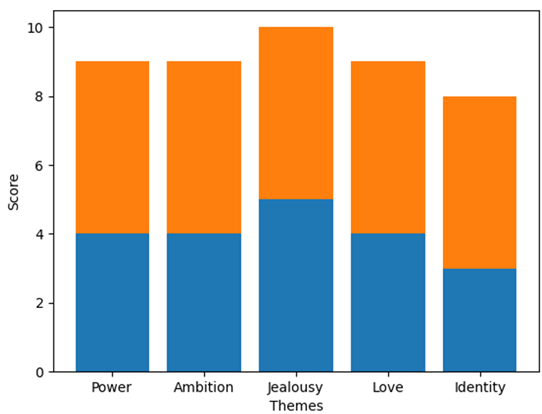
Figure 1 Thematic Transformation Comparison
Figure 1, this graph, indicates that Bollywood versions actually intensify major themes such as love, ambition, as well as identity as compared to the originals in Shakespearean plays. The topics are developed with the aspect of social and cultural elaboration, which renders them closer to the Indian viewers.
Figure 2
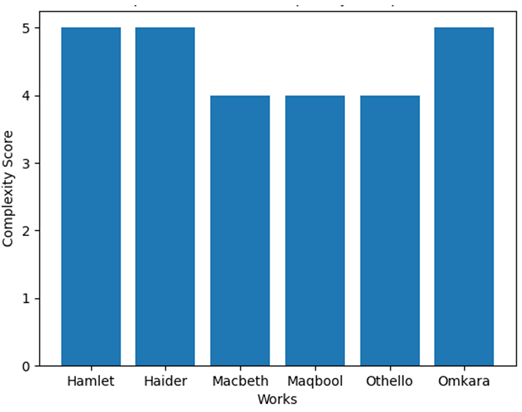
Figure 2 Narrative Complexity Comparison
Figure 2 shows that such adaptations as Haider and Omkara are more complex because of the introduction of socio-political factors (e.g., Kashmir conflict, caste politics). On the whole, Bollywood movies do not lose or diminish narrative levels.
Figure 3
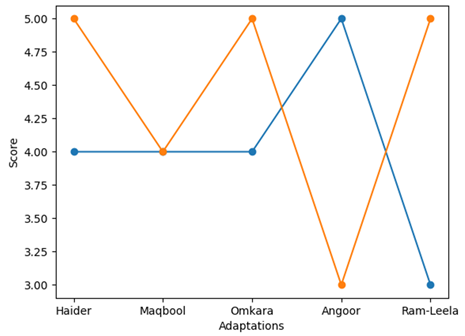
Figure 3 Fidelity vs Innovations
As shown in Figure 3, there is a trade-off between loyalty to the original texts of Shakespeare and free adaptation in Bollywood versions. It reveals that the films such as Angoor retain high fidelity with little modifications to the original play whereas Ram-Leela has high innovation inventing the story to the extent of adapting it into Indian cultural and cinematic realms. By contrast, adaptations like Haider, Maqbool and Omkara strike a more adequate balance, balancing the themes and characters and making significant cultural and narrative changes. This means that the key adaptations are those that are brilliant in executing originality with creative reinterpretation.
7. DISCUSSION AND FINDINGS
The comparative reading of Shakespearean plays and their adaptations in Bollywood indicates that there is a complicated relationship between preservation and transformation. The fundamental plots and the universal themes of Shakespeare are retained; however, their adaptation in Indian movie industry indicates a lot of cultural changes, structural and cinematic representation changes. This part summarizes the primary results of the research, indicating the role of adaptation as a process of negotiation on culture and innovative creativity.
7.1. Narrative and Thematic Transformations
The Bollywood adaptations of literary works have undergone a change in the narrative forms and thematic representations, which is one of the most notable results of the present research. The Shakespearean plays that were originally designed as a part of the social-political context of Elizabethan England are reformed to correspond to the modern Indian narrative and narration patterns. The plot lines and dialogue-oriented plays in Shakespeare are usually extended to the multi-layered film plots with subplots, visual narration, and emotional dramatization. As an example, the philosophical and self-reflective character of Hamlet is remodelled into the politically charged movie of Haider when personal revenge is mixed with the mass suffering and struggle . In the same manner, the subject of ambition of individuals in Macbeth develops further to a subject of crime and power web in Maqbool. In theme, although most of the fundamental themes including love, betrayal, ambition and jealousy are maintained, their meanings are modified to suit the Indian socio-cultural realities. Emotional depth and visual representation tend to increase the intensity of the themes and make them more accessible and close to a broader audience. The metamorphosis of themes shows that Shakespearean stories cannot be fixed in time but rather they can be changed and modified depending on the situation.
7.2. Cultural Recontextualization and Indianization
One of the most important findings of this study is the recontextualization of the cultures in which the Shakespearean works are localized in the Indian cultures. It is commonly called the Indianization process and requires the adjustment of characters, settings, language, and social standards to match the requirements of the Indian audiences. The changes in the European location to Indian ones mentioned in Haider (Kashmir), in underworld in Maqbool (Mumbai), in Omkara (rural Uttar Pradesh) show that the geography is a critical factor in determining the narrative meaning . Those settings are not just the backgrounds but dynamic elements that determine character motives and the development of the themes. Family structures, honor systems, caste dynamic, and religious practices are part of the cultural elements that are incorporated into the stories replacing or altering the previous cultural codes. To take an example, racial tension in Othello is redefined into caste and class tension in Omkara, which is a mirror reflection of Indian socio-cultural context. Language is also important in the localization. The local dialects, idiomatic expressions and culturally specific conversations make it more authentic and more engaging to the audience. This Indianization process accentuates the flexibility of the works by Shakespeare and their possibilities to sound in other cultures.
7.3. Role of Bollywood Elements (Music, Dance, Visual Symbolism)
The cinematic style unique to Bollywood has an immense effect on the translation of Shakespearean plots. Bollywood films are very visual-based as opposed to Shakespearean drama, which is text-based. Music and dance are used as narrative means, and are used to substitute or supplement traditional dialogu e. The song sequences in movies such as Ram-Leela do not just contribute to the emotional presentation in movies, but also serve as narration tools that convey the motivations of characters and thematic content in the movies. Another important element is visual symbolism. Psychological states and thematic differences are represented with the help of such cinematic techniques as color palettes, lighting, mise-en-scene, etc. An example is that dark colors and dark images in Maqbool are seen as a symbol of moral indefinition and self struggle whereas the bright colors in Ram-Leela are associated with passion and intensity.
Also, it is important that Bollywood places more emphasis on melodrama, which increases the level of emotional appeal of the movies as well as making complicated themes more relatable to the viewer. The combination of these aspects turns Shakespearean stories into a new form of immersion in the cinematic experience, and it fills the gap between classical literature and popular entertainment.
7.4. Socio-Political Influences on Adaptation
The paper confirms that the modern-day socio-political situations play a significant role in Bollywood adaptations. Although Shakespearean plays are universal in theme, they are reinstated to present issues that are pertinent to the Indian society. The political instability in Kashmir serves as the background of Haider to bring about the themes of state violence, identity clash and resistance that which turns the story into commentary of the problems in the real world. On the same note, Maqbool is a mirror of the organized crime and corruption in the urban India and Omkara examines caste hierarchies, political power-games and gender norms. Such adaptations indicate that the works by Shakespeare will be a pattern wherein modern-day problems may be examined. The inclusion of socio-political aspect does not only make the narratives more relevant, but also gives filmmakers an opportunity to interact with the burning issues of the society. Moreover, the change between the individual tragedy and collective experience is an important change. In contrast, whereas the plays by Shakespeare have tended to center on individual conflicts, the Bollywood versions have been able to add more social interests in these plays and this has made the plays more cultural.
7.5. Comparative Insights: Fidelity vs Innovation
One of the key themes that came out of this study is the dilemma of loyalty to the original text, and innovation. The Bollywood adaptations are not concerned with a strict conformity to the Shakespearean texts; rather they reinvent and alter them to fit in new cultural and cinematic backgrounds.
The fidelity is witnessed with respect to the upholding of the core plot structures, archetypes of characters, and thematic backdrop. Nonetheless, one can observe innovation in the settings change, the motivations of characters, the methods of telling the story, and the focus on the theme.
This equilibrium may be thought of as a spectrum:
· High fidelity: Recollection of main plot and themes.
· Middle ground adaptation: Localization of culture and reinterpretation of themes.
· High narrative innovation: Significant narrative change of context.
These findings imply that effective adaptations are the ones that retain the core of the works by Shakespeare, but adopt the freedom of creativity. Through this method, one is able to come up with familiar and new narratives that attract different audiences.
8. CONCLUSION AND FUTURE SCOPE
This paper has examined the complex equation between Shakespearean plays and the Bollywood versions of these plays in systematic comparison analysis. Through the analysis of the chosen case studies, Haider, Maqbool, Omkara, Angoor, and Ram-Leela, the research creates the focus of reinterpreting the classic literary materials within one of the Indian cinematic contexts. These results demonstrate that although the stories told by Shakespeare are based on Elizabethan situations, the stories are strikingly universal in that they can be redefined by different cultures, languages, and artistic forms. Among the most important findings of this study is that the adaptations of Bollywood are not simply imitations of Shakespearean works that are replicated and modified by means of cultural localization and cinematic invention. The basic subjects like love, ambition, jealousy, betrayal and identity are maintained but they are reinstated to conform to the Indian socio-cultural realities. The shifts between the royal courts and the settings like political conflict in Kashmir, city crime networks, and power structures in countryside show how narratives also transform so as to be applicable to the modern audience.
The research is also able to determine that cultural recontextualization is one of the key factors of adaptation. The ancient cultural codes of the Shakespeare plays are substituted or re-understood by elements, which include caste, honor, family values, and regional identities. It is not only in this way that such a process of Indianizing contributes to the formation of hybrid narratives that takes into consideration the tradition of world literature as well as the manifestation of local culture. Moreover, the study highlights the importance of the Bollywood language in film adaptations. Music, dance, visual symbolism and melodrama are not just aesthetic additions but part and parcel of storytelling through redefinition. These aspects enable movie directors to translate the intricate feelings and messages in way that appeals to the general masses and as a result close the gap between traditional literature and mass entertainment.
The other significant finding is that socio political contexts have an effect on adaptation. The Bollywood movies are recast Shakespearean plots, to deal with modern problems including political antagonism, corruption, caste relations and gender roles. Such change of the individual tragedy to the collective experience makes the adaptations more socially relevant and makes them critical commentaries of the Indian society. Another characteristic of successful adaptations, which is also elucidated by the study, is the balance between fidelity and innovation. Although the basic framework of Shakespearean works is maintained, the presence of creative changes makes sure the stories are dynamic and relevant to the culture. Such balance proves that the process of adaptation is not a derivation, but, on the contrary, a creative process of redefinition through which new meanings and points of view are created.
Although this study is very insightful, it also presents research gaps that can be filled through further research. Future research can examine Shakespearean translations in local Indian film industries like the Marathi, Tamil, Malayalam, and Bengali cinema which can provide different insights into the process of localization and reinterpretation of cultural specifics. Differences in perception of the adaptations by various audiences like urban or rural, Indian versus global can help better understand the effects and success of the adaptations on their culture. Literary studies combined with media and sociology and cultural studies could be used to better understand adaptation as a multi dimensional phenomenon. A more comprehensive comparative study of the adaptation of the film in other nations will be able to place Bollywood in the international environment of Shakespearean reimaginings. As OTT platforms and digital storytelling emerge, future studies may explore the topic of Shakespeare being adapted into new media forms and the way it is affecting narrative strategies.
CONFLICT OF INTERESTS
None.
ACKNOWLEDGMENTS
None.
REFERENCES
A Comparative Study of Macbeth Adapted
as Maqbool. (2023). International Journal of
English Literature and Social Sciences.
A Study Selective of Shakespearean Adaptations in Indian Cinema. (2024). JETIR Journal of Emerging Technologies and Innovative Research.
Agirrezabal, M. (2024). Creating an Aligned Corpus of Shakespeare and Milton. arXiv.
Buckley, T. (2025). Adapting Shakespearean Romance in Indian Cinema. Journal of Adaptation Studies. https://doi.org/10.1080/17450918.2025.2573797
Dixit, A. (2023). Film Noir in Bollywood Cinema: Special Reference to Vishal Bhardwaj Films. Journal of Film Studies.
Khanpurkar, A., Tembhekar, P. K., Bagde, J. N., Janbandhu, R. D., Moharkar, K. R., and Godhane, S. W. (2025). Design and Development of an Arduino-Based Intelligent Object Sorting System. International Journal of Trendy and Advanced Research in Mechanical Engineering, 14(1), 23–28. https://doi.org/10.65521/ijtarme.v14i1.516
Nandi, S., and Chakraborty, K. (2025). A Critical Study of the Cinematic Adaptations of Shakespearean Tragedy in the Indian Subcontinent: Text and its Presence in Screenplay and Intermediality. Proceedings of the Comparative Literature Conference.
Pal, S. (2025). The Contributions of Vishal Bhardwaj to Hindi Cinema: A Study of Shakespearean Adaptations. ACADEMICIA, 15(4). https://doi.org/10.5958/2249-7137.2025.00031.2
Sharma, A., et al. (2024). Social Norms in Cinema: A Cross-Cultural Analysis of Shame and Pride in Bollywood and Hollywood. arXiv.
Siddiqui, M. (2023). Shakespeare Being Glocal: A Comparative Study of Hamlet and Haider. International Journal of Language and Literary Studies, 5(2).
Singh, P. (2024). The Adaptation of Shakespeare’s Plays in Indian Cinema. Borrowers and Lenders: Journal of Shakespeare and Appropriation, 18(1). https://doi.org/10.18274/764ysv85
Swisher, C., and Shamir, L. (2023). A Data Science Approach to Analysis of Shakespeare’s Plays. arXiv. https://doi.org/10.46298/jdmdh.10829
Vishal Bhardwaj’s Commentary on Indian
Society Through Shakespearean Adaptations. (2024).
Frontiers in Literary Studies.
Zaman, S. (2025). Reimagining Shakespeare’s Othello in Omkara: A Postcolonial Perspective. Journal of English Language and Literature, 12(1), 118–128.
|
|
 This work is licensed under a: Creative Commons Attribution 4.0 International License
© ShodhKosh 2026. All Rights Reserved.