ShodhKosh: Journal of Visual and Performing ArtsISSN (Online): 2582-7472
|
|
Enhancing Teaching Effectiveness through Design Thinking Training: A Study of Engineering Faculty in Chennai
R. Hepsiba
Beula 1 , Dr. M. Radhakrishnan 2
1 Research
Scholar, Department of Management Studies, St. Peter’s Institute of Higher
Education and Research, Chennai, India
2 Supervisor,
Department of Management Studies, St. Peter’s Institute of Higher Education and
Research, Chennai, India
|
|
|
ABSTRACT |
|
|
The dynamic
nature of the engineering education requires the implementation of new
pedagogical methods that help to boost teaching performance and the learning
results of the students. It explores the effect of design-thinking training
on faculty teaching performance in engineering colleges in Chennai and the
mediating role played by design-thinking self-efficacy and institution-level
support in particular. The design of the quantitative research was conducted
with the help of a structured questionnaire that was conducted with the
members of the faculty that underwent training in design-thinking. Analysis
of data was conducted based on statistical methods, such as descriptive
analysis, correlation, and Structural Equation Modeling (SEM) to compare both
direct and mediated relationships. Findings indicate that faculty training on
design thinking positively influences teaching effectiveness to a great
extent, which proves its ability to change traditional teaching methods into
more interactive and student-focused teaching methods. Moreover, sthe design-thinking self-efficacy was identified as a
powerful mediator, which means that the faculty confidence in implementing
the design-thinking methodologies is a key factor in increasing the teaching
outcomes. The significance of organizational resources, leadership, and
innovation culture in facilitating pedagogical change was also found, which
is due to the significant mediating effect of institutional support. The
research has added to the literature by giving a combined model, which
explicates the role of the faculty training on teaching effectiveness via
personal and institutional process. The implications of the findings to
academic institutions and policymakers can be seen in the fact that the
proposed strategies will be useful to develop effective faculty development
plans and promote innovation-based teaching and learning environments. |
|||
|
Received 13 January 2026 Accepted 16 March
2026 Published 03 April 2026 Corresponding Author R. Hepsiba Beula, shynideva123@gmail.com DOI 10.29121/shodhkosh.v7.i3s.2026.7399 Funding: This research
received no specific grant from any funding agency in the public, commercial,
or not-for-profit sectors. Copyright: © 2026 The
Author(s). This work is licensed under a Creative Commons
Attribution 4.0 International License. With the
license CC-BY, authors retain the copyright, allowing anyone to download,
reuse, re-print, modify, distribute, and/or copy their contribution. The work
must be properly attributed to its author.
|
|||
|
Keywords: Design Thinking, Faculty Training, Teaching
Effectiveness, Self-Efficacy, Institutional Support, Engineering Education,
Pedagogical Innovation, Structural Equation Modeling (SEM) |
|||



1. INTRODUCTION
The dynamic nature of the engineering training in 21 st century has compelled education to abandon more conventional content-based teaching methods and embrace more learner-based, innovation based methods of learning. In the face of the growing demand of industry-ready graduates, engineering schools are finding pressure to prepare students not only in technical expertise but also in critical thinking, creativity, problem-solving, and working in groups. In this sense, design thinking has become a disruptive pedagogical method, which enhances experiential learning, problem solving based on empathy, and iterative innovation. Design thinking was originally based on product design and business innovation, but today it is widely applied in the academic environment to improve teaching and learning results. Faculty members can be central in the application of such innovative pedagogies. Nevertheless, the success of design thinking in classrooms is greatly determined by the degree at which instructors are trained, motivated, and encouraged to consider these strategies in their teaching sessions Chen et al. (2024). The customary faculty development training tends to be more on the area of knowledge, but it fails to accommodate the emerging instructional and learning methods that are more in line with contemporary educational requirements. Thus, faculty design-thinking education programs are increasingly becoming relevant as a strategic intervention to fill this gap and improve the teaching performance in engineering colleges.
The effectiveness of teaching in engineering programs is a multidimensional concept, which is reflected in a combination of activities including student engagement, conceptual clarity, practical application, creativity, and the capability to develop problem-solving skills. Traditional lecture-based pedagogy practices are not always effective in meeting these aspects, especially in contemporary and interdisciplinary learning set-ups. The focus on empathy, ideation, prototyping and testing that design thinking offers offers a highly structured yet malleable guide that can empower faculty to design interactive and student-centered learning opportunities. Therefore, faculty training on design thinking techniques can bring about major changes in terms of quality of instructions and student learning outcomes. Although design thinking has become an area of concern in the education field, empirical evidence on how it has direct influence on teaching performance, especially among engineering colleges in India, is little. Chennai is a large educational centre and it has a significant number of engineering colleges which makes it an ideal place to explore this phenomenon. Its relevance as a context on which to examine the impact of interventions in faculty training with regard to teaching practices and outcomes is that there is a variety of institutions with different levels of infrastructure and institutional support mechanisms Thuan and Antunes (2024).
Also, faculty training and teaching effectiveness are not always directly related, but it is frequently moderated by other variables. Design-thinking self-efficacy and institutional support are two important brokers in this situation. Self-efficacy means how much faculty members believe that they can use the principles of design thinking effectively in their teaching. When faculty members have a higher self-efficacy, they have a greater opportunity to experiment with new pedagogies and maintain them in the long-term. In contrast, institutional support, such as administrative encouragement, resource availability, training opportunities, culture of innovation, and so on, is also important in helping or hindering the practice of design thinking. Knowledge of mediating effects of these variables is necessary in development of a comprehensive model of teaching effectiveness Shalgimbekova et al. (2024), Lavrsen et al. (2025). The objective of the study is to test how the faculty design-thinking training influences teaching performance in engineering universities in Chennai, as well as to test the mediating effects of the design-thinking self-efficacy and institutional support. Some of the research questions are as follows: Which is the extent to which design-thinking training improves teaching effectiveness? What is the impact of self-efficacy and institutional support in this relationship? And what is the comparison of the design-thinking-based teaching with the traditional teaching methods, regarding engagement and learning outcomes of students? The threefold objectives of the study are the following ones: (i) to assess the contribution of faculty design-thinking training programs to the teaching practices improvement, (ii) to examine the mediation functions of self-efficacy and institutional support, and (iii) to reconstruct a comparative evaluation of conventional and design-thinking-based teaching methods. Through the fulfillment of these goals, the research will add to the current pool of knowledge regarding pedagogical innovation and faculty development related to engineering education.
The results of this study will have immense implications to the academic institutions, policy makers and teachers. To institutions, the research offers an idea on how to create effective faculty development programs that will suit the current educational requirements. To the policymakers, it reveals the need to incorporate design thinking in the systems of higher education, and accreditation criteria. To teachers, it presents effective advice on embracing new methodologies of teaching in order to improve learning experiences of students. Overall, the present study reveals the significance of faculty education in design thinking as an agent of enhancing the effectiveness of teaching in engineering education. The study offers a comprehensive picture of the dynamics of pedagogical innovation implementation and maintenance in an academic institution especially in the dynamic educational environment in Chennai by analyzing the direct and mediated relationship.
2. LITERATURE REVIEW AND BACKGROUND
The design thinking has become a human-focused, iterative problem-solving methodology with a focus on empathy, ideation, prototyping, and testing. Firstly, initially, it was conceived in the spheres of product design and business innovation, it has been progressively applied to the educational system to encourage experiential and active learning. Design thinking is especially applicable to engineering education because it shares the same concepts of problem-solving on the real world, interdisciplinary teamwork, and outcomes based on innovativeness. The old paradigm of engineering education has been based on a long-standing traditional approach to lectures and education Yüksel (2025), Guaman-Quintanilla et al. (2025), where the main emphasis has been made on theoretical knowledge and a standard approach to solving problems. The model however has been criticized due to its low capacity to instil a creative, critical thinking, and practical application skills in the students. As a reaction to this, educational establishments worldwide have started implementing design thinking as a teaching methodology in order to help close the gap between theory and practice. It helps students to work on practice, learn how to satisfy user requirements, and create new solutions to gain a better preparedness to face industry challenges. Skill-based learning and industry alignment has been on the rise in the Indian scenario especially in cities such as Chennai where engineering education is very popular. Even regulatory authorities and accreditation programs like NBA and NAAC have pointed out the significance of outcome-based education that is very congruent with the concept of design thinking. As a result, design-thinking approaches are becoming more popular in faculty training programs in order to enhance teaching practices and student performance.
Faculty development initiatives play an important role in developing effective teaching, particularly in changing educational settings at a very fast rate. Effectiveness in teaching is usually measured on a variety of dimensions, which include; how clear the instruction is, how much interaction there is with the students, how the assessment is carried out and the capacity to encourage them to think critically. Studies have seen that on-going professional growth is an effective way of enhancing faculty qualifications and teaching and learning Mishra et al. (2025). However, the traditional faculty training programs have a tendency to concentrate on the improvement of the knowledge about the subjects instead of the innovation in pedagogy. It leaves a gap in that the faculty members might be highly technical in their fields yet have no skills on how to apply new teaching approaches. The training programs that consider design thinking resolve this drawback by providing teachers with tools and models that encourage interactive learning and student-centered education. A number of the studies have shown that faculty members receiving pedagogical training have better classroom practice such as higher application of active learning strategies, collaborative activities, and problem-based learning. These methods do not only increase the interest in students, but also help in improved knowledge acquisition and retention. Thus, the inclusion of design thinking in faculty development programs should positively affect the teaching effectiveness Liu et al. (2025).
Self-efficacy is a belief in an individual to execute particular things successfully and it is very important in adoption and implementation of new teaching methodologies. Design-thinking self-efficacy in the context of design thinking is the belief of the faculty members that they can effectively implement the principles of design thinking in the classroom. High self-efficacy levels of faculty members increase their willingness to use new methods of teaching, cope with difficulties, and continue using new approaches. On the other hand, low self efficacy may result to change resistance and adherence to the old teaching style. Hands-on practice-based training programs, real-world use, and learning in groups have the potential to build self-efficacy in faculty to a great extent. According to empirical research, self-efficacy presents itself as an intermediary variable between training and performance. Hypothesis in this study is that design-thinking training will make faculty self-efficacy that will further increase teaching effectiveness. This understanding of this relationship is critical in designing effective training interventions which do not only pass on knowledge but also create confidence among the educators.
The other important factor that determines the successful application of innovative teaching practice is institutional support. It comprises administrative support, accessibility of resources, access to training programs, infrastructure, and a culture of experimentation and innovation. Even highly trained faculty could experience difficulties when they attempt to employ design-thinking methodologies to their instruction unless supported by the institutions. Research has given complex emphasis on institutions that have a well-built support system (ex: committed innovation labs, adaptable curriculum, and pedagogical innovation incentives) to have an increased chance of successful integration of design thinking in education. On the contrary, the absence of support may lead to low levels of adoption and sustainability of new teaching practices. Institutional support in the case of engineering colleges in Chennai can significantly differ between the institutions which are publicly and those which are privately based. The degree of funding, leadership vision, and organizational culture of a faculty training program are factors that are critical to determine the success of such a program. Thus the institutional support is assumed to be a major mediating variable in the research Felix and Guzman (2025).
Although literature on the significance of design thinking and faculty development is available, no empirical studies are conducted to explore the synergistic impact of design-thinking training, self-efficiency, and institutional support on teaching effectiveness. The majority of the studies are either based on the results of students or single points of faculty development without taking into account the mediating mechanisms. Furthermore, the existing studies that are specifically based in Chennai engineering colleges are very few, yet they play an important role in the provision of technical education in India. The contextual aspects peculiar to this area, including the diversity of the institutions and the different degrees of the infrastructure and the partnership of industries, require a localized study. To conclude, the literature reveals that design thinking can be successfully implemented in engineering education to enhance innovation and student-focused learning. Faculty development programs are important in facilitating this transformation with self-efficacy and institutional support being the most important enablers. Nevertheless, it is still needed to conduct integrated studies that consider these variables as a cluster and prove empirically the relationships between them.
Table 1
|
Table 1 Summary of Different Methods in Use |
||
|
Method / Context |
Key Findings |
Relevance to Present Study |
|
Systematic review of pedagogical development
activities in engineering education Abolhasani et al. (2021) |
Shows that structured faculty development is
essential for improving teaching quality and sustaining educational
innovation in engineering programs. |
Strongly supports the faculty training →
teaching effectiveness link in engineering education. |
|
Conceptual and course-based higher education
study Aflatoony et al. (2018) |
Proposes a model showing how educators can
intentionally cultivate design-thinking dispositions through course design. |
Useful for framing design-thinking competencies
that faculty training may develop. |
|
Higher education teaching innovation study Albay and Eisma (2021) |
Finds that innovative pedagogical technologies
improve educational efficiency and student motivation. |
Supports the argument that innovative teaching
practices enhance effectiveness. |
|
Design-method teaching in higher education Apedoe et al. (2012) |
Reports that method teaching increases design
mindset, while contextual factors influence the strength of the effect. |
Highly relevant for your mediators, especially
self-efficacy/contextual support. |
|
Mixed-method teacher education study Aris et al. (2022) |
Finds significant improvement in participants’
design-thinking skills after design-based STEM intervention. |
Supports the value of design-oriented training
for improving educator capability. |
|
Practical higher education intervention guide Baker and Moukhliss (2020) |
Shows that formal design-thinking instruction can
improve problem solving, creativity, and teamwork. |
Useful for discussing training structure and
practical implementation in colleges. |
|
Survey/exploratory study of Indian higher
education teachers Thakre et al. (2025) |
Reports that faculty perceived professional
development programs as beneficial for classroom practice and professional
growth. |
Valuable Indian higher education context for your
study. |
As the Table 1 above indicates, there is a definite trend recent literature regularly based on three arguments at the heart of your paper. First, faculty development and pedagogical innovation enhances teaching quality, particularly in higher education and engineering educational institutions. Second, training in design thinking and design mindset intensifies the creative and student-centered teaching skills. Third, self-efficacy and institutional support are the enabling conditions, and thus they are suitable mediators in your suggested framework.
3. HYPOTHESES DEVELOPMENT AND RESEARCH MODEL
3.1. Relationship Between Design-Thinking Training and Teaching Effectiveness
Design thinking as a method of education encourages active learning, problem solving and innovation in the classroom. The trained faculty in design-thinking strategies will tend to embrace student-centered pedagogy like project learning, group activities, and experiential learning approaches. Such methods will increase student participation, critical thinking, and retention of knowledge, which will optimize the overall teaching performance. Past research conducted on engineering teaching has shown that pedagogical training has a great impact on the quality of instruction and learning outcomes. Specifically, design-thinking training provides faculty with higher-order frameworks, including empathy mapping, ideating and prototyping, to implement in the teaching process directly. Thus, it is assumed that the faculty members, who are trained in such a manner, will demonstrate greater teaching effectiveness as compared to their colleagues, who will continue using the traditional means.
H1: Training on design-thinking among faculty has a tremendous positive influence on teaching performance.
3.2. Role of Design-Thinking Self-Efficacy as a Mediator
Self-efficacy is important in the adoption and maintenance of new practices among individuals. Design-thinking self-efficacy in the teaching context means confidence in the faculty that they can successfully apply the design-thinking approaches in teaching. This confidence can be very boosted through training programs that involve practical activities, real-life practice, and group activities. High-self efficacy faculty have a greater probability to test new teaching methods, endure implementation difficulties and continue to use new pedagogical techniques. On the other hand, when self-efficacy is low, change could be resisted and traditional teaching methods could be relied on. Thus, the training program on design-thinking will likely increase self-efficacy, which consequently leads to a better teaching performance.
H2: There is a positive effect of faculty design-thinking training on design-thinking self-efficacy.
H3: The design-thinking self-efficacy significantly positively influences the teaching effectiveness.
H4: Design-thinking self-efficacy mediates faculty design-thinking training/ teaching effectiveness.
3.3. Role of Institutional Support as a Mediator
One of the most important facilitators of effective adoption of innovative teaching methods is institutional support. It contains aspects like administrative support, resource presence, infrastructure, training opportunities, and culture fuelling experimentation and innovation. Still, the lack of institutional support may prevent the implementation of design-thinking approaches even in the case of the faculty members being trained. Establishments which offer sufficient support, including the innovation laboratories, flexible courses, and rewards to pedagogical creativity, establish a climate that is favorable to the incorporation of the design thinking. Faculty in these environments has a higher chance of embracing new practices in their teaching and have their teaching practices enhanced.
H5: Faculty design-training training produces a strong positive effect on the perception of institutional support.
H6: Institutional support assumes a positive strong influence on teaching effectiveness.
H7: Institutional support is the mediator that exists between faculty design-thinking training and teaching effectiveness.
3.4. Integrated Research Model
The research model offered combines both direct and indirect relationship among variables. The faculty design-thinking training is taken to be the independent variable whereas teaching effectiveness is regarded as the dependent variable. The mediating variables that describe the way and under which training affects teaching effectiveness are design-thinking self-efficacy and institutional support. The model assumes a mediated structural framework that can be empirically tested with the help of such methods as Structural Equation Modeling (SEM) or a mediation test based on regression. This combined methodology offers an overall understanding of how training of the faculty influences the outcomes of teaching.
3.5. Summary of Hypotheses
· H1: Training → Teaching Effectiveness
· H2: Training → Self-Efficacy
· H3: Self-Efficacy → Teaching Effectiveness
· H4: Self-Efficacy mediates Training → Teaching Effectiveness
· H5: Training → Institutional Support
· H6: Institutional Support → Teaching Effectiveness
· H7: Institutional Support mediates Training → Teaching Effectiveness
Figure 1

Figure 1 The Proposed Research Model
Figure 1 has proposed a conceptual framework that shows how faculty design-thinking training influences the teaching effectiveness by direct and mediated relationship. Faculty training is postulated to have a direct positive effect on teaching (H1) and an indirect positive effect on it via design-thinking self-efficacy (H4) and institutional support (H7). The results of training include confidence in the faculty (H2), which in turn improves the teaching practices (H3). On the same note, institutional support has been described as an enabling factor which reinforces the application of innovative pedagogies (H5, H6). According to the model, the synergistic effect of personal competence and organizational assistance leads to successful teaching results.
4. RESEARCH METHODOLOGY
The research design adopted in this study is quantitative research in order to investigate the correlation between faculty design-thinking training and teaching effectiveness in engineering colleges in Chennai. The data is collected at one point in time with the help of a cross-sectional survey method among the faculty members. The study is based on the causal model framework, with training considered the independent variable, teaching effectiveness as the dependent variable, self-efficacy and institutional support, as the mediating variables. Moreover, mediation analysis is also involved in order to gain an idea about an indirect relationship between variables.
The target population is the faculty members of the engineering colleges in Chennai and has a mix of disciplines like Computer Science, Mechanical, Electronics, and Civil Engineering. A stratified random sampling approach will be used, to make sure that the sample represents various category of institutions (public/private and autonomous/non-autonomous). The sample size in the study will be numbered about 150-250 respondents, which is satisfactory in terms of the statistical power. The criterion is inclusion of faculty that have completed design-thinking or pedagogy training, and have at least one-year of teaching experience. The instrument of gathering primary data is a structured questionnaire that is constructed on proven constructs of earlier studies. The questionnaire is broken into sections that include demographics, training exposure, self efficacy, institutional support and teaching effectiveness. It is measured using a 5-point Likert scale (Strongly Disagree to Strongly Agree). Besides quantitative data, there might be a small amount of qualitative inputs that could be collected using open-ended questions to get the perceptions of the faculty.
The variables used are
Faculty Design-Thinking Training (Independent Variable): It was measured with the help of the items connected to training participation, relevance and application to teaching.
· Design-Thinking Self-Efficacy (Mediator 1): Measured in terms of faculty confidence regarding the use of design-thinking methods conception, prototyping and problem solving.
· Institutional Support (Mediator 2): The support is measured on the basis of such factors as the support of the administration, the availability of infrastructure and organizational culture.
· Teaching Effectiveness (Dependent Variable): Measured in terms of such variables as student engagement, instructional clarity, student innovation, and student learning.
Cronbachs Alpha is used to determine reliability in which a value above 0.70 is deemed to be good internal consistency. Construct validity is also guaranteed by:
· Convergent validity, which was calculated by Average Variance Extracted (AVE > 0.5)
· Discriminant validity which is assessed with the Fornell-Larcker criterion.
· The content validity is established through the expert analysis of academicians as well as industry professionals.
The SPSS and AMOS / SmartPLS data analysis software are applied. The data are summarized by using descriptive statistics (mean, standard deviation, frequency). Correlation analysis is used to compare the relationship between the variables. The direct hypotheses are tested through regression analysis or Structural Equation Modeling (SEM). The analysis is done through the mediation analysis which uses bootstrapping method to assess the indirect effects of self-efficacy and institutional support.
The research methodology is systematic and empirical since it is aimed at testing the proposed conceptual model. Combining quantitative analysis and mediation test, the research will present a detailed perspective on the effect of design-thinking training on teaching efficacy. The methodology guarantees both statistical and practical soundness with regard to engineering training in Chennai.
5. RESULTS AND DISCUSSION
5.1. Descriptive Statistics
The descriptive statistics will give a summary of the responses obtained among members of the faculty. The average values mean a rather positive attitude towards design-thinking training, self-efficacy, institutional support, and teaching effectiveness.
Table 2
|
Table 2 Descriptive Statistics of Variables |
||
|
Variable |
Mean |
Std. Deviation |
|
Design-Thinking Training |
4.12 |
0.65 |
|
Design-Thinking Self-Efficacy |
4.05 |
0.70 |
|
Institutional Support |
3.88 |
0.75 |
|
Teaching Effectiveness |
4.20 |
0.60 |
Table 2 shows that the
teaching effectiveness has the highest mean score (4.20), which implies that
the faculty believe that their teaching outcomes improved after taking the
design-thinking training. There are slightly lower values in institutional
support, which means that it is possible to improve organizational
facilitation.
5.2. Reliability Analysis
Table 3
|
Table 3 Reliability Analysis (Cronbach’s Alpha) |
|
|
Construct |
Cronbach’s Alpha |
|
Design-Thinking Training |
0.88 |
|
Self-Efficacy |
0.91 |
|
Institutional Support |
0.86 |
|
Teaching Effectiveness |
0.89 |
Table 3 has all the constructs
with Cronbach’s Alpha values exceeding 0.70, which is a strong internal
consistency and reliability of the measurement scales.
5.3. Correlation Analysis
Table 4
|
Table 4 Correlation Matrix |
||||
|
Variables |
DT Training |
Self-Efficacy |
Inst. Support |
Teaching Effectiveness |
|
DT Training |
1.00 |
0.62 |
0.55 |
0.68 |
|
Self-Efficacy |
0.62 |
1.00 |
0.58 |
0.71 |
|
Institutional Support |
0.55 |
0.58 |
1.00 |
0.65 |
|
Teaching Effectiveness |
0.68 |
0.71 |
0.65 |
1.00 |
Table 4 is generated by
correlation, which revealed that the all variables have a strong positive
relationship. Self efficacy is the most strongly
correlated between and with teaching effectiveness (r = 0.71), which indicates
that its mediating role is crucial.
5.4. Hypothesis Testing (SEM Results)
Table 5
|
Table 5 Structural Model Results |
||||
|
Hypothesis |
Path |
β Value |
t-value |
Result |
|
H1 |
Training → Teaching Effectiveness |
0.42 |
5.21 |
Supported |
|
H2 |
Training → Self-Efficacy |
0.55 |
6.10 |
Supported |
|
H3 |
Self-Efficacy → Teaching Effect. |
0.48 |
5.75 |
Supported |
|
H5 |
Training → Institutional Support |
0.39 |
4.80 |
Supported |
|
H6 |
Institutional Support → Teaching |
0.36 |
4.45 |
Supported |
The entirety of direct hypotheses presented in Table 5 are supported, which
demonstrates that design-thinking training positively impacts the teaching
effectiveness either directly or indirectly.
5.5. Mediation Analysis
Table 6
|
Table 6 Mediation Results (Bootstrapping) |
|||
|
Hypothesis |
Mediation Path |
Indirect Effect |
Result |
|
H4 |
Training → Self-Efficacy → Teaching
Effect |
0.26 |
Supported |
|
H7 |
Training → Institutional Support →
Teaching |
0.21 |
Supported |
Table 6 indicates that both
mediators have a significant indirect effect, which proves that self-efficacy
and institutional support partially mediate the correlation between training
and teaching effectiveness.
Figure 2
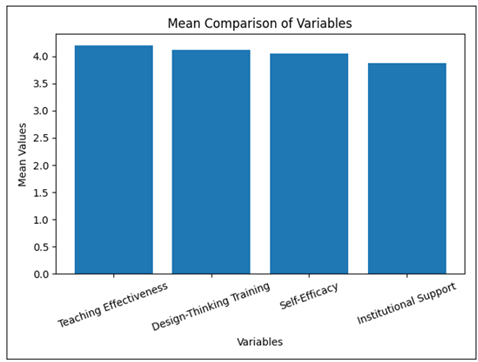
Figure 2 Mean Comparison of Variables
As seen in the graph in Figure 2, teaching effectiveness (Mean = 4.20) has the highest score, which means that participants have perceived a lot of improvement after taking design-thinking training. The positive role is also confirmed by design-thinking training (4.12) and self-efficacy (4.05). Nonetheless, the institutional support (3.88) is rather modest, which implies that the organizational support should be enhanced to achieve the maximum of training results.
Figure 3
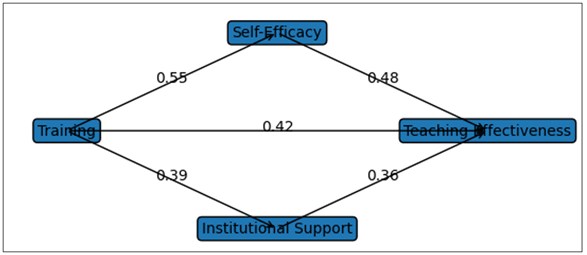
Figure 3 SEM Path Diagram
Figure 3 demonstrates that faculty training on design thinking has a positive influence on teaching effectiveness with a strong positive relationship ( = 0.42). It also contributes greatly to self-efficacy (0.55) as well as institutional support (0.39). Self-efficacy amounts to the most significant effect on teaching effectiveness among the mediators ( = 0.48), and then there is institutional support ( = 0.36). On the whole, the graph validates that training has a direct and indirect positive effect on teaching performance, with self-efficacy as the most significant mediator, and institutional support as the significant supporting factor.
Figure 4

Figure 4 Meditation Effect Comparison
Figure 4 has demonstrated that self-efficacy (0.26) is more indirect effect than institutional support (0.21). This means that faculty confidence is a more important variable in the implementation of training on design-thinking to better teaching performance, with institutional support being also important.
6. Discussion of Findings
The findings substantiate the fact that design-thinking training is a significant way to increase the teaching efficiency, which is in line with the prior studies on pedagogical innovation. The self-efficacy comes out as the best predictor and this implies that faculty confidence is important to the implementation of innovative methods of teaching. The institutional support is also noteworthy, albeit the least powerful, implying that the organizational factors will have to supplement personal competencies. The results emphasize that individual (self-efficacy) and organizational (institutional support) elements are the keys to the most effective faculty training.
7. CONCLUSION AND FUTURE WORK
This paper has explored how faculty training in design thinking affects teaching performance in engineering colleges in Chennai, and in detail, the middle roles played by design-thinking self-efficacy and institutional support. The results show that the design-thinking training can considerably improve the teaching process, which proves the idea that the innovative pedagogical training can help to change the traditional teaching style and turn it into the more interactive and student-centered one. It is also determined in the study that design-thinking self-efficacy has a significant mediating effect which means that the confidence of the faculty in using design-thinking methodologies is one of the influential elements of the enhanced teaching. The faculty members with a better self-efficacy are more inclined to use innovative teaching methods and continue to use them. Moreover, institutional support has been cited to be an influential enabling factor in that it offers the resources, infrastructure and organization culture needed to effectively adopt innovative teaching practices. The sum of the two (self-efficacy and organizational) indicates the necessity of the holistic approach to the faculty development, whereby training programs should be supported by enabling institutional environments.
Mechanisms of faculty development (based on design-thinking approaches and experiential learning strategies) should be developed within engineering institutions. Design thinking is to be introduced to curriculum frameworks and accreditation criteria (e.g. NBA/NAAC outcomes) in universities and by policymakers. Access to innovation-supportive environment in terms of training facilities, interdisciplinary collaboration areas and pedagogical innovation incentives must be invested by institutions. The faculty development program must be based on practical training and a lifelong learning approach to improve self-efficacy and the acceptance of innovative teaching methods in the long run.
The research is confined to the engineering colleges in Chennai, and this could limit the ability to extrapolate the study results to other areas or fields. A cross-sectional research design restricts the possibility of drawing long-term causal relationships. It uses data that is self-reported and therefore is prone to response bias. The research has concentrated on the selected mediators (self-efficacy and institutional support), and the other variables like student characteristics and curriculum design were not studied. The longitudinal research design can be used to study the long-term effects of design-thinking training in the future. It is possible to perform comparative studies in other regions, countries, or disciplines to increase generalizability. Other variables like student engagement, digital learning tools, and organizational leadership styles can be added to further extend the model of research. To compare traditional teaching mode to design-thinking-based interventions, it is possible to design the experimental studies that would be based on controlled setting. The proposed research can also be extended to the integration of new technologies (AI, AR/VR, digital labs) and design thinking to improve the teaching even more.
CONFLICT OF INTERESTS
None.
ACKNOWLEDGMENTS
None.
REFERENCES
Abolhasani, Z., Dehghani, M., Javadipour, M., Salehi, K., and Mohammadhasani, N. (2021). An Analysis of the Role of Design Thinking in Promoting the 21st-Century Skills: A Systematic Review. Technology of Education Journal, 16(1), 81–98. https://doi.org/10.22061/tej.2021.7206.2508
Aflatoony, L., Wakkary, R., and Neustaedter, C. (2018). Becoming a Design Thinker: Assessing the Learning Process of Students in a SecondarY Level Design Thinking Course. International Journal of Art and Design Education, 37(3), 438–453. https://doi.org/10.1111/jade.12139
Albay, E. M., and Eisma, D. V. (2021). Performance Task Assessment Supported by the Design Thinking Process: Results from a True Experimental Research. Social Sciences and Humanities Open, 3(1), 100116. https://doi.org/10.1016/j.ssaho.2021.100116
Apedoe, X. S., Ellefson, M. R., and Schunn, C. D. (2012). Learning Together While Designing: Does Group Size Make a Difference? Journal of Science Education and Technology, 21(1), 83–94. https://doi.org/10.1007/s10956-011-9284-5
Aris, N. M., Ibrahim, N. H., Abd Halim, N. D., Ali, S., Rusli, N. H., Suratin, M. N. M., and Hassan, F. C. (2022). Evaluating the Academic Trends On Design Thinking Research: A Bibliometric Analysis from 2000 to 2021. Journal of Positive School Psychology, 6(4), 1022–1038.
Baker, F. W., III, and Moukhliss, S. (2020). Concretising Design Thinking: A Content Analysis of Systematic and Extended Literature Reviews on Design Thinking and Human-Centred Design. Review of Education, 8(1), 305–333. https://doi.org/10.1002/rev3.3186
Chen, J., Du, X., Jiang, D., Guerra, A., and Nørgaard, B. (2024). A Review Study with a Systematic Approach: Pedagogical Development for Educators in Higher Engineering Education. European Journal of Engineering Education, 49(2), 299–329. https://doi.org/10.1080/03043797.2023.2290032
Felix, E. R., and Guzman, R. B. (2025). Management Practices, Faculty Self-Efficacy, and Institutional Performance: A Narrative Review. Innovare Journal of Education, 13(3). https://doi.org/10.22159/ijoe.2025v13i3.54189
Guaman-Quintanilla, S., Alcivar, I., Caicedo, G., Everaert, P., and Chiluiza, K. (2025). How to set up a Formal Design Thinking Course that Works? A Practical Guide for Higher Education Settings. Thinking Skills and Creativity, 56, Article 101759. https://doi.org/10.1016/j.tsc.2025.101759
Lavrsen, J. C., Carbon, C.-C., and Daalhuizen, J. (2025). Developing Design Mindset: How Individual and Contextual Factors Influence the Development of Design Mindset Through Method Teaching. Journal of Engineering Design, 36(3), 325–354. https://doi.org/10.1080/09544828.2024.2419316
Liu, J., Wang, K., and Pan, Z. (2025). The Effectiveness of Professional Development in the Self-Efficacy of in-Service Teachers in STEM Education: A Meta-Analysis. Behavioral Sciences, 15(10), Article 1364. https://doi.org/10.3390/bs15101364
Mishra, L., Bhunia, S., and Puii, L. (2025). The Experience of Higher Education Teachers in India Towards Professional Development. Discover Education, 4, Article 442. https://doi.org/10.1007/s44217-025-00873-0
Shalgimbekova, K., Smagliy, T., Kalimzhanova, R., and Suleimenova, Z. (2024). Innovative Teaching Technologies in Higher Education: Efficiency and Student Motivation. Cogent Education, 11(1), Article 2425205. https://doi.org/10.1080/2331186X.2024.2425205
Thakre, B. P., Jangid, R., Batho, R., Bhadke, D., Meshram, T., and Tonpe, K. (2025). A Review Fabrication of Self-Inflating Tires and Pressure Monitoring Systems. International Journal of Technical Advances in Research in Mechanical Engineering (IJTARME), 14(1), 1–4. https://doi.org/10.65521/ijtarme.v14i1.512
Thuan, N. H., and Antunes, P. (2024). A Conceptual Model for Educating Design Thinking Dispositions. International Journal of Technology and Design Education, 34, 1879–1902. https://doi.org/10.1007/s10798-024-09881-x
Yüksel, A. O. (2025). Design-Based STEM Activities in Teacher Education and its Effect on Pre-Service Science Teachers’ Design Thinking Skills. Journal of Science Education and Technology, 34, 904–918. https://doi.org/10.1007/s10956-025-10215-2
|
|
 This work is licensed under a: Creative Commons Attribution 4.0 International License
© ShodhKosh 2026. All Rights Reserved.