ShodhKosh: Journal of Visual and Performing ArtsISSN (Online): 2582-7472
|
|
TRADITIONAL CHINESE ARCHITECTURAL ELEMENT INTEGRATION AS A PREDICTOR OF FENG SHUI-INSPIRED SPATIAL VITALITY: EFFECTS ON SPIRITUAL CHARM AND CULTURAL INDENTITY
Junsong Wang 1

1 Local
Art, Udon Thani Rajabhat University, Thailand
|
|
|
ABSTRACT |
|
|
The fast
modernization of urban areas has frequently resulted in the demise of
culturally significant architectural design, particularly the incorporation
of traditional Chinese architectural concepts into contemporary constructed
environments. As a result, many contemporary settings lack cultural identity,
spatial coherence, and experiential depth. Addressing this issue, this study
investigates how incorporating traditional Chinese architectural aspects
improves spatial vitality, spiritual experience, and cultural identity in
contemporary design. The study specifically investigates the effects of
Traditional Chinese Architectural Element Integration—which includes spatial
philosophy integration, material and ecological integration, and symbolic and
cultural abstraction—on Feng Shui-Inspired Spatial Vitality, as well as its
impact on spiritual charm and cultural identity. A quantitative study
methodology was used, with data obtained from individuals who have
experienced traditional Chinese architectural surroundings using online and
onsite questionnaire questionnaires. A total of 250 valid responses were
collected and analysed using Structural Equation Modelling (SEM) to test the
predicted correlations between the study variables. The findings show that
spatial philosophy integration has the greatest influence on increasing Feng
Shui-inspired spatial vitality, followed by material and ecological
integration and symbolic cultural abstraction. Furthermore, Feng
Shui-inspired spatial vitality enhances both spiritual attractiveness and
cultural identity in architectural settings. This study advances
architectural theory by offering an integrated framework that connects
classical spatial philosophy, cultural symbols, and ecological materials to
experience spatial outcomes. Practically, the findings suggest how architects
and urban planners might reinterpret ancient Chinese architectural principles
in contemporary design to produce culturally relevant, environmentally
responsive, and experientially rich constructed spaces. |
|||
|
Received 21 January 2026 Accepted 15 February 2026 Published 27 March 2026 Corresponding Author Junsong
Wang, 13871588807@163.com DOI 10.29121/shodhkosh.v7.i1.2026.7362 Funding: This research
received no specific grant from any funding agency in the public, commercial,
or not-for-profit sectors. Copyright: © 2026 The
Author(s). This work is licensed under a Creative Commons
Attribution 4.0 International License. With the
license CC-BY, authors retain the copyright, allowing anyone to download,
reuse, re-print, modify, distribute, and/or copy their contribution. The work
must be properly attributed to its author.
|
|||
|
Keywords: Traditional Chinese Architectural Elements, Feng
Shui Spatial Vitality, Spiritual Charm, Cultural Identity, Architectural
Integration |
|||



1. INTRODUCTION
Architecture is more than just a physical construct; it is also a cultural medium for expressing symbolic meanings, philosophical views, and social identities Rapoport (1982), Norberg-Schulz (1980). Built environments transmit values, encode traditions, and affect human experiences by bridging the gap between space, perception, and meaning Tuan (1977). Within the Chinese architectural tradition, architecture has historically embodied cosmological concepts, ethical systems, and aesthetic ideologies that reflect broader socio-cultural and metaphysical frameworks Steinhardt (2019).
Among these fundamental foundations, Feng Shui has played a critical role in influencing spatial organization, environmental harmony, and human health. Feng Shui is a body of traditional Chinese wisdom in knowledge and experience about the built environment that has been amassed over three thousand years. It is based on the earliest and greatest Chinese philosophy work, Yi Jing (The Book of Changes), which was developed around 800 B.C. The primordial knowledge of Feng Shui was based on observations of three sources: astronomical occurrences, natural phenomena, and human conduct Feuchtwang (1974). Morevoer, Feng Shui, posits that spatial layouts influence the circulation of energy (Qi), psychological comfort, and experiential balance Bruun (2008), Xu (1998). Unlike solely technical design paradigms, Feng Shui combines environmental responsiveness with symbolic and metaphysical interpretations of space Mak and Ng (2005). Its principles continue to influence modern debates about spatial vitality, environmental psychology, and culturally integrated design methods Lip (1995).
Since the late 1960s, western civilisation and technology have had a global impact. Western scholars have recognised the limitations of modern scientific paradigms, which do not fully explain natural phenomena. They have also recognised similarities between modern science and eastern philosophy. Lee (1986) recognised that standard architectural interpretations based on formal, spatial, and technological facts are insufficient to describe the context and meaning of this Feng Shui construction. Along with the rising interest in Feng Shui, contemporary architectural discourse has emphasised the reinterpretation and incorporation of traditional design aspects into modern constructed settings. This movement is consistent with larger objectives for cultural sustainability, historical preservation, and identity-driven design Chang and Huang (2011). Traditional Chinese architectural elements like axial symmetry, courtyard configurations, roof curvature, lattice screens, and symbolic ornamentation are more than just aesthetic motifs; they represent environmental adaptation, ritual order, and philosophical symbolism Knapp (2005), Steinhardt (2019).
Despite the growing popularity of culturally inspired
architecture design, the incorporation of Traditional Chinese architecture
Elements is primarily viewed as an aesthetic or stylistic technique rather than
a scientifically tested environmental variable. Existing research usually
emphasises historical interpretation, symbolic interpretations, or qualitative
evaluation, with little efforts to quantify how such design aspects influence
occupants' perceptual and psychological responses Rapoport
(1982), Nasar
(1998). Furthermore, while Feng Shui is
widely recognised as a philosophical framework for spatial organization and
environmental harmony, much of the literature is still conceptual, speculative,
or practice-oriented. Empirical validation of Feng Shui-related notions,
particularly those associated with quantitative user impressions, remains
lacking Bruun
(2003), Mak and Ng (2005). The concept of Feng
Shui-Inspired Spatial Vitality, which represents perceived energy flow,
harmony, and vitality in space, has rarely been used to quantitative
architectural study.
Constructs such as Spiritual Charm and Cultural Identity are becoming more widely recognised in environmental psychology, human geography, and place studies as key characteristics of human-environment interaction. Spiritual Charm portrays the subjective, atmospheric, and transcendent aspects of spatial experience, whereas Cultural Identity captures the symbolic attachment, sense of belonging, and continuity of meaning connected with place Lewicka (2011), Scannell and Gifford (2010). Contemporary research emphasises that these categories are closely related to emotional, symbolic, and experience interpretations of the built environment rather than solely utilitarian features Channuwong et al. (2025), Pallasmaa (2012). Prior study has usually examined Spiritual Charm and Cultural Identity in isolation of architectural form and culturally meaningful spatial characteristics. As a result, the mechanisms by which culturally embedded design strategies shape higher-order experiential and psycho-cultural results are theoretically fragmented and inadequately incorporated into predictive architectural models Lewicka (2011), Scannell and Gifford (2017).
This study tackles a major research issue that stems from
a lack of empirical data linking architectural symbolism to perceived spatial
vibrancy and psycho-cultural effects. Existing literature reveals several gaps:
(1) limited quantitative research on the experiential effects of Traditional Chinese Architectural Element
Integration, (2) insufficient operationalisation of Feng
Shui-related perceptual constructs, and (3) the uncommon inclusion of Spiritual
Charm and Cultural Identity in predictive architectural models. Furthermore, no
established theory explains how architectural element integration leads to
perceived liveliness and consequent psychological responses. To close these gaps, the study
presents and empirically examines an integrative conceptual model in which
Traditional Chinese Architectural Element Integration predicts Feng
Shui-Inspired Spatial Vitality, which then influences Spiritual Charm and
Cultural Identity. Using a quantitative, hypothesis-driven methodology, the
study adds to architectural design theory, environmental psychology, and
cultural experience studies, while also providing practical implications for
constructing psychologically and culturally resonant settings.
Accordingly, the objectives of this study are:
1) To examine the effects of Traditional Chinese Architectural Element Integration as a multidimensional construct comprising of Spatial Philosophy Integration, Material and Ecological Integration, and Symbolic and Cultural Abstraction on Feng Shui–Inspired Spatial Vitality.
2) To investigate the influence of Feng Shui–Inspired Spatial Vitality on Spiritual Charm.
3) To analyze the influence of Feng Shui–Inspired Spatial Vitality on Cultural Identity.
2. LITERATURE REVIEW
2.1. INTEGRATION OF TRADITIONAL CHINESE ARCHITECTURAL ELEMENTS AND SPATIAL EXPERIENCE
The incorporation of Traditional Chinese Architectural Elements into contemporary architectural design has emerged as an important technique for combining modernisation and cultural continuity. Under the demands of globalisation, architecture practice must increasingly balance the preservation of cultural identity with technological innovation and changing aesthetic preferences Jencks (2002), Frampton (2007). Traditional architectural materials are no longer considered immobile historical artefacts, but rather dynamic transmitters of symbolic, spatial, and ecological meaning Xu (2019).
Existing research indicates that traditional cultural elements are typically incorporated through architectural form, spatial organization, material application, and decorative expression Wang and Li (2018), Zhang (2020). Traditional elements such as roof typologies, courtyard systems, axial symmetry, and garden compositions are commonly abstracted and reinterpreted in contemporary design languages. This abstraction approach allows designers to maintain cultural intelligibility while meeting modern functional and aesthetic standards Lin (2016).
From a spatial standpoint, classical Chinese architecture principles such as enclosure, hierarchy, balance, and transitional sequencing contribute to impressions of coherence and sensory flow Steinhardt (2015), Xu (2019). Norberg-Schulz (1980) emphasises that architectural space is central to human environmental experience, influencing both cognitive interpretation and emotional response. The reinterpretation of classical spatial philosophy has an impact on how people perceive environmental harmony and vitality Hwangbo (2002).
Materiality has an important influence in cultural integration. Traditional materials like timber, brick, and tile represent not just construction techniques but also philosophical orientations toward human-nature harmony, which is a fundamental concept in Chinese cosmology and Feng Shui theory Mak and Ng (2005), Xu (2019). Contemporary reinterpretations frequently use innovative technology to improve sustainability and performance, transforming old materials into ecological modernisation tools Ding (2017).
Semiotic approaches see architecture as a system of signs in which meaning is created through design intention, user interpretation, and sensory feedback Eco (1986), Broadbent (1995). Traditional architectural components function as culturally encoded symbols that communicate identity, memory, and value Jencks (2002). Their adaptation to modern circumstances necessitates reconstruction and reinterpretation rather than literal duplication Frampton (2007).
Traditional architectural characteristics can also be divided into "hard" (tangible) and "soft" (intangible) dimensions Rapoport (1990). Perceptible features such as form, colour, and spatial configuration fall under the category of hard elements, whereas soft elements contain ingrained cultural meanings, ceremonial order, and philosophical symbolism. Colour symbolism, particularly red, yellow, grey, and white, has been found to transmit hierarchy, cosmology, and socio-cultural identity in Chinese architectural traditions Koh (2013).
2.2. THEORETICAL FRAMEWORK
A theoretical framework that integrates Feng Shui Theory, Environmental Psychology, Sense of Place Theory, Symbolic Interactionism, and Place Identity Theory forms the basis of this study. Together, these viewpoints clarify how Feng Shui-Inspired Spatial Vitality is influenced by the incorporation of Traditional Chinese Architectural Elements, and how Feng Shui-Inspired Spatial Vitalit in turn shapes Spiritual Charm and Cultural Identity. The main philosophical framework for comprehending spatial harmony is provided by feng shui theory. Feng Shui, which has its roots in Chinese cosmology, emphasises the dynamic flow of Qi, the equilibrium of Yin and Yang, and the interaction of the Five Elements (Wu Xing) as factors that determine human well-being and the quality of the environment. Feng Shui-aligned spatial arrangements are thought to improve psychological comfort, vitality, and experiential resonance Bruun (2008), Mak and Ng (2005).
Environmental psychology discusses how physical settings function as stimuli impacting human cognition, emotion, and behavioural reactions, which complements this philosophical viewpoint. Perceptions of energy, enjoyment, and significance can be produced by designed rooms that use natural materials, logical arrangements, and symbolic signals Mehrabian and Russell (1974), Ulrich (1984). According to this theory, Feng Shui–Inspired Spatial Vitality (FSV) is an affective and perceptual reaction that arises from materiality, cultural symbolism, and spatial order.
The role that spatial experiences have in fostering
emotional attachment and depth of experience is further explained by the Sense
of Place Theory. Stronger emotional ties and feelings of authenticity are
fostered by locations created with cultural coherence and symbolic richness Relph
(1976), Tuan (1977). Thus, the
incorporation of traditional Chinese architectural elements serves as a means
of enhancing the vibrancy of the experience.
Symbolic interactionism sheds light on how social interpretation gives architectural symbols their meaning. The physical environment's cultural motifs, conventional forms, and symbolic abstractions serve as conduits for common cultural meanings, influencing users' spiritual and emotional interpretations Blumer (1969). The relationship between perceived spiritual charm and symbolic-cultural integration is supported by this theoretical viewpoint.
Lastly, Place Identity Theory describes how surroundings help people develop their sense of self and group identity. According to Proshansky et al. (1983), spaces that showcase cultural tales and legacy enhance people's sense of continuity and belonging. Cultural Identity is defined in this study as an outcome that is impacted by perceived spatial vitality.
Based on
theories of culturally symbolic architecture, environmental perception, and
psycho-cultural experience, the present study proposes the following
hypotheses:
H1: Traditional Chinese Architectural Element
Integration positively influences Feng Shui–Inspired Spatial Vitality.
Feng Shui-Inspired Spatial Vitality is the
perceived sensation of energetic flow, harmony, balance, and environmental
aliveness that exists within a spatial space. Contemporary environmental
psychology and architectural research increasingly acknowledge that vitality
perception is influenced not only by functional performance, but also by
symbolic coherence, spatial order, and culturally embedded design cues Kaplan and Kaplan (1989), Kellert
(2008), Scannell
and Gifford (2010). Traditional Chinese
Architectural Elements, which include axial symmetry, courtyard typologies,
tiered thresholds, spatial hierarchy, roof curvature, and symbolic
ornamentation, are more than just stylistic expressions. These aspects encode
environmental adaption techniques, cosmological beliefs, and socio-cultural
values that influence spatial perception Knapp
(2005); Steinhardt
(2019). Their integration
into modern spaces may thereby influence users' impressions of harmony,
coherence, and vitality.
From a perceptual-processing standpoint, environments with structural coherence and organized complexity tend to create greater aesthetic preferences and favorable affective reactions Kaplan and Kaplan (1989), Reber et al. (2004). Symbolically relevant architectural aspects can also increase experience richness and emotional involvement, hence improving perceived spatial quality Nasar (1998), Pallasmaa (2012). Furthermore, biophilic design research indicates that architectural configurations that incorporate nature-linked spatial patterns, such as courtyards and framed landscape views found in Traditional Chinese Architectural Elements, have a positive impact on psychological restoration and perceived environmental vitality Kellert (2008), Joye (2007). These findings are consistent with Feng Shui principles, which emphasize the balance of built form and natural elements.
Recent empirical research show that culturally resonant spaces improve users' place-related perceptions, emotional connection, and environmental quality assessments Lewicka (2011), Ramkissoon and Mavondo (2015), Channuwong et al. (2025). When Traditional Chinese Architectural Elements are incorporated in ways that preserve symbolic clarity and spatial logic, they have the potential to support perceptions of spatial harmony and energy continuity, which are key components of Feng Shui-Inspired Spatial Vitality.
H1a: Spatial Philosophy Integration positively
influences Feng Shui–Inspired Spatial Vitality.
Spatial Philosophy Integration is the use of traditional Chinese spatial logic, such as axial organization, hierarchical sequencing, balance, and symmetry. According to theories of environmental perception and spatial cognition, organized spatial order improves perceived coherence, legibility, and harmony Kaplan and Kaplan (1989), Nasar (1998). Coherent surroundings minimize cognitive burden and increase psychological comfort, which are linked to sensations of vitality and environmental resonance Herzog and Bryce (2007). Traditional Chinese spatial philosophy places an emphasis on equilibrium, proportionality, and relational balance between created form and natural forces. Mak and Ng (2005) contend that Feng Shui concepts are naturally consistent with perceptual assessments of harmony and environmental appropriateness. Empirical research show that balanced and symmetrically organized spaces improve affective appraisal and environmental choice Brielmann and Pelli (2017). Spatial Philosophy Integration is believed to improve Feng Shui-Inspired Spatial Vitality.
H1b: Material and Ecological Integration positively
influences Feng Shui–Inspired Spatial Vitality.
Material and Ecological Integration refers to the use of natural materials, environmental responsiveness, and ecological design principles based on traditional Chinese architectural wisdom. Biophilic design theory holds that natural materials and ecological cues improve perceived environmental quality, restorative capacity, and emotional well-being Kellert (2018), Ryan et al. (2014).
According to environmental psychology research, natural textures, organic materials, and ecological congruence improve perceptions of liveliness, comfort, and sensory engagement. Such environments are frequently regarded as more dynamic and energetically favourable Browning et al. (2014). Feng Shui emphasises balance with natural elements and environmental flow, hence Material and Ecological Integration conceptually promotes vitality perception. Therefore, Material and Ecological Integration is hypothesised to positively influence Feng Shui-Inspired Spatial Vitality.
H1c: Symbolic and Cultural Abstraction positively
influences Feng Shui–Inspired Spatial Vitality.
Symbolic and cultural abstraction refers to the employment of symbolic themes, cultural metaphors, and abstract interpretations of conventional forms. Symbolic interactionism and meaning-making theories propose that symbolic architectural characteristics influence emotional involvement, perceived atmosphere, and experiential interpretation Krampen (1991), Jencks (2005).
Pallasmaa (2012) argues that symbolic and multimodal architectural expressions increase experiential depth and perceived spatial vitality. Empirical evidence suggests that culturally meaningful design cues improve perceived distinctiveness, memorability, and emotive response. Symbolic richness may thereby enhance users' perceptions of spatial liveliness and resonance.
H2: Feng Shui–Inspired Spatial Vitality positively
influences Spiritual Charm.
Perceived vitality represents people' feelings of aliveness, harmony, and dynamic equilibrium in space. According to affective evaluation theories, environments that are judged to be lively and coherent elicit higher levels of emotional engagement and appreciation for the atmosphere.
Spiritual Charm denotes the transcendent, atmospheric, and emotionally evocative aspects of place. According to phenomenological architecture theory, experiential intensity, spatial flow, and atmospheric coherence all increase spiritual and emotive responses. Empirical research also show that environments viewed as dynamic and harmonious improve emotional connection and sensory richness Ramkissoon and Mavondo (2015). The Stimulus-Organism-Response (S-O-R) theory proposes that environmental stimuli (architectural features) influence psychological outcomes via interior perceptual states. Architectural design features may not directly elicit spiritual reactions, but instead work through perceptual mediators such as energy, harmony, and atmospheric appraisal. Thus, Feng Shui–Inspired Spatial Vitality is projected to have a favorable effect on Spiritual Charm.
H3: Feng Shui–Inspired Spatial Vitality positively
influences Cultural Identity.
Symbolic attachment, belonging, and continuity of meaning all contribute to cultural identity. According to place identity theory, environmental factors that influence emotional and symbolic appraisal play a role in identity creation.
Vital and harmonious settings promote place connection and symbolic interpretation Scannell and Gifford (2017). Perceived vitality may so strengthen users' identification with culturally significant venues. Perception-based mediation models in environmental psychology show that physical design characteristics influence identity results via cognitive-affective judgements Nasar (1998), Lewicka (2011), Channuwong et al. (2025).
2.3. CONCEPTUAL FRAMEWORK
This study proposes an integrative
conceptual framework grounded in theories of culturally symbolic architecture,
environmental perception, and psycho-cultural experience.
Figure 1
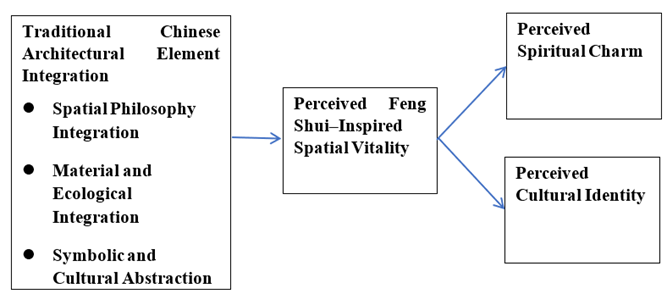
Figure 1 Conceptual Framework
3. RESEARCH METHODOLOGY
This study used a quantitative research approach to look into the relationships between Traditional Chinese Architectural Element Integration, Feng Shui-Inspired Spatial Vitality, Spiritual Charm, and Cultural Identity. The study sought to investigate how the incorporation of traditional Chinese architectural elements influences the perceived vitality of Feng Shui-inspired spatial environments, and how such perceptions impact individuals' spiritual experiences and cultural identification within the space. The structural links between the constructs were analyzed using a causal explanatory method. Data were gathered through a cross-sectional survey of people who had visited architectural areas influenced by traditional Chinese architecture and Feng Shui notions.
3.1. POPULATION AND SAMPLES
This study's target population was people who had visited or experienced architectural environments with elements of traditional Chinese architecture or Feng Shui-inspired spatial design, such as Chinese temples, heritage buildings, classical gardens, cultural centers, or Chinese-style commercial spaces. Because the actual population number is unknown and geographically distributed, a non-probability sampling method, specifically purposive sampling, was used. Respondents were chosen based on their previous expertise in Chinese-style architectural contexts. A screening question was included in the questionnaire to ensure that participants had prior experience with settings affected by traditional Chinese design or Feng Shui concepts. Only responders who validated their experience were included in the final dataset. To provide enough statistical power and reliable parameter estimation, a minimum sample size of at least 200 respondents was set in accordance with Structural Equation Modelling (SEM) methodological standards. Previous methodological studies suggest that SEM analysis typically requires sample sizes ranging from 200 to 400 cases to obtain stable and reliable estimates of structural relationships Hair et al. (2019). Therefore, the sample size targeted in this study meets widely accepted methodological standards for SEM-based research.
3.2. RESEARCH INSTRUMENT
The primary research tool utilized in this study was a structured questionnaire designed to assess views of architectural integration, spatial vitality, spiritual experience, and cultural identity. The questionnaire has multiple components. The first portion contained a screening question to determine respondents' knowledge with areas affected by traditional Chinese architectural design or Feng Shui notions. The second segment assessed Traditional Chinese Architectural Element Integration using fifteen elements divided into three dimensions: spatial philosophy integration, material and ecological integration, and symbolic and cultural abstraction. These items evaluated the amount to which traditional philosophical principles, natural materials, and cultural symbolism are used in spatial design.
The third segment assessed Feng Shui-Inspired Spatial Vitality using six items that represented impressions of spatial harmony, balance, energy flow, and environmental vitality. The fourth component assessed Spiritual Charm with five items that captured emotional resonance, inner tranquility, and the perceived spiritual aura of the location. The final portion assessed Cultural Identity using five items pertaining to cultural belonging, heritage recognition, and enjoyment of Chinese cultural traditions within the spatial environment. All measuring questions were evaluated on a five-point Likert scale ranging from 1 (strongly disagree) to 5 (strongly agree), which is commonly used in social science research to assess attitudes and perceptions Likert (1932), Joseph et al. (2019). Furthermore, demographic factors such as age, gender, education level, career, frequency of visiting Chinese-style places, and acquaintance with Feng Shui ideas were gathered as control variables. The questionnaire design adhered to recognized survey research criteria to ensure clarity, reliability, and construct validity Creswell and Creswell (2018), Sekaran and Bougie (2016).
3.3. DATA COLLECTION
To enable broad participation from people who have encountered traditional Chinese architectural surroundings, data were collected utilizing a combination of online and onsite survey approaches. The questionnaire for the online poll was circulated via several digital platforms, including academic networks, architectural discussion groups, and social media communities focused on Chinese culture, architecture, and heritage tourism. This method allowed the researchers to contact respondents from various geographic places who had previously visited Chinese-style architectural surroundings. For the onsite survey, questionnaires were distributed to visitors at locations with traditional Chinese architectural elements and Feng Shui-inspired spatial design, such as Chinese temples, cultural heritage sites, classical gardens, cultural centers, and Chinese-style commercial environments. These venues were chosen because they offer tourists firsthand experiences with spatial qualities connected with traditional Chinese architectural design and Feng Shui principles.
Prior to completing the questionnaire, respondents were asked to answer a screening question to check whether they had previously seen locations influenced by traditional Chinese architectural design or Feng Shui notions. The survey only included individuals who confirmed such experiences. The data collection process lasted around six weeks, from January to February 2026. During this time, 300 questionnaires were distributed via both online and onsite means. A total of 250 questionnaires were returned, for an 83.33% response rate. After removing partial replies and questionnaires that did not match the screening requirements, the final analysis included 250 valid responses. The final sample size meets the recommended sample size for Structural Equation Modelling (SEM), which normally requires at least 200 observations for accurate parameter estimate Hair et al. (2019).
3.4. DATA ANALYSIS
The acquired data was analyzed with the Statistical Package for the Social Sciences (SPSS) and Structural Equation Modelling (SEM) tools like AMOS. Descriptive statistics were first employed to summarize respondents' demographic information as well as the overall distribution of responses. Cronbach's alpha was used to assess the internal consistency of the measuring scales, and values greater than 0.70 were judged acceptable. Confirmatory Factor Analysis (CFA) was used to assess construct validity by analyzing factor loadings, composite reliability, and extracted average variance. After validating the measurement model, Structural Equation Modeling was applied to test the hypothesized relationships among the constructs. Model fit was assessed using standard goodness-of-fit indices, including chi-square divided by degrees of freedom, the Comparative Fit Index (CFI), the Tucker–Lewis Index (TLI), and the Root Mean Square Error of Approximation (RMSEA).
4. RESULTS
A total of 250 valid responses were obtained, with no missing data across all demographic variables. The sample demonstrates a balanced gender distribution, with 53.6% female (n = 134) and 46.4% male (n = 116) respondents. In terms of age, the majority of respondents were 36–45 years old (32.8%), followed by 26–35 years (26.8%), indicating that most participants were mid-career professionals. Smaller proportions were 46–55 years (15.2%), over 55 years (14.8%), and below 25 years (10.4%). Regarding educational attainment, most respondents held a Bachelor’s degree (60.4%), while 36.4% possessed postgraduate qualifications, and 3.2% reported education below the bachelor’s level, indicating a generally well-educated sample. Professionally, respondents were mainly academics or researchers (48.8%) and architects or designers (47.2%), with a small proportion of business professionals (4.0%). Most respondents reported moderate engagement with the relevant activity (4–6 times per year, 60.4%), while 36.4% engaged frequently (monthly). Finally, respondents demonstrated basic familiarity with the topic, with 53.6% moderately familiar and 46.4% slightly familiar, suggesting that participants possessed sufficient awareness to provide informed responses.
The results show several items with relatively higher and lower mean values across the constructs. For Spatial Philosophy Integration (SPI), the highest mean was SPI1 (M = 3.59), indicating strong agreement that the spatial layout reflects balance and harmony, while the lowest was SPI4 (M = 3.45). For Material and Ecological Integration (MEI), MEI3 (M = 3.60) recorded the highest score, suggesting that respondents clearly perceived environmental adaptability in the design, whereas MEI4 (M = 3.53) was the lowest. Within Symbolic and Cultural Abstraction (SCA), SCA3 (M = 3.42) showed the highest perception of symbolic decorative elements, while SCA4 (M = 3.35) recorded the lowest mean. For Feng Shui–Inspired Spatial Vitality (FSV), the highest score was FSV2 (M = 3.63), indicating a strong perception of harmony and comfort, while FSV4 (M = 3.54) was the lowest. In Spiritual Charm (SC), SC3 (M = 3.64) had the highest mean, reflecting a strong sense of transcendence, whereas SC1 (M = 3.51) was the lowest. Finally, for Cultural Identity (CI), CI2 (M = 3.57) showed the highest agreement, while CI3 (M = 3.49) recorded the lowest. Overall, the findings highlight stronger perceptions of spatial harmony, environmental sustainability, and spiritual experience.
4.1. MEASUREMENT MODEL ASSESSMENT
Reliability was assessed using Cronbach’s alpha to evaluate the internal consistency of the measurement scales. The results show that all constructs achieved high reliability, with alpha values ranging from 0.876 to 0.916, exceeding the recommended threshold of 0.70. Among the constructs, , and Spatial Philosophy Integration (SPI) (α = 0.876), followed by Symbolic and Cultural Abstraction (SCA) (α = 0.898), Material and Ecological Integration (MEI) showed the highest reliability (α = 0.916), Feng Shui–Inspired Spatial Vitality (FSV) and Cultural Identity (CI) (α = 0.897), and Spiritual Charm (SC) (α = 0.883). These results indicate that all measurement items demonstrate good internal consistency and are suitable for further analysis. The reliability threshold follows the recommendation that Cronbach’s alpha values above 0.70 indicate acceptable internal consistency Hair et al. (2019).
Confirmatory Factor Analysis (CFA) was conducted to evaluate the measurement model. The results indicate that the model demonstrates an excellent overall fit with the data. The chi-square value was χ² = 239.042 (df = 237, p = 0.451) with a χ²/df ratio of 1.009, which is below the recommended threshold of 3.0, indicating a good model fit. The Root Mean Square Error of Approximation (RMSEA) was 0.006, with a PCLOSE value of 1.000, suggesting an excellent fit. Additional goodness-of-fit indices also confirmed the adequacy of the model. The Comparative Fit Index (CFI = 0.999), Tucker–Lewis Index (TLI = 0.999), and Incremental Fit Index (IFI = 0.999) all exceeded the recommended threshold of 0.90. Similarly, the Goodness-of-Fit Index (GFI = 0.929) and Adjusted Goodness-of-Fit Index (AGFI = 0.910) indicate a satisfactory fit. The Root Mean Square Residual (RMR = 0.044) also falls within the acceptable range. Overall, the CFA results demonstrate that the measurement model fits the data well, supporting the validity of the constructs and indicating that the measurement items are appropriate for subsequent structural analysis Hair et al. (2019).
4.2. STRUCTURAL EQUATION MODELLING
The structural path analysis revealed several significant relationships among the constructs. Spatial Philosophy Integration (SPI) had the strongest positive effect on Feng Shui–Inspired Spatial Vitality (FSV) (β = 0.613, p < 0.001), indicating that spatial balance and organization significantly influence the architectural integration outcome. Symbolic and Cultural Abstraction (SCA) also showed a significant positive effect on Feng Shui–Inspired Spatial Vitality (FSV) (β = 0.130, p = 0.033), while Material and Ecological Integration (MEI) had a smaller but significant influence on Feng Shui–Inspired Spatial Vitality (FSV) (β = 0.118, p = 0.040). Furthermore, Feng Shui–Inspired Spatial Vitality (FSV) significantly influenced both Cultural Identity (CI) (β = 0.456, p < 0.001) and Spiritual Charm (SC) (β = 0.439, p < 0.001), indicating that architectural integration contributes positively to both perceived experience and spatial development outcomes. The model explains 50% of the variance in Feng Shui–Inspired Spatial Vitality (FSV) (R² = 0.50), indicating that Spatial Philosophy Integration (SPI), Symbolic and Cultural Abstraction, and Material and Ecological Integration (MEI) jointly provide substantial explanatory power. In addition, Feng Shui–Inspired Spatial Vitality (FSV) explains 20.8% of the variance in Cultural Identity (CI) (R² = 0.208) and 19.2% of the variance in Spiritual Charm (SC) (R² = 0.192).
Overall, the SEM results indicate that Spatial Philosophy Integration (SPI) plays the most influential role in shaping architectural integration, followed by Symbolic and Cultural Abstraction (SCA) and Material and Ecological Integration (MEI). In turn, architectural integration significantly enhances both perceived experience and spatial development outcomes, supporting the proposed structural relationships in the model.
5. CONCLUSION AND DISCUSSION
This study examined how the integration of traditional Chinese architectural elements shapes cultural experience and spatial perception. The findings demonstrate that incorporating ecological materials, traditional spatial ideas, and cultural symbolism greatly improves architectural integration and user experience. The most significant element among the factors analyzed was the integration of spatial philosophy, which was followed by the integration of material and ecological elements and symbolic cultural abstraction. Together, these components strengthen architectural integration, which enhances cultural identity, experience quality, and spatial vitality. The results have significant ramifications for urban planning and architectural design. Designers should concentrate on incorporating classical philosophical ideas and ecological themes into modern space design rather than just copying ancient architectural forms. This strategy promotes sustainable and culturally sensitive habitats while preserving cultural heritage's relevance.
The results emphasize how crucial it is to incorporate
traditional architectural concepts to improve spatial quality and cultural
significance in modern settings. The findings specifically highlight how
Spatial Philosophy Integration promotes Feng Shui-Inspired Spatial Vitality.
Concepts of harmony, hierarchy, and balance between people and the natural
world form the foundation of traditional Chinese spatial philosophy. Feng Shui
theory, which emphasizes spatial arrangement, orientation, and environmental balance
to improve the flow of energy within built settings, is closely related to
these ideas. According to recent architectural studies, traditional Chinese
architecture's spatial arrangement and philosophical tenets have a big impact
on how people perceive space and the harmony of their surroundings Steinhardt
(2019). Similarly, studies on
Feng Shui and built environments suggest that spatial organization based on
traditional philosophical concepts can improve environmental comfort, spatial
coherence, and user well-being Mak and Ng (2005).
Additionally, the study shows how Symbolic and Cultural Abstraction enhances spatial liveliness inspired by Feng Shui. Architecture can convey deeper cultural narratives through architectural symbolism, which includes historic motifs, spatial metaphors, and culturally imbedded design features. In constructed landscapes, cultural symbolism is essential for conveying identity and legacy. Rapoport (2005) claims that architecture serves as a system of cultural communication in which social values and cultural meanings are communicated through spatial shapes and symbolic elements. According to more recent studies on cultural architecture, people' perceptions of cultural authenticity and heritage continuity in modern architectural environments are strengthened by symbolic design aspects Wang (2013).
Furthermore, Material and Ecological Integration is crucial to maintaining spatial life. Through the use of natural materials, climate responsiveness, and interaction with the surrounding landscape, traditional Chinese architecture places a strong emphasis on ecological sensitivity. The larger philosophical idea of harmony between humans and nature is reflected in these ideas, which are still very applicable to modern sustainable design techniques. According to studies on sustainable architecture, using regional materials and ecologically conscious design techniques improves environmental performance while preserving cultural authenticity Rapoport (2005), Wang (2013). Therefore, the development of architectural settings that are both culturally significant and environmentally responsive is facilitated by the integration of ecological materials and environmental practices.
In addition, the results show that Feng Shui-Inspired Spatial Vitality strengthens Spiritual Charm and Cultural Identity. Emotional attachment and a stronger feeling of place can be fostered by architectural settings that integrate culturally rooted spatial principles and symbolic meanings. Culturally responsive design improves place identification, social cohesiveness, and users' emotional ties to build settings, according to research in environmental psychology and cultural architecture Relph (2008), Tuan (2001). In this situation, spatial vitality derived from traditional design principles strengthens spiritual meaning and cultural continuity in addition to improving spatial experience.
Overall, the findings support the perspective that architectural design should integrate spatial philosophy, cultural symbolism, and ecological considerations to create environments that are both culturally meaningful and environmentally responsive. Contemporary architecture can benefit from reinterpreting traditional design principles to enhance spatial vitality, strengthen cultural identity, and cultivate spiritual and experiential qualities within built environments.
6. Implications
6.1. Theoretical implications
This work adds to architectural and cultural theory by offering a comprehensive knowledge of how traditional Chinese architectural principles might improve spatial experience and cultural meaning in modern settings. Specifically, the study advances theoretical discussions by empirically connecting spatial philosophy, symbolic cultural abstraction, and ecological material integration to Feng Shui-inspired spatial vitality and cultural identity in architectural design. First, the study broadens the theoretical application of classical Chinese spatial philosophy to modern architecture. While prior studies have emphasised the philosophical basis of traditional spatial organization, this study shows that including philosophical ideas such as harmony, hierarchy, and balance between humans and environment considerably improves spatial vitality. This study lends support to the concept that cultural values encoded in spatial organization influence environmental perception and spatial experience, as underlined by Amos Rapoport (2005) and Steinhardt (2019). By framing spatial philosophy as an active design strategy rather than a solely historical idea, the study broadens its theoretical relevance in contemporary architectural discourse. Second, the study adds to the paradigm of architecture as cultural communication by highlighting the importance of symbolic and cultural abstraction in enhancing spatial vibrancy and cultural authenticity. Architectural symbolism, such as cultural motifs and spatial analogies, allows constructed settings to convey historical narratives and cultural identity. Consistent with Rapoport's cultural communication framework and studies on Chinese cultural architecture Wang (2013), the findings indicate that symbolic abstraction enables designers to reinterpret traditional cultural elements within modern architectural contexts while maintaining cultural continuity. Third, this work strengthens the theoretical relationship between ecological materials and culturally embedded sustainability. Traditional Chinese architecture values the use of natural materials, environmental responsiveness, and interaction with the surrounding landscape. The findings suggest that incorporating ecological materials not only improves environmental performance, but also enhances spatial vitality and cultural authenticity. This bolsters growing theoretical viewpoints that argue for incorporating local cultural knowledge and ecological practices into sustainable building design. Finally, the study adds to place identification and environmental psychology theories by demonstrating how Feng Shui-inspired spatial vibrancy improves users' spiritual experience and cultural attachment to a location. The findings support the work of Tuan (2001) and Edward Relph (2008), which found that culturally responsive spatial design increases emotional ties between people and the built environment.
6.2. Practical Implications
This study makes various practical contributions to architectural design, urban planning, and cultural heritage-based development. The findings provide designers and planners with practical advice on how to effectively incorporate traditional Chinese architectural concepts into modern constructed settings to increase spatial quality, cultural identity, and environmental responsiveness. First, the study emphasizes the practical value of incorporating traditional spatial theory into contemporary architectural design. The findings indicate that spatial philosophy, including principles of harmony, hierarchy, spatial balance, and the link between humans and nature, plays the most important impact in increasing Feng Shui-inspired spatial vitality. For architects and urban designers, this means that successful cultural integration must go beyond a simple copy of historical forms. Designers should rethink established spatial logic, circulation patterns, and orientation techniques while creating modern environments. Nancy Shatzman Steinhardt's architectural study emphasizes the importance of traditional Chinese spatial organization in reflecting philosophical ideals of order and harmony that can still inform current design techniques Steinhardt (2019). Second, the study offers useful insights into the application of symbolic and cultural abstraction in architectural design. Designers can improve cultural identity and spatial experience by introducing symbolic elements like traditional motifs, spatial metaphors, and culturally significant architectural characteristics into modern building. Instead of simply recreating historical architectural components, symbolic abstraction enables architects to transmit cultural values into contemporary design languages. This approach supports Amos Rapoport's view that architecture is a sort of cultural communication in which spatial forms and symbols express social meaning and cultural identity Rapoport (2005). Third, the study emphasizes the practical importance of material and ecological integration in developing sustainable and culturally responsive habitats. Natural materials, climate-responsive design solutions, and landscape integration can enhance environmental performance while preserving cultural authenticity. For practitioners, this entails prioritising locally obtained materials, ecologically conscious construction processes, and ecological design concepts that mirror traditional architectural traditions Wang (2013), Damrongsiri et al. (2022). Fourth, the findings provide recommendations for urban planners and cultural development programs that want to improve place identity and tourism value. Incorporating culturally based spatial design ideas can improve the experiential quality of public places, heritage districts, cultural parks, and tourist attractions. Yi-Fu Tuan and Edward Relph's research on place identity theory proposes that culturally significant locations promote better emotional attachment and social participation within communities Relph (2008), Tuan (2001).
7. Recommendations and Further Studies
Based on the study's findings, various recommendations are made to architects, urban planners, scholars, and policymakers to improve the integration of traditional Chinese architectural concepts into current design and planning methods.
1) Architectural
Design Practice.
Architects and designers should prioritize the reinterpretation of traditional spatial theory in contemporary building projects. Rather than simply imitating past architectural forms, designers should incorporate key spatial principles such as harmony, hierarchy, balance, and the link between humans and environment into modern spatial planning. These concepts can help guide building orientation, spatial hierarchy, courtyard arrangement, and landscape integration in order to improve spatial vitality and user experience Steinhardt (2019). Designers are also encouraged to use symbolic and cultural abstraction in architectural aspects. Cultural themes, spatial metaphors, and historic symbolic patterns can be incorporated into contemporary design languages via façade design, interior spatial composition, and landscape architecture. As Amos Rapoport points out, architecture is a medium of cultural communication that uses spatial shapes to express social norms and cultural meanings.
2) Sustainable
and Ecological Design
Architectural practitioners should improve the incorporation of ecologically friendly materials and design strategies. The use of natural and locally derived materials, passive climate-responsive architecture, and landscape-oriented spatial arrangement can improve environmental sustainability while preserving cultural authenticity Wang (2013). Natural ventilation systems, courtyard-based spatial layouts, shaded transitional spaces, and green landscape integration are some design ideas that can increase environmental comfort and spatial quality.
3) Urban
Planning and Cultural Development
Urban planners should incorporate traditional spatial
ideas into urban-scale design to improve cultural identity and spatial
coherence in today's cities. Preservation of historic spatial patterns,
incorporation of cultural sites, and the construction of culturally significant
public places are all possible planning solutions. In heritage districts and
cultural tourist initiatives, incorporating traditional architectural
components can improve place identity and the visitor experience. Yi-Fu Tuan
and Edward Relph found that culturally significant environments generate
greater emotional ties between individuals and places Relph
(2008), Tuan (2001), Lertatthakornkit
et al. (2025).
4) Policy
and Cultural Heritage Preservation
Policymakers should support architectural guidelines and planning legislation that facilitate the incorporation of cultural heritage elements into contemporary development projects. This could involve creating design frameworks that allow for the reinterpretation of classical architectural philosophy, symbolic aspects, and ecological materials in future urban constructions. Government organizations and cultural institutions can also encourage multidisciplinary collaboration among architects, historians, and cultural scholars to ensure that traditional architectural knowledge is properly applied to contemporary design practices.
5) Future
Research
Future research should look into the connections between conventional spatial philosophy, cultural symbols, and user perception in various cultural and architectural contexts. Comparative studies across locations and architectural traditions may provide a more comprehensive understanding of culturally sensitive design strategies. Future studies could also use quantitative spatial analysis, simulation methods, or post-occupancy evaluations to investigate how Feng Shui-inspired spatial principles affect environmental comfort, spatial behavior, and psychological well-being in modern built environments Mak and So (2015).
CONFLICT OF INTERESTS
None.
ACKNOWLEDGMENTS
None.
REFERENCES
Blumer, H. (1969). Symbolic Interactionism: Perspective and Method. University of California Press.
Brielmann, A. A., and Pelli, D. G. (2017). Beauty Requires Thought. Current Biology, 27(10), 1506–1513. https://doi.org/10.1016/j.cub.2017.04.018
Broadbent, G. (1995). Design in Architecture: Architecture and the Human Sciences. John
Wiley and Sons.
Browning, W. D., Ryan, C. O.,
and Clancy, J. O. (2014). 14 Patterns of Biophilic
Design. Terrapin Bright Green.
Bruun, O. (2003). Fengshui in China: Geomantic Divination Between State Orthodoxy and Popular Religion. University of Hawaii Press.
Bruun, O. (2008). An Introduction to Feng Shui. Cambridge University Press. https://doi.org/10.1017/CBO9780511800931
Chang, T. C., and Huang, S. (2011). Reclaiming the City: Cultural Sustainability and Urban Regeneration. Urban Studies, 48(14), 3041–3059.
Channuwong, S., Tongvijit, M., Bangbon, P., Siripap, P., Weerachareonchai, P., Rattananda, N., Samapat, P., and Wongwean, B. (2025). The Influence of Cultural Factors on Organizational Justice of Public Organizations in Bangkok. Journal of Neonatal Surgery, 14(3), 1–9. https://doi.org/10.52783/jns.v14.1962
Creswell, J. W., and Creswell,
J. D. (2018). Research Design: Qualitative,
Quantitative, and Mixed Methods Approaches (5th ed.). Sage Publications.
Damrongsiri, T., Harnphanich, B., Snongtaweeporn, T., Channuwong, S., Benjawatanapon, W., Raktakanishtha, P., Wongsurakrai, S., and Siribensanont, C. (2022). Leadership of Administrators for Improving Mission Implementation of Thai Private Higher Education Institutions. Journal of Positive School Psychology, 6(9), 2558–2568.
Ding, G. K. C. (2017). Sustainable Construction-The Role of Environmental Assessment Tools. Journal of Environmental Management, 86(3), 451–464. https://doi.org/10.1016/j.jenvman.2006.12.025
Eco, U. (1986). Function and Sign: Semiotics of Architecture. In N. Leach (Ed.),
Rethinking Architecture: A Reader in Cultural Theory (xx–xx). Routledge.
Feuchtwang, S. (1974). An Anthropological Analysis of Chinese Geomancy. Vithagna.
Frampton, K. (2007). Modern Architecture: A Critical History (4th ed.). Thames and Hudson.
Hair, J. F., Black, W. C., Babin, B. J., and Anderson, R. E. (2019). Multivariate Data Analysis (8th ed.). Cengage Learning.
Herzog, T. R., and Bryce, A. G. (2007). Mystery and Preference in Within-Forest Settings. Environment and Behavior, 39(6), 779–796. https://doi.org/10.1177/0013916506298798
Hwangbo, A. B. (2002). An Alternative Tradition in Architecture: Conceptions in Feng Shui
and its Continuous Tradition. Journal of Architectural and Planning Research,
19(2), 110–130.
Jencks, C. (2002). The New Paradigm in Architecture: The Language of Post-Modernism.
Yale University Press.
Jencks, C. (2011). The Story of Post-Modernism: Five Decades of the Ironic, Iconic and Critical in Architecture. Wiley.
Joye, Y. (2007). Architectural Lessons from Environmental Psychology: The Case of Biophilic Architecture. Review of General Psychology, 11(4), 305–328. https://doi.org/10.1037/1089-2680.11.4.305
Kellert, S. R. (2008). Dimensions and Elements of Biophilic Design. In S. Kellert, J. Heerwagen, and M. Mador (Eds.), Biophilic Design: The Theory, Science and Practice of Bringing Buildings to Life (3–19). Wiley.
Kellert, S. R. (2018). Nature by Design: The Practice of Biophilic Design. Yale University Press. https://doi.org/10.12987/9780300235432
Knapp, R. G. (2005). Chinese Houses: The Architectural Heritage of a Nation. Tuttle
Publishing.
Koh, J. (2013). Color Symbolism in Traditional Chinese Architecture. Color Research
and Application, 38(4), 259–268.
Lee, S. H. (1986). Feng Shui: Its Contextual Meaning in Architecture. Journal of Architectural and Planning Research, 3(2), 101–110.
Lertatthakornkit, T., Niamsri, P., Zafri, K. Z., Senathirajah, A. R. B. S., Jing, L., and Boondee, S. (2025). Exploring Factors Affecting Behavioral Desire Towards Behavioral and Sharing Intention of Youths in Energy Saving Campaign. International Journal of Environmental Sciences, 11(8), 81–94. https://doi.org/10.64252/46gbmz90
Lewicka, M. (2011). Place Attachment: How Far Have We Come in the Last 40 Years? Journal of Environmental Psychology, 31(3), 207–230. https://doi.org/10.1016/j.jenvp.2010.10.001
Liang, S. (1984). A Pictorial History of Chinese Architecture. MIT Press.
Likert, R. (1932). A Technique for the Measurement of Attitudes. Archives of Psychology,
140, 1–55.
Lin, Y. (2016). Reinterpreting Traditional Chinese Architectural Elements in
Contemporary Design. Frontiers of Architectural Research, 5(3), 312–327.
Lip, E. (1995). Feng Shui: Environments of Power. Academy Editions.
Mak, M. Y., and Ng, S. T. (2005). The Art and Science of Feng Shui: A Study on Architects' Perception. Building and Environment, 40(3), 427–434. https://doi.org/10.1016/j.buildenv.2004.07.016
Mak, M. Y., and So, A. T. (2015). Scientific Feng Shui for the Built Environment: Theories and Applications. Routledge. https://doi.org/10.1515/9789629375218
Mehrabian, A., and Russell, J.
A. (1974). An Approach to Environmental Psychology.
MIT Press.
Nasar, J. L. (1998). The Evaluative Image of the City. Sage Publications.
Norberg-Schulz, C. (1980). Genius Loci: Towards a Phenomenology of Architecture. Rizzoli.
Pallasmaa, J. (2012). The Embodied Image: Imagination and Imagery in Architecture. Wiley.
Proshansky, H. M., Fabian, A. K., and Kaminoff, R. (1983). Place-Identity: Physical World Socialization of the Self. Journal of Environmental Psychology, 3(1), 57–83. https://doi.org/10.1016/S0272-4944%2883%2980021-8
Ramkissoon, H., and Mavondo, F. (2015). The Satisfaction-Place Attachment Relationship: Potential Mediators and Moderators. Journal of Business Research, 68(12), 2593–2602. https://doi.org/10.1016/j.jbusres.2015.05.002
Rapoport, A. (1982). The Meaning of the Built Environment: A Nonverbal Communication
Approach. Sage Publications.
Rapoport, A. (1990). The Meaning of the Built Environment: A Nonverbal Communication
Approach (2nd ed.). University of Arizona Press.
Rapoport, A. (2005). Culture, Architecture, and Design. Locke Science Publishing.
Reber, R., Schwarz, N., and Winkielman, P. (2004). Processing Fluency and Aesthetic Pleasure. Personality and Social Psychology Review, 8(4), 364–382. https://doi.org/10.1207/s15327957pspr0804_3
Relph, E. (1976). Place and Placelessness. Pion.
Relph, E. (2008). Place and Placelessness. Pion.
Ryan, C. O., Browning, W. D., Clancy, J. O., Andrews, S. L., and Kallianpurkar, N. B. (2014). Biophilic Design Patterns. International Journal of Architectural Research, 8(2), 62–76. https://doi.org/10.26687/archnet-ijar.v8i2.436
Scannell, L., and Gifford, R. (2010). Defining Place Attachment: A Tripartite Organizing Framework. Journal of Environmental Psychology, 30(1), 1–10. https://doi.org/10.1016/j.jenvp.2009.09.006
Scannell, L., and Gifford, R. (2017). The Experienced Psychological Benefits of Place Attachment. Journal of Environmental Psychology, 51, 256–269. https://doi.org/10.1016/j.jenvp.2017.04.001
Sekaran, U., and Bougie, R.
(2016). Research Methods for Business: A
Skill-Building Approach (7th ed.). Wiley.
Steinhardt, N. S. (2015). Chinese Architecture: A History. Princeton University Press.
Steinhardt, N. S. (2019). Chinese Architecture: A History. Princeton University Press. https://doi.org/10.1515/9780691191973
Tuan, Y. F. (2001). Space and Place: The Perspective of Experience. University of
Minnesota Press.
Tuan, Y.-F. (1977). Space and Place: The Perspective of Experience. University of Minnesota Press.
Ulrich, R. S. (1984). View through a Window May Influence Recovery from Surgery. Science, 224(4647), 420–421. https://doi.org/10.1126/science.6143402
Wang, D. (2013). Architecture and Modernity: A Critique. Harvard University Press.
Wang, J., and Li, S. (2018). Cultural Continuity in Contemporary Chinese Architecture. Journal of Asian Architecture and Building Engineering, 17(2), 245–252. https://doi.org/10.3130/jaabe.17.245
Wilson, E. O. (1984). Biophilia. Harvard University Press. https://doi.org/10.4159/9780674045231
Xu, P. (1998). Feng Shui Models Structured Traditional Beijing Courtyard Houses.
Journal of Architectural and Planning Research, 15(4), 271–282.
Xu, Y. (2019). Tradition and Modernity in Chinese Architectural Design. Habitat International, 87, 102–110.
Zhang, L. (2020). Abstraction and Innovation of Traditional Architectural Symbols in Modern China. Sustainability, 12(14), 5678. https://doi.org/10.3390/su12145678
|
|
 This work is licensed under a: Creative Commons Attribution 4.0 International License
© ShodhKosh 2026. All Rights Reserved.