ShodhKosh: Journal of Visual and Performing ArtsISSN (Online): 2582-7472
|
|
Cultural Entrepreneurship and the Digital Economy: Emerging Business Models in Performing Arts
Dr. R Arasu 1
 ,
Dr. Mili Dutta 2,
Dr. Sonali Sharma 3
,
Dr. Mili Dutta 2,
Dr. Sonali Sharma 3 ,
Dr. Preeti Jain 4
,
Dr. Preeti Jain 4
 ,
Dr. Vinod Kumar 5
,
Dr. Vinod Kumar 5 ,
Dr. Pooja Singh 6
,
Dr. Pooja Singh 6 ,
Brijesh Kumar 7
,
Brijesh Kumar 7
1 Dean-Research,
Department of Management Studies, University of Madras, Chennai, India
2 Assistant
Professor, Department of Management, BIT Mesra, Lalpur Campus, Ranchi, India
3 School of Management Studies (SMS), CGC University, Mohali - 140307,
Punjab, India
4 Assistant Professor, Ajay Kumar Garg Institute of Management,
Ghaziabad, Uttar Pradesh, India
5 Assistant Professor, Department of Management, Gurugram University,
Gurugram, Haryana, India
6 Associate Professor, Poornima University, Jaipur,
Rajasthan,
India
7 Assistant Professor, School of Commerce and Management, IIMT
University, India
|
|
|
ABSTRACT |
|
|
This has been
greatly influenced by high development rate of the digital economy thus
leading to new forms of cultural entrepreneurship and new business models in
the performing art industry. This paper examines how digital technologies can
contribute to the business model development of performing arts, in its
sustainability, interactions with the audience, and the creation of value.
Based on the theories of cultural entrepreneurship, digital entrepreneurship
and the platform economy, the paper presents a conceptual model, which
combines the cultural creativity with the technological adoption and business
model innovation. The research method is a mixed-method study, which includes
quantitative survey analysis and qualitative knowledge about conduct and practice
of performing arts using interviews and case studies of practitioners and
organizations in the performing arts sector. The results indicate that the
adoption of digital technologies is a significant mediator of the ability to
facilitate new types of business processes like hybrid performances,
subscription-based platforms, crowdfunding, and blockchain-enabled
monetization. The models increase the world coverage, better revenue
diversification, and interactive audience. The paper also displays the moderating
nature of the audience participation in enhancing the relationship between
innovation and sustainability. Digital and hybrid models have been found to
be better in scalability, accessibility, and long-term viability compared to
traditional models, but issues of platform dependency, digital inequality,
and intellectual property issues still remain. The results provide an insight
into the need to strategically combine digital means and approaches to art to
achieve economic and cultural sustainability. The research is an addition to
the literature since it provides an extensive framework of the understanding
of the cultural interaction of entrepreneurship and digital economy in the
performing arts. It offers a real-life lesson to artists, cultural organizations,
and policymakers who can seek to negotiate and make ends meet creative
enterprises in a more digitalized world. |
|||
|
Received 26 December 2025 Accepted 25 March 2026 Published 28 March 2026 Corresponding Author Dr. R
Arasu, spk16062014@gmail.com DOI 10.29121/shodhkosh.v7.i2s.2026.7361 Funding: This research
received no specific grant from any funding agency in the public, commercial,
or not-for-profit sectors. Copyright: © 2026 The
Author(s). This work is licensed under a Creative Commons
Attribution 4.0 International License. With the
license CC-BY, authors retain the copyright, allowing anyone to download,
reuse, re-print, modify, distribute, and/or copy their contribution. The work
must be properly attributed to its author.
|
|||
|
Keywords: Cultural Entrepreneurship, Digital Economy,
Performing Arts, Business Model Innovation, Audience Engagement, Hybrid
Models, Digital Platforms, Creative Industries |
|||



1. INTRODUCTION
The performing arts industry has been transformed through the convergence of the cultural entrepreneurship domain and the digital economy. Having historically relied on the physical site comprising of the theaters, auditoriums and cultural facilities, performing arts enterprises have been the traditional reliance on the localized audiences, patronage systems as well as institutional financing. However, the rapid advancement of digital technologies, the diffusion of the internet connection and platform-grounded ecosystems has once again determined the form in which cultural products are created, distributed, and used. This transformation has led to the discovery of new forms of business entrepreneurship which is creative innovation and innovative business to the digital business. Cultural entrepreneurship is a term that is applied to refer to the process of creating, organizing and operating cultural businesses, which generate both economic and social returns. This is best seen within the context of performing arts where artists, producers and/or organizations employ innovation and creativity to develop sustainable business models without sacrificing cultural heritage and expression of artistic talents. With the emergence of the digital economy, cultural entrepreneurs are starting to adopt technology oriented approaches in order to reach out to more individuals, diversify their revenue streams and reach a broader target group. The digital means, streaming applications, virtual reality (VR), social media are now indispensable components of the process of facilitating the new artistic production and communication with the audience Tolosana et al. (2020). The digital economy has brought disruptive transformations to the performing arts industry in terms of the data-driven nature and platform ecosystems on which it is founded, and decentralized value creation. The current business models are no longer static and more dynamic and scalable, turning to subscription-based streaming, crowdfunding, digital patronage, and blockchain-based monetization with the use of non-fungible tokens (NFTs). The consequence of these events has seen the democratization of access to cultural content in which independent artists and smaller scale organizations can afford not to rely on the traditional gatekeepers but instead get right to the audiences. At the same time, they have increased the level of competition and challenged the idea of sustainability, intellectual property and fair distribution of revenue. The development of the integration of cultural entrepreneurship into the digital economy also comes with a number of challenges even with the increased usage of the digital technologies. Digital inequality, technological barriers, and the artists lack of the digital skills or commodification of cultural contents are all issues that still affect the efficiency of these new business models. Additionally, the conflict between art and business is one of the burning issues that cultural entrepreneurs working in digitally mediated spaces need. It is necessary to know the interaction between these factors to develop resilient and inclusive business plan in the performing art sector He et al. (2019), Xi et al. (2023).
This study mainly aims at describing emerging business models in performing arts as a result of cultural entrepreneurship in the digital economy. This paper will examine the effects of digital technologies on entrepreneurial practices, the most important trends and innovations in the field, as well as assess the sustainability and effectiveness of the models used. It also aims at building a conceptual learning of the relationship between creativity, technology, and economic value with regard to performing arts enterprises. The scope of this paper includes both theoretical and empirical and cogitates upon the present tendencies in the digital platforms and hybrid modes of performance, along with new revenue models. It includes case studies of the international case studies and comparing the traditional and digital methods of doing business. They will be employed to inform the academic discourse, train policy makers and provide helpful suggestions on how cultural entrepreneurs can navigate the dynamic digital landscape. The rest of the paper will be structured in the following manner: Section II will be the literature review regarding the recent research on cultural entrepreneurship and digital transformation in the performing arts; Section III will be the theoretical framework and conceptual model; Section IV will be emerging business models, Section V will be the research methodology, Section VI will be analysis and discussion and Section VII will be a conclusion and key findings and future research directions.
2. Literature Review
Over the last several years, cultural entrepreneurship and the digital economy is becoming an increasing subject of scholarly concern, and in the performing arts in particular. Cultural entrepreneurship has been construed in numerous aspects as an undertaking where people and organizations create cultural value and at the same time make economic profits. The literature in the field points to the two-sidedness of cultural businesses between artistic and economic sustainability Mirsky and Lee (2021). The scholars have stressed that the cultural entrepreneurs possess a powerful ecosystem, which makes these three characteristics of symbolic value, creativity, and market dynamics pattern intersect such that their business models are distinctive compared to other commercial business projects. The performing arts industry is not an exception since the digital technologies have facilitated the transformation of the industry very much. The body of knowledge on the subject of digital transformation underlines the relevance of the information and communication technologies (ICTs) in reshaping the trends of production, distribution, and consumption. The digital mediums have enabled performing arts groups to reach a global audience since geographical demarcations do not act as a hindrance. The streaming services, the social media and the digital ticketing systems made the accessibility higher, and also initiated new possibilities in regards to analytics of the audience and custom experience. Researchers believe that such technologies have led to the emergence of the so-called platformization of the cultural industry, in this scenario the middlemen plays a decisive role between the creators and the consumers. The other important branch of literature deals with the creative economy in the development of business models Kane (2019). The digital monetization practices are turning out to be the complementary or substitute of the traditional sources of revenue in performing arts, such as ticket sales, sponsorships or grants. The order of the day has turned out to be the subscription model, crowdfunding, and digital patronage system (e.g., membership communities). The innovations are thought to empower artists so that they would be less reliant on intermediaries, yet the challenges of market volatility and regulatory frameworks are still there.
Hybridization is another widely used concept of the integration of the physical and digital performance formats. The hybrid models, including live-streamed performances, online concerts, and immersive activities based on augmented reality (AR) and virtual reality (VR) have become more prominent, especially in the post-pandemic period. According to scholars, such models contribute to better interaction and interaction between the audience because they have participatory and interactive experiences. In the meantime, they have questioned the authenticity and immediacy of performing arts which have traditionally been defined by the presence of such elements as co-presence and immediacy. In addition, the change to passive consumption to active participation of the audience is also reflected in the literature regarding the audience behavior and participation Maras and Alexandrou (2019), Öhman (2020). Through online spaces, audiences will be able to interact with artists, create together through their content and experience and, therefore, reformulate the consumer as a prosumer. Digital channels can assist cultural entrepreneurs to enhance their retention and loyalty of the audience through gaining data-driven insights and maximizing content- and marketing-related choices. However, some ethical issues related to privacy, surveillance and algorithmic preferentiality can also be seen in this data-centric way. Although such developments have been made, a number of challenges are under-researched in the current studies. Digital divide and weaknesses in the technological infrastructure, and digital illiteracy among artists can slow down the use of innovative business models. Moreover, the sustainability of online revenues and the fair share of benefits in the platform ecosystem remains an issue of discussion. Another danger that is indicated by scholars is the danger of cultural homogenization, in which global online platforms would favor commercially viable content over culturally varied or niche artworks. Review of the existing literature indicates that there is a knowledge gap on combining the existing cultural entrepreneurship theory with the digital economy frameworks more specifically applied to the performing arts segment. Although many studies are found about each element separately, that is, the aspects of digital transformation, business models or audience engagement, they do not provide the comprehensive conceptual framework that would involve the dynamic relationship between creativity, technology and economic value creation. This gap is a focus of this paper because it aims to offer a detailed framework and discuss new business models which characterize the future of performing arts in the digital era Kang et al. (2022).
Table 1
|
Table 1 Summary of Existing Literature |
||
|
Methodology |
Key Findings |
Research Gap / Relevance |
|
Panel-data econometric
analysis Firc et al. (2023) |
Shows that the digital
economy significantly promotes creative-industry development, with innovation
efficiency acting as a partial mediator. |
Strong macro-level evidence,
but not specific to performing arts business models. Useful for framing
digital economy as an enabler. |
|
Systematic literature review
Nah et al. (2023) |
Synthesizes core
developments in digital entrepreneurship and highlights the need for stronger
theoretical grounding. |
Not arts-specific, but
highly relevant for defining digital entrepreneurial logic in cultural
ventures. |
|
Conceptual/review paper Malik et al. (2022) |
Argues that digital
technologies democratize entrepreneurship by lowering resource barriers and
changing entrepreneurial processes. |
Valuable for explaining how
digital tools open opportunities for artists and small performing arts
enterprises. |
|
Framework-based conceptual
study Masood (2023) |
Explains how digital
transformation affects value creation, delivery, and capture in cultural
organizations. |
Focuses on cultural heritage
rather than live performance, but offers a transferable business-model
framework. |
|
Mixed-method study;
interviews, SWOT, and financial analysis of 12 Italian organizations Ilankovan (2025) |
Finds that post-COVID
performing arts organizations are reshaping business models around new
technologies, sustainability, and hybrid value creation. |
Highly relevant and directly
aligned with your topic; limited by national context. |
|
Review plus semi-structured
survey evidence Nguyen (2022) |
Finds blockchain adoption in
music is still largely experimental; major barriers include metadata quality
and lack of common governance frameworks. |
Important for discussing
NFT/blockchain monetization limits in performing arts entrepreneurship. |
|
Taxonomy-building study Passos et al. (2024) |
Develops a taxonomy of
cultural event platform business models and identifies six archetypes. |
Very useful for
platform-based ticketing, promotion, and audience data models in performing
arts. |
|
Applied/conceptual analysis Dolhansky et al. (2020) |
Shows that AI and NFTs are
transforming audience personalization, decentralization, and market
strategies in music entrepreneurship. |
Relevant for emerging
monetization models, though more focused on music than broader performing
arts. |
Table 1 has reviewed studies that demonstrate three key trends. To start with, the digital economy is an enabelling infrastructure to the creative industries, which enhances innovation, market access, and novel value creation. Second, it is platformization at its core: cultural event platforms, streaming systems, and social media are becoming more reachable at the cost of becoming more dependent and asymmetrical to artists and organizations. Third, performing arts are adopting new business models that are hybrid, performing live and delivering digitally, gathering data to interact with audiences, blockchain/NFT experiments and cultural export strategies. Simultaneously, there is a gap in the literature regarding an integrated model that specifically deals with cultural entrepreneurship in performing arts, in particular, one that will tie creativity, platform dependence, monetization, audience co-creation, and sustainability within one framework.
3. Theoretical Framework and Conceptual Model
The changing environment of cultural entrepreneurship in the digital economy requires a solid theoretical basis that incorporates the viewpoints of entrepreneurship theory, digital innovation, and creative economy frameworks. This part will provide the theoretical framework and suggest a conceptual framework explaining the way the new business models in the performing arts sector are developed by the interplay between creativity, technology, and market forces. Cultural entrepreneurship is based on the fact that cultural actors, such as artists, producers and organizations, are entrepreneurs, who create symbolic and economic value. As compared to the conventional entrepreneurs, cultural entrepreneurs move in a dual logic such as the expression of art and commercial sustainability. Such duality is in line with the theory of value creation that focuses on the production of tangible (economic returns) and intangible (cultural, social, and aesthetic) value. The digital entrepreneurship theory goes further to offer this view by emphasizing the creation and transformation of new vents through the use of digital technologies. The digital platforms lower barriers to entry, enable scalability, and enable companies to reach the international market with minimum physical infrastructures. Digital technologies, including streaming platforms, social media, and immersive technologies (AR/VR), can be used by the performing arts industry to reach larger audiences and explore new possibilities of content delivery.
The platform economy theory is also a key to the interpretation of the current performing arts ecosystem. Platforms are the intermediaries between creators and audiences, where value may be co-created through interacting, receiving feedback and being involved. However, the dependencies on the platform also come with the following problems: revenue sharing restrictions, the visibility of the algorithm, and power inequality. The creative economy paradigm is a complementary theory to these theories since it puts emphasis on the role of intellectual property, innovation and cultural capital in economic development. It has embraced performing arts as a part of a bigger ecology where art has led to economic growth, job generation and the sharing of cultures. In totality, the theories provide an understanding of the multidimensional approach to the operation of cultural entrepreneurship in the digital economy.
Based on the theoretical background, the specified conceptual model involves the following constructs. Cultural Entrepreneurship (Independent Variable) Refers to the entrepreneurship behaviour of artists and cultural institutions like innovation, creativity, and strategic management of cultural businesses.
It incorporates the use of digital technology, such as streaming services, social media, analytics, and blockchain technology, and immersive technology to enhance production, distribution and viewer interactions. Business Model Innovation (Mediating Variable) The transformation of the traditional paradigm of the performing arts to digital paradigms and hybrid ones, including subscription services, crowdfunding, virtual performances, and NFT-based monetization. Audience Engagement and Value Co-Creation (Moderating Variable) Characterizes the interactive character of the audiences in co-creating the cultural experiences through participating, providing feedback and sharing content in the digital environment. Economic and Cultural Sustainability (Dependent Variable) Denotes the sustainability of performing arts enterprises over time in respect of financial performance, cultural preservation as well as social impact.
3.1. Proposed Conceptual Model
The conceptual model suggests that cultural entrepreneurship has a direct impact on the sustainability outcomes, but it also affects them indirectly via the use of digital technology and the innovation of business models. One of the roles of digital technologies is an enabler of innovative business models that in turn help to increase audience engagement and value creation. The audience engagement also modulates the correlation between business model innovation and sustainability by enhancing a relationship between creators and consumers. Cultural entrepreneurship Digital technology adoption to Business model innovation to Sustainability Outcomes to Cultural entrepreneurship Sustainability (direct effect) to Audience engagement moderates innovation to sustainability.
The proposed framework implies that cultural entrepreneurs who successfully learn to use digital technologies will have higher chances to transform their business model and generate sustainable results. As an example, a performing art entity using the live streaming and subscription services can increase the revenue streams and reach international audiences. On the same note, blockchain and NFT can be integrated to allow the emergence of new ownership and monetization models, improving financial sustainability. moreover, audience engagement is paramount to increasing the success of such models. The digital platforms enable the audience to engage with the performers, to hold a live discussion and to help in creating the content, which creates a sense of community and loyalty. This mutual creation of value makes the performing arts projects more sustainable due to the ongoing interaction and encouragement.
Figure 1

Figure 1
Model Cultural
Entrepreneurship and Digital Economy in Performing Arts
In order to inform empirical validation, propositions are formulated as follows. P1: Digital technology adoption is positively associated with cultural entrepreneurship, P2: Business model innovation is positively related to the role of digital technology, and P3: Business model innovation impacts economic sustainability and cultural sustainability, P4: P5: The audience engagement has a positive moderating association between business model innovation and sustainability and between business model innovation and cultural sustainability. It connects cultural creativity and digital innovation, which provides a basis to understand the new business models and long-term perspectives. The idea model explains how the process of cultural entrepreneurship triggers the change of the performing arts in the digital economy. It demonstrates that cultural entrepreneurship (innovation and creative strategy) becomes the initial impetus, which promotes the use of digital technologies, including streaming platforms, social media, blockchain, and AR/VR. The technologies can facilitate business model innovation, such as subscriptions, crowdfunding, and monetization based on NFT. The model underlines that, the use of digital technologies, as well as a business model innovation have a positive effect on attaining economic and cultural sustainability, which guarantees financial sustainability and preservation of cultural values. Also, the audience engagement and value co-creation moderates the effect of innovation on sustainability by enhancing its effectiveness. Engagement and the possibility to interact with the audience make it more loyal and successful in the long-term.
4. Emerging Business Models in Performing Arts
The high rate of adoption of digital technologies has contributed to the development of new business models in the performing arts industry. Cultural entrepreneurs are also increasingly shifting out of conventional revenue models and into hybrid, platform-based, and technology enabled models that make accessibility, scaling, and sustenance more likely. This section discusses some of the major business designs that are transforming the performing arts sector in the digital economy. The models surrounding the distribution and monetization of performing arts content have been centralized on olatform. The Internet sources of information such as streaming services, ticketing portal and social media networks are intermediaries between artists and the world. The latter consist of platforms where shows can be broadcasted in real-time, where shows can be accessed on demand, and where interaction with the audience may occur in real-time. The advantage of these models is that they are data-driven and can be scaled so that cultural entrepreneurs can comprehend the behavior of the audience and adjust the content to suit them. Nonetheless, revenue-sharing limitations, the lack of algorithmic visibility, and less control over content distribution may also be considered to be a concern caused by platform dependency. Hybrid models are a combination of the traditional live performances and the digital delivery mechanism. This method has seen major traction during and following the COVID-19 pandemic where artists and companies shifted to live streaming in addition to face-to-face events. The hybrid performances increase the reach of the audience because it involves both the local and the global. They also generate additional sources of income by establishing online ticketing and virtual access. In addition, innovative technologies, e.g. augmented reality (AR) and virtual reality (VR), make the audience more engulfed and make the experiences interactive. Although these benefits exist, preserving the originality and feeling of the live performances is one of the challenges.
The subscription-based models also grant the audience unlimited access to performing arts content in a monthly or annual plan. These models are usually applied in online performance archives and streaming platforms in the digital environment. Other advantages of membership-based communities include exclusive content, first-hand access to shows, and artists. Such a model would provide revenue streams that can be predicted and it would encourage long-term engagement of the audience. Nevertheless, it must maintain a regular content creation and quality services to maintain subscribers. Crowdfunding and online patronage platforms allow artists to get funds directly out of crowds. Such websites as Kickstarter and Patreon enable fans to sponsor a particular project or creative work. This model enables individual artists to be empowered as they are not as dependent on institutional funding and middlemen. It also enhances the connection between creators and the audiences by using the feeling of ownership and involvement. However, marketing activities, coverage, and credibility have a critical role in the successful crowdfunding process. The implementing technology of blockchain and the use of non-fungible tokens (NFTs) have provided new opportunities of ownership and monetization in the performing arts. Artists are offered the opportunity to stamp their shows or digital art works, or exclusivity, and they can carry on transactions safely and openly. NFTs allow the artists to earn royalty fees when selling their artworks again and will also establish direct economic relationships with the viewers. Though new revenue opportunities have arisen through this model, the model is in its experimental stage and it has its problems of market volatility, uncertainty in regulation and environmental issues.
The more the amount of audience data increases, the more the performance arts organizations are adopting the use of data to enhance user experiences. Analytics tools make it possible to personalize the content, target marketing and recommendation systems. The model increases satisfaction and interest of the viewers by offering them personal experiences. It can also be employed in the process of making certain that organizations optimize their pricing processes and performance schedules. It, however, has the ethical problems of privacy of data, spying and bias of algorithms. Collaborative models aim at engaging the audience into the creative process. The online platforms enable the audience to contribute the ideas or vote on the performance features or take part in the interactive storytelling. The Co-creation promotes increased engagement and community development with the performing arts. It also increases the productivity of innovation since diversity of views is introduced in the work of art. However, in these kinds of participatory environments, creative control and artistic integrity may be hard to manage.
5. Research Methodology
The mixed-method research design is considered as the framework on the basis of which the research design must be conducted in the current research in order to conduct a comprehensive analysis of the emerging business models in performing arts within the framework of cultural entrepreneurship and the digital economy. The mixed method study includes the qualitative and quantitative approach with the purpose to obtain the depth of digital transformation in which the research results are provided in the form of a synthesis of empirical data and theoretical validation. This is exploratory research as well as analytical research which attempts to establish trends, correlations and implications of digital business model innovation in the performing arts industry in one way or the other. The data collection is based on the primary and secondary sources. The primary data to be collected will be gathered through structured surveys and semi-structured interviews with the key stakeholders whose names are performing artists, cultural entrepreneurs, event organizers and managers of digital platforms. The following variables could be responded to by the survey tool; the adoption of digital technology, business model innovation, the audience engagement strategy, and the sustainability outcomes. Interviews provide qualitative information on challenges, opportunities and actual experience of switching to the digital business models in detail. The secondary data is provided in the form of the research articles, industry reports, online platform analytic, and case study of the performing art organizations that have effectively managed to adopt innovative models. The sampling technique used in the study under consideration is a purposive and convenience sampling. The participant sample is selected based on his/her participation in performing arts and experience of using digital mediums or entrepreneurial activities. It will comprise independent artists, cultural start-ups as well as older performing arts organisations, which will offer a level of variation in the size as well as digital maturity of organisations. The sample size will be large enough to statistically be analysed but is also possible to collect data.
The research uses qualitative and quantitative methods in data analysis. The statistical tools that analyze quantitative data produced by surveys include descriptive statistics, correlation analysis, and regression modeling to test the relationships that were put forward in the conceptual framework. Applicably, the hypothesized relationships are validated using structural equation modeling (SEM) to establish the relationship between cultural entrepreneurship, adoption of digital technology, business model innovation, audience engagement, and sustainability. Interpretations of qualitative data in the form of interviews are implemented through the thematic analysis to determine common themes and patterns to give the contextual interpretation and supplement the quantitative results. The conceptual model within Section III gives the research variables. The independent variable is cultural entrepreneurship, whereas the mediating variables are the digital technology adoption and business model innovation. The moderating variable is considered to be the audience engagement and economic and cultural sustainability are regarded as dependent variables. Digital entrepreneurship and creative industries have validated studies on which measurement scales are based, which guarantees reliability and validity of constructs. In the quest to achieve research validity and reliability, the study will utilize the best methodological utensils to include pilot testing of survey tools, internal consistency of Cronbach alpha, and data source triangulation. The ethical consideration is also discussed through the maintenance of respondent confidentiality, informed consent, and transparency in using data.
6. Analysis, Discussion, and Comparative Insights
In this chapter, the discussion of the obtained data and its analysis based on the conceptual framework is offered. This is intended to examine the contribution of cultural entrepreneurship through digital technologies on business model innovation and its contribution to economic and cultural sustainability in the performing arts sector. The quantitative findings show that the relationship between cultural entrepreneurship and the adoption of digital technologies is significant and positive and proves Prop P1. Dynamic cultural entrepreneurs that are innovative and strategic in their thinking would adopt digital technologies such as streaming services, social media, and immersive technologies. Furthermore, the application of digital technology indicates a high impact of business model innovation (P2) which implies that technological opportunities are the key drivers of altering the traditional model of performing art to digital and hybrid forms. The results also support the fact that the business model innovation contributes significantly to the sustainability (P3). Organizations are better placed in terms of financial stability and expanded reach of the financial support of the wider audience that adopts subscription models, hybrid performances, and digital patronage systems. More importantly, there is a direct relationship between cultural entrepreneurship and sustainability (P4), where entrepreneurial orientation is critical in the long-term success. The moderating influence of the audience engagement (P5) is of particular interest. This discussion has shown that the more the degree of audience interaction and participation, the greater relationship between the course of business model innovation and sustainability. Live chats, social media and interactive content through online interaction ensure loyalty of the audience and maximization of revenue. The observation substantiates the view that the performance group companies should adopt customer-oriented strategies to ensure their competitiveness in the digital economy. Interpretive analysis of interviews illustrates that there are several significant findings about the themes established. One, the digital technologies can be approached in the light of the critical role of cultural entrepreneurs to concentrate on flexibility and lifelong learning. Second, hybrid models of performance have been known to be effective in the course of balancing the old-fashioned artistic experiences and the availability online. Third, there is always technological barriers, lack of digital skills and platform dependency. The presented findings provided a context to the statistical findings and support the proposed framework.
The comparison between the traditional and digital business model shows that they are vastly different in terms of structure, reach and sustainability. The classical paradigm performing arts is largely dependent on bricks and mortar, small size of the audience, and government financing. Digital and hybrid models, on the contrary, are all scalable, global and possess diverse revenue streams. The conventional models are more experienced and authentic as compared to the digital models which are more accessible and interactive. Hybridization of the two systems is the most effective strategy of achieving sustainability. Higher revenues, cost-effectiveness, and market expansion are realized as a result of the creation of digital business models of economic and cultural impacts. At the same time, they contribute to the preservation of the culture, since they enable the distribution of artistic materials to a greater extent. However, there are burning issues such as the problem of commodification of culture, intellectual property and unfair distribution of revenues, which should be addressed. The findings also indicate a set of challenges and issues, including reliance on the platform, the bias of the algorithms, data safety, and the digital divide. Smaller organizations and arm amateurs may experience difficulties related to the access to high-level technologies, competence to large terms. Overall, it has been demonstrated in the discussion that effective partnership between cultural entrepreneurship and digital technologies will lead to the emergence of new business models that are bound to enhance the sustainability of the performing arts industry. The results do not only serve as support to the proposed conceptual framework but also provide praxis implications to the working, policymaking, and researchers. The next section will conclude the research paper with an overview of the key results and future research intentions.
6.1. Comparative Analysis with Table and Graph
The analysis of the traditional and the digital/ innovative model of business or the transformation of performing arts is provided in a comparative analysis with the assistance of the systematic table and graphical representation.
Table 2
|
Table 2 Comparative Analysis Table |
||
|
Criteria |
Traditional Performing Arts
Model |
Digital / Emerging Business
Model |
|
Revenue Source |
Ticket sales, sponsorships,
grants |
Subscriptions, streaming,
crowdfunding, NFTs |
|
Audience Reach |
Local / limited capacity |
Global, scalable audience |
|
Cost Structure |
High operational costs
(venue, logistics) |
Reduced physical costs,
higher tech investment |
|
Accessibility |
Restricted by geography |
Accessible anytime, anywhere |
|
Audience Engagement |
Passive participation |
Interactive, participatory
(co-creation) |
|
Scalability |
Limited |
Highly scalable |
|
Technology Use |
Minimal |
High (AI, AR/VR, blockchain,
analytics) |
|
Sustainability |
Dependent on funding cycles |
Diversified and continuous
revenue streams |
|
Content Delivery |
Live, in-person |
Hybrid (live + digital
streaming) |
|
Data Utilization |
Limited audience insights |
Data-driven personalization
and targeting |
Figure 2
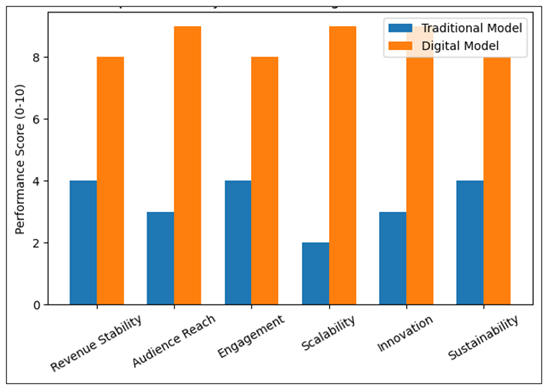
Figure 2
Comparative Analysis
of Performing Arts Business Models
The digital models, as the graph reveals, are superior to the traditional models in most, and in particular, in the areas of audience reach, scale, innovation as well as engagement. The classic models are moderate as far as authenticity and live experiences are concerned, but not flexible and scalable. Digital models, in their turn, are characterized by the Global accessibility, Multiple revenue sources, Technology-based interaction and Decision-making based on Data. However, it is important to add that it can be said that live performances are more emotional and authentic than digital models.
The table gives a methodical breakdown of the traditional and the digital performing arts business model in areas of critical dimensions. It shows that the traditional models rely on limited number of source of revenues, domestic viewers, and physical infrastructures, whereas digital models have multiplied sources of revenues, international penetration, and technological interactions. As highlighted in the table, digital models are more extensible, open, and information-driven as compared to conventional ones that do not diminish their strength in live authenticity and cultural experience. This comparison is further been strengthened by the bar chart, which presents higher scores in performance of digital models in all the parameters, especially in terms of audience reach, scalability, and innovation. The conventional models are worse because they are not very flexible, and are heavily reliant on physical facilities. On the whole, it is possible to state that the table and the graph show that digital and hybrid models offer more sustainability and growth opportunities to the performing arts industry in the context of the contemporary digital economy.
7. Conclusion and Future Directions
The paper examines the junction point of cultural entrepreneurship and the digital economy, and in particular, the new forms of business in the performing arts sector. Its results show that the digital revolution has greatly reshaped the process of creating, distributing, and monetizing performing arts. To become innovative with digital technologies, to increase the size of the audience, and guarantee the long-term sustainability, cultural entrepreneurs tend to utilize digital technologies. The discussion proves that cultural entrepreneurship is a key determinant of digital adoption and innovation. Those entrepreneurs who are able to merge creativity, strategic and technological skill are, in a better position, to adjust with the changing digital environment. Another finding of the study is that the adoption of digital technology is one of the primary enablers of business model innovation, which allows a new source of revenue in the form of subscriptions, crowdfunding, and digital patronage. Not only are these innovations economically feasible, they assist in ensuring that the cultural aspect is not lost in the fast paced world, as far as performing arts are concerned. The other notable finding is the importance of the value co-creation and the engagement of the audience. The digital platforms have transformed the audiences beyond a passive spectators and it has enhanced the interaction, personalization and building communities. This form of change helps in increasing the connection between the artists and the audiences and consequently, sustainability results are realized. However, the issues of platform dependency, digital inequality, intellectual property, and the danger of cultural commodification, among others, have been also listed among the problems, which are now crucial and have to be addressed.
In practical terms, the research proposes that the performing arts organizations must embrace hybrid business models which are integrative of both the conventional and digital business models. The strategies that can help a company to be successful include investing in the digital infrastructure, creating technological skills, and capitalizing on data analytics. Digital capacity-building activities and development of mechanisms that guarantee equal access and equal distribution of revenue in digital ecosystems should also be supported by policymakers and cultural institutions. Though it has its contributions, the study has some limitations. The study is also limited in the size and the geographical area covered which might limit the generalization of the results. Moreover, due to the fast-changing environment of the digital technologies, the business models can still evolve, and the research and adaptation should be sustained. Regarding future research directions, more research can be conducted to examine the long-term effects of emerging technologies on the performing arts entrepreneurship, including artificial intelligence, blockchain, and immersive media. Cross-cultural comparisons should allow getting a better understanding of the variations of digital transformation between the regions and artistic cultures.
REFERENCES
Dolhansky, B., et al. (2020). The Deepfake Detection Challenge (DFDC) Dataset. arXiv.
Firc, A., Malinka, K., and Hanáček, P. (2023). Deepfakes as a Threat to Speaker and Facial Recognition: An Overview of Tools and Attack Vectors. Heliyon, 9, e15090. https://doi.org/10.1016/j.heliyon.2023.e15090
He, Z., Zuo, W., Kan, M., Shan, S., and Chen, X. (2019). AttGAN: Facial Attribute Editing by Only Changing What You Want. IEEE Transactions on Image Processing, 28, 5464–5478. https://doi.org/10.1109/TIP.2019.2916751
Ilankovan, M. (2025). Deep Learning and Optimization Approaches in Prediction of Iot Traffic Using Gradient Boosting, Auto-Metric Graph Neural Network, and Lyapunov Optimization-Based Predictive Model: A Review. International Journal of Advanced Computer Engineering and Communication Technology, 14(2), 116–122.
Kane, T. B. (2019). Artificial Intelligence in Politics: Establishing Ethics. IEEE Technology and Society Magazine, 38(1), 72–80. https://doi.org/10.1109/MTS.2019.2894474
Kang, J., Ji, S. K., Lee, S., Jang, D., and Hou, J. U. (2022). Detection Enhancement for Various Deepfake Types Based on Residual Noise and Manipulation Traces. IEEE Access, 10, 69031–69040. https://doi.org/10.1109/ACCESS.2022.3185121
Malik, A., Kuribayashi, M., Abdullahi, S. M., and Khan, A. N. (2022). Deepfake Detection for Human Face Images and Videos: A Survey. IEEE Access, 10, 18757–18775. https://doi.org/10.1109/ACCESS.2022.3151186
Maras, M. H., and Alexandrou, A. (2019). Determining Authenticity of Video Evidence in the Age of Artificial Intelligence and in the Wake of Deepfake Videos. International Journal of Evidence and Proof, 23(3), 255–262. https://doi.org/10.1177/1365712718807226
Masood, M., et al. (2023). Deepfakes Generation and Detection: State-of-the-Art, Open Challenges, Countermeasures, and Way Forward. Applied Intelligence, 53, 3974–4026. https://doi.org/10.1007/s10489-022-03766-z
Mirsky, Y., and Lee, W. (2021). The Creation and Detection of Deepfakes: A Survey. ACM Computing Surveys, 54(1), 1–41. https://doi.org/10.1145/3425780
Nah, F.-H., Zheng, R., Cai, J., Siau, K., and Chen, L. (2023). Generative AI and ChatGPT: Applications, Challenges, and AI-Human Collaboration. Journal of Information Technology Case and Application Research, 25(4), 277–304. https://doi.org/10.1080/15228053.2023.2233814
Nguyen, T. T., et al. (2022). Deep Learning for Deepfakes Creation and Detection: A Survey. Computer Vision and Image Understanding, 223, 103525. https://doi.org/10.1016/j.cviu.2022.103525
Öhman, C. (2020). Introducing the Pervert's Dilemma: A Contribution to the Critique of Deepfake Pornography. Ethics and Information Technology, 22, 133–140. https://doi.org/10.1007/s10676-019-09522-1
Passos, L. A., et al. (2024). A Review of Deep Learning-Based Approaches for Deepfake Content Detection. Expert Systems, 41, e13570. https://doi.org/10.1111/exsy.13570
Tolosana, R., Vera-Rodriguez, R., Fierrez, J., Morales, A., and Ortega-Garcia, J. (2020). Deepfakes and Beyond: A Survey of Face Manipulation and Fake Detection. Information Fusion, 64, 131–148. https://doi.org/10.1016/j.inffus.2020.06.014
Xi, Z., Huang, W., Wei, K., Luo, W., and Zheng, P. (2023). Ai-Generated Image Detection Using a Cross-Attention Enhanced Dual-Stream Network. In Proceedings of the Asia Pacific Signal and Information Processing Association Annual Summit and Conference (APSIPA ASC) (1463–1470). https://doi.org/10.1109/APSIPAASC58517.2023.10317126
|
|
 This work is licensed under a: Creative Commons Attribution 4.0 International License
© ShodhKosh 2026. All Rights Reserved.