ShodhKosh: Journal of Visual and Performing ArtsISSN (Online): 2582-7472
|
|
ITSM TOOLS IN VISUAL AND DIGITAL LEARNING CONTEXTS: EXPLORING USER PERCEPTION AND ACCEPTANCE IN HIGHER EDUCATION
Jaime P. Pulumbarit
1

1 Bulacan
State University, City of Malolos, Bulacan, Philippines
|
|
|
ABSTRACT |
|
|
This study
evaluated the perception and acceptance of IT Service Management (ITSM) tools
within visual and digital learning contexts among students and faculty in
Philippine higher education institutions, using the Technology Acceptance
Model (TAM) as a framework. A total of 100 participants (50 students and 50
teaching faculty) responded to a validated Likert-scale questionnaire.
Findings revealed that faculty members consistently rated ITSM tools more
positively than students in terms of perceived usefulness, ease of use, and
behavioral intention. A significant difference was observed in perceived
usefulness (p = 0.029), while no significant difference was found in
perceived ease of use between the groups. Strong correlations were identified
between perceived usefulness and behavioral intention (r = 0.78), and between
perceived ease of use and behavioral intention (r = 0.69). Frequency of
system use emerged as a strong predictor of user intention, with daily and
weekly users demonstrating higher commitment (82%) compared to sporadic users
(33%). Variations were also observed in awareness
levels and perceived barriers, particularly in relation to limited training
and technical challenges. The findings affirm the applicability of TAM in
digital and visual learning environments, emphasizing the importance of user
exposure, training, and contextual support. The study recommends inclusive,
role-specific strategies to enhance ITSM engagement and support sustainable
integration within higher education. |
|||
|
Received 22 January 2026 Accepted 18 February 2026 Published 31 March 2026 Corresponding Author Jaime P. Pulumbarit, jaime.pulumbarit@bulsu.edu.ph
DOI 10.29121/shodhkosh.v7.i1.2026.7345 Funding: This research
received no specific grant from any funding agency in the public, commercial,
or not-for-profit sectors. Copyright: © 2026 The
Author(s). This work is licensed under a Creative Commons
Attribution 4.0 International License. With the
license CC-BY, authors retain the copyright, allowing anyone to download,
reuse, re-print, modify, distribute, and/or copy their contribution. The work
must be properly attributed to its author.
|
|||
|
Keywords: Visual and Digital Learning, Higher Education, ITSM |
|||



1. INTRODUCTION
Higher education digital transformation's accelerated advancement has changed the way universities run operations and deliver services Bucăţa and Tileagă (2024), Qolamani and Mohammed (2023). Today, the economy of knowledge is sustained by a solid information technology (IT) infrastructure beyond educational and learning functions with automation, transparency, and aiming at providing regional responses Francisca (2023). IT Service Management (ITSM) systems are one of the tools for bringing about this transformation because they allow organizations to improve effectiveness and quality of operations and of services and set the stage for future optimization. For example, these systems employ organized methods—such as the ITIL (Information Technology Infrastructure Library) model—to manage such functions as incident management, asset management, and service request fulfillment, among others Marrone and Hammerle (2021). In higher education, where digital fluency and access vary widely, these systems can bridge critical service gaps when effectively implemented and embraced by users Fleming et al. (2021).
Higher education digitalization has become a timely issue in the Philippines, particularly in the light of recent policy pronouncements and directions specially in the province based intitutions. Taking its cue from the Bayanihan to Recover As One Act (Republic Act No. 11494), the Commission on Higher Education (CHED) has at least institutionalized xer sways through the implementation of the Smart Campus Program. This program focuses on the provision of strong support for technology-driven innovations that not only enhance accessibility but also build equity and add to the overall quality of higher education in the country Commission on Higher Education (CHED) (2021). This strong push toward the construction and development of smart campuses relies heavily not just on the installation of various digital tools but also on their effective and smooth integration into the current academic and operation culture of schools. Nevertheless, it is important to note that the availability of technology in itself is not a guarantee for success. As emphasized by the Department of Information and Communications Technology Department of Information and Communications Technology (DICT) (2023), a paltry 39% of State Universities and Colleges (SUCs) in the country have been able to implement full-fledged IT Service Management (ITSM) or digital helpdesk systems. This percentage highlights a disturbing gap that there is between provision of necessary infrastructure and actual institutional capability to sustain and effectively utilize such technology over a long period.
Indeed, rather than engrained in the tools themselves, the factors that cause the resistance to the adoption of ITSM tools in HEIs are rooted in various aspects of user perception, including but not limited to the anxiety caused by technology entanglement and lack of institutional support Only faculty and students can be considered as the user groups in this sense due to their status as the primary users of these systems. There are several reasons why these two groups of users could resist the use of this system, with the lack of the feeling of useful usage definitively on the list. As research has illustrated, “perceived usefulness predicts users’ intention to use while perceived ease of use influences the actual use of technology”. Moreover, depending on the knowledge of similar systems, exposure to such tools, and digital literacy, these factors can be highly context-driven. This is precisely why it is so important to understand the perception and acceptance of these tools among faculty and students through the lens of design.
An impressive number of higher education institutions are now adopting ITSM solutions, setting them up nicely for creating smart, agile campuses. Nevertheless, most of the empirical studies about ITSM adoption are in corporate and enterprise Islam et al. (2021). Probably, there is some issue with domain specific situational wise analysis where stakeholders themselves perceive the same set of tools but probably they think it good and other bad in an academic context (especially at developing world as we are from Philippines) The problem is this gap stops HEIs from being able to make any evidenced based decisions as to how the IT service improvements potentially can be achieved, who needs to be trained in using it and also provides a clear direction for long term sustainability. This divide needs to be overcome especially now as digital service delivery has surged in a post-COVID world.
Consequently, this study investigates the perception of ITSM tools among lecturers and student in higher institutions. Furthermore, it aims to discover what shapes their acceptance factors, to determine robots´ visibility and application rates, and any significant variation in perception from two perspectives. These user-centric dimensions will help the research to provide a data-driven insight, one that can inform institutional agendas for more inclusive and sustainable digital service management.
This study thus helps to achieve national objectives of digital transformation, institutional robustness and academic advancement. It is also in line with the strategic visions of CHED and DICT as it drives responsible digital transformation in higher educational institutions in the Philippines. The perception and acceptance of ITSM tools from both faculty and student perspectives is less about how these tools work as it necessarily part of a more strategic intermediate institution – the nature in which digital reforms can accurately deliver on its promise to be useful unto its own people.
2. MATERIALS AND METHODS
2.1. Research Design
The second study applied a quantitative descriptive-correlational research approach as it has been accompanied to explore the views and adoptions responses of ITSM tools within faculty and students from higher education institutions. The design was chosen to establish the association between user perceptions and acceptability, as well as to report on trends and differences among respondent groups. The survey-based approach enabled the collection of standardized responses from a large population sample over a short period of time, providing objective and statistically reliable data.
2.2. Participants
The study involved faculty members and students from identified higher education institutions in the Philippines that already implemented ITSM tools or system under implementation or piloting phase. Researchers employed stratified random sampling to ensure equal representation from each of the faculty and student groups. The study aimed at 100 respondents fall under the category of faculty and students, so half with themuation were conducted. Participants were selected to satisfy the study’s inclusion criterion of attendance by individuals who interacted directly with the institution’s ITSM tool for at least one month in a prior academic year.
2.3. Instrument
Data for this study are collected by a self-made structured survey questionnaire built on Technology Acceptance Model (TAM) propound by Davis (1989). The instrument comprised five dimensions of their profile, perceived usefulness, perceived ease of use, attitude toward use and behavioral intention to use. The response scale was a 5-point Likert scale where 1 represents “Strongly Disagree” and 5 represent for the highest agreement (Strongly Agree). The self-administered questionnaire was content-validated by three IT and educational technology experts; administered to 30 respondents for pilot testing for reliability (Cronbach alpha of 0.91)
2.4. Data Collection Procedure
Survey via Google Forms was conducted between March and May 2025 after Institutional Ethics Review Committee endorsement and after acquiring the necessary documents of the involved institutions of higher education institutions. The invitations were requested through institutional formal communication channels, and informed consent forms were distributed before engagement. Confidentiality and anonymity were ensured, and the rights of participants to withdraw at any moment without any consequences were not revoked.
2.5. Data Analysis
Data gathered were coded and analyzed using version 27 of the Statistical Package for the Social Sciences (SPSS). Descriptive statistics such as mean, standard deviation, and frequency were used to synthesize demographic profiles and overall perceptions. Pearson correlation analysis was used to test correlation between perceived ease of use, perceived usefulness, and behavioral intention. Independent samples t-tests were used to test differences in perception and acceptance between professor and student groups. The level of significance used in all statistical tests was p < 0.05.
3. RESULTS AND DISCUSSION
3.1. Demographic and Group Overview
The research used a sample of 100 participants, comprising 50 instructors and 50 students from different universities and colleges in the Philippines. All the participants had prior experience in using the institution's IT Service Management (ITSM) tool in the academic year. A balanced sample enabled a straightforward comparison of user groups, which is fundamental in distinguishing diverse perceptions. In comparison to a considerably large sample, the relatively small sample size can limit the generalizability of the results of this research Islam et al. (2021). Age, discipline, or background technology could offer more detailed information regarding behavioral patterns and thus refine future research. This research failed to take into account fully how digital skills of users influence the acceptance of ITSM tools. Future studies in this regard are required.
3.2. Perception and Acceptance Levels by Group
Perception and acceptance were evaluated according to the principles of the Technology Acceptance Model (TAM). Table 1 illustrates that faculty members consistently evaluated ITSM tools more positively than students across all dimensions, with the highest mean values for both groups observed in attitude toward usage and perceived utility.
Table 1
|
Table 1 Mean scores by respondent group (n = 100) |
||
|
Construct |
Faculty (M ± SD) |
Students (M ± SD) |
|
Perceived Usefulness |
4.20 ± 0.48 |
3.96 ± 0.61 |
|
Perceived Ease of Use |
4.01 ± 0.60 |
3.87 ± 0.65 |
|
Attitude Toward Use |
4.18 ± 0.50 |
4.02 ± 0.54 |
|
Behavioral Intention |
4.01 ± 0.55 |
3.75 ± 0.64 |
This corresponds with Davis (1989), who asserts that individuals are more inclined to embrace technologies they perceive as beneficial and user-friendly. Fearnley and Amora (2020) highlight the same study which demonstrates that, even with good attitudes, there may still be low actual use of the system because of institutional limitations. Low attitude gap towards use shows that, even with differences in perceived usefulness, students are, by nature, not resistant towards the ITSM system Petersen (2020). This suggests that there may be a predisposition towards the adoption of students and faculty of the system, subject to structural and contextual facilitations as mentioned. These results serve to highlight the need for employing deployment strategies that are aligned with the user group.
4. Comparison of Perception and Acceptance Constructs by Group
Figure 1 illustrates the mean scores and standard deviations (represented by error bars) of students and faculty across four significant constructs. Faculty evaluated ITSM tools more favorably than students regarding perceived utility and behavioral intention universally.
Figure
1
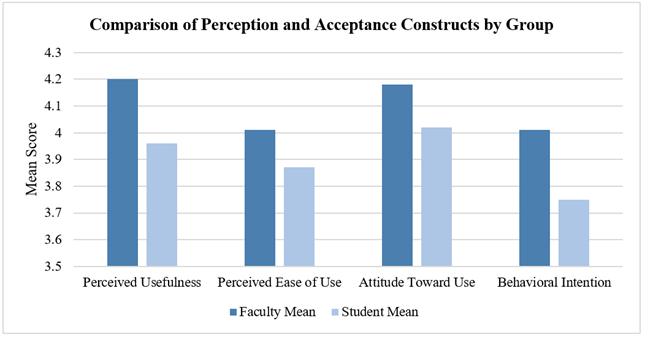
Figure 1 Comparison of Mean Scores on Perception and Acceptance Constructs by Group
5. Group Comparison: T-Test Results
Table 2 displays the outcomes of the independent samples t-test. A notable disparity was observed in perceived usefulness (t = 2.21, p = 0.029), accompanied by a modest effect size (Cohen’s d = 0.44). No substantial difference in reported ease of use was observed, indicating that both groups regard the platform as equally accessible.
Table 2
|
Table 2 T-Test Comparison Between Faculty and Students |
||||
|
Construct |
t-value |
p-value |
Significance |
Effect Size (Cohen’s
d) |
|
Perceived Usefulness |
2.21 |
0.029 |
Significant |
0.44 (moderate) |
|
Perceived Ease of Use |
1.12 |
0.264 |
Not Significant |
— |
This is in support of the finding of Azad and Semiyari (2020), who had established that various academic activities affect perceptions of technology. This contradicts the findings of Fearnley and Amora (2020) and Mehra and Mital (2007), who indicated that there was no variation in acceptability between the faculty and the students in using ITSM. The large variation in perceived usefulness can be attributed to role-associative interaction with ITSM tools, where professors depend on the tools for academic reporting, documentation, and ticket closure. Students might interact intermittently. This indicates that the identification of the congruence of ITSM roles with users' expectations is needed.
6. Correlations Among Constructs
Table 3 shows the findings for correlation. Perceived usefulness was strongly related to a high level (r = 0.78, p < .01) with behavioral intention, while perceived ease of use was moderately significant (r = 0.69, p < .01). These findings support TAM's hypothesis that ease and perceived usefulness will play a crucial role in long-term system usage.
Table 3
|
Table 3 Correlation Between Constructs |
||
|
Variable Pair |
Pearson r |
p-value |
|
Perceived Usefulness
↔ Behavioral Intention |
0.78 |
< .01 |
|
Perceived Ease of Use
↔ Behavioral Intention |
0.69 |
< .01 |
This confirms TAM's model in the sense that perceived usefulness is a robust determinant of behavioral intention Davis (1989). Marrone and Hammerle (2021) argue that cultural and administrative constraints can influence individual perceptions and result in variable acceptability within educational settings. This research provides a robust correlation between TAM features, such that customers' perceptions of utility and usability have a predictive influence on their intention to keep using ITSM services. Yet external factors such as peer influence, institutional imperative, or service quality can play a critical role in outcomes in real-world settings.
7. Frequency of ITSM Use
The usage frequency of ITSM varied across the groups, as can be seen in Table 4. While 62% of teachers utilized the ITSM tools weekly or daily, the same frequency was utilized by only 36% of the students.
Table 4
|
Table 4 ITSM Usage Frequency by Respondent Group |
||
|
Frequency |
Faculty (%) |
Students (%) |
|
Daily |
14 |
8 |
|
Weekly |
48 |
28 |
|
Monthly |
28 |
36 |
|
Rarely |
10 |
28 |
The students utilized them every now and then or monthly more frequently. Repeat usage can result in greater confidence and perceived use. Adya and Mascha (2011) warn that heavy use does not necessarily result in heavy acceptance, particularly if the system is seen as mandatory or bureaucratic. Frequency measures indicate a training need for students, a significant number of whom fall into seldom usage. Institutions can gain from integrating ITSM processes into routine teaching practices to facilitate repeated use, especially among students.
8. Awareness of ITSM Tools
Faculty were more likely to report high awareness of ITSM systems (68%), compared to only 42% of students. A concerning 36% of students rated their awareness as low.
Table 5
|
Table 5 ITSM Usage Frequency by Respondent Group |
|||||
|
Awareness Level |
Faculty (%) |
Students (%) |
|||
|
High |
68 |
42 |
|||
|
Moderate |
26 |
22 |
|||
|
Low |
6 |
36 |
|||
This concurs with Commission on Higher Education (CHED) (2021), where institutional orientation is highlighted amidst the process of smart campus change. However, Firmansyah et al. (2020) state that there will be students who will resist the adoption of systems even if they are aware, because of perceived inapplicability to scholarly work. Awareness will make adoption more or less likely and also determine perceived legitimacy of the system. The gap requires joint communication efforts, orientation, and positioning ITSM tools as beneficial beyond administrative work.
9. Barriers to Effective Use
Table 6 summarizes the common barriers cited by respondents. The most frequent issue across both groups was lack of training or orientation, especially among students (60%).
Table 6
|
Table 6 Barriers to ITSM Tool Utilization |
||
|
Barrier |
Faculty (%) |
Students (%) |
|
Lack of
training/orientation |
44 |
60 |
|
Technical/system
issues |
42 |
34 |
|
Unclear support or
ticketing |
36 |
26 |
|
Limited access (off-campus) |
14 |
22 |
Buabeng-Andoh et al. (2022) posit that such barriers significantly affect user confidence. Marrone and Hammerle (2021) contended that such barriers are often breakable by adaptable ITSM design rather than solely by end-user training. The prevalence of training-based barriers indicates a reactive rather than proactive approach to ITSM deployment. Organizations must adopt a tiered support model with user documentation, self-service, and recurring training sessions.
10. Relationship Between Usage and Behavioral Intention
Table 7 indicates a positive association between usage frequency and behavioral intention. Between the daily and weekly users, 82% indicated a high intention to continue using the system, compared to 41% of monthly users and 33% of infrequent users. The results indicate the importance of familiarity and repetition of contact in the formation of user commitment. Habitual usage would naturally lead to familiarity and trust, and these would lead to extended usage.
Table 7
|
Table 7 Cross-Tabulation of Itsm Usage Frequency and Behavioral Intention |
|||
|
Usage Frequency |
High Behavioral
Intention (≥4.0) |
Low Behavioral
Intention (<4.0) |
Total Respondents |
|
Daily |
9 (82%) |
2 (18%) |
11 |
|
Weekly |
32 (82%) |
7 (18%) |
39 |
|
Monthly |
13 (41%) |
19 (59%) |
32 |
|
Rarely |
6 (33%) |
12 (67%) |
18 |
This aligns with Constantine (2006), which had argued that high system contact gives rise to user commitment and trust. It is also worth noting that high-frequency users are indeed forced to use the system out of academic or administrative need, rather than volition. But the high behavioral intention of high-frequency users maintains the hypothesis that heavy use—rather than exposure—fuels acceptance. Institutions should therefore not only monitor how frequently user contact with ITSM systems but also their relevance and quality.
11. CONCLUSION
This research empirically examined the acceptance and attitude of IT Service Management (ITSM) technology by university students and teachers based on the Technology Acceptance Model (TAM) theory. Studies revealed that teachers recorded higher perceived utility and behavioral intention than students, yet both had generally positive attitudes towards ITSM technology. There is high correlation between perceived utility and behavioral intention in the aspect that the users who perceived ITSM technology as functionally useful would use them more often. Frequent usage and higher awareness were also correlated to higher behavioral intention, yet common barriers were lack of training and technical support. These results underscore the significance of user-focused ITSM strategies that cater to user-specific requirements, system accessibility, and frequent participation. The research stresses that successful ITSM integration should be supported by a strong infra and mass user support, and institutional culture alignment.
12. RECOMMENDATIONS
Post-secondary institutions need to institutionalize regular training programs, particularly among students, to fill gaps in awareness and confidence identified in this study. ITSM software must be incorporated into core academic and administrative processes for user familiarity and ease of use. User-centered design must be embraced by system developers and IT organizations for interface and support system design to improve perceived usability. Institutions are also encouraged to solicit regular feedback from teachers and students to enhance ITSM services, minimize technological hurdles, and ensure compliance with CHED's Smart Campus program. Ultimately, inclusive implementation plans will ensure that ITSM solutions are not only implemented but adopted as well.
CONFLICT OF INTERESTS
None.
ACKNOWLEDGMENTS
None.
REFERENCES
Adya, M., and Mascha, M. F. (2011). Can Extended Exposure to New Technology Undermine its Acceptance? Evidence from System Trials of an Enterprise Implementation. Communications of the AIS, 29(1), Article 14. https://doi.org/10.17705/1CAIS.02914
Azad, M., and Semiyari, S. R. (2020). An Investigation on the Perceived and Actual Technological Literacy of University Instructors and Students in Iran. International Electronic Policy Analysis, 3(9), 29–39. https://doi.org/10.22034/IEPA.2020.230985.1168
Buabeng-Andoh, C., Effah, P., and Owusu-Acheaw, M. (2022). Factors Influencing the Acceptance of Educational Technologies Among University Faculty: A Modified UTAUT Model. Education and Information Technologies, 27(1), 865–885. https://doi.org/10.1007/s10639-021-10658-w
Bucăţa, G., and Tileagă, C. (2024). Digital Renaissance in Education: Unveiling the Transformative Potential of Digitization in Educational Institutions. Revista Academiei Forţelor Terestre, 29(1), 20–37. https://doi.org/10.2478/raft-2024-0003
Commission on Higher Education (CHED). (2021). CHED Launches P15.4M Smart Campus Project in Region VIII.
Constantine, L. (2006). Trusted Interaction: User Control and System Responsibilities in Interaction Design for Information Systems. In Proceedings of the International Conference on Human-Computer Interaction (pp. 20–30). Springer. https://doi.org/10.1007/11767138_3
Davis, F. D. (1989). Perceived Usefulness, Perceived Ease of Use, and User Acceptance of Information Technology. MIS Quarterly, 13(3), 319–340. https://doi.org/10.2307/249008
Department of Information and Communications Technology (DICT). (2023). Philippine Digital Transformation Strategy 2023–2028. https://dict.gov.ph/digital-strategy-2023/
Fearnley, M. R., and Amora, J. T. (2020). Learning Management System Adoption in Higher Education Using the Extended Technology Acceptance Model. International Journal of Education, 8(2), 89–106. https://doi.org/10.22492/ije.8.2.05
Firmansyah, A. F., Aini, Q., Saehudin, A., and Amsariah, S. (2020). Information Security Awareness of Students on Academic Information System Using Kruger Approach. In Proceedings of the 2020 International Conference on Information Technology Systems and Management (CITSM). IEEE. https://doi.org/10.1109/CITSM50537.2020.9268795
Fleming, E. C., Robert, J., Sparrow, J., Wee, J., Dudas, P. M., and Slattery, M. J. (2021). A Digital Fluency Framework to Support 21st-Century Skills. Change: The Magazine of Higher Learning, 53(2), 41–48. https://doi.org/10.1080/00091383.2021.1883977
Francisca, V. D. (2023). Mengintegrasikan Sistem Teknologi Dalam Manajemen Sarana Dan Prasarana Untuk Pendidikan Yang Lebih Modern. Proceedings Series of Educational Studies. https://doi.org/10.17977/um083.7910
Gkrimpizi, T., and Peristeras, V. (2022). Barriers to Digital Transformation in Higher Education Institutions. In Proceedings of the International Conference on Theory and Practice of Electronic Governance. ACM. https://doi.org/10.1145/3560107.3560135
Islam, M. S., Hossain, M. A., and Hasan, M. M. (2021). Understanding the Adoption of ITSM Frameworks in Organizations: An Empirical Investigation. Information Systems Frontiers, 23(6), 1445–1460. https://doi.org/10.1007/s10796-020-10038-2
Marrone, M., and Hammerle, M. (2021). IT service management: From ITIL to Digital Transformation. Journal of Enterprise Information Management, 34(2), 660–682. https://doi.org/10.1108/JEIM-12-2019-0414
Mehra, P., and Mital, M. (2007). Integrating Technology Into the Teaching-Learning Transaction: Pedagogical and Technological Perceptions of Management Faculty. International Journal of Education and Development Using ICT, 3(1), 105.
Petersen, F. (2020). Students’ Attitude Towards Using a Mobile Learning Management System: A Large Undergraduate Information Systems Class. In Proceedings of the 2020 International Conference on Information Communication Technology and Society (ICTAS) (1–6). IEEE. https://doi.org/10.1109/ICTAS47918.2020.233991
|
|
 This work is licensed under a: Creative Commons Attribution 4.0 International License
© ShodhKosh 2026. All Rights Reserved.