ShodhKosh: Journal of Visual and Performing ArtsISSN (Online): 2582-7472
|
|
Innovation in Stage Design through Virtual Reality and Immersive Technologies
Nivetha N. 1 , Damodaran B. 2
 ,
Dhanalakshmi V. 3
,
Dhanalakshmi V. 3
 ,
Hari Hara Subramanyan P.V. 4
,
Hari Hara Subramanyan P.V. 4 ,
Parimala K. 5
,
Parimala K. 5 , Dr.
Raghavendra Jayesh 6
, Dr.
Raghavendra Jayesh 6
1 Department
of Computer Science, Meenakshi College of Arts and Science, Meenakshi Academy
of Higher Education and Research, India
2 Associate
Professor, Department of Psychology, Meenakshi College of Arts and Science,
Meenakshi Academy of Higher Education and Research, India
3 Assistant Professor, Department of Computer Science, Meenakshi
College of Arts and Science, Meenakshi Academy of Higher Education and Research, India
4 Meenakshi College of Physiotherapy, Meenakshi Academy of Higher
Education and Research, India
5 Department of Pharmacology, Meenakshi Medical College Hospital and
Research Institute, Meenakshi Academy of Higher Education and Research, India
6 Professor and Head, Department of Prosthodontics Crown and Bridge,
Sree Balaji Dental College and Hospital, Bharath Institute of Higher Education and
Research, India
|
|
|
ABSTRACT |
|
|
The stage
design is a vital factor when it comes to creating the visual, spatial, and
emotional significance of performing art productions. Historically,
theatrical scenes have been based on physical sets, light, and set design to
facilitate the narration and improve the experience of the audience.
Nonetheless, new possibilities of changing the stage design have been
introduced by the recent technological developments of digital and immersive
technologies. This paper discusses how Virtual Reality (VR) and immersive
technology can be used to achieve stage design and performance production
innovation. The study looks at the potential of VR in aiding virtual stage
prototyping, digital scenography, interactive stage settings and the
immersion of an audience. Based on the literature review and assessment of
the current practices of stage design, the research identifies the benefits
of VR-based design methods, which are better visualization, increased
creative ability, improved teamwork in the production teams, and more
immersive experiences of the audience. There is also a comparative study of
the conventional stage design techniques and VR-oriented ones aimed at
assessing the difference in the working process, efficiency of production,
creative opportunities, and experience of the audience immersion. Moreover,
the paper suggests a theoretical framework of the incorporation of VR
technologies in stage design procedures, showing the combination of artistic
creativity and technology improvement to create the immersive setting in the
performances. The samples of immersive theatre plays prove that digital
technologies may widen the frames of the stage design and narrative. The
paper also covers the main issues related to immersive technologies, such as
technical infrastructure, budget, training and development of skills, and
ethical issues related to digital performance environments. The results
indicate that there will be a great potential in terms of creative and
participatory ability of performing arts with a hybrid solution that
incorporates the use of conventional stagecraft and immersive technologies.
The study also ends with the identification of the future trends in immersive
stage design, such as artificial intelligence, extended reality, and
metaverse-based performance platforms integration. |
|||
|
Received 22 December 2025 Accepted 27 March 2026 Published 03 April 2026 Corresponding Author Nivetha N,
nivethan@maher.ac.in DOI 10.29121/shodhkosh.v7.i3s.2026.7327 Funding: This research
received no specific grant from any funding agency in the public, commercial,
or not-for-profit sectors. Copyright: © 2026 The
Author(s). This work is licensed under a Creative Commons
Attribution 4.0 International License. With the
license CC-BY, authors retain the copyright, allowing anyone to download,
reuse, re-print, modify, distribute, and/or copy their contribution. The work
must be properly attributed to its author.
|
|||
|
Keywords: Virtual
Reality, Stage Design, Immersive Technologies, Digital Scenography, Extended
Reality, Performing Arts Innovation, Interactive Performance Environments |
|||



1. INTRODUCTION
1.1. Background of Stage Design in Performing Arts
Stage design is an essential part of performing arts, and it is a very critical element of the creation of the visual and spatial space where the performances are performed. Stage design traditionally refers to the process of creating tangible sets, lighting plans, props, costumes and scenic elements to back up the story-line and artistic vision of a show. The stage design is used in theatre, dance, opera, and musical performances to create mood, atmosphere, and context in addition to directing the audience perception and emotional response. Designers do hand in hand work with directors, choreographers, and performers to bring conceptual ideas to reality on stage. The design of the stage has changed over time as it started with simple painted backgrounds as well as inanimate decorations to advanced scenographic activities incorporating lighting, projection, sound, and multimedia. Although this has been improved, traditional stage design has some physical constraints that can curtail the extent of creative experimentation, including space, cost and complexity of logistics.
1.2. Emergence of Digital and Immersive Technologies
The swift evolution of digital technologies has dramatically changed the environment of the performing art production. Computer graphics technology, real-time rendering, projection mapping, motion capture, and interactive media technologies have increased stage design and performance environment possibilities. The more recent is the introduction of immersive technologies, such as Virtual Reality (VR), Augmented Reality (AR), and Mixed Reality (MR), that brought about completely new techniques of designing the stage space. The technologies enable designers to design dynamic and interactive visual spaces which may vary in real time and react to the actions of performers or audience feedback. Immersive technologies can also assist the designers in simulating the possible stage environment when planning a stage show, where the creative teams can test various scenographic ideas without the physical production processes. Consequently, the area of digital stage design is slowly turning into a hybrid area of convergence between artistic creativity and technological advancement.
1.3. Role of Virtual Reality in Contemporary Stage Production
The use of Virtual Reality has become one of the most revolutionary technologies in the modern stage design and performance production. VR enables designers to create complete three dimensional spaces which can be traversed and interacted upon at real time. VR platforms allow stage designers to see complex stage layouts, test lighting and spatial layouts and see the perspective of the performance prior to building physical sets. It is not only an efficient way to design items, but also the way to make creative teams cooperate. Moreover, VR also makes it possible to make use of completely virtual stage settings where the scenery is substituted or augmented with the physical one. These environments are capable of establishing very creative and immersive experiences to the audience as well, particularly when used with projection setups, interactive media, and spatial audio technologies. Thus, VR is becoming more popular in theatre production, live concerts, immersive exhibitions and experimental performance art Finkel and Platt (2020).
1.4. Research Problem and Motivation
Although immersive technologies have become increasingly popular in the field of performing arts, the concept of Virtual Reality in stage design has not been studied thoroughly in the academic literature and practical domain. The traditional scenographic techniques are continued to dominate many performing arts institutions, whereas the stage design possibilities of VR have not been explored to the full extent to improve creativity, efficiency, and audience immersion. Besides, the introduction of the immersive technologies is also faced with a number of challenges, such as the technical complexity, financial limitations, and the necessity of interdisciplinary cooperation between the artists and the specialists in the field of technologies. These concerns demonstrate the necessity of organized research that focuses on studying the way VR and immersive technologies can be successfully used to facilitate the process of stage design without harming artistic integrity and authenticity of performance.
1.5. Objectives of the Study
The main goal of this study is to discuss how Virtual Reality and immersive technologies can be used to change the stage design of modern performing art. In particular, the research will evaluate the technological devices that facilitate the work of immersive stages, analyze the existing use of VR in performance production, and assess the advantages and drawbacks of the use of immersive technologies in the process of stage design. The other goal is to present a conceptual map illustrating how VR-based stage design could improve the use of creativity, teamwork, and interaction with the audience in performances.
1.6. Research Questions
The present study is informed by a number of questions. To begin with, what effect are immersive technologies like Virtual Reality having on the modern stage design practices? Second, what are the existing technologies and techniques of producing immersive stage environments? Third, in which ways is the use of VR-based stage design more creative, efficient, and engaging to the audience than the traditional scenography? Lastly, what are some of the challenges and opportunities associated with the adoption of immersive technologies in performing arts production?
2. Literature Review
2.1. Evolution of Stage Design in Theatre and Performance
The stage design has developed considerably during the history of the theatre and performing arts. In the early theatre, the stage setting was very basic, usually painted backgrounds, very few props and even symbolic features that depicted a specific location or subject. Classical Greek theatre was based on architectural elements like the skene and orchestra to facilitate performance, but medieval and renaissance theatre made use of mobile scenery and perspective painting, making them appear more realistic. In the nineteenth and twentieth centuries, stage design evolved into a more advanced practice following the emergence of scenic technologies, lighting systems and mechanized stage equipment. The works of influential practitioners like Adolphe Appia and Edward Gordon Craig made people see the necessity of using light, space, and movement to provide expressive stage conditions instead of the use of the ornamental scenery. The development of contemporary stage design has not stopped at this point, with the introduction of the elements of multimedia, digital projections, and interactive technologies, now allowing a designer to build a more dynamic and immersive visual environment Uršič and Cotič (2025).
2.2. Digital Transformation in Cultural and Performing Arts
The high rate of development of digital technologies has contributed to the significant changes in the production and presentation of cultural and performing arts. The use of digital media and computer-based visual systems in the stage design has gained popularity in contemporary productions as digital scenography. Projection mapping, LED displays, and computer-generated imagery are some of the technologies that enable the designer to design versatile stage settings that are dynamically adjustable to performances. Also possible through the use of digital tools is the incorporation of visual effects, real-time animation, and interactivity in response to the actions of the performers or to the input of the audience. Also, digital media are used to document and preserve performing arts in high-quality recordings, electronic archives and online exhibitions. The developments have increased the scope of artistic expression and have also developed new interdisciplinary collaborative approaches between artists, technologists, and designers.
2.3. Virtual Reality Applications in Stage and Set Design
The Virtual Reality has become a strong device in stage production visualization, design, and experimentation. The VR technologies enable stage designers to recreate the spatial arrangement of performance spaces in full three dimensions. This possibility enhances the effectiveness of the designing process and saves production expenses as the design can be tested and changed at an early stage. Besides being used to aid pre-production planning, VR also allows creating completely virtual performance spaces with digital settings instead of the traditional physical setup. These applications have been experimented in experimental theatre performances, immersive installations and virtual performance events, in which audiences can experience performances using VR headsets or interactive digital space Antchak (2017).
2.4. Immersive Technologies and Audience Experience
The use of immersive technologies is significant in the engagement and involvement of audiences in the performing arts of today. AR, MR, and interactive projection systems are technologies that enable audiences to have more dynamic and participative performances. As an illustration, AR has the ability to superimpose digital components on real-world stage settings to generate hybrid visual experiences that entail the integration of real and virtual elements. Likewise, immersive installations and interactive theatre performances are the ones that enable people to move within spaces of performance and access digital environments in real time. These methods change the conventional performer audience relationship with the audience, in a way that makes them active contributors in the realm of performance. Consequently, immersive technologies have gained a significant value as a means of developing new types of storytelling and immersive theatre.
2.5. Integration of Extended Reality (XR) in Creative Performance Spaces
Virtual Reality is one of the major concepts formed by Extended Reality (XR), consisting of Virtual Reality, Augmented Reality, and Mixed Reality that is becoming the heart of the next-generation performance environments. XR technologies enable designers to combine both physical stage with the use of digital content to form hybrid performance space that goes beyond the limitations of traditional theatres stages. An example is that with the help of XR, a virtual scenery, character or environment can be displayed on physical stages so that performers can interact with digital elements in real time. The technologies have found increased applications in concerts, multimedia productions and experimental theatre productions where immersive visual storytelling is the need. With incorporation of XR technologies into stage design, artists will have the ability to develop visually complex and interactive environments that help them to express narratives and communicate to the audience Carmona (2019).
Table 1
|
Table 1 Literature Review of Recent Research |
||
|
Focus / Method |
Key Contribution |
Limitations |
|
Review-based geographic analysis of the
relationship Gohar and Ragab (2021) between cultural festivals and cities. Stevens and Dovey (2023) |
Shows that festivals are increasingly used by
cities for marketing, tourism, and socio-economic development, while also
shaping urban identity and community experience. It helps frame temporary
events as not only cultural activities but also strategic urban
interventions. |
The paper is broad and conceptual, so it offers
less detail on operational design criteria, event management tools, or
technology-enabled evaluation of festival spaces. This limitation is an
inference from the review-oriented scope described in the source. |
|
Immersive Virtual Environment (IVE)-assisted
design experiment for communication and collaboration in urban design. Karachalis (2021) |
Demonstrates that virtual environments can help
laypeople communicate design ideas more effectively and collaborate using
shared 3D artifacts. This is valuable for participatory planning and public
engagement in design processes. |
The study appears focused on participatory
communication and design interaction rather than long-term implementation
outcomes, policy adoption, or large-scale real-world deployment. Its
applicability may therefore be stronger in experimental or workshop settings
than in full urban governance contexts. |
|
Conceptual and analytical study on VR for citizen
engagement in participatory urban policymaking. Behmanesh and Brown (2025) |
Highlights VR as a tool for making participatory
policymaking more accessible, inclusive, and efficient. It extends immersive
technology from design visualization into policy communication and citizen
decision-support. |
The study also acknowledges technological
limitations, physical and psychological constraints, and ethical, privacy,
and legal concerns. These issues suggest that adoption may still be
constrained by infrastructure, usability, and governance barriers. |
|
Study of AR/XR applications in urban design
pedagogy, including “phygital” installations in Houston and Amsterdam. Liu and Nijhuis (2020) |
Shows that AR/XR can make urban design more
interactive and can better capture people’s perceptions in design education
and proposal development. It is useful for understanding how immersive tools
support learning, visualization, and communication. |
The study is centered
on pedagogy and design exploration, so its findings may not directly
translate into policy execution, event operations, or infrastructure
management. The available sources also indicate emerging use rather than
mature, standardized practice. |
|
Research aimed at developing design principles or
a design aid/tool for temporary event implementation in public spaces. Shakibamanesh et al. (2025) |
Provides a practical contribution by linking
urban design criteria to the planning and management of temporary
public-space events. It is especially useful for improving the effectiveness
of festivals, markets, and other temporary interventions in city spaces. |
Because the paper is very practice-oriented, it
may focus more on event design guidance than on broader social, cultural, or
immersive-technology impacts. The source also indicates it is recent/in
press, so long-term validation across multiple contexts may still be limited. |
In all these five papers, there are three dominant themes. To start with, temporary events and festivals are being seen more as urban-activation and place-making as opposed to cultural programming. Second, VR and AR commonly enhance communication, engagement, and visualisation of the urban design and policy. Third, even though these approaches were promising, they are still limited by infrastructure, ethics, privacy, scale, and actual implementation. With respect to your paper, this review indicates that there is a distinct gap in the literature: further research is required that links immersive technologies, participatory design and practical event/public-space management with each other within a single frame. This comes to pass as a conclusion to the various focal points of the chosen studies.
2.6. Research Gaps in Immersive Stage Design
Though tremendous advances have been achieved in the digital scenography and immersive performance technologies, various gaps in research are present in the sphere of immersive stage design. Most of the current research is also largely on the evolution of technology and does not look into the effects of these technologies on creativity in the arts, teamwork in design, and viewer perception. In addition, systematic frameworks are not well researched as the way forward in integrating immersive technologies into stage production processes. In practical issues, like the technical infrastructure needs, cost limitations and training of artists are also unexplored in the scholarly sources. These gaps need to be addressed to come up with comprehensive models that will facilitate the successful application of Virtual Reality and immersive technology in stage design and performing art production.
3. Applications of Virtual Reality in Stage Design and Production
The Figure 1 demonstrates Virtual Reality as the key technology that facilitates the innovation in stage production. It has been used in the areas of virtual stage prototyping and previsualization, digital scenography and virtual set building, real-time interactive stage environments, immersive audience experiences, and collaborative virtual production processes. With all these elements, the performing arts of today are more visualized, experimentally creative, efficient in production, and interdisciplinary in their collaboration.
Figure 1
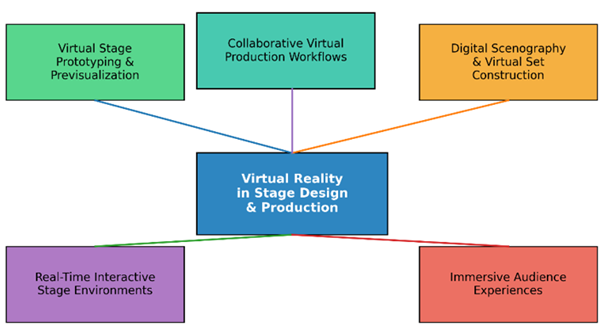
Figure 1 Applications of Virtual Reality in Stage Design
3.1. Virtual Stage Prototyping and Previsualization
VR has proved to be a useful stage prototyping and previsualization tool of modern performing arts production. Traditional stage design practices have designers using sketches, scale models, and computer generated images to visualize stage settings, and then build them. These techniques tend however to give poor spatial knowledge and do not necessarily reflect the actual experience of being inside the stage space. VR will be able to overcome these shortcomings because designers can create three-dimensional models of a stage that are easy to explore. Using VR headsets and real-time rendering software, designers, directors, and production teams can access the stage area virtually and look at elements of the set in various perspectives and assess the look of visual composition of the performance space. This visually previsualizing system enables creative teams to detect problems in the design stages early, do pre-test using alternative layouts, and strengthen the concept of the stage before spending money on physical production Mehan and Mostafavi (2024).
3.2. Digital Scenography and Virtual Set Construction
Digital scenography is the application of digital technologies to fabricate and create stage spaces. VR is significant in this process, as it enables the designers to design very elaborate virtual staging that replicates physical set-ups on the stage. With VR design software, scenic designers are experiencing a 100 percent immersive view in modeling an architectural aspect, stage property, and background setting. These digital sets may be incorporated in physical stage building later or even incorporated into the performances itself by projection systems and LED displays. Additional benefits of virtual set construction are the ability to quickly test various visual styles, textures, lighting conditions and spatial layouts. The virtual sets can also be changed and redesigned in real time unlike traditional physical sets which consume a lot of resources to make the necessary changes. Consequently, VR-based digital scenography enhances the range of creative opportunities and adds more efficiency to the design process and decreases the cost of production.
3.3. Real-Time Interactive Stage Environments
In these systems digital spaces react dynamically to the movements of the performers, or communication with the audience or visual cues that are programmed into the environment. Digital elements that can be modified in real-time using motion capture technology, sensor and real-time rendering engines include virtual landscapes, animated objects and effects. As an example, actors or dancers can engage with the projected digital setting that can change in reaction to their actions or movements. These interactive environments can be tested and refined on a VR-based system of design and then implemented in real life. These technologies help to transform the stage into a live and interactive place where the story is told and the visual aspect is enriched Verma et al. (2026).
3.4. Immersive Audience Experiences
The VR technologies also open new opportunities in terms of the engagement of the audience, as they provide the opportunity to view the content immersively. There are also a few experimental theatre productions and VR performances where audience members can see them using VR headsets, in which the viewer can observe the virtual stage setups in a variety of perspectives. Viewers do not watch the performance sitting in the same seat, but they have the opportunity to move in the virtual performance space and see the story in different angles. VR performances can also have the interactive experience where the viewers can control certain elements of the setting or plot. Moreover, VR technology allows remote viewers to be part of the performance, and this results in increased access by the global audience.
3.5. Collaborative Virtual Production Workflows
The VR technologies will also promote the collaborative design and production process between the creative teams. In the conventional stage production, it is common that several meetings, design revisions and demonstration of physical models are done. The VR platforms allow designers, directors, lighting engineers, and stage technicians to get together and interact in a virtual space where all participants can view any stage designs and make modifications instantly. Such collaboration enables the stakeholders to visualize changes in the design in real time and share ideas better. Interdisciplinary cooperation of artists with specialists in the field of technology is also supported by virtual production workflow, which allows combining innovative mixtures of artistic imagination and technical skills. Consequently, VR-based collaboration is capable of enhancing the efficacy of stage production processes and develop more integrated and experimental performance design.
In general, it can be stated that the application of Virtual Reality in stages design and production can be greatly beneficial in terms of creative exploration, production efficiency, and audience engagement. VR technologies are changing the conceptualization, design, and experience of stage environments in modern performing arts by allowing them to be conceived and designed in an immersive manner, through interactive environments, collaborative design processes, and so forth.
4. Comparative Analysis of Traditional and VR-Based Stage Design
4.1. Design Workflow and Creative Process
Conventional stage design is usually developed in a linear process whereby stage designs may start with conceptual drawings, scale models, technical drawings and at last stage set construction. The design team still uses manual visualization and physical models to communicate to directors and the production teams. Although the technique has been used to support the staging of theatre over the decades, it can take up too much time and necessitate many revisions when the design of the theatre has to be deeply changed. Designers can create three-dimensional stage models with the help of the virtual environments and can be explored and modified in real time. Consequently, VR-based design processes enable designers to experiment with a variety of creative concepts with a high degree of control over art Haefner et al. (2021).
4.2. Cost and Production Efficiency
The cost management plays a significant role in stage production. Conventional stage design can be associated with high material expenses associated with physical set building, buying of props and alteration of the stage designs. In case of changes in design at later phases of production, new costs can be incurred through re-construction or redesigning of physical aspects.
A possible cost benefit of VR-based stage design is that it allows state designers to work on the design of the stage, without making any physical investment. Virtual prototyping and simulating enable production teams to detect design errors and optimize the layout of each stages early in the design process. This minimizes the possibility of making expensive changes at the advanced productions. Whereas the initial cost of VR hardware and software can be considered fairly high, the costs can be recouped in the long term by the effectiveness of the design processes and material waste reduction.
4.3. Flexibility and Creative Possibilities
Conventional design of a stage is often limited by whether it is physically available; dimensions of the stage, materials available and technical infrastructure. Massive scenic changes or complicated visual effects can necessitate massive mechanical engineering and other resources. These restrictions may under certain circumstances limit the extent of experimentation in creativity.
The stage design of VR is also much more creative since it enables the professionals to create spaces that they may not be able to create using physical sets. Online worlds may consist of moving landscapes, inter-active visual graphics and changing digital landscapes. The immersive virtual spaces allow designers to recreate lighting, spatial motion and environmental change effects. Such lack of rigor allows artists to experiment with more creative and imaginative scenographic ideas without losing the integrity with the storyline and artistic objectives of the performance Kothare et al. (2025).
4.4. Audience Engagement and Immersion
One of the aims of performing arts production is to engage the audience. In the traditional theatre the audience does not have to move while viewing the play, rather sits in fixed seats and perceives the stage through visual and auditory stimuli. New types of immersion into the audience are created by Virtual Reality technologies allowing to experience in many perspectives and interactively. During VR-based performances, the audience can explore virtual worlds, watch the performance through alternate angles, or touch and control objects on the stage digitally. Spatial audio, projection systems, and augmented reality overlay can also be included in immersion technologies to focus on the sense experience. These innovations enable the audiences to be more actively involved in the performance space, as they are not simple observers but are the participants of the narrative space Kothare et al. (2025).
4.5. Technical Challenges and Limitations
Although it has numerous benefits, the stage design using VRs also has a few technical issues. The use of immersive technologies involves the use of special equipment, software platforms, and skills. The technology infrastructure and skilled staff needed to produce VR are also not available to all the performing arts organization. Also, synchronization in case of motion tracking, speed of rendering and compatibility of systems may pose a challenge when integrating virtual environments with real-time performances.
The other drawback is the issue of artistic genuineness and conserving the embodiment of live performance. Performing arts involve the large use of human presence, movement and direct contact between the performers and the audience. An excessive use of digital technologies can pose a threat to the potential of overwhelming the emotional and expressive aspects of live theatre. Consequently, although VR provides great opportunities in the development of stages, it must be carefully incorporated in a manner that does not exclude conventional artistic activities.
Altogether, the comparative analysis has shown that both the traditional and VR-based stage design methods have their own pros and cons. The old-fashioned scenography offers the background physical settings and facilitates the established theatrical traditions, whereas VR-based approaches bring about the flexibility, efficiency, and immersion. A hybrid solution applying physical stagecraft methods with immersive technologies can be the best avenue of future innovation in stage design.
5. Proposed Conceptual Framework for VR-Driven Stage Design
5.1. Design Principles for Immersive Stage Environments
The incorporation of Virtual Reality (VR) into the design of the stage must be accompanied by a set of principles that can balance between the technological innovation and the artistic expression. Immersive spatial design is one of the main principles and is aimed at building stage spaces that contribute to the presence and involvement of the audience in the space of the performance. VR allows designers to create three-dimensional spaces, which may replicate the realistic or fanciful worlds, without contradiction to the narrative and the aesthetic vision of the production. Interactivity and responsiveness is another value. The stage environments must be able to react to the movements of the performers, environmental interactions or audience interactions. This reactiveness is possible using technologies like motion capture, sensors and real time renderings systems that enable digitally represented stage elements to be dynamically modified during a performance. These interactions allow changing the stage into an active part of the storytelling process, rather than a lifeless part.
The third one is artistic-technological integration. Designing an immersive stage involves collaboration and cooperation of artists, stage designers, software developers, and technical experts. Technology is not something that can be considered as separate but instead, VR tools must accommodate the creative workflow. Lastly, as an element of the artistic vision of the stage, the technological capabilities must be employed in the technology of the VR-based stage design to make it accessible and scalable. The importance of immersive technologies to enable the various performing arts organizations, including the large theatres and smaller cultural institutions, to adopt the tools in accordance to the resources they have and their technical abilities ought to be designed in a manner that can be adapted by the relevant organizations Mistry et al. (2024).
5.2. Framework Architecture for VR-Based Stage Production
The suggested VR-based stage design is a complex of interrelated layers that facilitate the development, visualization, and production of immersive stage settings. The initial level is the creative concept layer and is the artistic image of the performance. The narrative themes, choreography, and style of performance and visual appearance of the stage constitute the first layer and the third layer is the virtual design and simulation layer where stage designers design virtual theatres of three dimensional VR design systems. This layer enables the creative teams to experiment with the stage layouts, light setups and scenic designs by visually immersing themselves in the design. Before the physical production, designers are able to simulate the audience perspectives and experiment with the varying scenographic arrangements. The third layer is the technology integration layer, it uses tools like motion capture systems, projection mapping technologies, interactive media platforms and spatial audio systems. These technologies enable virtual design features to be rendered as an actual stage environment in real-time live performances. The last layer is the performance and audience interaction layer, in which the immersive technologies would be incorporated into the live stage setting. At this point, the visual elements of digital elements interplay with performers and contribute to a better engagement among the audience due to the presence of immersive visual and audio experiences.
Figure 2
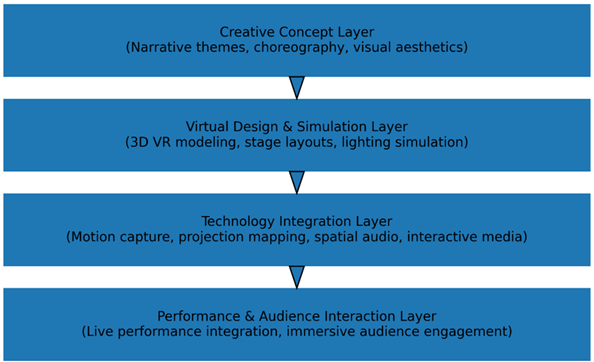
Figure 2 Proposed Architecture
The architecture depicts the four layers that are connected in order to design the stage of VR. The Creative Concept Layer accounts artistic vision such as storyline themes, choreography and visual aesthetics. It is Virtual Design and Simulation Layer which allows designers to develop and test 3D stage environments with VR platforms. The Technology Integration Layer uses the technology of motion capture, projection mapping, interactive media and spatial audio to bring the virtual designs into real time stage setting. Lastly, the Performance and Audience Interaction Layer combines immersive technology with live performances and allows interactive engagement of the performer, new digital settings, and audiences.
5.3. Integration of Artistic and Technological Components
Among the most important issues that need to be tackled when working on VR-based stage design is making sure that technological factors are used in a way that does not overwhelmingly affect the artistic part of the performance. The suggested system focuses on harmonious combination of creative artistic approach and technological breakthrough. Designers have to take into account the role of digital stage elements in narration, emotion, and visual symbolism. To illustrate, the VR environments may be applied in establishing dynamic stage transitions that indicate a change in time, place, or the mood during a performance. Likewise, interactive visual components can react to gestures of the performer and improve the expressiveness of choreography or theatrical movement. When combined with technological features and artistic intentions, the stage design may make the overall aesthetic experience of the performance richer by means of immersion Abu-AlSondos (2023).
5.4. Workflow for Virtual Stage Design Implementation
The stage design that relies on VR usage is the process with a well-developed workflow that starts with the concept development and script analysis. At this stage, designers determine the visual subjects and space demands of the performance. The second step is a virtual stage modeling which is where designers make a virtual model of the stage environment using a VR design software. Such models enable the creative teams to experiment with various scenographic concepts and develop the stage arrangements in a collective manner. The third stage is simulation and technical integration in which the designers check the features of the interaction, lighting systems, and motion tracking technologies in the virtual world. This phase follows through and makes sure digital stage components work before they are implemented live. Lastly, performance deployment phase deploys the VR-based design in the stage production of the performance. Interactive presentation, digital forecasts, and booming audio are synchronized with the actions of performers to produce the whole stage experience. All in all, the attempt to create a conceptual framework shows that the possibilities to integrate VR technologies into the stage design processes can be organized well. Ensuring the integration of the elements of immersive visualization, interactive technologies, and workflows, the framework offers a systematic model of progressing the innovation in the modern production on the stage.
6. Case Studies of Immersive Stage Productions
6.1. VR-Based Theatre and Performance Experiments
Over the past years, a number of production of experimental theatrical works have experimented with the Virtual Reality (VR) in order to design stage experiences. Experiments that involve VR-based theatre are frequently a mixture of conventional performance with digital space which can be explored by the viewers with the help of VR-headsets or interactive installations. Another interesting practice is the establishment of fully virtual performance spaces where actors are staged in digitally built space, and recorded by motion tracking systems. Through these performances, the viewers can view theatre in different ways, such as being able to move around the virtual stage set and view the play through numerous angles. Theatrical VR has also been applied to discover new forms of storytelling where storytelling is enacted within interactive virtual worlds. As an example, immersive VR projects can enable viewers to track various characters in a storyworld, to have their own experiences of performance. These experiments show that VR can redesign theatrical space and push the limits of the traditional stage design.
6.2. Immersive Digital Theatre Projects
The combination of physical stage performances and digital visual technologies including projection mapping, augmented reality overlay and virtual scenography are used in immersive digital theatre projects. In such productions, digital environments address performers and change dynamically in the process of performance. An example of this kind of projection mapping is that of projection mapping, which enables the designer to turn stage surfaces into animated landscapes or architectural scenes which change during the storyline.
A number of modern theatre performances have integrated immersive digital technologies to provide visual dynamic environments, which react to lighting, sound effects, and movement of actors. The discussed projects demonstrate that digital scenography can be employed to improve storytelling by establishing smooth movement between scenes and spaces. Immersive theatre also helps to engage viewers more because it tends to place people in the middle of the action through high-energy presentation of visual-auditory elements that are not confined to the stage Ballerini et al. (2024).
6.3. Applications in Concerts, Dance, and Multimedia Performances
In addition to theatre, immersive technologies are starting to be applied in concerts, dances, and productions with multimedia on the stage. Massive concerts usually make use of virtual stage setting, holographic representation, and interactive projection to build visually spectacular experience. Digital imagery in dance performances can be traced in motion capture systems and interactive visual projections by providing a visual effect synchronized with the movement of the dancers to add up to the choreography. Multimedia performance art is often a combination of live performance and digital animation, VR simulation and immersive sound design. These mixed performances combine the line between physical and digital art. Through the application of immersive technologies in performance design, performers can develop complex imagery narratives that develop in real-time to present audiences with very interactive experiences. Jadhav et al. (2025)
6.4. Lessons Learned from Existing Productions
The discussion of immersive stage production shows that there are some major lessons to be made in the future evolution of VR-based stage design. To begin with, immersive technologies can strongly help improve the process of visual narration and engagement in the audience when considered carefully as a part of the creative process. Digital technologies cannot substitute the traditional stagecraft but are best deployed to supplement the physical performance aspects and aid in the narration. Second, immersive productions demand a robust cooperative effort on the part of artists, designers, technologists, and engineers. Immersive stage design requires skills in artistic and technical fields, as it is an interdisciplinary field. The working production space can assist in making sure that technological systems will work without problems and contribute to the artistic idea of the performance. Third, the immersive technologies bring new possibilities of participation and spatial exploration by the audience. Allowing audiences to engage in performance spaces or relish stories through multi-point of view, immersive stage design can change the passive spectator experience into a more active and participatory one. Desai et al. (2026)
Lastly, the technical reliability and proper planning are also emphasized in immersive stage performances. Digital systems, motion tracking systems, and VR platforms should be able to work in real-time in order to sustain the immersion of the audience during live shows. With the ongoing development of immersive technologies, further productions on stage will probably incorporate physical scenography and digital environment to produce new and more engaging experiences of performance.
7. Challenges and Ethical Considerations
7.1. Technical Infrastructure and Cost Barriers
VR and immersive technologies that have integrated into stage design demand considerable technological infrastructure and may pose a major challenge to performing arts organizations. The adoption of VR based production systems is typically associated with special hardware like VR headsets, motion capture systems, high-performance computers, real-time rendering engines, and projection. Not only is financial investment needed in these systems but also technical skills in terms of installing, maintaining and operating. Vasanthan et al. (2023)
In the case of big production houses and technologically developed theatres, it could be possible to use immersive technologies. Smaller theatre companies, solo artists and local cultural entities can be challenged by insufficient financial resources and technical support, though. Such differences can promote the appearance of technological gap in the performing arts industry where only the well-endowed institutions can afford to explore the potential of immersive stage design fully. To solve these types of barriers in costs, it is necessary to create accessible tools, open-source technologies, and collaborative production settings that can help to expand the range of immersive design practices.
7.2. Learning Curve for Artists and Designers
The other issue of significance in regards to the immersion stage design is the learning curve that must be taken by the artists, designers, and production teams. The background of traditional stage designers is usually in scenic painting, construction of physical models, lighting design and stagecraft. Nevertheless, the stage design of VR necessitates other competencies associated with digital modelling, real time rendering software, interactive media programming and virtual environment design.
To most artists, it might be difficult to adapt to such new technological tools if the artist does not have experience using digital design platforms. This learning curve can slow down the production processes at the initial stages of adoption. In order to surmount the challenge, performing arts institutions might have to invest in training programs, interdisciplinary education and working jointly with technology experts among artists. Playing an important role can also be played by educational institutions that teach performing arts and stage design since they can include training in digital scenography and immersive technology in their curricula. Rawandale and Kolte (2024)
7.3. Maintaining Artistic Authenticity
Although the use of immersive technologies offers great visual and interactive potential, its application in stage design raises the issues of the preservation of the artistic truth. The traditional focus of performing arts is a human expression and physical presence, and the direct contact between the performers and the audiences. The overuse of digital technologies can create the threat of displacing the sense of emotion and the artistic expression that live performances possess.
Stage designers have, therefore, a great responsibility to strike a balance between technology and the artistry. Immersive technologies must support storytelling and acting instead of the stage being full of technologies. Designers ought to make the digital elements to be in line with the narrative, emotional, and thematic meaning of the performance. It is necessary to maintain this balance in order to preserve the specific features of live theatre and performing arts traditions. Venkata et al. (2025)
7.4. Accessibility and the Digital Divide
Another ethical issue in the introduction of immersive technologies in performing arts is accessibility. Although VR and digital platforms can increase the reach of the audience through making it possible to participate remotely and hold virtual performances, they are not always available to all audiences to access technology and enjoy it. VR devices, high-speed data networks, and other equipment can not be so readily accessible to every viewer.
On the same note, the artists and cultural organizations
within developing countries might experience restrictions on access to advanced
technological resources. This digital disparity has the potential to develop
unequal access to engagement in immersive performance practices. To secure fair
representation in accessing the immersive technologies, inclusive design, cheap
technological solutions, as well as the supportive policies towards
technological access in the cultural sector are requisites. Patil et
al. (2025)
7.5. Ethical Use of Digital Performance Technologies
There are also some ethical concerns of intellectual property, cultural representation and data privacy with regard to the use of digital technologies in stage design. There can be creation and access to performance information in digital space, virtual avatars, and motion capture video, which should be handled in a responsible manner. The artists and performers should agree explicitly on how their digital representation of their work will be owned and used.
Moreover, immersive technologies can be based on the digitalization of cultural performances and established art activities. Designers need to care about the fact that such representations are culturally authentic and do not misrepresent or purport cultural heritage. Ethical principles and responsible online conduct are thus needed to guard the rights of artists, performers and cultural groups.
In general, although Virtual Reality and immersive technologies present the revolutionary potential of stage design, to be implemented in the performing arts, technical, educational, and ethical issues will have to be managed to introduce it into the workflow in a responsible and sustainable way.
8. Future Directions in Immersive Stage Design
8.1. Artificial Intelligence in Stage Visualization
In the future, Artificial Intelligence (AI) is likely to contribute greatly to the progress of immersive stage design. The AI design tools could help the stage designers to create visual concepts, optimize the stage designs, and simulate performance environments. Intelligent software can be used to examine the spatial layouts, lighting schemes and sightlines in order to suggest viable stage design solutions. Also, automated animation and real-time visual effects can be assisted through AI, where the designer can develop dynamic stage setups that change according to the performance streamline. With the continually developing AI technologies, they can be used to offer assistance in design that is intelligent to support the progression of creativity and efficiency in stage production processes.
8.2. Extended Reality (XR) Performance Spaces
VR is part of the Extended Reality (XR), which also includes Augmented Reality (AR) and Mixed Reality (MR). In the future, the performance spaces will be redefined by the use of Extended Reality (XR). XR technologies allow creating hybrid spaces in which the physical elements of the stage can be easily integrated with digital visual solutions. Such technologies enable the performer to respond to remote objects, characters, or sceneries displayed on the stage area. XR performance spaces have a possibility to be more widely used in theatres and performance spaces in the future, where the design of the performance space can form flexible conditions on the stage that can change immediately based on the story or the artistic vision of the show.
8.3. Metaverse-Based Theatre Experiences
The notion of the metaverse has brought new opportunities in conducting performances and stage design. The metaverse is a network of connected virtual space in which users may interact in digital avatars in immersive digital worlds. Within the performing art sector, metaverse-based theatre may enable viewers across various regions of the world to watch the performances in common virtual space. Stage designers are able to establish completely digital theatres where the performance takes place in the virtual landscape of the imagination that is not confined by the physical constraints. These spaces can be used to facilitate interactive storytelling where the audience can get into virtual performance areas and communicate with the performers in real time. Even at a developmental phase, metaverse theatre can become a valuable area of development of the accessibility and internationalisation of performing arts.
8.4. Smart Stages and Interactive Performance Environments
The next generation stage setting will encompass smart technologies that design the responsive and adaptive performance spaces. Smart stages can include sensors, motion tracking, artificial intelligence and real-time data processing to allow a dynamic response to stage environments based on performer actions. An example is that lighting systems can automatically vary with movement patterns and digital projections can change with choreography or dramatic indications. Performing arts like theatre can have an improved expressive possibility by having the elements of the stage work as active contributors to the story.
Moreover, the development of spatial audio, holographic displays, and immersive projection system will help to create highly advanced stage settings that will be physically and digitally integrated. These technologies can allow to create full immersive theatrical experiences where viewers are enclose in the world of active visual and auditory experience.
In general, it is possible to state that the future of immersive stage design will be more connected with the increased use of digital technologies, artificial intelligence, and interactive media systems. Through the integration of the technology and artistry, the designers of the stage will have the possibility to generate the novel types of performance spaces, which will broaden the scope of the traditional theatre and offer the audience the most engaging and immersive cultural experiences.
9. Conclusion
The paper study the Virtual Reality (VR) and immersive technologies into the design of the stage is a major twist in the world of performing arts. Traditionally, stage design has been based on physical sets, lighting system and scenic to provide visual environments which assist in storytelling and artistic expression. Even though these traditional methods have yielded great theatrical experiences over the ages, they are usually limited in physical capability, costs of production and logistic issues. The introduction of digital technology, especially VR and other immersive technologies, has created new opportunities to redesign the construction of the feel of the stage environment, visualization, and visualization. This study has analyzed the changing relationship between stage design and immersive technologies and has shown how Virtual Reality is increasingly becoming a need in modern performance production. The research examined the role of VR to improve stage prototyping, digital scenography, and interactive real-time environments to enable designers to test the creative ideas in virtual immersive environments. Design tools that use VR allow design production teams to create visual representations of the stage layout, lighting setup, and space relations prior to actual building. The capability enhances efficiency and minimizes errors in designs, as well as, encourages more interactive creative work among directors, designers and technical experts. The comparative evaluation of the analysis provided in the present research showed that the VR-based stage design has a number of benefits over the conventional scenographic techniques, such as the increased flexibility of the design, the increased efficiency of the production, and the increased ability to immerse the audience. Meanwhile, the research has reinforced the fact that conventional stagecraft is necessary to maintain the embodied and expressive nature of live performance. The combination of a physical stage component and digital technologies in balanced form can thus offer the best way to the future stage production. The conceptual framework of VR-based stage design proposed demonstrated the way through which the use of immersive technologies can be integrated into the process of creative work. Through the synthesis of artistic visioning, virtual design tools, integration of technology and interaction with the audience, the framework offers a systematic approach of the implementation of immersive stage environments. The examples of immersive theatre productions further showed that digital technologies could add to visual narration, invite people to engage with the narrative, and increase the scope of performance spaces. Although immersive technologies will allow making a significant transformation, a number of challenges will have to be tackled to make their adoption effective and responsible. These obstacles are demand of technological infrastructure, financial obstacle, necessity of interdisciplinary training, and ethical implication of digital representation and cultural authenticity. These challenges will be overcome by working together with artists, technologists, educators, and cultural institutions to create easy to use tools, training, and ethical standards on immersive performance design. In the future, more new technologies can be identified, including artificial intelligence, extended reality (XR), and stage design performances based on the metaverse, which will have an even more prominent impact on the development of stage design. Such innovations can support the development of more interactive and dynamic staging conditions that transform the audience and artistic performance. The future of a stage design and performance production will become reliant on immersive technologies as they grow more advanced and take on a more significant role in the design process. Finally, the controlled use of the VR and immersive technologies has a promising potential to develop and open up the creative opportunities without losing the cultural and artistic values that make the performing arts so special.
CONFLICT OF INTERESTS
None.
ACKNOWLEDGMENTS
None.
REFERENCES
Abu-AlSondos, I. (2023). The Impact of Business Intelligence System (BIS) on Quality of Strategic Decision-Making. International Journal of Data and Network Science, 7(4), 1901–1912. https://doi.org/10.5267/j.ijdns.2023.7.003
Antchak, V. (2017). Portfolio of Major Events in Auckland: Characteristics, Perspectives and Issues. Journal of Policy Research in Tourism, Leisure and Events, 9(3), 280–297. https://doi.org/10.1080/19407963.2017.1312421
Ballerini, J., Yahiaoui, D., Giovando, G., and Ferraris, A. (2024). E-Commerce Channel Management on the Manufacturers’ Side: Ongoing Debates and Future Research Pathways. Review of Managerial Science, 18, 413–447. https://doi.org/10.1007/s11846-023-00645-w
Behmanesh, H., and Brown, A. (2025). Improving the Design and Management of Temporary Events in Public Spaces by Applying Urban Design Criteria. Journal of Urban Management. Advance Online Publication. https://doi.org/10.1016/j.jum.2025.06.010
Carmona, M. (2019). Principles for Public Space Design: Planning to do Better. Urban Design International, 24(1), 47–59. https://doi.org/10.1057/s41289-018-0070-3
Desai, V. P., Shinde, P. P., Mirajkar, G. S., Pillai, P. K., and Oza, K. S. (2026). Assessment of Adulteration in Edible Oil Using Machine Learning. IAENG International Journal of Computer Science, 53(1), 456–464.
Finkel, R., and Platt, L. (2020). Cultural Festivals and The City. Geography Compass, 14(1), e12498. https://doi.org/10.1111/gec3.12498
Gohar, N., and Ragab, T. S. (2021). Local Events as a Temporary Urbanism Tactic for Public Spaces Revival. In Proceedings of the International Conference on Silk Road Sustainable Tourism Development and Cultural Heritage (pp. 43–58). Cham: Springer. https://doi.org/10.1007/978-3-031-31027-0_5
Haefner, N., Wincent, J., Parida, V., and Gassmann, O. (2021). Artificial Intelligence and Innovation Management: A Review, Framework, and Research Agenda. Technological Forecasting and Social Change, 162, 120392. https://doi.org/10.1016/j.techfore.2020.120392
Jadhav, K. D., Bhilare, M., Patil, M., and Ali, S. S. (2025). Bridging Knowledge Gaps: Conceptual Frameworks for Inclusive Learning Dissemination in Development Impact Assessment. Enterprise Development and Microfinance, 35(1), 223–242. https://doi.org/10.3362/edm.v35i1.17
Karachalis, N. (2021). Temporary use as a Participatory Placemaking Tool to Support Cultural Initiatives and Its Connection to City Marketing Strategies: The Case of Athens. Sustainability, 13(4), 1652. https://doi.org/10.3390/su13041652
Kothare, H. J., Lanjewar, S. S., Wankhede, M. V., Bagadte, V. R., and Polke, A. (2025). Wireless Bluetooth Low Energy (BLE) Voltmeter: A Modern Solution for Remote Voltage Monitoring. International Journal of Advances in Electrical and Electronics Engineering, 14(1), 6–10. https://doi.org/10.65521/ijaeee.v14i1.324
Liu, M., and Nijhuis, S. (2020). Mapping Landscape Spaces: Methods for Understanding Spatial-Visual Characteristics in Landscape Design. Environmental Impact Assessment Review, 82, 106376. https://doi.org/10.1016/j.eiar.2020.106376
Mehan, A., and Mostafavi, S. (2024). Emerging Technologies in Urban Design Pedagogy: Augmented Reality Applications. Architectural Intelligence, 3, 29. https://doi.org/10.1007/s44223-024-00067-y
Mistry, H. K., Mavani, C., Goswami, A., and Patel, R. (2024). The Impact of Cloud Computing and AI on Industry Dynamics and Competition. Educational Administration: Theory and Practice, 30(7), 797–804. https://doi.org/10.53555/kuey.v30i7.6851
Patil, R. V., et al. (2025). Decentralized Autonomous Organizations as Emerging Economic Entities in Accounting and Governance Frameworks. International Journal of Accounting and Economics Studies, 12(4), 166–177. https://doi.org/10.14419/1sy2j677
Rawandale, U. S., and Kolte, M. T. (2024). Improving the Hearing Aid System Using Optimized Variable Bandwidth Filter Based on Wolf Optimization. Multimedia Tools and Applications, 83, 79503–79531. https://doi.org/10.1007/s11042-024-19748-x
Shakibamanesh, A., Ghorbanian, M., Izadi, S., Riahi, A., and Zeifodini, P. (2025). Utilizing Virtual Reality in the Participatory Urban Policy-Making Process: A Step Toward Facilitating Effective Citizen Engagement. International Journal of Human Capital and Urban Management, 10, 371.
Stevens, Q., and Dovey, K. (2023). Temporary and Tactical Urbanism: (Re)Assembling Urban Space. New York, NY: Routledge. https://doi.org/10.4324/9781003284390
Uršič, M., and Cotič, T. (2025). The Limited Role of Socio-Ecological Indicators in Temporary Use of Space: Deficits in Revitalization of Degraded Urban Areas. Sustainability, 17(11), 5224. https://doi.org/10.3390/su17115224
Vasanthan, R., Jeyarani, J., and Karthikeyan, J. (2023). Harnessing the Benefits of Translingualism for English Language Education in India. Journal of Law and Sustainable Development, 11(6), e1196. https://doi.org/10.55908/sdgs.v11i6.1195
Venkata, S. B., Ashirova, A., Karwande, V. S., Aruna, T., Kholiyarov, E., and Singh, S. (2025). Towards Accurate Maritime Surveillance: A Hybrid CNN-Transformer Architecture for Ship Detection in SAR Imagery. International Conference on Innovations in Intelligent Systems: Advancements in Computing, Communication, and Cybersecurity (ISAC3 2025). https://doi.org/10.1109/ISAC364032.2025.11156808
Verma, D. A., Kale, A., Agarwal, K., Chandratreya, A., Rani, A., and Ajani, S. N. (2026). Digital Preservation and Intelligent Innovation in Traditional and Modern Arts. Shodhkosh: Journal of Visual and Performing Arts, 7(1s), 1–3. https://doi.org/10.29121/shodhkosh.v7.i1s.2026.7169
|
|
 This work is licensed under a: Creative Commons Attribution 4.0 International License
© ShodhKosh 2026. All Rights Reserved.