ShodhKosh: Journal of Visual and Performing ArtsISSN (Online): 2582-7472
|
|
Virtual Performance Spaces and the Future of Live Art Experiences
Dhanalakshmi V 1 , Shanthi P 2
 , Damodaran
B 3
, Damodaran
B 3 , Nishaa
Bharathi M 4
, Nishaa
Bharathi M 4 , Veda
Vijaya T 5
, Veda
Vijaya T 5 , Cheng
Xinwen 6
, Cheng
Xinwen 6
1 Assistant
Professor, Department of Computer Science, Meenakshi College of Arts and
Science, Meenakshi Academy of Higher Education and Research, India
2 Department of Visual Communication,
Meenakshi College of Arts and Science, Meenakshi Academy of Higher Education
and Research, India
3 Associate Professor,
Department of Psychology, Meenakshi College of Arts and Science, Meenakshi
Academy of Higher Education and Research, India
4 Meenakshi College of
Physiotherapy, Meenakshi Academy of Higher Education and Research, India
5 Professor, Department of
Pharmacology, Meenakshi Ammal Dental College and Hospital, Meenakshi Academy of
Higher Education and Research, India
6 Faculty of Psychology,
Faculty of Management, Shinawatra University, Thailand, Research Fellow, INTI
International University, Malaysia
|
|
|
ABSTRACT |
|
|
The rapid
evolution of digital technologies caused the radical shift of the environment
of performing arts and new virtual performance spaces were developed that are
transforming the manner in which live art experiences were being developed,
delivered, and experienced. Traditional performing arts have always been
premised on the physical space and close association between the acting and
the audiences. However, in recent years, the development of immersive
technologies, including, virtual reality (VR), augmented reality (AR), mixed
reality (MR), motion capture systems, spatial audio technologies, and
cloud-based streaming devices has made it possible to create dynamic virtual
space and expand the limits of artistic expression to the stage. In this
paper, the concept of virtual performance space and its role in
revolutionizing the future of live performance of art will be discussed. The
paper includes the review of literature of the present research on digital
performing arts and review of the technologies which are involved in creating
the illusion of immersible virtual performance environments. Various digital
performance platforms, including live streaming platforms, virtual theatre
platforms, and metaverse environments, are evaluated through the comparative
analysis with the following criteria being evaluated: immersion,
accessibility, interaction with the audience, scalability, and flexibility of
production. Based on this discussion, it is proposed that a conceptual design
of the virtual performance spaces be developed, comprising of the integration
of immersive media technologies, interactive tools of audience participation
and cloud based distribution infrastructures. Besides, the provided framework
is predicted to be utilized in serving the whole lifecycle of digital
performance production, including content creation and virtual staged design,
real-time engagement with the audience and performance analytics. |
|||
|
Received 23 December 2025 Accepted 24 March
2026 Published 03 April 2026 Corresponding Author Dhanalakshmi
V, dhanalakshmiv@maher.ac.in
DOI 10.29121/shodhkosh.v7.i3s.2026.7324 Funding: This research
received no specific grant from any funding agency in the public, commercial,
or not-for-profit sectors. Copyright: © 2026 The
Author(s). This work is licensed under a Creative Commons
Attribution 4.0 International License. With the
license CC-BY, authors retain the copyright, allowing anyone to download,
reuse, re-print, modify, distribute, and/or copy their contribution. The work
must be properly attributed to its author.
|
|||
|
Keywords: Virtual Performance Spaces, Digital Performing Arts,
Virtual Reality, Augmented Reality, Immersive Media, Audience Engagement,
Interactive Storytelling, Metaverse, Digital Culture |
|||



1. INTRODUCTION
1.1. Background of Performing Arts in the Digital Era
Traditional enactment of performing arts like the theatre, dance, music, and multimedia performances have usually been carried out in physical places where the performers and the audience inhabit the same time and space. These plays are very much dependent on human interaction, stage design, lighting, sound, and live audience interaction to come up with artistic experiences of significance. Traditionally, the main point of the meeting between artistic expression and audience is theatres, concert halls and cultural buildings. Nevertheless, the accelerated growth of digital technologies in the last 20 years has changed the process of the production, distribution, and experience of the artistic content dramatically. The age of digital has brought a lot of new tools and platforms which have pushed the limits of the performing arts. High-definition video streaming, virtual reality (VR), augmented reality (AR), motion capture systems, and immersive media environments are the technologies that are making artists experiment with new types of performance and storytelling. Digital enables performance to be captured and shared and viewed worldwide thus transcending the geographical and physical boundaries. This change was further boosted by the COVID-19 pandemic as theatres, festivals, and performing arts organizations started moving online to communicate to their audiences elsewhere Arn (2023).
1.2. Emergence of Virtual Performance Spaces
These spaces are spaces which are digitally created in which performances are staged, experienced and interacted with using online platforms, virtual reality environments or metaverse-like systems. The virtual environments of performances have made it possible, unlike in the olden days, to have artists and audiences participating in the performances without being physically co-located in the same place.Immersive technologies like VR headsets, motion capture, 3D rendering engines and interactive digital platforms have enabled the development of virtual performance environments. Such technologies help performers to look like digital developments, communicate with the elements of the virtual stage, and involve the audiences in the immersion of the storytelling experience. As an example, one might consider digital performances in which the actors work with virtual stages and dynamic backgrounds and special effects that cannot be realized in real theatres. Moreover, it is possible to have new kinds of audience engagement in the virtual performance spaces. The viewers have the opportunity to watch performances in the virtual reality environment or interactive streaming space or on a digital event space where they see the performance environment, communicate with the other audience, and control the elements of the performance itself. This kind of development points out towards a change in the consumer approach of the audience towards more interactive and participatory experience.
1.3. Impact of Digital Technologies on Live Art Experiences
The digital technologies are basically revolutionizing the production and consumption of live art experience. The approaches of virtual reality, augmented reality, mixed reality, artificial intelligence, and streaming platforms on clouds have broadened the range of creative opportunities that can be offered to artists and performance designers. Immersion and interaction on the stage are among the effects of digital technologies, as well as increased engagement of the audience. Virtual reality spaces enable the audience to experience that they are physically present in a performance space, whereas augmented reality can superimpose digital components on real performance. Motion capture technologies help performers to manipulate digital avatars in real time so that a performance can be executed in all-digital worlds. The other significant effect is the spread of accessibility. Online performance platforms enable audiences in various geographical locations to be in a position to attend performance even remotely thus making cultural experiences democratic. Artists have access to the world without logistical problems of touring or the restrictions of a venue Coulstring (2023).
Figure 1

Figure 1 Conceptual Relationship Between Technology, Art, and Audience Experience
In Figure 1, the correlation between the digital technologies, creative arts and spectators engagement in the process of creating a virtual live art experience is provided. The highest level of the digital technologies is Virtual Reality (VR), Augmented Reality (AR), Artificial Intelligence (AI), and cloud platforms facilitating enabling tools that create immersive performance environments. These technologies have two significant aspects which are influenced. The former can be artistic creative, and it incorporates the elements of storytelling, digital scenography, and hybrid performances, a mixture of physical and digital art. The second element is the audience engagement, in which viewers are engaged in interactive viewing, immersion, and social interaction in virtual worlds. The artistic creativity and the interaction with the audience creates a dynamic ecosystem that improves the total performance experience. Collectively, the elements result in the formation of virtual live art experiences, in which viewers are involved in the digital performances instead of all passively watching. This model brings out the aspect of technological innovation that can turn the traditional performing arts to the immersive and interactive cultural experience.
1.4. Research Problem and Motivation
Even though the use of digital technologies in the performing arts is on the rise, little has been done, in terms of research, on how the virtual performance spaces can sufficiently substitute or supplement the experiences that live arts can offer. The performing art that is traditional is highly reliant on instantaneousness, physical contact between the audience and the performer, and creation of mutual emotional context within physical spaces. It is specifically challenging to transfer these aspects to the virtual world. The existing digital performance platforms are more inclined towards being originally more of live streaming or mere online broadcasting, and this may not be capable of recreating the same experience and involvement with live performances. Moreover, not every virtual performance system has created a framework that would integrate immersive technologies, audience engagement system, and performance analytics within the same architecture. This research is inspired by the desire to find the way how new digital technologies can be introduced in order to create effective virtual performance space to enhance artistic creative power and the experience of the audience. The suggested study will generate a conceptual framework of how virtual performance environments are to evolve in the future through the assessment of the current technological solutions and the creation of their deficiencies Dean (2024).
2. Literature Review
2.1. Evolution of Digital Performing Arts
The evolution of the digital technologies impacted the alteration of the performing arts considerably within the last several decades. Conventionally, performing arts like theatre, dance, music and opera were based on the use of physical space and direct contact between the performers and the audience. With the introduction of digital media and communication technologies, though, there has been an increase in what can be produced and presented in arts. The initial digital versions were primarily the recording of performances to archive them or to air them on television and the Internet. These activities facilitated greater distribution of artistic works yet still a very passive audience experience was achieved. With the development of digital technologies, artists and cultural institutions started introducing the aspect of multimedia into live performances. The development of high-speed internet, advanced graphics processing, and interactive software over the past few years has only intensified the digital performing art development further. The COVID-19 pandemic was the key factor in boosting the digital transformation in the performing arts industry. As theatres and performance spaces shut down, artists and organisations turned to the digital world in order to continue their connection with their audiences. Online theatre production, online concerts, and online festivals became the new forms of art. Consequently, the definition of digital performing arts has moved beyond the recording of digital media to as immersive virtual performances, interactive installations, and hybrid performance formats that merge the physical and the digital space of performance Heller et al. (2023).
2.2. Virtual Reality and Augmented Reality in Performance
The VR and AR technologies have grown to be significant in the creation of immersive performing art experiences. The VR technology allows to create the digital environments that are fully simulated and the performers and audiences can be interacted with. Using VR headsets and motion tracking systems, the viewers are able to watch the shows in various perspectives and visit a virtual stage and appreciate the interactive nature of the storyline. It has also been used in experimental theatre productions, in digital dance performances and in immersive story-telling experiences where the traditional stage space has been removed. Conversely, Augmented Reality is a superimposition of some digital content on the real environment and allows similar performances to be enhanced by digital effects. AR technologies can be used to superimpose virtual characters, scenery, and visual effects over real staging or audience space so as to create a hybrid space in which the real world is incorporated into the virtual world. Artists can communicate with virtual objects, visual imagery, or online characters, which increases the opportunities of creativity.
2.3. Online Performance Platforms and Digital Stages
Online performance systems have emerged as key platforms upon which digital performances can be offered to the audiences across the world. Video-sharing sites, social media platforms, and special virtual event platforms allow streaming platforms to stream performances in real time or share recordings of productions by artists. The digital stages allow artists to cut geographical boundaries and reach more people who would not access live cultural activities. A digital stage is an imaginary space where performances may be created, broadcast and enjoyed online. Digital stages are usually associated with the number of cameras such as multi-cameras streaming, audience interaction in real-time, and virtual audience rooms with the possibility of communication between viewers with each other. Other sites can also incorporate new technologies like virtual reality simulators and 3-D performance areas, where viewers can watch the performances in virtual digital environments Lee (2022).
2.4. Audience Engagement in Virtual Performances
The interest of the audience is one of the key success factors of a traditional and virtual performance. The reaction of the audience to the performance in terms of applause, laughter, and other feelings is part of the physical theatre environment setting. It is quite difficult to recreate this sense of a shared experience in a virtual setting. Online performance websites are trying to solve this problem with the introduction of interactive performances like live chats, reactions of viewers, polls, and other virtual applause systems. These features enable viewers to interact with other audience and performers whenever there is a performance in order to feel like they are participating together. Other platforms allow the audience to personalize their visual perspectives, navigate virtual performance worlds, or communicate with digital characters in the narrative environment.
2.5. Immersive Media and Interactive Storytelling
The new opportunities to storytelling in performing art presented by immersive media technologies have offered fresh prospects. In comparison to the traditional linear narratives, immersive storytelling enables the audience who is engaged in the exploration of the narrative environments and can impact the development of the narrative. The use of technologies 3D virtual environments, spatial audio, and interactive interface allows viewers to watch the performance in various perspectives and take part in the building of the narrative.
Table 1
|
Table 1 Literature Review of Recent Research on Virtual Performance Spaces |
||
|
Methodology |
Key Contributions |
Limitations |
|
Comparative literature
analysis and thematic analysis Lin (2023) |
Demonstrates how VR and AI
technologies enable immersive artistic experiences and transform creative
production processes |
Mainly
theoretical review with limited empirical validation (jatit.org) |
|
Structural equation modeling (PLS-SEM) Mondloch (2022) |
Identifies factors such as
psychological distance, social interaction, and accessibility that influence
audience participation in metaverse performances |
Focused
mainly on audience perception rather than technological design
(ScienceDirect) |
|
Experimental evaluation with
student participants Purić (2024) |
Shows that immersive 360° VR
video can place viewers inside dramatic scenes, improving experiential
understanding |
VR
immersion may cause disorientation and requires specialized equipment (Taylor
& Francis Online) |
|
Survey data analysis using
structural equation modelling Schuld (2023) |
Identifies experiential
attributes such as immersion, enjoyment, and visual appeal that affect
emotional responses to AR performances |
Study
conducted in a theme park context, limiting generalizability to theatre
venues (ScienceDirect) |
|
Design research and
prototype testing Sutton (2017) |
Demonstrates how VR can
replicate aspects of physical theatre environments and enable remote
participation |
Limited
scale experiments with small user groups (Centrum Wiskunde
& Informatica) |
|
User experience evaluation
and performance recording experiments Vaidya et al. (2025) |
Shows potential of
VR-captured performances to create realistic theatre experiences for remote
audiences |
Lack
of real-time interactivity between performers and audience (OARS) |
|
Qualitative case study and
audience perception analysis Bringsjord and Govindarajulu (2024) |
Highlights how immersive
theatre transforms spectators into active participants, strengthening
cultural engagement |
Focuses
mainly on physical immersive theatre rather than fully digital environments
(MDPI) |
|
Experimental user study with
20 participants Browne (2021) |
Demonstrates that virtual
audience avatars increase perceived social presence and engagement during AR
performances |
Small
participant sample and early-stage prototype system (arXiv) |
The Table 1 below highlights the growing importance of the virtual performance space as a middle space between the performing art and digital media, and the human computer interaction, and suggests the need of superior structures, integration of immersive technologies, analytics and creative production tools to the audience.
3. Technologies Enabling Virtual Performance Spaces
The advent of virtual performance spaces is highly motivated by the development of digital technologies that allow creating an immersive environment, interact in real time, and be accessible to people worldwide. Such technologies are changing the face of traditional performing arts by incorporating the digital platform, interactivity, and sophisticated computational technology. Virtual performance settings are based on a set of immersive visualization solutions, motion tracking systems, audio processing systems, and smart digital infrastructures that provide interesting and interactive artistic experiences. This part provides the presentation of the most important technologies which help in creating and developing virtual performance spaces and make it possible to experience the new life forms of arts.
Figure 2
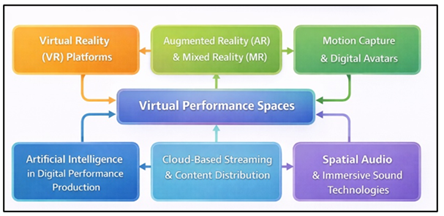
Figure 2
Technologies
Enabling Virtual Performance Spaces
3.1. Virtual Reality (VR) Platforms
Virtual Reality (VR) environments are instrumental in creating completely immersive digital performing environments. VR technology enables users to engage with simulated three-dimensional spaces with the usage of head-mounted visuals and motion tracking. Regarding performing arts, VR platforms develop virtual stages where performers and viewers can play in environments on which they share digital space. The VR-based performance systems give the audience the opportunity to watch performances in different points of view, simulate virtual stage spaces, and engage in interactive storytelling experiences. Artists are able to create active digital stages which include sophisticated visual effects, animated background and spatial dynamics which would not have been possible or difficult in a real theatre. Remote participation is also possible in VR platforms, where other viewers in various geographical areas can be present at performances at the same time sharing a common virtual space. Moreover, VR technology helps to offer immersive narrative platforms, as it puts the audiences in the middle of the performance space. Rather than watch a performance with a fixed viewpoint, the viewers can walk around the virtual space and get in contact with digital aspects of the performance Browne (2021).
3.2. Augmented Reality (AR) and Mixed Reality (MR)
This enables the performers to engage the virtual stageings and have a connection with the physical performance spaces. In the arts, AR can be used to add visual effects, virtual props and interactive characters to the stage, which interact with live performers. As an example, a dancer can work with digitally generated images on the stage floor and this forms a hybrid space performance environment where physical movement mixes with digital images. Fixed Reality further extends the possibilities provided by making it possible to interact in real-time between the physical and virtual objects in the same environment. MR systems enable performers and viewers to control computerized objects that seem to exist in the physical spaces. This technology favors innovative performance formats in which digital and physical components do not oppose each other.
AR and MR technologies find application especially in hybrid performance in which live stage performances are supplemented by digital storytelling aspects. The technologies also facilitate interaction between the audience by making use of interactive mobile applications that enable viewers to obtain more digital contents when they are performing.
3.3. Motion Capture and Digital Avatars
Motion capture technology is one of the most essential elements to virtual performance systems since it enables the physical movements of performers to be converted into digital animations in real time. Motion capture systems involve the use of sensors, cameras and special software to follow the movement of the performers and translate it to digital characters or avatars. Digital performance environments consist of digital avatars who are the virtual embodiment of performers in digital stages. Such avatars are able to imitate the gestures, facial expressions and body movement of the performers, enabling artists to act in totally virtual worlds. Motion capture technology allows the appearance of realistic characters in the digital form, which can react with the items of the virtual stage and other participants in real time. This has been very popular in the digital theatre, animation performances and virtual concerts. Motion capture costumed performers have the ability to play digital characters in real time, enabling audiences to view acts in virtual worlds that are occupied by animated avatars. Motion capture technology also enables actors to work together even at a distance through coordinating their actions in virtual spaces.
3.4. Spatial Audio and Immersive Sound Technologies
Sound is important in forming perceptions and emotional involvement of the audience in the performance spaces. The use of spatial audio and immersive sound technologies adds depth to virtual performances by providing a sense of a realistic soundscape, which changes according to the movement and perspective of the audience. Spatial audio systems can recreate how sound propagates in a physical space and enables the audience to experience the direction of sound, distance, and motion in a virtual space. Spatial audio can be used together with VR or AR environments to form some of the most immersive auditory experiences, which can make virtual performances more realistic. To demonstrate this, in a virtual concert setting, the capability of spatial audio technology enables the listeners to listen to the instruments and performers located in various positions depending on the location of the audience in the virtual concert hall. This acoustic sound environment recreates the sound of live performance in physical spaces Cao et al. (2024).
3.5. Cloud-based Streaming and Content Distribution
The technologies of cloud computing are critical in facilitating the massive distribution of digital performances. Online platforms offer the system that facilitates live performances, online content hosting, and interactive services with the audience on a global scale. Through streaming technologies, the performances can be streamed to the audience that is in other regions of the world in real time. Cloud-based systems oversee storage, processing and distribution of large multimedia files and therefore the delivery of high-quality video and audio content can be made possible in an efficient manner to reach various devices. Such sites also facilitate cooperative production processes and artists, designers and technicians can work together even at a distance. Digital content, stage design and performance data among distributed creative teams can be shared using cloud-based tools.
3.6. Artificial Intelligence in Digital Performance Production
AI in digital performance production is rapidly being incorporated into creative, automated, and interactive aspects of performance production. The AI technologies may help artists to create the digital images, design the stage setting, and adaptive narrative experiences. Machine learning algorithms have the ability to study the behavior and preference of the audience to tailor the performance experiences. As an example, recommendation systems powered by AI can recommend performances depending on the interests of the viewers, and real-time analytics systems may dynamically manipulate the aspects of a performance depending on how viewers engage it. Other ways AI can be used creatively include generative art and automated lighting design, as well as virtual character animation. Also intelligent systems can create dynamic stage imagery, simulate the effects of the environment or even run digital avatars in virtual performance. Moreover, conversational agents and virtual characters which are powered by AI are capable of engaging audiences with performances to provide interactive narrative experiences. These technologies allow new practices of participatory storytelling in which the audience has to make choices that affect the course of the performance.
4. Existing Virtual Performance Platforms and Systems
The high pace of digital technologies development has resulted in the emergence of different virtual performance platforms where artists are able to offer performance in online and immersive spaces. Such platforms are used to sustain various types of digital performances, such as basic live streaming platforms or more immersive metaverse-based art spaces. Virtual performance systems seek to recreate or to improve traditional performing arts experiences through the introduction of digital technologies into the experience: virtual reality, interactive media, real-time communication tools, and cloud-based streaming infrastructures. This section provides an overview of the key categories of virtual performance platforms that are currently presented in the performing arts industry and their potentials and shortcomings.
4.1. Virtual Theatre Platforms
Virtual theatre platforms Virtual theatre platforms are digital spaces that are specifically used to perform theatrical productions within an online or immersive virtual space. The platforms enable theatre productions to be acted and seen in digitally designed spaces that recreate a conventional theatre setting or open up new digital approaches to stage design. Most virtual theatre systems employ 3D virtual worlds where actors are represented by digital avatars as a result of either motion capture technology or real-time animation systems. These systems allow actors to work under virtual stage settings that have programmed lighting effects, computer-generated landscape, and interactive graphics. There are also not limited by physical stage space like in traditional theatre spaces and therefore allows designers to design creatively and make the stage space imaginative and visually complicated. Others are virtual theatre productions that employ full immersion virtual reality environments in which spectators accompany productions with VR headsets. In these types of performance, the spectators are free to move around the virtual theatre, see plays in various positions and engage with other spectators. This interactive style is more effective in increasing the involvement of the audience as they feel like they are a part of the performance space.
4.2. Live Streaming Performance Systems
Live streaming performance systems constitute one of the most commonly used approaches towards providing virtual performance arts experience. These systems enable real-time broadcasting of performances with the use of digital platforms, including video streaming services, social media networks, and special platforms on online events. Live streaming services offer a relatively easy and convenient means of artists and organizations to connect with the world. The performances can be captured with the help of a number of cameras and delivered directly to the audience via the internet-based devices, including computers, smartphones, and smart televisions. This will enable a big portion of the performing arts audience to extend its presence globally in that geographical settings can also attend cultural events. Live chat, real time audience feedback and virtual audience reactions are some of the common features of streaming systems. These interactive devices enable viewers to interact with the performers and other audiences in the process of live broadcasting. Virtual ticketing systems, merchandise and analytics of viewers are also features that are supported by some advanced streaming platforms.
Live streaming performance systems are limited in some ways, even though they are popular. The spectacle generally is passive and the audience observes the acts via a fixed camera angle. Streaming sites do not provide audiences with an opportunity to immerse themselves in virtual worlds as immersive virtual environments do since they cannot visit the performance space or engage directly with the performers. Consequently, the experience could be more of viewing recorded media as opposed to experiencing a live art event Cao et al. (2023).
4.3. Metaverse-Based Art Performances
One more immersive and interactive digital performing arts is the idea of the performance platforms based on the metafyses of the metaverse. The metaverse can be described as permanent virtual worlds in which individuals communicate with one another using digital avatars in the common digital realms. The metaverse can be used in performing arts in the following way: artists can design artificial performance spaces, where viewers and performers live in an online environment. The performances using the metaverse are usually held in 3D virtual spaces, which replicate concert halls, theatres, or completely imaginary digital spaces. The audience is immersed in these spaces via customizable avatars where they can move around the performance area, engage with the other audience members and interact with computational aspects of the performance. As an example, virtual concerts can have animated stage environments, digital visual effects, and interactive experiences with the audience, which react to user input. The possibility to create incredibly immersive experiences that cannot be constrained by the prohibitions of the traditional production on the stage is one of the greatest benefits of metaverse-based performances. Artists will be capable of creating virtual worlds that are dynamically changing during performances and providing spectacles of visual art and interaction with viewers.
4.4. Interactive Digital Concerts and Events
Another category of significant interactive digital concerts is the virtual system of performance. Interactive digital concerts, in contrast to traditional live streaming systems, include real-time audience interaction and multimedia interaction. Many of these performances are based on the digital platforms where the audience can engage with the performers, manipulate the visuals on the stage, or be part of the joint artistic experiences. Such interactive concert systems can also feature audience controlled lighting effects, virtual applause system, electronic voting systems and instant messaging. These characteristics enable viewers to actively contribute towards the formation of the performance environment. Interactive digital concerts in certain circumstances make use of the gaming technologies or the use of the virtual world to design interactive performance spaces. The viewers can access virtual concert halls, communicate with other members, or play mini-games and interactive activities devoted to the performance. These interactive systems are common especially in music performances, electronic concerts and multimedia art festivals. Interactive online concerts that use the gamification principles and socialization allow developing the interactive digital concerts as a source of interesting entertainment that will attract digitally connected people. But planning efficient interactive concert systems only comes with close coordination of the performers, technology developers, and organizers of the events. Such technical obstacles as latency, synchronization problems, and scalability of the platform should be overcome in order to provide seamless performance experiences Cetinic and She (2021).
5. Comparative Analysis of Virtual Performance Systems
5.1. Evaluation Criteria for Virtual Performance Spaces
In order to determine the efficiency of virtual performance systems, there are a number of technological and experiential parameters that should be taken into account. These assessment criteria can be used to estimate the extent to which a platform facilitates immersive performance spaces and engagement of the audience. Immersion Level: Immersion is defined as the level of how fans experience being in the performance space. Immersion is usually greater in platforms that operate on technologies like virtual reality, spatial audio, and three-dimensional environments than on simple live streaming platforms. Audience Interaction: Interactive features are essential in the process of reproducing the participatory quality of live performances. Social platforms that enable real-time feedback of audience, interaction in form of an avatar, or a collaborative engagement provide more interactive experiences. Accessibility and Device Compatibility: Accessibility assesses the ability of the audience to watch performances with the help of the widespread devices: smartphones, laptops, or VR headsets. Other platforms are highly accessible and reach more people since they reduce technological barriers. Scalability: Scalability is the capability of a platform to handle high amounts of simultaneous participants. Digital events that are hosted on the cloud tend to take the form of scalable infrastructures that can support an event that has a global audience. Visual and Audio Quality: Good graphics, animation, and spatial audio of visual performance play an important role in terms of the involvement and realism of the audience in the virtual performance. Flexibility in Production: The more flexible a platform is in terms of letting artists customize stage design, integrating digital assets, and experimenting with creative technologies, the more artistic flexibility is guaranteed More and Birmule (2025).
5.2. Comparative Analysis of Existing Platforms
Table 2
|
Table 2 Comparative Analysis Table of Existing Virtual Performance Platforms |
|||||||
|
Platform Type |
Immersion Level |
Audience Interaction |
Accessibility |
Scalability |
Visual & Audio Quality |
Production Flexibility |
Limitations |
|
Live Streaming Platforms |
Low |
Limited (chat, comments) |
Very High |
Very High |
Medium |
Low |
Limited interactivity and
immersive experience |
|
Virtual Theatre Platforms |
Medium |
Moderate (avatar
interaction, live feedback) |
Medium |
Medium |
High |
High |
Requires specialized
platforms and production tools |
|
VR Performance Platforms |
Very High |
High (immersive
participation) |
Low–Medium |
Medium |
Very High |
High |
Requires VR hardware and
high technical infrastructure |
|
Metaverse-Based Platforms |
Very High |
Very High (avatar
interaction, social presence) |
Medium |
High |
High |
Very High |
Complex infrastructure and
high development cost |
|
Interactive Digital Concert
Platforms |
Medium–High |
High (real-time reactions,
voting) |
High |
High |
High |
Medium |
Limited environmental
immersion compared to VR |
|
Hybrid Digital Performance
Systems |
High |
High |
Medium–High |
High |
High |
Very High |
Requires coordination
between multiple technolog |
As seen in the comparative analysis presented in Table 2, there is no existing platform that would offer an ideal mix of immersion, accessibility, and scalability. All types of platforms are relevant to their particular issues of digital performance experiences and have their own distinctive technological challenges.
5.3. Performance Metrics for Audience Experience
Viewer experience is one of the most important criteria in assessing the performance systems in virtual performance. The perception and interaction of digital performances by an audience may be evaluated with several performance metrics. Engagement Level: Engagement is used to determine the level of audience involvement in a performance. The engagement rates of the audience can be viewed through the metrics, e.g. the number of chats, the number of reaction, the number of interaction features. Presence and Immersion: The presence here is the degree to which the audience perceives that they are immersed in the virtual environment of the performance. Spaces based on VR technologies and spatial audio typically score higher on presence. Interaction Quality: Kumar and Jadhav (2023)
Interaction quality measures the effectiveness of the audience in communicating with performers and other actors. Higher quality of interactions is supported by real-time communication tools, interaction based on avatars, and interactive mechanisms of storytelling. User Satisfaction: User satisfaction represents the general impression of the performance experience. The level of satisfaction among the participants is often determined by the way surveys and user feedback have been carried out. Technical Performance: Technical performance comprises of the following metrics: System latency, streaming quality and platform stability. Poor technical performance will spoil continuous audience experiences. Through such performance measurements, scholars and programmers can find ways of enhancing the virtual performance systems and increasing the digital audience participation.
5.4. Graphical Evaluation of System Performance
Graphical analysis tools as indicated in Figure 3 presents a graphical description of the performance of various virtual performance platforms in the various assessment criteria. The most common charts used to show the difference between types of platforms are comparative charts, radar diagrams, and performance graphs. As an example, a comparative review graph can examine live streaming applications, VR demonstration structures, and metaverse spaces according to such variables as immersion, accessibility, interaction, scalability, and visual quality. These graphical illustrations assist the researcher to know the strengths and weaknesses of various technologies. In most cases, live streaming platforms will be rated highly in terms of access and scalability but low in terms of immersion and interactivity. VR-based platforms are highly ranked in terms of immersion and interaction yet might have a low rating on accessibility because of the hardware needs. The platforms written in the metaverse tend to be balanced in terms of immersion and interaction and need sophisticated technological equipment to provide effective work. Graphical analysis is also useful in indicating the aspects where improvement can be made technologically. As an example, the combination of immersive technologies and scalable cloud-based systems may be used to design virtual performance platforms with high levels of immersion and accessible globally. Suri et al. (2025)
Figure 3
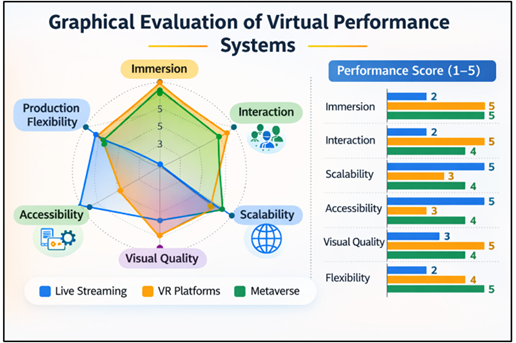
Figure 3 Evaluation of Virtual Performance
6. Proposed Framework for Virtual Performance Spaces
The augmenting popularity of immersive technologies in the performing arts industry necessitates a systematic structure that would support the design, creation and provision of the virtual performance. The existing platforms are more likely to focus on the unique technological features of such services as streaming or virtual worlds instead of providing an ecosystem that integrates the performers, audiences, digital infrastructure, and interactive technologies. Therefore, a common framework is required to create the virtual performance environments to be immersive, scalable, interactive and artistically meaningful. The proposed framework of the virtual performance space includes immersive technologies and real-time interaction systems, cloud infrastructure, and intelligent analytics tools, to support the whole lifecycle of digital production in performance. The structure is created in order to promote an effective interaction between the performers, designers and audiences and to form very entertaining and interactive works of art. Ganesan et al. (2025)
6.1. Components of the Proposed System
As it is implied in Figure 4, the proposed model includes several major components that work together to render digital performances immersive. A virtual developed performance environment where performers and spectators interact. The virtual stage can have live lighting, animation background and interactive stage effects. Devices that allow gamers to play with computerized worlds and control online personalities. Motion capture devices, VR controllers, and digital performance software assist the performer in transferring the physical performance onto a digital performance.A system in which the audience is interactive on the performance via avatars, chat systems, reaction systems, and interactive storytelling systems. A cloud-based solution is a system that is in charge of delivering performance content to the audiences of different devices and different geographic regions.
There is a technology layer that deals with 3D graphics, spatial audio processing and real time animation. A knowledge-based aspect that monitors the involvement, the behavior of interaction, and the quality of performance indicators of the listeners. These lessons may be used to second by maximizing the performance experiences and inform the creative decision making process. All these factors combined will form a complete ecosystem that will facilitate the creation and delivery of the digital performances that are immersive. Rawandale et al. (2025)
Figure 4

Figure 4 Proposed Framework for Digital Performance
6.2. Workflow of Virtual Live Art Production
Virtual live art production workflow consists of a number of steps that organize the process of creation of art, technological advancement, and combating the audience. It starts with the development of concepts in which artists and designers establish the narrative structure, performance style and digital environment of the production. In this phase, productive teams cooperate to create the image and interactivity of the performance. Content creation follows where performers capture data on motion capture, designers create digital stage environments and audio engineers create immersive soundscapes. After the creation of the digital assets, they are incorporated into the virtual performance space through the use of game engines or virtual production platforms. Also, interactive aspects and the involvement of the audience are introduced at this phase. Performance delivery stage is broadcasting or hosting the performance using digital mediums that enable people to engage in real time participation. The infrastructures based on the clouds make sure that the performance can be viewed by the people in various locations. Lastly, the post-performance analysis is performed using the data of audience engagement, feedback survey, and performance metrics. These lessons can enhance performance in the digital world in the future and optimize production policies.
6.3. Integration of Audience Interaction and Analytics
Virtual performance spaces are characterized by audience interaction. In contrast to the traditional performance where the audience is mostly a viewer, the digital environment can enable an audience to be involved in the artistic experience. Live chat, avatars communication, instant reaction, and storytelling mechanisms allow the audience to interact with the performers as well as other viewers. These communication tools are useful in replicating the shared experience of live performances in the virtual world. Besides facilitating interaction, the virtual performance systems are capable of gathering useful information regarding behavior of the audience. Measures that can be tracked using the analytics tools include the time spent by the viewer, the frequency of interactions, in-game movement, and involvement in an interactive activity. These lessons are a good source of information to the performers and the production teams. To provide an example, artists can see what aspects of a performance attract the audience the most and change future productions. Virtual performance structures can be used to generate dynamic and individual performance experiences by combining audience interaction systems with more sophisticated analytics tools. Moulick et al. (2025)
7. Challenges and Future Research Directions
The opportunities of artistic expression and connection with the audience have been opened in virtual performance spaces and several issues remain to be explored to ensure that digital performance space becomes effective and sustainable. These challenges are technological limitations, authenticity and emotional interest challenges, access and intellectual property challenges. All these concerns should be addressed to foster the future of the virtual performing arts and build the inclusive digital cultural ecosystems. Some of the most prominent pitfalls include a technological constraint and infrastructure requirements. Immersive technologies of every type (Virtual reality, augmented reality, motion capture systems, and spatial audio) demand high-quality hardware, specialized software, and constant high-speed internet connectivity. A majority of artists and other cultural organizations may lack the money or technical expertise to do big with these technologies. Network latency, bandwidth deficiency and compatibility issues with the system can also affect the quality of the virtual performances and derailment of the audiences. Further studies should focus on ensuring the introduction of scalable and interoperable technology infrastructures to promote immersive performance settings and reduce hardware dependencies. The other drastic quandary is linked to the aspect of authenticity and the sense of emotion in online works of art. Traditional performing arts rely heavily on action, instantaneous performance reaction, and the sense of community of the performance spaces. The audiences can be introduced to the performances in virtual spaces with the help of digital avatar or the screen that can reduce the sense of immediacy and emotional engagement. To enhance the emotional presence, scholars should find new means of doing so by applying high-quality models of interaction, realistically portrayed avatars, and immersive story telling techniques.
Access and digital divide is also an issue. Although virtual performance spaces allow reaching more people in the entire globe, not all people are equipped with a high-performance device, virtual reality equipment, or internet access. This digital divide would also make certain classes of individuals ineligible to have access to digital cultural experiences accidentally. The next research should therefore be on developing lightweight and device-free platforms that are capable of reaching the popular technologies such as smart phones and web browsers. The other issue is the field of intellectual property and the digital rights management. The reproduction of digital output is simple and can be replicated and documented and reused without any consent and this brings out the question of ownership and fair compensation of artists. These problems can be countered with the help of digital distribution systems, blockchain based authentication systems and more effective copyright systems. However, virtual performance space can create good opportunities in research and future through innovation. The upcoming technologies and data-driven audience analytics, artificial intelligence, and reactive performance space can enhance interactive storytelling and reactive performance space. The collaboration between artists, technologists and researchers will be interdisciplinary to arrive at sustainable virtual performance ecosystems that will combine technology development and artistic expression. Banerjee and Hazarika (2014)
8. Expected Outcomes and Impact
The creation of virtual performance spaces is deemed to have a tremendous impact on the transformation of performing arts through the integration of immersive technologies with creative arts and engagement with spectators. The virtual performance environments offer the use of digital platforms, immersive media, and real-time interaction tools to create new possibilities of the cultural engagement and artistic expression. The suggested model of virtual performance spaces is expected to enhance the level of accessibility, serve the audience better, and promote the existence of digital culture sustainably.
8.1. Transformation of Audience Experience
Online performance spaces are fundamentally changing how the performances are consumed by the audience. As opposed to the conventional theatrical environments where people watch performances sitting in the fixed seat, the immersive technologies provide the viewer with the experience of interacting and dynamic performance. By using technologies like virtual reality, augmented reality and spatial audio, the audience is able to experience virtual performance spaces, talk with the performers via digital avatars and participate in the story telling aspects in real time.
8.2. Global Accessibility of Performing Arts
Virtual performance platforms are important in increasing access to performing arts by eliminating geographical and physical boundaries. The digital platforms allow artists to offer performances to the world population with the help of online streaming platforms, virtual worlds, and metaverse platforms. The viewers of various countries and cultural backgrounds are able to attend performances without travelling to real places. This greater availability facilitates the cultural exchange, expands the audience and enables performing arts to reach out to a wider spectrum of people in the world.
8.3. New Creative Possibilities for Artists
The digital technologies also allow creating new creative opportunities by combining them with the artists and performance designers. VR environments enable an artist to explore dynamic stage space, interactive-story telling, and multimedia elements of performing that are not confined to conventional theatre. Motion capture technologies, digital avatars and immersive visual effects allow actors to experiment with new forms of expression and work together regardless of the geographical barriers. Such tools promote the creativity of the interdisciplinary approach and promote the emergence of new forms of digital performing arts.
8.4. Sustainable Digital Cultural Ecosystems
The virtual performance spaces are a source of the creation of sustainable digital cultural ecosystems. Online platforms enable artists and cultural organizations to deliver performances effectively and at a lower cost than the physical venue and transport expenses. Moreover, data analytics tools assist organizations in knowing the patterns of engagement of the audience to enhance performance strategies in the future. Through the integration of technology with creativity in art, virtual performance spaces can enable sustainable cultural practices in the long run and promote inclusive participation of people in performing arts across the planet.
9. Conclusion
The ever accelerating development of digital technologies has intensively changed the environment of performing arts, and as a result, the virtual performance spaces emerged redefining the manner in which the artistic experiences are produced, presented, and consumed. The paper has examined the changing interaction between performing arts and digital technologies, with the emphasis on how emerging experiences of live art are facilitated by the use of immersive experiences, including virtual reality, augmented reality, and motion capture systems, as well as cloud-based streaming infrastructure. Investigating the current online performance platforms, this study illuminates the increased importance of virtual spaces in terms of broadening the artistic imagination and involvement of the viewers. As it has been revealed in the literature review, the digital performing arts have developed into more than the primitive recording and broadcasting activities and formed the highly immersive and interactive virtual worlds. VR, AR, spatial audio, and artificial intelligence technologies enable artists to create dynamic performance spaces to engage audiences with performances using digital interfaces and an avatars. Such trends have generated novel possibilities of the cultural participation on a global scale and have put in question the conventional concept of performing on a stage, and engaging the audience. The analysis of the existing virtual performance platforms reveals that the gap between them is quite high in characteristics of immersion, accessibility, scalability, and interaction. Live streaming sites are very much available, whereas the immersive environment of VR and metaverses provides a higher level of interaction with the audience. However, the problems of technological infrastructure and challenges of access to digital space and also the elements of authenticity and intellectual property also have serious implications on future developing systems of virtual performances. To address these problems, the paper developed a clear idea of virtual performance spaces, and these technologies include the immersive technologies, the interactive communication systems, the cloud-based distribution infrastructures and the data-driven analytics. This platform serves as an enabler of the whole process of digital production of performances, the process that implies the creation of artistic content until the interaction with the audience and evaluation of the performance. In addition, the paper has also determined some of the key applications of the virtual performance technologies; digital theatre, virtual music concerts, immersive dance shows, cultural heritage exhibit, and performing arts education. These applications demonstrate how virtual performance platforms can enhance the creativity of cultures and create an inclusive participation in cultures. Virtual performance space will be a bigger contributor to the future of the live art experiences in the future. The virtual performance platform would be in a position to create immersive, accessible, and sustainable cultural ecosystems through artistry creativity and the development of technology. The additional interdisciplinary collaboration between artists, technologists, researchers and cultural institutions will be vital to the realization of the full potential of digital performing arts, as well as to make sure that virtual performance spaces are not merely vacant spaces
CONFLICT OF INTERESTS
None.
ACKNOWLEDGMENTS
None.
REFERENCES
Arn, J. (2023, November 20). The Sphere and Our “Immersion” Complex. The New Yorker.
Banerjee, R., and Hazarika, I. (2014). Determinants of Financial Performance of Commercial Banks in Dubai, UAE: A CAMELS Model Analysis. In International Proceedings of AWBMAMD Conference.
Bringsjord, S., and Govindarajulu, N. S. (2024). Artificial Intelligence. In E. N. Zalta and U. Nodelman (Eds.), The Stanford Encyclopedia of Philosophy (Fall 2024 ed.). Metaphysics Research Lab. Retrieved April 18, 2025, from
Browne, K. (2021). Who (or what) is an AI Artist? Leonardo, 55, 130–134. https://doi.org/10.1162/leon_a_02092
Cao, S., Jiang, W., Wang, J., and Yang, B. (2024). From Man vs. Machine to Man + Machine: The Art and AI of Stock Analyses. Journal of Financial Economics, 160, Article 103910. https://doi.org/10.1016/j.jfineco.2024.103910
Cao, Y., Li, S., Liu, Y., Yan, Z., Dai, Y., Yu, P. S., and Sun, L. (2023). A Comprehensive Survey of AI-Generated Content (AIGC): A History of Generative AI from GAN to ChatGPT. arXiv.
Cetinic, E., and She, J. (2021). Understanding and Creating Art with AI: Review and Outlook. ACM Transactions on Multimedia Computing, Communications, and Applications, 18, 1–22. https://doi.org/10.1145/3475799
Coulstring, M. (2023). iPhone History: From the Original Iphone to Iphone 16. Seamgen. Retrieved December 18, 2024, from
Dean, B. (2024). Snapchat Demographic Stats: How Many People Use Snapchat? Backlinko. Retrieved December 18, 2024, from https://backlinko.com/snapchat-users
Ganesan, M. P., Vasanthan, R.,
Govindaraj, C., Nabi, M. S. M., and Chong, S. T. (2025). Intelligent Learning Analytics for Adaptive Curriculum Design: A Multi-Modal Behavioural Study of
Student Engagement. OIDA International Journal of Sustainable
Development.
Heller, A., Sarnitz,
S., and Spiel, H. (2023). Luna Luna.
Phaidon Press.
Kumar, C., and Jadhav, K. (2023). Antecedents of Ecotourism Development: An Empirical Analysis of Case Study in Maharashtra. Academy of Marketing Studies Journal, 27(1), 1–9.
Lee, L. (2022). Worlds Unbound: The Art of Teamlab. Intellect. https://doi.org/10.1386/9781789384499
Lin, J. (2023). Old is the New: Immersive Explorations in Another Beautiful Country—Moving Images by Chinese American Artists. Arts, 12, Article 224. https://doi.org/10.3390/arts12060224
Mondloch, K. (2022). The Influencers: Van Gogh Immersive Experiences and the Attention-Experience Economy. Arts, 11, Article 90. https://doi.org/10.3390/arts11050090
More, S. S., and Birmule, P. R. (2025). Technology-Based Scheduling and Event Management in Sports. International Journal of Research and Development in Management Research, 14(1), 50–54. https://doi.org/10.65521/ijrdmr.v14i1.288
Moulick, J., Phursule, R., Kale, A. P., Rana, V. S., Goswami, S., and Karwande, V. S. (2025). Real-Time Crypt Analysis and Defense Mechanisms in Cloud Computing Services. Journal of Discrete Mathematical Sciences and Cryptography, 28(5), 1753–1761. https://doi.org/10.47974/JDMSC-2175
Purić, B. (2024). Inside André Heller’s Luna Luna: The First and Only Art Amusement Park, Rediscovered After Decades. Loophole. Retrieved December 10, 2024, from
Rawandale, U. S., Kotkar, S., and Middha, S. (2025). Self-Learning Adaptive Hearing Aid Filter Using Q-Learning. In 2025 International Conference on Information, Implementation, and Innovation in Technology (I2ITCON) ( 1–6). https://doi.org/10.1109/I2ITCON65200.2025.11210507
Schuld, D. (2023). Augmented Reality and
the Dematerialization of Experiential Art. Arts, 12, Article 116.
https://doi.org/10.3390/arts12030116
Suri, S., Lakshman, K., Goyal, E., Goyal, G., Sood, G., Mirajkar, G. S., and Anerao, P. (2025). Emotion Modeling in Sculpture Design Using Neural Networks. ShodhKosh: Journal of Visual and Performing Arts, 3(3s), 31–40. https://doi.org/10.29121/shodhkosh.v6.i3s.2025.6756
Sutton, G. (2017). Between Enactment and Depiction: Yayoi Kusama’s Spatialized Image Structures. In Yayoi Kusama: Infinity mirrors. Hirshhorn Museum and Sculpture Garden.
Vaidya, C., Chopade, S., Khobragade, P., Bhure, K., and Parate, A. (2025). Development of a Face Recognition-Based Attendance System. In 2025 12th International Conference on Emerging Trends in Engineering and Technology – Signal and Information Processing (ICETET-SIP) ( 1–6). https://doi.org/10.1109/ICETETSIP64213.2025.11156883
|
|
 This work is licensed under a: Creative Commons Attribution 4.0 International License
© ShodhKosh 2026. All Rights Reserved.