ShodhKosh: Journal of Visual and Performing ArtsISSN (Online): 2582-7472
|
|
Financial Sustainability in the Creative Economy: Investment Behaviour and Value Creation in the Visual Arts Sector
Dr. Monika Rana 1
 ,
Dr. Beena Devi 2
,
Dr. Beena Devi 2 , Dr.
Krishna Kumar TP 3
, Dr.
Krishna Kumar TP 3 ,
Dr. Sachin Chavan 4
,
Dr. Sachin Chavan 4 ,
Dr. Poonam Rehal 5
,
Dr. Poonam Rehal 5
1 Assistant
Professor, School of Management Studies, CGC University, Mohali, Punjab, India
2 Assistant
Professor, Bachelor of Business Administration, Maharaja Surajmal Institute, Affiliated
to GGSIPU, Dwarka, Sec-16 Delhi, India
3 Professor and Head, Nehru School of Management @NCERC, Pamapadi,
Thiruvilwamala, Thrissur, Kerala, India
4 Professor, Balaji Institute of International Business, Sri Balaji
University, Pune, India
5 Assistant Professor, Amity School of Business Administration, Amity
University, Punjab, India
|
|
|
ABSTRACT |
|
|
Creative
economy prosperity and sustainability financially in the long term hinge on
the changing sources of funds and investment patterns mostly in the visual
arts sector, where creative production frequently relies on short-term
changes in funding. In this paper, the points that will be highlighted are
that sustainable investment practices coupled with value creation processes
can enhance the economic stability of the artists, galleries, and cultural
institutions. Government strategic investments, as well as those of the
private and financial institutions, can help fund creative production and
create economic, cultural, and symbolic value, which can contribute to
sustainable development in the creative economy. Moreover, innovative
financial and management approaches like diversified financing systems,
online art platforms, and joint partnerships should be implemented in
cultural institutions to increase the level of financial stability and
audience interaction. The conceptual framework can be further developed in
future research where empirical studies can be undertaken to determine the
relationships between investment behavior, value creation, and financial
sustainability in the visual arts sector. A comparison between various
cultural and economic settings can also reveal more insight into the role of
policy frameworks and investment environment in determining the
sustainability of the creative industries. Moreover, the analysis of the
effects of new technologies, including digital art markets, virtual exhibitions,
and blockchain art platforms, might help to obtain valuable information about
the opportunities of new investments and value-generating processes of new
creative economy. |
|||
|
Received 20 December 2025 Accepted 17 March 2026 Published 28 March 2026 Corresponding Author Dr.
Monika Rana, monikarana.1502@yahoo.in DOI 10.29121/shodhkosh.v7.i2s.2026.7297 Funding: This research
received no specific grant from any funding agency in the public, commercial,
or not-for-profit sectors. Copyright: © 2026 The
Author(s). This work is licensed under a Creative Commons
Attribution 4.0 International License. With the
license CC-BY, authors retain the copyright, allowing anyone to download,
reuse, re-print, modify, distribute, and/or copy their contribution. The work
must be properly attributed to its author.
|
|||
|
Keywords: Creative Economy, Financial Sustainability,
Investment Behaviour, Cultural Value Creation, Visual Arts Sector |
|||



1. INTRODUCTION
Creative economy is becoming a well-recognized determinant of economic growth, cultural development, and social change. The cultural and creative sectors are important for creating employment opportunities, fostering innovation, and enhancing national competitiveness. These sectors encompass visual arts, music, film, design, architecture, and digital media, which, in turn, generate cultural and economic value. The visual arts industry has a unique role among these industries because of its ability to provide cultural expression, as well as the opportunity to make economic gains through art markets, galleries, and exhibitions. The sharp rise in the significance of creative industries has made the issue of creative economy interesting to policymakers, investors, and scholars alike, to gain knowledge about the economic dynamics of the creative economy. Cultural production is a source of artistic innovation and a very important factor in the formation of cultural identity and social activity. Nevertheless, financial sustainability is one of the greatest issues for artists and cultural institutions. The visual arts sector is prone to unpredictable sources of revenue, such as private investments, government grants, and philanthropic support, rather than being relatively stable, as in traditional industries. Creative industries are highly dependent on investment behaviour to influence their financial sustainability. The decisions made by collectors, individual investors, governments, and cultural institutions about whether to invest in art affect the availability of financial resources to produce art. The implementation of sustainable investment practices has been gaining popularity in recent years because it has shown the potential to enable long-term economic development and environmental sustainability Azam et al. (2022), Hunjra et al. (2022).
The concepts of green finance and responsible investment strategies have also been adopted as major tools for sustainable economic development. The studies have suggested that sustainable development objectives and economic resilience are partially attributable to environmentally responsible investment decisions Bei and Wang (2023), Yin et al. (2023). Such developments underscore the increased overlap between financial sustainability and larger sustainability programs. The creation of art can be an important factor in ensuring sustainability, too. Art has been employed to create awareness of the environmental issues and promote sustainable practices within communities Bloch and Verchere (2019), Rodriguez-Labajos (2022). The resulting effect of cultural activities is therefore economic growth, as well as environmental and social sustainability.
Despite these developments, few studies have examined the effects of investment behaviour on the creation of value and financial sustainability in the visual arts industry. Most of the current research focuses on sustainable finance or environmental policy, whereas comparatively little is known about the contribution of cultural industries to sustainable economic development. In this research, the gap is filled by shaping a conceptual framework that connects the elements of investment behaviour and value creation with financial sustainability in the creative economy. The article contributes to the literature by integrating perspectives from sustainable finance, cultural economics, and innovation research to explain how investment decisions determine the economic sustainability of the visual arts industry.
2. Literature Review
2.1. Investment Behaviour and Sustainable Finance
The behaviour of investment is now a significant field of study in the concept of sustainable economic development. Investor decisions on finances affect the economic growth, environmental sustainability, and technological innovation. Financial institutions and policymakers view sustainable investment practices as one way to pursue long-term economic and environmental goals Chan et al. (2022). Green finance has become one of the key mechanisms for promoting sustainable development. Green bonds and sustainable investment funds are some of the financial instruments that can be used to fund environmentally friendly initiatives Taghizadeh-Hesary et al. (2023), Ye and Rasoulinezhad (2023). The research also notes that institutional support is critical to achieving sustainable investment behaviour. By encouraging investors and market-supporting institutions to use resources for environmentally friendly projects, market-supporting institutions can advance sustainable development Azam et al. (2022).
2.2. Value Creation in the Creative Economy
The creative economy values are created through the artistic innovation, cultural expression, and knowledge production. Creative industries result in economic value and also in cultural and symbolic value to the society. Art programs have been found to impact technology innovation and sustainability. Art tendencies tend to respond to environmental and social issues and sustainability within communities Bloch and Verchere (2019), Sanz-Hernández and Covaleda (2021). Value creation has also increased due to the digital revolution in the creative industries. Online exhibitions, Virtual reality, and digital art platforms help artists attract global audiences and generate new sources of revenue Chen and Li (2024), Richesin et al. (2021).
2.3. Financial Sustainability in Creative Industries
Financial sustainability can be defined as a property of organizations to be able to uphold sustainable financial resources and yet remain in the production of economic and social value. The financial sustainability of the creative economy is a matter of a mix of investment flows, market demand, the creation of cultural value, and policy support. Some studies have shown that economic innovation and sustainability policies have significant effects in promoting long-term financial sustainability Deng et al. (2023), Bie et al. (2023). The outcomes of economic resilience and sustainability can be affected by government policies and financial incentives as well as investment strategies Badruddin (2023), Zhang et al. (2023).
3. Theoretical Foundations
The theories of sustainable investment, value creation, and the creative economy provide the conceptual background for this study. Sustainable investment theory describes the impact of financial investments on the long-term economic development and environmental sustainability Taghizadeh-Hesary and Yoshino (2019). The theory of value creation focuses on the fact that organizations create value by being innovative, creative and developing knowledge. Artistic production creates economic and cultural value in the setting of the creative economy. The theory of creative economy also emphasizes on the contribution of cultural industries to economic growth and social development. Cultural identity and economic opportunities. The artistic production is an essential element of the sustainable development strategies Lopez et al. (2017).
4. Conceptual Framework Development
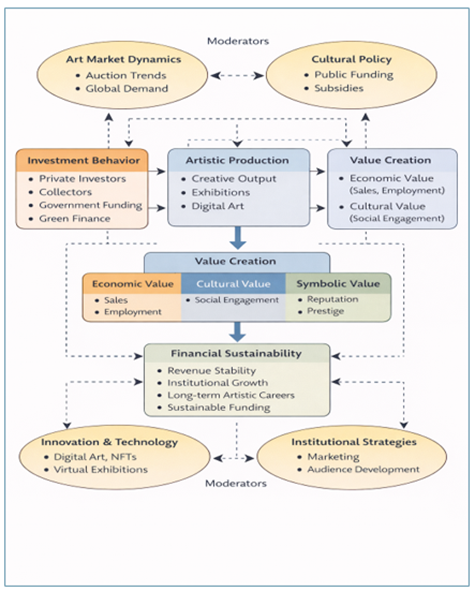
The conceptual framework's hypothesis is that investment behaviour can determine financial sustainability through value creation. Investment behaviour gives financial resources that facilitate the production of art, technological innovation and culture. These investments enable the production of artistic products and cultural experiences that create economic and symbolic value. The visual arts sector comprises value creation that encompasses economic, cultural, and symbolic value. The sale and exhibition in art markets create economic value, whereas cultural value is added to social interaction and heritage conservation.
Such processes of value creation eventually led to financial sustainability by creating stable sources of revenue and institutional resiliency.
Figure 1
Source: Developed
by Researchers
5. Propositions
P1: There is a positive relationship between investment behaviour and production of visual arts.
P2: Creative production has a positive contribution to value creation.
P3: Value creation can positively impact on financial sustainability.
P4: The cultural policy mediates the interdependence between the investment action and value creation.
6. Implications for the Creative Economy
The results of this conceptual research have significant policy implications to policymakers, investors, and cultural institutions that want to enhance financial sustainability in the creative economy, specifically in the visual arts industry. Governments can create favorable policy incentives that can promote sustainable investment in creative industries in form of tax incentives to investors in art, government funding of cultural institutions and grants to the emergent artist. Such policy support will also be able to mitigate financial uncertainties and enhance the growth of cultural industries in the long term and meet cultural industries with other sustainable development purposes Azam et al. (2022), Yin et al. (2023). Another important role belongs to financial institutions and investment organizations that can introduce new funding mechanisms in the form of cultural investment funds, impact investment programs, and green finance initiatives that can promise alternative sources of funds to support the projects in art Taghizadeh-Hesary et al. (2023), Hunjra et al. (2022). With the promotion of the development of the financial ecosystem of the visual arts industry, it is also possible to encourage the growth of capital flows and the production of creative works through stimulating the investment of individuals and the active involvement of collectors, galleries, and auction houses Gutsche et al. (2023), Chan et al. (2022). New sources of revenue and international audiences are also developed due to technological innovations like virtual exhibitions, online art platforms, and immersive media, and thus improve financial sustainability in cultural institutions Chen and Li (2024), Richesin et al. (2021). Besides, the value creation in the visual arts industry goes beyond the monetary payoffs to encompass cultural and symbolic worth since artistic projects may lead to social awareness, cultural identification, and sustainability change Bloch and Verchere (2019), Rodriguez-Labajos (2022). The cultural organizations must thus use strategic management practices like audience development, digital engagement, and international collaborations to develop diversified sources of revenue and institutional resilience. The long-term financial viability of the visual arts sector may be reinforced by combining sustainable investment practices, technological innovation and the creation of cultural value and adding to the overall expansion of the creative economy.
7. Conclusion and Directions for Future Research
The expertise of creative economy and its continuity is pegged on the long-term financial sustainability which further depends on the shifting sources of financing and investment modes especially in the visual arts, where creative production is usually based on short-term investments. The main aspect discussed in this paper is that economic stability of artists, galleries, and cultural institutions can be increased through the involvement of sustainable practices during investment and through the process of value creation. The strategic investments by the government and the privates and financial institutions can assist in funding creative production and creating economic, cultural, and symbolical value, which in turn can lead to sustainable development in the creative economy. Besides, new financial and management strategies, including diversified systems of financing, online art platforms, and collaborative partnerships, ought to be adopted in cultural institutions to improve financial security and viewership. The conceptual framework can also be extended in future researches where empirical research should also be conducted to establish the relationship between investment behaviour and value creation as well as the financial sustainability in the visual arts industry. Comparison of the different cultural and economic backgrounds can also help shed more light on how policy frameworks and the investment environment can influence the sustainability of the creative industries. Furthermore, the study of the implications of the new technologies, such as digital art markets, virtual exhibitions, and blockchain art platforms, could potentially provide some valuable insights into the possibilities of new investments and value-creating processes of the new creative economy.
CONFLICT OF INTERESTS
None.
ACKNOWLEDGMENTS
None.
REFERENCES
Azam, M., Ftiti, Z., Hunjra, A., Louhichi, W., and Verhoeven, P. (2022). Do Market-Supporting Institutions Promote Sustainable Development? Evidence from Developing Economies. Economic Modelling, 116, 106023. https://doi.org/10.1016/j.econmod.2022.106023
Badruddin, A. (2023). Sustainable Low-Carbon Post COVID-19 Recovery Measures Across Sectors in World Economies: A Thematic Analysis on its Coverage. Total Environmental Research Themes, 6, 100045. https://doi.org/10.1016/j.totert.2023.100045
Bei, J., and Wang, C. (2023). Renewable Energy Resources and Sustainable Development Goals: Evidence Based on Green Finance, Clean Energy and Environmentally Friendly Investment. Resources Policy, 80, 103194. https://doi.org/10.1016/j.resourpol.2022.103194
Bie, Q., Wang, S., Qiang, W., Ma, X., Gu, Z., and Tian, N. (2023). Progress Toward Sustainable Development Goals and Interlinkages Between them in Arctic Countries. Heliyon, 9(2), e13306. https://doi.org/10.1016/j.heliyon.2023.e13306
Bloch, J., and Verchere, C. (2019). How Art Places Climate Change at the Heart of Technological Innovation. Journal of Open Innovation: Technology, Market, and Complexity, 5(4), 93. https://doi.org/10.3390/joitmc5040093
Chan, K., Chong, L., Ng, T., and Ong, W. (2022). A Model of Green Investment Decision Making for Societal Well-Being. Heliyon, 8(8), e10024. https://doi.org/10.1016/j.heliyon.2022.e10024
Chen, Y., and Li, X. (2024). Utilizing Virtual Arts in Reforming Market Players' Behavior to Invest in Sustainability Projects. Humanities and Social Sciences Communications, 11, 2750. https://doi.org/10.1057/s41599-024-02750-x
Deng, Z., Song, S., Jiang, N., and Pang, R. (2023). Sustainable Development in China? A Nonparametric Decomposition of Economic Growth. China Economic Review, 81, 102041. https://doi.org/10.1016/j.chieco.2023.102041
Dutta, A., Bouri, E., Rothovius, T., and Uddin, G. S. (2023). Climate Risk and Green Investments: New Evidence. Energy, 265, 126376. https://doi.org/10.1016/j.energy.2022.126376
Gutsche, G., Wetzel, H., and Ziegler, A. (2023). Determinants of Individual Sustainable Investment Behavior: A Framed Field Experiment. Journal of Economic Behavior and Organization, 209, 491–508. https://doi.org/10.1016/j.jebo.2023.03.016
Henderson, K., and Loreau, M. (2023). A Model of Sustainable Development Goals: Challenges and Opportunities in Promoting Human Well-Being and Environmental Sustainability. Ecological Modelling, 475, 110164. https://doi.org/10.1016/j.ecolmodel.2022.110164
Hunjra, A., Azam, M., Bruna, M. G., and Taskin, D. (2022). Role of Financial Development for Sustainable Economic Development in Low Middle Income Countries. Finance Research Letters, 47(Part B), 102793. https://doi.org/10.1016/j.frl.2022.102793
Jiang, B., and Raza, M. (2023). Research on China's Renewable Energy Policies Under the Dual Carbon Goals: A Political Discourse Analysis. Energy Strategy Reviews, 48, 101118. https://doi.org/10.1016/j.esr.2023.101118
Khan, S., Yahong, W., and Zeeshan, A. (2022). Impact of Poverty and Income Inequality on the Ecological Footprint in Asian Developing Economies: Assessment of Sustainable Development Goals. Energy Reports, 8, 670–679. https://doi.org/10.1016/j.egyr.2021.12.001
Li, X., Wu, T., Zhang, H., and Yang, D. (2023). National Innovation Systems and the Achievement of Sustainable Development Goals: Effect of Knowledge-Based Dynamic Capability. Journal of Innovation and Knowledge, 8(1), 100310. https://doi.org/10.1016/j.jik.2023.100310
Lopez, A., Farinha, J., and Amado, M. (2017). Sustainability through Art. Energy Procedia, 119, 752–766. https://doi.org/10.1016/j.egypro.2017.07.102
Quach, S., Septianto, F., Thaichon, P., and Nasution, R. (2022). The Role of Art Infusion in Enhancing Pro-Environmental Luxury Brand Advertising. Journal of Retailing and Consumer Services, 64, 102780. https://doi.org/10.1016/j.jretconser.2021.102780
Rasoulinezhad, E. (2020). Environmental Impact Assessment Analysis in the Kahak's Wind Farm. Journal of Environmental Assessment Policy and Management, 22(1), 2250006. https://doi.org/10.1142/S1464333222500065
Richesin, M., Baldwin, D., and Wicks, L. (2021). Art Making and Virtual Reality: A Comparison Study of Physiological and Psychological Outcomes. The Arts in Psychotherapy, 75, 101823. https://doi.org/10.1016/j.aip.2021.101823
Rodriguez-Labajos, B. (2022). Artistic Activism Promotes Three Major Forms of Sustainability Transformation. Current Opinion in Environmental Sustainability, 57, 101199. https://doi.org/10.1016/j.cosust.2022.101199
Sanz-Hernández, A., and Covaleda, I. (2021). Sustainability and Creativity Through Mail Art: A Case Study With Young Artists in Universities. Journal of Cleaner Production, 318, 128525. https://doi.org/10.1016/j.jclepro.2021.128525
Schulte, J., and Knuts, S. (2022). Sustainability Impact and Effects Analysis—A Risk Management Tool for Sustainable Product Development. Sustainable Production and Consumption, 30, 737–751. https://doi.org/10.1016/j.spc.2022.01.004
Shome, S., Hassan, M. K., Verma, S., and Panigrahi, T. (2023). Impact Investment for Sustainable Development: A Bibliometric Analysis. International Review of Economics and Finance, 84, 770–800. https://doi.org/10.1016/j.iref.2022.12.001
Taghizadeh-Hesary, F., and Yoshino, N. (2019). The Way to Induce Private Participation in Green Finance and Investment. Finance Research Letters, 31, 98–103. https://doi.org/10.1016/j.frl.2019.04.016
Taghizadeh-Hesary, F., Phoumin, H., and Rasoulinezhad, E. (2023). Assessment of Role of Green Bond in Renewable Energy Resource Development in Japan. Resources Policy, 80, 103272. https://doi.org/10.1016/j.resourpol.2022.103272
Tu, Y., Alijumah, A., Nguyen, S., Cheng, C., Tai, T., and Qiu, R. (2023). Achieving Sustainable Development Goals through a Sharing Economy: Empirical Evidence from Developing Economies. Journal of Innovation and Knowledge, 8(1), 100299. https://doi.org/10.1016/j.jik.2022.100299
Wei, Y., Zhong, F., Song, X., and Huang, C. (2023). Exploring the Impact of Poverty on the Sustainable Development Goals: Inhibiting Synergies and Magnifying Trade-Offs. Sustainable Cities and Society, 89, 104367. https://doi.org/10.1016/j.scs.2022.104367
Wen, H., Liang, W., and Lee, C.-C. (2023). China's Progress Toward Sustainable Development in Pursuit of Carbon Neutrality: Regional Differences and Dynamic Evolution. Environmental Impact Assessment Review, 98, 106959. https://doi.org/10.1016/j.eiar.2022.106959
Xu, L. (2023). Role of Belt and Road Initiative in the Development of Renewable Energy: Mediating Role of Green Public Procurement. Renewable Energy, 217, 118963. https://doi.org/10.1016/j.renene.2023.118963
Xu, N., Kasimov, I., and Wang, Y. (2022). Unlocking Private Investment as a New Determinant of Green Finance for Renewable Development in China. Renewable Energy, 198, 1121–1130. https://doi.org/10.1016/j.renene.2022.07.037
Ye, X., and Rasoulinezhad, E. (2023). Assessment of Impacts of Green Bonds on Renewable Energy Utilization Efficiency. Renewable Energy, 202, 626–633. https://doi.org/10.1016/j.renene.2022.11.124
Yin, C., Zhao, W., Fu, B., Meadows, M., and Pereira, P. (2023). Key Axes of Global Progress Towards the Sustainable Development Goals. Journal of Cleaner Production, 385, 135767. https://doi.org/10.1016/j.jclepro.2022.135767
Yoshino, N., Rasoulinezhad, E., Phoumin, H., and Taghizadeh-Hesary, F. (2023). SMEs and Carbon Neutrality in ASEAN: The Need to Revisit Sustainability Policies. Economic Research-Ekonomska Istraživanja, 36(2), 2177180. https://doi.org/10.1080/1331677X.2023.2177180
Zhang, S., Anser, M. K., Peng, M., and Chen, C. (2023). Visualizing the Sustainable Development Goals and Natural Resource Utilization for Green Economic Recovery After COVID-19 Pandemic. Resources Policy, 80, 103182. https://doi.org/10.1016/j.resourpol.2022.103182
Zhang, T. (2021). Research on Environmental Landscape Design Based on Virtual Reality Technology and Deep Learning. Microprocessors and Microsystems, 81, 103796. https://doi.org/10.1016/j.micpro.2020.103796
Zhao, L., and Rasoulinezhad, E. (2023). Role of Natural Resources Utilization Efficiency in Achieving Green Economic Recovery: Evidence from BRICS Countries. Resources Policy, 80, 103164. https://doi.org/10.1016/j.resourpol.2022.103164
|
|
 This work is licensed under a: Creative Commons Attribution 4.0 International License
© ShodhKosh 2026. All Rights Reserved.