ShodhKosh: Journal of Visual and Performing ArtsISSN (Online): 2582-7472
|
|
THE ARCHITECTURE OF GHANSHYAM’S HOUSE: HERITAGE AND THE PRESENT
Dr. Arabinda Rajkhowa 1
 ,
Nobin Buragohain 2
,
Nobin Buragohain 2 , Munmi Dutta 3
 ,
Khagen Pegu 4
,
Khagen Pegu 4 ,
Dr. Ashim Chutia 5
,
Dr. Ashim Chutia 5 ,
Pubali Borah 6
,
Pubali Borah 6
1 Associate
Professor, Department of Assamese, North Lakhimpur University, Assam, India
2 Independent
Researcher, Sivasagar, Assam, India
3 Research
Scholar, Department of Assamese, North Lakhimpur University, Assam, India
4 Research
Scholar, Department of Assamese, North Lakhimpur University, Assam, India
5 Assistant
Professor, Department of Assamese, Sepon College, Dibrugarh, Assam, India
6 Research
Scholar, Department of Assamese, North Lakhimpur University, Assam, India
|
|
|
ABSTRACT |
|
|
The
architectural monuments of the Ahom period constitute some of the most
revered heritage sites of Assam. Among these, Ghanshyam’s House, located on
the western bank of the Jayasagar tank in Sivasagar district, represents a
structure of exceptional architectural and art-historical significance. Built
by Ghanshyamuddin, a Muslim artisan from Kochbehar invited to the Ahom
kingdom during the reign of Swargadeo Rudra Singha (r. 1696–1714 CE), the
monument has received limited systematic scholarly attention. While some
accounts suggest that Ghanshyam may have resided in this building, the
present study argues, on the basis of architectural evidence and field
investigation, that it functioned as a personal shrine constructed by the
craftsman himself. The structure is distinguished by its synthesis of Ahom,
Mughal, and Hindu architectural traditions, its distinctive terracotta
sculptural programme, and its resemblance to the Gaudiya Matha style of
Bengali Vaishnava temple architecture. This study analyses the architectural
form, spatial organisation, sculptural iconography, and conservation status
of this three-hundred-year-old monument, and evaluates its design in relation
to the principles of Vastu Shastra. It is argued that formal recognition of
its historical significance is essential to ensure this irreplaceable
monument receives appropriate scholarly and institutional attention. |
|||
|
Received 19 February 2026 Accepted 04 April 2026 Published 11 April 2026 Corresponding Author Dr.
Arabinda Rajkhowa, arabinda@nlu.ac.in DOI 10.29121/shodhkosh.v7.i4s.2026.7296 Funding: This research
received no specific grant from any funding agency in the public, commercial,
or not-for-profit sectors. Copyright: © 2026 The
Author(s). This work is licensed under a Creative Commons
Attribution 4.0 International License. With the
license CC-BY, authors retain the copyright, allowing anyone to download,
reuse, re-print, modify, distribute, and/or copy their contribution. The work
must be properly attributed to its author.
|
|||
|
Keywords: Ghanshyam’s House, Ahom Architecture, Rudra Singha,
Terracotta Sculpture, Kochbehar, Jayasagar, Medieval Assam, Vastu Shastra |
|||



1. INTRODUCTION
Ghanshyam Khanikar — the master craftsman — occupies a prominent place among the architects of the Ahom period. Although references to Ghanshyam’s life appear in the Assamese historical chronicles (Buranjis), these accounts are neither comprehensive nor detailed, a lacuna that has over time given rise to legendary narratives surrounding his figure. During the reign of Swargadeo Rudra Singha, Ghanshyam is credited with overseeing the construction of a considerable number of permanent brick structures in Assam. Among these, Ghanshyam’s House stands as a particularly notable example, yet no thorough scholarly investigation of this structure has hitherto been undertaken.
The building merits examination from multiple perspectives. As a surviving product of Ghanshyamuddin’s craftsmanship — a Bengali Muslim artist who converted to Hinduism — it preserves an invaluable record of architectural and artistic practice. The sculptural carvings on its walls represent a new artistic synthesis that emerged during the Ahom period, blending Hindu, Mughal, and indigenous Ahom traditions Burhagohain (2021).
The present paper aims to fill a significant gap in the scholarship on Ahom-period monuments. It provides a systematic architectural description of the structure, analyses its sculptural programme, situates it within its broader art-historical context, and evaluates its spatial organisation against the principles of Vastu Shastra. The study also addresses the urgent question of the monument’s conservation status.
Figure 1
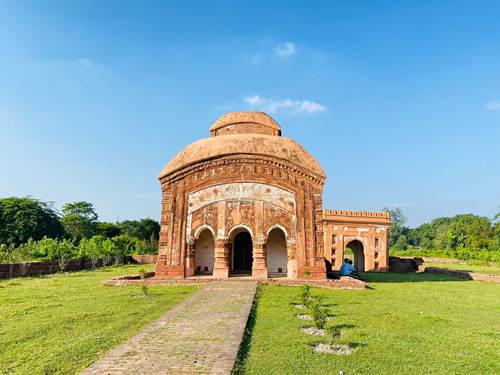
Figure 1 Ghanshyam’s House (Ghanshyamar Ghar) — Front View showing the dome, three-arched entrance, and the gateway structure (right), Jayasagar, Sivasagar District, Assam
2. METHOD
This study employs a mixed-methods approach combining primary field investigation with secondary documentary analysis. The primary data source is the structure of Ghanshyam’s House itself, examined through direct field observation, architectural measurement, and photographic documentation conducted over multiple site visits. Secondary sources comprise the existing body of Assamese-language Buranjis (historical chronicles), colonial administrative records, and published scholarly literature pertaining to Ahom-period architecture and history Gait (2016), Phukan and Burhagohain (2014), Tze (2016).
Architectural measurements were recorded in imperial units consistent with historical documentation of the site. The spatial organisation of the complex was analysed using descriptive and comparative methods. An evaluation of the structure’s conformity with traditional Vastu Shastra prescriptions was conducted by reference to the relevant Sanskrit architectural treatises and their modern commentaries Bordoloi (2016), Sharma (2006). All iconographic identifications of sculptural subjects were verified against standard references in Indian art history.
3. RESULTS AND DISCUSSION
3.1. The Architect: Ghanshyamuddin
The flourishing of permanent brick architecture in Assam is closely associated with the reign of Swargadeo Rudra Singha, who possessed a marked appreciation for the arts and introduced a notably diverse range of architectural styles into the Ahom kingdom. In order to undertake large-scale brickwork construction, he invited a Muslim artisan named Ghanshyamuddin from Kochbehar Phukan and Burhagohain (2014).
Edward Gait records: ‘Rudra Singha was anxious to build a palace and city of brick, but there was no one in his kingdom who knew how to do this. He therefore imported from Koch Bihar an artisan named Ghanshyam, under whose supervision numerous brick buildings were erected at Rangpur, close to Sibsagar, and also at Charaideo’ Gait (2016), p. 176). The Swargadeu Rudra Singhar Buranji confirms: ‘Then the Swargadeu brought a Bengali named Ghanshyam from the Koch country and built a brick city at Rangpur’ Phukan and Burhagohain (2014).
Although Ghanshyamuddin was originally a Muslim, he embraced Hinduism after settling in the Ahom kingdom. In his architectural practice he synthesised the cultural traditions of Hinduism, the Mughal Empire, and the Ahom state, producing a distinctive artistic idiom. Some chronicles record that Ghanshyam was later punished for alleged treachery against the royal house Gait (2016), while oral traditions suggest he died in considerable honour. The matter remains open to investigation.
3.2. Location and Historical Status
Ghanshyam’s House is located on the western corner of the Jayasagar tank (Barpukhuri) in Sivasagar district. The structure is known by several names locally: Ghanshyam’s House; Ghanshyam Khanikar’s House; Ghanshyam Temple (Mandir); Nati Gosain Deul; and Ghanshyam Deul. The site subsided approximately six cubits during the catastrophic earthquake of 1950. In British administrative records the structure is identified as the Nati Gosain Deul. The building is dated to approximately 1700 CE, contemporaneous with Rudra Singha’s construction of the Kareng Ghar palace at Rangpur.
The site is currently protected as a national monument by the Archaeological Survey of India under the Ancient Monuments and Archaeological Sites and Remains Act of 1958 (Act No. 24). The land registered in the name of Ghanshyam’s House bears plot number 8145, with a recorded area of 2 bighas, 3 kathas, and 14 lechas (Circle Officer, Sivasagar District Headquarters, personal communication).
3.3. Architectural Description: Main Structure
The principal building is oriented along an east–west axis, set upon a rectangular brick plinth measuring 31.8 feet in length and 30.1 feet in width; the building itself covers an area of 23.5 by 19 feet. The architectural style reflects a pervasive synthesis of Ahom and Mughal traditions alongside Hindu and Islamic influences — an idiom that may be characterised as distinctively ‘Ahom–Bengal’ Tze (2016). The rear (southern) portion has sunk as a result of the 1950 earthquake. Traces of a brick enclosure wall that once protected the complex during the Ahom period remain visible.
Above the main building rises a square dome of honeycomb form. The east and west walls of the dome each contain two corbelled niches (kundraks), giving a total of four. In the architectural tradition of Bengal, this typology is referred to as the Ath Chala (eight-roofed) style. The building has developed vertical cracks on both its northern and southern sides, attributable to natural calamities.
Figure 2
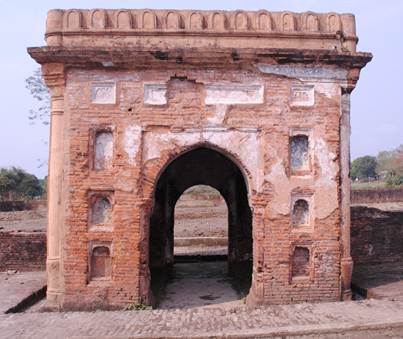
Figure 2
The Gateway
Structure (Batchora) — Northern Entrance Face, showing arched passage,
ornamental niches, and decorative parapet
Figure 3
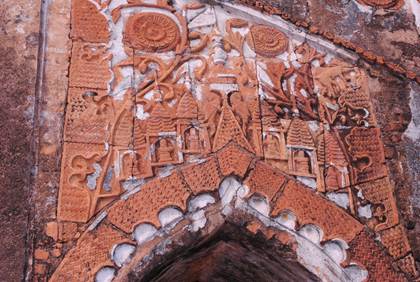
Figure 3 Terracotta Spandrel Above Central Doorway — Miniature Temple Forms, Deity Figures, and Mythological Scenes in Relief
3.4. The Sculptural Programme
The ornamental lattice-work (phul-jali) that once adorned all four sides of the building has been substantially lost over three centuries, though its former presence can be inferred from the surviving architectural composition. The building retains a large main entrance door, the three sides of which — excepting the base — are intricately carved with floral lattice-work. On the east and west faces, one oval window (gabaksha) each is positioned in the upper section.
On the southern facade, sixteen miniature sculptures are arranged in tiered arched niches (dhenubhiria prakostha). These sculptures depict a diverse pantheon: Garuda in the lotus-seated posture; four-armed Kali; a Shiva-like figure riding a bull; four-armed Vishnu (in multiple niches); Murulimanohara (Krishna with flute); the Kurma (Tortoise) avatara; and the Mughal Emperor Shah Jahan, shown seated and holding a six-petalled flower, with a kneeling courtier and a bird above the throne. The inclusion of Shah Jahan alongside Hindu deities is a striking expression of the syncretic cultural milieu of the Ahom court.
The flanking vertical panels originally contained thirteen sculptures (eastern) and fourteen (western). Of these, a substantial number in the lower sections have been damaged or lost. Surviving subjects on the eastern panel include: the four-armed Varaha (Boar) avatara; Garuda clasping Narayana; a flying dragon carrying an elephant; the four-armed Narasimha disembowelling Hiranyakashipu; and Krishna’s subjugation of the Kaliya serpent. On the western panel, surviving subjects include: a sage with a kamandalu; the divine sage Narada on a donkey with a vina; ten-armed Durga as Mahishamardini (significantly, with a dragon as her vehicle rather than a lion); and Murulimanohara.
The eastern wall carries nine miniature deity sculptures, including a notable depiction of the Chum-pha-rung-cheng-myung, the royal seal of the Tai-Ahom kings — a unique inclusion that underlines the monument’s connection to Ahom royal identity. Tribal and genre subjects also appear: a hunter shooting a bird, a tribal woman carrying firewood, and a yogi in meditation. The western wall carries a corresponding series including royal figures, a semi-nude female figure, and celestial nymphs (apsaras).
Figure 4
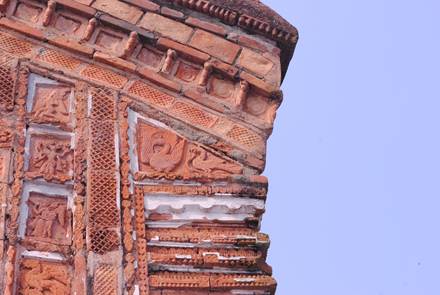
Figure 4 Upper Corner Terracotta Detail — Bird and Figurative Panels with Dense Geometric Lattice-Work Bordering
Figure 5
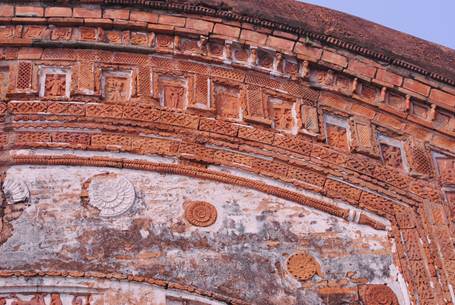
Figure 5 Upper Arch Frieze (Uporvagor Fuljali) — rows of deity figures in niches, lotus medallions, and herringbone borders
3.5. The Inner Sanctum and Subsidiary Structures
The central doorway giving access to the inner sanctum (garbhagriha) measures 6 feet 3 inches in height and 3 feet 3 inches in width. A significant feature of the inner sanctum is the presence of a large mihrab on its northern wall — the prayer niche characteristic of Islamic architecture, here juxtaposed with a fully-bloomed lotus flower above it and lattice-carved columns flanking it on either side. This coexistence of Islamic and Hindu elements within a single interior is perhaps the most explicit material evidence of Ghanshyamuddin’s syncretic vision. The front chamber is divided into three sections, of which the central has a honeycomb-shaped ceiling; its east–west length is 18.1 feet and north–south width is 6.10 feet.
A lower subsidiary structure standing directly in front of the facade, with three inverted ‘U’-shaped doorways, contains spaces that once held sculptural carvings, now absent. Its function remains unclear. The gateway structure (batchora) to the northeast is a cubic pavilion measuring 15 feet east–west and 13 feet north–south, which served as the formal entrance to Ghanshyamuddin’s building complex. Its doorways are of the same half-oval type found in all Ahom-period monuments Burhagohain (2018). Remains of a substantial brick fortification wall surrounding the entire compound indicate that the complex was once sufficiently robust to withstand cannon fire.
3.6. Evaluation from the Perspective of Vastu Shastra
Vastu Shastra is an ancient Indian system of architectural science grounded in three core principles: solar energy, cardinal direction, and the five elements (panchabhuta). The total area of any site is conceptually divided into nine zones, with construction prescribed only in designated portions Sharma (2006), Bordoloi (2016), Barua (2023).
An assessment of Ghanshyam’s House against these criteria is constrained by the destruction of the enclosure walls, which prevents accurate delineation of the original site boundaries. The main building is oriented east–west, but its principal entrance and facade face southward, a placement that maximises cross-ventilation while limiting direct sunlight into the interior. Evidence from the surviving plinth elevation suggests that adequate sunlight did enter the building when it was in active use. The structure cannot be described as strictly conforming to Vastu Shastra prescriptions; rather, it preserves broadly traditional spatial orientations consistent with Vastu principles. The traditional Assamese architectural proverb attributed to Dak — prescribing a duck pond to the east, bamboo groves to the west, betel-nut grove to the north, and fire to the south — reflects a comparable indigenous system of environmental orientation that some scholars regard as cognate with Vastu Shastra Sharma (2006).
3.7. Identity of the Structure
The central interpretive question addressed by this study is the function of the structure. The present investigation concludes that the brick building on the western corner of the Jayasagar tank was not Ghanshyam Khanikar’s residence. The adjacent two-storeyed ruin served that purpose. The structure examined here was Ghanshyam Khanikar’s personal place of worship — a shrine he constructed for himself. Its form, derived from the Gaudiya Matha tradition of Bengali Vaishnava temple architecture, is without parallel among the monuments of Assam Burhagohain (2021). Its sculptural programme — incorporating Hindu deities, Mughal imperial imagery, Ahom royal symbolism, and Islamic architectural elements — constitutes a unique artistic document of the syncretic cultural environment of the early eighteenth-century Ahom court.
4. CONCLUSION
This study has provided the first systematic architectural documentation of Ghanshyam’s House, a monument of exceptional significance in the history of Assamese and Indian art. The analysis has established that the structure functioned as a personal shrine built by Ghanshyamuddin — a Bengali Muslim craftsman who, having immersed himself in the Hindu cultural environment of the Ahom court, gave expression to his spiritual transformation through an extraordinary programme of terracotta sculpture and architectural ornament. The monument represents a singular synthesis of Islamic, Hindu, and Ahom traditions, embodied in a Gaudiya Matha-derived architectural form unique within the Assamese built heritage.
The structure is currently protected under the Ancient Monuments and Archaeological Sites and Remains Act of 1958, but its physical condition — including vertical cracks, subsidence, and the loss of a substantial portion of the sculptural programme — reflects the consequences of inadequate conservation attention. The documentation provided by this study serves as an essential baseline for future conservation planning. It is strongly recommended that the monument receive a formal heritage impact assessment, urgent structural stabilisation, and a comprehensive programme of scholarly documentation before further deterioration occurs. Its recognition as a monument of national art-historical importance — not merely an archaeological site — is long overdue.
CONFLICT OF INTERESTS
None.
ACKNOWLEDGMENTS
The authors acknowledge the assistance of the Circle Officer, Sivasagar District Headquarters, for access to land records. The authors also thank the Archaeological Survey of India for access to the protected site. All field measurements and photographic documentation were conducted by the authors. No external funding was received for this study.
REFERENCES
Barua, D. (2023). Vastushastra'r Prayogere Salani Karok Apanar Ghar [Transform Your
House with the Application of Vastu Shastra]. J.S. Publications.
Bhuyan, S. K. (Ed.). (1974). Satsari Assam Buranji (4th ed.). Gauhati University Publications.
Bhuyan, S. K. (Ed.). (2001). Deodhai Assam Buranji (4th ed.). Directorate of Historical and
Antiquarian Studies, Government of Assam.
Bhuyan, S. K. (Ed.). (2010a). Harkanta Barua Sadaraminor Assam Buranji (4th ed.). Directorate of Historical and Antiquarian Studies, Government of Assam.
Bhuyan, S. K. (Ed.). (2010b). Tungkhungiya Buranji (4th ed.). Directorate of Historical and
Antiquarian Studies, Government of Assam.
Bordoloi, B. (2016). Vastushastra'r Byavaharik Prayog [Practical Application of Vastu
Shastra]. Banalata.
Burhagohain, N. (2018). Ghanshyamar Ghar [Ghanshyam's House]. Kuhipar Prakashan.
Burhagohain, N. (2021). Ahom Jugar Deul Aru Iyar Sthapatya-Kala [The Temples of the Ahom Period and Their Architecture]. Banalata.
Burhagohain, N. (2023). Garhgaonor Kareng Ghar [The Kareng Ghar of Garhgaon] (3rd ed.). J.S.
Publications.
Gait, E. (2016). A History of Assam. EBH Publishers. (Original work published 1906)
Gogoi, L. (1994). Tai Sanskriti'r Ruparekha [Outline of Tai Culture] (4th ed.).
Sribhumi Publishing Company.
Goswami, S. K. (2010). Ahom Jugar Rajnaitik Aru Arthanaitik Buranji [Political and Economic
History of the Ahom Period]. Assam Prakashan Parishad.
Phukan, Y. N., and Burhagohain,
H. (Eds. and Trans.). (2014). Swargadeu Rudra
Singhar Buranji. Tai-Ahom Development Council, Government of Assam.
Sharma, B. (2006). Vastujnan Kalpataru. Bina Library.
Tamuli, L. (Ed.). (2013). Padmeshwar Naobaicha Phukanar Assam Buranji (3rd ed.). Assam
Prakashan Parishad.
Tze, C. L. (2016). Architecture of the Tai Ahom Period (2nd ed.). Krantikal Prakashan.
|
|
 This work is licensed under a: Creative Commons Attribution 4.0 International License
© ShodhKosh 2026. All Rights Reserved.