ShodhKosh: Journal of Visual and Performing ArtsISSN (Online): 2582-7472
|
|
Realism Revisited: An Interview-Based Study of Gender Politics in Balu Mahendra’s Cinema through Gen Z Lenses
Priya Palanimurugan 1 , Dr. V. Shanthi 2
 , Dr. Thulasi Bharathi. M 3
1 Research
Scholar, Department of Visual Communication, Meenakshi Academy of Higher
Education and Research (Deemed to Be University), Chennai, Tamil Nadu, India
2 Principal,
Faculty of Humanities and Science, Computer Science, Meenakshi Academy of
Higher Education and Research (Deemed to Be University), Chennai, Tamil Nadu, India
3 Assistant
Professor, Department of Visual Communication, Assistant Professor, SRM
Institute of Science and Technology, Vadapalani, Tamil Nadu, India
|
|
|
ABSTRACT |
|
|
Realism
occupied an important place in Tamil cinema, especially as a counter-movement
to dramatic and commercial film traditions. Among its leading practitioners,
Balu Mahendra was widely recognized for his naturalistic cinematography,
intimate storytelling, and emotionally nuanced female characters. His films
were often celebrated for their aesthetic minimalism and psychological depth.
However, while their realism was critically acclaimed, limited research
examined how contemporary youth audiences interpreted their gender politics
through a feminist framework. In particular, a gap existed in reception-based
studies exploring how Generation Z audiences re-evaluated these narratives in
the context of modern gender discourses. The study adopted a qualitative,
interview-based research design involving 40 Gen Z participants aged 18-27.
Following the selected film screenings, semi-structured interviews were
conducted, and responses were analyzed using thematic analysis. The findings
revealed a significant generational reinterpretation of realism. While
participants appreciated the emotional authenticity and visual subtlety of
the films, they also identified examples of patriarchal undertones,
sacrificial femininity, and the male gaze embedded within the narratives. The
study revealed that realism was not ideologically neutral but was open to
critical feminist rereading. By integrating audience reception theory with
feminist film studies, this research contributed to expanding contemporary
discourse in film and gender studies. |
|||
|
Received 21 January 2026 Accepted 29 March
2026 Published 18 April 2026 Corresponding Author Priya Palanimurugan, priyaofficial2205@gmail.com DOI 10.29121/shodhkosh.v7.i5s.2026.7255 Funding: This research
received no specific grant from any funding agency in the public, commercial,
or not-for-profit sectors. Copyright: © 2026 The
Author(s). This work is licensed under a Creative Commons
Attribution 4.0 International License. With the
license CC-BY, authors retain the copyright, allowing anyone to download,
reuse, re-print, modify, distribute, and/or copy their contribution. The work
must be properly attributed to its author.
|
|||
|
Keywords: Realism, Gender Politics, Gen Z, Feminist Film
Theory, Audience Reception |
|||



1. INTRODUCTION
1.1. Background of the Study
Realism has
occupied a distinctive and transformative position in Tamil cinema,
particularly from the late 1970s onward, when filmmakers began to move away
from theatrical melodrama and formula-driven commercial narratives. Influenced
by Italian Neorealism and Indian parallel cinema movements, realism in Tamil
films emphasized natural lighting, everyday locations, subdued performances,
and psychologically layered storytelling. Scholars such as Bazin
(1967) argued that realism in cinema functioned as
a moral and aesthetic commitment to representing life with minimal
manipulation, privileging ambiguity over spectacle. In the Indian context,
realism became a vehicle for social commentary, foregrounding middle-class
anxieties, gender relations, and domestic tensions Dissanayake
and Gokulsing (2013). Within this realist tradition, Balu
Mahendra emerged as a pioneering figure whose visual grammar significantly
reshaped Tamil cinematic language. Trained in cinematography, he brought a
photographic sensitivity to filmmaking, privileging natural light, intimate
framing, and emotional restraint. Films such as Moondram Pirai, Veedu, and
Marupadiyum exemplified his commitment to interior realism and female-centric
narratives. Critics often praised his nuanced portrayal of women as emotionally
complex individuals rather than caricatured stereotypes Sivathamby
(2005). His cinema replaced dramatic exaggeration
with silence, gaze, and everyday gestures, creating what many scholars
described as “emotional realism.” However, realism as an aesthetic practice
does not automatically guarantee ideological neutrality. Feminist film
theorists such as Mulvey
(1975) argued that cinematic realism could subtly
reproduce patriarchal structures through narrative positioning and visual
framing. Even when films appeared progressive, the underlying gaze and
narrative resolution often reinforced traditional gender hierarchies.
Therefore, realism must be examined not merely as style but as a cultural
discourse embedded within social power structures Hall (1997).
While earlier scholarship celebrated Balu Mahendra’s humanistic approach,
contemporary generational shifts in gender awareness invite renewed
examination. Generation Z—shaped by digital activism, intersectional feminism,
and media literacy—approaches cinema with critical awareness of representation
politics Twenge
(2017). Thus, revisiting realist cinema through
Gen Z lenses becomes necessary to understand how meanings evolve across
generations.
1.2. Statement of the Problem
Although realist
cinema is frequently perceived as authentic and unbiased, the assumption that
realism equates to ideological neutrality remains problematic. Realist
portrayals may naturalize gender hierarchies by presenting them as everyday
reality rather than as constructed norms. Althusser
(1971) theory of ideological state apparatuses
suggests that cultural texts, including cinema, reproduce dominant ideologies
subtly through normalization. In this sense, realism may mask patriarchal power
relations under the guise of authenticity. The problem addressed in this study
emerged from the tension between critical acclaim and contemporary
reinterpretation. While Balu Mahendra’s films were historically appreciated for
dignified female representation, little research examined whether young viewers
today interpret these portrayals differently. Gen Z audiences, exposed to
discourses on consent, agency, body politics, and equality, may question
narrative patterns previously considered progressive. Therefore, the central
problem investigated was whether realist portrayals in Tamil cinema,
particularly in Balu Mahendra’s films, function as ideologically neutral
representations or whether they embed subtle patriarchal assumptions that
contemporary viewers critically identify.
1.3. Research Questions
This study was
guided by the following research questions:
How does Gen Z
perceive realism in Balu Mahendra’s films?
How are female
characters interpreted through contemporary feminist lenses?
Does realism
function as a masking device for patriarchal structures?
These questions
were grounded in reception theory, which posits that meaning is not fixed
within the text but constructed by audiences within cultural contexts Hall (1980). Gen Z viewers may decode cinematic texts
differently from earlier generations due to evolving gender consciousness. By
focusing on interpretative processes rather than textual analysis alone, this
research sought to bridge aesthetic evaluation with ideological critique.
1.4. Objectives
The primary
objective of this study was to analyze gender politics embedded in selected
films directed by Balu Mahendra. Through qualitative interviews with 40 Gen Z
participants, the research aimed to examine interpretative patterns regarding
female agency, silence, sacrifice, and emotional labour. A secondary objective
was to evaluate realism not merely as an aesthetic strategy but as an
ideological device. Feminist scholars have long argued that representation
shapes perception Butler
(1990). Thus, examining whether audiences perceive
realism as progressive or regressive contributes to understanding cinema’s
cultural power. Additionally, the study aimed to explore generational shifts in
cinematic meaning-making. Mannheim
(1952) theory of generations suggests that shared
socio-historical experiences influence interpretative frameworks. Gen Z, shaped
by social media discourse and global feminist movements, may reinterpret
cinematic realism through new ethical and political standards.
1.5. Significance of the Study
This study held
significance on multiple academic fronts. First, it expanded feminist film
scholarship by integrating South Indian realist cinema into broader theoretical
debates. While much feminist film theory developed in Western contexts,
applying it to Tamil cinema enriched cross-cultural discourse Mulvey (1975), hooks
(1992).Second, the research introduced an
audience-based reinterpretation model. Rather than analysing films solely
through textual critique, it foregrounded lived audience responses. This
reception-oriented methodology aligned with contemporary cultural studies
approaches that emphasize negotiated and oppositional readings Hall (1980). Third, the study connected generational
theory with cinema studies by investigating how Gen Z’s ideological orientation
influenced film interpretation. Such interdisciplinary engagement bridged film
studies, sociology, and gender theory. Finally, the findings contributed
pedagogically by encouraging critical media literacy. Understanding that
realism may carry ideological weight empowers viewers to question normalized
gender roles within seemingly authentic narratives. By revisiting Balu
Mahendra’s cinema through Gen Z perspectives, the study demonstrated that
cinematic meaning is dynamic, historically situated, and open to feminist
re-reading.
2. Review of Literature
2.1. Realism in Indian Cinema
Realism has
historically functioned as both an aesthetic and ideological movement within
global cinema. The theoretical foundations of realism are often traced to the
work of André Bazin, who argued that cinema’s primary moral responsibility lay
in faithfully representing reality. Bazin
(1967) emphasized long takes, deep focus, and
minimal editing as techniques that preserved spatial and temporal continuity,
allowing audiences interpretative freedom. For Bazin, realism was not merely
stylistic but ethical—grounded in respect for the ambiguity of life. In the
Indian context, realism evolved through parallel cinema movements in the 1950s
and 1970s, influenced by Italian Neorealism and directors such as Satyajit Ray
and Mrinal Sen. Indian realism diverged from mainstream melodrama by focusing
on middle-class struggles, rural poverty, and socio-political issues Dissanayake
and Gokulsing (2013). Unlike commercial cinema, which privileged
spectacle and musical excess, realist films sought authenticity in location
shooting, restrained acting, and socially relevant themes. Tamil cinema adopted
realist elements later but adapted them to regional cultural sensibilities.
Rather than rejecting melodrama entirely, Tamil realist filmmakers blended
emotional intensity with everyday realism. This hybrid mode allowed for subtle
critiques of domestic life, gender expectations, and economic precarity.
However, scholars caution that realism does not guarantee ideological
neutrality. Cultural studies theorists argue that realism may naturalize social
hierarchies by presenting them as “common sense” Hall (1997). Thus, Indian realism must be examined not
only as aesthetic innovation but also as a cultural discourse embedded within
power structures.
2.2. Gender Representation in Tamil Cinema
Gender
representation in Tamil cinema has evolved across decades, reflecting changing
socio-cultural values. Early mainstream films often portrayed women within
rigid archetypes: the self-sacrificing mother, the virtuous wife, or the
romantic heroine. These representations aligned with dominant patriarchal norms
that positioned women as moral custodians of family honour Sivathamby
(2005). During the 1980s and 1990s, filmmakers
attempted more complex portrayals of female subjectivity. Women were depicted
as emotionally layered individuals facing social constraints. Yet, even
progressive narratives frequently maintained traditional frameworks, resolving
conflicts through marriage, sacrifice, or moral compromise. Feminist scholars
argue that Tamil cinema, while occasionally foregrounding female suffering,
often aestheticized that suffering in ways that reinforced gender hierarchies Lakshmi
(2019). Contemporary scholarship highlights how
visual framing, costume, and narrative closure contribute to subtle gender
messaging. The camera frequently positions women as objects of emotional or
visual contemplation rather than autonomous agents. Despite narrative
centrality, female characters are often defined relationally—through father,
husband, or lover. Therefore, examining gender representation requires
attention to both textual narrative and cinematic technique. In recent years,
digital platforms and feminist activism have encouraged younger audiences to
critically reassess earlier films. Generation Z viewers, exposed to
conversations about consent, agency, and body politics, may interpret
traditional portrayals differently from earlier generations. This generational
shift makes reception-based studies increasingly important.
2.3. Feminist Film Theory
Feminist film
theory provides critical tools for analyzing how cinema constructs gendered
meaning. One of the most influential contributions came from Laura Mulvey in
her seminal essay “Visual Pleasure and Narrative Cinema” (1975). Mulvey
introduced the concept of the “male gaze,” arguing that classical cinema
positioned women as objects of visual pleasure for a presumed heterosexual male
spectator. Through camera movement, framing, and narrative alignment, female
characters were often rendered passive spectacles rather than active subjects. The
male gaze framework is particularly relevant when analyzing realist cinema.
Even when films avoid overt glamour or sensationalism, subtle visual
codes—lingering shots, fragmented body framing, or emotional vulnerability—may
reproduce objectifying perspectives. Feminist scholars expanded Mulvey’s
argument by exploring intersectionality, spectatorship, and female agency hooks
(1992). Thus, feminist film theory does not simply
accuse cinema of bias; it interrogates the mechanisms through which visual
pleasure and narrative closure sustain patriarchal norms. Another crucial
theoretical framework emerges from Louis Althusser and his concept of
ideological state apparatuses (1971). Althusser argued that cultural
institutions, including media and cinema, reproduce dominant ideologies by
shaping individual consciousness. Applied to cinema, this theory suggests that
films function as ideological apparatuses that naturalize social roles,
including gender hierarchies. Realism, by appearing authentic, may reinforce
ideology more effectively than overt propaganda because it disguises
construction as reality.
Combining Mulvey
and Althusser allows for a nuanced analysis: cinema can simultaneously generate
emotional identification and ideological conditioning. Therefore, examining how
audiences decode these representations becomes essential. Reception theory, particularly
Hall (1980) encoding/decoding model, emphasizes that
viewers may accept, negotiate, or oppose dominant meanings. This theoretical
intersection forms the conceptual backbone for analyzing Gen Z interpretations
of realist cinema.
2.4. Previous
Studies on Balu Mahendra
Scholarly
engagement with Balu Mahendra has primarily focused on his narrative aesthetics
and visual style. Critics frequently describe his cinema as poetic realism,
marked by natural lighting, minimal background score, and emotionally
restrained performances. Films such as Moondram Pirai and Veedu have been
analyzed for their intimate portrayal of human vulnerability and middle-class
anxieties. Researchers highlight his background in cinematography as central to
his stylistic innovation. Long takes, ambient sound, and domestic interiors
created an immersive realism that contrasted sharply with mainstream Tamil
cinema’s theatrical excess. This aesthetic approach earned him critical acclaim
for authenticity and emotional depth. Regarding gender, scholars often argue
that Balu Mahendra depicted women with empathy and complexity. In Marupadiyum,
for instance, the female protagonist navigates betrayal and self-discovery,
challenging conventional marital norms. Such narratives positioned women as
moral and emotional centres within domestic spaces. However, some critics
observe that even these portrayals revolve around suffering and resilience
rather than structural empowerment. The emphasis on silent endurance may
romanticize female sacrifice rather than dismantle patriarchal expectations. Most
existing studies rely heavily on textual analysis and auteur theory, praising
Balu Mahendra’s humanism. Few investigations incorporate audience reception
data, especially from contemporary young viewers. Thus, while his narrative
aesthetics and emotional realism are well-documented, the ideological
implications of his realism remain underexplored in empirical research.
2.5. Research Gap
The review of
literature reveals two major gaps. First, there is limited interview-based
research examining how Generation Z audiences interpret gender politics in
Tamil realist cinema. Most prior studies adopt textual or theoretical
approaches without empirical audience engagement. Given the dynamic nature of
cultural meaning, relying solely on textual analysis overlooks how contemporary
viewers negotiate representation. Second, there is a lack of
intervention-oriented feminist reinterpretation. Few studies assess whether
exposure to critical frameworks influences audience perception. Realism is
often assumed to be progressive due to its authenticity, yet its ideological
layers remain insufficiently interrogated through structured audience research.
Therefore, this study addresses these gaps by conducting qualitative interviews
with Gen Z participants, exploring how they decode realism and gender
representation in Balu Mahendra’s films. By combining feminist theory,
ideological critique, and reception analysis, the research contributes to a
more holistic understanding of realism as both aesthetic practice and
ideological discourse.
3. Methodology
3.1. Research Design
This study
adopted a qualitative exploratory research design to investigate how Generation
Z audiences interpreted realism and gender politics in the films of Balu
Mahendra. A qualitative framework was selected because the research aimed to
explore subjective meanings, interpretative patterns, and ideological
reflections rather than measure quantifiable variables. Since audience
perception is shaped by lived experience, cultural awareness, and generational
identity, qualitative inquiry allowed for deeper engagement with participants’
perspectives. The study employed semi-structured, in-depth interviews as the
primary research method. This approach provided both structure and flexibility.
A predetermined set of guiding questions ensured consistency across interviews,
while open-ended prompts allowed participants to elaborate on emotional
reactions, critical reflections, and personal interpretations. The
semi-structured format enabled the researcher to probe emerging themes, clarify
ambiguities, and explore unexpected responses in greater depth. The exploratory
nature of the design was appropriate because limited prior research had
examined Gen Z reception of Tamil realist cinema through a feminist lens.
Therefore, the study sought to generate interpretative insights rather than
test predetermined hypotheses.
3.2. Participants
The study
included 40 Generation Z participants aged between 18 and 27 years. All
participants were urban college students enrolled in arts, media, literature,
or social science programs. Urban students were selected because they were more
likely to have exposure to contemporary feminist discourse, digital media
debates, and critical media literacy discussions. The gender distribution aimed
to ensure diversity of perspectives, including both male and female
participants. Participants came from varied socio-economic and educational
backgrounds within urban settings, enabling a range of interpretative
viewpoints. The selection of Gen Z was intentional, as this cohort had grown up
in a digital environment shaped by social media activism, global feminist movements,
and increasing conversations around consent and gender equality.
3.3. Sampling Technique
Purposive
sampling was employed to select participants who met specific inclusion
criteria. The criteria included: (1) belonging to the Gen Z age category (18–27
years), (2) willingness to participate in film screening sessions, and (3)
ability to articulate opinions in interview settings. Participants with prior
academic exposure to film studies were included, but those with professional
expertise in filmmaking were excluded to maintain focus on general audience
reception rather than expert critique. Purposive sampling was considered
appropriate because the study required participants capable of reflective
discussion. Random sampling was not adopted, as the research aimed for depth of
understanding rather than statistical generalization. The sampling strategy
ensured that participants were information-rich cases capable of providing
meaningful insights into generational interpretation.
3.4. Data Collection Tools
Data were
collected using two primary tools: (1) a structured interview guide and (2)
organized film screening sessions.
The interview
guide consisted of 10–15 open-ended questions designed to explore perceptions
of realism, emotional engagement, and gender representation. Questions
addressed themes such as:
·
How did
participants define realism in the films?
·
How
were female characters perceived?
·
Did
participants identify moments of agency or victimhood?
·
Were
certain portrayals interpreted as progressive or patriarchal?
The open-ended
structure encouraged participants to elaborate freely, allowing spontaneous
reflections and nuanced analysis. Film screening sessions were conducted prior
to interviews to ensure that all participants engaged directly with the
selected films. The screenings created a shared experiential foundation for
discussion. Participants viewed selected scenes or full-length versions of the
following films:
·
Moondram
Pirai
·
Veedu
·
Marupadiyum
These films were
chosen because they represented different dimensions of Balu Mahendra’s
realism, including psychological vulnerability, middle-class domestic struggle,
and female self-discovery. All interviews were audio-recorded with participant
permission and later transcribed verbatim for analysis.
3.5. Films Selected for Analysis
The films
selected for analysis were chosen based on thematic relevance and critical
recognition. Moondram Pirai was selected for its portrayal of emotional
dependency and vulnerability within a gendered framework. The film provided
insight into power dynamics embedded within care, memory loss, and romantic
attachment. Veedu was included due to its depiction of middle-class
economic struggle centered on a female protagonist navigating bureaucratic and
patriarchal structures. The film offered an opportunity to examine resilience
and structural constraint. Marupadiyum was selected for its narrative of
marital betrayal and female self-realization. The film allowed exploration of
agency, autonomy, and moral positioning within domestic relationships. Together,
these films represented varied aspects of realism and gender politics within
Balu Mahendra’s cinematic oeuvre.
3.6. Method of Analysis
The data were
analyzed using thematic analysis. This method was selected because it
facilitated systematic identification, organization, and interpretation of
recurring patterns within qualitative data. Thematic analysis allowed the
researcher to move from descriptive coding to interpretative categorization. The
analysis followed six stages: data familiarization, initial coding, theme
identification, theme review, theme definition, and report writing. Transcripts
were read multiple times to ensure immersion in participant responses. The
following coding categories were developed based on theoretical frameworks and
emerging patterns:
·
Emotional
realism – references to authenticity, natural acting, and emotional depth.
·
Female
agency – instances where participants identified autonomy, decision-making, or
empowerment.
·
Moral
positioning – discussions about women as ethical centres or moral guardians.
·
Silence
and sacrifice – interpretations of quiet endurance and emotional labour.
·
Body
politics – comments related to gaze, physical framing, or vulnerability.
These categories
were refined during analysis to ensure conceptual clarity. Interpretations were
grounded in participant narratives rather than imposed assumptions.
3.7. Ethical Considerations
Ethical integrity
was maintained throughout the research process. Informed consent was obtained
from all participants prior to data collection. Participants were provided with
information sheets explaining the purpose of the study, research procedures, and
their right to withdraw at any stage without penalty. Anonymity was strictly
preserved. Participants were assigned pseudonyms during transcription and
reporting to ensure confidentiality. Audio recordings and transcripts were
stored securely and accessed only for academic purposes. The data were used
exclusively for academic research and thesis writing. No personal identifiers
were disclosed in publications or presentations. The study adhered to
institutional ethical guidelines for research involving human participants.
4. Findings and Thematic Analysis
The thematic
analysis of interviews conducted with 40 Gen Z participants revealed layered
and sometimes contradictory interpretations of realism and gender politics in
the films of Balu Mahendra. While participants acknowledged the aesthetic
brilliance and emotional sensitivity of the films, they simultaneously offered
critical reflections shaped by contemporary feminist awareness. Five dominant
themes emerged from the data.
4.1. Theme 1: Realism as Emotional Authenticity
The first and
most consistent theme identified across interviews was the perception of
realism as emotional authenticity. Participants frequently described the films
as “natural,” “raw,” and “intimate.” The use of natural lighting, minimal
background score, and every day domestic settings created a sense of lived
reality rather than cinematic spectacle. Many respondents stated that the
absence of exaggerated dialogue or dramatic performance enhanced emotional
immersion. Participants particularly emphasized the emotional depth of
characters. In films such as Veedu, the portrayal of middle-class struggle was
described as relatable and grounded. The protagonist’s anxieties about housing
and financial stability resonated strongly with urban youth who recognized
similar pressures within contemporary society. The realism was interpreted not
merely as visual style but as psychological authenticity. However, some
participants noted that emotional realism sometimes intensified the impact of
suffering, particularly for female characters. Because situations appeared
believable, the emotional weight felt more disturbing than in melodramatic
cinema. Thus, realism functioned as a double-edged device—enhancing both
empathy and critical discomfort.
4.2. Theme 2: Women as Silent Sufferers
A prominent theme
that emerged was the portrayal of women as silent sufferers. While participants
acknowledged that female characters were central to the narrative, many
observed that their strength was frequently expressed through endurance rather
than resistance. Gen Z participants critiqued what they described as
“romanticized sacrifice.” In several interviews, respondents argued that
silence, patience, and emotional labour were portrayed as virtuous feminine
qualities. In Moondram Pirai, for instance, the female character’s
vulnerability and dependence were interpreted by some as reinforcing
traditional expectations of female fragility.
Female
participants, in particular, questioned whether emotional suffering was being
aestheticized. They expressed discomfort with narratives that equated
resilience with quiet endurance rather than structural empowerment. While
earlier critical discourse may have celebrated such portrayals as sensitive or
dignified, Gen Z viewers tended to interpret them as symptomatic of patriarchal
conditioning. This theme indicated a shift from admiration to interrogation.
Rather than rejecting the films outright, participants engaged in nuanced
critique, distinguishing between emotional depth and ideological messaging.
4.3. Theme 3: Agency vs Victimhood
The third theme
revealed conflicting interpretations regarding female agency. Participants
demonstrated divided opinions depending on the specific film context. In
Marupadiyum, many respondents identified moments of empowerment. The
protagonist’s decision to redefine her identity after marital betrayal was seen
as progressive and self-assertive. Participants appreciated the depiction of a
woman navigating emotional trauma while ultimately reclaiming autonomy. This
narrative was interpreted as aligning with contemporary feminist ideals of
self-respect and independence. In contrast, responses to Moondram Pirai
were more conflicted. While some participants interpreted the female
character’s vulnerability as a tragic consequence of circumstance, others
perceived it as reinforcing dependency and infantilization. The power imbalance
embedded in caregiving dynamics generated discomfort among viewers sensitive to
issues of consent and autonomy. Thus, agency was not interpreted uniformly
across films. Instead, it was negotiated within narrative context. Gen Z
participants demonstrated capacity for layered reading—recognizing both
progressive elements and problematic undertones. This thematic tension
reflected broader debates within feminist film criticism about representation
versus empowerment.
4.4. Theme 4: Male Gaze and Visual Framing
Another
significant theme that emerged was recognition of subtle objectification
through visual framing. Although Balu Mahendra’s cinema avoided overt glamour
typical of commercial films, participants noted instances where camera
positioning appeared aligned with a masculine observational perspective. Some
respondents observed lingering shots and intimate framing that emphasized
female vulnerability. While these techniques contributed to emotional realism,
they also prompted questions about spectatorship. Participants trained in media
literacy identified how visual focus sometimes directed audience sympathy
through a male character’s viewpoint. Interestingly, not all participants
interpreted these moments as problematic. Some argued that vulnerability was
central to narrative realism rather than objectification. However, the mere
presence of debate indicated heightened awareness among Gen Z viewers regarding
visual politics. The recognition of subtle gaze dynamics suggested that realism
did not eliminate ideological framing. Instead, it often concealed it within
aesthetic naturalism. This insight aligned with feminist theoretical concerns
about how cinema constructs spectatorship unconsciously.
4.5. Theme 5: Generational Shift in Interpretation
The final theme
highlighted a clear generational shift in interpretation. Many participants
explicitly compared their perspectives with those of older family members or
critics who admired the films without questioning gender dynamics.
Gen Z respondents
described their reading as shaped by conversations about consent, mental
health, emotional labour, and gender equality. Scenes previously interpreted as
romantic were re-evaluated through consent-based frameworks. Emotional
dependency, once considered poetic, was scrutinized for power imbalance. Participants
emphasized that appreciation and critique could coexist. They expressed
admiration for cinematic craft while rejecting certain ideological assumptions.
This dual stance reflected a broader generational pattern of critical
consumption—valuing art yet interrogating its politics. The findings
demonstrated that meaning was not static but historically situated. Realism
that once appeared progressive was reinterpreted within contemporary ethical
standards. This generational reinterpretation did not dismiss Balu Mahendra’s
contribution but expanded it into new critical territory.
Table
1
|
Table 1 Summary of Thematic Findings (N = 40) |
|||||
|
S.No |
Theme |
Description
of Theme |
No. of
Participants (n=40) |
Percentage(%) |
Interpretation
Pattern |
|
1 |
Realism as
Emotional Authenticity |
Appreciation
of natural lighting, minimalism, emotional depth |
34 |
85% |
Strong
aesthetic admiration |
|
2 |
Women as
Silent Sufferers |
Recognition
of sacrificial femininity and emotional endurance |
29 |
72.5% |
Critical
reflection on gender norms |
|
3 |
Agency vs
Victimhood |
Mixed
responses on empowerment and dependency |
26 |
65% |
Negotiated
interpretation |
|
4 |
Male Gaze
& Visual Framing |
Identification
of subtle objectification and male perspective |
22 |
55% |
Emerging
feminist awareness |
|
5 |
Generational
Shift in Interpretation |
Comparison
between older admiration and Gen Z critique |
31 |
77.5% |
Conscious
generational re-reading |
Table
2
|
Table 2 Film-wise Interpretation Pattern |
|||
|
Film |
Dominant
Audience Response |
Key Gender
Observation |
Overall
Perception |
|
Moondram
Pirai |
Emotional
but troubling |
Vulnerability,
dependency concerns |
Critically
appreciated |
|
Veedu |
Relatable
realism |
Structural
struggle, quiet resilience |
Strong
positive response |
|
Marupadiyum |
Empowering
narrative |
Assertion of
female autonomy |
Progressive
reading |
Table
3
|
Table 3 Coding Category Frequency |
||
|
Coding
Category |
Frequency
(Mentions) |
Thematic
Significance |
|
Emotional
Realism |
112 |
Core
aesthetic strength |
|
Female
Agency |
78 |
Conditional
empowerment |
|
Moral
Positioning |
64 |
Women as
ethical anchors |
|
Silence
& Sacrifice |
89 |
Feminist
critique trigger |
|
Body
Politics |
51 |
Subtle gaze
awareness |
Figure 1
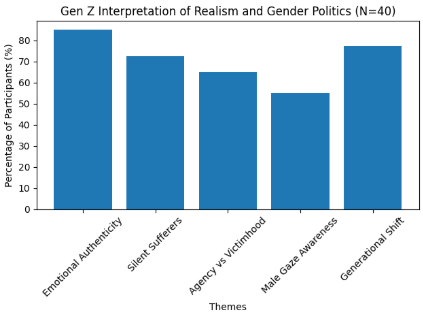
Figure 1
Distribution of Gen
Z Participants’ Thematic Responses on Realism and Gender Politics in Balu
Mahendra’s Cinema (N = 40)
5. Discussion
The findings of
this study demonstrated that realism in the films of Balu Mahendra was not
received as a neutral aesthetic form but as a layered cultural construction
open to generational reinterpretation. By situating audience responses within
feminist and ideological frameworks, this discussion re-examined realism,
gender representation, and spectatorship through contemporary theoretical
lenses.
5.1. Re-reading Realism: Realism as Ideological Construction
Traditional film
criticism frequently celebrated realism as an authentic reflection of life.
Drawing from André Bazin’s ontological theory, realism was understood as
cinema’s moral commitment to preserving ambiguity and minimizing manipulation Bazin
(1967) However, the present findings suggested
that realism functioned not merely as style but as ideological construction. Participants’
responses indicated that emotional authenticity intensified identification
while simultaneously normalizing certain gender hierarchies. This supports
Louis Althusser
(1971) argument that cultural forms operate as
ideological state apparatuses. Cinema does not simply depict reality; it
reproduces dominant norms by presenting them as natural. When female endurance,
sacrifice, or silence was portrayed within everyday domestic realism, they
appeared socially inevitable rather than structurally conditioned. Moreover,
Stuart Hall (1980) encoding/decoding model provides a
framework for understanding how realism carries encoded meanings that audiences
may negotiate or oppose. While earlier generations may have adopted dominant
readings that celebrated emotional subtlety, Gen Z participants engaged in
negotiated readings that appreciated craft while questioning ideology. Thus,
realism emerged as a powerful discursive tool: its claim to authenticity masked
its constructed nature. The study affirmed that cinematic realism is
historically situated and ideologically embedded rather than transparently
reflective.
5.2. Feminist Reinterpretation: From Moral Woman to Autonomous Subject
A significant
shift identified in the findings was the movement from perceiving women as
moral centres to evaluating them as autonomous subjects. Earlier scholarship on
Tamil cinema often described female characters as ethical anchors within
domestic narratives Sivathamby
(2005). Women mediated conflict, upheld family
values, and embodied resilience. Such portrayals were frequently interpreted as
dignified and respectful. However, feminist film theory challenges the
conflation of morality with passivity. Laura Mulvey
(1975) argued that classical cinema structured
women as objects of narrative containment rather than agents of transformation.
Although Balu Mahendra’s films offered psychological depth, the present study
showed that Gen Z viewers scrutinized whether such depth translated into
structural agency. Participants’ responses to films like Marupadiyum indicated
appreciation for moments where female characters asserted independence.
Conversely, portrayals in Moondram Pirai prompted discomfort when vulnerability
appeared linked to dependency or infantilization. This reinterpretation aligns
with Judith Butler
(1990) theory of gender performativity, which
suggests that gender roles are socially constructed rather than naturally
ordained. Gen Z viewers appeared attuned to these constructions, questioning
whether cinematic realism reinforced normative femininity under the guise of
authenticity. The transition from “moral woman” to “autonomous subject”
reflected broader feminist discourse that prioritizes consent, agency, and
self-definition over sacrificial virtue. Thus, the discussion demonstrated that
reinterpretation did not reject realism but recontextualized it within evolving
feminist ethics.
5.3. Gen Z as Critical Viewers: Media Literacy and Digital Feminism
One of the most
striking findings was the critical sophistication displayed by Gen Z
participants. Unlike passive spectatorship models proposed in early film
theory, contemporary audiences demonstrated active decoding practices. This
aligns with Hall (1980) assertion that viewers negotiate meaning
within cultural contexts. Generation Z’s interpretative patterns were shaped
significantly by digital media environments. Twenge
(2017) described Gen Z as “digitally native,”
growing up amidst social media activism, online discourse, and global feminist
campaigns. Exposure to movements such as #MeToo and widespread conversations
about consent has heightened awareness regarding gendered power relations. Media
literacy education also played a role in shaping interpretative frameworks.
Participants frequently referenced camera angles, narrative structure, and
framing techniques when discussing subtle objectification. This analytical
awareness suggests that contemporary viewers possess tools to deconstruct
cinematic representation. bell hooks
(1992) argued that oppositional gaze emerges when
marginalized viewers critically interrogate dominant visual culture. Although
hooks’ work focused primarily on race and gender in Western cinema, the concept
resonates here. Gen Z audiences enacted a form of oppositional or negotiated
gaze—valuing aesthetic realism while resisting patriarchal coding. Thus, Gen Z
functioned not merely as viewers but as interpretative agents whose readings
were shaped by digital feminism and critical pedagogy. Their responses underscored
the dynamic relationship between cultural production and audience
consciousness.
5.4. The Politics of Silence: Silence as Strength vs Suppression
The theme of
silence generated particularly nuanced discussion. Historically, silence in
cinema has been associated with emotional restraint, dignity, and moral depth.
In Balu Mahendra’s films, quiet gestures and unspoken suffering contributed to
aesthetic realism. However, feminist scholarship encourages interrogation of
silence as political construct. Silence can signify both resilience and
systemic suppression. Participants’ interpretations reflected this duality.
Some viewed silent endurance as emotional maturity and inner strength. Others
interpreted it as normalization of emotional labour disproportionately assigned
to women. Foucault
(1978) theory of discourse suggests that what
remains unsaid can be as significant as spoken narratives. Within realist
cinema, silence may conceal power asymmetries by aestheticizing them. When
female characters internalized suffering without protest, realism risked
presenting suppression as natural temperament. Gen Z participants tended to
evaluate silence through consent-based and equality-oriented frameworks.
Emotional repression was no longer automatically equated with virtue. Instead,
it was assessed in relation to structural agency and voice. Therefore, the
politics of silence emerged as central to feminist reinterpretation. Realism
amplified the power of silence, but contemporary audiences questioned its
ideological implications.
6. Conclusion
This study
concluded that the realism employed in the films of Balu Mahendra was
aesthetically powerful yet ideologically layered. While his cinematic style was
widely appreciated for its visual naturalism, emotional restraint, and
psychological depth, the findings demonstrated that realism did not function as
a neutral mirror of reality. Instead, it operated as a constructed narrative
framework embedded within cultural assumptions about gender, morality, and
domestic roles. The subtlety of realist technique intensified emotional
authenticity, but it also normalized certain patriarchal patterns by presenting
them as everyday life. The interview-based analysis revealed that Generation Z
audiences engaged with these films critically rather than passively. Although
participants admired the artistic craftsmanship and emotional sincerity, they
questioned portrayals of silent suffering, sacrificial femininity, and
relational dependency. Female characters were reinterpreted not merely as moral
centres but as subjects whose agency required evaluation through contemporary
feminist standards. This generational reading reflected broader shifts shaped
by digital feminism, consent discourse, and increased media literacy. Importantly,
the qualitative methodology highlighted a transformation in cinematic
meaning-making across generations. The study demonstrated that film texts are
not static; their interpretations evolve according to socio-cultural context
and audience consciousness. By foregrounding reception rather than solely
textual analysis, the research emphasized the dynamic interaction between
cinema and viewers. Finally, the study suggested the integration of feminist
media literacy within film pedagogy. Encouraging critical engagement with
realist cinema can foster analytical awareness of how aesthetics intersect with
ideology. Such pedagogical approaches would enable students to appreciate
artistic achievement while simultaneously interrogating embedded power
structures.
7. Implications
7.1. Academic Implications
This study
contributed significantly to academic discourse by expanding the application of
reception theory within the context of Indian cinema. While much scholarship on
Tamil films has traditionally focused on textual analysis, auteur studies, or
ideological critique, this research foregrounded audience interpretation as a
central analytical lens. By examining how Gen Z viewers interpreted the films
of Balu Mahendra, the study demonstrated that cinematic meaning is not fixed
within the text but dynamically constructed through generational consciousness.
The research also enriched feminist film scholarship in South Asian contexts.
Although feminist film theory has been widely applied to Western cinema, its
systematic integration into Tamil realist cinema remains limited. By combining
reception theory, feminist critique, and generational analysis, the study
broadened interdisciplinary engagement between film studies, gender studies,
and cultural sociology. It highlighted the importance of examining realism not
only as an aesthetic category but also as a cultural discourse embedded within
ideological frameworks. Furthermore, the study provided empirical evidence
supporting Stuart Hall’s encoding/decoding model within regional cinema
contexts. The negotiated and oppositional readings offered by Gen Z
participants confirmed that contemporary audiences actively reinterpret classic
films in light of evolving social values. This finding encouraged scholars to
reconsider canonical works through contemporary reception-based methodologies
rather than relying solely on historical critical acclaim.
7.2. Pedagogical Implications
The findings of
this study suggested important implications for curriculum design in film and
gender studies programs. Integrating feminist media literacy into academic
syllabi can encourage students to critically engage with cinematic realism
rather than consume it unreflectively. Courses that include films by directors
such as Balu Mahendra can benefit from structured discussions that analyze
narrative framing, gender representation, and ideological positioning. Incorporating
reception-based assignments—such as reflective screenings, focus group
discussions, and thematic analysis exercises—can enhance students’
interpretative skills. Such pedagogical practices promote analytical thinking
by encouraging learners to distinguish between aesthetic admiration and
ideological critique. The study demonstrated that young audiences are capable
of nuanced engagement when provided with theoretical tools. Additionally,
interdisciplinary modules combining cinema studies with sociology, psychology,
and gender theory can deepen understanding of how media shapes identity and
social norms. Encouraging critical dialogue around themes such as silence,
agency, and emotional labour may foster greater awareness of how representation
influences perception. Thus, the integration of feminist media literacy into
film pedagogy can contribute to socially conscious and critically informed
scholarship.
7.3. Future Research
The study opened several avenues for future research. First, comparative analysis with contemporary Tamil filmmakers would provide valuable insight into how gender representation has evolved across generations. Examining directors influenced by or reacting against Balu Mahendra’s realism could reveal shifts in narrative agency, consent representation, and visual framing practices. Such comparative research would illuminate whether contemporary cinema addresses the critiques raised by Gen Z audiences. Second, a quantitative validation study could strengthen and generalize the present findings. While the qualitative design offered depth and interpretative richness, a larger survey-based study using structured questionnaires could measure patterns across broader demographic groups. Statistical analysis might assess correlations between gender, media literacy exposure, and interpretative stance toward realism. Finally, future research could adopt a mixed-method approach combining textual analysis, audience surveys, and experimental intervention models. For instance, researchers could examine whether exposure to feminist film theory prior to screening alters interpretative outcomes. Such studies would further explore how ideology, education, and generational identity interact within cinematic meaning-making. Overall, the implications of this research extended beyond a single filmmaker. They underscored the necessity of examining realism as historically situated, ideologically layered, and continuously reinterpreted by evolving audiences.
CONFLICT OF INTERESTS
None.
ACKNOWLEDGMENTS
None.
REFERENCES
Althusser, L. (1971). Ideology and Ideological State Apparatuses. Monthly Review Press.
Bazin, A. (1967). What is Cinema? University of California Press.
Butler, J. (1990). Gender Trouble: Feminism and the Subversion of Identity. Routledge.
Chaudhuri, S. (2006). Feminist Film Theorists: Laura Mulvey, Kaja Silverman, Teresa de Lauretis, Barbara Creed. Routledge. https://doi.org/10.4324/9780203357026
Dissanayake, W., and
Gokulsing, K. M. (2013). Indian Popular Cinema: A
Narrative of Cultural Change. Trentham Books.
Foucault, M. (1978). The History of Sexuality: Volume 1. Pantheon Books.
Ganti, T. (2012). Producing Bollywood: Inside the Contemporary Hindi Film Industry. Duke University Press. https://doi.org/10.1515/9780822395225
Hall, S. (1980). Encoding/Decoding. In S. Hall, D. Hobson, A. Lowe, and P. Willis
(Eds.), Culture, Media, Language (pp. 128-138). Hutchinson.
Hall, S. (1997). Representation: Cultural Representations and Signifying Practices.
Sage Publications.
hooks, b. (1992). Black Looks: Race and Representation. South End Press.
Iyer, L. (2017). Cinema of Interruptions: Action Genres in Contemporary Indian Cinema.
Columbia University Press.
Krishnan, M. (2009). Contemporary Tamil Cinema: Cultural Identity and Narrative Form.
Oxford University Press.
Lakshmi, C. S. (2019). Gender and Representation in Tamil Cinema. Journal of South Asian
Film Studies, 11(2), 45-62.
Mannheim, K. (1952). Essays on the Sociology of Knowledge. Routledge and Kegan Paul.
Mulvey, L. (1975). Visual Pleasure and Narrative Cinema. Screen, 16(3), 6-18. https://doi.org/10.1093/screen/16.3.6
Mulvey, L. (1989). Visual and Other Pleasures. Palgrave Macmillan. https://doi.org/10.1007/978-1-349-19798-9
Pandian, M. S. S. (1992). The Image Trap: M. G. Ramachandran in Film and Politics. Sage
Publications.
Rajadhyaksha, A., and
Willemen, P. (1999). Encyclopedia of Indian Cinema.
Oxford University Press.
Sivathamby, K. (2005). Tamil Cinema: The Cultural Politics of India's Other Film Industry. Oxford University Press.
Storey, J. (2018). Cultural Theory and Popular Culture: An Introduction (8th ed.). Routledge. https://doi.org/10.4324/9781315226866
Thornham, S. (1999). Feminist Film Theory: A Reader. Edinburgh University Press. https://doi.org/10.1515/9781474473224
Turner, G. (2006). Film as Social Practice (4th ed.). Routledge. https://doi.org/10.4324/9780203825198
Twenge, J. M. (2017). iGen. Atria Books.
Williams, R. (1977). Marxism and Literature. Oxford University Press.
|
|
 This work is licensed under a: Creative Commons Attribution 4.0 International License
© ShodhKosh 2026. All Rights Reserved.