ShodhKosh: Journal of Visual and Performing ArtsISSN (Online): 2582-7472
|
|
Neural Synchronization and Brain-to-Brain Coupling in Collaborative Singing and Piano Performance
Aixin Luo 1 , Mengli Wang 2
1 College
of Music, Sejong University, Seoul, 05006, Korea
2 College
of Music, Sejong University, Seoul, 05006, Korea
|
|
|
ABSTRACT |
|
|
Music
performance in collaboration demands accurate time management and reactive
communication among the performers. The paper investigated neural
synchronization and brain-to-brain linkage in collaborative singing and
playing piano duet through the application of dual-electroencephalography
hyper scanning. The main aim was to test the hypothesis of using inter-brain
synchrony in different congruent (unison) and complementary
(melody-accompaniment) structures of coordination and to test whether neural
alignment is an indicator of behavioral timing accuracy. Both conditions were
subjected to 24 trained musicians doing structured musical work and
simultaneous neural and behavioral data were recorded under both conditions.
Phase-locking value and coherence of inter-brain frequency bands were
performed in theta, alpha, and beta frequency bands. Inter-onset interval
deviation and tempo variability were used to measure behavioral coordination.
Findings revealed that frontal theta synchrony was much stronger when they
had congruent performance and complementary performance stimulated better temporalparietal beta coherence. The process of theta
coupling on the frontal areas forecasted better timing. Results have shown
that collaborative performance involves frequency-related inter-brain
synchronization mechanisms that are sensitive to coordination structure that
supports oscillatory entrainment and predictive alignment models of joint
musical action. |
|||
|
Received 20 January 2026 Accepted 22 February 2026 Published 07 April 2026 Corresponding Author Mengli Wang, wangmengli965@126.com DOI 10.29121/shodhkosh.v7.i1.2026.7248 Funding: This research
received no specific grant from any funding agency in the public, commercial,
or not-for-profit sectors. Copyright: © 2026 The
Author(s). This work is licensed under a Creative Commons
Attribution 4.0 International License. With the
license CC-BY, authors retain the copyright, allowing anyone to download,
reuse, re-print, modify, distribute, and/or copy their contribution. The work
must be properly attributed to its author.
|
|||
|
Keywords: Neural Synchronization, Brain-to-Brain Coupling,
Classroom Collaborative Music Performance, Hyperscanning
EEG, Interpersonal Neural Co-ordination |
|||



1. INTRODUCTION
The group music performance is considered one of the most advanced types of human social coordination. In duet singing, piano accompaniment, team playing, etc., musicians always have to adjust the timing, rhythm, dynamics, phrasing, and expressiveness in real time. This form of coordination demands quick scanning of sensory fields, motor acuity, collective predictive schemes and responsiveness in interpersonal affairs. As opposed to solo performance, collaborative music making entails an active system where two or more brains interact, adapt, and they may even be synchronized at several neural levels. The experimental results of how the neural mechanisms are synchronized in the performance of music in unison can be of crucial value in terms of the biological basis of coordinated artistic performance.
Recent developments in the paradigm of hyper scanning have
revolutionized the social neuroscience field as they have enabled neural
activity to be recorded simultaneously in people who interact
The field of music presents an exceptionally promising
area of study into interpersonal neural synchrony due to the fact that it
demands particular exactness in time. Rhythm in music activates a distributed
network of cortico-subcortical areas taking place in the auditory cortex, basal
ganglia, cerebellum, and supplementary motor regions
The study of neural synchrony in music shows reliable
evidence of inter-brain coherence when it should be in duet and ensemble
performance
Music serves as a social system of communication besides
rhythm. Formal similarities of music and language indicate that music and
language are both dependent on hierarchical timing, predictive processing, and
turn-taking
Other studies on interpersonal synchrony also show that
the process of synchronization is multidimensional, as it includes
physiological, neural, and behavioral synchronization
Notably, recent empirical studies indicate that neural
synchrony could be different according to the structure of interaction.
However, an example is congruent joint performance (e.g., unison playing) which
seems to enhance prefrontal coupling that relates to shared prediction, and
complementary roles (e.g., melody-accompaniment) which involves temporoparietal
areas of adaptive coordination and perspective-taking
In spite of these developments, there still are big gaps. To begin with, there is a lack of literature that directly compares the performance of the collaborative singing and the performance of piano duet in a unified experimental setting. Secondly, there is a lack of frequency-band-specific convincible investigations on EEG using EEGs to determine frequency-band-specific synchrony in congruent versus complementary performance conditions. Third, neural synchrony and objective behavioral timing accuracy is a relationship that needs to be further clarified. It is necessary to address these gaps to promote a mechanistic concept regarding brain-to-brain coupling in artistic collaboration.
This paper thus examines the brain-to-brain coupling and neural synchronization during collaborative singing and playing piano through the dual-EEG hyper scanning of brain-to-brain interface. Specifically, we examine:
· Whether inter-brain synchronization differs between congruent (unison) and complementary (melody-accompaniment) performance conditions.
· Which frequency bands (theta, alpha, beta) are most strongly associated with collaborative coordination.
· Whether neural synchrony predicts behavioral timing accuracy.
Our hypothesis is based on predictive coding and oscillatory entrainment models of joint action, which predict that congruent performance will increase prefrontal theta synchrony that represents shared temporal prediction, whereas complementary performance will result in temporoparietal beta coupling which represents adaptive coordination. Also, we propose that frequency-specific synchrony is correlated with objective timing precision measures.
The proposed study will combine social neuroscience, rhythm neurobiology, and music cognition theories to offer empirical information that explains the neural processes that underlie collaborative musical performance. Insight into the synchronization of brains when famous people sing and interact with the piano can be of help not only to the neuroscience, but also to the methods of performance, training ensembles, and computation modeling of joint artistic behavior.
2. LITERATURE REVIEW
2.1. Social Interaction Neural Synchronization
The concept of interpersonal neural synchrony (INS) has
emerged as one of the key constructs in social neuroscience, which is described
as a temporal synchrony of neural oscillations in two people interacting. The
emergence of hyper scanning techniques has made it possible to record not one
but two or more brains simultaneously, which has transformed the paradigm of
research on a single brain to dynamic inter-brain systems
2.2. Neural Mechanism of Musical Rhythm and Coordination.
Timekeeping and predictability of rhythm are two essential
elements in musical performance. The meta-analyses of neuroimaging have found a
distributed cortico-subcortical network of rhythm perception and production
that comprises the supplementary motor area, basal ganglia, cerebellum, and
auditory cortex
2.3. Joint Music Performance Brain-to-Brain Coupling.
Recent studies that have used hyperscanning
to musical interaction have started to record the neural correlates of
collaborative performance. These findings are consistent as a systematic
analysis by
2.4. Theoretical Framework
The current research is based on a combination of the
theoretical frameworks of oscillatory entrainment theory, predictive coding
models of joint action and the interactional synchrony theory. Oscillatory
entrainment theory hypothesizes that neural rhythms can fit periodic stimuli,
which allow predicting time and coordination of motor performance
Table 1
|
Table 1 Comparative Summary of Key Studies on Neural Synchronization in Music and Social Interaction |
||||
|
Study |
Method |
Context |
Key Findings |
Limitation |
|
|
Review |
Hyperscanning |
Validates
inter-brain methodology |
Not
music-specific |
|
Kasdan et al. (2022) |
Meta-analysis |
Rhythm
processing |
Identified
cortico-striatal rhythm network |
Single-brain focus |
|
|
Systematic
review |
Musical
interaction |
Evidence
of frontal & parietal coupling |
Heterogeneous
tasks |
|
Abadle et al. (2024) |
Review
framework |
Joint
music making |
Integrated
behavioral & neural model |
Lacks
EEG band analysis |
|
|
Review |
Behavioral
synchrony |
Synchrony
enhances cooperation |
Not
music-specific |
|
|
Theoretical |
Music-language
interaction |
Music
as social communication |
No
neural data |
2.5. Research Gap
Despite the great strides that have been achieved in the reporting of interpersonal neural synchrony, there are a number of black holes in the literature. To start with, there is little research comparing collaborative singing and performance in the piano duet within one experimental design, even though there may be a difference in terms of vocal-motor control and playing an instrument. Second, although fNIRS studies using the hyperscan technique have given useful spatial data, EEG-based research that can also investigate frequency-dependent oscillatory processes during structured musical interaction has been limited. Third, current literature usually exemplifies the existence of neural synchrony but lacks systematic tests of its correlation to objective accuracy of timing behavior. Lastly, the difference in efficacy between congruent and complementary coordination structures on the particular frequency bands have not been studied in depth, namely theta, alpha, and beta frequency bands. These loopholes create the necessity of controlled EEG hyperscanning studies that would explore both the structure of performance and quantifiable coordination outputs.
2.6. Contribution of Present Study
The current research contributes to the research through an empirical investigation of neural synchronization and brain-to-brain connection when collaborating in singing and playing the piano with one unified experimental model. Frequency-specific inter-brain synchrony in congruent and complementary performance conditions is analyzed by the study using dual-EEG hyperscanning and the neural measures are directly related to objective timing accuracy. The approach is based on the literature from the past since it once again transcends the descriptive analysis of synchrony to a mechanistic explanation of the advantages of the oscillatory entrainment, predictive coding and interactional adaptation in cooperating to enable a collective musical performance. In this way the research contributes to the empirical data in the neuroscience of collaborative creativity and provides a rational framework after examining inter-brain activities at real-time performance environments.
3. METHOD
3.1. Research Design
The current experiment utilized the within-subject
controlled experimental design to investigate neural synchronization and
brain-brain connection when singing together in harmony and playing piano
together in a duet
3.2. Participants
It consisted of twenty-four trained musicians (12 dyads). Participants were people between 20 and 28 years of age (M = 23.6, SD = 2.9) and had not less than eight years of formal musical training. The number of dyads that included vocalists who had received training in singing together and dyads consisting of pianists who had received duet playing training were six. All the participants were healthy with normal hearing, no history of neurological and psychiatric problems, and were not taking medications that would influence the functionality of the central nervous system. Dyads were formed based on the history of prior collaboration to make the interaction naturalistic and retaining experimental control.
The informed consent was written and all the participants agreed to it as per institutional ethical standards. The University Research Ethics Committee gave approval to the study protocol.
3.3. Experimental Tasks and Conditions
The participants played pre-programmed musical passages that were crafted with the aim of controlling the experiment, and at the same time, maintained ecological validity. All dyads acted under two major conditions:
In the congruency condition, the performers played the same melodic lines in harmony. The same sequence was brought out by vocalists singing the same sequence and pianists playing the same melodic line. It is a state that focused on joint prediction of time and coordinated motor activity.
In the complementary situation, actors played different, yet mutually dependent roles. One of the performers sang or played the melody as the other either accompanied it with harmony or beats. Different trials were assigned different roles to regulate the effects of leaders and followers. It was a coordination state of adaptation and perspective-taking because of asymmetric task demands.
Every condition involved four trials with each of the trials being around two minutes. The sequence effects were reduced by counterbalancing the order of conditions among dyads. The use of a metronome to give a uniform initial tempo was dropped after the fourth measure in order to enable natural interactive timing.
3.4. EEG Hyper scanning Acquisition
Two synchronized 32-channel EEG recorded neural activity (BrainVision GmbH, Germany). Electrodes were fixed based on
international 10-20 system. Impedances were kept at a level of less than 10 kΩ. The sampling rate of signals was 500 Hz and it was band-pass filtered online within 0.1 and 100
Hz
To provide timing accuracy in relocating datasets the two EEG systems were synchronized by using a common trigger interface. Other markers were placed at the beginning and end of the trial to be segmented later in the analysis.
Performers were asked not to move the body too hard and sit at a constant distance in order to reduce artifacts of movement. Head-mounted microphones were used by vocalists so that they did not have to make any changes manually when singing.
3.5. Behavioral Measures
The measurement of behavioral synchronization was done with the help of high-resolution audio recording and MIDI timing (in the case of piano performance). Three major coordination measures have been calculated:
Inter-onset interval deviation was used to measure the temporal contrast between similar note onset in performers.
The standard deviation of inter-beat intervals in each of the trials was the measure of tempo variability.
Onset alignment error calculated by means of absolute difference in milliseconds between note onset of performers.
These measures gave objective estimates of accuracy of coordination in the conditions of congruency as well as complementarity.
3.6. EEG Preprocessing
EEG data were analyzed in EEGLAB (MATLAB) and custom scripts of hyperscanning. Re-referencing to common average and band-pass filtering between 1 and 40 Hz was done. Independent component analysis (ICA) removed the ocular and movement artifacts. Segments that were too noisy were eliminated.
Data were then divided into task related epochs of active performance periods following preprocessing. The artifact-free epochs were only utilized in the study of inter-brain synchrony.
3.7. Inter-Brain Synchrony Analysis.
Phase-locking value (PLV) and coherence measures between
homologous pairs of electrodes between performers were used to measure
inter-brain synchronization. Three frequency-bands were analyzed
depending on their theoretical relevance
Theta band (4-7 Hz), cognitive control and prediction of time.
Alpha band (8-12 Hz), which is related to the attentional alignment and shared monitoring.
Beta band (13-30 Hz), which is related to the motor coordination and adaptive control.
The computation of PVL was done to determine the consistency of phases between associated channels among participants. Frequency-specific linear coupling was measured by coherence analysis. Also, Granger causality analysis was conducted to identify pattern of directional influences in the event of complementary role conditions.
3.8. Statistical Analysis
The repeated-measures ANOVA was used on the obtained statistical analysis with Condition (Congruent vs Complementary) and Frequency Band (Theta, Alpha, Beta) as within-subject factor. Frontal and temporoparietal regions were analyzed separately and according to theoretical prediction.
The Pearson correlation tests were used to test the
correlations between neural synchrony measures and behavioral
timing accuracy. The false discovery rate (FDR) correction was used to deal
with the multiple comparisons
The ANOVA and correlation analyses were conducted using partial eta squared (η²p) and Cohen r respectively. The level of statistical significance was established at p <.05.
3.9. Reliability and Control Measures
In order to address internal validity, a number of control measures were taken. The tempo of the tasks was normalized at the start of the trial. There was counterbalanced role assignments between dyads. Reduction of environmental noise was achieved by use of sound attenuated laboratory conditions. All the preprocessing procedures of the EEG were based on the standardized protocols to minimize bias. Behavioral timing extraction had an inter-rater reliability of more than 0.95.
4. RESULTS
4.1. Behavioral Performance Outccome
Inter-onset interval deviation (IOI deviation), tempo variability and onset alignment error were used to measure behavioral synchronization accuracy. An ANOVA repeated-measures on Condition (Congruent vs Complementary) as a within-subject difference showed significant differences in all the metrics of coordination.
Performance that was congruent also had much less IOI deviation than was the case with complementary performance, F(1, 11) = 9.47, p = .010, η²p=.463. On a similar note, the variability of tempo was much more in complementary tasks, F(1, 11) = 7.88, p =.017, e2p=.417. The error at onset was also significantly different, F(1, 11) = 10.21, p =.008, η²p =.481.
There was no significant primary effect of Modality (Singing vs Piano) on overall timing accuracy, F(1, 10) = 1.32, p =.276, and overall behavioral coordination requirement in both vocal and instrumental tasks was similar shown in Table 2.
Table 2
|
Table 2 Behavioral Coordination Metrics Across Performance Conditions |
|||||
|
Measure |
Congruent (Mean ± SD) |
Complementary (Mean ±
SD) |
F(1,11) |
p-value |
η²p |
|
IOI Deviation (ms) |
12.8 ± 3.6 |
21.4 ± 5.2 |
9.47 |
0.01 |
.463 |
|
Tempo Variability (ms) |
15.2 ± 4.1 |
23.7 ± 6.0 |
7.88 |
0.017 |
.417 |
|
Onset Alignment Error
(ms) |
10.9 ± 3.2 |
18.6 ± 4.7 |
10.21 |
0.008 |
.481 |
4.2. Inter-Brain Phase Synchronization
Inter-brain syncing was measured in terms of phase-locking value (PLV) and coherence in theta (4-7 Hz), alpha (8-12 Hz) and beta (13-30 Hz) frequency bands as represented in Table 3.
Theta Band (4–7 Hz)
Condition showed a significant main effect of frontal theta synchrony, F(1, 11) = 11.63, p =. 006, e 2 p =.514. Frontal theta coupling was greater when there was congruent performance (M = 0.41, SD = 0.07) than when there was complementary performance (M = 0.33, SD = 0.06).
The theta synchrony in the temporoparietal was found to be no more different.
Alpha
Band (8-12 Hz)
There was also a large Condition x Region interaction, F(1, 11) = 6.92, p =. 023, e2p =.386. Complementary performance resulted in greater temporal parietal alpha synchrony compared to the congruent performance.
Beta Band
(13-30 Hz)
The superiority of temporoparietal beta coherence was found to be greater in complementary tasks, F(1, 11) = 12.18, p =. 005, e2p =.526. The conditions did not have a significant difference in frontal beta synchrony.
Table 3
|
Table 3 Inter-Brain Synchrony (PLV/Coherence) Across Frequency Bands |
||||||
|
Frequency Band |
Region |
Congruent (Mean ± SD) |
Complementary (Mean ±
SD) |
F(1,11) |
p-value |
η²p |
|
Theta |
Frontal |
0.41 ± 0.07 |
0.33 ± 0.06 |
11.63 |
.006 |
0.514 |
|
Theta |
TPJ |
0.29 ± 0.05 |
0.31 ± 0.07 |
1.84 |
.202 |
— |
|
Alpha |
Frontal |
0.34 ± 0.06 |
0.32 ± 0.07 |
2.11 |
.173 |
— |
|
Alpha |
TPJ |
0.29 ± 0.05 |
0.36 ± 0.08 |
6.92 |
.023 |
0.386 |
|
Beta |
Frontal |
0.30 ± 0.06 |
0.31 ± 0.07 |
0.42 |
.531 |
— |
|
Beta |
TPJ |
0.30 ± 0.06 |
0.38 ± 0.09 |
12.18 |
.005 |
0.526 |
|
TPJ
= Temporoparietal Junction |
||||||
4.3. Directionality of Neural Coupling
The analysis of Granger causality showed a high directional asymmetry in case of complementary performance, F(1, 11) = 8.54, p =.014, η²p=.437. There was more predictive influence in melody-role performers in comparison with accompaniment-role performers in beta-band temporoparietal networks. There was no difference in directional performance in congruent performance.
4.4. Neural-Behavioral Correlations
The theta synchrony of the frontal area through congruent performance had a negative correlation with IOI deviation (r = −.64, p = .003), meaning that better neural alignment reflected better timing accuracy.
Temporoparietal beta synchrony in the course of complementary performance was positively correlated with tempo variability (r =.52, p=.021) indicating a greater coordination between the neural functions when adaptive requirements are high.
These associations were significant after falsely discovering them.
Figure
1
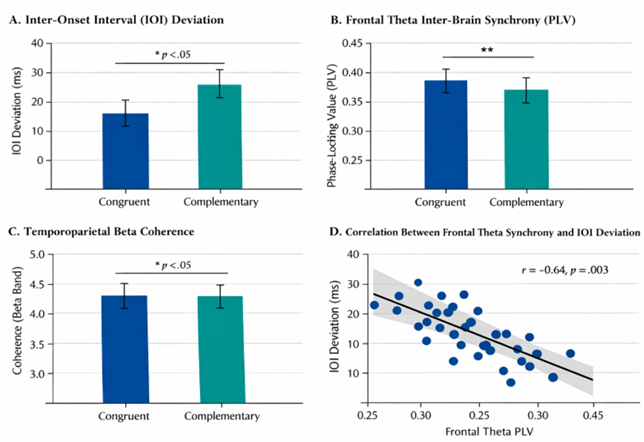
Figure 1 Concurrent Visualization of Behavioral and Neural Disparities of Congruent and Complementary Performance Conditions. (A) Behavioral Timing Deviation. (B) Frontal Theta Synchrony. (C) Temporoparietal Beta Coherence. (D) Relationship Between Frontal Theta Synchrony and Timing Accuracy.
Results indicate the frequency-specific and region-specific inter-brain synchrony when people performed music together. Frontal theta synchrony (temporal prediction) and shared alignment are improved by congruent performance and temporoparietal beta coherence (adaptive coordination) and role differentiation are improved by complementary performance. Notably, neural synchrony is a strong indication of behavioral timing accuracy, which is important in indicating its functional role in collaborative singing and piano playing.
5. DISCUSSION
The current experiment examined the neural synchronization and brain-to-brain interaction during collaborative singing and piano playing as measured by the dual-EEG hyper scanning. The study has compared congruence (unison) and complementary (melody-accompaniment) coordination structures to study the frequency-specific inter-brain synchrony and its correlation with schedule accuracy in behavior. The results offer empirical evidence to the frameworks of oscillatory entrainment, predictive coding, and interactional synchrony, proving that the collaborative music performance is associated with condition-dependent neural coupling.
5.1. Brain-to-brain Synchronization and Consistency
As it has been predicted in our first hypothesis, congruent performance induced much higher frontal theta-band inter-brain synchrony than complementary performance. Cognitive control, temporal prediction, as well as performance monitoring are commonly linked with frontal theta oscillations Cope et al. (2021). The stronger theta interaction that occurs with unison coordination indicates that mutual predictive models are strengthened when the performers perform the same rhythmic patterns. With this type of condition, both parties depend on perfectly compatible temporal expectations, whereby uncertainty is minimized, and minimal corrective actions are required.
These results are in line with other hyperscanning
studies that showed that frontal inter-brain coherence was higher in joint
action synchrony
Significantly, theta synchrony frontality had a strong impact on timing accuracy. This neural-behavioral relationship gives first-hand evidence that inter-brain alignment is not coincidental but it is functional to performance accuracy. These results expand the interactional synchrony theory through showing the neural alignment to lead to quantifiable increases in joint motor performance Hoehl et al. (2021).
5.2. Adaptive coupling and Complementary Performance
Complementary performance elicited greater temporoparietal
beta-band synchrony as compared to that in congruent performance.
Perspective-taking and role differentiation as well as adaptive social
processing have been associated with the temporoparietal junction (TPJ)
In contrast to unison performance, complementary coordination presupposes the performers to combine different rhythmic and harmonic parts and preserves temporal integrity. Such an asymmetry form is likely to increase what is demanded both with respect to cognitive processes of monitoring and predicting partner behavior and role adjustment. This interpretation is also supported by the directional relation in the outcome of the Granger causality test since there is no an asymmetry in the influence of the leaders and followers in the complementary tasks. This asymmetry is consistent with the results of studies of instrumental duets Yuan et al. (2025) and supports the notion that neural synchrony is vulnerable to the differences in interactional hierarchy, but not across collaborative situations.
Strong positive relationship between temporoparietal beta synchrony and tempo variability indicates that tightens connectivity happens with the growth of adaptive requirements. Instead of indicating mere synchronization, inter-brain coherence in beta-band can be the indication of active negotiation and correction of mistakes during difficult coordination.
5.3. Singing Vs. Piano Performance
Even though the study involved collaborative singing and piano duet tasks, there was no great modality difference in the overall neural synchrony patterns. This result indicates that brain-to-brain coupling mechanisms could be strong both in vocal as well as in instrumental fields. Although singing and piano performance are based on shared respiratory control and vocal-motor integration and fine motor coordination, respectively, both modalities are dependent on shared rhythmic prediction and adaptive timing. The fact that the patterns of neural synchronization are similar in the case of different modalities makes the idea that oscillatory entrainment and predictive coding systems are not modality-specific, but general-level joint actions.
However, minor patterns of increased frontal synchrony in singing dyads can be of interest to more research in bigger samples. Future studies that utilize respiratory and physiological variables would shed more light on whether vocal coordination brings more inter-brain coupling dynamics.
5.4. Theoretical Integration
The results of the current research are comprehensible in the framework of a synthesized theoretical model of oscillatory entrainment, predictive coding and interactional synchrony. The oscillatory entrainment theory is an explanation of how the rhythmic alignment at the neuronal level underlies the temporal precision Cope et al. (2021). Predictive coding models are those that consider the development and maintenance of shared anticipatory representations in the process of collaboration Abalde et al. (2024). The interactional synchrony theory focuses on adaptive social rewards of consonance on a behavioral and neural level DaSilva and Wood (2025).
Collectively, these mechanisms imply that music performance through collaboration implies a multi-layered coordination mechanism where neural oscillations become synchronized to aid in common timing, role negotiation and mutual prediction. The current research adds to the existing body of literature because it shows that these mechanisms are condition-dependent and frequency-specific.
5.5. Methodological Contributions
The methodological value of this study is that the study used EEG hyperscanning to examine frequency-band-specific neural synchrony during structured musical interaction. Although FNIRS has been many times used in previous researches, the temporal resolution of EEG can be used to investigate oscillatory processes that are important in rhythm and motor control. The study brings the field beyond descriptive reports of neural synchrony to the functional interpretation of neural synchrony by connecting the neural synchrony to objective time metrics of behavior.
Also, the head-on clash between similar and complementary coordination is a new contribution that can be made to understanding the role of the task design in the nature of inter-brain couplets. The method fills a literature gap, in which role-based disparities on neural synchronization have not been properly studied.
5.6. Limitations
Regardless of its contributions, there are a number of limitations that need to be mentioned. The sample size is similar to the previous hyper scanning studies; however, it is too small to have any statistical power to identify subtle modality differences. Although the conditions of the laboratory are controlled, it might not be as ecologically rich as live performance conditions. Also, EEG has a high temporal resolution but the spatial localization is approximate. EEG + FNIRS/motion capture in future studies, it may be possible to combine EEG with FNIRS or motion capture to provide multimodal understanding of neural and behavioral dynamics of team performance.
5.7. Future Directions
The future research should consider more ensemble situations, the investigations of emotional display besides timing accuracy and change in neural synchrony over time in the presence of recurring collaborative training. It is also possible to include techniques of computational modeling that can be used to determine how predictive alignment varies over time in experienced and novice dyads.
In order to conclude everything, the existing evidence has shown that inter-brain synchronization dynamics and frequency-specific patterns play roles in collaborative singing and playing piano, which depend upon the coordination structure and role division. Congruent performance is a task that enhances frontal theta coupling which is accompanied by common temporal prediction, complementary performance is temporal parietal beta synchrony that is linked with adaptive coordination. It is worth noting that neural synchrony predicts the accuracy of coordinating behavior timing, which has significance of its functionality value in the context of art collaboration. These results are consistent with a growing body of literature that brain-to-brain coupling is a process that supports the coordinated human functioning.
6. CONCLUSION
The present paper investigated neural synchronization and brain-to-brain interaction in cooperation during singing and playing a piano in the case of two-EEG hyper scanning. Empirical evidence provided in the study through the comparison of congruent (unison) and complementary (melody-accompaniment) coordination structures proves that inter-brain synchronization is both regionally localized and functional to the accuracy of performance and frequency-specific.
The findings show that, congruent performance favors the association between frontal theta-bands, which denote shared temporal prediction and congruent anticipatory processing. Complementary performance on the other hand, improves temporal parietal beta coherence which is a sign of adaptive co-ordination and role negotiation by the brain. It is noteworthy that neural synchrony significantly predicts precision of behavioral timing and this fact implies that, brain-brain connector-ness is not merely another fact of correlation but it directly influences the music concert performance.
Such results produce oscillatory entraining and predictive coding model into real time artistic collaboration that the usual neural dynamics proves beneficial in complex joint performance. A direct comparison through the same model of singing and piano modalities also shows that there are underlying processes of inter-brain co-ordination involved in both vocal and instrumental situations.
Besides the theoretical implication, the research implications have a practical one in the area of music and ensemble training. It is possible to use the understanding that neural alignment facilitates the accuracy and flexibility to influence the rehearsal practices that can be applied to enhance the quality of collaborative performance. Also, the methodological approach to the conglomeration of EEG hyper scanning and behavioral timing measurements is useful in the development of empirical strategies in neuroscience of performing arts.
In conclusion, joint musical performance entails the presence of dynamic, condition-mediated, neural coupling mechanisms, to which they contribute common timing, adaptive coordination and expressive congruence. The neurobiological effects that take place in the coordinated interaction in the arts include brain-brain synchronization.
CONFLICT OF INTERESTS
None.
ACKNOWLEDGMENTS
None.
REFERENCES
Abalde, S. F., Rigby, A., Keller, P. E., and Novembre, G. (2024). A Framework for Joint Music Making: Behavioral Findings, Neural Processes, and Computational Models. Neuroscience and Biobehavioral Reviews, 167, 105816. https://doi.org/10.1016/j.neubiorev.2024.105816
Adank, P. (2022). Identifying A Brain Network for Musical Rhythm: A Functional Neuroimaging Meta-Analysis and Systematic Review. NeuroImage, 136(3), 104588. https://doi.org/10.1016/j.neuroimage.2012.07.027
Ara, A., and Marco-Pallarés, J. (2026). Distinct Social Dynamics of Joint Action Represented by Interpersonal Neural Coupling in Congruent and Incongruent Joint Musical Performances. NeuroImage, 325, 121662. https://doi.org/10.1016/j.neuroimage.2020.116665
Babiloni, F., and Astolfi, L. (2014). Social Neuroscience and Hyperscanning Techniques: Past, Present and Future. Neuroscience and Biobehavioral Reviews, 44, 76–93. https://doi.org/10.1016/j.neubiorev.2012.07.006
Bastos, A. M., and Schoffelen, J. M. (2016). A Tutorial Review of Functional Connectivity Analysis Methods and Their Interpretational Pitfalls. Frontiers in Systems Neuroscience, 9, Article 165147. https://doi.org/10.3389/fnsys.2015.00175
Bellmann, O. T., and Asano, R. (2024). Neural Correlates of Musical Timbre: An ALE Meta-Analysis of Neuroimaging Data. Frontiers in Neuroscience, 18, Article 1373232. https://doi.org/10.3389/fnins.2024.1373232
Bieńkiewicz, M. M. N., Smykovskyi, A. P., Olugbade, T., Janaqi, S., Camurri, A., Bianchi-Berthouze, N., Björkman, M., and Bardy, B. G. (2021). Bridging the Gap Between Emotion and Joint Action. Neuroscience and Biobehavioral Reviews, 131, 806–833. https://doi.org/10.1016/j.neubiorev.2021.08.014
Brattico, E., and Vuust, P. (2017). Brain-to-Brain Coupling and Culture as Prerequisites for Musical Interaction. In M. Lesaffre, P. Maes, and M. Leman (Eds.), The Routledge Companion to Embodied Music interaction (249–257). Routledge. https://doi.org/10.4324/9781315621364-28
Cheng, S., Wang, J., Luo, R., and Hao, N. (2024). Brain-to-Brain Musical Interaction: A Systematic Review of Neural Synchrony in Musical Activities. Neuroscience and Biobehavioral Reviews, 164, 105812. https://doi.org/10.1016/j.neubiorev.2024.105812
Czeszumski, A., Eustergerling, S., Lang, A., Menrath, D., Gerstenberger, M., Schuberth, S., Schreiber, F., Rendon, Z. Z., and König, P. (2020). Hyperscanning: A Valid Method to Study Neural Inter-Brain Underpinnings of Social Interaction. Frontiers in Human Neuroscience, 14, Article 511484. https://doi.org/10.3389/fnhum.2020.00039
DaSilva, E. B., and Wood, A. (2025). How and Why People Synchronize: An Integrated Perspective. Personality and Social Psychology Review, 29(2), 159–187. https://doi.org/10.1177/10888683241252036
Hadley, L. V., and Pickering, M. J. (2020). A Neurocognitive Framework for Comparing Linguistic and Musical Interactions. Language, Cognition and Neuroscience, 35(5), 559–572. https://doi.org/10.1080/23273798.2018.1551556
Hoehl, S., Fairhurst, M., and Schirmer, A. (2021). Interactional Synchrony: Signals, Mechanisms and Benefits. Social Cognitive and Affective Neuroscience, 16(1–2), 5–18. https://doi.org/10.1093/scan/nsaa024
Hu, Y., Cheng, X., Pan, Y., and Hu, Y. (2022). The Intrapersonal and Interpersonal Consequences of Interpersonal Synchrony. Acta Psychologica, 224(3), 103513. https://doi.org/10.1016/j.actpsy.2022.103513
Izen, S. C., Cassano-Coleman, R. Y., and Piazza, E. A. (2023). Music as a Window into Real-World Communication. Frontiers in Psychology, 14, Article 1012839. https://doi.org/10.3389/fpsyg.2023.1012839
Kasdan, A. V., Burgess, A. N., Pizzagalli, F., Scartozzi, A., Chern, A., Kotz, S. A., Wilson, S. M., and Gordon, R. L. (2022). Identifying a Brain Network for Musical Rhythm: A Functional Neuroimaging Meta-Analysis and Systematic Review. Neuroscience and Biobehavioral Reviews, 136, 104588. https://doi.org/10.1016/j.neubiorev.2022.104588
Konrad, K., Gerloff, C., Kohl, S. H., Mehler, D. M. A., Mehlem, L., Volbert, E. L., Komorek, M., Henn, A. T., Boecker, M., Weiss, E., and Reindl, V. (2024). Interpersonal Neural Synchrony and Mental Disorders: Unlocking Potential Pathways for Clinical Interventions. Frontiers in Neuroscience, 18, Article 1286130. https://doi.org/10.3389/fnins.2024.1286130
Lee, H., and Orgs, G. (2022). Experiencing Art in Social Settings. In G. Cupchik and O. Vartanian (Eds.), The Routledge International Handbook of Neuroaesthetics (448–460). Routledge. https://doi.org/10.4324/9781003008675-26
Leonetti, S., Ravignani, A., and Pouw, W. (2024). A Cross-Species Framework for Classifying Sound-Movement Couplings. Neuroscience and Biobehavioral Reviews, 167, 105911. https://doi.org/10.1016/j.neubiorev.2024.105911
Liu, Q., Yang, X., and Zhang, W. (2024). Physiological Synchrony Evoked by Attentional Engagement: A Systematic Review Based on Citespace. SAGE Open, 14(4). https://doi.org/10.1177/21582440241298400
Montague, P. R., Berns, G. S., Cohen, J. D., McClure, S. M., Pagnoni, G., Dhamala, M., Wiest, M. C., Karpov, I., King, R. D., Apple, N., and Fisher, R. E. (2002). Hyperscanning: Simultaneous fMRI During Linked Social Interactions. NeuroImage, 16(4), 1159–1164. https://doi.org/10.1006/nimg.2002.1150
Oesch, N. (2019). Music and Language in Social Interaction: Synchrony, Antiphony, and Functional Origins. Frontiers in Psychology, 10, Article 1514. https://doi.org/10.3389/fpsyg.2019.01514
Samraksha, N., Sangeetha, S. R., and Patteswari, D. (2026). A Narrative Review of Neural Synchrony and Oscillations in Shared Consciousness of Self and Other in Romantic Intimacy. Journal of Psychosexual Health. https://doi.org/10.1177/26318318261421672
Seth, A. K., Barrett, A. B., and Barnett, L. (2015). Granger Causality Analysis in Neuroscience and Neuroimaging. Journal of Neuroscience, 35(8), 3293–3297. https://doi.org/10.1523/JNEUROSCI.4399-14.2015
Shemyakina, N. V., and Nagornova, Z. V. (2021). Neurophysiological Characteristics of Competition in Skills and Cooperation in Creativity Task Performance: A Review of Hyperscanning Research. Human Physiology, 47(1), 87–103. https://doi.org/10.1134/S0362119721010126
Solovey, E. T., and Putze, F. (2021). Improving HCI with Brain Input: Review, Trends, and Outlook. Foundations and Trends in Human-Computer Interaction, 13(4), 298–379. https://doi.org/10.1561/1100000078
Thaut, M. H., McIntosh, G. C., and Hoemberg, V. (2015). Neurobiological Foundations of Neurologic Music Therapy: Rhythmic Entrainment and the Motor System. Frontiers in Psychology, 5, Article 1185. https://doi.org/10.3389/fpsyg.2014.01185
Velletaz, T., Janaqi, S., Harispe, S., Lagarde, J., and Guyot, P. (2025). A Review of Human Synchronization Datasets. IEEE Access, 13, 67269–67285. https://doi.org/10.1109/ACCESS.2025.3560424
Wang, Y., Zhang, Y., Jiang, Y., Yao, Y., Zhao, F., Zhang, Z., and Zheng, M. (2026). Neural Mechanisms During Role-Playing in Music Psychodrama: An fNIRS Hyperscanning Study. Frontiers in Psychology, 17, Article 1712411. https://doi.org/10.3389/fpsyg.2026.1712411
|
|
 This work is licensed under a: Creative Commons Attribution 4.0 International License
© ShodhKosh 2026. All Rights Reserved.