ShodhKosh: Journal of Visual and Performing ArtsISSN (Online): 2582-7472
|
|
Application of Raganga in Raga Megh Malhar and Madhmad Sarang: A Comparative Study
Shatabhisha Sarkar 1
 ,
Tapasi Ghosh 2
,
Tapasi Ghosh 2
1 University
Research Fellow, Department of Performing Arts and Music, University of
Calcutta, India
2 Professor
of Music, Department of Home Science, University of Calcutta, India
|
|
|
ABSTRACT |
|
|
Several
Hindustani ragas share identical aroh and avroh but differ in chalan,
creating distinct flavours, as seen in ragas Megh, Malhar and Madhmad Sarang.
While the Malhar raganga impacts Megh Malhar, Madhmad Sarang is impacted by
the Sarang raganga. This comparative study qualitatively analysed the
placement of the Malhar and Sarang ragangas in Megh Malhar and Madhmad Sarang
through recorded performances of the ragas, comparing prominent phrases
within different sections of raga presentation, across five purposively
selected Gharanas, resulting in a total sample size of ten. One raga
presentation by an established artist from a specific Gharana in raga Megh
Malhar was compared to another presentation in raga Madhmad Sarang by a
different artist from the same lineage. The application of the Malhar and
Sarang phrases was observed through these comparisons. Significant
differences were observed in the application of ‘mR’, ‘PnP’, and ‘PR’ phrases
for both ragas. Findings showed that the Kanada phrase ‘mgmRS’ was used to
strengthen Malhar in Megh Malhar and to delineate it from Madhmad Sarang, and
that Risabh was not always rendered as ‘mR’ in Megh Malhar; often it was
rendered straight as ‘R’ to give the raga a more masculine character.
Comparisons indicated that Megh Malhar had a more complex and heavier
personality than Madhmad Sarang. Anga or phrasal analysis offered a new
framework for comparing these ragas, illustrating their character and
personality as reflected in the performances. Such comparisons provide fresh
insights into the qualitative and quantitative studies of Hindustani music,
especially for future machine-based and computational research on Hindustani
ragas. |
|||
|
Received 10 January 2026 Accepted 19 March
2026 Published 11 April 2026 Corresponding Author Shatabhisha
Sarkar, tapasighoshcu@gmail.com DOI 10.29121/shodhkosh.v7.i4s.2026.7242 Funding: This research
received no specific grant from any funding agency in the public, commercial,
or not-for-profit sectors. Copyright: © 2026 The
Author(s). This work is licensed under a Creative Commons
Attribution 4.0 International License. With the
license CC-BY, authors retain the copyright, allowing anyone to download,
reuse, re-print, modify, distribute, and/or copy their contribution. The work
must be properly attributed to its author.
|
|||
|
Keywords: Raganga, Raga-Personality, Comparative-Study,
Expression |
|||



1. INTRODUCTION
In Hindustani classical music, a raga delivers a unique musical idea through a tonal framework Tomer (2013). In this branch of Indian classical music, several ragas can emerge from identical aroh and avroh, i.e., ascent and descent, yet have different chalan or characteristic movements, creating distinct flavours. Raga Megh Malhar and Raga Madhmad Sarang also share a common aroh and avroh, ‘SRmPnṠ’ and ‘ṠnPmRS’, and are classified under the same thata, Kafi. Nonetheless, these ragas have different chalans and exhibit unique personalities. Studies reveal that the chalan is often impacted by each raga's underlying raganga (identifying phrase), which influences the vadi-samvadi (most important swaras of a raga), purvang-uttarang (lower and upper tetrachords), and uccharan, referring to the expression and pronunciation of melodic phrases in a raga Jha (2021), Ginde (2020). That is to say, the personalities of raga Megh Malhar and Madhmad Sarang become different not only because they have different chalans but also because their chalan is impacted by the Malhar and Sarang angas or raganga.
2. Research Gap
Previous musicological research on raga Megh Malhar and raga Madhmad Sarang has mainly focused on their historical backgrounds, relying on traditional compositions and expert knowledge Jha (2014), Banerjee (2014), Nahar (2002), Shah (1991). However, the study of how raganga is used in actual raga performances through a comparative analysis of recorded performances has not been explored. Conducting a detailed comparative-analytical study of Hindustani ragas using recordings can therefore enhance existing literature on Hindustani ragas. Specifically, a comparative analysis of Malhar and Sarang ragangas—as they appear in recorded performances of Raga Megh Malhar and Madhmad Sarang across different gharanas—would show how raganga or the key raga identifying phrase is used at various stages of the raga presentation, such as Alap, Bandish, Vistar, and Taan, thereby revealing their identities and shaping their personalities stage by stage. As Hindustani classical music continues to grow in global popularity, there is a rising need to share research findings with a wider audience. This study aims to broaden the discussion of raganga's role in Hindustani music beyond India and into the international academic community.
3. Concept of Raganga
The word raganga was first used by Matanga to classify ragas of his time. On the other hand, while classifying Desi ragas, Sarangadev, for the first time, elaborated that ragas with chhaya or influences of Gramragas were referred to as raganga ragas. Pandit Damodar and Kallinath had the same opinion Tiwari (2013). Bisht has highlighted in her paper that the classification of ragas according to common characteristic phrases was the raganga paddhati, and that this system of classification was officially begun not by ancient authors like Sarangadev or Matanga, but by Bhavabhatta Bisht (1973). The word raganga can be broken into raga and anga, where anga refers to a particular melodic form of the raga Taylor and Rani (2021). Bhatkhande has defined anga in Volume IV of Sangeet Shastra as that which gets clearly visible, i.e., when a swara is regularly skipped, when the aroh or avroh is presented in a particular way, or when the swaras are curated in distinctive ways Bhatkhande (1956). He was the first to make use of important phrases to classify ragas Bisht (1973). Tiwari has thus derived it that when a special cluster of swaras from the main raga is present in other ragas, then that cluster would be referred to as the raganga of that raga. It can thus be concluded that raganga is a special combinational phrase through which a raga can be identified Tiwari (2013), Patwardhan (1981). It is a cluster of swaras that helps to identify a raga's subtleties Chanchal (2022). A raganga is thus referred to as a special, combinational phrase of swaras, which carries the core elements of a particular raga, including komal, tivra, ati-komal, and such swara-positions, ornamentations as kans, gamak, meend, and an intrinsic pace of the raga which is inherent in the phrasing Bisht (1973). All these elements are communicated through ucchar or utchara Ratanjankar (1960), also referred to as uccharan, i.e., expression and pronunciation in raga presentation, by musicologists Ginde (2020), Jha (2021a). The significance of raganga in Hindustani ragas is such that it is considered a classificatory rubric that can accommodate multiple ragas and their variants. A classification system of ragas based on raganga is known as the raganga raga classification system, which emphasises swarup samya, i.e., the distinction based on common characteristic phrases. However, the thata-raga classification of Bhatkhande is often misinterpreted as merely emphasising swara-samya or tonal familiarity of swaras. Bhatkhande, in his thata-raga classification, skilfully employed both concepts to understand and classify ragas. Pt. Bhatkhande’s inclusion of most ragas from the Sarang, Malhar and Kanada groups under the Kafi thata in his elaborate descriptions of the ragas in his four-volume Hindustani Sangeet Shastra Series illustrates this.
3.1. Critical examination of the nomenclature of Megh Malhar
The dilemma surrounding the name of raga Megh Malhar is inextricably linked to the ambiguity of its proper form. Banerjee (2014) has opined that Megh Malhar has ancient roots, but differentiated Megh from Megh Malhar, positing the latter as a composite of raga Megh and Suddha Malhar. Banerjee (2014) has stated that Risabh and Nishad are presented as oscillating swaras in the raga. According to her, the inclusion of ‘R-P’ sangati and a nyas, i.e., pause or rest on Madhyam in Megh Malhar, differentiates it from Megh, bringing it closer to raga Madhmad Sarang since ‘R’ is vadi and ‘P’ is samvadi in Madhmad. Laxmi (2020) has held Risabh as the nyas swara in raga Megh Malhar. However, Banerjee (2014) has argued that although Risabh can be an extremely important swara in raga Megh Malhar, it cannot be used for nyas in the raga because it is almost always oscillated, and depends on Madhyam for assistance. Other musicologists, like Nahar (2002), have observed that the same raga, previously referred to as Megh in texts such as Brihaddesi, Bharatbhasyam, Sangeet Ratnakar, or Sangeet Raj, is later referred to in texts such as Sangeet Parijat as Megh Malhar. Therefore, many musicians and musicologists have considered Megh and Megh Malhar to be the same raga. As this study analyses recorded performances primarily from the twentieth century and contemporary times, this comparison is grounded in the nomenclature Megh Malhar, not Megh, to contrast the personalities of the two ragas and observe their relative similarities and differences.
Madhmad Sarang has often been referred to as Madhyamadi, Madhyamad, or Madhumad Sarang, among other names. No matter how it is referred to, the form of the raga remains undisputed, unlike Megh Malhar.
3.2. Characteristic Features of Ragas Megh Malhar, and Madhmad Sarang
Raga Megh Malhar is a mishra variant of the Malhar group of ragas, i.e., it has confluences of two or more ragas and is categorised under Kafi thata. Nishad is komal, i.e., flat, in this raga. Bhatkhande (1956) further delineates the raga through its meend-laden ‘m-R’ and ‘n-P’ sangatis, a vibrant taar Shadaj, and the ‘R-P’ sangati. According to the Patwardhan school of thought, the ‘mRP’ swara-vinyas, or phrasal expression from the Malhar raga, is frequently used in this raga Patwardhan (1967), Patwardhan (2015). As Bhatkhande, Banerjee, Nahar, and others advanced, contemporary musicological perspectives have identified two predominant Prakars: Audav, which omits komal Gandhar and Dhaivat, and Shadav, which features komal Gandhar. Inter-gharana variations in performance practice and divergent opinions on vadi and samvadi exist. While some musicologists, such as Laxmi (2020), have considered Shadaj and Pancham as the vadi and samvadi swaras for this raga, Banerjee (2014) has considered Madhyam as the vadi and Shadaj as the samvadi. Jha (2014) has considered Shadaj, Madhyam, and Pancham as nyāsa swaras for the rāga Megh Malhar. Risabh is called the ‘mukha’ swara or the face for raga Megh Malhar Parrikar (2000). Traditionally, Megh Malhar is performed during the monsoon or the second prahar, the second quarter of the night.
Conversely, raga Madhmad Sarang is a chhayalag variant of
the Sarang group of ragas and is categorised under the Kafi thata. Madhmad
Sarang is distinguished by its komal Nishad and Audav Jati structure, skipping
Gandhar and Dhaivat entirely. Rishabh and Pancham function as vadi and samvadi,
respectively. Individuated from Vrindavani Sarang due to the use of komal
Nishad, Madhmad Sarang is typically performed during the second Prahar of the
day, i.e., from 9 am-12 pm. Additionally, Madhyam is significant in Madhmad,
and Shadaj, Risabh, and Pancham are nyas swaras in the raga Jha (2014). Madhmad Sarang was
previously considered the raganga raga for the Sarang group in place of
Vrindavani Sarang, which is now recognised as raganga raga Sarang. Bhatkhande
(1956), has illustrated the
character of Sarang with phrases ‘ṇS, RmR, PR, S’ (254) and as ‘RmP, PmR’
(264). Ginde
(2020) lecture demonstration
has highlighted the Sarang anga as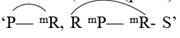 , and posited a potential evolutionary link between Sarang and Malhar angas,
differentiated primarily by swara pronunciation or ‘uccharan - bhed’ Ginde
(2020), Thakur
(2019). Shah (2000)
has noted the face of Sarang anga as ‘S’, ‘ṇSR’, ‘SR’, and illustrated
characteristic Sarang sangatis and phrases such as ‘S’, ‘mR’, ‘PmR’, ‘nPmR’,
‘RmPmR’, ‘mPR’, ‘SRṇS’, ‘ṇP̟’ to clarify Sarang anga. Sarang
anga has been characterised by Nahar
(2002) as, ‘SR, mR, P Pm R,
S’. Nahar (2002) has characterised Raga
Madhmad or Madhyamadi Sarang as ‘nP mR, RmPmR PmR S ṇSR, SR’. Jha (2021a) has demonstrated
raganga in Madhmad Sarang as ‘ṇSRmPmR’ (0:51), ‘ṇSRmR’
in purvang, and ‘mPnPnṠ’ (2:27) in the uttarang. ‘P-R’ in the purvang and
‘n-P’ in the uttarang have been considered as identifying angas Nahar
(2002), S. Patwardhan
(2015).
, and posited a potential evolutionary link between Sarang and Malhar angas,
differentiated primarily by swara pronunciation or ‘uccharan - bhed’ Ginde
(2020), Thakur
(2019). Shah (2000)
has noted the face of Sarang anga as ‘S’, ‘ṇSR’, ‘SR’, and illustrated
characteristic Sarang sangatis and phrases such as ‘S’, ‘mR’, ‘PmR’, ‘nPmR’,
‘RmPmR’, ‘mPR’, ‘SRṇS’, ‘ṇP̟’ to clarify Sarang anga. Sarang
anga has been characterised by Nahar
(2002) as, ‘SR, mR, P Pm R,
S’. Nahar (2002) has characterised Raga
Madhmad or Madhyamadi Sarang as ‘nP mR, RmPmR PmR S ṇSR, SR’. Jha (2021a) has demonstrated
raganga in Madhmad Sarang as ‘ṇSRmPmR’ (0:51), ‘ṇSRmR’
in purvang, and ‘mPnPnṠ’ (2:27) in the uttarang. ‘P-R’ in the purvang and
‘n-P’ in the uttarang have been considered as identifying angas Nahar
(2002), S. Patwardhan
(2015).
By analysing the differentiating characteristics of ragas Megh Malhar, and Madhmad Sarang, the study aims to fulfil the following objectives:
· To identify qualitative similarities and differences through phrasal comparisons in the raga Megh Malhar and Madhmad Sarang.
· To examine the application or implementation of the Malhar and Sarang ragangas as they present themselves in the raga renditions.
· To identify, analyse, and elucidate the characteristic and supportive phrases employed by the artists for their raga presentations.
· To investigate and evaluate how phrasal relationships within each raga contribute to the steady building up of the overall character and personality of the ragas.
· To compare and identify relative points of contrast in the phrasal representation of the two ragas through the individual artists’ presentational point of view.
· To bridge gaps between musicological studies and the performance practice in these two ragas through such a comparison.
· To find valuable insights into the relationship between technique and aesthetics involved in the phrasal expressions in the performance practice of these two ragas.
4. Method
To explore the application of raganga across vocal recordings of Megh Malhar and Madhmad Sarang, a substantial corpus of approximately 35 performances in both ragas was subjected to detailed auditory analysis. From this dataset, 10 samples were purposively selected and divided into five groups. Phrasal comparisons were made between one sample of raga Megh Malhar and one sample of raga Madhmad Sarang, five times across five different Gharana pairs. The goal was to keep the Gharana consistent in each pair so that the overall rules for rendering the two ragas remained within the aesthetic boundaries of those particular gharanas, as set for the study. The five Gharana pairs included Gwalior, Agra, Jaipur-Atrauli, Kirana, and Rampur-Sahaswan. Each sample features renditions by accomplished Hindustani classical musicians, recognised as leading practitioners within their respective musical lineages, ensuring expertise and authenticity in the raga interpretations.
Depending on the time and availability, either vilambit (slower tempo), madhya laya (medium tempo), or drut (fast tempo) presentations were selected for analysis. Based on the recordings, available theoretical references, audio lectures, and demonstrations on these two ragas, the researcher qualitatively analysed the samples.
4.1. Compositional Focus
Previous scholarly research by Nahar (2016) and Banerjee (2014) established the traditional Jhap tala bandish ‘Garaje Ghata Ghana’ by Sadarang as a canonical composition in raga Megh Malhar. Therefore, to maintain a focused, comparative analysis between Megh Malhar and Madhmad Sarang, this study exclusively examined recordings featuring this specific bandish for raga Megh Malhar, except for Mallikarjun Mansur’s Jhap tala rendition of ‘Bolan Lagi’ bandish in raga Megh Malhar for Jaipur Gharana. Given the relative consensus regarding the formal structure of raga Madhmad Sarang, a less rigid selection process was employed for compositions in this raga.
Table 1
|
Table 1 Source Details of Selected Samples |
|||||
|
Pair I Gwalior |
Raga |
Artist |
Bandish |
Source/URL |
|
|
Megh Malhar |
Gajananbuwa Joshi |
Garaje Ghata Ghana |
Pokri Poki, You Tube: https://www.youtube.com/watch?v=xwFVRUBb8xA |
||
|
Madhmad Sarang |
Veena Sahasrabuddhe |
Ranga De Rangrejwa |
Vibhuti Productions, YouTube: |
||
|
Pair II Agra |
Megh Malhar |
Lalith J. Rao |
Garaje Ghata Ghana |
Collected from the artist’s husband, N. Jayavanth
Rao, by Prof. Tapasi Ghosh |
|
|
Madhmad Sarang |
V.R. Athavale |
Ri Mahi Aj Badhao Raga |
Pokri Poki, YouTube: https://www.youtube.com/watch?v=NrfZTzL2WRk |
||
|
Pair III Jaipur-Atrauli |
Megh Malhar |
Mallikarjun Mansur |
Bolan Lagi |
Pokri Poki, You Tube: |
|
|
Madhmad Sarang |
Manjiri Asnare |
Ranga De Rangrejwa |
Komal Nishad Classical Music, You Tube: |
||
|
Pair IV Kirana |
Megh Malhar |
Bhimsen Joshi |
Garaje Ghata Ghana |
Raju Asokan, You Tube: |
|
|
Madhmad Sarang |
Venkatesh Kumar |
Aj Anjana Diye |
Indian Classical Music Boulevard, YouTube: |
||
|
Pair V Rampur- Sahaswan |
Megh Malhar |
Ghulam Sadiq Khan |
Garaje Ghata Ghana |
AIR Archives, You Tube: |
|
|
Madhmad Sarang |
Rashid Khan |
Thake Sab Gaye Bajaye |
Sigar Studio, You Tube: |
||
5. Analysis
Table 2
|
Table 2 Selected Artists for Comparison |
|||
|
1 |
Gajananbuwa Joshi |
Raga Megh Malhar |
|
|
2 |
Veena Sahasrabuddhe |
Raga Madhmad Sarang |
|
Alap
This Nom Tom Alap is not phased in terms
of slower-to-faster layas or rhythm sets, as done in the Agra gharana; however,
in this elaborate Alap, Gajananbuwa Joshi has demonstrated the essential
features of raga Megh Malhar. A brief
excerpt of the Alap from the beginning is as follows:
'ṇR-- R R- R R RRRR-
S--- ṇ S-- 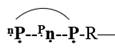
RiDe- Nene Nene RiReNene Nu-- Re --- ---------- -De—
P̟ R-----R—R—, S R ṇS ṇR-, SRṇS P̟n P̟S ṇR
RiDe-- ne---ne--- Ri re Na- na- , Rirena- de—de- Rire-
SR mg- mg-
mg- mg - m
R—S---, S S
S S ṇṇS- 
Rire Na- --
-- -- -
- Nu-- Ne
Re Ne Re
Tana- Nu m’
Joshi (2019)
The depth and gravity in the uccharan of
the ‘PnP’ phrase, appearing in the mandra saptak, is noteworthy. Here, ‘ṇP̟--P̟ṇ--P̟’ is pronounced more roundedly, with
Nishad being pronounced from Pancham’s position, gliding onto the Pancham on
the other side. This Nishad sounds slightly lower due to the kan of Pancham
than in phrases like ‘SRṇS’ used in this introductory excerpt. ‘P̟ṇP̟’ and the oscillated
Komal Gandhar in ‘mgmRS’ are
often associated with Kanada anga. However, the use of komal Gandhar with the
kan of Madhyam suggests that this Kanada phrase in Megh Malhar is used with a
lighter hand than the heavy, complex ragas of the Kanada group, such as Darbari.
Often, to lighten the effect of the
Kanada phrase, the Sarang phrase ‘PmR’ is joined by ‘S’ as ‘PmRS’ and ‘mR’ is also converted into ‘mRS’
following the appearance of ‘gmRS’ in the Alap, balancing out the impact of the
Kanada phrase for Megh Malhar:
‘mg mg
m R S, P m R
S, SP-- P m
R S,
P m R S, mRS,
Re Na – Re Na,
RiReReNa, Ri—ReNeNeNa, RiReReNa,
ReNeNe’
Joshi (2019)
In the case of the Alap in Madhmad, all
Malhar phrases like ‘mR’, ‘RP’ and ‘nP’ are found, yet their treatment varies.
Double or even triple Komal Nishads, bracketed by one Pancham on each side in
‘PnnP’, emphasise a sharp pronunciation of Nishad, alongside a prominent Madhyam as part of
Alap. ‘RmR’ is expressed as 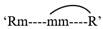 .
Similarly, ‘RP’ has appeared as part of another Sarang phrase ‘RPm’ where ‘m’
is stressed more, as ‘mRPP----m---', making Madhyam prominent again.
Though it is noteworthy that ‘R’ is pronounced with a slight kan of Madhyam,
which is outside the norm for this raga, the kan or grace note of Madhyam in
this phrase can be considered as the artist’s individual aesthetic. Meend is
used in both cases, but the pauses and the uccharan differ for Madhmad:
.
Similarly, ‘RP’ has appeared as part of another Sarang phrase ‘RPm’ where ‘m’
is stressed more, as ‘mRPP----m---', making Madhyam prominent again.
Though it is noteworthy that ‘R’ is pronounced with a slight kan of Madhyam,
which is outside the norm for this raga, the kan or grace note of Madhyam in
this phrase can be considered as the artist’s individual aesthetic. Meend is
used in both cases, but the pauses and the uccharan differ for Madhmad:

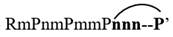
Sahasrabuddhe
(2021)
The reason behind the sharpness of the
Nishad can be that the ‘nn’ in ‘RmPnnP’ is pronounced in arohatmak or ascending
way, and therefore it sounds higher, sharper and closer to Taar Shadaj. In a
phrase like ‘RmPnmP’, the Komal Nishad gets avrohatmak or descending because of
‘m’ following it and thus sounds less sharp than the previous example. In
contrast, Gajananbuwa’s repeated use of Risabh without using the kan of
Madhyam, in this excerpt of Alap in Megh Malhar, can be considered as another
instance of artistic choice:
‘ṇR--- R R- R R RRRR- S---
RiDe- Nene Nene RiReNene Nu—’
‘P̟S’ ‘ṇR’, and ‘ṇS’,
have acted as supporting phrases for the phrases of Megh Malhar in this
excerpt.
However, Gajananbuwa Joshi’s choice is
not an exception. Because Bhimsen Joshi, too, refrained from using Madhyam as a
kan every time Risabh was repeated in his Megh Malhar rendition. Both have
struck at the Risabh without the kan of Madhyam, bringing out the raga's
masculine character. This can be because Megh raga was traditionally considered
a Purush raga under the Raga-Ragini classification system. This is likely why Jha (2014)
suggested that the raga is predominantly of the Veer rasa, as chivalry is
generally associated with the masculine. Malhar anga has been represented in
the rendered Bandish through the ‘n-P’ sangati:
|
X |
2 |
0 |
3 |
|
R R |
R - S |
ṇ S |
P̟ ṇ P̟ |
|
Ga ra |
ja - Gha |
ta - |
Gha - na |
Joshi (2019)
And, also
here:
|
S - |
S ṇ R |
S S |
ṇP̟ P̟ṇṇ P̟ |
|
Pa - |
wa- - sa |
Ri- tu |
Aa - yi |
|
Pm nP |
Ṡ - Ṡ |
n P |
Rṇ S - |
|
Du- li |
ha- - na |
Ma na |
Bha- - yi |
Joshi (2019)
Gajananbuwa Joshi has rendered the
Bandish in a way that the ‘mRP’ phrase of Malhar Jha (2014), Patwardhan 1968, Patwardhan (2015) does
not find any place in it. In practice, the artists also appear to modify the
renditions of the Bandishes, tailoring them according to their training and
artistic preferences. These cases reveal gaps between theory and practice, as
well as between traditional knowledge and modern guidelines established through
the rendition of the Bandish. Therefore, despite ‘Garaje Ghata Ghana’ being a
traditional bandish for Megh Malhar, the artist has chosen to interpret the
Bandish in accordance with raga Megh, as distinguished by Bannerjee (2014). Notably, Veena Sahasrabuddhe, in
a recorded performance from 1990, rendered the Bandish ‘Barkha Ritu Ayi’ with
‘mRP’; for example, the word ‘Bundariya’ sung at approximately 3:19 minutes is
illustrated as ‘SRṇS---mRmRRP-P-P’
Sahasrabuddhe (2017).
Conversely, in Sahasrabuddhe’s rendition
of the Madhmad Sarang Bandish, ‘Rang De Rangrejwa’, the Sam invariably falls on
Madhyam through the phrase, ‘RPm’. ‘m’ as mukha swara for Madhmad Sarang, is
added to ‘nnP’, as ‘nnPm’ – making the phrase characteristically appropriate
for Madhmad Sarang. The ‘n-P’ phrase as part of Sarang anga is demonstrated in
the Sthayi in this way
|
X |
2 |
0 |
3 |
|
P nnPm Pm
PnṠ |
n P m P |
mR (S)ṇ SR |
|
|
Pi ---- ya-
--- |
Ki - Pa - |
ga- ri- ya- |
Sahasrabuddhe
(2021)
In the Antara as:
|
0 |
3 |
|
nn |
Pm Pm -P
Ṡ- |
|
Ran |
ga De -Mo ri- |
Sahasrabuddhe
(2021)
Other than ‘n-P’ sangati, ‘P mR(S)ṇSR’
shown in the Sthayi excerpt includes two phrases of relevance ‘PmR’
and ‘nSR’. ‘m’ in ‘PmR’ is used as a kan swara; the phrase is
pronounced exactly how Ginde (2020) has demonstrated the uccharan of ‘P mR’ in his lecture
demonstration, while differentiating between Malhar and Sarang angas.
Vistar
Next to the Alap and Bandish, Buwa has
demonstrated the most essential raga-vachak, i.e. raga- abiding phrase, in the Bolbant section
at 04:05 minutes:
‘0
- mR mR mR mR
mR mR mR
mR mR
- Ga
ra ja Gha ta
Gha na Ga a’
Joshi (2019)
Through this layakari or
tempo-variation, Gajananbuwa has demonstrated ‘mR’ sangati, expressed as ‘mR’,
highlighting the mukha swara, Risabh, in its most characteristic way Thakur (2019), Banerjee (2014), hammering on the phrase repeatedly in
a different laya than that of the Tabla accompaniment. The layakari unfolds the
complete personality of the raga through the Malhar anga, revealed through ‘mR’.
Additionally, Buwa has used gamak, i.e. deep tonal vibrations and oscillations,
generously to emphasise the uccharan of ‘mR’.
At 4:18 minutes, Buwa has demonstrated
Malhar through ‘mR’ alongside the Kanada phrase broken into ‘mgm’
and ‘RS’ vigorously accompanied by a playful layakari:
X
‘mR mR m RSṇS-- -- RR SS
mm RS ṇS
mgm RS SSṇ RRS
Ga
ra ja aa---
-- Gha- ta- Gha-
Na- -- Kare-
Kare Garaje Ghata’
Joshi (2019)
On the other hand, Sahasrabuddhe has
illustrated Sarang anga in an elaborate Vistar, beginning at 5:35 minutes with
Aakar and concluding with the bol or lyrics of the Bandish at 6:10 minutes.
Sahasrabuddhe’s treatment of the raga in this raga-vistar suitably brings out a
Shringar-based character of Madhmad Sarang through blended phrases like
‘RmPnmP’, which has ‘RmP’ blended with ‘nmP,’ where the aesthetic stress lies
on ‘mPnn----P’ in the following way:

Sahasrabuddhe
(2021)
Two phrases, ‘n-P’ and ‘m-R’, blended
as, 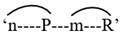 , have
been sung in this excerpt of the Vistar. This phrasing is common to both Megh
Malhar and Madhmad. However, Sahasrabuddhe has calmly and carefully handled the
meends, stressing and highlighting ‘n’ and ‘m’ without pouring influences of
subsidiary swaras on them.
, have
been sung in this excerpt of the Vistar. This phrasing is common to both Megh
Malhar and Madhmad. However, Sahasrabuddhe has calmly and carefully handled the
meends, stressing and highlighting ‘n’ and ‘m’ without pouring influences of
subsidiary swaras on them.
Taan
Gajananbuwa has niftily focused on
phrasings in Megh Malhar in each Sargam and Taan. Interestingly, in the
following Taan, the dominance of Malhar phrases ‘mmR’ and ‘RPPmnn’ are such
that Kanada phrase ‘gmRS’ is reduced to ‘gmm SRR ṇSS’
where komal Gandhar is not oscillated, and ‘nnP’ eventually becomes ‘nnmPP’
shedding much of its weight before approaching the Kanada phrase:
‘mmRSṇS mmRSṇS mmRSṇS nnPmRSṇS, mmRSṇS, mmRSṇSRR,
SRRṇSS, P̟SSṇRRSmm, RPPmnnPṠṠnṘṘ,
nṠṠPnnmPP, gmmSRRṇSS’
Joshi (2019)
Though ‘RP’ is audible in the example
cited above, its use in the Taans of Megh Malhar does not follow the usual
Malhar pattern; however, this contradicts the observation that the artist has
presented it as Megh, not Megh Malhar, based on earlier sections where ‘RP’ was
not used. ‘nRR’, ‘SRR’ emphasize Risabh. At the same time, ‘nSS’, ‘PSS’,
‘mnnP’, ‘nnmPP’, along with the previously mentioned phrases, firmly hold the
melodic structure of Megh Malhar.
In contrast, in this Aakar Taan at 10:03
minutes, Sahasrabuddhe fascinatingly used swaras ‘m’, ‘R’, ‘P’ side by side and
yet saved it from sounding like the Malhar phrase ‘mRP’ through her artistic
expertise and sense of proportion, so that the phrasing conveys ‘RmRPmP’.
Sahasrabuddhe also illustrates Sarang anga, ‘nnP’ followed by ‘m’ and ‘RmR’
through the following Taan:
‘ṇSRmmmRPPPmPmnnnPnPmRmRSṇS-’
Sahasrabuddhe
(2021)
Regarding the use
of the ‘RmR’ phrase in any Sarang raga, Ramshankar
(2012) has noted that it is central to all types or Prakars of Sarang.
Thus, through
phrasal comparison, the depth and lightness in the application of similar
phrases in the two ragas with identical scales become practically observable,
and their nuanced application can be used for advanced studies.
5.2. Pair II: Agra
Table 3
|
Table 3 Selected Artists for Comparison |
|||
|
1 |
Lalith Rao |
Raga Megh Malhar |
Collected from the artist’s
husband, N. Jayavanth Rao, by Prof. Tapasi Ghosh |
|
2 |
V. R. Athavale |
Raga Madhmad Sarang |
https://www.youtube.com/watch?v=NrfZTzL2WRk |
At the very
beginning of Lalith Rao’s Nom Tom Alap in raga Megh Malhar, she introduces
‘n-P’ sangati, where Komal Nishad oscillates in the mandra saptak with the kan
of Pancham and Shadaj. In Rao’s Alap, ‘n-P’ is emphasized more compared to
Athavale’s use of ‘n-P’ in the Alap of Madhmad. The komal Nishad in ‘n-P’,
starting from mandra Pancham and from Shadaj, produces two distinct sounds
recognisable through careful observation, as seen in this excerpt:
Sṇ
Sṇ Sṇ ṇ ṇ S----------- —S, P̟ṇ---
Sṇ Sṇ Sṇ SṇSṇSṇSṇ
ṇP̟--, ṃ- P̟ṇ-
Sṇ Sṇ Sṇ
Sṇ ṇP̟--,
Nu- - -
- - - ---------- -- -,
Na-- -- -- -- -- -- -- -- -- --, Re na- -- -- --
-- -- --,
Rao (1991)
This recalls Bannerjee’s (2014) proposition of two komal
Nishads with two distinct shrutis audible within the raga (60).
At 8:49 minutes of
her Alap, Rao introduces the Kanada phrase:
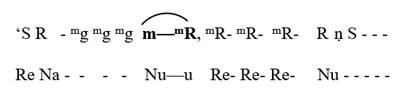
Rao (1991)
Wherein, ‘gmRS’ is
pronounced with gamak and oscillations, then blended with Malhar phrases,
broken through ‘m-mR-’ and ‘R ṇ S’ phrases, with the recurring ‘mR’ emphasizing the character of
Megh Malhar. The ‘R’ is pronounced with the kan of ‘m’. ‘m’ in ‘m-mR-’ is
pronounced with gamak and meend. Additionally, ‘mR’ is repeated and merges into
‘R ṇ S’, blending
Malhar and Kanada phrases in Megh Malhar.
Conversely, V.R.
Athavale’s Alap of Madhmad Sarang emphasizes a mirror-like Sarang phrase,
‘RmR’, more than ‘n-P’ in the introductory part of his Alap, highlighting
Madhyam:
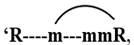 PmR Rṇ ṇ ṇS--,
 P---m—P---mnP mRm---m(m)R-’
Athavale (2020)
By staying on
Madhyam with meend in, Athavale has explored the ‘m-R’ phrase differently in
Madhmad Sarang. He has demonstrated the expanse of Madhyam, and additionally,
in Athavale’s Alap rendition, ‘n-P’ has been shown in the madhya saptak:

Athavale (2020)
On the other hand,
Rao, while illustrating the prominence of Risabh in Megh Malhar, has frequently
used gamak, as in the phrase ‘ṃ-R’ Rao (1991). In fact, meend
and gamak are common in Rao’s Nom Tom. The ‘P-R’ sangati appears at 8:12
minutes with elongation of the mandra ‘P’ and a subtle push at ‘R’ in the
madhya saptak.
Athavale’s use of
Sarang phrases in his Alap shows his dedication to accurately representing the
raga, similar to how Rao has aimed to combine a traditional Nom Tom Alap with
an ancient raga through a traditional Bandish. Preservation of tradition and adherence
to raga rules are key goals for the artists of the Agra Gharana.
Bandish
In the renditions
of ‘Garaje Ghata Ghana’, Rao has repeatedly and distinctly used the kan of
Madhyam on Risabh unlike Bhimsen or Gajananbuwa:
|
X |
2 |
0 |
3 |
|
R mR |
mR mRS S |
Rṇ S |
P̟ ṇ P̟ |
|
Ga ra |
ja -- Gha |
ta - |
Gha - na |
Rao (1991)
Here, ‘mR’
has represented Malhar in Megh Malhar, ‘P̟ṇP̟’, Megh. ‘Rn’ has been identified as a
common phrase in Megh Malhar Lakshmi (2018).
On the other hand,
Athavale has demonstrated Sarang in the Sthayi section of his Bandish ‘Ri Mahi
Aj Badhao Raga Gawo’ in the following way:
|
X |
2 |
0 |
3 |
|
RRSṇS SR |
|||
|
Ri--- Mahi |
|||
|
m R - RRmPmP |
P mn P nmP |
PnṠ Pn
PPm nmP |
mR RmR RṇS |
|
A aj -
BadhaoRa |
ga Ga
wo Sa-- |
ba-- Mi-
la-- Na-- |
ara a--
Piya |
Athavale
(2020)
Here, aside from
the ‘RmR’ phrase, ‘mnP’ and ‘nmP’ phrases are heard consecutively. Madhyam is
emphasized. ‘nmP’ appears twice with ‘PnS’ and ‘mR’ to bring weight to the
structure of the Bandish, since previous studies have indicated that ‘nmP’ is a
Malhar phrase Varshaneya
(2018) and often a Kanada phrase Jha (2004). This is likely because the depths of a
raga are truly explored in the vilambit Bandish.
In Megh Malhar’s Antara, the Bandish lyric up
to ‘Ghana Ghora’ is rendered with variations. ‘Ora’ is sung in one breath like
a quick Taan burst, ‘nnPmPnṠ-Ṡ’. ‘nnP’ is followed by ‘m’, though Madhyam is not sustained for
long. Additionally, ‘Ghana Ghora’ is sung as ‘nPmR-S’, clearly
demonstrating Malhar anga through ‘n-P’ and the distinct application of Risabh
via kan of Madhyam as ‘mR’, bracketed by taar Shadaj and followed by Shadaj in
the madhya saptak and weaving a melodic pattern through the Bandish that is
both aesthetically pleasing and technically sound. The notation is provided
below:
|
X |
2 |
0 |
3 |
|
m P |
nnPm PnṠ -Ṡ |
n P |
mR - S |
|
Cha hu |
O - ra |
Gha na |
Gho - ra |
Rao (1991)
On the other hand,
Athavale has used phrases like ‘nṠṘ’, ‘nP’, ‘ṠṁṘṠ’, ‘P-mR’, and ‘mRṇS’, highlighting
taar saptak for Madhmad Sarang in the Antara. The phrases used by Athavale do
not include ornamentations such as meend, gamak, or kans:
|
X |
2 |
0 |
3 |
|
mm PṠnṠP |
|||
|
Dhana Ma-ng |
|||
|
nṠ Ṡ nṠṘ Ṙ-Ṡ |
nṠ n P nṠṘṘ |
ṠṁṘṠ nṠ nP mPṠnP |
P-mR mRṇS |
|
ga la
Di- - - -na |
Dhana Bha-
ga Ja-ge |
Janamali yo- hai-
Raghu |
kula- Nandana |
Athavale (2020)
Similar phrasings
in the ragas often produce different effects. This was particularly evident in
the analysis of Rao and Athavale's Vistars. For instance, Lalith Rao has shown
Malhar anga through ‘mR’, ‘n-P’, and ‘m-R’ phrases in the following
Vistar at 39:43 minutes:
‘mR m
P n P m R (ṇ) SR
Gha ta - Ghana
Kare - --
Rao (1991)
The ‘m-R’ phrase,
as ‘mR’ and ‘m-R’, creates different effects, shifting weights and
proportions according to the rules of raga Megh Malhar. Conversely, Athavale presents the Sarang anga ‘m-R’ through the ‘P
mRR’ and ‘PmR’ phrases in the Vistar as follows:
‘P mRR
--- Rm- PmR ṇṇS- RṇS—S--
A- aja Ma-- E--
E---- Ma— E--- -
-- ’
Athavale (2020)
Blended
phrases were found in both ragas, but each artist's treatment of these phrases
differed. For example, Lalith Rao broke away from the rhythm on Tabla and
explored the taar saptak using ‘mR’ and ‘nP’ phrases, in the Vistar of Megh Malhar. The blended
phrasing ‘nPmR’ was used in
the following way:
‘Rm PnṠ nPnṠṘ- nṠṁṘ ṠnP mR R(S)ṇS-
Dula
ha--- a---- a--- Mana Mana
Bha-ye-’
Rao (1991)

In the Vistar
section, as in her entire performance, Rao refrained from portraying ‘mRP’ or
‘RP’ as Malhar anga in Megh Malhar. Conversely, at 3:42
minutes, Athavale demonstrated ‘RPmP’ and ‘RPmnP’ in such a way that Madhyam
appears prominently in these Madhmad phrasings. Although 'PnP’ is present in
his Vistar, it is sung entirely in the madhya saptak, unlike in most cases in
Megh Malhar, where the phrase is placed in the mandra saptak, and does not
involve any meend or long pause on Pancham or Nishad:

A----- A –Mai E----
--- --- -- ---
E-- Ma-- ---- ----
--- ’
Athavale (2020)
Lalit Rao
incorporates Bolbant in her rendition of Megh Malhar. Elements like Bolbant
help express ragas such as Megh Malhar, especially when sung by a performer
from the Agra Gharana, which specialises in playing with laya. An example of
this is seen in Rao’s demonstration at 43:25 minutes of her performance:
X
‘-SṘ- Ṙ-Ṡ ṠnnP, -mn-
n-P nPmR, - nn- nP-P PmmR RṇS
-Gara- ja-Gha ta-Ghana,
-Gara- ja-Gha ta-Ghana,
-Gara- ja-gha ta-Ghana
Ka-re’
Rao (1991)
Here, the phrases
lack meend and ornamentation and are expressed with a roughness and captivating
rhythm in the swaras, independent of the tala played in the Tabla
accompaniment. The ‘n-P’ sangati is used in various forms such as ‘ṠnnP’, ‘n-P’,
‘nPmR’, ‘nn-nP-P’, etc., where ‘m-R’ and ‘n-P’ sangatis are common to both Megh
Malhar and Madhmad Sarang. ‘PmR’, prominent in Madhmad, is used here as ‘PmmR’,
with Pancham and Risabh bracketed by two Madhyams to suit the phrasing for Megh
Malhar. This underscores both the closeness and the distinctiveness of phrases
present in both ragas simultaneously.
2
‘nnPm PnṠnṠ-, Ṡn ṠP nP nP Ṡn ṘṠ ṁṁṘṠnṠ nnPm PmPnṠ ṠnPmnnPmPmRSṇRS
Eri--- Ma---i-, A- ja- Ba- dha- va- Ray A—ja-Ba-
dha-va- Ma----- Ma----------ee--------’
Athavale (2020)
Clearly, ‘ṠnnP’ or ‘nPmR’
phrases of Megh Malhar can be viewed as a direct contrast to ‘nnPm’, where ‘n-P’ is followed by the prominent ‘m’,
which is a key
note in Madhmad Sarang.
‘m-R’, primarily associated with Malhar anga, is used in this Boltaan as ‘ṁṁṘṠ’,
emphasizing Madhyam through repetition. Phrasal expressions of ‘n-P’ such as
‘nnPm’ illustrate a trend indicating that Nishad moves swiftly and recurs more
often than Pancham in Madhmad.
5.3. Pair III: Jaipur-Atrauli Gharana
Table 4
|
Table 4 Selected Artists for Comparison |
|||
|
1 |
Mallikarjun Mansur |
Raga Megh Malhar |
|
|
2 |
Manjiri Asnare Kelkar |
Raga Madhmad Sarang |
|
Alap
In this section,
while Mallikarjun Mansur has begun with the typical ‘mRP’
phrase, expressed as ‘mR mR mR P’, the ‘mg—mR-S’
phrase of Kanada is also used. The ‘P-R’ phrase is placed in two
different saptaks, madhya and taar. Notably, in the Alap renditions of Megh
Malhar by Gajananbuwa Joshi, Lalith Rao, Bhimsen Joshi, and Ghulam Sadiq Khan,
the ‘PR’ phrase was sung using two different saptaks for ‘P’ and ‘R’, but in
those cases, ‘P’ was placed in the mandra saptak and ‘R’ in the madhya:

Mansur (2019)
‘n-P’ is common to
Sarang, Malhar, and Kanada angas. However, the kan of Pancham added to Nishad
denotes Kanada Jha (2004), Thakur
(2019). In Megh Malhar, ‘n-P’ is often found with the kan of Pancham or
as Pancham fully pronounced before ‘n-P’. ‘ṇ S P̟ P̟ṇ P̟’ phrasing typically
conveys the trepidations of the heart as the monsoon clouds call in. As ‘P̟ P̟ṇ P̟’ indicates the
presence of Kanada Jha (2004), ‘ṇ S’ added to ‘P̟ P̟ṇ P̟’ acts as a balancer
to the phrase during the rendition of the Alap, invoking seasonal
characteristics unique to Megh Malhar. Jha (2004), in his analytical discussion of Suha
Kanada, has identified ‘PnP’ as a phrase suggesting Megh. These observations
reconfirm close connections between Malhar and Kanada phrases and illustrate
how the same phrases are deployed in different ragas to achieve different
effects.
Conversely, Manjiri
Asnare Kelkar has demonstrated Sarang anga, dividing her Alap into several
phases, beginning with Aakar as, ‘ṇSRmPn—P mR, ṇṇ S’ Kelkar (2022). The intrinsic pace of the Alap is faster
here, compared to Mansur’s; therefore, the phrases are automatically delivered
with greater speed, which immediately establishes the buoyant and sprightly
personality of Madhmad Sarang. This Alap displays smooth movement between
arohatmak and avrohatmak swaras, bridged through the ‘n-P’ phrase. Here is an
excerpt:
‘mPnṠṘṠnṠ PnPmR (in Aakar)
ṇ S
R m P n-- nP m R (in syllables)
Re - Re –
Re --- Re ----’
Kelkar
(2022)The stress on Nishad is unaccompanied by
any kan or influence from other swaras up to this point in the Alap. The last
phase of the Alap proceeds as:
‘ṇSRmPn, PmPṠ-nnṠ---nṠṘṠ--
nṠṘṁṘṠ nṠ Pn
mPnṠṘ ṠnmPn-
PmR, RmPnPmR,mRṇS-’
Kelkar (2022)
The Sarang phrases
are demonstrated through expressions such as ‘ṇSR’, ‘nṠṘṁṘ’, ‘nPmR’, ‘PmR’, and ‘mRṇS’. In this phase,
Kelkar has used ‘m-R’ more as a helping phrase to the main phrases of
Madhmad Sarang. In contrast, the Alap of Mansur has given greater importance to
the ‘m-R’ sangati, emphasising Risabh through the kan of Madhyam as ‘mR
mR mR P’, thereby strengthening the Malhar anga in Megh
Malhar.
Bandish
From 0:45 minutes,
the Malhar anga ‘mRP’ is expressed as ‘mRRP’, and ‘mRmRP-P’
through the Bandish lyrics, ‘Dadura More Bana Bana Papiha Piyu Piyu Karata’ in
Mansur’s rendition of ‘Bolan Lagi’. Here, ‘mgmRS’ -the Kanada phrase
is turned into a Malhar phrase by adding ‘mRRP’ to ‘mg’:
|
X |
2 |
0 |
3 |
|
mg mRR |
P - P |
||
|
Da Dura |
Mo - re |
||
|
mR mR |
P - P |
nmP - |
Ṙ - Ṡ |
|
Ba na |
Ba na Pa |
Pi- ha |
Pi - yu |
Mansur (2019)
In contrast, in
Kelkar’s treatment of Bandish, ‘R-P’ and ‘m-R’, sangatis merge as ‘RPm--R-mR’
and represent Sarang anga through nyas on the focal swara of Madhmad, which is
Madhyam, where the Sam (X) arrives:
|
X |
2 |
0 |
3 |
|
m R |
ṇ S R P |
||
|
Ran ga |
De -
Ran ga |
||
|
m - - - |
R -
m R |
ṇ S |
|
|
Re -
- - |
- - e ja |
wa - |
Kelkar (2022)
The Malhar phrase
‘RP’ thus has been made a Sarang phrase by the addition of ‘m’ as ‘RPm’. ‘RmR’
is identified exclusively as a Sarang phrase by Ramshankar
(2011). Madhyam’s prominence in the raga is evident from the fact that
the Antara begins with repeated emphasis on Madhyam followed by ‘n-P’:
|
X |
2 |
0 |
3 |
|
m m
m |
P - n P |
||
|
Ran ga
de |
Ai -
si - |
||
|
n Ṡ - Ṡ |
Ṡ Ṙ Ṡ - |
||
|
Su ra
ng Chu |
na ri ya - |
Kelkar (2022)
Vistar
Much like
Gajananbuwa Joshi and Ghulam Sadiq Khan, Mallikarjun Mansur has given
prominence to the ‘P̟--ṇ--P̟’ phrase in every
vital stage of his raga presentation. Though Mallikarjun Mansur has not sung ‘Garaje Ghata Ghana’, his repeated use
of the ‘RP’ or ‘mRP’ phrases, as 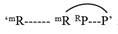 in the example of the Vistar presented
thereafter, for Megh Malhar,
depicts that he was a follower of the same school of thought as Vinayak
Patwardhan, particularly concerning the rules of singing raga Megh Malhar. An
example of Mansur’s Vistar presentation for Megh Malhar depicting Malhar anga
is as follows:
in the example of the Vistar presented
thereafter, for Megh Malhar,
depicts that he was a follower of the same school of thought as Vinayak
Patwardhan, particularly concerning the rules of singing raga Megh Malhar. An
example of Mansur’s Vistar presentation for Megh Malhar depicting Malhar anga
is as follows:
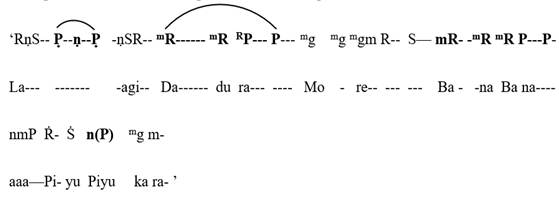
Mansur
(2019)
On the contrary,
Kelkar has demonstrated Sarang anga with ‘n---P’ and by breaking it as ‘mn--P’,
‘RmPn—P’, ‘PnPmR’ or by breaking ‘mR’ as ‘PmR’, ‘RmR’, ‘RmP’ and ‘nPmR’,
presenting different knitting patterns with the same phrases to achieve new
effects.
‘n----P----mP mn----P, n P m R
RmPn—PnPmR m--RmRSṇS’
(in Aakar)
Kelkar (2022)
The ‘PnP’ phrase has been present in the Vistars of both artists, Mansur and Kelkar, and yet, in Megh Malhar, it appears mainly in the mandra saptak. Additionally, Vistars show that the phrases adjacent to ‘PnP’ in Megh Malhar are often ‘nSR’ or ‘SRR’. In contrast, in Madhmad, ‘m-R’ is added as a suffix to ‘PnP’ whenever audible. This indicates that phrases with base or purvang swaras are preferred by artists like Mansur for depicting Megh Malhar, which has a heavier personality, compared to Madhmad Sarang, which has a more easygoing personality.
In the following example, the ‘mRP’ phrase of Malhar is
transformed into the ‘mRPm’ phrase of Sarang through the addition of ‘m’ in
Kelkar’s Vistar. Phrases like ‘nP’ and ‘nPmR’ show common features between
Sarang and Malhar angas. However, inserting ‘mPm’ between ‘mRP’ and ‘n-P’
ensures Sarang’s dominance in Kelkar’s Vistar, as shown below:
‘mRPmPmnP- PnnnṠ---n P m R S-
Rang------------------- ga-re-ja-wa-’
Kelkar (2022)
Taan
Where Bhimsen
Joshi, Ghulam Sadiq Khan, and Gajananbuwa Joshi have rarely used ‘mRP’, Mansur
deliberately depicts Malhar anga even in a Boltaan through ‘mRP’, ‘nP’, and
‘PnP’ phrases, inserting komal Gandhar through Kanada phrase ‘gmRS’ towards the
end. The recurrence of Risabh is also present in Mansur’s Taan in Megh Malhar:
‘SSS mmm RRR
PPP nnnPPPṠ--- ṘṘṘṠṠṠ PnPmPP gmRSṇS
Bo-- la--- na---
La-- a--------gi--- Bo-------
la-- na-- la- gi--- ’
Mansur
(2019)
Conversely, Kelkar
has demonstrated Vistar through the ‘nP’ and ‘PmR’ phrases, ending with Madhyam
in the Aakar Taan at 3:43 minutes:
‘n--PnPn--PmR, nPn-PmP-mRm-’
Kelkar (2022)
‘n-P’ has been
expressed as ‘n—PnPn--P’ and ‘nPn-P’, placing swaras in a zigzag pattern.
Wherever ‘n’ is stressed, it sounds sharper. This is perhaps because it is
given more importance than ‘P’ within the ‘n-P’ phrase in Madhmad, as is also
evident in previous samples. As seen in previous examples, the ‘m-R’ or ‘R-P’
phrases have been turned into Sarang phrases by adding ‘m’ in Madhmad Sarang;
thus, here, ‘m-R’ has been turned into ‘mRm’.
5.4. Pair IV: Kirana
Table 5
|
Table 5 Selected Artists for Comparison |
|||
|
1 |
Bhimsen Joshi |
Raga Megh Malhar |
|
|
2 |
Venkatesh Kumar |
Raga Madhmad Sarang |
|
Alap
‘mRSṇSRmPn—P
mPn---
n--- nPmR—
mRṇ---SRmP
n-Pn---P
mPnṠṘ---
ṘṠnP---
Ṙ--nP--PṠnṠnP---n--
Ṡ----’
Kumar (2020)
In the Alap of Megh Malhar, phrases such
as ‘(S)ṇR--, SR(S)ṇR-’,
are audible, where mandra komal Nishad, inserted between two adjacent swaras
‘S’ and ‘R’, create depth to the raga. The ‘ṇP̟-R’ phrase with meend follows, where ‘ṇP̟’ and ‘P̟-R’ sangatis merge. Both combinations are
significant for both ragas.
Bhimsen Joshi’s Alap emphasizes Risabh
at the end of most phrases, likely because it is the mukha swara of raga
Megh Malhar, and it is enough to suggest Megh Malhar’s identity Parrikar (2000). As sequences like ‘ṇS-ṇP̟--P̟ ṇ SR’
appear, phrases such as ‘ṇS ṇP̟’ are responded to with ‘P̟ ṇ SR,’ resembling a
palta. When Bhimsen Joshi sings the mukhda or melodic face of the
Bandish, ‘Garaje Ghata Ghana,’ as a prelude to the main presentation, a long
meend of the ‘n-P’ phrase in the mandra saptak evokes the calling of dark,
heavy monsoon clouds.
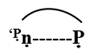
Gha----na’
Joshi (2016)
In contrast, in
Kumar’s Alap, ‘n-P’ sangati progresses from the mandra to the madhya saptak
within a few seconds as: ‘ṇP̟- P̟ṇ SR
Pm nP’, demonstrating a
comparatively lighter character of Madhmad Sarang.
The
prominence of ‘P-R’ sangati placed within the mandra and madhya saptak is
notable in the Alap of Megh Malhar by Bhimsen Joshi, Ghulam Sadiq Khan, and
Gajanan Rao Joshi.
Bhimsen
Joshi begins with ‘RRS’ placed on ‘Garaje’, where Risabh is unaccompanied by
the customary kan of Madhyam:
|
X |
2 |
0 |
|
R R |
S - R |
ṇ S |
|
Ga ra |
je - Gha |
ta - |
Joshi (2016)
‘RṇS’ appears as
a common phrase in both Megh Malhar and Madhmad Sarang, but what sets them
apart is the preceding and succeeding phrasal combinations. In the example
given below, Joshi has used the ‘P̟ṇP̟’ phrase with meend and a touch of gamak
following ‘RṇS’, to emphasize
Megh in Megh Malhar:
|
2 |
3 |
|
|
S - -R |
S - |
- -RṇS P̟ṇP̟ |
|
je - - Gha |
ta - |
- -Gha na |
Joshi (2016)
The use of meend
and gamak in the swaras of the mandra saptak has made Joshi’s bandish rendering
in Megh Malhar weightier than Kumar’s in Madhmad. For example, in the rendition
of ‘Aj Anjana Diye’, Kumar started as:
|
X |
0 |
3 |
|
|
n - |
P nnPm PnP |
mR RS |
RSṇ
SR mP |
|
A a |
ja Aaa an |
ja na |
Di- -- ye-- |
Kumar
(2020)
Though Kumar has
begun the Bandish with the ‘n-P’ phrase, the traditionally accepted Sarang
raganga, emphasising the ‘n’, the ‘PnP’ phrase used for ‘anjana’ does not carry
the same weight as in raga Megh Malhar because it lacks the meend and gamak.
Additionally, the prominence of Madhyam in the rendition of Madhmad is well
known. The Sthayi reinforces this through phrases such as ‘nnPm’, ‘PnPmR’, and
‘SRmP’. These phrases are also delivered more quickly.
It is interesting
to observe how both Bandishes have employed the ‘RRS’ phrase, applying each
other’s rules interchangeably through the artists’ sense of proportion and
choice. In Megh Malhar, the ‘RRS’ has been delivered in a staccato manner,
i.e., straight, although it was intended to be pronounced as ‘mR mRS’.
In Madhmad, Kumar uses the kan of Madhyam as ‘mR’ in the first ‘R’
of ‘RRS’, where it should have been sung directly in the raga. If ‘mR’
had been repeated in the next ‘R’ of the ‘RRS’ phrase in Madhmad, Megh Malhar
could have emerged. Nevertheless, Sarang anga is vibrantly integrated into the
Bandish through a skilled arrangement of the remaining phrases in the Madhmad
Bandish, as it also is true for Megh Malhar.
Since both ragas
share similar phrasings, using the Kanada phrase ‘mgmRS’ offers an
easy way to distinguish between them. The second line, ‘Kare Kare,’ in the
‘Garaje Ghata Ghana’ Bandish in Megh Malhar, thus illustrates Kanada phrase, ‘mgmRS’,
complemented by the phrase ‘ṇ SR’ of Sarang to balance the phrasal structure of raga Megh
Malhar:
|
X |
2 |
0 |
3 |
|
R - |
mg mg m |
R - |
(S) ṇ |
|
Ka - |
re - - |
Ka - |
- - re |

Joshi
(2016)
Though ‘R’ precedes
the andolit or oscillated Komal Gandhar in the ‘mgmRS’ phrase, the
kan of Madhyam to komal Gandhar takes it to a higher shruti.
The customary
andolan or oscillation of Risabh through the kan of Madhyam in Megh Malhar is
found in Joshi’s rendering of ‘Pawas Ritu Ayi’ where ‘mRP’ appears as ‘mR-mR-mRPP.’
This phrase dominantly establishes the Malhar anga:
|
X |
2 |
0 |
3 |
|
mR - |
mR - mR |
P - |
P nm P |
|
Pa - |
wa - sa |
Ri - |
tu Aa yi |
Joshi (2016)
Nevertheless, in
Bhimsen’s rendition of the line, ‘Dulihana mana bhayi’, ‘nP’ is followed by ‘mRṇ’, where ‘R’ has
the customary kan of Madhyam. ‘Rṇ’ typically represents Megh Lakshmi (2018). The Kanada phrase loses some of
its weight, mainly in these last words, where ‘gmRS’ is broken into ‘mgm
R’ and ‘SṇSR’. ‘mgm R’ and ‘Sṇ SR’ knit Kanada,
to Sarang phrases in the Bandish preserving Megh Malhar’s identity from Madhmad
Sarang:
|
2 |
0 |
3 |
|
- nP mRṇ |
mgm R |
Sṇ - |
|
- ha na |
Ma na |
Bha - yi |

Joshi
(2016)
Kumar’s rendition
of the Antara of Madhmad is full of ‘n-P’ sangati, illustrating Sarang in the
uttarang at several points:
|
X |
2 |
0 |
3 |
|
n - |
P Ṡ Ṡ |
Ṡ - |
Ṡn ṘṠ nP |
|
Mee - |
na Mri ga |
Hee - |
na- Ku- la- |
|
n n |
P n Ṡ |
Ṡ - |
Ṡ nṘṠ nP |
|
La ja |
ta Kha an |
ja na |
Na re- sha |
Kumar (2020)
The ‘n-P’ sangatis
have been pronounced without kan of other swaras, unlike most cases in the Megh
Malhar bandish.
Vistar
Bhimsen Joshi has
established Malhar anga in his Vistar primarily around the ‘P̟ṇ----P’ phrase. He
has emphasised the focal swara Risabh, highlighting combinational phrases such
as ‘RRS’, ‘ṇSR’, and ‘ṇRR’, which resolve into Shadaj:
R
R--S--- ṇS----S-----  R------S(S)ṇS --ṇSRR—, R S
ṇ--- SR ṇRR---
R------S(S)ṇS --ṇSRR—, R S
ṇ--- SR ṇRR---
Ga ra-je— Gha—ta---
-----------,
Gha---na---Ga—ra—je—, Gh a na Gara
je-----
ṇ-----SR R
S--RSSṇ---ṇ ṇSS ṇSRR----RSṇṇS-
Ga------- ra
aa-----------je--------------------------’
Joshi
(2016)
On the contrary,
Kumar has established Sarang anga mainly through phrases such as ‘PmR’, ‘ṇSR’, ‘mnP’, and
‘RmR’, emphasising Madhyam, which carries the life force of the raga, as
audible in the Vistar:
‘P- PP mPmR-- R------
mPmnPmR SṇSR, mmm--
RmRṇSRm—
An jana Di ye--- E-------
Ra- -- Dhe- -- -- , Radhika
Aa------------
mmm--- Rṇ ṇ-mR ṇR mm Rṇ ṇRm-RSṇSR S-, m- P- mR
Radhika---- aa--- Radhika---- Ra—dhi----ka Ra dhi ka-’
Kumar (2020)
On the contrary,
Bhimsen Joshi has pronounced ‘P mR’ with meend and demonstrated a
nuanced Risabh with the kan of Madhyam in Megh Malhar. Here, notably, Risabh is
pronounced softly from Madhyam:

Joshi
(2016)
The Vistar
demonstrates that when the kan of Madhyam accompanies Risabh, ‘P mR’
appears as an overlapping phrase common to both ragas, but
differs in terms of effect and uccharan.
Although Patwardhan (1967) has suggested the frequent use of ‘mRP’
in Megh Malhar (37), Bhimsen Joshi’s Vistar has relied more on ‘m-R’ and ‘n-P’
sangatis for representing the Malhar anga in the Vistar.
Taan
Although depicting
the nuances of raga in Taans can be challenging, Bhimsen Joshi and Venkatesh
Kumar have demonstrated otherwise with their Taan renditions of Megh Malhar and
Madhmad Sarang. A comparison follows:
B. Joshi:
‘ṘṘṠ nṠ ṘṘṠ
nPmR SṇSS-’
Joshi
(2016)
Kumar:
‘ṠṘ-Ṙ,
nṠ-Ṡ, Pn-n, mP-P, R-mPnṠ,R-mPnṠ,R-mPnṠ’
Kumar
(2020)
Bhimsen Joshi has
demonstrated the Malhar anga in this Taan through recurring emphasis on Risabh
and the phrase ‘nPmR’. Additionally, taar, madhya, and mandra saptaks have
merged. Interestingly, ‘ṘṘṠ’ in Megh Malhar is inverted as ‘ṠṘ-Ṙ’ in the Madhmad
Taan by Kumar. The phrase ‘R-mPnṠ’ is used as a typical arohatmak ascent in Madhmad.
5.5. Pair V: Rampur Sahaswan
Table 6
|
Table 6 Selected Artists for Comparison |
|||
|
1 |
Ghulam Sadiq Khan |
Raga Megh Malhar |
|
|
2 |
Rashid Khan |
Raga Madhmad Sarang |
|
Alap
The Alap
demonstrated by Ghulam Sadiq Khan has shown the ‘P̟-R’ sangati at the beginning, where Pancham
is placed in the mandra saptak, and Risabh in the madhya saptak, in the same
way as Bhimsen Joshi, Lalith Rao, or Gajananbuwa preferred to demonstrate the
sangati in their Alaps. Risabh of ‘P-R’ is not laden with any kan. Here, it has
been straight. Malhar phrase ‘m-R’ follows twice and is supported by ‘ṇS’:

Khan (2020)
Conversely, Rashid Khan’s Alap of Madhmad
Sarang began with the phrase ‘RSSṇ’, emphasising Risabh as vadi, i.e., the
most important swara. Other Sarang phrases follow. An excerpt illustrates this:
‘RSSṇ ṇS----(S)ṇ
S---ṃ P̟ṇ SR S SR---RmPmRS-S---ṇSRmP
mPm(R)- ṇ---SR SR RSṇSṇ--S—R Rm---------mR--mRSṇ
ṇSRmRm---, mRSṇ ṇSRmRmPmRS, RmmRmPmR, mRSṇ- S---ṇP̟ṇRS---RmnPmRS
RSṇP̟--ṇSRPm---PmRmR(S)ṇP̟, P̟ṇRSṇP̟S----’
Khan (2021)
Bandish
Ghulam Sadiq Khan
emphasizes the Malhar anga at the start of the Bandish ‘Garaje Ghata Ghana’:
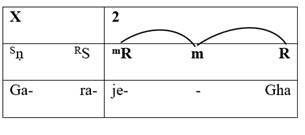
Khan (2020)
Here, ‘m-R’ sangati
appears in two forms: ‘mR’ and ‘m-R’. In the first case, the kan of
Madhyam accompanies Risabh. The next ‘m-R’ completes the Malhar anga in Megh
Malhar.
‘Ghana’ is sung
with a long meend in ‘P̟n̟-P̟’, where ‘n’ is voiced through the kan of ‘P̟’, illustrating
depth and evoking the call of the monsoon clouds:
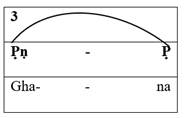
Khan (2020)
And in these
places:

Khan (2020)
Contrary to this,
Rashid Khan has used Sarang phrases ‘RmR’, ‘RmP’, ‘nSR’, ‘Pm R’, and ‘n-P’,
placed on the words ‘Guniyana Na’, and on the words ‘Bicha Bisarayi’ in the
Bandish ‘Thake Sab Gaye Bajaye’ in Madhmad Sarang, in the following manner:
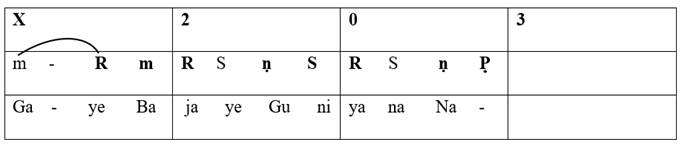
Khan (2021)
|
n P R
m |
|||
|
Bi cha
Bi sa |
|||
|
P n - - |
Pn Pm
R SR |
ṇ SR R |
|
|
ra -
- - |
-- -- -- -- |
a --
yi |
Khan (2021)
In Rashid Khan’s
demonstration of ‘m-R’ in Madhmad Sarang, a meend can be observed when the word
‘Gaye’ is sung at 4:13 minutes; however, this meend does not include any kan.
The meend relates more to the roundedness of ‘Sur’ in the raga, without
emphasising any specific microtone, as Ravi Shankar illustrates in an interview
Shankar
(2002).
The phrases ‘m-R’
and ‘R-P’ stand for Malhar anga, while angas like ‘Rṇ’ demonstrate a
sangati of raga Megh. When these phrases are arranged differently, they produce
a different effect within the Madhmad Sarang Bandish:
|
X |
2 |
0 |
3 |
|
R |
ṇ S R P |
||
|
Tha |
ke -
Sa ba |
||
|
m - R m |
R S ṇ S |
R S ṇ P̟ |
|
|
Ga -
ye Ba |
ja ye
Gu ni |
ya na
- - |
Khan (2021)
When examining the
placement of the phrases in this specific example, it becomes evident that the
phrasal fragment ‘RṇSRPm-RmR’ has been divided into ‘RṇS’, ‘RPm’, and ‘RmR’. Sam (X) occurs on
Madhyam as a vital aspect of Madhmad. In this way, the fragment uncovers a
cluster of Sarang phrases.
In the Megh Malhar
Bandish, the second ‘Kare’ in ‘Kare hi Kare’ has been sung through oscillated
komal Gandhar, with the kan of Madhyam. The swara positions invite the Kanada
phrasing, yet the Shadaj is skipped from the ‘mgmRS’ phrase,
presenting it as ‘mg mg mR’ – only reinforcing Megh
Malhar, weakening the effects of Sarang phrases:
|
X |
2 |
0 |
3 |
|
Sṇ Sṇ |
R - R |
mg mg |
m R - |
|
Ka -- |
re - Hi |
Ka - |
- re - |
Khan (2020)
Another notable
contrast between the renditions of raga Megh Malhar and raga Madhmad Sarang is
the use of the oscillated komal Nishad, which is audible in the Antara of the
rendered Bandish by Ghulam Sadiq Khan.
|
X |
2 |
0 |
3 |
|
m P |
Ṡn Ṡn n |
Ṡ - |
Ṡ - Ṡ |
|
Bo - |
le - Da |
du ra |
Mo - ra |
Khan (2020)
The phrasal
fragment ‘mPṠnṠnnṠ’ exhibits andolan, i.e., oscillation in komal Nishad,
demonstrating a characteristic trait of raga Megh Malhar due to its emergence
from raga Megh Patwardhan
(2015), Lakshmi, 2018, Thakur
(2019). Such nuances help keep samprakrutik or similar ragas, such
as Madhmad Sarang, at bay.
Vistar
Heightening the
relatively weighty character of Megh Malhar, Ghulam Sadiq Khan has elaborately
emphasised the qualities of Malhar anga through the ‘n-P’ sangati, situated in
the mandra position:

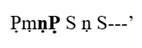
Khan (2020)
The Vistar has
emphasised a meend-laden prominence of the ‘n-P’ sangati in Megh Malhar. The
‘n-P’ phrase approached through the mandra saptak is often accompanied by the
kan of Pancham as, ‘P̟ṇ-------P̟’, and also,
Shadaj, as ‘(S)Sṇ-----ṇ-----P̟’. At one point, ‘R-P’ sangati, absent
in the earlier sections, has arrived in the mandra as ‘RPmnP’, but it has to be
admitted that in Ghulam Sadiq’s interpretation of raga Megh Malhar, ‘RP’ has
not acquired the depth and space that ‘n-P’ has received in demonstrating the
Malhar anga in the raga Vistar section.
In the next
elaboration cycle, starting at 4:55 minutes, komal Gandhar arrives, where the
phrasal fragment ‘SRmg-mg m R, R-S-’ is audible, breaking
‘mgmRS’ into ‘SRmg-gmR’ and ‘R-S’ phrases, lightening the
effect of Kanada phrase once again. The pace of expressing the phrase, i.e.,
the uccharan, of ‘m-R’ after ‘SRmg-mg’ as ‘SRmg-mg
m R’ is longer and slower in Ghulam Sadiq’s rendition than the uccharan of
‘m-R’ in Madhmad by Rashid Khan in ‘mPPmR’, ‘RnnP mR’ and ‘mRSṇSRS’ phrases used
in raga Madhmad Sarang as could be compared through the following Vistar
presented by him:
2
‘RmPn mnPmR-----
RnPnnPmR - Sṇ SR S-
Ga--- a---ye
------ Ga---a-- a- -- ye- --’
Khan (2021)
Taan
‘PmPP RmPP RmPP RmPRmRPmP, RmRP, RmRP, RmRPmP, RmPP, RmRS’
Khan (2020)
‘RmPRmRS RP SRP, SRSPmP RmRS, RmPRmP, SRmSRPRmRS’
Khan (2020)
Sadiq’s insertion
of ‘RP’ in the Taans protects the Malhar anga from the rapid pace of Taans
during raga presentations. However, Ghulam Sadiq’s preferred speed for
performing Taans in the Jhap tala was slower and more relaxed than Rashid
Khan's preferred pace of Taans in Madhmad.
Contrary to Sadiq,
Rashid’s Taans in Madhmad Sarang exhibit a certain ease of movement and a
joyful spirit, diving into and across the mandra, madhya, and taar saptak. In
the Taan of Madhmad Sarang at 12:10 minutes, the phrasal fragment,
‘RP-P-P-P-m-m-mRS’, is audible where ‘P’ and ‘m’ are repeated multiple times,
merging phrases ‘RPm’ with ‘PmR’ or ‘PmRS’ together, in one fragment:
‘PmRSṘnṠnPnmPRP-P-P-P-m-m-mRS-’
Khan (2021)
Additionally,
Rashid, in his Akar Taan starting around 16:56 minutes, has demonstrated ‘nP’
in various expressions such as ‘nnPm’ and ‘nnnPnPm’, where the phrases are
consistently dissolved into ‘m’ swara of Madhmad. The Taan presents notable
blended phrases, like ‘PnPmR’, which combine two phrases, ‘PnP’ and ‘PmR’, with
‘P’ serving as the common element between them:
‘nnPm PnṠṘṘ ṠnPm PmPnnnPnPm RmRmPnnnPnPm
PnPmRSṇSS-’
Khan (2021)
Though ‘PmR’ has
been identified as a typical Sarang phrase, and ‘PnP’ as a Malhar phrase, all
scholars and musicologists have undeniably agreed on the evolutionary link
between Malhar and Sarang angas. Therefore, the use of ‘PmR’ and ‘PnP’
interchangeably in both raga presentations becomes natural. However, the
romanticism of the long and bold uccharan of ‘PnP’ in Megh Malhar can hardly be
matched with the uccharan of ‘PnP’ approached through Madhmad. On the other
hand, the feminine sensuousness in the sharp uccharan of ‘n’ in ‘n-P’ is
equally breathtaking and incomparable to the masculine expressions of the many
phrases of Megh Malhar.
6. Discussion
The study explored the close associations between the Malhar and Sarang phrases in the ragas Megh Malhar and Madhmad Sarang, focusing on phrasal similarities and differences that affected the chalans of the two ragas. They are being presented below:
It was found that although Megh Malhar’s whole personality was revealed through phrases such as ‘PnP’ and ‘PR’, along with ‘mR’ and other expressions of ‘n-P’, oscillations of komal Nishad with the kans of Shadaj and Pancham in appropriate places, along with the oscillation of Risabh with the kan of Madhyam. The proportion and utilisation of these phrases differed with respect to the artist’s choice. When the artist sought a more masculine expression of ‘Garaje Ghata Ghana’, the Madhyam’s kan on Risabh was skipped. When the seriousness of the raga had to be emphasised, the komal Gandhar and the influence of Kanada were introduced. When the seriousness had to be lightened, then a Sarang phrase like ‘PmR’ or ‘nSR’ was used.
The present study revealed that several samples demonstrated ‘mRP’ sparingly, or ‘RP’ was suddenly given prominence during Taans. Selected artists from Gwalior and Agra Gharanas did not use ‘mRP’ in their renditions in the usual way. Bhimsen Joshi, a representative of the Kirana Gharana, used it less frequently but demonstrated it skillfully in the Bandish. Moreover, Ghulam Sadiq, selected for Rampur-Sahaswan, used ‘RP’ only in the Taans of his Megh Malhar rendition. Their scattered use of ‘mRP’ suggests they considered Megh and Megh Malhar to be the same. The only artist who uniformly employed ‘mRP’ as Malhar raganga in Megh Malhar at each stage of the performance was Mallikarjun Mansur from the Jaipur Gharana. This conflict was surprising because ‘Garaje Ghata Ghana’ had previously been acknowledged as a traditional Bandish in the raga Megh Malhar Banerjee (2014), Nahar (2002).
The present study found that the prominence and heavy ucchar of ‘RP’ was lesser in Megh Malhar than in other Malhar types, like Gaud Malhar or Miya Malhar, and that in Madhmad it was reduced to a supporting phrase Ramshankar (2011). A characteristic such as this brought their personalities dangerously close.
The study also revealed that the phrasings in the Madhmad were mainly built around Madhyam, which, in turn, gave Madhmad Sarang the exclusivity it required over raga Megh Malhar. V.R. Athavale’s presentation particularly illustrated this characteristic in the Vilambit setting:
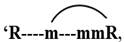 , PmR
Rṇ ṇ ṇS--,
, PmR
Rṇ ṇ ṇS--,  P---m—P---mnP mRm---m(m)R-’ Athaval (2020)
By staying on
Madhyam with meend in  , Athavale explored the ‘m-R’
phrase in Madhmad Sarang. Other artists who have sung the raga have also
emphasised Madhyam.
, Athavale explored the ‘m-R’
phrase in Madhmad Sarang. Other artists who have sung the raga have also
emphasised Madhyam.
The difference in the uccharan for phrases like ‘P-R’ in Megh Malhar and Madhmad Sarang was also distinct. In Madhmad Sarang, no kan or meend of any swara affected the ‘uccharan’ of ‘P-R’ in the raga. In Megh Malhar, ‘P’ mainly sat in the mandra saptak or lower register, while ‘R’ was usually in the madhya saptak or middle register. Sometimes, ‘P’ moved to the madhya saptak, and ‘R’ to the taar saptak or upper register. Conversely, in Madhmad Sarang, the ‘PR’ phrase is occasionally used between madhya and taar saptaks but never between mandra and madhya saptak. Though ‘PR’ has been identified as a characteristic phrase of Sarang Bhatkhande (1956), a key finding of this study is the prominent role of the ‘P-R’ sangati placed between the mandra and the taar saptak by all artists in their Alaps to express raga Megh Malhar, which was not addressed in previous studies.
Though ‘nP’ and ‘PR’ (placed in the mandra and taar saptak) were found to be prominent phrases in all selected renditions of Megh Malhar, the study showed that ‘PR’ was not the only or most prominent of Sarang phrases in Madhmad Sarang, contrary to claims made by previous studies by S. Patwardhan (2015). In fact, Ramshankar (2011) observed that ‘PR’ should be treated as a varna or supporting phrase in Madhmad Sarang, not as an anga in the raga.
Moreover, ‘PR’ sangati is generally ascribed to Kalyan anga. Its presence in Megh Malhar should then suggest the presence of Kalyan anga in the raga. However, this is not true. In Kalyan anga, ‘PR’ is typically pronounced through Tivra Madhyam as ‘P MR’ Tiwari (2013) or ‘PMGR’ (69) or as P-PR in the case of raga Chhayanat (77). The ‘uccharan’ of Pancham is sometimes noted as ‘(P)’, which has a phrasal cluster like ‘PMDP’ in the ‘uccharan’ of ‘P’ in ‘P-R’ of Kalyan anga. In contrast, in Megh Malhar, the ‘uccharan’ of ‘P’ is always straight and simple.
Often overlapping phrases such as ‘P mR’ and blended phrases such as ‘nPmR’ appeared in Megh Malhar and Madhmad Sarang, but the artists’ treatment of these phrases differed in both ragas.
All selected artists used the Kanada phrase ‘mgmRS’ in their recorded presentations of Megh Malhar, occasionally breaking it into ‘mgmR’ and ‘RS’ or ‘SṇSR,’ or similar phrases. Although the use of komal Gandhar is acknowledged for some cases, the use of the Kanada phrase is not explicitly mentioned for Megh Malhar in either Bhatkhande’s Sangeet Shastra or V. Patwardhan’s Raga Vigyan. Additionally, Bhatkhande warned against excessive dwelling on or oscillation between the komal Gandhar to safeguard the form of Megh Malhar Bhatkhande (1956). However, oscillations are common among artists from all gharanas.
Therefore, it was found that for vocal presentations used directly in the study, as well as others not used directly, gharana did not play an important role in the comparison between the ragas Megh Malhar and Madhmad Sarang. Since it was found that Jayteerth Mevundi, the representative of the same gharana as Bhimsen Joshi, rendered raga ‘Megh’ using ‘mRP’ Malhar phrase clearly and frequently. However, he did not use komal Gandhar anywhere, which makes his approach to the raga different from Joshi’s. Ashwini Bhide, a representative of Jaipur Atrauli gharana, the same as Mansur’s, has also used ‘mRP’ in her presentation of raga Megh Malhar but abstained from using komal Gandhar in her presentation of ‘Garaje Ghata Ghana’ Bhide (2021). This has been true for Sharafat Hussain Khan’s (Agra gharana) rendition of Megh Malhar, too, where the use of komal Gandhar could not be found. In this context, the researcher was informed by her supervisor, also a disciple of renowned musicologist Pt. D.T. Joshi, that some of the artists consider Megh and Megh Malhar identical, and komal Gandhar is not used by them. They are thus sung with the same chalan by those artists. However, some treat Megh and Megh Malhar as distinct ragas, and though komal Gandhar is not employed in Megh, it is employed in Megh Malhar Tapasi Ghosh, Direct Communication (2024). In a recording, Yunus Khan has also backed this fact. Before beginning one of his demonstrative presentations, the celebrated Agra doyen and the son of Ustad Vilayat Hussain Khan clearly distinguished between the two types of rendering of Megh Malhar—one with komal Gandhar and another without it Khan (2020).
Like in an earlier
paper by Sarkar
and Ghosh (2023), this study also revealed that phrases
assume different identities depending on the raga in which they are set. For
example, ‘nmP’ could represent both Malhar Varshaneya (2018), and Kanada Jha (2004) anga, and, as found in Athavale' s use,
it could also denote Sarang Athavale (2020,).
Similarly, the ‘PnP’ phrase suggested Megh in a raga like Suha Kanada Jha (2004). Hence, it can also indicate Kanada in
a raga like Megh Malhar. In fact, interestingly, Varshaneya (2018), in her article on rare Malhar types,
analysed ‘mgmRS’ as both a Malhar and a Kanada phrase in the context
of Shwet Malhar, reaffirming the same finding. It can thus be said that phrases
such as ‘PnP’ or ‘mgmRS’ have been used to strengthen the Malhar
anga in Megh Malhar and keep it far away from Madhmad Sarang.
The study also
found ‘P̟S’ to be a supportive phrase for the raga
Megh Malhar apart from ‘ṇS’ and ‘ṇR’.
Although ‘ṇSR’ was identified as a Sarang phrase Shah (2000), it appeared
in both ragas. Furthermore, it was more prominent in Megh Malhar than other
Sarang phrases, such as ‘PmR’, perhaps because of its more reflective
personality.
7. Conclusion
To
conclude, it was found that the Malhar raganga ‘mRP’ appeared in parts, either
as ‘mR’ or ‘RP’, but not consistently across all sections of the raga
presentations in Megh Malhar. To address this inconsistency, ‘m-R’,
‘P̟-R’, ‘P̟ṇP̟’, and ‘mgmRS’ were used as
prominent phrasal expressions by artists to represent Malhar anga, apart from a
notable Risabh, for Megh Malhar. Conversely, different expressions of ‘n-P’
were highly prominent in the raga illustrations of Madhmad, and given the ancient
origin of Sarang, ‘n-P’ could be regarded as the Sarang raganga. However,
several Sarang phrases, such as ‘PmR’, ‘RmR’, ‘RmP’, ‘ṇSR’, and ‘mR’,
focusing on Madhyam, were collectively found useful for expressing the chalan
and revealing the personality of Madhmad Sarang.
While
both ragas shared connections to common Sarang and Malhar phrases, their unique
characteristics — particularly in their phrasal expressions and uccharan
(pronunciation) — set them apart. The nyas or pause positions, ornamentations such as gamaks and
kans, proportionate swar-lagav, i.e., how the swaras were associated with each
other within the phrases in the two ragas, contributed to the building of their
personalities.
Megh
Malhar, with its calm, heavy, monsoon-inspired personality, relied more on the
mandra saptak for characterising the Malhar anga. In contrast, Madhmad Sarang,
with its more delicate and romantic personality, emphasised the madhya and taar
saptak for the phrasal expressions in Sarang anga. It was found that in several
cases, musicological reference books on ragas ascertain certain traits, such as
the use of ‘mR’ in Megh Malhar, as necessary characteristics, but in
practice, they are not as stringently followed.
This
comparative and analytical research approach thus brought greater clarity to
the phrasal movement of the ragas, thereby refining and extending the existing
literature on raga musicology, ensuring its continued growth and
sustainability.
8. Limitations
A key limitation of the current study was the limited choice of artists available on the online platform, which could have improved gharana-wise sample pairing and provided a more homogenised setting for comparison across the same time periods.
Another limitation was the small sample size and the qualitative nature, which meant the results could not be generalised across the entire performance practice arena for raga Megh Malhar and raga Madhmad Sarang.
Therefore, although the current study's findings revealed many aspects of raganga application and a comparative-analytical understanding of the phrases, it is worth noting that listening to and comparing vocal samples from available online sources alone cannot provide a complete picture or accurate knowledge of ragas. Therefore, it is equally important to include personal communications and interviews with established musicians in the field to ensure that such studies are accurate and well-founded.
9. Future Studies
Future research on raga analysis using compare-and-contrast methods is strongly recommended to fill gaps between the current musicological literature and raga performance practice from a research perspective. Such studies could also overcome the limitations of machine-based quantitative approaches by providing high-quality, annotated data obtained through qualitative research.
10. Acknowledgment
I thank my
supervisor, Prof. Tapasi Ghosh, for giving me the idea for this paper and
guiding me wherever I stumbled. I am also sincerely grateful to Vidushi Lalith
Rao and Jayavanth Rao for sharing one of her exclusive recordings in Megh
Malhar with my Supervisor. I am also indebted to my parents and my gurus,
Sumanta Sarkar and Mamata Sarkar, for their valuable guidance and support
throughout my studies. I also acknowledge the constant moral support of all
other family members and fellow scholars
CONFLICT OF INTERESTS
None.
ACKNOWLEDGMENTS
None.
REFERENCES
Athavale, V. R. (2020, March 27). V R Athavale Madhmad Sarang Raga [Audio]. YouTube.
Joshi, B. (2016, May 23). Pt. Bhimsen Joshi—Raag Megh Malhar: Garaje Ghata Ghana Kare ri Karee [Audio]. YouTube.
Joshi, G. (2019, August 21). Gajananbuwa Joshi Raga Megh Malhar [Audio]. YouTube.
Kelkar, M. A. (2022, November 29). Raag Madmat Sarang | Hindustani Classical Vocal | Komal Nishad (Part 6/7) [Video]. YouTube.
Khan, G. S. (2020, April 22). Ustad Ghulam Sadiq Khan—Raag Megh [Audio]. YouTube.
Khan, R. (2021, July 7). Madhmad Sarang—Ustad Rashid Khan [Audio]. YouTube.
Kumar, V. (2020, July 13). Pandit Venkatesh Kumar—Raag Madhmad Sarang [Audio]. YouTube.
Mansur, M. (2019, June 23). Mallikarjun Mansur Raga Megh [Audio]. YouTube.
Rao, L. (1991). Live Performance in Raga Megh Malhar [Unpublished Audio Recording]. Baroda, Gujarat.
Sahasrabuddhe, V. (2021, June 29). Raag Madhmad Sarang—Rang De Rangrejwa [Audio]. YouTube.
Bhide, A. (2021, August 11). Raag Megh | Hindustani Classical Vocal (Part 2/5) [Video]. YouTube.
Khan, Y. (2020, April 29). Ustad Yunus Khan Raga Megh Sadra [Audio]. YouTube.
Mevundi, J. (2020, September 5). Raag Megh | Hindustani Classical Vocal (Part 1/6) [Video]. YouTube.
Sahasrabuddhe, V. (2017, April 27). Raag Megh Malhar—Barakhaa Ritu Aayee [Audio]. YouTube.
Banerjee, G. (2014). Malhar Darshan: Malhar Evam Malhar Ke
Prakaron Ke Kriyatmak Tatha Shastriya Paksh Ka Vistrit Vivechan. Sangeet Sree
Prakashan.
Bhatkhande, V. N. (1956). Sangeet Shastra: Hindustani Sangeet Paddhati (Vol. 4). Sangeet Karyalaya.
Bisht, K. (1973). Significance of Raganga in Hindustani Music. Journal of the Music Academy Madras, 44, 210–216.
Ginde, K. G. (2020). LD 003 Malhar Ang Raag. In Roots of Raga Sangeet:
Lecture Demonstrations (PD.001). Meera Music.
Jha, R. (2004). Abhinavgeetanjali (Vol. 2, 6th ed.). Sangeet Sadan Prakashan.
Jha, R. (2014). Abhinavgeetanjali (Vol. 3, 7th ed.). Sangeet Sadan Prakashan.
Jha, R. (2020). Abhinavgeetanjali (Vol. 5, 5th ed.). Sangeet Sadan Prakashan.
Jha, R. (2021a). On raganga Sarang, Ragas Brindavani Sarang, and Madmadh Sarang [Video]. YouTube.
Jha, R. (2021b). Raag Megh and Megh Malhar [Video]. YouTube.
Laxmi, V. (2020). Sarang Ang ke Rago ka Sashtriya Adhyayan (Doctoral Dissertation). Shodhganga.
Nahar, P. (2002). Hindustani Sangeet mein Sarang, Malhar aur Kanhada. Kanishka Publishers.
Parrikar, R. (2000, October 16). Book review: Raga Malhar Darshan. Rajan Parrikar Music Archive.
Patwardhan, S. (2015). Sangeet Raga Vigyan (Vol. 3). Sangeet Karyalaya.
Patwardhan, V. R. (1967). Raag Vigyan (Vol. 4, 5th ed.). Maharashtra Executors and Trusty.
Patwardhan, V. R. (1981). Raag Vigyan (Vol. 6, 3rd ed.). Maharashtra Executors and Trusty.
Ratanjankar, S. N. (1960). Gamakas in Hindusthani Music. Journal of the Music Academy Madras, 31, 94–107.
Sarkar, S., and Ghosh, T. (2023). Identification of Malhar Anga in Hindustani Music Praxis: An Analysis. Sangeet Galaxy, 12(1), 91–96.
Shah, J. T. (1991). Malhar ke Prakar (2nd ed.). Shah Family.
Shah, J. T. (2000). Sarang ke Prakar (2nd ed.). Shah Family.
Shankar, R. (2002). Interview on Raga: A Personal Introduction. In Ravi Shankar: In portrait [Video]. YouTube.
Thakur, O. (2019). Sangeetanjali (Vol. 7). Pilgrims Publishing.
Tiwari, S. (2013). Raag Vargikaran Paddhatiyon mein Raganga Paddhati ka Mahatva. Adhyayan Publishers.
Tomer, A. P. S. (2013). Raganga-Based Identification System. IOSR Journal of Humanities and Social Sciences, 16(3), 83–85.
Varshaneya, S. (2018). Malhar Anga ke Aprachalit Prakar. In Raag Evam Raganga: Vibhinna Prakar (125–230). Radha Publications.
|
|
 This work is licensed under a: Creative Commons Attribution 4.0 International License
© ShodhKosh 2026. All Rights Reserved.