ShodhKosh: Journal of Visual and Performing ArtsISSN (Online): 2582-7472
|
|
Identifying the Skill Gap in the Skill India Course “Digital Marketing” – A Study in the Navi Mumbai Region
Dr. Mona Sinha 1 , Dr. Anjali Kalse 2
 , Rikhi
Yadav 3, Mona
Mohanty 4
, Rikhi
Yadav 3, Mona
Mohanty 4
1 Professor
and HOD, Bharati Vidyapeeth (Deemed to be University) Department of Management
Studies, Navi Mumbai, India
2 Director,
Bharati Vidyapeeth Institute of Management Studies and Research, Navi Mumbai, India
3 Assistant Professor, Bharati Vidyapeeth (Deemed to be University) Department
of Management Studies, Navi Mumbai, India
4 Research Scholar, Bharati Vidyapeeth (Deemed to be University) Department
of Management Studies, Navi Mumbai, India
|
|
|
ABSTRACT |
|
|
India’s digital economy is growing at an unprecedented pace, yet a noticeable gap persists between the number of trained graduates and the number of genuinely employable professionals. The Skill India Mission, launched in 2015, was designed to address this challenge by equipping young people with market-relevant vocational skills. Despite these efforts, uncertainties remain about how well its digital marketing courses actually meet industry requirements. This study explores these concerns by examining the “Digital Marketing” course offered under Skill India in the Navi Mumbai region. It evaluates how course content, trainer effectiveness, and pedagogical practices influence employability outcomes. Using a quantitative approach supported by Structural Equation Modelling (SEM), data from 176 students and trainers were analysed to assess the relevance of the curriculum and the quality of training delivery. The results reveal a strong relationship (R² = 0.83) between overall learner satisfaction and three core components: course content, pedagogy, and employability skills. While participants reported gaining a solid conceptual foundation, many also indicated gaps in hands-on campaign execution and analytical skill development. To address these shortcomings, the study recommends incorporating live projects, digital analytics tools, and sustained trainer upskilling into the programme. These insights
hold important policy implications for the Skill India Mission. A shift from
focusing primarily on certification numbers to prioritising employability
outcomes would significantly enhance the initiative’s impact. Strengthening
alignment with industry expectations will not only support India’s rapidly
evolving digital economy but also advance progress toward Sustainable
Development Goal 8: Decent Work and Economic Growth. |
|||
|
Received 11 January 2026 Accepted 19 March
2026 Published 03 April 2026 Corresponding Author Dr. Mona
Sinha, mona.sinha1@bharatividyapeeth.edu
DOI 10.29121/shodhkosh.v7.i3s.2026.7217 Funding: This research
received no specific grant from any funding agency in the public, commercial,
or not-for-profit sectors. Copyright: © 2026 The
Author(s). This work is licensed under a Creative Commons
Attribution 4.0 International License. With the
license CC-BY, authors retain the copyright, allowing anyone to download,
reuse, re-print, modify, distribute, and/or copy their contribution. The work
must be properly attributed to its author.
|
|||
|
Keywords: Skill India Mission, Digital Marketing,
Employability, Skill Gap, Vocational Education, SEM Analysis, Trainer
Effectiveness |
|||



1. INTRODUCTION
1.1. Background and Rationale
India’s digital expansion coincides with a demographic surge, yet its youthful workforce remains constrained by persistent skill mismatches. Although projections estimate a demand for over 30 million digitally skilled professionals by 2030 — nearly five times current supply (NASSCOM–McKinsey and Company (2023)) — training systems appear unable to convert demographic advantage into employable capability.
The Skill India Mission, including the Digital Marketing programme under PMKVY, was designed to address this gap. However, rising certification numbers have not translated into consistent placement outcomes. Employers in the Mumbai Metropolitan Region frequently report that trainees possess theoretical familiarity but lack practical competence in campaign execution and analytics. This concern aligns with global assessments identifying digital marketing as a high-growth field still marked by shortages of job-ready talent World Economic Forum (2023).
While India’s digital economy has expanded rapidly — with firms scaling digital marketing functions despite ongoing talent shortages PWC India (2024) — the quality and industry alignment of training remain uneven. Placement rates in technology-oriented programmes remain modest despite large certification volumes Ministry of Skill Development and Entrepreneurship (MSDE) (2023–24), raising questions about the efficacy of current vocational models.
These limitations are particularly visible in Navi Mumbai, where standardised curricula often fail to reflect regional industry expectations. This study therefore evaluates the Skill India Digital Marketing (SIDM) course in Navi Mumbai to examine its alignment with labour market demands and identify structural gaps constraining employability.
India’s rapid digital transformation, accelerated by initiatives such as Digital India and widespread smartphone adoption, has repositioned digital platforms at the centre of business strategy. Marketing today is increasingly data-driven, analytics-oriented, and technology-dependent. However, the growth of digital infrastructure has not been accompanied by proportional workforce readiness. Although organisations are expanding their digital marketing functions, persistent shortages of industry-ready professionals suggest that current training systems may be prioritising certification outputs over capability development.
Digital marketing now demands hybrid competence — creative thinking, analytical reasoning, technological fluency, and hands-on execution. Yet placement outcomes in technology-oriented programmes remain inconsistent, raising questions about the practical effectiveness of vocational models. In Navi Mumbai, where digital agencies and service firms are growing steadily, standardised training modules often fail to reflect regional industry expectations. As a result, many graduates possess theoretical familiarity but limited applied proficiency. This study therefore critically examines whether digital marketing training genuinely enhances employability within Navi Mumbai’s evolving digital ecosystem, or merely expands formal credentials without substantive workplace readiness.
1.2. Theoretical Foundation
To examine this gap systematically, the study draws upon two complementary theoretical lenses: Human Capital Theory (HCT) and the Employability Skills Framework (ESF).
HCT Becker (1964) conceptualises education and skill development as investments that enhance productivity and generate economic returns. In principle, vocational programmes such as Digital Marketing are expected to convert structured learning into employability capital, improving labour market competitiveness and wage potential However, when training lacks industry alignment or trainer expertise is limited, the anticipated returns on this investment diminish. In such cases, human capital formation becomes partial — certified, but not fully productive. Empirical evidence from developing economies further suggests that persistent skill mismatches can suppress wage growth and reduce organisational efficiency, weakening the developmental promise of skill initiatives.
ESF expands the analysis by recognising employability as multidimensional. Yorke and Knight (2006) argue that employability extends beyond knowledge possession to include the capacity to apply knowledge effectively in changing contexts. Pool and Sewell (2007) further emphasise career adaptability — encompassing self-efficacy, resilience, reflective capacity, and networking competence. In digital marketing practice, this translates into agility: the ability to adapt to algorithmic shifts, integrate emerging technologies such as AI-driven analytics or immersive marketing tools, and continuously recalibrate strategy.
Integrating these frameworks enables employability to be conceptualised not merely as job attainment, but as a dynamic capability emerging from the alignment between technical skills, cognitive adaptability, and socio-behavioural competence. From this perspective, the employability gap observed in Navi Mumbai is not solely a training deficit; it reflects a systemic misalignment between human capital formation processes and the rapidly evolving capability demands of digital industries.
1.3. Literature Context and Research Gap
The literature consistently identifies skill mismatch as one of India’s major labour market inefficiencies. The OECD Employment Outlook (2023) reported that nearly 55% of Indian youth are either underemployed or employed in roles misaligned with their training (OECD). Similarly, the World Bank has emphasised that India’s education-to-employment pipeline requires stronger feedback mechanisms between industry and training institutes s
Within the field of digital marketing education, research remains fragmented. International studies, such as Royle and Laing (2014), underscore the lack of integration between creative and analytical skills in marketing curricula. Järvinen et al. (2012) found that overly theoretical content reduces learner engagement and fails to prepare students for dynamic marketing environments. In the Indian context, Prasad and Purohit (2017) highlighted the limited benchmarking of vocational training modules against international standards.
Despite numerous national initiatives, a few empirical studies have examined Skill India’s Digital Marketing programme at a micro level. Navi Mumbai, with its dense network of training institutes and expanding digital ecosystem, offers a relevant context to assess whether training genuinely enhances employability. To date, no study has systematically applied Structural Equation Modelling (SEM) to analyse the relationship between course design, pedagogy, and employability outcomes within this programme. By addressing this empirical and regional gap, the present study also responds to several broader conceptual and methodological limitations that persist in the literature.
1.4. Research Gap
· Established employability frameworks have not been sufficiently contextualised within India’s Skill India digital programmes.
· Empirical evidence linking curriculum design, pedagogy, and learner attributes to measurable employability outcomes remains limited.
· In fast-evolving fields like digital marketing, alignment between training content and emerging competencies (analytics, automation, AI tools) is under-examined.
· Existing studies are largely descriptive and do not establish causal relationships between training practices and job readiness.
· Evaluation systems continue to emphasise certification numbers rather than skill utilisation and workplace performance.
1.5. Research Contribution
· Develops and empirically tests an integrated model linking course content, pedagogy, and learner engagement to employability outcomes.
· Contextually validates employability constructs within the Skill India Digital Marketing (SIDM) programme.
· Provides data-driven insights to strengthen curriculum relevance and industry alignment.
· Contributes to policy and pedagogical reform by shifting focus from output-based to outcome-based skilling evaluation.
1.6. Objectives of the Study
1) To examine the relationship between course content and employability outcomes in the Skill India Digital Marketing (SIDM) programme.
2) To assess the impact of pedagogical practices—including experiential, reflective and technology-integrated learning—on workplace readiness.
3) To analyse the mediating role of learner engagement and the moderating role of trainer preparedness in shaping employability.
4) To evaluate the alignment between the SIDM curriculum and current digital marketing industry requirements, particularly in analytics, automation and AI-driven tools.
5) To develop and validate a structural model (SEM) linking course content, pedagogy, learner engagement and employability outcomes.
6) To offer policy and pedagogical recommendations for strengthening Skill India’s vocational training approach.
1.7. Research Questions
RQ1: How does the course content of the Skill India Digital Marketing (SIDM) programme influence learners’ employability outcomes?
RQ2: What is the impact of pedagogical practices (experiential, reflective and technology-enabled methods) on employability outcomes?
RQ3: Does learner engagement mediate the relationship between pedagogical practices and employability outcomes?
RQ4: What role does trainer preparedness play in strengthening the effectiveness of course content?
RQ5: To what extent is the SIDM curriculum aligned with current and emerging digital marketing skill demands?
RQ6: Can a structural model effectively explain the interrelationships among course content, pedagogy, learner engagement and employability outcome
1.8. Hypotheses of the Study
1) H0: The course content of Digital Marketing course of Skill India does not significantly match the industry requirement
2) H1: The course content of Digital Marketing course of Skill India matches significantly with the industry requirement
3) H0: Trainers are not significantly well equipped for course delivery
4) H1: Trainers are significantly well equipped for course
5) H0: Pedagogy adopted is not significantly relevant with respect to the Digital Marketing course
6) H1: Pedagogy adopted is significantly relevant with respect to the Digital Marketing course
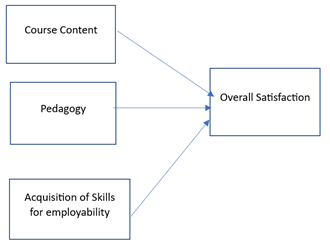
7) H0: Overall satisfaction of the student is not significantly dependent on course content, pedagogy and acquisition of skills for employability
H1: Overall satisfaction of the student is significantly dependent on course content, pedagogy and acquisition of skills for employability
1.9. Variables Framework
Independent Variables (IVs)
· Course Content (CC): relevance, currency and industry alignment.
· Pedagogy (PG): experiential learning, reflection, project-based work and digital integration.
Mediating Variable
· Learner Engagement (LE): motivation, participation and self-directed learning.
Moderating Variable
· Trainer Preparedness (TP): digital competence, instructional design skills and industry exposure.
Dependent Variable
· Employability Outcomes (EO): workplace readiness, job placement potential and skill transferability.
1.10. Conceptual Framework and Study Relevance

The conceptual framework developed for this study is built on the premise that Overall Satisfaction and Employability depend on the synergy between Course Content Alignment, Pedagogical Effectiveness, and Skill Acquisition for Employability.
1) Course Content Alignment: Evaluates whether curriculum content reflects evolving digital marketing practices such as automation, influencer marketing, and data analytics.
2) Pedagogical Effectiveness: Assesses trainer capability, delivery methods, and engagement strategies including live case studies, client projects, and simulations.
3) Skill Acquisition for Employability: Measures how far learners gain practical, transferable skills applicable to real-world scenarios.
Quantitative analysis through SEM revealed strong interrelationships among these variables, with an R² value of 0.83, indicating that these three constructs collectively explain 83% of student satisfaction and employability variance. This validation confirms that effective pedagogy and practical skill development are central to bridging the skill gap.
The study’s significance lies in its dual contribution — academically, it extends employability research by integrating Skill India’s model into a measurable framework; practically, it offers a data-driven roadmap for policymakers and training institutions to strengthen India’s vocational ecosystem.
2. Literature Review
2.1. Conceptualising Skill Development and Employability
Skill development and employability have long been central to India’s economic policy discourse, particularly under the Skill India Mission (SIM) initiated in 2015 by the Ministry of Skill Development and Entrepreneurship (MSDE). SIM aims to address the critical mismatch between the skills demanded by employers and those supplied by educational institutions. The MSDE Annual Report (2023–24) highlights India’s progress in creating a multi-tiered skilling ecosystem through initiatives like Pradhan Mantri Kaushal Vikas Yojana (PMKVY) and Jan Shikshan Sansthan (JSS). Yet, the report acknowledges persistent challenges, including uneven quality across training centres, limited industry participation, and weak monitoring of learning outcomes Ministry of Skill Development and Entrepreneurship (MSDE) (2023–24).
These concerns are reinforced by the India Skills Report (2023), which found that only 50.3% of Indian youth are employable, despite rising enrolments in vocational courses. The report attributes this partly to curricular obsolescence and inadequate experiential learning, emphasising that employability cannot be measured solely by certification rates India Skills Report (2023). This underscores the need for outcome-based training models where learning translates into measurable workplace performance.
From a theoretical standpoint, Human Capital Theory (HCT) provides the foundational framework for analysing skill development and employability. Becker (1964) posited that education and skill acquisition constitute investments in human capital that enhance productivity and yield higher economic returns. In the Indian context, Skill India’s vocational programmes—such as the Digital Marketing course—embody this principle by seeking to transform training into employability capital. However, as the International Labour Organization (2019) notes, when training fails to align with labour-market requirements, the expected return on human capital diminishes, eroding both productivity and wages ILO (2019).
2.2. Employability Frameworks and Theoretical Underpinnings
While HCT focuses on economic returns from education, employability theory broadens this view by incorporating psychological, behavioural, and contextual factors. Yorke and Knight (2006) proposed that employability should be understood as a dynamic capability that combines technical knowledge with “efficacy beliefs” and reflective capacities. Their USEM Model (Understanding, Skills, Efficacy, and Metacognition) highlights how learners must integrate knowledge application, adaptability, and confidence to remain employable Yorke and Knight (2006).
Building on this, Pool and Sewell (2007) developed the Career EDGE Model, which emphasises five key dimensions—Career development learning, Experience, Degree subject knowledge, Generic skills, and Emotional intelligence—as predictors of employability outcomes. Their model identifies self-efficacy, resilience, and reflection as the psychological enablers of long-term employability Pool and Sewell (2007).
Recent research has extended these foundational models into 21st-century learning and employment settings. Xiaoxue (2024) applied the Career EDGE framework to analyse employability among university students, revealing that targeted interventions in career guidance and reflective learning significantly enhance confidence and professional readiness (Journal of Modern Learning Development). Similarly, Tushar et al. (2023) conducted a semi-systematic global review and found that employability in contemporary workplaces increasingly depends on personal capital — including adaptability, digital literacy, problem-solving, and emotional intelligence — aligning closely with the behavioural dimensions outlined by Yorke, Knight, Pool, and Sewell (National Library of Medicine).
Together, these frameworks and recent validations reinforce the idea that employability is not a fixed attribute but a multi-dimensional process of continuous self-improvement and contextual adaptability. In the context of the Skill India Digital Marketing (SIDM) programme, these insights imply that employability development must extend beyond classroom instruction to include experiential, reflective, and emotionally intelligent learning. Students who engage in self-assessment, collaborative problem-solving, and applied project work are more likely to demonstrate the flexibility and self-confidence required in dynamic digital industries.
Applying these frameworks to the Skill India Digital Marketing (SIDM) context, employability should not be viewed as a static endpoint but as a continuous process of skill evolution, where learners adapt to emerging marketing tools such as AI-driven analytics, marketing automation, and virtual engagement platforms. This broader view situates employability at the intersection of technical competence, adaptability, and creative problem-solving.
2.3. The Digital Marketing Skills Gap
Globally, the digital marketing field has expanded rapidly, yet training systems often struggle to keep pace with industry expectations. Royle and Laing (2014) provided one of the earliest comprehensive analyses of the “digital marketing skills gap,” identifying a divide between creative content creation and data-driven analytics within educational curricula Royle and Laing (2014). They argued that marketing education frequently lags behind technological advancements, leaving graduates ill-prepared for integrated campaign environments.
Similarly, Järvinen et al. (2012) observed that excessive reliance on theoretical instruction and insufficient hands-on exposure to analytics tools results in limited learner engagement and skill transferability Järvinen et al. (2012). These findings resonate strongly with the Indian context, where many vocational programmes under Skill India remain heavily standardised and insufficiently contextualised for regional labour markets.
The PwC India “Future of Work” report (2024) corroborates this concern, revealing that 67% of employers cite talent shortages in digital and marketing analytics roles, while 87% plan to expand their digital operations PWC India (2024). The report recommends stronger industry-academia partnerships and continuous curriculum refresh cycles to maintain relevance. In line with these insights, the McKinsey and Company (2023) “Digital India Vision 2030” report predicts that India will require an additional 30 million digitally skilled workers by 2030, underlining the urgency of upskilling initiatives McKinsey and Company (2023).
2.4. Indian Studies on Skill Gaps and Vocational Alignment
In the Indian context, Prasad and Purohit (2017) explored challenges in benchmarking India’s vocational training programmes against global standards. Their study concluded that curriculum fragmentation, outdated pedagogical methods, and weak trainer certification systems hinder the success of national skill development initiatives Prasad and Purohit (2017).
Recent evaluations from the MSDE further indicate that while Skill India has trained over 10 million youth, placement rates remain below 45% in technology-driven sectors—reflecting systemic inefficiencies in linking training with job markets Ministry of Skill Development and Entrepreneurship (MSDE) (2023–24).
The India Skills Report (2023) similarly highlights regional disparities and sectoral imbalances, noting that urban centres such as Navi Mumbai possess significant institutional capacity but insufficient industry integration. This finding reinforces the rationale for the present study, which investigates how course content, pedagogy, and trainer preparedness affect employability outcomes in Skill India’s Digital Marketing programme.
Complementing this, Gupta et al. (2023) demonstrated that work-based learning and experiential training significantly enhance employability among vulnerable youth, particularly when combined with mentorship and employer feedback loops Gupta et al. (2023). Their results underscore the value of integrating internships, live projects, and real-world analytics into digital marketing curricula to strengthen skill applicability.
2.5. Emerging Research and Policy Directions
Recent policy literature advocates for a shift from certification-based to outcome-based skilling approaches. Both the ILO (2019) and OECD (2023) stress that employability metrics must extend beyond qualification counts to include job retention, skill utilisation, and career progression (ILO, 2019). For India, this implies revising the Skill India performance framework to prioritise long-term employability outcomes over quantitative targets.
The evolving body of research therefore aligns around a central proposition: sustainable employability depends on the alignment of curriculum, pedagogy, and labour-market demand. The current study builds upon this foundation by applying SEM to test the relationships among course content, pedagogy, and employability in Skill India’s Digital Marketing course. In doing so, it aims to offer both empirical validation and policy-relevant insights for improving the design and implementation of vocational programmes in India.
3. Research Methodology
3.1. Proposed methodology for the research work
Research Design:
An exploratory research design with a cross-sectional approach will be adopted
Pilot study with a sample of 100 respondents will be done to check the reliability and validity of the questionnaire.
Data collection method: Data will be collected through Primary as well as Secondary methods from the students enrolled in Digital Marketing course of Skill India.
Multiple data collection techniques will be used. Primary data will be collected through questionnaires and the researchers will also make use of in-depth Structured Interviews of students to get their perception.
4. Methodology
Universe: The Students of Navi Mumbai Region of Maharashtra enrolled for the ‘Digital Marketing’ course will be the universe of the study from which the population will be taken for the study.
Population: The Population consists of all the students enrolled for digital marketing in Institutes for Navi Mumbai region.
Sample Size: Respondents are selected by random sampling method.
Institutes across Navi Mumbai region will be considered for the study.
Sample size will be of 176 students and trainers of Navi Mumbai will be considered for the proposed study.
Instrument: Structured questionnaire using 15 close-ended Likert-scale items (1 = Strongly Disagree to 5 = Strongly Agree).
Secondary Data: Secondary Data sources will also be used for the study which will include journal, websites, newspapers, magazines, research papers, and other previous studies.
Reliability: The reliability of the data will be checked by using Cronbach’s alpha test and after checking the reliability the data will be analysed.
Data Analysis: The data analysis will be done by using the statistical software SPSS. The respondents’ data will be analysed by using different statistical tools like one sample t test and regression.
Structural equation modelling will be used to test the validity of the theoretical framework.
For hypothesis testing, the following statistical methods were applied:
· Descriptive statistics to analyse perceptions (means, standard deviations).
· Reliability analysis using Cronbach’s Alpha.
· One-sample t-tests to examine the alignment of course content, trainer effectiveness, and pedagogy with industry requirements.
· Regression analysis to test the influence of course content, pedagogy, and employability skills on overall satisfaction.
· Structural Equation Modelling (SEM) to validate the hypothesized model and confirm relationships between constructs.
5. Theoretical framework
6. Analysis
1) Descriptive
Statistics
|
Descriptive
Statistics |
||||||||
|
How well do you think the course content matches
the current trends and standards in the digital marketing industry? |
Do you feel the skills you learned in this course
can be applied directly to real-world digital marketing jobs? |
Has this course improved your understanding of
how to create and implement effective digital marketing strategies? |
Do you feel the course materials, like textbooks
and online resources, are helpful and relevant to today's digital marketing
needs? |
Did the practical assignments and projects help
you connect the theoretical concepts to real-world applications? |
Do you feel this course has given you the
knowledge and skills to pursue a career in digital marketing? |
Do you feel the course covers a good range of
important topics that you think are essential for digital marketing? |
||
|
N |
Valid |
176 |
176 |
176 |
176 |
176 |
176 |
176 |
|
Missing |
0 |
0 |
0 |
0 |
0 |
0 |
0 |
|
|
Mean |
3.56 |
3.54 |
3.47 |
3.48 |
3.45 |
3.42 |
3.58 |
|
|
Std. Deviation |
1.317 |
1.291 |
1.305 |
1.274 |
1.282 |
1.375 |
1.294 |
|
|
Statistics |
|
|
|
|
|
|
|
|
|
|
|
Has the course improved your ability to analyse
and make sense of digital marketing data? |
Do you feel the instructor's explanations of
digital marketing concepts clear and easy to follow? |
Do you feel confident in applying the digital
marketing techniques you learned during this course? |
Do you feel course has inspired you to explore
further studies or consider a career in digital marketing? |
Do you feel the case studies and examples shared
in this course relevant and helpful in understanding real-world scenarios? |
Do you feel the course gives you enough
opportunities to engage in hands-on learning and practical activities? |
Are the tools and software introduced in the
course useful and applicable to the digital marketing industry? |
Overall, how satisfied are you with the course in
terms of its relevance and quality for learning digital marketing? |
|||
|
N |
Valid |
176 |
176 |
176 |
176 |
176 |
176 |
176 |
176 |
|
|
Missing |
0 |
0 |
0 |
0 |
0 |
0 |
0 |
0 |
||
|
Mean |
3.57 |
3.52 |
3.48 |
3.5 |
3.48 |
3.51 |
3.59 |
3.53 |
||
|
Std. Deviation |
1.263 |
1.296 |
1.247 |
1.287 |
1.305 |
1.251 |
1.257 |
1.356 |
Comment: It can be Seen that all the Statements have a Mean Score Higher than 3
Which is the Neutral Score.
2) Reliability
of questionnaire
|
Reliability Statistics |
|
|
Cronbach's Alpha |
N of Items |
|
0.985 |
15 |
Comment: Since the Value of Cronbach Alpha > 0.7, it Shows High Reliability of
the Questionnaire.
3) Testing
of Hypotheses:
1) H0: The course content of Digital Marketing course of Skill India does not significantly match the industry requirement
H1: The course content of Digital Marketing course of Skill India matches significantly with the industry requirement
|
One-Sample Statistics |
|
|
|
|
||
|
N |
Mean |
Std. Deviation |
S.E. Mean |
|||
|
How well do you think the course content matches
the current trends and standards in the digital marketing industry? |
176 |
3.56 |
1.32 |
0.1 |
||
|
One-Sample Test |
||||||
|
Test Value = 3 |
||||||
|
t |
df |
Sig. (2-tailed) |
Mean Difference |
95% Confidence Interval of the Difference |
||
|
Lower |
Upper |
|||||
|
How well do you think the course content matches
the current trends and standards in the digital marketing industry? |
5.67 |
175 |
0.000 |
0.56 |
0.37 |
0.76 |
Comment: Since the significance value is 0.000< 0.05, we reject H0 and conclude
that the course content matches the current trends and standards in the digital
marketing industry.
2) H0: Trainers are not significantly well equipped for course delivery
H1: Trainers are significantly well equipped for course delivery
|
One-Sample Statistics |
|
|
|
|
|
|
|
N |
Mean |
Std. Deviation |
S.E. Mean |
|||
|
Do you feel the instructor's explanations of
digital marketing concepts clear and easy to follow? |
176 |
3.52 |
1.3 |
0.1 |
||
|
One-Sample Test |
|
|
|
|
|
|
|
Test Value = 3 |
||||||
|
t |
df |
Sig. (2-tailed) |
Mean Difference |
95% Confidence Interval of the Difference |
||
|
Lower |
Upper |
|||||
|
Do you feel the instructor's explanations of
digital marketing concepts clear and easy to follow? |
5.29 |
175 |
0.000 |
0.52 |
0.32 |
0.71 |
Comment: Since the significance value is 0.000< 0.05, we reject H0 and conclude
that the Trainers are significantly well equipped for course delivery.
3) H0: Pedagogy adopted is not significantly relevant with respect to the Digital Marketing course
H1: Pedagogy adopted is significantly relevant with respect to the Digital Marketing course
|
One-Sample Statistics |
|
|
|
|
|
|
|
N |
Mean |
Std. Deviation |
S.E. Mean |
|||
|
Are the tools and software introduced in the
course useful and applicable to the digital marketing industry? |
176 |
3.59 |
1.26 |
0.09 |
||
|
One-Sample Test |
||||||
|
Test Value = 3 |
||||||
|
t |
df |
Sig. (2-tailed) |
Mean Difference |
95% Confidence Interval of the Difference |
||
|
Lower |
Upper |
|||||
|
Are the tools and software introduced in the
course useful and applicable to the digital marketing industry? |
6.17 |
175 |
0.000 |
0.59 |
0.4 |
0.77 |
Comment: Since the significance value is 0.000< 0.05, we reject H0 and conclude that Pedagogy adopted is significantly relevant with respect to the Digital Marketing course
4) H0: Overall satisfaction of the student is not significantly dependent on course content, pedagogy and acquisition of skills for employability
H1: Overall satisfaction of the student is significantly dependent on course content, pedagogy and acquisition of skills for employability
|
Model Summary (Overall, how satisfied are you with the course in terms of
its relevance and quality for learning digital marketing?) |
|||||
|
R |
R Square |
Adjusted R Square |
Std. Error of the Estimate |
||
|
0.91 |
0.83 |
0.83 |
0.56 |
||
|
ANOVA (Overall, how satisfied are you with the course in terms of its
relevance and quality for learning digital marketing?) |
|||||
|
Sum of Squares |
df |
Mean Square |
F |
Sig. |
|
|
Regression |
267.53 |
3 |
89.18 |
282.31 |
0.000 |
|
Residual |
54.33 |
172 |
0.32 |
||
|
Total |
321.86 |
175 |
|||
|
Coefficients (Overall, how satisfied are you with the course in terms of
its relevance and quality for learning digital marketing?) |
|||||
|
Unstandardized Coefficients |
Standardized Coefficients |
t |
Sig. |
||
|
B |
Std. Error |
Beta |
|||
|
(Constant) |
-0.09 |
0.13 |
0 |
-0.7 |
0.487 |
|
How well do you think the course content matches
the current trends and standards in the digital marketing industry? |
0.32 |
0.06 |
0.31 |
5.64 |
0.000 |
|
Are the tools and software introduced in the
course useful and applicable to the digital marketing industry? |
0.43 |
0.06 |
0.4 |
7.5 |
0.000 |
|
Do you feel this course has given you the
knowledge and skills to pursue a career in digital marketing? |
0.27 |
0.06 |
0.28 |
4.52 |
0.000 |
Comment
1) In the model summary table, the value of R square is 0.83 which means that 83% of the variation in overall satisfaction is explained by these three independent variables.
2) In the ANOVA table, the significance value is 0.000 < 0.05 which means that the combined effect of ‘Course content’, ‘Pedagogy’ and ‘’Aquisition of skills for employability’ on overall satisfaction is significant.
3) In the coefficients table, the significance value of each of the three independent variables is 0.000 < 0.05 which means that the individual effect of each of them on overall satisfaction is significant.
4) Summary
of testing of hypotheses
|
Sr. No. |
Hypothesis |
Test applied |
Significance
value |
Decision |
Conclusion |
|
1 |
H1: The course content of Digital Marketing course of Skill
India matches significantly with the industry requirement |
One sample t test |
0.000< 0.05 |
Reject H0 |
The course content of Digital Marketing course of
Skill India matches significantly with the industry requirement |
|
2 |
H2: Trainers are significantly well equipped for course
delivery |
One sample t test |
0.000< 0.05 |
Reject H0 |
Trainers are significantly well equipped for
course delivery |
|
3 |
H3: Pedagogy adopted is significantly relevant with respect
to the Digital Marketing course |
One sample t test |
0.000< 0.05 |
Reject H0 |
Pedagogy adopted is significantly relevant with
respect to the Digital Marketing course |
|
4 |
H4: Overall satisfaction of the student is significantly
dependent on course content, pedagogy and acquisition of skills for
employability |
Regression |
0.000< 0.05 |
Reject H0 |
Overall satisfaction of the student is
significantly dependent on course content, pedagogy and acquisition of skills
for employability |
5) Structural
Equation Modelling
Overall Tests
|
Model tests |
|||
|
Label |
X² |
df |
p |
|
User Model |
156 |
60 |
<.001 |
|
Baseline Model |
3324 |
78 |
<.001 |
Comment: The value of chi-square/df is less than 5 and the significance value < 0.001 which indicates a good fit.
|
Fit Indices |
||||
|
95% Confidence Intervals |
||||
|
SRMR |
RMSEA |
Lower |
Upper |
RMSEA p |
|
0.019 |
0.095 |
0.077 |
0.114 |
<.001 |
Comment: The value of RMSEA is < 0.1 and the significance value < 0.001 which indicates a good fit.
|
User model versus baseline model |
|
|
Model |
|
|
Comparative Fit Index
(CFI) |
0.970 |
|
Tucker-Lewis Index (TLI) |
0.962 |
|
Bentler-Bonett
Non-normed Fit Index (NNFI) |
0.962 |
|
Relative Noncentrality
Index (RNI) |
0.970 |
|
Bentler-Bonett Normed
Fit Index (NFI) |
0.953 |
|
Bollen's Relative Fit
Index (RFI) |
0.939 |
|
Bollen's Incremental Fit
Index (IFI) |
0.971 |
|
Parsimony Normed Fit
Index (PNFI) |
0.933 |
Comment: The values of all the above indices are > 0.9 which indicate a good fit for the model.
|
Additional fit indices |
|
|
Model |
|
|
Goodness of Fit Index
(GFI) |
0.943 |
|
Adjusted Goodness of Fit
Index (AGFI) |
0.901 |
|
Parsimony Goodness of
Fit Index (PGFI) |
0.944 |
|
McDonald Fit Index (MFI) |
0.961 |
Comment: The values of all the above indices are > 0.9 which indicate a good fit for the model.
|
Parameters estimates |
||||||||
|
95% Confidence Intervals |
||||||||
|
Dep |
Pred |
Estimate |
SE |
Lower |
Upper |
β |
z |
p |
|
Overall satisfaction |
Course content |
1.221 |
0.545 |
0.154 |
2.29 |
1.028 |
2.242 |
0.025 |
|
Overall satisfaction |
Pedagogy |
1.995 |
1.036 |
-1.67 |
2.21 |
1.67 |
1.97 |
0.035 |
|
Overall satisfaction |
Skills_for_employability |
2.649 |
1.326 |
1.248 |
2.95 |
1.87 |
2.01 |
0.029 |
Comment: The p value for the effect of course content on Overall satisfaction is 0.025< 0.05. Hence it shows that the effect of Course content on Overall satisfaction is significant. Similarly, the p value for the effect of Pedagogy on Overall satisfaction is 0.035< 0.05. Hence it shows that that the effect of Pedagogy on Overall satisfaction is significant. Also, the p value for the effect of ‘Skills for employability’ on Overall satisfaction is 0.029< 0.05. Hence it shows that effect of ‘Skills for employability’ on Overall satisfaction is significant.
6.1. Path Diagram

Since the p values of all the 3 independent variables are < 0.05, their individual effect on ‘Overall satisfaction’ is significant.
This validates our model.
6.2. Results and Findings
1) Descriptive
Statistics:
· Mean scores for all items were above 3 (neutral), indicating favourable perceptions.
· Highest mean scores: course coverage of essential topics (3.58) and usefulness of tools/software (3.59).
2) Reliability:
· Cronbach’s Alpha = 0.985 confirmed very high reliability of the questionnaire.
3) Hypotheses
Testing:
· Course content: Significant match with industry requirements (t = 5.67, p < 0.05).
· Trainers: Significantly well-equipped for delivery (t = 5.29, p < 0.05).
· Pedagogy: Relevance confirmed (t = 6.17, p < 0.05).
· Overall satisfaction: Regression results (R² = 0.83, p < 0.05) showed that course content, pedagogy, and employability skills significantly influenced student satisfaction.
4) SEM
Findings:
· Good model fit with indices above thresholds (CFI = 0.970, TLI = 0.962, RMSEA = 0.095).
· Path analysis showed significant positive effects of course content (p = 0.025), pedagogy (p = 0.035), and employability skills (p = 0.029) on overall satisfaction.
6.3. Discussion and Interpretation
The findings highlight that the Skill India Digital Marketing course is well aligned with industry requirements, with trainers and pedagogy being effective in delivering practical and theoretical knowledge. The strong explanatory power (R² = 0.83) demonstrates that student satisfaction largely depends on course content relevance, pedagogy quality, and the degree to which employability skills are developed. The SEM results further validate these relationships, confirming that a learner-centric design with industry relevance enhances satisfaction and perceived career readiness.
These findings imply that digital marketing education must continuously adapt to evolving industry trends, ensuring that tools, case studies, and skill-based learning remain current and practical.
6.4. Managerial Implications
1) Curriculum Development: Institutions should update digital marketing curricula regularly to align with industry practices and emerging technologies (AI tools, analytics, SEO trends).
2) Trainer Capacity Building: Continuous professional development for trainers will enhance delivery effectiveness and student outcomes.
3) Pedagogical Strategies: Integrating live projects, simulations, and case studies can further bridge theory–practice gaps.
4) Employability Focus: Courses must emphasize skill acquisition that translates directly into workplace readiness, boosting placement opportunities and career pathways.
5) Policy Relevance: For Skill India, these findings can inform scalable training models that integrate digital literacy with employability outcomes nationwide.
6.5. Limitations
1) The study was limited to a single course (Skill India Digital Marketing) and may not reflect perceptions of other courses.
2) Data was collected from 176 students, which, though adequate, restricts broader generalization.
3) The cross-sectional nature of the study prevents tracking changes in perceptions over time.
6.6. Scope for Further Research
1) Comparative Studies: Comparing multiple Skill India courses or benchmarking against private digital marketing training programs.
2) Longitudinal Analysis: Tracking students post-completion to assess actual employability outcomes.
3) Mixed-Methods Approach: Incorporating qualitative insights (interviews, focus groups) to capture deeper perspectives.
4) Regional and Demographic Analysis: Exploring how perceptions differ across regions, age groups, or educational backgrounds.
5) Impact Assessment: Evaluating the long-term effectiveness of curriculum changes on employment and industry performance.
|
Model
Summary and Structural Equation Modelling (SEM) Results |
|||
|
Model Component |
Indicator |
Value |
Interpretation |
|
Regression Model Fit |
R² |
0.83 |
The model explains 83% of the variance in learner
satisfaction. |
|
Course Content →
Satisfaction |
β |
1.028 |
Course content has a strong positive effect on
learner satisfaction. |
|
Pedagogy →
Satisfaction |
β |
1.67 |
Pedagogical quality significantly enhances
learner satisfaction. |
|
Employability Skills
→ Satisfaction |
β |
1.87 |
Employability skill development has the highest
impact on satisfaction. |
|
Statistical Significance |
p-values |
< .001 |
All predictor variables are statistically
significant. |
|
SEM Model Fit Indices |
CFI |
0.970 |
Indicates excellent model fit. |
|
TLI |
0.962 |
Demonstrates strong reliability and internal
model consistency. |
|
|
RMSEA |
0.095 |
Acceptable fit for a moderately complex model. |
|
|
SRMR |
0.019 |
Very good fit; low residuals indicate accurate
model representation. |
|
|
Note. β = standardized regression coefficient, CFI =
Comparative Fit Index, TLI = Tucker–Lewis Index, RMSEA = Root Mean Square
Error of Approximation, SRMR = Standardized Root Mean Square Residual. |
|||
7. Ethical Considerations
This study adhered to the highest ethical standards in social-science research. Participation in the survey was entirely voluntary, and informed consent was obtained from all respondents before data collection. Participants were assured that their responses would remain anonymous and would be used solely for academic purposes. No personally identifiable information was collected at any stage, ensuring full compliance with data-protection norms under India’s Information Technology (Reasonable Security Practices and Procedures) Rules, 2011. The study design and data-gathering procedure were reviewed for transparency and non-maleficence, adhering to the ethical principles of respect, beneficence, and justice. The findings have been presented objectively, without manipulation or bias, and all sources have been appropriately acknowledged to maintain academic integrity.
8. Recommendations and Future Directions
8.1. Policy and Curriculum Recommendations
While the present study provides meaningful insights into the alignment between training design and employability outcomes, several policy-level improvements can strengthen the Skill India framework and enhance its long-term impact.
Future research should undertake comparative analyses across multiple Skill India courses—such as Data Analytics, Web Design, and Retail Management—to identify cross-sectoral competencies and evolving skill demands. Longitudinal studies tracking graduates’ employment trajectories would further clarify how Skill India certifications influence job stability and upward mobility. Moreover, qualitative inquiries involving trainers and employers could complement the current quantitative findings, offering a more comprehensive understanding of India’s dynamic skill ecosystem.
Building on these perspectives, the following recommendations are proposed to reinforce policy coherence and curricular relevance:
1) Annual
Curriculum Revision:
Establish a cross-sector review board comprising educators, policymakers, and digital-marketing professionals to periodically update course modules. Priority should be given to emerging domains such as marketing analytics, AI-enabled campaigns, and process automation to maintain parity with global industry standards.
2) National
Trainer-Upskilling Mandate:
Implement a Train-the-Trainer 2.0 certification under the Ministry of Skill Development & Entrepreneurship (MSDE), in collaboration with industry bodies such as NASSCOM and Google India. This initiative will ensure that trainers possess current technical proficiency and contemporary pedagogical skills.
3) Experiential
Learning Integration:
Each Skill India training centre should embed at least one live client project and one analytics-based capstone assignment in collaboration with local start-ups or small enterprises. This approach would bridge the gap between theoretical instruction and practical application, thereby fostering authentic workplace readiness.
4) Outcome-Based
Monitoring Framework:
Replace conventional “number-trained” metrics with multidimensional evaluation dashboards that capture job placement rates, wage progression, and skill utilisation. Such a framework would shift institutional priorities from quantity of certifications to the quality of employment outcomes achieved.
8.2. Institutional and Pedagogical Strategies
· Embed blended-learning models using simulations and AI-based progress tracking to personalise learning.
· Develop mentoring networks connecting alumni, trainers, and employers for continuous skill reinforcement.
· Incorporate structured soft-skill modules—communication, critical thinking, teamwork—since behavioural competence amplifies technical ability.
8.3. Limitations and Future Research
This study is limited to Skill India participants in Navi Mumbai and focuses solely on the digital-marketing domain. Future research could:
· Conduct comparative multi-city analyses across different vocational sectors.
· Include employer-side evaluations to triangulate perceived and actual employability.
· Employ longitudinal tracking to measure career outcomes over time.
9. Contribution to Knowledge and Practice
This paper is among the first to apply SEM to the evaluation of a national skill-development initiative in India’s digital-marketing domain. It bridges the gap between policy ambition and practical employability, offering a model that can guide similar vocational programmes in other emerging economies. By humanising statistical data through the learner experience, the study provides actionable insights for academics, policymakers, and industry collaborators committed to transforming training outputs into sustainable employment.
CONFLICT OF INTERESTS
None.
ACKNOWLEDGMENTS
None.
REFERENCES
Becker, G. S. (1964). Human Capital: A Theoretical and Empirical Analysis, with Special Reference to Education. University of Chicago Press.
Dacre Pool, L., and Sewell, P. (2007). The Key to Employability: Developing a Practical Model of Graduate Employability. Education + Training, 49(4), 277–289. https://doi.org/10.1108/00400910710754435
Gupta, P. K., et al. (2023). Developing Employability Skills in Vulnerable Youth: Work-Based Learning and Skill Formation. Elsevier / Sciencedirect.
India Skills Report. (2023). India Skills Report 2023. TeamLease, CII and AICTE.
International Labour Organization. (2019). Work for a Brighter Future – Global Commission on the Future of Work. ILO.
Järvinen, J., Töllinen, A., Karjaluoto, H., and Jayawardhena, C. (2012). Digital and Social Media Marketing Usage in the B2B Industrial Sector. Marketing Management Journal.
McKinsey and Company. (2023). Digital India: Vision 2030.
Ministry of Skill Development and Entrepreneurship (MSDE). (2023–24). Annual Report 2023–24. Government of India.
Prasad, J., and Purohit, D. G. M. (2017). Skill Development, Employability and Entrepreneurship Through Make in India: A Study. International Journal of Engineering Research and Applications, 7(12 Part II), 18–28.
PWC India. (2024). Future of Jobs in India: Workforce Transformation and Skills Evolution.
Royle, J., and Laing, A. (2014). The Digital Marketing Skills Gap: Developing a Digital Marketer Model for the Communication Industries. International Journal of Information Management, 34(2), 65–73. https://doi.org/10.1016/j.ijinfomgt.2013.11.008
Yorke, M., and Knight, P. T. (2006). Embedding Employability into the Curriculum. Higher Education Academy.
|
|
 This work is licensed under a: Creative Commons Attribution 4.0 International License
© ShodhKosh 2026. All Rights Reserved.