ShodhKosh: Journal of Visual and Performing ArtsISSN (Online): 2582-7472
|
|
Revisiting Indian Folk Art Nautanki from Tradition to Contemporary Expression: An Empirical Analysis
Jay Prakash Tiwari 1
 ,
Dr. Adish Kumar Verma 2,
Dr. Kulin Kumar Joshi 3
,
Dr. Adish Kumar Verma 2,
Dr. Kulin Kumar Joshi 3 ,
Bishal Prasad 4
,
Bishal Prasad 4
1 PhD Scholar, Department
of Performing and Fine Arts, Central University of Punjab, Bathinda, India
2 Assistant Professor, Department of
Performing and Fine Arts, Central University of Punjab, Bathinda, India
3 Assistant Professor, Department of Performing and Fine Arts, Central
University of Punjab, Bathinda, India
4 PhD Scholar, Department of Performing and Fine Arts, Central University of Punjab, Bathinda, India
|
|
|
ABSTRACT |
|
|
The research
article examines the development of folk theatre, with a special emphasis on
the path taken by the folk-drama nautanki from its inception to the present.
At first, nautanki captivated audiences with its performances, drawing
sizable crowds both day and night. But as other kinds of entertainment
surfaced, nautanki’s plot, length, staging, and structure changed, though its
music never stopped being a highlight. The core of this folk-drama is its
focus on acting, dancing, and music, which captivates audiences in both rural
and urban North India. At first, nautanki told stories that were deeply
ingrained in the minds of the audience historical, mythical, and modern. But
in an attempt to draw in viewers, commercial pressures forced the inclusion
of profanity, which destroyed the original charm. The purpose of this article
is to examine two aspects of nautanki: its original splendour,
which highlights its classical singing, musical instruments, and storyline,
and its current form, which considers the effects of market forces, changes
in the genre, and popularity. |
|||
|
Received 13 December 2025 Accepted 11 March 2026 Published 28 March 2026 Corresponding Author Jay
Prakash Tiwari, jaiprakashtiwari1989@gmail.com DOI 10.29121/shodhkosh.v7.i2s.2026.7211 Funding: This research
received no specific grant from any funding agency in the public, commercial,
or not-for-profit sectors. Copyright: © 2026 The
Author(s). This work is licensed under a Creative Commons
Attribution 4.0 International License. With the
license CC-BY, authors retain the copyright, allowing anyone to download,
reuse, re-print, modify, distribute, and/or copy their contribution. The work
must be properly attributed to its author.
|
|||
|
Keywords: Folk Theatre, Folk Performing Arts, Theatre, Music in
Performing Arts, Musical Instruments in Folk Theatre, Folk Theatre Nautanki |
|||



1. INTRODUCTION
India is a culturally diverse nation. The performing arts
scene here is likewise replete with examples of this diversity. The various
forms of folk theatre are the most prominent example of this. Folk dramas have
been classified as a composite art form because they include dancing,
music, dialogue, and acting; these elements have been presented more
frequently. Everywhere in the nation, musicians such as Kuchipudi in Andhra
Pradesh, Ankiya Natya in Assam, Jatra in Bengal, Bhavai in Gujarat, Swang in
Haryana, Kariala in Himachal, Yakshagana in Karnataka, Bhand Pather in Kashmir,
Kutiyattam in Kerala, Mach in Madhya Pradesh, Lalit,
Tamasha, and Dashavatar in Maharashtra, and Swang and Sangeet in Punjab
developed according to similar artistic traditions. In Rajasthan, Khayal; in
Tamil Nadu, Bhagwatmail; in Uttar Pradesh, Rasleela, Ramleela, Bhagat, Swang,
Sangeet, etc.
Interestingly, Nautanki, also known as Swang style, is
primarily associated with Uttar Pradesh and Bihar and shares close ties with
Khayal. This style blends sensual dancing, dramatic recitation of poetry, and
traditional drumming and singing. While some song items in Nautanki use other
Hindi dialects, the dialogue is primarily in flowery Urdu. Prose sections and
comedic skits were added to Nautanki performances in the early 20th century,
which had previously only included songs and recitative elements. These days,
comedy and dance pieces usually open an evening performance
This idea suggests that there is another variation
regarding Nautanki's beginning. The term Nautanki is composed of two words:
‘tank’, which is the unit of measurement for silver money equal to about four
grammes, and ‘Nau’, which means nine. This exquisitely beautiful Shahazadi is said to have weighed just thirty-six grammes,
or nine tanks, due to her delicate nature. The following describes her beauty:
She lived in a fortress-like palace encircled by thickets and watched over
round-the-clock. Her name had become widely known throughout the entire nation,
even though she was a reclusive and elusive person. Her delicate nature
surpassed that of the fairies. Her body had a glow that was greater than the
moon's, her eyes were the colour of a doe's, and her
voice had the sweet notes of a cuckoo. Every time she laughed, jasmine flowers
opened all around her. Her lotus-like breasts and the three folds at her waist
enthralled men when she was a young woman. She seemed to float on the wind
gusts when she went outside. Her weight could only be compared to a few flowers
because of her incredible allure
The storyline reads like a synopsis or passage from a play
or story that features a transformation, a patriarchy-related symbolic scene,
and a reversal of conventional gender roles. The narrative seems to question
and challenge social norms, especially those pertaining to women's chastity and
the repercussions that follow. The way that Phul Singh turns the protagonist's
friend into a man at the start of the story, setting up a night together,
emphasises how much society values female chastity and how breaking it can have
dire repercussions—in this case, Phul Singh’s arrest and execution. The idea
that a woman's purity is determined by her weight and that any increase in
weight indicates defilement is symbolised by the reference to the princess
being weighed in flowers. This is consistent with Michel Foucault's “repressive
hypothesis,” Foucault
(1978), which holds that
institutions and society control sexuality in order to preserve power
structures. However, when Nautanki steps in to save Phul Singh, the narrative
takes an unexpected turn. Clad in a male outfit and bearing a sword and dagger,
she contests the execution and requests her partner’s forgiveness. In the end,
the King agrees to their marriage, subverting gender norms by depicting
Nautanki as a female warrior. This narrative turnup questions and subverts
conventional gender roles, providing a different take on feminism that is
compatible with Indian cultural settings. The story concludes with Phul Singh
and his new bride returning home, highlighting the triumph of love over social
expectations. In addition to highlighting Nautanki's beauty and individuality,
the narrative also touches on themes of love, selflessness, and defiance of
social norms. Additionally, it offers a distinctive viewpoint on feminism
within the context of Indian culture
Khushi Ram's Sangit Rani Nautanki Ka, also known as The
Musical Drama of Queen Nautanki 1882, is the first version of this tale to be
published. As a result of later compositions and numerous performances, the
form gained popularity and spread from the Punjab and Haryana region to Uttar
Pradesh and Bihar. Seeing how tales can change and circulate over time among
various locales and cultures is fascinating
2. Research methodology
Using keywords like “Nautanki,” “Nautanki in performing arts,” and “Nautanki in Uttar Pradesh,” a number of books, journals, articles, and magazines from databases like Scopus, JSTOR, Google Scholar, Project Muse, Historical Abstracts, and Vogue Archive were consulted in order to obtain pertinent information. In-depth interviews were conducted with the highly regarded Nautanki artists in order to gather information about the current state of this folk art form. The entire study explores the Indian folk art of Uttar Pradesh, or Nautanki. This study made an effort to concentrate on Nautanki's speciality, which is a special blend of singing with musical instruments, storyline, choreography, and extended periods of nonstop performance, all of which changed throughout the course of the troupe's arduous journey.
3. Initial glory of nautanki
Nautanki is the most
important folk theatre form of North India. We know that diverse cultural,
social, and religious traditions are a collective expression of the
sensibilities and values of a particular society, same is with Nautanki too. In
the 18th-19th century, folk dramas like Khayal, Bhagat, Swang,
etc. were famous and prevalent in UP. Which was transformed into a Nautanki
style as a result of the new consciousness of art and the innovative nature of
folk artists. Later Nautanki flourished and became the famous, glorious, and
prominent folk drama style of Uttar Pradesh. The uniqueness of its music and singing greatly influenced the public. By
weaving mythological and historical characters into stories and making new
Nautankis, which were a blend of NAV RASA (nine emotions), Nautanki has done an
important task of generating hope and faith in have-nots. Even in that era
devoid of communication resources, Nautanki started bringing joy to the hearts
of people living in remote villages. The beginning of the 20th century can be considered the golden period for
Nautanki. Which did not slow down even in the sixth-seventh decade. The wide
audience that Nautanki received for the entire half-century was much more than
other folk theatre forms of India. Mainly two schools of Nautanki were
considered - one is Nautanki of Kanpur, and the other is Nautanki of Hathras.
Nautanki of Hathras gained great popularity in the second half of the 19th century, Pt. Natharam
Sharma Gaur developed the Hathras style of Nautanki
in such a way that it came to be known as a school or style. The main objective
of this genre was to awaken the feeling of nationalism and patriotism in the
hearts of the people through various stories. Dramas like “Dhruvcharit”
and “Satya Harishchandra” are examples of it. In Hathras
style, the dialogue was in verse only. This style was influenced by the Raas Leela
of Braj, hence there is more inclusion of classicism in this style. In Hathras style, Paran, Tukda,
Tihai, etc., are used. (Paran, Tukda, and Tihai are
the singing and playing patterns of Nautanki of Hathras
style)
In the tradition of
Ustad 'Inderman' Akhara, P. Natharam
Gaur of Hathras Nautanki was the creator, singer, and
actor of Swang Sangit, whose name is still well
acclaimed today. Satya Harishchandra, Amar Singh Rathore, Bhakta Puranmal, Laila Majnu, etc. have been the major
performances of Hathras.
Kanpur School of
Nautanki, Shri Krishna Pahalwan
was the identity of Kanpur school. The Kanpur style developed after the Hathras style. Singing in Kanpur style is very simple,
dialogue is emotional and different folk tunes are included in it
Stage and costume of
Nautanki, the scenery
plays an important role in showing the locale and surroundings of any
play-performance of Nautanki. Similarly, scenery is also an integral part of
Nautanki, but in the long history of Nautanki, there was no permanent set,
painted curtains were used. These curtains were very attractive, and the scenes
were painted exactly like that. They were created with such craftsmanship that
they gave the impression of reality. If they had to show a scene of a palace,
then a curtain was used on which the exact palace was depicted. To bring the
curtains to the stage, it was either pulled down from the top or slid from the
side. These curtains were in line with the plot of the drama. Normally, there
were 3-4 screens in a
Nautanki, but the commercial company had more curtains, which kept changing
according to every scene.
In Nautanki, actors
used to wear clothes as per their characters, for example, if someone played
the role of a king, he would wear such clothes to make him look like a king.
Similarly, if an actor played the role of a monk or a beggar, he would also
wear clothes according to the character.
4. Musical Instruments of nautanki
Many musical
instruments like Dholak, Harmonium, Manjira, etc. were used in Nautanki, but
mainly Nagara, which people also called Nakkara.
Nautanki cannot be imagined without Nakkara. The
Nagara also has two parts – the left side Nakkara is
big in size and produces a low pitch sound, and the right side Nakkara is comparatively small and produces high pitch
sound. Nakkara has great importance in the singing
style of Nautanki, or it can be said that the singing style of Nautanki itself
was such that its coordination would not be possible without the Nakkara. There has even been a tradition of the audience
coming after hearing the sound of the Nakkara.
The singing style of
the Chhand (verse) used in Nautanki is such that only Nakkara
can coordinate with that Chhand. For
example, Doha from Sultana Daku can be seen as -
District is Bijnor, in between UP.
जिला
एक बिजनौर है,
यूपी के
दरम्यान|
To the city of Najibabad, take life in it.
शहर
नजीबाबाद को,
लो उसमें ही
जान||
Followed by the sound ringing on the Nakkara –
Kad- kadkad kirr-kirr-kirr (कड़-कड़कड़
किर्र-किर्र-किर्र)
Kir-kir-kir kirr kadam (किर-किर-किर
किर्र कडाम)......, (musical sound on Nakkara)
Nautanki cannot be imagined without these sounds. And this sound can be
produced on the Nakkara only.
Texture: Nakkara is an instrument Like Pakhwaj
(musical instrument), solemn lyrics are also played in it. There are two types
of Nakkara. One is known as Nagadiya, and another big
one is called Nakkara. Most of the Nagadiya are made in the flame by
making them of clay. Nakkara is made of wood, iron,
copper, etc.
The Nagadiya are
overlaid with goat skin, and the Nakkara are overlaid
with the soft skin of a big animal. By heating the Nagadiya in front of the
fire, the essence is created, and the cloth soaked in the drum is swung so that
a solemn sound can come out. In
its playing, two sticks made of wood are attacked. The rhythms of Nakkara are so abstract that the listeners hear its solemn
sound from a distance.
Nautanki has also
developed two styles of singing and playing the instruments. Western Style of
instrumentation is seen in Rajasthan, Haryana, the western part of Uttar
Pradesh, which includes Mathura, Agra, Hathras,
Aligarh, Meerut, and Saharanpur districts. In this style, Nakkara
is used in such a way that on one hand it reflects the folk style and at the
same time the special style of playing makes it classical as well. In the
Eastern Style of Nautanki Kanpur, Bareilly, Hardoi, Shahjahanpur, Pilibhit etc, and the western part of Bihar is included. In
this style, a soft rhythm is played.
5. Singing style of Nautanki
The folk theatre
Nautanki is an opera. Nautanki was the main source of entertainment in the
Hindi-speaking region in the past. The audience used to flock to watch its
performances, which took place night after night. Its biggest feature was the
singing used in dramatic performances. When the Swarlahri
(musical wave) took shape, and there was a combination of slow and loud
notes, the tinkling sound of the Nakkara, then
piercing the silence of the night, reached the hearts of the people. People would know by the sound of the Nakkara in which direction the drama was taking place. Not
only this, but which verse was being played at a particular time, and even the
plot could be known from the tune being played on the Nakkara.
The attraction of Nautanki was so much that even after hard work throughout the
day, people could not stop themselves from watching the drama.
It is very difficult to
trace the history of folk theatre, irrespective of caste or place, and still
maintains its identity among the people. As far as the origin of Nautanki is
concerned, there is no information about when it started. Often, this fact can
also be tested in the context of various folk traditions. But still, we find
some mention in Ain-e-Akbari, which we can call the initial description about
Nautanki. Abul Fazl, in his book, mentions two traditions, Kirtan, and Bhagat.
According to him, Kirtaniyas were Brahmins whose
instruments were like those used in ancient times - they dressed smooth-faced
boys as women and sang hymns in praise of Krishna and recited his deeds. ‘In
this period, folk plays of Bhagat tradition used to take place in temples’ Khemchandra (2018).
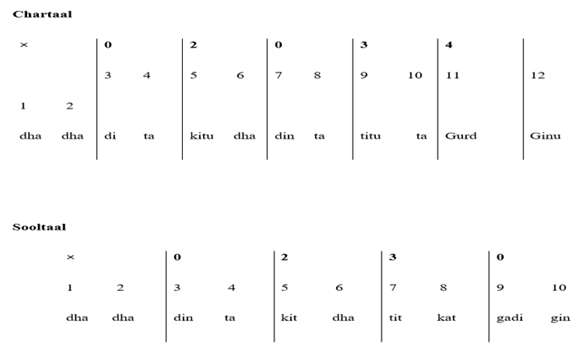
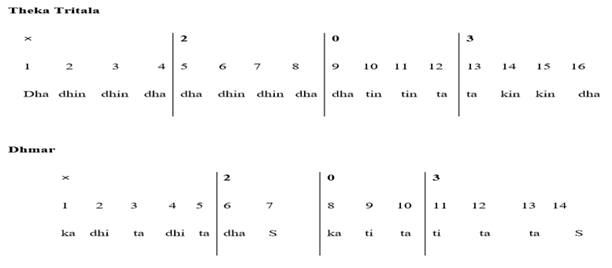
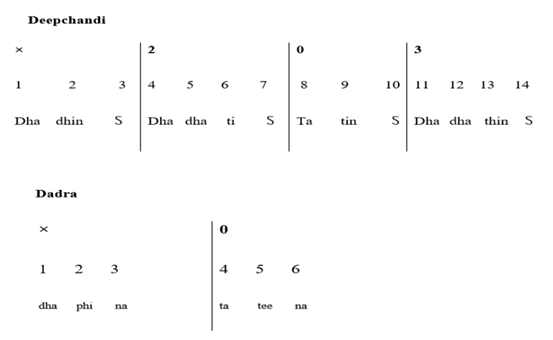
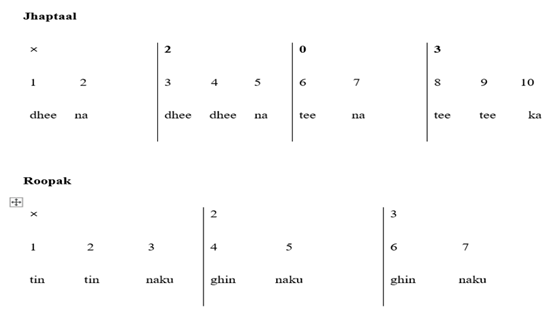
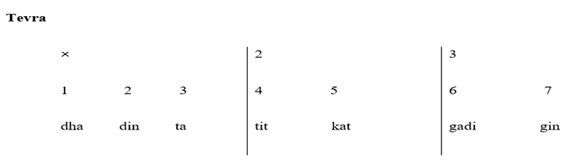
6. The Main Theka that are played on the
Nakkara are
Nakkara is played at the beginning of the nautanki
performance and its sound goes far and wide. The synchronized form of singing,
acting and movements makes the audience crazy about nautanki. Nakkaara is the liveliest instrument of nautanki. Besides,
sarangi, dholak, harmonium, chloronate, bella and bronze bowl are also played with carvings
7. Poetry and music
Art and music are
inextricably linked. Words take existence before they take shape in the form of
music. After that, the ascending and descending of the voice, the instrument,
and the artist together give it perfection. The main rhythms are Doha, chaubola, chaand, daud, lavani, bahere-e-tabil, and dubola, etc., like two
characters of Amar Singh Rathore play to talk to each other using doha, chaubola, daud
Doha, in a Nautanki, Doha is used independently or with
a Chhand and essentially before a Chaubola.
Chaubola, Chaubola is sung after the Doha in the Nautanki. Chaubola is used a lot in Nautanki, which shows its
importance. In Chaubola, it is mandatory to use a
verse called Doha at the beginning and Daud at the end.
Daud, this is a Chhand sung after Chaubola.
It is called a Daud because it sings at a very fast pace. The daud is not sung
separately. It is seen as a link to Chaubola. This
Chhand also ends the scene many times.
Bahar-e-Tabeel, the most used Chhand in the Nautanki is the
Bahar-e-Tabeel. Bahar-e-Tabeel is a popular Chhand among the khayalbajas. Which started to be used in Swang and Nautanki, but it is an old Chhand.
Lavani, the use of Lavani/Swang
Chhand in Nautanki is the result of the thinkers. They are composed according
to raga-ragas. According to the context, the poet used to write verses and
according to the context, his restrictions were made in the raga, but due to
the lack of songs and writers, many types of Lavani are not seen today.
Dubola, Due to consisting of two lines, it may have been named Dubola. It is basically a Chhand of Khayal which was
brought by Khayal singers. In nautanki, there is a tradition of singing this
Chhand at the beginning of the performance after Doha, Chaubola,
and before the Daud.
Chhand, it is used in places like Mathura, Hathras, etc., it is sung without rhythm, it does not use
rhythm and instruments. The Chhand begins with Doha. Therefore, the Doha comes
first, followed by the singing of Chhand.
8. The Nature of Modern-day Nautanki
Today, there are some
forms of musical, or drama that are beyond the concept and definition of drama
that have been going on for centuries. There are also a lot of technical flaws
in this, where artists must come and speak on two stand mics, and the singing
is always emotionless. In such presentations, no principles such as acting,
expression of emotions, and visual relations are applicable. The artists travel
from one mic to another throughout the night and only perform singing. The absence of new
stories/narratives and high-pitched singing has hindered the carrying forward
of the tradition of rich drama. Due to such performances, the famous folk drama
style of Uttar Pradesh is in danger of extinction.
It's interesting to
note that Nautanki, while still holding an important place in people's
collective imagination, is also facing dialectical tension. On the one hand, it
continues to be an important part of North India's cultural heritage, with its
unique music and singing style that deeply influenced the public. However, on
the other hand, it is also struggling to deal with changing audience
aspirations and the need to compete with other forms of entertainment. As
mentioned in the abstract of the article, the popularity of Nautanki suffered
due to the introduction of vulgarity in its plots to compete with Parsi dramas
and films. Through this study, the article aims to analyze
the initial glory of Nautanki as well as the damage to its popularity and how
it is coping with changing audience aspirations any art form needs to evolve and adapt to changing times to remain relevant
and popular
The term
"nautanki" is often used to describe theatrical performances that are
characterized by their vibrant and lively nature. "Modern nautanki"
could refer to contemporary adaptations or reinterpretations of this
traditional art form. In the context of modern entertainment and performance
arts, artists and groups may blend elements of nautanki with contemporary
themes, styles, and technology to create a more relevant and engaging
experience for contemporary audiences.
Modern nautanki
performances might incorporate elements such as Contemporary Themes: like
current social, political, or cultural issues. Incorporation of Technology:
Using modern audio-visual techniques, lighting, and sound systems to enhance
the overall production value. Innovative Storytelling: to appeal to a diverse
audience but it is important to note that the term "modern nautanki"
can be interpreted in various ways, and different performers or groups may
approach it differently. The goal is often to preserve the essence of nautanki
while making it accessible and relevant to contemporary audiences.
Certainly, In a more metaphorical or colloquial sense, "modern
nautanki" might be used to describe situations, events, or behaviors that resemble the lively and dramatic nature of
traditional nautanki but in a contemporary context. It could be applied to
situations that involve theatrical or exaggerated elements for effect, often
with a hint of playfulness or irony.
For example, if someone
describes a political event as a "modern nautanki," they might be
suggesting that the event is characterized by theatrics, grand gestures, or
exaggerated performances. It's a way of expressing that the situation seems like
a dramatic and entertaining spectacle. Keep in mind that the term's usage in
this sense may vary depending on regional dialects and individual perspectives.
Digital Nautanki: With
the rise of digital media, artists may explore creating nautanki performances
for online platforms. This could involve live streaming or recorded
performances, reaching a broader audience, and
adapting to changing modes of entertainment consumption.
Urban Nautanki: Artists
might reinterpret nautanki in an urban context, addressing contemporary issues
faced by city dwellers. The themes, language, and characters may reflect the
urban lifestyle and challenges.
Experimental
Storytelling: Contemporary nautanki could experiment with narrative techniques
and storytelling styles, incorporating elements of surrealism, abstraction, or
non-linear storytelling to appeal to a modern audience.
Cross-Cultural
Collaborations: Collaborations with artists from different disciplines, such as
contemporary dance, digital art, or experimental music, could lead to
innovative and hybrid performances that blend traditional nautanki elements
with modern artistic expressions.
Socially Relevant
Themes: Artists may choose to address current social and political issues in
their nautanki performances, making the art form a platform for commentary and
discussion on contemporary challenges
It is concerning to see
that traditional forms of performing arts, such as nautanki, are facing the
risk of being eradicated due to the impact of not only Western culture but also
modern technology. It is important to preserve these art forms and promote
their value to maintain the diversity and richness of our cultural heritage
If you look at the
Nautanki of the present time and at the same time look at the traditional
Nautanki, there have been many meaningful changes in the traditional Nautanki,
the male characters used to act as a female character, for which a heavy mask
was done and mainly such a character was selected which was beautiful to look
at, he was dressed according to the character and perform on the stage. Gulab
Bai was born as the first female character in the art of Nautanki
With the beginning of
the electronic age, many meaningful changes were seen in the Nautanki, such as
the artists who had to call the audience miles away with a loud voice, now the
use of microphones has relieved that exhaustion. Musicians now started sitting
on the left edge of the front part of the stage, and the singer artist of
Nautanki got the freedom to sing the story only once. The entire duration of Nautanki, which used to
last for 8-10 hours, has
now started happening in one to
one and a half hours,
and the Nautanki with the big plot is also presented in a maximum of two hours
Nautanki art used to
have Akharas earlier, and their income was mainly sourced from the audience or
by the host on a special occasion, such as a birthday, wedding, or festival.
There were even ticketed shows of Nautanki
9. Interview Insights on the Contemporary Transformation of Nautanki
To understand the present condition and evolving aesthetics of Nautanki, an in-depth interview was conducted with eminent folk theatre practitioner Pandit Ramdayal Sharma, a leading figure who has witnessed the transition of the form from village-based all-night performances to contemporary stage productions. Honoured with national recognitions, including the Padma Shri and awards from the Sangeet Natak Akademi, Sharma’s reflections provide valuable primary insights into the historical continuity and modern adaptations of Nautanki.
10. Duration and Structural Transformation
According to Sharma, Earlier most of the nautanki
used to take place in the villages and people used to watch the nautanki all
night in the comfort of their farm work. At that time, there were events of
nautanki on every occasion, like on the occasion of marriage, on the occasion of
tonsure, meaning this nautanki was called on every occasion from birth to
death. Calling the team of Nautanki also showed the status. And later it was
seen that the nautanki that earlier people used to watch full night began to change
as people started doing jobs, started living in cities, and later television
came, so that they could be entertained in 1.5 to 2 hours. which led to a
change in the performance duration of the Nautanki. Otherwise, 60-70 years ago,
when we used to go for the performance of Nautanki, there used to be the
staging of Nautanki for 6-7 hours or the whole night, and at that time, there
used to be only bullock carts. We used to take a bullock cart from one village
to another to go to the stage. And in the morning, we had to sit with folded
hands, please allow us to go now, the bullock cart has come for us. Now another
village has to go for staging. But now there have been many changes. Now people
have become accustomed to watching movies even at weddings, and the tradition
of staying overnight on auspicious occasions like weddings has also ended.
People started returning after eating food, so Nautanki should also be staged
when someone stops. After the arrival of television, people started going to
homes, watching serials, etc., for entertainment. Secondly, in the whole night
staging of Nautanki, they had to face the effects of the weather also. Now,
after the arrival of television, their entertainment started taking place in
their homes. Due to all these reasons, the script also started getting smaller.
We also shortened the old script, which used to be quite big. The duration is
approximately 1:30 to 1:45 hours. Just like today's film has been limited in
less time, similarly, the time of Nautanki also had to be limited because
people have got used to it, so there was a change in its writing, and in modern
times, Nautanki started being written for a maximum of 2 hours.
11. Changing Narrative Themes
Sharma emphasized that earlier, most of the nautanki were
based on Shringar Rasa and Veer Rasa, and along with
the literary plot, nautanki was also written on the religious plot, but in
today's plot, the issue has dominated. Television and news show how many problems there are,
and the same is filled in the mind, then based on that, Nautanki is written, so
people watch more. In this, based on today's problems like foeticide, the
problem of children's education, the problem of suicide, the problem of
environment, and many other social issues, nautanki began to be written, which
has a good response, which also encourages the writer of nautanki. There is a
change now to write new nautanki, because of films, that in a short time,
nautanki should be staged, so instead of editing old scripts, I want to write
new scripts, write about today's problems, which affect and we also write.
12. Genre Identity and Terminological Clarification
Sharma said that First of all, let me tell you that Nautanki is not the
name of any genre. There was a script by the name of Nautanki Shehzadi, and our
ancestors staged many shows of Shehzadi Nautanki. This script was very popular,
based on which this genre came to be known as Nautanki. The genre was mainly
known by the name of Swang, and before that was known
as Bhagat, but Bhagat used to have only religious themes, and Swang used to have historical themes as well as themes
based on all nine Rasa (nine emotions). Therefore, the books that will be
available mainly for Nautanki will have Swang written
in them.
13. Performance Space and Stagecraft
The advent of curtains can be said to be from the Parsi theatre because
colourful curtains were used in the Parsi theatre, from the Parsi theatre, then
the trend started in the Ramlila, then the trend of curtains started in the
Nautanki also. Still, there is no need for the backdrop in the Nautanki.
Earlier, the stage used to be made by collecting materials from the nearby
houses in the open area to make a stage and by putting two bamboo sticks in the
front and lighting them with gas lanterns or even before that, by lighting
torches/flambeau. For me, an actor should be good, should be good
in direction, should be good in his art, should be good at singing, should be
good at acting, then the attention of the audience will not go anywhere; it
will be immersed in the story. I still focus on these aspects today. Nowadays,
people have started resorting to synthesizers and many other types of musical
instruments, but it is also not needed so much.
14. Role of Sutradhar and Performance Convention
Despite modern changes, Sharma argued, It is not like this
that even today there are Nat (actors) and Nati(actresses) who come before the
beginning of the drama, then the Sutradhar (character
of Nautanki) come, there is worship then the actors and actresses entertain, comedians come
and a female character comes dancing, entertains the audience in this way. He
is approached by the Sutradhar, who is also called Ranga, and he comes in all
the nautankis because without him, the nautanki does not start. After starting
the nautanki, even if the scenes keep changing on their own, no one of the
nautanki gives any information about the upcoming scenes. Sutradhar is the main
character of the nautanki.
15. Critical Reflection
Sharma's interview
reveals that as India has evolved, its cultural, traditional, and social
landscapes have also changed. Because our folk traditions are deeply rooted in
the common people, they take on changing forms with each development. However,
its custodians must incorporate fundamental changes, such as urbanization, the
use of technology, and the changing expectations of audiences, without altering
its original form. These changes should be implemented not merely to
demonstrate its decline but to make Nautanki more popular and accessible to the
masses through meaningful use.
16. Conclusion
The Nautanki is constantly evolving. Nautanki, as a folk art, has come a
long way. During its development, the basic form of Nautanki has changed as
well. In Nautanki also it is the same as in other genres of folk. Nautanki,
moving from folk to elitist, has managed to retain its original flair, but the
influence of market and time has inevitably left its mark on Nautanki. Today,
what we call the modern form of Nautanki or modern Nautanki. In fact, it is a
modified form of Nautanki and, in many ways, a misguided form. Today, just as
the market has influenced all our folk forms, it has also influenced Nautanki.
Just as other folk expressions have not been able to evolve and assume a new
dimension, Nautanki has also remained confined to its two abodes - Kanpur and Hathras.
During its development, Nautanki has continuously changed its form. This
change has come at the level of content and form. For example, the performance
of the first Nautanki used to go on throughout the night. At that time, there
was no other means of entertainment. Now that there are so many media of
entertainment, not only has the content of Nautanki changed, but the time of
performance has also been reduced to 2-3 hours. Not only this, but the
entry of Nautanki performed by making an open stage outside has now happened in
the auditoriums. And in this way, this means of public entertainment
is now luring the elites.
Today, there is a need to link all expressions of people with teaching,
training, and research. They should be made an essential part of the curriculum
and teaching-learning. Only then can the modern form of Nautanki be developed.
The need today is not to modernize the Nautanki, but to preserve its unique and
original form and performance technique. So that Nautanki does not remain only
a means of ideological churning and intellectual discussion of a handful of
people, preservation of various folk-theatre forms, including Nautanki, is the
need of the hour and also an inevitable necessity, and this work must be done
by the institutions associated with teaching-training and archiving of
literature, art and culture.
Sharma also noted the shift in the tradition of patronage. He said that earlier, Nautanki was performed at the invitation of the public, the cost of which was borne by the organizers or the audience through ticket purchases. Nowadays, this art form receives limited support from government funding, repertory grants, theatre festivals, and various institutions, due to which Nautanki's audience is limited to cities, and its reach to rural and remote audiences is diminishing. This requires reflection.
CONFLICT OF INTERESTS
None.
ACKNOWLEDGMENTS
This paper has not previously published and is not currently under consideration by another journal and that all authors have approved of and gave agreed to submit the manuscript to this journal .
REFERENCES
Chandrasakhi, B. K. (2018). Saangeet
(Nautanki) Ka Pran Vadya Nakkara [Nakkara: The Soul Instrument
of Saangeet (Nautanki)].
Kala Vasudha, 17(6), 36–40.
Foucault, M. (1978). The History of Sexuality: Volume 1. An
Introduction (R. Hurley, Trans.). Pantheon
Books.
Gargi, B. (1966). Folk Theatre of India. University of Washington Press.
Hansen, K. (1991). Grounds for Play: The Nautanki Theatre of North India. University of California Press. https://doi.org/10.1525/9780520910881
Hansen, K. (2009). Staging Composite Culture: Nautanki and Parsi Theatre in Recent Revivals. South Asia Research, 29(2), 151–168. Https://Doi.Org/10.1177/026272800902900203
Hansen, K. (2023). Grounds for Play: The Nautanki Theatre of North India. University of California Press. https://doi.org/10.2307/924432
Kramrisch, S., and Vatsyayan, K. (1983). Traditional Indian Theatre, Multiple Streams. Artibus Asiae, 44(2/3), 235. https://doi.org/10.2307/3249599
Mehrotra, D. P. (2006). Gulab Bai: The Queen of Nautanki Theatre. Penguin Books.
Sharma, D. (2006). Performing Nautanki: Popular Community Folk Performances as Sites of Dialogue (Doctoral Dissertation, Ohio University). OhioLINK Electronic Theses and Dissertations Center.
Sharma, D. (2020a). Community, Artistry, and Storytelling in the Cultural Confluence of Nautanki and Ramlila. Asian Theatre Journal, 37(1), 107–132. https://doi.org/10.1353/atj.2020.0027
Sharma, D. (2020b). Reminisces with My Father, a Nautanki and Ramlila Master Artist. Asian Theatre Journal, 37(1), 133–146. https://doi.org/10.1353/atj.2020.0028
Singh, S. (2020). Nautanki: Evolution, Issues and Challenges. Rupkatha Journal on Interdisciplinary Studies in Humanities, 12(6). https://doi.org/10.21659/rupkatha.v12n6.16
Vatsyayan, K. (1980). Traditional Indian Theatre: Multiple Streams. National Book Trust, India.
|
|
 This work is licensed under a: Creative Commons Attribution 4.0 International License
© ShodhKosh 2026. All Rights Reserved.