ShodhKosh: Journal of Visual and Performing ArtsISSN (Online): 2582-7472
|
|
THE AESTHETICS OF DIGITAL IMAGES AND THE DYNAMICS OF VISUAL PRACTICES IN THE MEDIA ENVIRONMENT OF THE NEW ERA
Alla Diachenko 1
 ,
Alla Breniuk 2,
Volodymyr Petrashyk 3,
Kseniia Nikolenko 4
,
Alla Breniuk 2,
Volodymyr Petrashyk 3,
Kseniia Nikolenko 4 ,
Daryna Yaremenko 5
,
Daryna Yaremenko 5
1 Candidate
of Pedagogical Sciences, Associate Professor, Department of Industrial Design
and Computer Technologies, Dean of the Faculty of Decorative and Applied Art,
Mykhailo Boichuk Kyiv State Academy of Decorative Applied Arts and Design,
Kyiv, Ukraine
2 Candidate
of Art Criticism, Senior Lecturer, Department of Fine Art and Arts and Crafts
and Restoration of Works of Art, Faculty of Pedagogics, Kamianets-Podilskyi
Ivan Ohiienko National University, Kamianets-Podilskyi, Ukraine
3 PhD in Art Studies, Associate Professor, Acting Head of the Department
of Theory and History of Art, National Academy of Fine Arts and Architecture,
Kyiv, Ukraine
4 Candidate
of Philosophical Sciences, Associate Professor of the Department of Psychology,
Sociology and Pedagogy, Donetsk State University of Internal Affairs,
Kropyvnytskyi, Ukraine
5 Lecturer
of the Department of Computer Science and Intelligent Systems, Interregional
Academy of Personnel Management, Kyiv, Ukraine
|
|
|
ABSTRACT |
|
|
The use of
digital technologies has become a central element in artistic practice in the
21st century. In terms of creative techniques and communication formats -
digital images are now becoming autonomous artistic artifacts that are being
circulated in the global art market and obtaining material worth through
sales. The growing awareness of digital art as a potential for new forms of
artistic creation and new ways of communicating between artists and viewers
has become one of the central themes in contemporary art discourse. The
objective of this project was to determine the variables influencing the sale
price of specific artistic products. For this study, we applied a
comprehensive visual, formal, and contextual analysis of twenty of the most
expensive digital visual art products sold during recent years. We were able
to show that both highly detailed (works by Beeple) and simple, minimalistic
images with pixelation (works by Larva Labs) created by the use of algorithms
and other generative technologies (works by Dmitri Cherniak), as well as
images composed of white text on a black background were among the most
expensive works. The results of our study indicate that artistic technique
does not significantly influence the price of digital images. Instead, the
most important factors are a complex interplay of social-political concepts,
the artist’s previous reputation and success within the art world. |
|||
|
Received 10 January 2026 Accepted 06 February 2026 Published 06 March 2026 Corresponding Author Alla
Diachenko, pani.alla0107@gmail.com DOI 10.29121/shodhkosh.v7.i1.2026.7204 Funding: This research
received no specific grant from any funding agency in the public, commercial,
or not-for-profit sectors. Copyright: © 2026 The
Author(s). This work is licensed under a Creative Commons
Attribution 4.0 International License. With the
license CC-BY, authors retain the copyright, allowing anyone to download,
reuse, re-print, modify, distribute, and/or copy their contribution. The work
must be properly attributed to its author.
|
|||
|
Keywords: Visual Art, Contemporary Art, Digital Art,
Experience Economy, NFT, Design, Fine Arts |
|||



1. INTRODUCTION
Digital technologies have opened up new creative avenues in the 21st century for all types of art - both visual and auditory - and have made possible entirely new types of artistic expressions. Digital media make available new conditions for the appearance of new artistic phenomena that are being studied under the heading of "digital art" and continue to challenge and expand the limits of the visual arts Li (2024). Digital tools serve not only as a means of artistic expression, but are also a source of artistic concept and the artist is transformed into a “experience designer, creator of virtual worlds, visual environment programmer” Blazhev (2021).
In addition to transforming the aesthetic aspects of art, digital technologies have introduced new mechanisms of economics - in particular, they enable the sale of digital artistic products in a virtual environment without requiring physical delivery of the object or physical contact between the two parties in a real environment. The base technological innovation that enables these new mechanisms is Non-Fungible Tokens (NFTs) - digital tokens that have been authenticated via blockchain technology and allow creators to sign their work and to sell it digitally on online platforms Zelazko (2023), Derstuhanova (n.d.).
The trend of using visual art in commercial production has continued into the 20th and 21st centuries and now plays a major role in the marketing of products in the marketplace and as a key component of competitive forces. Pine and Gilmore (1999) have referred to this trend as the "experience economy," indicating a movement away from the utility of each product toward the experiential enjoyment of those products.
By the 21st century the art market was playing a large role in contemporary global economic systems Kowalski (2018), Byrkovych et al. (2023) and by that time had gained the status of the most dominant arena for the creation and legitimation of modern art Bakhov et al. (2022). The current question that emerges is: what aesthetic practices that exist in today's digital art cause collectors to spend their money on works of art? Do there exist aesthetic strategies in digital art that can be scientifically identified, or are other non-artistic factors - economic, social, and cultural - the primary factors? These are the issues that will be addressed in the proposed study.
2. LITERATURE REVIEW
Among recent studies, several areas can be identified that address different aspects of digital art and its role in society.
Digital Art continues to be a topic of controversy within both Media Studies and Contemporary Art History. Chikarkova (2022), states that digital art is defined as “creative activity based on the use of computer technologies, resulting in works in digital form, whose main environment of existence is computer platforms or the Internet”. She points out, however, that merely using computer technology is not sufficient to qualify an artwork as “digital art,” rather the significance of the use of computer technology in the artistic process is also important to consider. Similarly, according to Bondarenko et al. (2025) the defining factor of digital art is the effect of technology “on the specificity of the artistic image of an art artifact”, and they also stress that the term "digital art" should represent not only visual arts but also audio arts (specifically electronic music).
Many studies have focused on the evolution of the "experience economy" concept. As Pine and Gilmore explain, the experience occurs when a company "uses services as the stage and goods as props to involve individual customers in a memorable event. Commodities are interchangeable, goods are tangible, services are intangible, and experiences are memorable." Boiarska (2016) views the "experience economy" as a method of advertising goods or services via emotions created during interactions with said goods or services. Interestingly, in her article, written in Ukrainian, "experience" is translated as "impression," which further implies more of an emotional experience than just cognitive or technological interaction. Lipski considers the experience economy to be part of a broader range of phenomena: what in the cultural dimension is “part of the aestheticization (culturalization) of reality”, in the economic dimension is a “component of cognitive capitalism”, and the consequence of this phenomenon is the expansion of the cultural space – the “iconosphere”, which from a separate field of the social world “becomes an omnipresent characteristic (socio-cultural unity)” Lipski (2020).
Economic issues in the field of culture have been studied in a number of works. For example, Jensen (2022) has documented historical trends in the price of fine-art works of art over the years, including how the value of art increased in the nineteenth-century; declined in the early twentieth-century; and then again increased in the 1960s as the result of changes in collectors' preferences. Whitaker (2021) has studied the roles of artists, managers, and galleries as active agents in the contemporary art market and identified the effects of economic processes, such as pricing, supply, and demand, upon the composition and operation of the art environment. The researcher concludes that “The economics of visual art defies many principles of economics while also relying on them. This makes the economics of art a creative and political practice unto itself” Whitaker (2021).
A more practical approach to research is demonstrated in Xiong's work. Using the principles of behavioral economics, art management, and statistical analysis, the author developed a series of practical recommendations for artists regarding the sale and purchase of works of art. The author indicated that "psychological factors significantly affect bidders' decision making, resulting in deviations of auction prices from the intrinsic value of artworks" Xiong (2024). Similarly, researchers Xiong (2024) and Whitaker and Kraeussl (2025), examined several economic risks that are present for art collectors. Additionally, Rusakov (2019) emphasized that in order to determine the value of an artwork, one must have knowledge of that artwork and the required skills to evaluate its worth.
Researchers have also evaluated the use of Non-Fungible Tokens (NFTs). Specifically, Joshi (2024) and Tokranova and Bauters (2025), explored the potential benefits of using NFTs and stated that "NFTs provide a solution to the digital art value problem by providing uniqueness, traceability, and verifiable properties that were lacking in prior digital distribution methods" Tokranova and Bauters (2025).
Another important area of research is the study of technical, stylistic, and semiotic features of various forms of visual art in a digital context. In particular, Mi (2024) analyzes the technologies for creating and optimizing an animated art space using Unity3D and LOD models and notes their effectiveness in optimizing visual quality and speed of interaction with space. Kherid et al. (2023) explore collages and propose analyzing them in terms of “metafunctionality”, which includes three functions – “Ideational”, “Interpersonal”, and “Textual” – that can be used to reading digital collage works in line with visual culture in the discourse of seduction, namely sensory images that can seduce the audience by offering pleasure”.
Numerous studies have focused on the application of artificial intelligence technologies in digital art and their implications for artistic practices Derstuhanova (2019). Bedir and Freedman (2024) has explored the transformation of art education in response to digital technologies and artificial intelligence and concluded that "the integration of digital technologies in art education curricula requires a multifaceted skill that aligns with the evolving demands of the digital age" Bedir and Freedman (2024).
Several works have addressed the interaction of digital art with local cultural elements. Niu (2024) studied the feasibility of incorporating digital art into local cultural elements of Guangdong Province and assessed the total level of "visual communication effect" as "excellent". Sirohi and Dhar (2025) have studied the interaction of new digital art with traditional Indian artistic techniques and provided examples of successful collaborations between Indian artists, such as Singh, and Raghava.
3. METHODS
This study uses a thorough visual, formal, and contextual analysis of a selected group of non-fungible tokens (from now on referred to as NFTs) representing the highest-priced digital works sold at the market between 2021 and 2024. The principal objective was to find common stylistic features, artistic trends and visual patterns in contemporary digital art. The original sample used was a list of the most prominent sales of non-fungible tokens, collected and summarized by the prestigious mass media resource NFT Now in the article The 20 Most Expensive NFT Sales of All Time (NFT Now, 2024). This sampling covered all major transactions on the field of NFT art and was based on confirmed data from the largest auction houses such as Christie's, Sotheby's, Nifty Gateway, Foundation, SuperRare, etc.
The collected data is organized in a comparative table, which allows to identify similarities and differences. The following criteria were used to describe the artistic features: technique (pixel art, 3D animation, glitch art, neo-expressionism, etc.), color scheme (dominant colors, contrast, light and shadow), compositional structure (static/dynamic, symmetry, rhythm), conceptual elements (irony, political criticism, futurism, nostalgia), interactivity or physical presence (in the case of hybrid NFTs, such as “Human One”).
4. RESULTS
Below are the results of a visual and contextual analysis of the twenty most expensive NFT works identified based on data published in the NFT Now ranking (NFT Now, 2024). Each digital work was analyzed according to the following parameters: authorship, date and sale price, artistic style, technical execution, and color characteristics.
The data obtained is summarized in a comparative table Table 1, which allows us to trace both the individual characteristics of individual works and general trends in the field of digital art. The analysis revealed a wide range of artistic strategies, from neo-expressionist glitch art and algorithmic generative graphics to socially engaged conceptualism and satirical pixel art.
Table 1
|
Table 1 The Most Expensive NFT Works According to the NFT Now Rating |
||||
|
Author |
Title |
Cost ($) |
Date of sale |
Style |
|
Beeple |
Everydays: The First 5000 Days |
$69.3M |
Mar. |
Digital art |
|
Julian Assange & Pak |
Clock |
$52.7M |
Feb. |
Conceptual art |
|
Beeple |
Human One |
$28.9 million |
Nov. 21 |
Physical-digital hybrid |
|
Larva Labs |
CryptoPunk #5822 |
$23.7M |
Feb. |
Pixel art (PFP) |
|
Larva Labs |
CryptoPunk #7523 |
$11.8M |
Jun. |
Pixel art (PFP) |
|
TurboToad |
Tpunk #3442 |
$10.5M |
Aug. |
Pixel Art (CTO) |
|
Larva Labs |
CryptoPunk #4156 |
$10.3M |
Dec. |
Pixel art (PFP) |
|
Larva Labs |
CryptoPunk #5577 |
$7.7M |
Feb. |
Pixel art (PFP) |
|
Larva Labs |
CryptoPunk #3100 |
$7.6M |
Mar. |
's Pixel Art (PFP) |
|
Larva Labs |
CryptoPunk #7804 |
$7.6M |
Mar. |
Pixel art (PFP) |
|
Dmitri Cherniak |
Ringers #109 |
$7.1M |
Oct. |
Generative art |
|
XCOPY |
Right-click and Save As Guy |
$7.1M |
Dec. |
Crypto art |
|
Larva Labs |
CryptoPunk #8857 |
$6.6M |
Sep. |
Pixel art (PFP) |
|
Beeple |
Crossroad |
$6.6M |
Feb. |
Digital art |
|
XCOPY |
All Time High in the City |
$6.2M |
Jan. |
Crypto art |
|
Dmitri Cherniak |
Ringers #879 |
$6.2M |
Aug. |
Generative art |
|
Ross Ulbricht |
FreeRoss |
$6.1M |
Dec. |
Conceptual art |
|
XCOPY |
A Coin for the Ferryman |
$6.0M |
Nov. 21 |
Crypto art |
|
Beeple |
Ocean Front |
$6.0M |
Mar. |
Digital art |
|
Edward Snowden |
Stay Free |
$5.4M |
Apr. |
Conceptual art |
|
Source: Author's Compilation Based on Data (NFT Now, 2024) |
||||
The most expensive among all the analyzed works is "Everydays: The First 5000 Days" by the digital artist Mike Winkelmann (under the pseudonym – Beeple) - a digital collage composed of 5,000 separate images, made between May 1, 2007 and January 7, 2021. The entire collage is 21,069 x 21,069 pixels in total size, and each of the 5,000 elements of the collage is an individual picture, measuring about 300 x 300 pixels. The collage contains a large quantity of visual information; however, due to the cognitive limits of the human visual system Kahneman et al. (1992) perceiving the full extent of this information is very difficult. Therefore, the viewer of the work should perceive it in steps, orienting him/herself to the concepts contained within.
The second most expensive digital artwork is a joint effort by the anonymous digital artist Pak and the journalist and founder of WikiLeaks, Julian Assange. The joint project is represented by the NFT entitled "Clock". The title refers to the white numerical notation "1064" placed against a black background. The numeral "1064" corresponds to the number of days Assange spent in British detention at the time when the work was created. Due to the symbolic simplicity of the visual representation of the work, its emphasis is placed on the theme of persecution for the right to free speech.
Thus, the two most expensive images represent certain opposites in terms of detail, volume of visual information, and color palette Figure 1.
Figure 1
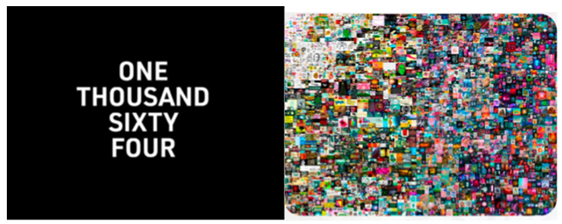
Figure 1 “Clock” by Julian Assange and Pak and “Everydays:
The First 5000 Days” by Beeple
Source: NFT Now, 2024
The largest number of works presented are images created in the pixel art style Table 2. These works are characterized by the use of a limited color palette and a low level of visual detail; compositionally, they are reduced to an image of a pixelated human face, sometimes supplemented with elements such as headgear.
Table 2
|
Table 2 Pixel Art Images |
|||
|
Title |
Color scheme |
Compositional structure |
Conceptual elements |
|
CryptoPunk #5822 |
Limited palette (blue, beige); medium contrast |
Static, frontal symmetry; no dynamics |
Status avatar, identity, nostalgia |
|
Alien CryptoPunk #7523 |
Turquoise, red, white; high contrast |
Symmetrical, focus on the face; no rhythm |
Symbolism, pandemic allusion (mask), irony |
|
TPunk #3442 |
Purple, white, black; moderate contrast |
Static; asymmetry in the face |
Post-irony, parody (Joker image) |
|
CryptoPunk #4156 |
Beige, blue, black; medium contrast |
Centered face; simple symmetry |
Nostalgia, minimalism |
|
CryptoPunk #5577 |
Brown, yellow, beige; warm tones |
Centered, static; no rhythmic elements |
Archetypal (cowboy); stylized portrait |
|
CryptoPunk #8857 |
Dark shades: black, red; high contrast |
No dynamism; vertical symmetry |
Punk aesthetics, rebellious image, subculture |
|
Source: Author's Compilation |
|||
Stylistically and thematically similar are the works of artist XCOPY – “Right-click and Save As Guy” and “A Coin for the Ferryman”, which also depict human faces but are distinguished by a slightly higher level of detail and the presence of additional elements, such as fragments of clothing Figure 2.
Figure 2

Figure 2 “CryptoPunk #5822” by Larva Labs and “A Coin for the
Ferry Man” by Xcopy
Source: NFT Now (2024)
Two more works by Beeple – “Crossroad” and “Ocean Front” – represent examples of digital surrealist art created using three-dimensional (3D) graphics. Both images present imaginary landscapes with a high degree of visual complexity: more than 30 distinct color shades are used, and there are a significant number of small objects and textured planes, indicating a high level of detail in the composition Figure 3.
In particular, "Crossroad" stands out for its very clear political subtext. At the central location of the composition lies a hyperbolic representation of a man who, as reported by Decrypt media platform, can be identified as Donald Trump: "The NFT, titled ‘Crossroad,’ depicts former President Trump lying in a heap after losing the 2020 presidential election" Decrypt (2021). The visual element supplements the semantic content of the work, in which the artist uses irony to express his dissatisfaction with the results of the 2020 U.S. presidential election and with the role of the political leader as a symbol. At the same time, both of these images include unexpected combinations of contrasting elements typical for surrealist art, as well as "dream-like environments at times creating a divide in what is real and what is imaginary" Tang and Misri (2025).
Figure 3
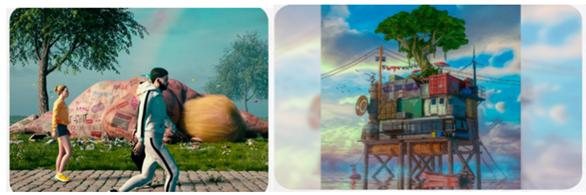
Figure 3 Images by Beeple: “Crossroad” and “Ocean Front”
Source: NFT Now, 2024
Artist Dmitri Cherniak’s artwork are typically classified as "generative art", where the distinctive characteristic of generative art is that at least a portion of the generation is subject to some form of control that is not directly controlled by the artist Boden and Edmonds (2009). Dmitri Cherniak’s two images, "Ringers #109" and "Ringers #879," are both examples of generative art based upon repeating rings of various sizes, offsets and colors generated algorithmically. Additionally, "FreeRoss," by Ross Ulbricht is another example of generative art. "FreeRoss" is a drawing of an eye with multiple human faces reflected in the eye and was drawn with a graphic technique Figure 4.
Figure 4
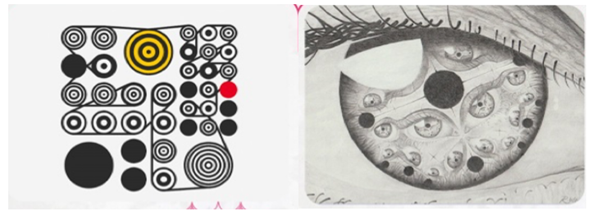
Figure 4 “Ringers #109” by Dmitri Cherniak and “FreeRoss” by
Ross Ulbricht
Source: NFT Now (2024)
5. DISCUSSION
In scientific literature, the art market is often defined as a “hybrid, multifunctional, and polyphonic phenomenon” that structurally combines opposing trends. On the one hand, it is oriented toward artistic autonomy, aesthetic self-expression, and symbolic capital; on the other hand, it is oriented toward economic benefit, the capitalization of creativity, and market infrastructure Held et al. (1999), Yermachenko et al. (2023).
An analysis of the most valuable digital artworks on the art market since 2018, does not show a significant relationship between the commercial value of a digital artwork and traditional artistic values such as the use of techniques, detail or color palette. At times, the conceptual aspect of a piece can play a significant role — particularly so in the case of Clock, which addressed important socio-political issues. Nonetheless, we cannot determine the existence of a single factor that determines the commercial value of a digital artwork. As such, Raymond Moulin's argument regarding the art market being a place where "through some secret alchemy, cultural goods are transformed into commodities" Moulin (1987) is relevant.
Additionally, only eight artists were involved in the creation of the top twenty most expensive digital artworks. Specifically, Larva Labs was represented in this group seven times, Beeple four times, and XCOPY three times. All three of these artists are well-known and active participants in the digital art community, which may suggest that a reputation and recognition capital plays an important role in the determination of the market price of digital artworks. For example, as of 2025, Larva Lab's collection "Cryptopunks" contains approximately 10,000 artworks and Dimitri Cherniak's collection "The Ringers" contains 1,000 paintings, each corresponding to an NFT.
This feature suggests that the commercial value of a digital image will depend not solely on the aesthetic or technical attributes of the image, but also on the level of recognition of the artist, the reputation of the artist, and the artistic brand that has been established over time. An artistic brand is established over time through a combination of consistent artistic production, exhibition, press coverage, social networking, and support from institutions or collectors, all of which contribute to establishing trust with the viewer/consumer and subsequently increasing the commercial value of the artist's products.
At the same time, the question of whether there exists a correlation between artistic value and monetary value continues to be debated within both the historical discipline of art history and economic discourse. While there is a common belief in both disciplines that there exists a direct relationship between the aesthetic properties of a work and its monetary value, empirical research demonstrates the complexity and ambiguity of this relationship and is influenced by a variety of cultural, social, and institutional factors (Velthuis, 2005). A sociological study conducted by Zakharova provides evidence of this ambiguity, demonstrating that only 44 percent of respondents agree that the aesthetic properties of a work will always determine its commercial value (Zakharova, 2014). Thus, while there exist a number of factors that will determine the commercial value of an artistic product, the majority of those factors are non-aesthetic and include marketing strategies, the artist's authority, the media attention garnered by the work, institutional support, and the overall state of the art market.
6. CONCLUSIONS
High-value digital images have shown that it is not the aesthetics of these images that determine their price, but rather how well the creator has managed to create a unique combination of social narrative, political commentary, intellectualism and personal brand recognition.
This creative approach can take many forms - from highly detailed visually complex compositions (such as many Beeple’s works), through to minimal formal approaches where the works are little more than a simple pixelated face ("Pixel Art" by Larva Labs), or even a single black/white inscription against a plain colored background (like Julian Assange and Pak's "Clock"). The works can also be generated by the use of algorithms to generate the images (like Dmitri Cherniak's "Ringers"), or they can be created using traditional methods and no coding (most of the hand drawn digital art).
However, the creators of high-value digital images do share one common trait - each of them has been recognized for their professional ability and authority; as such, their potential to successfully sell digital artworks is greatly increased over other artists - regardless of how complex the visual composition of the artwork is, or how the artwork was created.
CONFLICT OF INTERESTS
None.
ACKNOWLEDGMENTS
None.
REFERENCES
Bakhov, I., Panchenko, S., Radul, O. S., et al. (2022). Topical Issues in Contemporary Ukrainian Cinema Space: Challenges of Time and Prospects. Relações Internacionais no Mundo Atual, 3(36), 551–569.
Bedir, S., and Freedman, K. (2024). Integrating Digital Technologies and AI in Art Education: Pedagogical Competencies and the Evolution of Digital Visual Culture. Participatory Educational Research, 11, 57–79. https://doi.org/10.17275/per.24.94.11.6
Blazhev, B. (2021). Visual Arts and Digital Technologies. Cultural and Historical Heritage: Preservation, Representation, Digitalization, 7, 191–207. https://doi.org/10.26615/issn.2367-8038.2021_2_018
Boden, M. A., and Edmonds, E. A. (2009). What Is Generative Art? Digital Creativity, 20(1–2), 21–46. https://doi.org/10.1080/14626260902867915
Boiarska, M. A. (2016). The Essence and Definition of the Experience Economy at the Present Stage of Development of Economy of Ukraine. Young Scientist, 4(31), 25–27.
Bondarenko, A., Romanenko, A., and Bondarenko, O. (2025). Electronic Music as Digital Art. Humanities Science Current Issues, 1(84), 93–98. https://doi.org/10.24919/2308-4863/84-1-13
Byrkovych, T., Denysiuk, Z., Gaievska, L., Akimova, L., Prokopenko, L., and Akimov, O. (2023). State Policy of Cultural and Art Projects Funding as a Factor in the Stability of State Development in the Conditions of Globalization. Economic Affairs (New Delhi), 68(1), 199–211. https://doi.org/10.46852/0424-2513.1s.2023.23
Chikarkova, M. (2022). Digital Art: Definitions and Origins. Ukrainian Culture: Past, Present, Development Trends (Mystetstvoznavstvo), 42, 108–113.
Derstuhanova, N. V. (2019,
April 26). Educational Environment of Spiritual
Educational Institutions: Content and Priorities. In International Scientific
Research: Integration of Science and Practice as a Mechanism for Effective
Development (21–23). Kyiv, Ukraine.
Derstuhanova, N. V. (n.d.). Pedagogical Foundations for Implementing Innovations in the Professional Training of Future Theology Specialists. Scientific and Methodological Internet Conference on Higher Education Issues “Improving the Quality of Educational Activities in Higher Education Institutions through Interactive Forms of Learning”, 32.
Held, D., McGrew, A., Goldblatt, D., and Perraton, J. (1999). Global Transformations. Stanford University Press.
Jensen, R. (2022). The Rise and Fall and Rise Again of the Contemporary Art Market. Journal of Cultural Economics, 47, 1–28. https://doi.org/10.1007/s10824-022-09458-3
Joshi, P. (2024). Study of Role of Artificial Intelligence in the Production of Digital Art and the NFT. Artworks, 10. https://doi.org/10.13140/RG.2.2.29342.65609
Kahneman, D., Treisman, A., and Gibbs, B. J. (1992). The Reviewing of Object Files: Object-Specific Integration of Information. Cognitive Psychology, 24(2), 175–219. https://doi.org/10.1016/0010-0285%2892%2990007-O
Kherid, Z., Soeteja, Z., and Masunah, J. (2023). Visual Culture: Reading Digital Collage Art. In The Fifth International Conference on Arts and Design Education (Proceedings). Singapore. https://doi.org/10.2991/978-2-38476-100-5_32
Kowalski, W. (2018). Muzea a Ryzyka Związane z Globalizacją Rynku Sztuki. Opuscula Musealia, 25, 287–310. https://doi.org/10.4467/20843852.OM.17.021.9618
Legendary NFT Artwork Gets Resold for $6.6 Million. (2021). Decrypt.
Li, Z. (2024). A Multidimensional Exploration of the Visual Arts: History, Impact and Future Trends. Journal of Education, Humanities and Social Sciences, 31, 66–70. https://doi.org/10.54097/67myp227
Lipski, A. (2020). Ekonomia Doświadczeń w Warunkach Estetyzacji Rzeczywistości. Śląskie Studia Historyczno-Teologiczne, 52(2), 411–428.
Mi, J. (2024). Animation Art Space Display Model Based on Digital Visual Design. Applied Mathematics and Nonlinear Sciences, 9. https://doi.org/10.2478/amns-2024-3576
Moulin, R. (1987). The French Art Market: A Sociological View. Rutgers University Press.
Niu, Y. (2024). Research on the Visual Communication Effect of Combining Digital Art and Local Cultural Elements in Cross-Cultural Communication. Applied Mathematics and Nonlinear Sciences, 9. https://doi.org/10.2478/amns-2024-2629
Pine, B. J., and Gilmore, J. H. (1999). The Experience Economy: Work Is Theatre and Every Business a Stage. Harvard Business Press.
Rusakov, S. (2019). The Phenomenon of the Art Market as a Problem of Contemporary Cultural Studies. Cultural Thought, 16(2), 175–183. https://doi.org/10.37627/2311-9489-16-2019-2.175-183
Sirohi, T., and Dhar, A. (2025). Contemporary Trends in Digital Art of India: Significant Shift in Indian Visual Arts Scenario. Journal of Research in Humanities and Social Science, 13, 41–55. https://doi.org/10.35629/9467-13044155
Tang, Y., and Misri, I. (2025). Exploring Surrealist Approaches in Digital Media Art for Enhancing Graphic and Visual Communication Design. Journal of Humanities, Music and Dance, 5, 1–14. https://doi.org/10.55529/jhmd.51.1.14
The 20 Most Expensive NFT Sales of All Time. (2024). NFT Now.
Tokranova, D., and Bauters, M. (2025). Reflecting on Digital Art Value: NFTs’ Potential for the Art-Market Rarity. Digital Humanities in the Nordic and Baltic Countries Publications, 7. https://doi.org/10.5617/dhnbpub.12293
Velthuis, O. (2005). Talking Prices: Symbolic Meanings of Prices on the Market for Contemporary Art. Princeton University Press.
Whitaker, A. (2021). Economics of Visual Art: Market Practice and Market Resistance. Cambridge University Press. https://doi.org/10.1017/9781108649919
Whitaker, A. (2023). The Rise of Hybrid Practice: Creative Institutional Design as Arts Entrepreneurship. Journal of Entrepreneurship in the Arts, 11(3). https://doi.org/10.34053/artivate.11.3.192
Whitaker, A., and Kraeussl, R. (2025). Art Collectors as Venture-Stage Investors. Journal of Cultural Economics, 1–29. https://doi.org/10.1007/s10824-024-09528-8
Xiong, S. (2024). Study on the Price Formation Mechanism of Art Auctions from the Perspective of Behavioral Economics: The Influence of Anchoring Effect and Endowment Effect. Advances in Economics, Management and Political Sciences, 134, 9–14. https://doi.org/10.54254/2754-1169/2024.18720
Yermachenko, V., Bondarenko, D., Akimova, L., et al. (2023). Theory and Practice of Public Management of Smart Infrastructure in the Conditions of Digital Society Development. Economic Affairs (New Delhi), 68(1), 617–633. https://doi.org/10.46852/0424-2513.1.2023.29
Zakharova, O. A. (2014). Art Galleries and Centers in the Modern Art Market. ScienceRise, 3(1), 72–77. https://doi.org/10.15587/2313-8416.2014.27465
Zelazko, A. (2023). What Is an NFT? Encyclopædia Britannica.
|
|
 This work is licensed under a: Creative Commons Attribution 4.0 International License
© ShodhKosh 2026. All Rights Reserved.