ShodhKosh: Journal of Visual and Performing ArtsISSN (Online): 2582-7472
|
|
National Identity of Contemporary Art and Design in a Globalized Society
Ihor Yurchenko 1
 ,
Mariia Kravchenko 2,
Kyrylo Kharitontsev 3
,
Mariia Kravchenko 2,
Kyrylo Kharitontsev 3 ,
Oleksandra Penchuk 4,
Taras Rozputenko 5
,
Oleksandra Penchuk 4,
Taras Rozputenko 5
1 Doctor
of Art Criticism, Associate Professor, Department of Visual Design and Art,
Institute of Architecture and Design, Lviv Politechnic
National University, Lviv, Ukraine
2 Doctor
of Philosophy, Associate Professor of the Department of Design, Open
International University of Human Development “Ukraine”, Institute of Philology
and Mass Communication, Kyiv, Ukraine
3 Postgraduate
Student, Department of Design and Technology, Kyiv National University of
Culture and Arts, Kyiv, Ukraine
4 Candidate
of Technical Sciences, Associate Professor, Department of Design and
Technology, Kyiv National University of Culture and Arts, Kyiv, Ukraine
5 Postgraduate
Student, Interregional Academy of Personnel Management, Kyiv, Ukraine
|
|
|
ABSTRACT |
|
|
The issue of
preserving national identity in the context of globalization and
digitalization is becoming particularly relevant, in particular for peoples
who are under the influence of more powerful states in various fields. The
spread of digital technologies contributes to the formation of a global
culture, which often displaces local cultural narratives. At the same time,
there is a growing interest in preserving cultural diversity and local
identity. The interaction of these opposing trends creates a complex context
in which cultural practices are transforming and new strategies for
preserving and reproducing national identity are being developed. The purpose
of this study is to predict the future of national identity based on trends
observed in contemporary art, given its ability to represent nationally
characteristic artistic images and symbols. The study uses an
interdisciplinary approach that combines a critical analysis of scholarly
works on national identity with a cultural analysis of digital artifacts in
the fields of music, fine arts, and design. The study reveals the diversity
of forms of representation of national identity in digital art, particularly
in music, visual arts, and design. These possibilities give grounds for an
optimistic forecast of the future of national identity, provided that there
is a significant public interest in folk culture and appropriate support for
art at the state level or from patronage communities. |
|||
|
Received 12 January 2026 Accepted 23 March
2026 Published 03 April 2026 Corresponding Author Ihor Yurchenko, igorjur@gmail.com DOI 10.29121/shodhkosh.v7.i3s.2026.7203 Funding: This research
received no specific grant from any funding agency in the public, commercial,
or not-for-profit sectors. Copyright: © 2026 The
Author(s). This work is licensed under a Creative Commons
Attribution 4.0 International License. With the
license CC-BY, authors retain the copyright, allowing anyone to download,
reuse, re-print, modify, distribute, and/or copy their contribution. The work
must be properly attributed to its author.
|
|||
|
Keywords: National Identity, Information Society, Digital Art,
Globalization, Music, Visual Arts, Design, Ethnic Artistic Tradition |
|||



1. INTRODUCTION
In the era of globalization, the problem of preserving national identity is becoming particularly relevant, in particular for peoples who are under the influence of more powerful states, both in the economic and military-political dimensions. The notion of national identity is seen as an abstract, multidimensional construct associated with various spheres of life Smith (1991), and implies identity, historical individuality, and the presence of a national idea popular among the masses Nahorna (2003) and is compared to such concepts as national idea, cultural identity, and citizenship, each of which has its own characteristics.
The spread of digital technologies, which intensified at the turn of the twentieth and twenty-first centuries, contributes not only to the development of the global information space, but also to the unification of forms of production, communication, and cultural artifacts. On the one hand, these processes form the preconditions for the creation of a mass global culture that displaces local narratives and aims to level national identity. On the other hand, there can also be observed opposite processes - namely, the interest in preserving local identity and cultural diversity, which is manifested in various forms of culture, while global culture is criticized for failing to provide the qualities of collective faith, dignity, and hope Ariely (2019) that national ideas provide.
In this context, there is an urgent need to find out to what extent contemporary artists manage to preserve and actualize elements of national identity in the context of the intensive spread of digital technologies, which increasingly affect both the content and the form of artistic activity. In particular, authors are talking about the fields of art and design, where digital tools are not only a means of production, but also a formative factor that affects the specifics of the artistic image of an artistic artifact Bondarenko et al. (2025). Thus, the objective of our research is to identify the nature and specifics of the use of digital technologies in the processes of representing national identity in contemporary art and design, as well as to analyze strategies for preserving cultural identity in the context of digital globalization, on the basis of which the future of national identity can be predicted.
2. LITERATURE REVIEW
The monographs by Smith (1991) and Nahorna (2003), which became the conceptual basis for further research, have been continued in a number of contemporary studies that expand and specify the issues of national and cultural identity.
Facor et al. (2025) emphasize the key importance of language in preserving national identity, which is also a key component of national security. Uwase (2025) explores the relationship between the concepts of national identity and national memory in sociological and psychological contexts. The author argues that national memory not only performs a fundamental function in nation-building processes, but also serves as a “terrain of struggle over who belongs and whose past matters” Uwase (2025).
Purevsuren and Bor (2025) compare national identity with the concepts of ethnicity and citizenship. While the notion of ethnicity, according to the researchers, is based mainly on biological identity, including common ancestry, genetics, physiology, and citizenship – on the commonality of social systems and legal framework, the issue of national identity is more a matter of consciousness, “language, culture, behavior, tradition, religion, ideology, politics, and beliefs” Purevsuren and Bor (2025)
The concept of cultural identity is thoroughly explored in Payne (2020). The author defines cultural identity as a social construct that encompasses “the values, beliefs, norms, expressive symbols, practices, and artifacts we hold that develop from the social relationships we experience throughout our lives” Payne (2020). Radwan (2022) explores the issue of cultural identity in relation to media and finds a positive correlation between them. The author interprets cultural identity as a set of memories, impressions, ideologies, images, idioms, inventions, and ambitions. Bala (2024) study, based on the theory of use and enjoyment, analyzes the tools that provide digital platforms for expressing cultural identity, building a sense of belonging, and intercultural interaction. At the same time, it emphasizes the risks associated with digital inequality, digital literacy issues, ethical issues of representation, and cybersecurity threats.
A separate area of research focuses on manifestations of national identity in various forms of art and in the field of art education. Studies of the role of music education in the formation of national and cultural identity show contradictory results: in particular, Fu and Tu (2023) found no significant impact of an eight-week course in national music on the self-identity of Chinese students, while Sun and Han (2025) emphasize the positive role of ethnic music classes in shaping cultural identity, especially in a multicultural environment.
A number of studies have focused on music in local contexts. For example, Serbian scholars substantiate the role of music as a spiritual pillar and an important tool for national education Cicović Sarajlić et al. (2024). Sabagyo and Vera (2023) investigate the functioning of the traditional Indonesian genre of dangdut in modern conditions as a factor of cultural representation and raising the social status of the musical tradition. Moreno-Luzón and Nagore-Ferrer (2024) analyze the role of national anthems and songs in shaping national identity in different historical and geographical contexts; the authors consider anthems as political and cultural texts that can serve as a unifying function in societies.
A number of articles explore the issue of national identity in the visual arts. Dyachenko (2023) analyzes the representation of national identity in the contemporary visual arts of Ukraine and the Baltic States and justifies the relevance of this trend in connection with the desire to determine one’s place in the global cultural space, to demonstrate the most expressive features of national culture. Ķencis (2015) substantiates the significant influence of folklore in the visual arts of Latvia. Nurbossynova (2024) analyzes the digital visual arts of Kazakhstan and concludes that “Kazakh digital artists play a crucial role in shaping the country’s cultural transformation and fostering deeper societal dialogue” Nurbossynova (2024).
Similar results are found in studies of spatial arts by authors from Southeast Asia. For example, Karim et al. (2024) explore the Intrans style of sculpture, which represents the national identity of Malaysia through transformed (changeable) forms. The authors aim to create a two-format interactive sculpture that combines elements of local culture and contemporary art. Ahimsa-Putra (2013) considers culture and art as a system of symbols used to communicate, convey meanings and express ideas and provides examples of different types of art from different regions of Indonesia that are significant for the identification of certain ethnic groups. The author emphasizes the need to develop and implement a cultural policy that would help preserve and popularize the national cultural heritage, support local artists, and create conditions for cultural exchange.
A number of studies have been devoted to identifying national elements in digital design. Design is considered as a field of visual and material culture, has often been consciously or unconsciously incorporated into the constructions of national identity by various agents around the world Filipová (2017). Holovko (2023) and Syvash (2024) study the transformation of design in the digital era, noting the unlimited possibilities of digital technologies for experimenting with typography, colors, layouts, and at the same time identifying a tendency to create realistic images based on the author’s interpretation of national primary sources.
Recent works also include studies on the role of poetry in preserving national identity. A group of Indonesian researchers consider poetry as a means of fostering patriotism, cultural awareness, and understanding of national identity Sudigdo et al. (2024). Thus, it can be summarized that research on issues related to national identity remains extremely relevant and touches upon various types of contemporary art.
3. METHODS
The study uses a qualitative interdisciplinary approach that combines a critical analysis of scholarly works on national identity with a cultural analysis of digital artifacts. First of all, such cultural spheres as digital music, fine arts, and design are analyzed in terms of the possibility of representing national identity.
At the first stage, the academic discourse is analyzed to identify the main theoretical approaches to the topic of national identity in the context of globalization and digitalization. At the second stage, specific cultural works, such as musical compositions, digital images, and design solutions, are studied as visual and sound carriers of identity. Comparing theoretical concepts with practices in digital art allows us to draw conclusions about the mechanisms of preserving or transforming national identity in the digital environment. This approach allows us to trace how national identity is represented in the contemporary cultural space, as well as how the digital environment affects the mechanisms of its formation, reproduction or erosion.
4. RESULTS
Digital technologies today cover a wide range of different areas of culture and arts, which demonstrates their universality and significant impact on creative practices, which can be summarized and presented in the following table Table 1.
Table1
|
Table 1 Application of Digital Technologies in Various Artistic Fields |
||
|
Branch
of art |
Field
of application of digital technologies |
Sphere
of manifestation of national identity |
|
Musical
art |
Electronic
music and sound installations |
Sound
images that integrate features of folk music |
|
Visual
arts |
Digital
painting, media art |
Visual
representation of symbols and images of traditional culture |
|
Design |
Graphic
design, UX/UI design |
Formation
of a visual style using recognizable images of national culture |
|
Source: Author’s Compilation |
||
Digital technologies have been widely used in music at the turn of the XX/XXI century. These technologies have manifested themselves most characteristically in electronic music, significantly expanding its timbral palette with specific electronic sounds that cannot be produced by acoustic instruments or generated by analog synthesis methods Bondarenko (2025).
The interest of European composers in national elements was actualized in the Romantic era and already in the early twentieth century played a significant role in mobilizing the people in the name of the nation in dramatic events of history Schiller (2022). Romantic style implies that composers use folk melodies and rhythms in classical music genres such as romance, sonata, symphony, or opera Lyudkevych (1999). In the era of modernism, composers’ desire to renew the musical form did not exclude the interest of individual composers in folk music and its timbral, rhythmic, and melodic features, whose work is generally called neofolklorism in musicology Derevianchenko (2005).
Contemporary electronic music, the creation of which involves the use of digital technologies, also does not exclude the combination of synthesized experimental sounds with samples of folk instruments or folk vocals. Such combinations are used both in experimental electroacoustics and in the genres of electronic dance music and popular music Bondarenko (2021). Examples of such combinations are presented in Table 2.
Table 2
|
Table 2 Types of Ethnic Sound in Electronic Music and Their Examples |
|
|
Characteristics
of ethnic sound |
Examples
of pieces/performers |
|
Combining
the sound of folk instruments with synthesized sounds in experimental
electronic music |
Alla
Zahaykevych – Friend of Li Bo (Ukraine); |
|
Combining
folk singing with synthesized sounds in experimental electronic music |
Alla Zagaykevych – Nord/Ouest (Ukraine); Oleksandr Nesterov –
Irradiated Sounds (Ukraine). |
|
Interplay
of folk singing with synthesized sounds in club electronic music |
Dengue Dengue Dengue – Simiolo (Peru); Oumou Sangaré –
Yere Faga (Mali); Stephan Micus – The Garden of Mirrors (Germany) |
|
Integration
of folk instruments, ethnic rhythms with synthesized sounds |
Onuka – Vatra, Zenith, Who
(Ukraine); Dengue Dengue Dengue
(Peru); Yosi Horikawa – Wandering (Japan) |
|
Integration
of folk singing, folk instruments and national design into contemporary forms
of electronic music representation |
Onuka – visual images and fonts in music videos; Go_A – stage style based on traditional ornaments |
|
Source: Author’s Compilation |
|
The visual arts, as Ķencis (2015) aptly observes, are “nationalized” “through form – ethnographic patterns of ornamentation – or through content, the latter ranging from local landscapes and people to motifs of ancient history, folklore, and mythology”. Important markers of national identity include state symbols, traditional national clothing, musical instruments, images of cultural monuments, architectural structures, and prominent historical figures. Elements of traditional symbolism (colors, signs, animals), religious aspects of culture (manifestations of beliefs and rituals), and ornamentation also play a significant role Dyachenko (2023), Pavlichenko (2023).
Digital fine art has its own peculiarities, which are due to the use of modern digital technologies. Innovations include working with and overlaying individual image layers, creating different types of noise, using unique brushes, filters, and corrections that are not available in traditional painting Bludov (2023). However, these features do not exclude the possibility of referring to national images, but allow for a new look at them in the context of a modern vision (Bondarenko et al., 2022).
As examples of references to folk symbols by means of digital painting, authors will cite the works of the Kazakh author Danabol Birlesbek Figure 1 and the Ukrainian author Yaroslavartist Figure 2. Both images are made in a photorealistic style with an emphasis on lighting, texture and atmosphere. Both are centered compositions: a hut (yurt), a symbol of stability, roots, and national identity, is in the center of the image. At the same time, the emotional background of these images is different – Yaroslavartist presents an idealized nostalgic image, while Birlesbek is apocalyptic, referring to fantastic images associated with the premonition of global catastrophes Chmyr et al. (2023b).
Figure 1

Figure 1 Traditional Kazakh Dwelling, Depicted by the Artist Danabol Birlesbek. Digital Drawing
Source: Nurbossynova (2024)
Figure 2

Figure 2 Traditional Ukrainian map by Yaroslavartist. Digital
Drawing
Source: Nurbossynova (2024)
Other examples of referring to national symbols are the use of geographical forms of countries’ territories in digital artworks. For example, the image “Ukraine – the shield of Europe! ” (2022) by Nikita Titov Figure 3 allegorically represents Ukraine as a shield that protects Europe from Russian aggression, visualizing the national silhouette of the country that delays the flow of missiles from the east. This image has become not only an artistic manifesto, but also a part of the museum’s exhibition “Ukraine – Crucifixion”, symbolizing self-sacrifice and heroism Sydorenko et al. (2023).
Figure 3
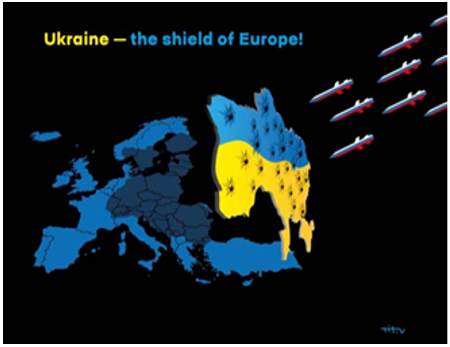
Figure 3 Artwork “Ukraine the shield of Europe!” by Nikita Titov
Source: Sydorenko et al. (2023)
Figure 4
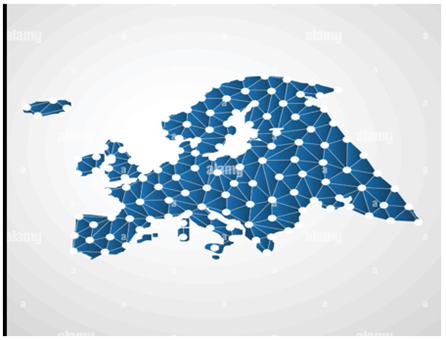
Figure 4 Abstract Polygonal Map of Europe with Digital Network Connections by Josef Bagota
Source: Sydorenko et al. (2023)
Instead, Josef Bagota’s work Figure 4 is an abstract map of Europe in the form of a digital network, where all countries are devoid of political or conflict markers. In this comparison, Titov’s work appears as an expressive political statement, while Bagota’s map represents a unified, technocratic space without an emphasis on contemporary challenges Derstuganova (2024), Derstuganova (2025).
The introduction of national symbols is relevant in modern commercial design. Nationally characteristic elements include traditional costumes, folk characters, elements of the traditional image, symbols associated with plants and animals Syvash (2024). National traditions are realized through the citation, stylization or interpretation of national primary sources Holovko (2023). Examples of the visual embodiment of national identity in commercial and urban design are the label of dairy products “Slovianochka” Figure 5 and the inscription on the Zvirynetska metro station (Figure 6). Both examples demonstrate the use of stylistic elements that appeal to the Ukrainian cultural traditio (Chmyr et al., 2023а).
The label “Slovianochka” features an image of a girl in a wreath, a classic archetype of a Ukrainian woman as a symbol of nature, fertility and purity. The illustration is stylized in a light graphic style, and the floral wreath of red, pink and blue flowers visually echoes folk decorative art (in particular, elements of Petrykivka painting). The logo is in harmony with the name, written in a soft, rounded font with a slight waviness – which adds a sense of handmade or ethnographic handwritten tradition Byrkovych et al. (2023).
In the case of the Zvirynetska metro station, national features are revealed in the typography and decorative design. A font with elements of Old Slavonic script was used: vertical strokes are widened, corners are pointed, and symmetrical graphemes form a rhythmic, almost runic structure. This stylization indicates a connection with the historical forms of Ukrainian Cyrillic script, in particular, with Baroque and Gothic trends in church graphics of the 17th and 18th centuries. Additional decorative elements (diamonds, strokes) complement the aesthetics of the ancient decoration, which also reinforces the national context.
Figure 5
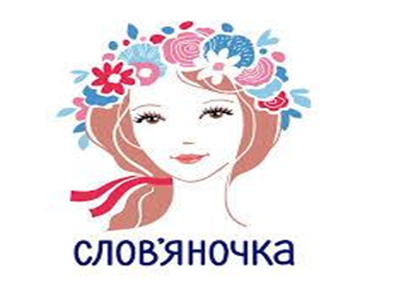
Figure 5 Design of the Label of Dairy Products “Slovianochka”
Source: Syvash (2024)
Figure 6
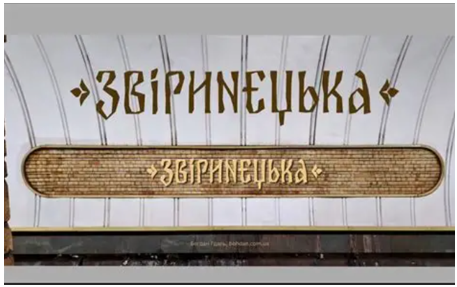
Figure 6 The Inscription on the Zvirynetska Metro Station
Source: Syvash (2024)
5. DISCUSSION
An analysis of recent research shows that the issue of national identity and its components is increasingly being considered in the context of national security. In particular, these components include language Facor et al. (2025), customs and traditions Revutska et al. (2022). Accordingly, the issues of protecting the state language Demchenko (2019), Derstuganova (2019), preserving intangible cultural heritage Kazakov (2024), and protecting cultural and traditional values from the pressures of globalization Sulistio and Prihantika (2025) are becoming more relevant in the scientific discourse. This approach suggests that the issue of the future of national identity is inextricably linked to the issue of security.
The problem of identifying the components of national identity in artistic works, especially those that lack a verbal component, is significantly complicated. In the above examples, some national elements are easily recognized by the recipient (in particular, the flower wreath in Figure 5); , while in other cases their identification requires a thorough art historical analysis. This is especially true of instrumental music that does not operate with specific imagery and is not associated with a verbal text. Examples of such musical discourse are, in particular, the symphonic works of Borys Liatoshynskyi, where the national element is manifested through individual leit intonations or leit chords Bondarenko (2025), or the early piano works of Witold Lutosławski, in which Polish folk melodies are transformed in an atypical atonal context for folklore Nidecka (2015).
In the case of digital art, the criteria for the involvement of national elements are not sufficiently studied. For example, Lazarev (2018) identifies such areas of contemporary electronic music as Latin House, Dutch House, Afro Tech, UK Garage, UA Techno, UA House, UA Trance, UA Bass, in which national identity is present in the genre name, but the researcher does not justify the peculiarities of these genres in terms of timbre or formative characteristics. At the same time, the above-mentioned works by A. Zahaykevych, which are digital artworks, contain national elements that are easily identified by the recipient, such as the sound of a folk musical instrument – the bandura (“Druze Li Bo”), or the inclusion of fragments of folk songs in authentic performance (“Nord/Ouest”).
One of the most controversial aspects of predicting the future of the cultural sphere is determining the mechanisms for the formation and support of certain artistic genres. Although the technical potential of digital technologies is an important prerequisite for the development of digital art, it does not guarantee sustainable development by itself. Both market mechanisms and state institutional support play a significant role in this process, which is necessary for the creation of public goods that cannot be effectively provided by market means alone Frey (2000). The complex issue of social mechanisms for supporting nationally oriented art, such as demand generation, patronage or public funding, has its own specific manifestations in each country. It is the effectiveness of these mechanisms that largely determines not only the viability of artistic practices oriented to national values, but also the prospects for preserving and transforming national identity in the digital age.
6. CONCLUSIONS
Digital technologies provide ample opportunities for integrating nationally characteristic elements into works of contemporary art and design. Such integrations can be carried out both through copying individual elements and their creative reinterpretation while preserving recognizable elements of folk art or national symbols. Such elements can include folk melodies or characteristic timbres of instrumental folk music, state symbols, traditional clothing, images of cultural monuments and historical figures, symbols associated with the flora and fauna of the country concerned, national coloring, stylized fonts in visual art and design.
Thus, in countries where there is a significant public interest in traditional culture, and cultural initiatives are supported by the state or by patronage communities, the future of national identity looks optimistic due to the formation of a favorable environment for the emergence of new artistic artifacts based on the cultural code of the respective peoples. Instead, in countries where society loses interest in preserving national identity and cultural institutions are weakened, the prospects for national identity become pessimistic due to the gradual erosion of traditional values, loss or marginalization of the cultural code. In such circumstances, there is a growing risk of a break with the deep layers of collective memory that provide historical continuity, identification with a cultural community, and internal motivation to preserve national identity.
CONFLICT OF INTERESTS
None.
ACKNOWLEDGMENTS
None.
REFERENCES
Ahimsa-Putra, H. S. (2013). Budaya Bangsa, Jati Diri dan Integrasi Nasional: Sebuah Teori Jejak Nusantara. Edisi Perdana, Tahun I, 6–19. https://jurnal.isbi.ac.id/index.php/prosidingpasca/article/view/1278
Ariely, G. (2019). The Nexus Between Globalization and Ethnic Identity: A View from Below. Ethnicities, 19(5), 763–783. https://doi.org/10.1177/1468796819834951
Bala, A. V. (2024). Digital Media and Cultural Identity: Exploring Intersections, Impacts, and Challenges. Gusau Journal of Sociology, 4(3), 305–317. https://doi.org/10.57233/gujos.v4i3.17
Bludov, A. (2023). Features of the Formation of the Teaching Process of Digital Painting. Ukrainian Academy of Arts, 33, 106–114. https://doi.org/10.32782/2411-3034-2023-33-13
Bondarenko, A. (2021). Ukrainian Electronic Music in Globalisation and National Revival. Scientific Journal of Polonia University, 43(6), 9–15. https://doi.org/10.23856/4301
Bondarenko, A. (2025). Modal and Tonal Harmony in Borys Lyatoshynsky's Chamber Creativity. Bulletin of Kyiv National University of Culture and Arts. Series in Musical Art, 8(1), 6–18. https://doi.org/10.31866/2616-7581.8.1.2025.331186
Bondarenko, A., Romanenko, A., and Bondarenko, O. (2025). Electronic Music as Digital Art. Humanities Science Current Issues, 1(84), 93–98. https://doi.org/10.24919/2308-4863/84-1-13
Bondarenko, S., Bratko, A., Antonov, V., Kolisnichenko, R., Hubanov, O., and Mysyk, A. (2022). Improving the State System of Strategic Planning of National Security in the Context of Informatization of Society. Journal of Information Technology Management, 14, 1–24. https://doi.org/10.22059/jitm.2022.88861
Byrkovych, T., Denysiuk, Z., and Gaievska, L. (2023). State Policy of Cultural and Art Projects Funding as a Factor in the Stability of State Development in the Conditions of Globalization. Economic Affairs, 68(1), 617–633. https://doi.org/10.46852/0424-2513.1s.2023.2
Chmyr, Y., Moshnin, A., and Tsymbal, B. (2023a). Societal Content and Main Determinants of "National Security" Phenomenon. In The Information and Communication Context (25–41). Contributions to Political Science. https://doi.org/10.1007/978-3-031-33724-6_2
Chmyr, Y., Nekryach, A., and Kochybei, L. (2023b). Postindustrial Society and Global Informational Space as Infrastructure Medium and Factor for Actualization of the State Informational Security. In Contributions to Political Science (61–73). https://doi.org/10.1007/978-3-031-33724-6_4
Cicović Sarajlić, D. J., Kovač, A. M., and Belojica Pavlović, B. M. (2024). Srpska Duhovna Muzika Kao Činilac Razvoja Nacionalnog Identiteta Učenika. Uzdanica, 21(3), 41–54. https://doi.org/10.46793/Uzdanica21.3.041CS
Demchenko, V. (2019). Protection of the State Language: The Jurislinguistic Aspect. Expert: Paradigm of Law and Public Administration, 3(5), 80–88. https://doi.org/10.32689/2617-9660-2019-3%285%29-80-88
Derevianchenko, O. (2005). Neofolklorism in the Musical Art: Static and Dynamic of the Development in the Music of the First Part of the XXth Century [Candidate of Sciences thesis].
Derstuganova, N. (2024). Development of General Competencies as an Important Factor of European Integration Processes. Scientific Notes of the Volodymyr Hnatyuk Ternopil National Pedagogical University. Series: Pedagogy, 2. https://doi.org/10.32782/2415-3605.24.2.4
Derstuganova, N. V. (2019). Educational
Environment of Spiritual Educational
Institutions: Content and Priorities.
In International Scientific Research: Integration of Science and
Practice as a Mechanism of Effective Development (21–23). Kyiv.
Derstuganova, N. V. (2025). The European Reference Framework of Key Competences for Lifelong Learning: An Updated View on the Development of General Competences. Expert.
Dyachenko, A. (2023). Analysis of the Representation of National Identity and Cultural Heritage in the Visual Arts of the Baltic Countries and Ukraine. Topical Issues of the Humanities Sciences, 65(1), 97–103. https://doi.org/10.24919/2308-4863/65-1-15
Facor, K., Habib, S., Mohammadi, M., and Forogh, B. (2025). The Relationship Between National Language and National Identity and Its Role in National Security. Nangarhar University Social Science Journal, 2, 10–16. https://doi.org/10.70436/nussj.v2i02.33
Filipová, M. (2017). Design and National Identity (Review). Journal of Design History, 30(4), 425–427. https://doi.org/10.1093/jdh/epx031
Frey, B. S. (2000). State Support and Creativity in the Arts. In Arts and Economics. Springer. https://doi.org/10.1007/978-3-662-04225-0_8
Fu, H., and Tu, J. (2023). Exploring the Influence of National Music Lessons on Subjective Well-Being, Self-Esteem, and National Identity Among University Students: A Case Study from China. Frontiers in Psychology, 14, 1151007. https://doi.org/10.3389/fpsyg.2023.1151007
Holovko, O. (2023). Media Design as a Factor in National Identification Processes. Printing Horizon, 2(14), 282–295. https://doi.org/10.20535/2522-1078.2023.2%2814%29.295434
Karim, A., Khidzir, N. Z., Ibrahim, Z., and Zali, A. A. (2024). INTRANS: An Emerging Design of Malaysian National Identity in Transforming Sculpture. International Journal of Heritage, Art and Multimedia, 7(22), 29–44. https://doi.org/10.35631/IJHAM.722003
Kazakov, H. (2024). State Policy on the Protection of Intangible Cultural Heritage. Problems of Modern Transformations. Series: Law, Public Management and Administration, 14. https://doi.org/10.54929/2786-5746-2024-14-02-04
Ķencis, T. (2015). The Role of Folklore in the Formation of Latvian Visual Art. Folklore: Electronic Journal of Folklore, 62, 55–80. https://doi.org/10.7592/FEJF2015.62.kencis
Lazarev, S. (2018). Electronic Music as a Sociocultural Phenomenon (the Second Half of the XX - the Beginning of the XXI Centuries) [Dissertation].
Lyudkevych, S. (1999). Nationalism in Music. In Z. Shtunder (Ed.), Lyudkevych S. Research, Articles, Reviews, Performances (Vol. 1, 35–52). Dyvosvit. https://surl.li/bneiil
Moreno-Luzón, J., and Nagore-Ferrer, M. (Eds.). (2024). Music, Words, and Nationalism: National Anthems and Songs in the Modern Era. Springer Nature Switzerland AG. https://doi.org/10.1007/978-3-031-41644-6
Nahorna, L. (2003). The Concepts of "National Identity" and "National Idea" in the Ukrainian Terminological Space. Political Management, 2, 14–30.
Nidecka, E. (2015). Folklor We Wczesnej Twórczości Fortepianowej Witolda Lutosławskiego. Studia Artystyczne, 3, 109–114.
Nurbossynova, B. (2024). Digital Visual Art as a Social Integrator (on the Example of Digital Art in Kazakhstan). Proceedings Bali Bhuwana Waskita: Global Art and Creativity Conference, 4, 1–12. https://doi.org/10.31091/bbwp.v4i1.540
Pavlichenko, Y. (2023). Representation of National Identity in Contemporary Visual Culture (Doctoral dissertation, Kyiv National University of Culture and Arts). https://uacademic.info/ua/document/0824U000705
Payne, W. S. (2020). Human Behavior and the Social Environment II. University of Arkansas Press. https://doi.org/10.54119/XYHY2549
Purevsuren, M., and Bor, E. (2025). The National Identity and Its Elements. International Journal of Innovative Technologies in Social Science, 1(45). https://doi.org/10.31435/ijitss.1%2845%29.2025.3180
Radwan, M. (2022). Effect of Social Media Usage on the Cultural Identity of Rural People: A Case Study of Bamha Village, Egypt. Humanities and Social Sciences Communications, 9(1), 248. https://doi.org/10.1057/s41599-022-01268-4
Revutska, S., Ostapenko, S., Udovichenko, H., and Dmytruk, L. (2022). Language and National Identity as a Foreword for Ensuring National Security. In National Security: Contemporary Challenges and Solutions (Chap. 2). PC Technology Center. https://doi.org/10.15587/978-617-7319-59-6.ch2
Sabagyo, O. A., and Vera, N. (2023). Building a National Identity Through Dangdut Music Programs on Television (Case Study: D'Academy 5 Indosiar). Jurnal Komunikasi, 15(2), 347–367. https://doi.org/10.24912/jk.v15i2.24415
Schiller, M. (2022). Music and the Nation. In G. Stahl and J. M. Percival (Eds.), The Bloomsbury Handbook of Popular Music, Space and Place (pp. 301–314). Bloomsbury Academic. https://doi.org/10.5040/9781501336317.ch-024
Smith, A. D. (1991). National Identity. University of Nevada Press.
Sudigdo, A., Pamungkas, O., Hastangka, H., Suprapto, S., Sumarni, S., Abdurrahman, O., and Mastiyah, I. (2024). Children's Voices in Poetry: The Illustration and Re-Imagimation of National Identity. Journal of Language Teaching and Research, 15(5), 1581–1592. https://doi.org/10.17507/jltr.1505.19
Sulistio, E., and Prihantika, I. (2025). Fighting Strategies to Preserve the Existence of Indonesia's Multicultural Society Amidst the Currents of Globalization. Journal of Research in Social Science and Humanities, 5(2), 79–90.
Sun, J., and Han, J. (2025). Constructing Cultural Identity Through International Collaboration in Ethnic Music Education Within Multicultural Contexts. Education, Language and Sociology Research, 6, 105. https://doi.org/10.22158/elsr.v6n1p105
Sydorenko, A., Chibalashvili, A., Shalinskyi, I., Berdynskikh, S., and Mazur, V. (2023). Ukrainian Digital Art During the Full-Scale Russian-Ukrainian War. AD ALTA: Journal of Interdisciplinary Research, 13, 125–130. https://doi.org/10.33543/j.130237.125130
Syvash, I. (2024). Motives of Ethnodesign in Modern Visual Culture. National Academy of Managerial Staff of Culture and Arts Herald: Science Journal, 2, 131–138. https://doi.org/10.32461/2226-3209.2.2024.308373
Uwase, M. (2025). The Role of Memory in Shaping National Identity. Eurasian Experiment Journal of Humanities and Social Sciences, 7(2), 169–176. https://www.researchgate.net/publication/392621224_The_Role_of_Memory_in_Shaping_National_Identity
|
|
 This work is licensed under a: Creative Commons Attribution 4.0 International License
© ShodhKosh 2026. All Rights Reserved.