ShodhKosh: Journal of Visual and Performing ArtsISSN (Online): 2582-7472
|
|
Gender Inclusion in Bharatanatyam: A Quantitative Research of Knowledge and Attitudes by Dance Practitioners
Dr. U Himabindu 1 , Dr. Murali Basa 2
 ,
Bhargavi Savalapurapu 3,
Olympica Rajbhangshi 4
,
Bhargavi Savalapurapu 3,
Olympica Rajbhangshi 4
1 Assistant
Professor, Department of Music, Dance and Fine Arts, Sri Padmavati Mahila
University, Tirupati, India
2 Assistant
Professor, Department of Performing Arts, Assam University, India
3 Research Scholar, Department of Home Science, Sri Padmavati Mahila
University, Tirupati, India
4 Research Scholar, Department of Performing Arts, Assam University, India
|
|
|
ABSTRACT |
|
|
The issue of
gender inclusiveness has grown more and more important in Indian classical
dance styles, specifically in Bharatanatyam, a dance that was historically
conditioned by adherence to strict gender conventions, canons of classic
aesthetics, and heteronormative discourse. Although the last several decades
have seen an increase in the involvement of male, transgender, and non-binary
performers, the issues of acceptance, representation, and equality remain
still in the institutional and pedagogical environment. The current research
investigates the level of knowledge, gender discrimination attitudes among
dance practitioners with a particular view to Bharatanatyam. Data were
gathered using descriptive cross-sectional survey design and it was collected
on 141 respondents with varying demographic backgrounds. Analysis was done
using descriptive statistics and Chi-square tests. The results show that
there is an equal distribution of the knowledge about gender discrimination
across the demographic variables, and the attitudes towards gender
discrimination are significantly correlated with gender (p <.05). The
paper identifies an urgent gap between awareness and attitudinal acceptance
and suggests the continuation of pedagogical, institutional, and cultural
interventions to create the conditions of real gender inclusivity in
Bharatanatyam. |
|||
|
Received 31 January 2026 Accepted 11 March
2026 Published 11 April 2026 Corresponding Author Dr. U
Himabindu, himabindu@spmvv.ac.in DOI 10.29121/shodhkosh.v7.i4s.2026.7188 Funding: This research
received no specific grant from any funding agency in the public, commercial,
or not-for-profit sectors. Copyright: © 2026 The
Author(s). This work is licensed under a Creative Commons
Attribution 4.0 International License. With the
license CC-BY, authors retain the copyright, allowing anyone to download,
reuse, re-print, modify, distribute, and/or copy their contribution. The work
must be properly attributed to its author.
|
|||
|
Keywords: Bharatanatyam, Gender Inclusivity, Gender
Discrimination, Classical Dance, Quantitative Research, Performance Studies |
|||



1. INTRODUCTION
The Indian classical dance forms are not just aesthetic activities but are complex cultural systems with the social, religious, and historical context. Bharatanatyam, one of the most notable Indian classic dance traditions, has gone through a lot of metamorphosis since the times when it was performed in temples to the current times when it is performed at the national and international levels. The shape remains informed by deep rooted gender norms that affect training practices, aesthetics of performance, narrative, and reception in spite of these changes.
Traditionally, Bharatanatyam has been linked to idealized femininity, especially in the wake of its revival in the twentieth century to place the dance in a more respectable position as a cultural practice that could have attracted nationalist and upper-caste values. This resurgence, though playing a useful role in maintaining the form, strengthened the binary gender roles and suppressed other forms of gender. Transgender actors, male dancers and gender non-conforming bodies have typically been forced to negotiate about their legitimacy in a structure that favors normative femininity and masculinity.
The more recent introduction of a variety of gender identities into the performance has brought a new wave of debate on whether classical dance should be made gender inclusive. Nevertheless, inclusivity cannot be evaluated in terms of representation or participation only. It is also about looking at the awareness, attitudes and acceptance by practitioners themselves. It is thus important to understand how dancers experience gender discrimination in order to assess the level to which Bharatanatyam has become an inclusive cultural place.
Although the current literature has used gender and identity in Bharatanatyam mainly as qualitative research, there is a dearth of empirical quantitative research that seeks to analyze the issue of gender discrimination as it applies to the perception and understanding of the practitioners. The current research aims to fill this gap and give a statistical analysis of knowledge and attitudes about gender discrimination among dance practitioners with special consideration to Bharatanatyam.
2. Review of Literature
The role of the Indian classical dance as a factor in strengthening culture and social hierarchy has been a longstanding focus of academic discussion of Indian dance. According to Srinivasan (2012), the reform and revitalization of Bharatanatyam was characterized by the restructuring of the body of the dancer to be in line with mainstream moral and gender values, which led to the extinction of the off-centre identities of the devadasi tradition. The feminization of the form and the normalization of particular gendered aesthetics were some of the processes that led to this.
O’Shea (2007) explores how Bharatanatyam is circulating across the globe and the fact that although globalization has provided more opportunities to the performers it has also strengthened the traditional gender structures to enable them to perform to the expectations of authenticity. Bharatanatyam male dancers have frequently been made out as exceptions, who have to prove their presence with excessive displays of masculinity or spiritual power Banerji (2018).
The last decade is witnessing the emergence of research that approaches these models with fluidity of gender and inclusiveness of performance. Chatterjee (2020) discusses the interactions of transgender and non-binary performers with the vocabularies of classical dance in order to establish other gender identities and frequently undergo oppression, both among institutions and audiences. As it is pointed out by Katrak (2019), there is a rise in awareness of gender discrimination in performing arts; nevertheless, the lack of attitudinal and structural change.
Although these have been contributed, a lot of the existing literature is based on qualitative narratives, ethnographic reports and performance analysis. Little quantitative research has been done looking at knowledge and attitudes of practitioners with regard to gender discrimination especially in the context of Bharatanatyam. The current research will fill this gap by providing empirical evidence that will supplement the existing theoretical and qualitative research.
3. Methodology
3.1. Research Design
The research design was descriptive cross-sectional survey in which the knowledge and attitude level were estimated among the dance practitioners in relation to gender discrimination. This design was considered befitting since it allows the investigative analysis of the prevalent perceptions among a specific population at a particular point in time, vice versa, without controlling or imposing any experimental surroundings.
3.2. Sample
The sample comprised of 141 respondents, who were chosen using a non-probability approach of convenience sampling. Some of the participants are students, working professionals, self-employed people, and experienced dance practice practitioners in different parts of India and few international destinations. The respondents were of varying dance backgrounds yet majority of the dance form practiced by respondents was Bharatanatyam.
The consideration of participants who have different years of dance practice, starting with a beginner and continuing with more than seven-year-old practitioners, gave the diversity of experiences on gender discrimination and inclusiveness.
3.3. Data Collection Tool
A structured questionnaire that was subdivided into the three sections was used to collect data.
The demographic details, such as gender, age, education, locality, dance practised, years of practice, occupation and financial status.
Experience on gender discrimination, measurement of gender awareness about unequal opportunities, gender stereotyping, and inclusivity in the context of dance.
Gender discrimination attitude, gauging the acceptance, openness and evaluative reactions to gender-diverse involvement in Bharatanatyam and other types of dance.
3.4. Statistical Analysis
The analysis of data was done with the help of descriptive statistics (frequency and percentage) to simplify the demographics and patterns of responses. The Chi-square test was used to test the relationships between demographic and level of knowledge and attitude. A p-value of below 0.05 was assumed to be significant.
3.5. Data Analysis
Figure 1
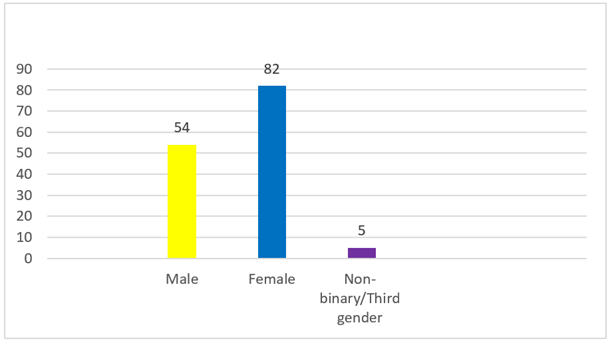
Figure 1 Gender-Wise
Distribution of Respondents
Demographic analysis showed that There is a noticeable female domination in the gender balance. The number of female respondents is 82 which forms 58.15 percent of the sample. This is an indication of a high representation of women in the practices and training of Bharatanatyam. Male respondents are 54, comprising 38.29 percent of the sample which means that male representation is increasing, although at a low rate than the female. The five respondents or 3.5 percent of the respondents are non-binary or third gender. Even being small in number, it is significant to include them in a study that should be in gender inclusiveness. In general, the distribution shows that although the field is still controlled by women, it is also associated with involvement of various genders and, therefore, is appropriate to study the attitudes toward gender discrimination and inclusivity.
Figure 2
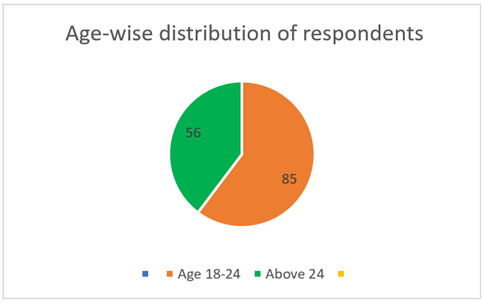
Figure 2 Age-Wise
Distribution of Respondents
The age data shows that there is high concentration of young adults in the sample. The number of respondents in the age group of 18 to 24 years is 85 or 60.28 percent, which gives early adulthood as the most active period of engagement in the Bharatanatyam practice. It is actually a trend that is observed at a time when people are usually engaged in the formal training, college and acquiring skills. The number of respondents aged above 24 years is 56, which constitutes 39.72 percent of respondents. This segment is older (or more established) and may contain retired practitioners that moved to teaching, professional performance or advanced training. The younger participants predominance indicates that this study is mostly capturing the view of upcoming practitioners although there is still the contribution of mature dancers. Such a balance leads to knowledge and attitude analysis at various levels of dance participation.
Figure 3
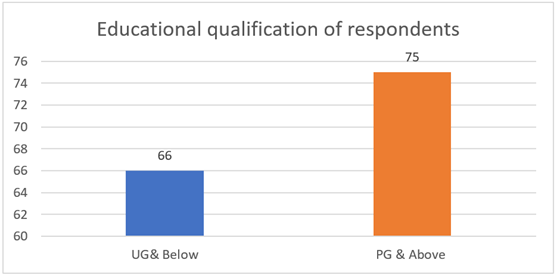
Figure 3
Educational
Qualification of Respondents
The education profile indicates the slightly better representation of postgraduate or higher qualification respondents. There are 75 respondents or 53.19 percent who belong to this group, which means that over fifty percent of the sample is exposed to academic advancement. This implies that there is an increased likelihood of such a group having greater amounts of analytical capacity, awareness, and interest in social and cultural concerns and gender inclusivity. The number of respondents who have undergraduate or below qualification is 66, and it constitutes 46.81 percent. This group consists of those students who are in their initial academic stages as well as those with limited formal education. The fact that the two categories are almost equal means that there is diversity in the background of education and this helps in investigating whether there are differences in attitudes and knowledge between academic levels. The data in general indicate a slightly well-educated group of participants.
Figure 4
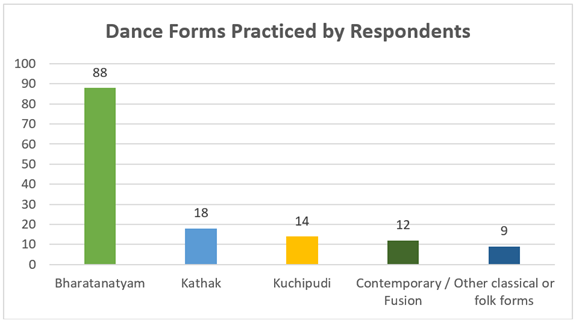
Figure 4 Dance Forms Practiced by Respondents
It is evident that the distribution of dance forms exhibits that of Bharatanatyam being the predominant of the respondents. Of the total sample 141 people were found to be practicing Bharatanatyam with 88 being the total percentage of whom practice Bharatanatyam. This shows that almost two thirds of the practitioners in the research are practicing this classical form and thus it is the primary focus of the group of participants. Kathak is practised by 18 participants whereas Kuchipudi have 14 practitioners. Modern or fusion styles entail 12 participants, whereas other classical or folk genres have 9 interviewees. Such reduced numbers indicate that, despite the presence of various traditions of dance, they are a secondary representation to Bharatanatyam. The high density of Bharatanatyam allows seeing the topicality of the title of the study and guarantees that the results on gender inclusivity will be based on the experience of the representatives of the largest classical tradition.
Figure 5
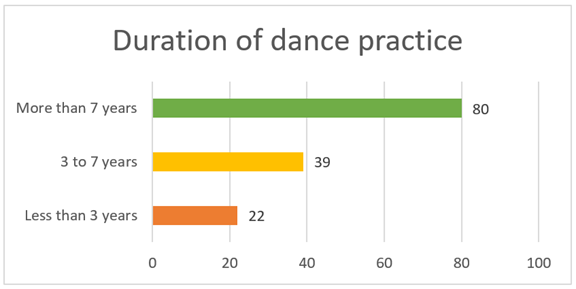
Figure 5 Duration of Dance Practice
The sample distribution of the experience of dancing is that a majority of the sample is made up of long-term dancers. Eighty (80) of the respondents, who constitute 56.73 percent, have experienced over seven years of practice in dancing. This implies that more than 50 percent of the participants have been engaged and heavily exposed to training and performance and the cultural setting of dance. This kind of experience implies an adult knowledge of professional and social processes in the profession. The other 39 respondents, or 27.65 percent, are of three to seven years of practice. This category represents the intermediate practitioners who still are developing but have already structured training backgrounds. The third group with the least percentage of respondents is the 22 who have less than three years of experience. These respondents are beginners or novice learners. In general, the trend is that the research includes the views of largely experienced dancers that makes their opinions more valid on the subject of gender inclusivity and discrimination within the dance community.
Figure 6
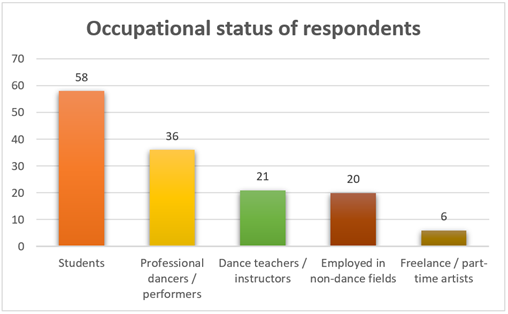
Figure 6 Occupational
Status of Respondents
The occupational profile indicates that the students constitute the highest number in the study. There are 58 respondents who have found themselves in this category and this means that a significant number of the participants are still learning in their academic or dancing professional lives. This is in line with the age factor, with the majority being at the age of young adults. In the second place, there are professional dancers or performers, 25.53 percent of the sample. This group includes representatives of people who are working in the sphere of performance-based careers and practice of dances. In the third position is the third largest segment of 14.89 percent; dance teachers and instructors. Their presence is a manifestation of skilled professionals who are engaged in the transfer of knowledge and training. The non-dance sector (that is those who do not do dance as a profession) occupies 14.18 percent, which indicates that there are some practitioners who are in a position of balancing dance with other jobs. The least group is made up of freelance and part time artists at 4.2 percent though this means that very few of them are seeking flexible jobs in dance or project-based jobs in dance. On the whole, the occupational spread indicates that there is involvement of learners, professionals, and educators which offers a wide view of attitudes in the dance community.
Figure 7
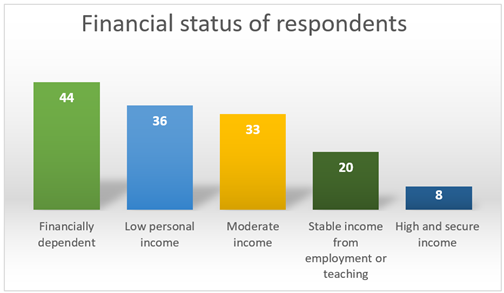
Figure 7
Financial Status of
Respondents
The financial outlay demonstrates the strong focus on lower income groups. The proportion of respondents who rely on family or guardians to get financial support is 31.2 percent which is approximately a third. The other 25.5 percent records low personal income, which is an indication of early career dancers or trainees. Overall, over 50 per cent of the respondents are either financially dependent or low-income earners. There is a moderate income and partial financial independence around 23.4 percent. Such a group would probably consist of those who have dance as their additional source of earnings. A smaller percentage of 14.2 percent are consistently earning through employment or teaching, which implies that only a few have professional income which is attributed to work jobs. Very low percentage of 5.7 percent are in the high- and safe-income bracket. These must be professionals who have long-term careers.
3.6. Relationship between the Knowledge on Gender Discrimination and the Demographic factors
Figure 8
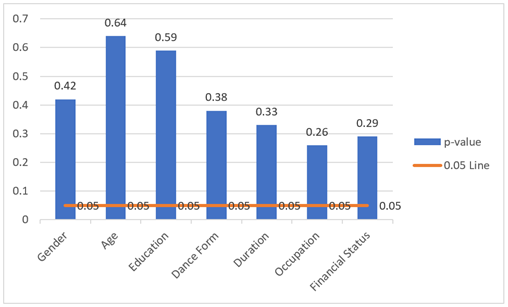
Figure 8 Association
Between Knowledge on Gender Discrimination and Demographic Variables
The chi square outcomes indicate that there is no difference in knowledge regarding gender discrimination among different demographic groups. The gender identity differences do not affect the level of awareness. Similar understanding is exhibited by younger and old practitioners. Educational level also fails to cause a variance in levels of knowledge. The awareness of practitioners of various types of dance and experience of various lengths is similar. Professional positions and wealth status also have no impact on knowledge patterns. It means that the awareness about gender discrimination is common among the dance population and is not exclusive to the certain population group.
3.7. Correlation of Attitude toward Gender Discrimination and Demographic
Figure 9
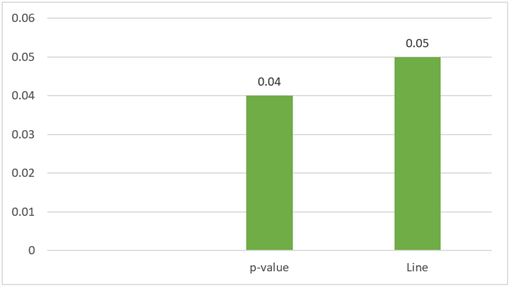
Figure 9 Association Between Gender and Attitude Toward Gender Discrimination
There was a statistically significant relationship between gender and attitude towards gender discrimination (p =.04), which is an indication that the attitudes towards inclusivity differ based on the gender one belongs to.
Figure 10
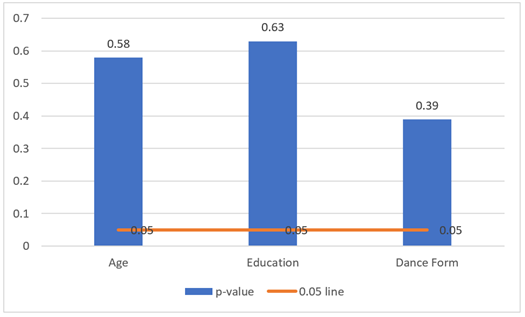
Figure 10 Between Association Between Attitude and Other Demographic Variables.
The regression analysis shows that the attitude towards gender discrimination and age, education, and dance form do not have statistically significant correlation. There is no significant change in the attitude of the younger and older practitioners. This is not influenced by the level of education in terms of inclusivity perspective. The practice of the Bharatanatyam or any other kind of dance did not bring the attitude difference as well. This implies that these groups of demographics and professionals have the same perception regarding the presence of gender discrimination.
4. Results AND Discussion
4.1. Key Findings from the survey
1) Basic
knowledge LGBTQ Concepts:
In response to the outcomes of the on-line KAP questionnaire, there is a fairly moderate to high level of knowledge about LGBTQ identities and related concepts among the Bharatanatyam dancers. Most of the respondents revealed that they had the knowledge on the basic terms and that gender identity and sexual orientation were two distinct aspects of identity. Greater conceptual insight, however, had been established to be insufficient, particularly as to non-binary identities and the past presence of gender and sexual fluidity in Indian classical arts. It means that despite the increased exposure to LGBTQ discourse, the comprehensive and contextually specific knowledge thereof does not exist.
2) The
view of LGBTQ Community within Bharatanatyam:
According to a major percentage of those interviewed, there are LGBTQ members of the Bharatanatyam community. Respondents recognized the historical and modern contributions that have been made to the art genre by dancers of different gender and sexual orientations. Irrespective of this information, it was stated that there were not many blatant discussions about LGBTQ matters in Bharatanatyam training and performance studios, where there was a lack of visibility in formal institutional contexts.
3) Disposition
towards the eradication and acceptance of LGBTQ Community:
The results indicate that the surveyed population had a fairly positive and favourable opinion on LGBTQ dancers. Most of the interviewed respondents said that the gender or sex orientation of a dancer must not affect his or her talent in dance or his or her chances of a successful career. This indicates that Bharatanatyam is getting more open particularly in the younger and those dancers who are professionally active.
4) Gender
Expression and Role Representation: Acceptance:
The answers to the question were mixed in terms of how convenient it was to use gender-nonconformity in appearance during performances despite high scores in terms of acceptance. A few participants expressed concerns on LGBTQ dancers dancing traditionally gendered roles or modifying traditional abhinaya and costumes. This attracts an under conflict between following of traditional conventions and aesthetics and inclusiveness.
5) Practices
and Interpersonal Engagement:
Speaking of practice, most of the participants shared positive and professional and polite encounters with LGBTQ peers at dance spaces. Cases of blatant discrimination were said to be minimal. Nonetheless, the involvement in the inclusive practices, including the support of LGBTQ representation, the introduction of the discussion or participation in the choreographies with the queer / LGBTQ theme, was relatively low.
6) Readiness
to cooperate or dance with LGBTQ dancers:
Participants noted that in case of preparations and performances, they would be willing to collaborate with LGBTQ dancers. Fewer respondents, however, also said that they had personally participated in inclusive or explicitly queer-themed performances; this is certainly indicative of a lack of opportunities as opposed to not being accepted.
4.2. Advocacy and Institutional practices
The findings indicate the disparity between proactive advocacy and positive attitudes. Even though the majority of dancers themselves were pro-diversity, less stated that they took part in institutional programs or discussed LGBTQ issues openly. There appears to be a lack of visible advocacy and policy level inclusion due to the hierarchical nature of traditional dance institutions, sensitivity of their cultural aspects, and fear of being criticized by the society.
In total, the results indicate that Bharatanatyam dancers possess a unique knowledge, attitude and practice gap. The elementary usage of inclusive behaviors is low even though the awareness of LGBTQ people and the degree of their acceptability are relatively high. This gap signifies the influence of institutional frameworks and traditional values within the process of forming individual views.
5. Discussion
The results indicate that there is a vital difference between knowledge and attitude amongst the dance practitioners. Although the awareness of gender discrimination is similar in the different demographic categories of respondents, the inclusivity attitudes vary widely according to gender. This reinforces the theoretical views that knowledge cannot always be translated into attitudinal and behavioural change.
This distance can be explained by in-built aesthetic norms, institutional pedagogies and practices of Bharatanatyam which still hold on to normative gender expressions. The high relationship between gender and attitude highlights the role of lived-experience in developing the perception of discrimination and acceptance.
It is these results that indicate that awareness-based initiatives alone may not result in meaningful inclusiveness. Rather, the structural inequalities in classical dance traditions require sustained interaction using curriculum reform, inclusive pedagogy and institutional policy reforms.
6. Conclusion
The research indicates that though dance professionals show a high degree of awareness on gender discrimination, there is a wide range in attitudes towards gender inclusiveness in gender identities. This shows that there is an evident disparity between awareness and acceptance among the Bharatanatyam practitioner fraternity. The results indicate that the deeply rooted aesthetic ideals, traditions of pedagogy, and institutional frameworks still affect the views on gender roles in classical dancing. As such, gender inclusivity in Bharatanatyam cannot be realized by mere awareness but will take a long-term work to be attained by bringing about attitudinal and structural change. The research reaffirms the significance of being inclusive of diverse pedagogies, institutional sensitivity, and critical approach to traditional norms in order to guarantee a level of equity in the participation of all gender identities. This study offers a more detailed perspective of gender inclusiveness in Indian classical dance by presenting quantitative data.
7. Future Research Limitations and Scope
The current research has limitations in that the study is based on the descriptive cross-sectional design that does not allow drawing causal conclusions between demographic factors and gender discrimination perceptions. Social desirability and response bias can also be used in self-reported data usage. Despite the fact that the sample consisted of respondents living in various parts, the relatively few non-binaries and third-gender people do not allow the inference of the results to all genders within the Bharatanatyam community. Also, the research was mainly quantitative based and this might not be the best way to understand the complexity of lived experiences in gender inclusivity.
Further studies can be based on mixed-method design or longitudinal design to compare the analysis of attitude changes in the course of time and to include profound qualitative narratives. Increase in the sample size and considering the institutional, pedagogical, and performance-based contexts would add to the idea of gender inclusivity in Bharatanatyam and other Indian classical dance forms.
CONFLICT OF INTERESTS
None.
ACKNOWLEDGMENTS
None.
REFERENCES
At Home in the World: Bharata Natyam on the Global Stage. (2008). Choice Reviews Online, 45(5), 45-2533. https://doi.org/10.5860/choice.45-2533
Azzarelli, S. (2015). Dancing Across Gender Boundaries: An Exploration on the Process of Gender Identity Construction Through the Indian Classical Dance Bharatanatyam. Acta Ethnographica Hungarica, 60(1), 77–84. https://doi.org/10.1556/022.2015.60.1.9
Azzarelli, S. (2019). Exploring Queer Spaces in and Through the Indian Classical dance Bharatanatyam. Whatever, 2(1), 117–134. https://doi.org/10.13131/2611-657X.WHATEVER.V2I1.13
Chakravorty, P. (2008). Bharata Natyam Mapped: Not Subjectivity but Subject Position. Dance Chronicle, 31(3), 471–475. https://doi.org/10.1080/01472520802402796
Ganesh, V., Chen, T., Budhiraja, A., Horowitz, B., Sauer, C., and Victorson, D. E. (2025). A Qualitative Interview Study to Illuminate the Lived Emotional, Physical, and Spiritual Impacts of Experienced Bharatanatyam Dancers. Global Advances in Integrative Medicine and Health, 14. https://doi.org/10.1177/27536130251382235
Murali Basa. (2021, February 21). @MuraliBasa Designed Lights for the Ravindranath Tagore Dance Drama Tasher Desh-1 [Video]. YouTube.
O’Shea, J. (2007). At Home in the World: Bharata Natyam on the Global Stage. Wesleyan University Press.
Sakalkale, S., and Natu, S. (2024). From Tradition to Transformation: Bharatanatyam Explored Through Feminist and Psychological Contexts. Journal of Psychosocial Research, 19(1). https://doi.org/10.32381/jpr.2024.19.01.17
Sen Mandala, S. (2021). Traditional Challenges, Challenging Tradition: Helping Students Find Agency in Bharata-Natyam at the Junction of Ancient Indian Thought, Somatic Practices and Feminist Pedagogy. Journal of Dance Education, 21(2), 92–102. https://doi.org/10.1080/15290824.2019.1705304
Singh, J. P., Alghare, N., Sonber, B. K., and Deshmukh, A. (2025). Classical Indian Dance Genres for Better Mental Health: Revisiting Empirical Evidences. Mind and Society, 13(4), 15–24. https://doi.org/10.56011/mind-mri-134-20243
|
|
 This work is licensed under a: Creative Commons Attribution 4.0 International License
© ShodhKosh 2026. All Rights Reserved.