ShodhKosh: Journal of Visual and Performing ArtsISSN (Online): 2582-7472
|
|
Generative AI for Reviving Lost Art Traditions
Hemant Bansod 1 , Dr. Swati Gopal Gawhale 2
 , Pawan Wawage 3
 ,
Priyadarshani Singh 4
,
Priyadarshani Singh 4 , Pushpalatha P. 5
 , Dr. Deepshikha
Saxena 6
, Dr. Deepshikha
Saxena 6 
1 Department
of Mechanical Engineering, Suryodaya College of
Engineering and Technology, Nagpur, Maharashtra, India
2 Department of Electronics and
Telecommunication Engineering, Bharati Vidyapeeth's College of Engineering, Lavale, Pune, Maharashtra, India
3 Assistant Professor, Department of Information Technology,
Vishwakarma Institute of Technology, Pune, Maharashtra, 411037, India
4 Associate Professor, School of Business Management, Noida
International University, Greater Noida, 203201, India
5 Assistant Professor, Meenakshi College of Arts and Science,
Meenakshi Academy of Higher Education and Research, Chennai, Tamil Nadu,
600083, India
6 Professor, Mangalayatan University, Beswan, Aligarh, India
|
|
|
ABSTRACT |
|
|
The
disappearance of ancient forms of art can be seen as a great loss of cultural
knowledge not only in the form of physical objects but also as symbolic
meaning, stylistic grammar, and practice in aesthetic. Although current
digital heritage projects focus on documentation, and preservation, they do
not offer much assistance in the active revival of art. The ethically-based
structure of the AI-driven reconstruction of the lost art traditions is
proposed in this paper, making generator artificial intelligence a
participatory system of developing the knowledge in artistic traditions. It
consists of a semantic annotation framework, structured data curation,
cultural knowledge graph, and hybrid diffusion-transformer model and
human-in-the-loop governance. According to the experimental findings, in
several case studies, the suggested method has been demonstrated to be
superior to GAN-based and diffusion-only baselines in the parameters of
perceptual quality, stylistic coherence, diversity, and authenticity evaluated
by experts. |
|||
|
Received 11 September 2025 Accepted 09 December 2025 Published 17 February 2026 Corresponding Author Hemant
Bansod, bansod.hemant@gmail.com DOI 10.29121/shodhkosh.v7.i1s.2026.7084 Funding: This research
received no specific grant from any funding agency in the public, commercial,
or not-for-profit sectors. Copyright: © 2026 The
Author(s). This work is licensed under a Creative Commons
Attribution 4.0 International License. With the
license CC-BY, authors retain the copyright, allowing anyone to download,
reuse, re-print, modify, distribute, and/or copy their contribution. The work
must be properly attributed to its author.
|
|||
|
Keywords: Generative Artificial Intelligence, Cultural
Heritage Revival, Digital Art Preservation, Diffusion Models, Transformer
Networks |
|||



1. INTRODUCTION
Art traditions represent the shared memory, identity and aesthetic knowledge of communities which is commonly passed across generations through practice, ritual and oral education. Nevertheless, the high rate of urbanization, globalization, socio-economic change, and the deterioration of the historical system of apprenticeship have put a large number of indigenous and historical art forms under threat of obliteration Liu (2025). When upset, these traditions cannot be well re-created, since they are not only, as represented in visual form, the traces of the tradition but also, in a non-material form, the grammar of style, the symbolic sense, the practices of materiality, and Eissa (2025) the contextual stories Stoean et al. (2024). Traditional preservation strategies, including documentation, museum archiving, and passive digitization, have a significant part in protection of traces of such traditions, but they are rather passive and provide little assistance in active revival or creative continuum Pan et al. (2022).
Figure 1

Figure 1 Conceptual Framework Illustrating the AI-Driven Revival of Lost Art Traditions
Recent progress in generative artificial intelligence (AI) offers new possibilities to deal with this issue as it allows computational systems to learn, synthesize, and reinterpret artistic knowledge based on fragmented and heterogeneous cultural data. Adversarial networks and diffusion-based models as well as transformer models have shown tremendous performance in modeling the intricate visual patterns, stylistic regularities, compositional patterns Artopoulos et al. (2023). Administered with due care, these models can rise above simple copying to contribute to the restoration of lost or threatened art traditions in reconstruction of stylistic space, experimentation to find viable alternatives and help artists, educators, and researchers rediscover dormant creative practices. Notably, the use of generative AI on cultural heritage is in a different concept than its application in modern digital art or business design Altaweel et al. (2024). It is not automation or a replacement of human creativity but augmentation, contributing to the cultural interpretation, teaching, and informed re-creation which are controlled by human and community action. This repackages AI as a work with culture, ethics, and epistemics, yet not a work that is creative and autonomous. In turn, the problems of cultural authenticity, authorship, data governance, and representational bias become a primary concern in designing and evaluating the system Li et al. (2025).
The paper explores generative AI as a tool of researching the revival of lost traditions of art through a systematic, cross-disciplinary approach that combines machine learning, digital heritage studies, and pedagogy of art. It suggests a progressive structure of organizing cultural information, recording artistic expertise and producing revival-based outputs that are authenticated by expert and community reviews. Placing generative AI as an enabler of continuity in culture and not a disruptive technology, this work is a contribution to making interventions in the digital era sustainable and ethically justified to preserve and renew the endangered artistic knowledge.
2. Background and Related Work
Historically, conservation and renaissance of art practices have been sought in such disciplines as art history, anthropology, conservation science, and museology. The traditional preservation strategies are based on recording and protecting the existing artifacts by sketching, photographic materials, written accounts, and physical restoration of artifacts with the aid of experts Khalid et al. (2024). Though they are essential in the prevention of complete cultural erosion, they are in themselves retrogressive and backward and only capture visible products of artistic activity without addressing the creative logic, symbolic structures and generative procedures that perpetuate traditions as living phenomena of culture Morrison (2022). Online heritage technologies have enhanced the ability of conservation by providing three-dimensional scanning, photogrammetry, virtual museums, and multimedia archives, as well as enhancing fidelity, accessibility, and long-term storage. Nonetheless, the digital heritage systems are, nevertheless, mostly representational, with an emphasis on replicating artifacts correctly instead of reconstructing lost stylistic grammars and compositional rationality and the material decision making processes. Consequently, they make things visible, accessible, but provide little assistance to continuity of creativity or proactive artistic renewal Parker and Khanyile (2024). Simultaneously, computational creativity and generative artificial intelligence have advanced such that it is now possible to model and generate complex arts. Deep generative models, such as GANs and diffusion models and transformer-based models, have shown themselves to be very effective in learning the distribution of visual data and generating new content Li and Liu (2023). Their practice against cultural heritage is however limited and mostly experimental in nature and has been mostly focused on stylistic replication or restoration without adequate contextualization in terms of culture and ethics and also participatory authentication Altenberger (2024). To explain these differences in concepts, Table 1 will compare conventional preservation, digital heritage methods, and generative AI-based art revival models.
Table 1
|
Table 1 Comparison of Traditional Preservation, Digital Heritage, and Generative AI–Based Art Revival Approaches |
|||
|
Dimension |
Traditional
Preservation |
Digital Heritage
Approaches |
Generative AI–Based
Revival |
|
Primary Objective Bao et al. (2025) |
Safeguard and document
existing artworks |
Digitally represent
and disseminate artifacts |
Revive and reinterpret
lost artistic knowledge |
|
Nature of Output Dong et al. (2025) |
Physical records,
sketches, photographs |
2D/3D digital replicas
and archives |
Novel yet culturally
grounded artistic variants |
|
Treatment of Style Shih (2025) |
Implicit,
expert-dependent |
Explicit but
surface-level |
Learned stylistic
grammar and generative rules |
|
Handling of Lost
Knowledge Qian et al. (2025) |
Limited historical
inference |
Constrained to
available artifacts |
Reconstruction of
plausible stylistic spaces |
|
Role of Technology Wang (2024) |
Supportive
documentation tools |
Representational
visualization systems |
Generative and
exploratory AI systems |
|
Human Involvement Hou et al. (2022) |
Conservators and
historians |
Archivists and
technologists |
Artisans, scholars,
and communities in the loop |
|
Adaptability &
Evolution Mazurkevych et al. (2024) |
Static and
retrospective |
Semi-static with
enhanced access |
Dynamic and iterative
through feedback |
All three methods of reviving the past presented in Table 1, traditional and digital heritage methods focus on preservation and representation, and generative AI-based revival methods focus on reconstructing creative processes and stylistic opportunities. The predominant trend in the paradigm of the regeneration of knowledge is the shift of the traditional perspective on fixed pieces of art onto generative AI, which creates a paradigm shift. More importantly, the human-in-the-loop validation and ethical regulation are also built in this paradigm, which touches upon the issues of cultural authenticity, authorship, and misrepresentation. This work synthesizes the knowledge of digital heritage studies, computational creativity and participatory design, to go past preservation to sustainable artistic knowledge regeneration.
3. Theoretical Foundations of Art Revival through Generative AI
The regeneration of the lost art traditions using generative artificial intelligence needs to be theoretically supported, which is more than only the technical model performance to include a cultural epistemology, creative agency, and socio-technical collaboration. Traditions of art are not simply groups of visual shorthorns; they are systems of knowledge that are historically situated, historically constrained, historically symbolically constituted, and socially practiced. When these traditions fail or are erased, not only an array of stock but also a principle of generation that controlled the creation of art is forfeited. Thus, any AI-based revival initiative should be presented as the process of knowledge reconstruction, but not aesthetic replication. Generative AI models can be viewed as probabilistic learners of spaces of style, as far as computational creativity is concerned. These systems can estimate the latent grammar of artistic traditions by learning distributions in terms of relationships of forms, colors, compositions, and motifs. In contrast to deterministic rule-based systems, current generative models allow exploration in constrained creative spaces, that is, generate variations which are consistent, yet novelty can be discovered, in accordance with learned stylistic rules. This ability in the art revival context facilitates the creation of culturally plausible artifacts that can be used as pedagogical guide or point of departure in human initiated reinterpret at ion, as opposed to definitive or authoritative reconstructions.
Figure 2

Figure 2 Conceptual Relationship Between Replication, Restoration, and Revival Paradigms in AI-Assisted Cultural Art Practices.
One of the major theoretical differences in the field is the distinction between replication, restoration and revival. Replication is concerned with high-fidelity reproduction of existing works, and commonly can be accomplished by image-to-image translation or super-resolution methods. Restoration is aimed at the restoration of damaged or unfinished artifacts, which are normally addressed in light of conservation principles and professional expertise. Revival, in turn, is concerned with the traditions that do not exemplify full-fledged models, and the processes of creativity must be ferreted out of incomplete information by means of inferences. Generative AI best fits into this paradigm of revival because it allows the generation of content based on fragmented sources, and the process of extrapolating stylistic continuity instead of strictly matching. The human-AI co-creation theory also contributes to this framework as it focuses on the collective creative agency. Within revitalization-oriented systems, AI is an advisory ally and not an innovator. Human practitioners (artisans, historians, educators, members of the community, etc.) continue to possess artistic authority in order to interpret, select, and modify AI-generated outputs. This co-production is necessary to ensure the cultural legitimacy, as well as preventing the reification of the algorithmic products as culturally conclusive. The establishment of feedback between human judges and generative systems allows the process of refinement to proceed in an iterative manner to bring the computational exploration process in line with culturally based judgment.
4. Generative AI Models for Artistic Knowledge Reconstruction
Building artistic knowledge using discontinuous or partially lost traditions Generative models that can learn stylistic structure, symbolic relationships and composition constraints using sparse and heterogeneous information are required to reconstruct artistic knowledge. In contrast to classical image inpainting problems with massive, homogeneous collections of data, art revival problems are associated with an immigrated quality of documentation and intermodal evidence, such as photographs, written records, drawings, and verbal accounts. Generative models should therefore be able to learn representations in the uncertainty awareness and be sensitive to human guidance and cultural limitation. Nonetheless, GANs can be prone to the lack of data and collapse at certain modes, which restrict the variation in styles of cultural data. In more recent times, the diffusion-based generative models have become a credible contender to low-data, high-fidelity generation. Their fixed training dynamics and repetitive denoising mechanism allow controlled synthesis and constraints of style and symbolism are incorporated during the generation. These characteristics render diffusion models especially appropriate in revival-oriented tasks, which require cultural plausibility and traditional conformity.
Figure 3

Figure 3 Hybrid Diffusion + Transformer Architecture for Artistic Knowledge Reconstruction
The diffusion-based models demonstrate specific potential in art revival because of being stable, highly fidel to visual art, and being able to synthesize under constraints in a limited amount of data. Transformer-based models can be used to complement this with long-range stylistic and symbolic dependencies, and GAN-based methods are even successful on traditions requiring a lot of textures given a sufficient amount of curated data. Generative architecture Generative architectures based on transformers have since expanded this functionality to include long range dependencies and hierarchies of composition.
5. Data Curation and Knowledge Encoding of Lost Art Traditions
The quality, cultural completeness, and representational structure of the data pipeline have more important parts in the success of generative AI to revive lost art traditions than the level of sophistication of the models. Revival environments normally have sparse datasets, fragmented and historically uneven, commonly made of partial artifacts, low-resolution photos, hand-written notes or reproductions of other artifacts. In addition, the characteristic knowledge of a tradition can be entrenched in intangible aspects, symbolic meanings, ritual situations, material practices and geographical restrictions, which cannot be reconstructed by means of images only. Thus, data curation should be regarded as a reconstruction of knowledge, which integrates evidence of multimodality with expert-conducted encoding policies to create a machine-readable but culturally-faithful form. One of the revival-oriented curation pipelines starts with identification of the source and provenance control. Primary sources can consist of museum collections and archival photographs and catalog scans, field documentation and personal collections and surviving workshop output. Academic monographs, exhibition notes, ethnographic reports, and oral narratives are usually secondary sources that help in providing the essential contextual background on the interpretation of motifs and stylistic variations. Since cultural authenticity and ethical legitimacy are key values in revival, all data items must be linked to provenance metadata, such as origin, collection process, ownership, and consent under which it was collected. This stratum does not allow turning the dataset into a decontextualized visual corpus and instead allows downstream governance procedures of proper reuse.
Figure 4
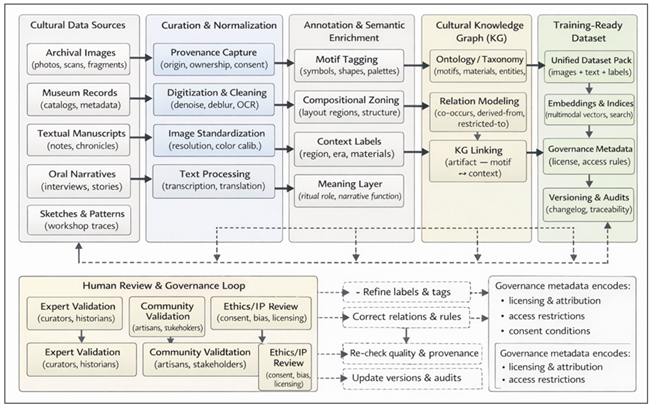
Figure 4
Data Pipeline for Cultural Knowledge Curation
After collection, it has to be digitized and normalized in order to minimize technical variability that may bias model learning. The processing of an image usually involves resolution harmonization, geometrical correction, color calibration and noise removal, and attention is paid to maintain material cues, e.g. brush texture or pigment granularity. Textual data are being transcribed and normalized and structured term extractors are used to enhance machine readability and preserve semantics. Storing original and processed copies will be beneficial in terms of strong learning and professional authenticity audits. The encoding of knowledge revolves around the notations, motif labeling, and symbolic mapping. In contrast to generic art data sets, revival based data sets need tradition specific semantics such as canonical motifs, compositional areas, narrative functions, color symbolism and cultural limiting factors. Tiered annotation approach, visual, semantic and contextual levels, make it possible to produce conditional generation, synthesis under constraints and to assess surface similarity. Other formalizations of relationships between motifs, materials, techniques, regions, and symbolic meanings are cultural ontologies and knowledge graphs. With dependencies including co-occurrence, ritual association, and so on, KGs facilitate culturally uniform generation and enhance interpretability because they allow professionals to trace decisions made during generation. Lastly, there should be human-in-the-loop checking and data control. This governance makes the dataset a living cultural resource that is shaped in a participatory interaction as opposed to a fixed knowledge store.
6. Case Studies and Experimental Evaluation
This part of the paper will assess how effective the art revival framework proposed works by using representative case studies and controlled experimental tasks. The evaluation will not only evaluate the quality of visual, but also the aspects of cultural consistency, stylistic variations, and the results with the expectations of the experts and community. Since there are not many very large and standardized measuring sticks of lost or threatened art traditions, the design of the experiment focuses on comparative analysis, expert validation, and multi-dimensional metrics that meet the aims of revival.
Step-1] Data sets and Case Study Selection.
There are three representative groups of art traditions, which are believed to represent different levels of data availability and complexity of structure. In the former instance, there is a folk painting culture which is motif-filled, having repetitive symbolic objects, limited color schemes, and geographically-dependent composition rules. The evidence in this case is a small portion of archived photographs, museum catalog scans as well as descriptive text on the semantics of the motif and the ritual context. The second one considers the decorative craft tradition (e.g., textile- or surface-ornamentation), in which the elements of geometric repetition and material constraint prevail as the means of stylistic expression.
Table 2
|
Table 2 Summary of Datasets, Experimental Tasks, and Evaluation Metrics for Art Revival Experiments |
|||
|
Case Study / Dataset
Type |
Data Characteristics |
Experimental Tasks |
Evaluation Metrics |
|
Motif-Rich Folk
Painting Tradition |
Limited archival
images, museum scans, motif annotations, ritual descriptions |
Stylistic
reconstruction; controlled motif-based variation |
FID, LPIPS; motif
presence accuracy; color palette adherence; expert authenticity scores |
|
Decorative Craft /
Pattern Tradition |
Pattern fragments,
workshop sketches, geometric annotations, material metadata |
Controlled variation
generation; compositional consistency |
Style coherence score;
diversity index; geometric constraint satisfaction; artisan evaluation |
|
Partially Lost
Narrative Art Form |
Sparse degraded
images, textual narratives, oral histories, KG relations |
Knowledge-driven
completion; speculative reconstruction |
Semantic consistency
(KG-based); expert symbolic correctness; inter-rater agreement |
|
All Case Studies
(Cross-Cutting) |
Multimodal datasets
with provenance and governance metadata |
Comparative evaluation
against GAN and diffusion-only baselines |
Diversity metrics;
constraint violation rate; governance compliance checks |
|
Human-in-the-Loop
Validation Set |
Expert and community
feedback records |
Cultural authenticity
assessment; revival usefulness evaluation |
Mean expert rating;
community consensus score; qualitative interpretability assessment |
The data sources comprise of pattern fragments, workshop sketches and ethnographic annotations. The third case involves a somewhat lost art form of narrative art, where only textual descriptions and few visual records that are in poor condition have been preserved. The case challenges the framework to recreate plausible stylistic spaces where the amount of data is severely sparse. The resultant datasets include image-text pairs that are aligned, motif and context labels, KG links and governance metadata which are training ready inputs to the hybrid generative model.
Step-2] Interpretation and Observations of Case Studies
In case studies, the hybrid diffusion transformer is always better than their baseline generators in style coherence and controlled diversity, especially in the low-data regime. The analysis of expert reviews shows that products created under the guidance of KGs have fewer semantic inconsistencies and more easily explain them as culturally-conditioned variants than as generic stylistic imitations. Controlled variation experimentation shows that the framework is able to investigate the plausible design spaces and thus should be used as a revival and educative tool, but not to substitute traditional practice.
7. Result AND Discussion
The findings support the idea that the suggested hybrid diffusion-transformer model is more effective than base generative methods, especially when the data is limited and the cultural conditions are restrictive. In all the datasets, diffusion-based synthesis with transformer-based contextual conditioning increased visual quality and stylistic consistency significantly. According to the summary provided in Table V, the hybrid model had the lowest Fréchet Inception Distance (FID), which suggests a better perceptual matching to reference artifacts, and at the same time, the highest scores on the style coherence indexes obtained with the help of motif and compositional annotations. This implies that overt odelling of long range stylistic grammar helps the generator to maintain cultural structure as opposed to the creation of surface ornamentation.
Table 3
|
Table 3 Comparative Quantitative and Qualitative Results Across Generative Models |
|||
|
Metric |
GAN-Based |
Diffusion-Only |
Hybrid
Diffusion–Transformer |
|
FID (↓) |
48.2 |
32.5 |
24.8 |
|
Style Coherence Score
(↑) |
0.62 |
0.71 |
0.84 |
|
Diversity Index
(↑) |
0.55 |
0.68 |
0.79 |
|
Expert Authenticity
Score (↑) |
3.4 |
3.9 |
4.5 |
Diversity constraint, which is a priority of revival-oriented generation was also increased. Conversely, models based on GAN showed mode collapse, i.e. the creation of visually similar artifacts in multiple sampling runs. Diffusion models alone were better at enhancing diversity, but sometimes semantically inconsistent, and would not always work without higher level contextual information present.
Figure 5

Figure 5 Model-wise Comparison Across Key Metrics
Figure 5, provides a comparison of quantitative and qualitative measures in the evaluated generative models in a grouped manner. The hybrid diffusion-transformer network is repeatedly lower in the values of the FID, which means that it is closer to reference artifacts with a perception, and at the same time is also superior to baseline models in terms of style coherence and variety. It is interesting to note that expert authenticity scores are most high on the hybrid model, which indicates that better architectural context modeling would result in higher cultural plausibility and interpretability. GAN-based models have a relatively poorer performance, especially regarding the diversity, which is indicative of mode collapse in the presence of limited cultural data.
Figure 6
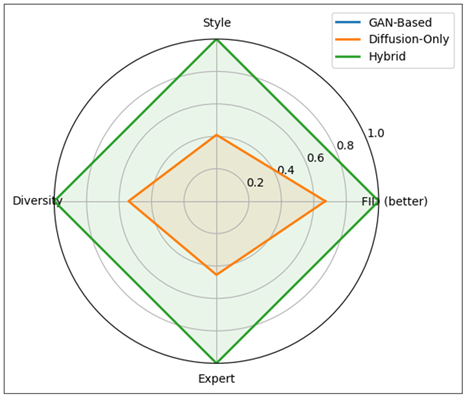
Figure 6 Normalized
Performance Profile of Generative Models
Figure 6, represents the balance of overall performance of each model in a normalized radar representation. Hybrid model exhibits a high profile in all the measures that were assessed, and it is almost symmetrical in shape, including balanced increases in the perceptual quality, stylistic consistency, variety, and expert verification. Conversely diffusion models only demonstrate intermediate progress compared to GAN-based baselines, but have lower holistic stylistic and semantic consistency. This visualization indicates the significance of the combination of contextual reasoning and generative fidelity in the work that aims at revival.
Figure 7

Figure 7 Diversity–Authenticity
Trade-off Analysis
Figure 7, brings out the trade-off between diversity of output and authenticity, as judged by experts. The hybrid diffusion transformer model fits in the upper-right area with the highest degree of diversity and does not conflict with cultural plausibility, whereas the larger the marker size, the better the perceptual quality. Conversely, the models of GAN-based models are concentrated in the bottom-left area, which indicates a lack of diversity and a decrease in expert faith. These results are additional findings supported by expert and community assessments. The hybrid framework received the most ratings of authenticity on a five-point Likert scale, and reviewers observed that it would be an appropriate pedagogical resource and design driver as opposed to being a complete reconstruction. An increased inter-rater agreement of hybrid outputs means that there is a greater consensus of cultural plausibility. In general, these results confirm that hybrid generative architectures, supported by structured knowledge encoding and human-in-the-loop validation, provide a solid base to restore the lost art traditions, but annotation depth and scalability of evaluations are still of concern.
8. Conclusion
It provides a morally correct idea of using the generative artificial intelligence in the reconstruction of the lost and endangered art traditions with a system that considers not the digitization act as an act of revival but the act of reconstructing the knowledge of art. The structure renders the AI a collaborative and culturally responsible tool through integrating data curation in a systematic manner, cultural KGs, a hybrid diffusion transformed architecture, and human-in-the-loop governance. The experimental results of the different case studies confirm that the hybrid model is the most effective model compared to GAN-based model and diffusion-only model in regards to perceptual quality, stylistic consistency, controlled variety, and professional critique of genuineness. The expert and community reviews also testify to the fact that the outputs produced are the culturally likely variants which may be applied as instructional, interpretation, and practice-based revival environment. The ethics and governance are also implemented into the framework of the generative pipeline, provenance tracking, data handling using consent, and protection of intellectual property (to prevent the risk of misrepresentation and appropriation of cultures). Overall, this paper will advocate a prudent path of action regarding how generative AI could be spent on enforcing cultural continuum, but rather than passively retaining it, it will be active reproduction of artistic knowledge.
CONFLICT OF INTERESTS
None.
ACKNOWLEDGMENTS
None.
REFERENCES
Altaweel, M., et al. (2024). Using Generative AI for Reconstructing Cultural Artifacts: Examples Using Roman Coins. Journal of Computer Applications in Archaeology, 7(1), 301–315. https://doi.org/10.5334/jcaa.146
Altenberger, I. (2024). Signs, Billboards, and Graffiti: A Social-Spatial Discourse in a Regenerated Council Estate. Social Semiotics, 34, 253–268. https://doi.org/10.1080/10350330.2022.2090832
Artopoulos, G., Maslioukova, M. I., Zavou, C., Loizou, M., Deligiorgi, M., and Averkiou, M. (2023). An Artificial Neural Network Framework for Classifying the Style of Cypriot Hybrid Examples of Built Heritage in 3D. Journal of Cultural Heritage, 63, 135–147. https://doi.org/10.1016/j.culher.2023.07.016
Bao, Y., Ding, T., Huo, J., Liu, Y., Li, Y., Li, W., Gao, Y., and Luo, J. (2025). 3D Gaussian Splatting: Survey, Technologies, Challenges, and Opportunities. IEEE Transactions on Circuits and Systems for Video Technology. Advance Online Publication. https://doi.org/10.1109/TCSVT.2025.3538684
Dong, Z. H., Ye, S., Wen, Y. H., Li, N., and Liu, Y. J. (2025). Towards Better Robustness: Progressively Joint Pose-3DGS Learning for Arbitrarily Long Videos. arXiv.
Eissa, M. E. A. (2025). The Influence of AI-Generated Content on
Trust and Credibility within Specialized Online Communities: A Brief Review on
Proposed Conceptual Framework. ShodhAI: Journal of Artificial Intelligence,
2(2), 1–14. https://doi.org/10.29121/shodhai.v2.i2.2025.40
Hou, Y., Kenderdine, S., Picca, D., Egloff, M., and Adamou, A. (2022). Digitizing Intangible Cultural Heritage Embodied: State of the Art. Journal on Computing and Cultural Heritage, 15, 55. https://doi.org/10.1145/3494837
Khalid, S., Azad, M. M., Kim, H. S., Yoon, Y., Lee, H., Choi, K.-S., And Yang, Y. (2024). A Review On Traditional and Artificial Intelligence-Based Preservation Techniques for Oil Painting Artworks. Gels, 10, 517. https://doi.org/10.3390/gels10080517
Li, W., and Liu, P. (2023). Evoking Nostalgia: Graffiti as Medium in Urban Space. Sage Open, 13, 1–16. https://doi.org/10.1177/21582440231216600
Li, X., Lin, J., and Zhang, X. (2025). Dynamic Transmission and Innovative Transformation of Cultural Heritage: Generative Artificial Intelligence Practices Based on Cultural Cognitive Models. Applied Sciences, 15, 12651. Https://Doi.Org/10.3390/App152312651
Liu, J. (2025). The Impact of Generative AI on Traditional Painting Art Forms. In Proceedings of the 2025 International Conference on Generative AI and Digital Media Arts (GAIDMA '25) (pp. 25–30). Association for Computing Machinery. https://doi.org/10.1145/3770445.3770450
Mazurkevych, O., Мазуркевич, О., Skoryk, A., Скoрик, А., Antipina, I., Антипіна, І., Goncharova, O., Гoнчарoва, О., Kondratenko, I., and Кoндратенкo, І. А. (2024). The Specifics of Preserving Cultural Identity in the Context of Globalization Processes. Mankind Quarterly, 66(1). https://doi.org/10.46469/mq.2024.64.4.8
Morrison, C. (2022). “Erasing a Mural Does Not Erase Reality”: Queer Visibility, Urban Policing, and the Double Life of a Mural in Ecuador. Environment and Planning D: Society and Space, 40, 432–450. https://doi.org/10.1177/02637758221090523
Pan, J., Li, L., Yamaguchi, H., Hasegawa, K., Thufail, F. I., Brahmantara, and Tanaka, S. (2022). 3D Reconstruction of Borobudur Reliefs from 2D Monocular Photographs Based on Soft-Edge Enhanced Deep Learning. ISPRS Journal of Photogrammetry and Remote Sensing, 183, 439–450. https://doi.org/10.1016/j.isprsjprs.2021.11.007
Parker, A., and Khanyile, S. (2024). Creative Writing: Urban Renewal, the Creative City and Graffiti in Johannesburg. Social and Cultural Geography, 25, 158–178. https://doi.org/10.1080/14649365.2022.2134580
Qian, J., Yan, Y., Gao, F., Ge, B., Wei, M., Shangguan, B., and He, G. (2025). C3DGS: Compressing 3D Gaussian Model for Surface Reconstruction of Large-Scale Scenes Based on Multi-View UAV Images. IEEE Journal of Selected Topics in Applied Earth Observations and Remote Sensing, 18, 4396–4409. https://doi.org/10.1109/JSTARS.2025.3529261
Shih, N.-J. (2025). AI- and AR-Assisted 3D Reactivation of Characters in Paintings. Heritage, 8, 207. https://doi.org/10.3390/heritage8060207
Stoean, R., Bacanin, N., Stoean, C., and Ionescu, L. (2024). Bridging the Past and Present: AI-Driven 3D Restoration of Degraded Artefacts for Museum Digital Display. Journal of Cultural Heritage, 69, 18–26. https://doi.org/10.1016/j.culher.2024.07.008
Wang, W. (2024). Real-Time Fast 3D Reconstruction of Heritage Buildings Based on 3D
Gaussian Splashing. In Proceedings of the 2024 IEEE 2nd International
Conference on Sensors, Electronics and Computer Engineering (ICSECE)
(1014–1018). IEEE. https://doi.org/10.1109/ICSECE61636.2024.10729491
|
|
 This work is licensed under a: Creative Commons Attribution 4.0 International License
© ShodhKosh 2026. All Rights Reserved.