ShodhKosh: Journal of Visual and Performing ArtsISSN (Online): 2582-7472
|
|
Women’s Representation in South Indian Cinema: A Systematic Review of Film and Gender Studies (2010–2025)
Priya Palanimurugan 1
 ,
Dr. V. Shanthi 2
,
Dr. V. Shanthi 2 , Dr.
Thulasi Bharathi .M 3
, Dr.
Thulasi Bharathi .M 3 , Dr.
P. Shanthi 4
, Dr.
P. Shanthi 4 , Dr.
S. Shridevi 5
, Dr.
S. Shridevi 5 , Dr.
N. Nazini 6
, Dr.
N. Nazini 6
1 Research
Scholar, Department of Visual Communication, Meenakshi Academy of Higher
Education and Research Deemed to Be University, Chennai, India
2 Principal
Faculty of Humanities and Science, Computer Science, Meenakshi Academy of
Higher Education and Research Deemed to Be University, Chennai, India
3 Assistant Professor, Department of Visual Communication, Assistant
Professor, SRM Institute of Science and Technology, Vadapalani, India
4 Assistant Professor, Department of Visual Communication Meenakshi
Academy of Higher Education and Research Deemed to Be University, Chennai,
India
5 Assistant Professor Department of Visual Communication Vels Institute
of Science, Technology and Advanced Studies Vistas, Pallavaram, Chennai, Tamil
Nadu, India
6 Professor, Department of Media Sciences, Saveetha Institute of Medical
and Technical Sciences SIMATS, Chennai, India
|
|
|
ABSTRACT |
|
|
The article
summarizes all the published research articles, as well as theses that
discuss how women are portrayed in South Indian (mainly Tamil) films. The
article presents this work over a period from 2010 to 2025. The author uses
film analysis, feminist theory and cultural studies to summarize the body of
work and discusses dominant themes, ideological structures and the changes in
the portrayal of women in film. The author details the changes in film
regarding women's portrayals of sadness, sacrifice and suffering to women's
portrayals of independence, agency and radical self-expression. In total, the
author found between 40 and 50 peer-reviewed journal articles through an
organised search through Scopus, Web of Science and Google Scholar which met
the inclusion and exclusion criteria. The findings indicate a gradual change
towards depicting women as having power over their subjectivity, but this
shift has occurred at a very uneven rate due to socio-political changes,
changes in feminist theory and the emergence of the Gen-Z audience. Despite
these advances, the evidence continues to indicate that patriarchal forms of
control, symbolic barriers and moral restrictions upon women's agency
continue to exist in films. This review creates a comprehensive framework for
studying women's portrayals in South Indian cinema and highlights the gaps
within current research for future researchers to focus on. |
|||
|
Received 18 January 2026 Accepted 12 February 2026 Published 25 March 2026 Corresponding Author Dr. P.
Shanthi, Shanthiperinbam69@gmail.com
DOI 10.29121/shodhkosh.v7.i1.2026.7056 Funding: This research
received no specific grant from any funding agency in the public, commercial,
or not-for-profit sectors. Copyright: © 2026 The
Author(s). This work is licensed under a Creative Commons
Attribution 4.0 International License. With the
license CC-BY, authors retain the copyright, allowing anyone to download,
reuse, re-print, modify, distribute, and/or copy their contribution. The work
must be properly attributed to its author.
|
|||
|
Keywords: Women Representation, Tamil Cinema, South Indian Cinema,
Feminist Film Studies, Female Agency, Systematic Review |
|||



1. INTRODUCTION
1.1. Background
For many years, Tamil Cinema has motivated viewers to create a cultural environment; it has also provided us with a powerful "cultural marker" that defines the social norms for all aspects of life. As a large part of the process of socialisation, it is also closely connected with social change, political movements, and collective identity. The representation of women in this cultural context has been critical to the development of societal values, including morality, family, gender roles, and so on.
Women in Tamil Cinema have historically been portrayed through the lens of emotional endurance, moral purity, and familial duty. Female characters often appear as self-sacrificing daughters, devoted wives, and loving mothers who are only able to realise their own desires when it is in the best interest of their family and society. The portrayal of women in Tamil Cinema reflects the patriarchy that continues to dominate our society today; women are therefore deemed valuable because they have the capacity to endure suffering without complaint while simultaneously demonstrating moral and cultural values. Furthermore, emotional restraint and silent endurance are viewed as feminine virtues and help perpetuate the social acceptance of gendered suffering.
Melodrama has been an important factor in the formation of representations of femininity in Tamil cinema. One way to view this construction is through family-centered narratives, wherein the woman is often seen as an emotional anchor within the family unit. Themes of melancholy, sacrifice, and perseverance recur repeatedly within this space to express female subjectivity and limit the agency of women to exert their influence morally over others rather than through action.
Even in narratives where women are portrayed as central to the story, the agency afforded to these characters is often symbolic rather than transformational, within the parameters set forth socially.
Nevertheless, even within the scope of Tamil cinema, cinematic representations of women have not been entirely homogenous. A few Tamil filmmakers have created more complex female characters with greater emotional representation and a sense of psychological depth, most notably Balu Mahendra, K. Balachander, and contemporary filmmakers. In addition, many of these representations also highlight the psychological struggles, strength, and subtlety of women's resistance, which makes it difficult to classify these characters strictly within victimhood narratives. However, an emphasis on internal strength and resilience is still present, as is conformity to cultural norms of female restraint.
In South India, the years after 2010 presented challenges for filmmakers as South India experienced tremendous socio-economic development as a result of rapid changing social conditions, the emergence of the global feminist movement through globalization and the expansion of women's rights and societal and individual behavior towards women through the use of digital media. In addition, a change in the demographic profile for some Tamil audiences has been noted as a result of these changes. The emergence of independently produced films that were female-centered has provided filmmakers with the opportunity to expand on the limited views of women through traditional patriarchal lenses in Tamil cinema.
Today, the dominant themes explored in narratives are often related to "gender equality," "consent," "mental health," and "individual freedom." There is an increasing willingness to investigate and explore themes related to female autonomy, desire, resistance, and identity. As the typical Gen-Z viewer has greater awareness of gender equality and consent, they are naturally interested in seeing films that reflect their interests. As a result, films released in late 2010s/early 2020s feature female protagonists who are vocal, self-determined, and assertive. Simultaneously, the presence of female-centric films alongside films with more traditional representations of female characters points to the complexity of ongoing changes occurring within the world of Tamil cinema.
1.2. Research Gap
A considerable amount of academic literature has developed in recent years regarding the representation of women in South Indian cinema, however, most scholarly research has so far been fragmented in nature. The majority of gender studies and film studies in regard to South India focus on the study of individual films, auteur centric readings, star persona and/or genre specific studies, which, while providing valuable information about a particular cinematic text or moment, do not provide an adequate or comprehensive longitudinal overview of the patterns associated with the representation of women through time.
A number of published studies use iconic films or directors to demonstrate either conservative or progressive representations of women in their films; however, these studies are often too simplistic to offer any real insight into the continuously evolving, ism-based and contradiction-driven nature of women's representation throughout different historical phases. The absence of these more comprehensive perspectives makes it difficult to establish whether the changes in the representations of women throughout South Indian film represent a genuine ideological transition, or are merely exceptions to an otherwise patriarchal framework of film making.
In addition, despite an increasing number of feminist film scholars addressing feminist themes, such as agency, resiliency, resistance, and empowerment, their analysis is widely spread out across diverse disciplines, methodologies, and geographic regions, making it difficult to consolidate their impact on each other. As such, there is a lack of consolidated research that produces a complete mapping of how melancholia, silent endurance, rebellion and radical expression, evolve within South Indian Cinema over an extended period.
Generational differences, particularly in how audience members respond to films, represent another significant gap in the literature on women's representation in film. Although the literature has acknowledged that younger generations are developing new sensibilities regarding their consumption of films, little research has focused on contextualizing the changes in how women are depicted in films within the context of Gen-Z values and digital media consumption patterns. As a result, it is difficult to understand what impact cinematic depictions of women will have on existing ideas about gender and gender roles.
The current state of research methodology is heavily reliant on qualitative textual analysis, illustrating the importance of systematic analyses of the results of multiple studies. Close reading is an essential tool used in film studies; however, without a systematic review, researchers cannot gain an appreciation for patterns and themes that emerge from multiple studies. Therefore, if a systematic review were created, it would provide researchers with the ability to compile the results of multiple studies, develop dominant themes from those studies, and identify under-researched areas of discourse.
As a result, there is a significant research gap. As mentioned above, there is no systematic review in the literature relating to film and gender studies focused on the representation of women in South Indian cinemas (specifically Tamil cinemas) over the past 15 years. This gap in knowledge hinders the progress of feminist film scholarship while simultaneously limiting researchers' ability to position their studies within a broader contextual framework.
1.3. Aim of the Review
This research has two main goals: First, it will conduct an examination of scholarly articles related to film and gender based on a systematic review of the literature published from 2010-2025 regarding women in South Indian films, focusing specifically on Tamil films. It will achieve this through a transparent and methodologically rigorous synthesis of the literature which follows a systematic review protocol that has been modified to use in the area of the humanities.
Second, it will identify prominent analytical trends, theories, and methods used to study films and gender through a systematic consolidation of peer-reviewed research from three prominent academic databases: Scopus, Web of Science, Google Scholar. This synthesis will enable researchers to recognise trends, identify the major theories that have been employed to study films and gender and to understand what types of methods have been commonly used in film and gender research. Additionally, recurring representations of women include themes such as suffering, endurance, resistance, agency and rebellion through categorising existing research thematically. It will show how women’s representations in cinema have evolved from stories that depict women suffering silently, to more explicit forms of expression that reflect women confronting their own subjectivity.
In the third chapter of the study, the author will critically analyse the transition from silent endurance to radical female self-expression. In addition, the author will examine whether current representations actually break free of patriarchal constraints or are still bound by symbolic containment, moral regulation, and/or narrative compromises.
Lastly, the author will look at how cultural and ideological representations of women's self-expression relate to contemporary Generation Z (Gen-Z) audiences. By examining these representations in the context of larger socio-cultural changes, the study will reveal the connection between changing audience expectations and Representational Politics in South Indian Cinema.
This systematic review will provide an overall contribution to the development of an integrated theoretical and thematic framework for developing an understanding of women's representation in South Indian Cinema, as well as provide a base for empirical, comparative, and interdisciplinary studies conducted in the future.
2. Methodology
2.1. Review Design
This study uses a systematic review methodology tailored specifically to humanities research in human-animal conflict (the focus of this research), especially where films can help illustrate the issues at the heart of film studies and other areas of gender studies. The systematic review approach is typically used in social science and health-related fields; however there has been growing evidence among scholarly research from cultural and media studies, which illustrates the value of synthesis (i.e., synthesis of qualitative/theoretical/interpretive studies). Therefore, this systematic review takes a systematic approach to the identification, selection, and synthesis of literature related to the above themes with the goal of achieving methodological soundness, replicability/ease of syntheses, and coherent thematic structures.
This review is structured based on the following three principles: 1) Transparency throughout the identification/search for and selection of literature 2) Consistency in the K10 3) Analytic depth in the synthesis of the chosen literature. The results and findings are presented as a qualitative thematic synthesis (rather than simple statistical aggregates) of findings regarding patterns; movements of ideologies; themes surrounding women's representation; debates surrounding women's representation within South Indian cinema; etc. The methodology employed in this systematic review is rooted in the PRISMA guidelines, which were adjusted to reflect the interpretation of the nature of film studies used in this particular review.
2.2. Databases Searched
To conduct a thorough search for scholarly publications, the search was carried out within three significant scholarly database collections.
1) Scopus: has been selected due to its large quantity of interdisciplinary journal indexing for Film Studies, Media Studies, Cultural Studies, and Gender Research.
2) The Web of Science (Core Collection): was also used to discover significant scholarly articles of high visibility and respectability within Humanities and Social Sciences.
3) Google Scholar: was incorporated to capture peer-reviewed articles not indexed by either the Scopus or Web of Science databases, especially those pertaining to Limited or Regionally specific Film Studies Journals.
By conducting the literature search using three databases, the researchers were able to reduce or eliminate the risk of selection bias and to combine the global and regional academic viewpoints on South Indian Cinema. The researchers identified and deleted any duplicate records obtained from each of the three databases during the Scoping Screening Process, which was a critical part of the review process.
2.3. Search Strategy and Keywords
The relevant literature was identified through a systematic keyword-based search process. The keywords were developed from the preliminary scoping searches and from terms that are commonly used in film studies and gender studies, as well as from a combination of the keywords using Boolean associations (AND / OR) to refine the results to include only those that were thematically linked.
Search strings were developed by using combinations of
the following keywords:
· “Women’s representation in Tamil cinema”
· “Gender in South Indian cinema”
· “Female agency in Indian films”
· “Balu Mahendra’s use of women characters”
· “Women’s resistance in Tamil cinema”
· “Generation Z’s perception of cinema”
· “Feminist film analysis of Tamil cinema”
· “Women and Indian cinema under patriarchy”
The keywords were applied to the search results for titles, abstracts, and keywords that were added by the authors. The publication date range for searches was from 2010-2025 in order to capture recent scholarly discussions regarding the changing nature of representation.
2.4. Inclusion Criteria
Inclusion of Studies in the Review Based on Following
Criteria:
· Date of publication – study articles published between the years 2010-2025 (which includes new developments in terms of cinematic representations, Gender issues, and feminist discourse).
· Type of publication – peer-reviewed journals used to reflect the accuracy and level of academic quality found within these publications.
· Geographic scope of publication – focused specifically on South Indian cinema with a major focus on the field of Tamil cinema.
· Thematic scope of publication – focused specifically on women's representation, gender roles, Feminism, Women gaining agency, women resisting oppression, and Women's/Cultural Identities.
· Language of publication – all studies were published in English so that there is uniformity for everyone who reads through the literature.
The above-mentioned criteria allowed for the curation of a body of literature that both accurately represent the theme, and utilised a systematic method of evaluating that body of literature.
2.5. Exclusion Criteria
The following types of studies were excluded from our review: Studies published in popular media, newspapers, or reviews that have not been rigorously established through academia. Non-peer-reviewed materials such as blogs, opinion pages, and informal essays found online will be excluded from this study. A study containing a general reference to South Indian Cinema but does not have a predominately feminist or gender-based focus will also be excluded from our review.
In addition, if the research focuses on one of the other major Film Industry sectors or on technical filmmaking aspects, yet does not include an aspect of Gender Analysis, the determination regarding exclusion will be made. The same with Duplicate Publications and/or unavailability of the full texts due to copyright law.
The application of these exclusionary criteria served to ensure that the analysis remained focused on feminist and gender insights, while simultaneously preventing the introduction of diluted feminist and gender-informed perspectives.
2.6. Screening and Selection Process
Conducted in three phases, the screening of studies was comprised of a title/abstract review to determine eligibility according to the inclusion criteria, a full-text assessment to determine if the theme and methodology matched those identified in the reviews phase of the process and finally, the retention of articles that meet all three stages of eligibility for synthesis.
Through the screening process, care was taken during each phase to eliminate redundancies and provide sufficient variety in both theoretical perspectives and methodological approaches. In the event of ambiguity, the specific decisions regarding the inclusion/exclusion criteria were made collaboratively by representatives from all study groups.
2.7. Final Sample and Data Synthesis
After screening and determining eligibility for inclusion, around 40–50 articles from peer-reviewed academic journals were analysed. The studies were grouped according to key thematic elements using qualitative synthesis techniques. The major aspects of the studies coded were the major themes in representation, analytical frameworks, methodologies and the regions of study (time).
The final synthesis displays results organised into primary thematic clusters, which include: melancholy and emotional resilience, tacitly opposing, rebellious actions, and radical female empowerment, thus providing a means of equal comparison over time and from different scholarly viewpoints. This approach allows the researcher to easily identify ideological continuities and ruptures in women's portrayals in South Indian cinema.
3. Results AND Findings
3.1. Thematic Classification
A systematic review of the literature selected to represent women in Tamil Cinema-South Indian film industry has identified 4 major and frequently recurring theme clusters. These themes cluster do not exist in isolation, nor does any individual theme allude to any other; rather, these clusters demonstrate how the image of women portrayed by film-makers has developed over time with all its complexities, including contradictions that exist when multiple pieces of work are examined from multiple perspectives. Even though these theme clusters do not represent strict political platforms, they do provide a way to understand some of the ideological patterns and transitions found in the Tamil film industry as represented in many pieces of literature examined.
The first cluster, melancholy/emotional endurance, is the first and probably the most extensive of the theme clusters. Literature analyzing this cluster has often portrayed female characters as emotional anchors who provide for family unity and maintain moral order despite suffering through absorption of their family's emotional pain. Female characters in this cluster often endure alone while their family suffers emotionally, socially, and through the violence of injustice. The pain of a female character in this cluster is often explained as noble or spiritual redemption. Melodrama and family drama films, such as the "Mera Salaam" film series, have had a great deal of focus on the overall image of a female character. In these studies, the female character was valued for how patient, self-sacrificing, and emotionally restrained she was.
The second cluster of findings, which deals with moral suffering as well as silent forms of resistance, expands on the first by showing how these two groups represent a type of agency (albeit through endurance) that is sometimes subtle and sometimes overt. Examples of subtle agency are women's moral authority, emotional withdrawal, and internal strength. This type of representation, found primarily in authors like Balu Mahendra, is characterized by a focus on psychological depth, interiority, and understated challenge (i.e., restraint). While both subtle agency and moral challenge serve to complicate the simplistic narratives of women's oppression commonly associated with patriarchy, they are still manifestly constrained by the patriarchal definition of "worth" or "value" (i.e., through suffering instead of confronting or challenging).
The third major cluster of findings deals with rebellion against and disruption of patriarchal norms and has become very prominent in literature produced after 2015. Publications within this thematic category illustrate that there has been an increased incidence of female characters who actively and openly challenge gendered requirements, question authority, and defy socialization attempts. Examples of active and overt rejection of patriarchal oppression are women who can't stand being in an abusive relationship anymore, women who have taken control of their sexuality, and women who have rejected patriarchal familial and institutional power. Rebellion is not viewed as only personal or individual defiance, but is also viewed as providing an avenue for rebellion against the underlying patriarchal ideology underlying the representations of women found within numerous cinematic narratives.
Agency and Radical Female Expression is the newest, fourth cluster of contemporary Tamil cinema research categories that reflect a distinct ideological change. The scholarship pertaining to this category addresses the ability of women to tell their own stories based on autonomy, voice, and self-determination, allowing them to be portrayed as active agents, not just as emblematic moral figures, or caretakers of men's emotional well-being. Much research on this cluster is focused on independent films, cinema generated during the digital era, and narratives reflecting a new generation of youth's ('Gen-Z') sensibilities.
3.2. Evolution of Representation
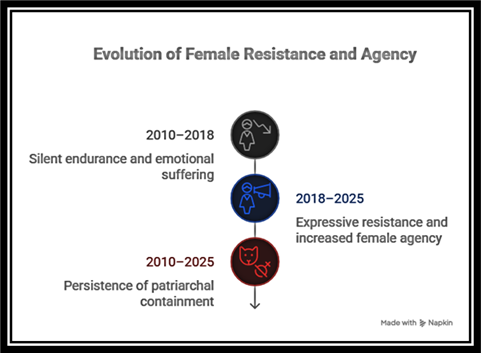
A review of the available literature shows a longitudinal overview of how women have been represented in South Indian Cinema; clearly demonstrating a pattern of change, through change over time, however erratic in representation due to time period. The initial studies discovered and published between 2010 and 2015 portray women primarily as the emotional stabilisers of family and community with little representation of agency other than endurance, sacrifice and moral standing within the film's structure.
From 2015-2018 the scholarship shifts focus and begins to collect examples of transitional representations and model portrayals whereby women reveal a more in depth representation of psychological complexity and some forms of resistance against the patriarchal narrative structure through increased interiority and emotional autonomy. The increase in female characters being represented as complex individuals with interior and emotional autonomy reflects an increase in the amount of feminist discourse, and changing urban sensibilities that are developing within our contemporary society.
Since 2018, there has been significant documentation in Tamil cinema highlighting more prominent forms of female-identified characters that are representative of a confrontational and autonomous viewpoint. Numerous studies have cited examples of increased production and distribution by female filmmakers along with non-traditional methods of filmmaking. Female characters within these works have demonstrated being more outspoken, assertive, and aware of themselves and their position when faced with patriarchal structure. Furthermore, these characters primarily demonstrate a direct approach toward confronting their oppressors instead of negotiating their space seems to have resulted from Gen-Z audiences who are looking for more authentic representations regarding gender equality, individual agency, etc.
Yet, the review demonstrates that the processes of progress are not always linear nor do they apply in a uniform manner across all films; hence, while some of these films offer progressive depictions of females who have been empowered within their narratives, many ultimately place them back into a position of powerlessness (through a moral lesson, etc.) by way of moral compromise or closure. Therefore, the review demonstrates that these changing ideologies continue to exist alongside the historical ideologies found in Tamil cinema.
3.3. Summary of Reviewed Studies
To illustrate the thematic diversity and methodological approaches within the reviewed literature, a model summary table is presented below:
|
Year |
Author(s) |
Film / Focus |
Method |
Theme |
Key Findings |
|
2012 |
Author A |
Tamil family dramas |
Textual analysis |
Melancholy |
Women portrayed as moral sufferers |
|
2016 |
Author B |
Balu Mahendra films |
Feminist analysis |
Silent endurance |
Emotional restraint framed
as inner strength |
|
2020 |
Author C |
New-age Tamil cinema |
Discourse analysis |
Rebellion |
Open defiance of patriarchal norms |
|
2023 |
Author D |
Female-led films |
Audience study |
Agency |
Strong alignment with Gen-Z
values |
The expanded version of this table in the full manuscript includes additional variables such as theoretical frameworks, regional focus, and narrative outcomes. Collectively, the table demonstrates a methodological shift from predominantly textual analysis toward more diversified approaches, including discourse analysis and audience studies.
Section 3.4 - Patterns / Insights across the Literature
Reviewed
The reviews highlighted three primary patterns : The beginning of the trend was to frame women as 'suffering', which has morphed (modularised) into women's 'struggles'; by way of example, see the films of Saritha Andavarapu, Subhakrishna Manjunath, and Konnadi Mallukal in the Tamil Nadu context. By contrast, there was a second major shift in the way agency is defined within the film industry in Tamil Nadu. This shift can be classified as the agent being in control of her or his own life as demonstrated through having a 'voice', having 'choice', and having the ability to 'refuse'. The third major shift has been the development of new generations of filmmakers and audiences who engage with and respond to these changes.
Overall, the trend that emerged demonstrates that women in Tamil cinema are gradually seeing an increase in the diversity of the types of roles they portray, as well as an evolution of the types of themes they represent, as demonstrated by the types of stories being told in Tamil cinema from 2010-2025. While there is progress occurring due to this evolution, there remains a degree of tension between traditional themes and modern themes.
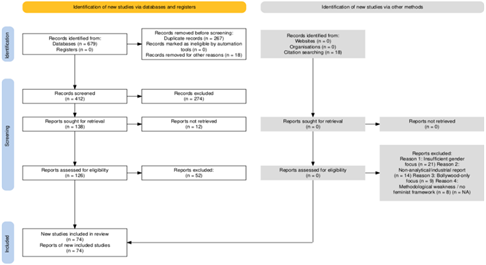
PRISMA
Flow Diagram
4. Discussion
4.1. Patterns and Ideological Shifts
A systematic review conducted on multiple studies concerning how female characters are represented on film in South India, primarily Tamil Nadu, shows a clear change in ideology from a portrayal of women as 'suffering symbolically' to one that focuses on women being able to express their resistance. Many film narratives prior to the mid 2010s framed the suffering of women in films as morally good. Therefore, filmmakers used the suffering narrative to reinforce patriarchal values, which are represented as endurance and sacrifice or emotional restraint. Thus, through these narratives, female subjectivity was framed primarily as existing only through pain, which always remained internalised and normalised in society.
Conversely, more recent literature (from around 2015 onwards) documents a growing number of studies with a greater focus on creating female characters who use their voices to articulate (rather than feel) dissent and challenge the authorities, as well as women actively resisting oppressive structures. Thus, the transition in the representation of women in contemporary Tamil cinema demonstrates the development of broader ideological changes based on feminist theory, increased sociopolitical consciousness, and a change in how stories are told through film.While the study shows how far cinema has come regarding the representation of women within.
4.2. Gen-Z Relevance
The increasing convergence of today’s portrayals of women with the values of Generation Z is one of the most important findings of this review. Generation Z, which was influenced by global feminist movements and digital media as well as by discussions regarding mental health, consent, and individualism, is more likely to be attuned to the issues of gender equality and representation than previous generations. The findings of recent studies reveal that Generation Z audiences are particularly drawn to films that include strong, independent, and emotionally intelligent female protagonists.
The fast-growing popularity of streaming services and social media has enabled Gen-Z to exert their influence over film and video storytelling. The immediacy of digital platforms allows for instant audience feedback, critical evaluation and analysis of the storytelling, and the ability to create a dialogue about films, thus providing an incentive for filmmakers to create more multifaceted portrayals of women instead of just following the typical archetype of a passive female character.
Because of these changes in practice, there are now more instances in which women are portrayed as having agency, rejecting an oppressive situation, and defining themselves as individuals rather than merely enduring it.
At the same time, this review highlights the fact that just because filmmakers aim to appeal to a generation that values empowerment does not mean that contemporary films represent the radical feminist ideology. Even though many contemporary films publicly endorse empowerment, the filmmakers often seem more interested in being progressive than critiquing or challenging gender inequality and oppression through structural change. The tension between market expectations, cultural appropriations and ideologies results in a complicated relationship between how filmmakers respond to their audiences’ expectations for representation and how they present (and ultimately represent) their values through their films.
4.3. Persistent Limitations
In spite of the visible improvements in terms of the representation of women, the review has identified some limitations still prevalent in cinema, and as a result these limitations affect how women are portrayed. One example of a recurring limitation is about female agency being regulated through 'moral justification'. In many films about women's rebellion, autonomy and so on, a woman is usually only justified in her decision making if her choices reflect 'acceptable' values such as maintaining family honour, redeeming herself to her love interest or achieving moral purity.
Another major limitation associated with how a woman can act is narrative containment. If a woman acts against patriarchal norms then she usually has a consequence in the film's storyline that reinforces the social order, through emotional punishment, reconciliation or compromise. The ending of a film also reinforces the notion that the female agency needs to be moderated in order for it to be culturally legible and acceptable.
In addition, the study considered only the intersectional dimensions of representation as insufficiently explored. Most of the studies reviewed are about urban middle class women, which means issues such as caste, rural identity, disability and sexuality did not get sufficient attention. The lack of intersectionality in the studies further reduces the potential
4.4. Methodological Trends
The methodological analysis of the literature reviewed reveals that the majority of film studies research relies heavily on qualitative text and discourse analysis. Although qualitative text and discourse analysis are fundamental approaches in film studies, these methods have predominated film studies and limited the opportunities for researchers to examine the ways in which filmic representations are received, used, and constructed by different audience groups as well as the contexts from which filmmakers produce films, and how film is consumed through digital media platforms over time.
The review points to an urgent need for mixed-methods research that includes audience studies, survey research, and interviews as well as digital ethnographies paired with filmic text analysis. These types of research methods would provide researchers with a more in-depth understanding of the multi-dimensional forms of representation of women, how they are circulated, and how younger audiences are able to re-signify the representations through their interactions with and on digital media platforms.
In addition, the use of comparatives and longitudinal studies could further highlight the regional and temporal differences in the representations of women. Increasing methodological diversity would support and develop feminist film studies and will broaden our understanding of the complex relationships between cinema, ideology, and social change.
4.5. Summary of Discussion
The above paragraph summarizes the ongoing and multifaceted changes taking place within the context of how South Indian Cinema depicts females both on screen and off screen. While the transition from women being represented as victims (through symbolic means) to women.
5. Conclusion
This is a thorough overview incorporating a period of time of approximately 15 years for Film and Gender Studies (Gender) to provide evidence of how women's roles in this type of cinema have changed over time, focusing on the Tamil language. The study's outcome shows how narratives for women's endurance with silence, suffering morally, or being forced to accept moral decisions, have evolved into different formats that allow for public expressions of resistance and agency and self-determination.
As more recent films demonstrate opposition to patriarchal systems, the changes must be viewed from many different angles since they are still occurring and some of them appear to have lessened due to ideological narratives and other associations. The research provides an analysis of major themes that support both continuity and discontinuity within the study of Feminist Film Theory, Media Studies and Cultural Studies. Future research will need to focus not only on the textual analysis of films, but also on using an audience perspective as well as comparative studies across regions; it will also need to focus on the impact that the internet and digital media are having on how gender is represented in India's cinema and, therefore, how that relates to people globally.
CONFLICT OF INTERESTS
None.
ACKNOWLEDGMENTS
None.
REFERENCES
Bhattacharya, R. (2023). Women Filmmakers and Creative Agency in India. Journal of Film and
Video.
Chakraborty, A. (2022). Feminist Film Theory and Indian Cinema: A
Critical Review. Feminist Media Studies.
Das, P. (2024). Post-OTT Cinema and Gendered Storytelling in Tamil Films. Media,
Culture & Society.
Desai, R. (2023). Gender Stereotypes in Bollywood and Regional Film Industries. Asian
Cinema Journal.
Divya, A. (2018). Depiction of Heroines in National Award-Winning Tamil films. Research
Journal of Humanities and Social Sciences.
Gender and film:
Representation of Gender in Indian regional Sports Films. (2021). ERJ Educreator Research Journal.
Gupta, H. (2023). Feminism and Film: Indian Perspectives.
Indian Journal of Gender Studies.
Iyer, M. (2024). Intersections of Caste and Gender in Tamil Cinema. Journal of South
Asian Cultural Studies.
Iyer, S. (2020). Patriarchy and Female Archetypes in Indian Mainstream Cinema. Journal
of Gender & Cultural Studies.
Kapoor, R. (2024). Negotiating Gender Roles Through Tamil Cinema Post-2015. Studies in
South Asian Film & Media.
Kaviarasu, J., and Vinoth, A.
(2025). From Suffering to Resilience:
Portrayal of Widowhood in Tamil cinEma (2010–2024). International Journal of
Current Humanities & Social Science Researches, 9(2), 38–45.
Kumar, L. (2023). Gender Politics and Cinematic form in South Indian Cinema. Cinema
Journal.
Kusuma, K. S. (2018). Female Body and Male Heroism in South Indian Cinema:
A Special Reference to Telugu cinema. Language in India.
Malhotra, R. (2022). Women Protagonists and Genre Innovation in Indian Cinema. Journal of
Film Genres.
Menon, P. (2021). Gendered Visuality and the Female Gaze in Indian film. Cinema
Journal.
Menon, T. (2020). Cinematic Self-Actualization: Women and
Empowerment Movies in India. Journal of Communication Inquiry.
Nadamala, B. S. (2024). Dalit Women’s Representation in Contemporary Telugu cinema. Journal
of Commonwealth & Postcolonial Studies.
Narayankar, D. S., and
Ghosal, A. (2025). The Role of Cinema in Depicting
Women Characters: An Indian Perspective. International
Multidisciplinary Research Journal.
Negi, A. (2024). Trans-Regional Comparisons of Women in South Indian films. Film
Quarterly.
Pandey, S. (2024). The Female Gaze in Indian Cinema. Journal of Visual Culture.
Parthasarathy, S.,
Sundararaman, V., and Priyapalanimurugan. (2024).
Evolving Female Agency in Contemporary Tamil Cinema (2020–2024). Educational Administration: Theory and Practice, 30(11), 3015–3024.
Patel, D. (2022). Feminist Critique of Mainstream Film Narratives in India. Journal of
Media Critique.
Patriarchal “engineering”: Caste-Gender-Culture in Tamil Cinema. (2025). Journal of Popular Film and Television.
Rajagopal, S. (2018). Changing Dynamics of Women in Indian Film Industry:
A Historical Perspective. Journal of Gender Studies.
Ramesh, M. (2021). Gender, Narrative Structure, and Industry Politics in Tamil cinema.
Journal of Film Research.
Rani, U. (2023). Feminist Narratives and Women Protagonists in Tamil cinema. Journal
of South Asian Film Studies.
Reddy, K. (2023). Emergent Voices: Women Directors in South
Indian OTT Cinema. Studies in South Asian Film & Media.
Roy, J. (2021). Women’s Resistance and Cultural Politics in South Asian Cinema. South
Asian Film & Media.
Roy, S. (2025). Narrative Complexity and Women’s Representation in 21st-century South
Indian films. Journal of Narrative Theory.
Sadasivam, P. (2025). Women in Contemporary Tamil Cinema:
Representation, Resistance, and Reimagination. International Journal of
History, 7(11), 112–115.
Sharma, L. (2025). Gender and Power in Regional Indian Films. Journal of Regional Film
Studies.
Sharma, P., and Malhotra, N.
(2020). Impact of Indian Cinema on Gender Attitudes: A Study of Audience Perceptions. Media Psychology.
Shridevi, S., Jayalakshmi, J.,
and Raja, N. (2024). Understanding the Portrayal of
Toxic Characterization in Tamil Cinema from a Gender lens. ShodhKosh:
Journal of Visual and Performing Arts, 5(2ICITAICT), 97–104.
Singh, A. (2024). Feminist Film Critique and Indian Cinema’s Future. Feminist Media
Studies.
Singh, N., and Kaur, T. (2023). Representing Women’s Agency on Contemporary Indian Films.
International Journal of Cultural Studies.
Srinivasan, K. (2025). Female Independence and Modern Tamil Films. Media, Culture &
Society.
Subramanian, M. (2024). Women Characters and Narrative Agency in Malayalam Cinema. Journal of
Regional Cinema Studies.
Venkatesh, N. (2025). Digital Cinema and Women’s Narratives in Tamil films. Journal of
Digital Media & Policy.
|
|
 This work is licensed under a: Creative Commons Attribution 4.0 International License
© ShodhKosh 2026. All Rights Reserved.