ShodhKosh: Journal of Visual and Performing ArtsISSN (Online): 2582-7472
|
|
A Study on Character Identity Highlights with reference to Indian Mythological Character: Mahishasur
Shreejit Guha 1
 ,
Varuna Semwal 2
,
Varuna Semwal 2 ,
Debkumar Chakrabarti 3
,
Debkumar Chakrabarti 3
1 Assistant Professor, Communication
Design, School of Design, UPES, Dehradun, Uttarakhand, India
2 Gautam
Buddha University, Greater Noida, Uttar Pradesh, India
3 School of Design, UPES, Dehradun, Uttarakhand, India
|
|
|
ABSTRACT |
|
|
The mainstream
media popularizes norms established by the dominant culture while the
alternate media highlights the other representations. To assess how designers
perceive character highlights in overlapping but distinct cultures in
mainstream and alternate media, reference can be taken of the state-of-art
representation of the body of the mythical Hindu demon king Mahishasur,
presented as an evil force in Durga Puja festivities in West Bengal, India
and the newly constructed visual representation of Mahishasur as the martyr
“Hudur Durga” in the Santhali culture prevalent in the state. Through
discussions with idol-makers from Kumartuli, the hub of idol-making in West
Bengal about the perception of Mahishasur in mainstream representation and
interactions with the Santhal community in Ayodhya hills, Purulia about the
current perception in the Santhali culture, this study sought to understand
the varying perceptions around the character representation of the mythical
character leading to the development of counter-culture character designs and
the possibility of acceptance of such alternate representations among the
dominant culture populace. |
|||
|
Received 22 November 2025 Accepted 24 February 2026 Published 27 March 2026 Corresponding Author Shreejit
Guha, shreejit.guha@ddn.upes.ac.in
DOI 10.29121/shodhkosh.v7.i2s.2026.7023 Funding: This research
received no specific grant from any funding agency in the public, commercial,
or not-for-profit sectors. Copyright: © 2026 The
Author(s). This work is licensed under a Creative Commons
Attribution 4.0 International License. With the
license CC-BY, authors retain the copyright, allowing anyone to download,
reuse, re-print, modify, distribute, and/or copy their contribution. The work
must be properly attributed to its author.
|
|||
|
Keywords: Character Design, Identity Highlight, Durga Idol, Alternate
Media, Santhali Culture, Bengali Culture |
|||



1. INTRODUCTION
The human body in character design undergoes frequent modification in accordance to the intended message to be communicated. The resultant character highlights communicate traits and underlying themes in accordance to specific cultural and social aspects that influence the character. A hero’s body have been one of the most enduring visual identity elements that communicates traits aspired and admired by the members of the specific cultural group. Cultures are overlapping and often, a major culture becomes dominant over minor, overlapping cultures. In such cases, the minor cultures create idols that represent identities that define their cultural identities. The channel of these communications being the art media, the channel finds itself divided between the mainstream and the alternate.
Representation of the human body in character design has evolved in accordance to numerous aspects such as geographic considerations, racial aspects, sexuality, gender and ethnicity Museum of Modern Art. (n.d.). While rendering body features representative of an ethnicity and culture renders believability and realness, to render certain abstract aesthetics and otherwise visually uncommunicable concepts such as underlying themes and character traits, certain modifications are executed on the standard anthropometric body considerations. These modifications can also be called highlights as they render specific characterisation to the entity the body represents. Such representations have been in vogue for generations of designers/ practitioners and is used till today in character design traditions such as idol-making, scroll-paintings and others.
With the evolution of the society, cultures overlap and often a major culture creates hegemony over the minor ones. This creates stereotypical conceptions of a character identity as if endorsed by a locality. However, localities in question are subjected to further division of smaller localities, which can lead to further smaller localities-each of them endorsing their own identity. In the realm of art media, such divisions of dominant and subordinate culture are often categorised as the mainstream and the alternative.
Mainstream media refers to established traditional art forms and narratives that are broadly popular with the public while alternative media endorses forms and narratives outside the established mainstream. Such dominant mainstream cultures establish and design icons in accordance to their belief systems, leading counter-dominant reactions to create alternate designs in order to sustain cultural identity. Cultural sustainability in an era of overlapping, syncretic culture is a global concern. Often taken as the fourth pillar of sustainability alongside social, economic and environmental sustainability Hawkes (2001), the role of culture as a driver of sustainable development has also been recognised in the UN post-2015 Millenium Development Goals (MDGs) UNESCO. (2012). Cultural sustainability is crucial for the sustenance of cultural diversity and identity in a post-globalized world.
Considerations of a cultural icon’s body representation in such a state of affairs may have multiple interpretations, taking into account mainstream and alternative representations. A hero, in popular culture possesses characteristics highly appreciated by people in a society/culture, as a role model. Thus, it is likely that a traditional hero’s body represents the “Reward Body” Gadjin and Umeyo (1973) aspired by the people of a particular culture. Studying contrastive representations and implications of character highlights requires a case of an iconic figure with contrasting representations in dominant and subordinate cultures. Different groups of people perceive the same icon and manifest the concepts surrounding it in ways they feel appropriate.
To confirm the aforementioned idea and understand the perception of the various character representations, a case study has been conducted in West Bengal. This is especially because of the beliefs of two co-existing groups: the Hindu Bengali community and the Santhal community – a major tribal community in West Bengal. Coexisting for centuries and at the onset of modernization, both cultures have had fair amount of cultural exchange between them, causing much social changes particularly among the Santhal populace (Guha and Ismail; Eftakhar; Baskey; Paul and Gupta; Bhowmick and Jana). While the Hindu Bengali culture is known for worshipping of the Goddess Durga in her warrior form, the idols representing her avatar “Mahishasurmardini”- in the action of killing the demon king Mahishasur Joshi (2013). In the indigenous populace, particularly amongst the Santhal community, Mahishasur has been highly revered as an indiginous “Hero”-also called “Hudur Durga”. While the Santhals have seldom been known for idol-worship, idols have been erected of the icon since 2011, started by the Kherwal Santhals Hembram (2018) as the Mahishasur movement has emerged as a counter-culture movement headed by Adivasi and oppressed-caste groups. However, whereas the Santhals don’t worship Hudur, they commemorate him as a great leader Hembram (2018) and created an alternate iconology. This renders the body representation of Mahishasur an ideal case to study the difference in character highlights perception in overlapping but distinct cultural groups. In case of West Bengal, the Bengali Hindu community constitutes of 60.2% Hinduism in West Bengal, (n.d.), Sen (2022), Wikipedia contributors. (n.d.) of the total population as per census data 2011 and can be called the dominant while the Santhals following animism, predominantly Sari religion constitutes of approximately 2.75% (Santal people, n.d.; West Bengal Religion wise Population 2011, (n.d.) be called the subordinate. While the dominant and the subordinate may overlap in case of media consumption, the mainstream media primarily caters to the ethos of the dominant cultural populace, why the alternate media tends to cater the subordinate Adhikari and Dash (2020), Anderson (2018), Ihlebæk et al. (2022). Thus, the representation by the Bengali Hindu culture, with a higher population and prominence, can be termed as the mainstream, while the representation of Mahishasur in the indigenous culture, thus becomes the alternate. However, how the dominant Bengali Hindu culture perceives the alternate representation, is essential to understand the dynamics of perception of the hero’s body that impacts overlapping cultures. Mahishasur is also represented a figure to be worshipped along with Durga, it also carries a heroic appearance, and thus it raises an issue if these two can be clubbed or used as alternate as a value addition in expressing the theme.
Differences have been noticed in the overall design aspects of these varying representations and a study of the character highlights may provide insightful perspectives about the perception of character highlights in overlapping but distinct communities. Considering West Bengal as a locality where both these cultures thrive, this study aims to investigate the possibility of acceptance of alternate character representation practices for theme highlighting through the following objectives:
· To explore the implementations of character highlights rendered on Mahishasur’s body in mainstream representations.
· To explore the implementations of character highlights rendered on Hudur Durga’s body in alternate representations.
· To explore the possibility of acceptance of the alternate representation among the population of the dominant culture.
2. METHODOLOGY
To understand the perception of the body of Mahishasur in mainstream and alternate representations, two target groups were chosen through purposive random sampling. One target group (TG 1, N=5) consisted of the idol makers from Kumartuli, the hub of the Bengali idol-making industry. The discussions were conducted in the post-Durga Puja period of 2022 considering the idol-makers’ availability. The other target group (TG 2, N=5) consisted of the members from the Santhal community in Ayodhya Hills, Purulia. This target group was approached around pre-Durga Puja period of 2023, considering the time they prepare for the Dasai ceremony- a dance ritual remembering Hudur Durga. For conducting the discussions, qualitative discussion methods were employed. The discussions revealed that though they hold an alternate perspective, the Santhal community at Ayodhya Hills doesn’t create idols. Not much could be uncovered about the specific location where Hudur idols are made. Thus, the perceptions of the Santhal community were considered along with images of Hudur idols over the internet. Relevant background study was conducted through surveys of books, journals, blogs, vlogs and research papers and the background data was employed to analyse the images to understand the differing character highlights. To explore the possibility of acceptance of the alternate character highlights among the populace of the Dominant culture, a questionnaire study was conducted among Bengali Hindu populace. The flow of the methodology executed can be visualized in the given diagram,
Figure 1

Figure 1
Study Design at a Glance
Issue raised: Among the three options, which one do you think is most potent to represent the idea/ image of Mahishasur?
Sampling: For the questionnaire study, Bengali Hindu participants selected through random purposive sampling (N=85) were asked the following question:
· Among the three options (given below), which one do you think is most potent to represent the idea/ image of Mahishasur?
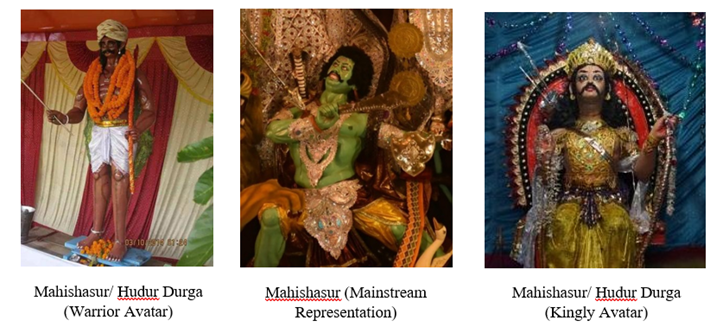
The result of the perception study was then analysed to draw conclusion.
3. RESULTS and DISCUSSIONS
The study of character highlights on the body of Mahishasur makes it imperative to study the general notion of character highlights on the body of Devas (Gods as referred in Hindu mythology) and Asuras (Demons as referred in Hindu Mythology) to understand the difference in visual representations as compared to a standard anthropometric human body. Through interviews with idol-makers from Kumortuli, a colony of idol-makers from Kolkata, West Bengal, perceptions were recorded to investigate the application of character highlights on the body of Devas and Asuras. For reference of the Devas’ body, the body representation of Lord Kartikeya was considered, given the presence of both Mahishasur and Kartikeya in the assemblage of the idols worshipped during the Durga Puja, ref. Figure 2 (the assemblage of idols of Godesses Durga, Lakshmi, Saraswati and Gods Ganesha and Kartikeya along with their Vahanas- animals referred to as vehicles: Lion for Durga, owl for Lakshmi, swan for Saraswati, rat for Ganesh, peacock for Katikeya. The idol includes the demon Mahishasur and the carcass of a slaughtered buffalo from where the demon king emerges). This expels certain variables such as the personal beliefs and style of the artists. Also, Lord Kartikeya is the Hindu God of War while Mahishasur was also known as a warlord.
3.1. DESIGNER’S PERCEPTION ON CHARACTER HIGHLIGHTS IN THE MAINSTREAM REPRESENTATION OF MAHISHASUR
Hindu mythology has been scattered with tales of wars between the Devas (the righteous Gods) and Asuras (the unrighteous Demons). Popular iconography has developed through the years and the character design stereotypes have developed in public perception. For most idol-makers in Kumartuli, Kolkata, idol-making is a generational occupation. Most practitioners admitted that the character highlights applied are taught and carried forward as a form of generational knowledge. Value-addition occurs in the form of personal expression of the artist, but the salient characteristics are religiously maintained. As for the source of the knowledge, they cite the Puranas, revered books in the Hindu cannon. Much knowledge about Hindu iconography traces its origins from ancient Hindu literature such as the Agamas, Puranas and the Vedas Ihlebæk et al. (2022), Macdonell (1916). The discussions provided the following points on the idol-maker/ designer’s perception on the state-of -art character highlights application on the bodies of Devas and Asuras.
Figure 2

Figure 2 Shows the Image of a Traditional Durga Idol.
From The Right Is Lord Ganesh with His Vahana (Rat), Goddess Lakshmi with Owl,
Goddess Durga with Lion Killing Mahishasur, Goddess Saraswati with Swan, Lord
Kartikeya with Peacock. Source: Pexels Soumya Bhattacharjee
· The abstracted body of the Deva: The idol-makers maintained that the body of a Deva shouldn’t be like the body of a common human being rather emit their Godliness through their bodily representation. Godliness as a visually representation requires certain modifications on the aesthetic approach of representing the human body as a way to show it above realistic application. Such a design approach indicates abstraction from anthropometric standards, rendering a “softness” to the character. The idol-makers believed that such highlights indicate the characteristics of the Devas- kindness, soberness, softness of heart, benevolence among others. Some idol-makers referred to the Rigveda and the Dhyanas attributed to the deity as the source of such depictions. In the mainstream depictions, Kartikeya has been mentioned to have skin like molten gold as can be seen in the depictions given in Figure 3. The depictions of most Devas are rendered, soft, well-rounded bodies with peaceful expressions, without hard edges depicting peace and benevolence. The depiction of Lord Kartikeya, albeit the God of War, should emit his Godliness- the essence of kindness and justness. The traditional Kartikeya had a larger face, wide-eyed, rounded shouldered and rounded jointed with a small, slim physique as shown in Figure 3 (a). The more modern value-added designs added more realistic approach by the 1940s, however, keeping intact the essence of sublime Godly abstraction. The body became more human-like, but the well-rounded, smooth-skinned, soft-bodied iconography continued, ref. Figure 3 (b). The idol-makers also mentioned that well-defined muscles and movements are rendered only when special needs such as exemplifying or showcasing of power of any other characteristics arise, though emphasizing that such exaggerations are moderate, as extreme exaggeration may result in a loss of the character’s visual identity. The amount of value addition has increased with the emergence of theme-based idol making, as the character designs are being experimented with, breaking off from the traditional rules; though most participants maintained that the general tendency of the value-addition is to modify the body without expelling the Godliness, ref. Figure 3 (c). Another perception that emerged from the discussions is the idea of the intellectual superiority of the Devas. This perspective puts forward the concepts of technical superiority of the Devas in the case of warcraft. This theory emphasizes the intellectual traits of the character in the representation of the body that contradict the muscular, aggressive body of the Asuras.
Figure 3
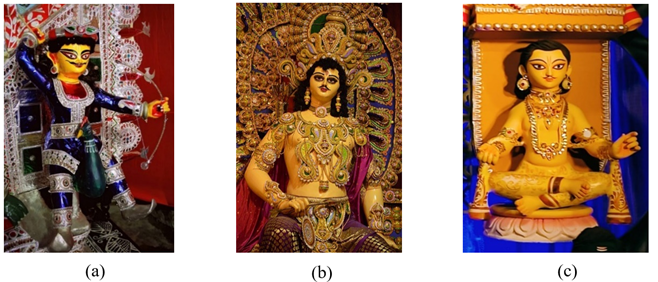
Figure 3 Shows the Images of the Traditional(A), Modern (B) And Artistic (C) Representations of Lord Kartikeya. Source:(A) Sohan Soo, (B)File: Kartikeya Durga Puja Pandal Ekdalia Evergreen Ekdalia Road Kolkata 2017-09-26 4118.JPG - Wikimedia Commons, (C) Pexels-Kolkatar Chobiwala
· The realistic body of the Asura: Most artisans refer to Mahishasur as a God and a King with monstrous qualities. To showcase his aggression and power, he is often represented in a muscular frame with fierce expression. Unlike Kartikeya’s calm and composed expression and posture, Mahishasur is portrayed in action, his expressions fierce with a sword on his right hand in motion of striking a blow while his chest is pierced by the spear of the Goddess, as shown in Figure 4 (a+b+c). The lion is often portrayed attacking Mahishasur’s sword arm while Mahishasur himself emerges from the body of a buffalo with a severed head Figure 2. The legend of Mahishasur states that Mahishasur was born out of the union of an Asura named Rambha and a she-buffalo, Mahishi. The name Mahishasur (Mahish= Baffalo, Asur= Demon) literally translates to Buffalo Demon. The legend further mentions the shape-shifting powers of Maishasur- it states that the Demon king could metamorphize his body into animals at will and utilize this special power during warfare. As is stated in the legends, Devi (Goddess) Durga killed Mahishasur in his buffalo form, elevating artist’s imagination in portraying the war scene. However, it is stated by the idol-makers that the ancient original depictions that had been copied from the scriptures have been value-added through generations, as artists started pouring in their own imagination. The traditional depictions of Mahishasur were abstracted, without exaggerated muscles or expressions as shown in Figure 4 (a). It was only after the designers started to take a more realistic approach around the 1940s that the designs changed. With time, the designs changed to more realistic forms, with a muscular frame and fierce expressions. The hair changed to curly and dense, moustache became larger and dense black, often resembling villains in popular media as portrayed in Figure 4 (b+c). The colour green, often rendered to Mahishasur’s body, has mixed opinions; some idol-makers are of the opinion that the colour represents Tamas- a concept from the Hindu philosophy which symbolizes the traits of ignorance, obscurity, darkness-representing someone who has not faced the light of knowledge. Other opinions included some implications of green in colour psychology which denotes envy and jealousy, while others stated that the colour green may be associated with the symbolism of the buffalo as the colour green signifies forests and the greens. Most of the participants agreed that though not always is green, Mahishasur has traditionally been depicted in darker shades. The hypermasculinity employed on the body through ripped physique is associated with aggression, rage, brutal force, ferociousness and physical realism, contrasting his figure from the surrounding assemblage of softer bodied Devas. The idol-makers emphasized that the body of Mahishasur is a personification of the six vices in Hinduism (Shororipu)- Kaam (Desire), Krodh (Anger), Lobh (Greed), Mad (Ego), Moh (Attachment), and Matsarya (Jealousy) and Alasya (Laziness) Gaurav. (2020). All these vices bind the soul in the mortal world, defining Mahishasur’s attachments to the material, physical realm. The idol-makers further stated that the though the exaggerated highlight adds characteristics for character communication, the exaggerations shouldn’t distort the identity.
Figure 4
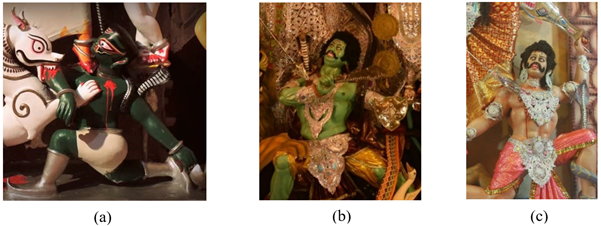
Figure 4 Shows the Images of Traditional (A) And Modern (B+C) Representations of Mahishasur. Source: (A) Sohan Soo, (B) File Traditional Durga Idol, Bagbazar, 2017.Jpg - Wikipedia, (C) Original
Table 1
|
Table 1 Differences Between the State-Of-Art Representation of Lord Kartikeya and Mahishasur In +Mainstream Representation |
||
|
Highlight Elements |
Representation of Kartikeya |
Representation of Mahishasur |
|
Body Type |
Lean and soft-edged |
Bulky and Muscular + Hard edged |
|
Costume |
Long dhoti with turban/ crown. Varies
greatly in theme-based pujas. |
Short dhoti with armour / ornaments.
Varies greatly in theme-based pujas. |
|
Weapons |
Bow and Arrow |
Sword and shield. |
|
Pose |
Standing and seated. Calm and composed. |
Attacking; In action. |
|
Expression |
Calm |
Mostly Fierce |
Mahishasur has different body style than that of the God Kartikeya as shown in Table 1, but in Hudur Durga concept it carries both; in a different attempt can Mahisasura adorne the Hudur imagination and create a new representation and art form- it raises a scope of study and cultural value addition possibilities combining the design identity elements from both cultures?
3.2. DIFFERENCES IN THE APPLICATION OF CHARACTER HIGHLIGHTS IN THE MAINSTREAM AND ALTERNATE REPRESENTATIONS OF MAHISHASUR
In the Santhali culture, Mahishasur is regarded as their revered King named Hudur Durga, who, according to their folk tradition was a great king of the indigenous population- the natives. Discussions with the Santhali populace around Ayodhya hills in Purulia provided insights into the lore that is believed to be a narrative developed around the ancient war between the Aryans, now known as Devas and the Non-Aryan races, now known as Asuras. The participants stated that the name Mahishasur is derived from the fact that the Santhals herded buffaloes (Mahish in Sanskrit). Hudur Durga a.k.a Mahishasur is believed to have been the King of the Non-Aryan Santhali populace the ruler of a fabled land called Chai-champa near the banks of Indus (Sinjoli, in Ol-chiki language, the language of Santals) who was killed by the Aryans through deceit. The discussions revealed the story of two sisters, Joya and Bijoya, who were sent by the Aryans after they were repeatedly defeated by Hudur Durga. The two sisters appeared in front of Hudur as homeless and requested shelter to which, the kind-heated Hudur sympathized and acceded. The sisters hunted on for opportunities to kill Hudur, until the day of Karam Naach, a ritual of the Santhals arrived. On the day of the Karam Naach, after the celebrations of dance and songs, they found a perfect opportunity as a defenceless Hudur was receding from the celebration ground. Grasping the moment, the sisters murdered Hudur with the weapon provided by Indra, the king of the Aryans. From that time onwards, the Santhals celebrate the “Dasai Naach”- the Dasai dance, during the Navaratri celebrations, when the sisters are believed to have killed Hudur Durga. The Dasai dance is a dance ritual by the Santhali males dressed as females, searching around for their missing king Hudur. The discussions disclosed the belief that it was the result of this event – the demise of Hudur that forced the Santhals to move towards east of the subcontinent from the banks of Indus river. Not much could be known about the iconography of Hudur Durga. However, the participants stated that there are multiple versions of these narratives.
As the participants stated, idol-making is not a common practice among the Santhals and this particular group in Ayodhya doesn’t abide by it. However, as a probable reaction to the dominant worship of Mahishasurmardini, a new movement have gained ground among many in the indigenous populace, who have created a body for the commemoration of Mahishasur/ Hudur Durga on the Mahishasur Martyrdom Day held every year since 2011 Hembram (2018) . Without a history of idol-worship and iconography attributed to Hudur Durga, the designers perhaps took refuge to their environment amount them for inspiration. The character designs show an image of a natural, realistic image of a Santhali warrior- the Santhalis regard Hudur not as a God, but as a living, breathing human. Two main types of avatars of Mahishasur have been created so far- Bir- Rup (warrior avatar) and the Rajrup (king avatar) Sen (2022) as portrayed in Figure 5 (a+b). The fierce character highlights from the mainstream designs are expelled rendering a peaceful but stout character. The exaggerated muscles have been replaced by strong hands, dark but smooth-skin while the moustache has been kept moderate. The skin shows darker shades, especially in the warrior form. The Rajrup Figure 5.b) resembles the character highlights attributed to Hindu Gods, however, the credit might belong to the idol-makers, who for ages have practiced designing the deities in the specific mainstream design aesthetics.
Figure 5
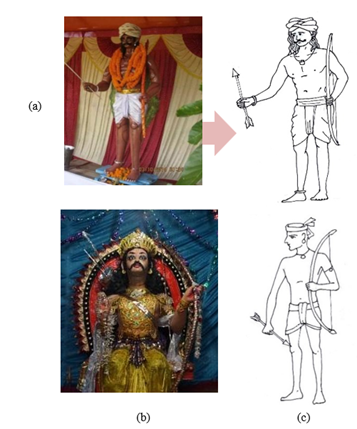
Figure 5 Shows the Images of the Alternate Representations of Mahishasur: Bir Rup -Illustration Added for Better Understanding of Body Highlights (A), Raj Rup (B) and an Artist’s Representation of a Santhal Warrior. The Character Highlights in Bir Besh Bears Resemblance with the Character Highlights in the Illustration (C). Source: (A)Mahisasura.Jpg (480×640) (Bp. Blogspot. Com) Photographer: Anonymous; Original Sketch (B) Samata Biswas for Dalit Camera (C) Original
Table 2
|
Table 2 Differences Between the State-Of-Art Representation of Mahishasur / Hudur Durga in Mainstream and Alternate Representations |
||
|
Highlight Elements |
Mainstream Representation |
Alternate Representation |
|
Body Type |
Bulky and Muscular |
Lean and Muscular |
|
Costume |
Short dhoti with armour / ornaments. Varies greatly in
theme-based pujas. |
Warrior Avatar (Birbesh): Short dhoti and turban. Kingly Avatar (Rajbesh): Long, gorgeous dhoti, armour and
ornaments crown. |
|
Weapons |
Sword and Shield. |
Bow and Arrow |
|
Pose |
Attacking; In action. |
Standing or seated. Calm and composed. |
|
Expression |
Mostly Fierce |
Calm |
Impact of the Alternate Character Highlights on the
body of Mahishasur amongst the Dominant Culture Group
To explore the possibility of acceptance of the alternate representation of Mahishasur among the populace of the dominant culture a questionnaire study had been conducted through random purposive sampling of Bengali Hindu individuals. Around 85 people responded.
Preferences
· The public perception among the Bengali Hindu group revealed a trend towards the mainstream representation of Mahishasur as portrayed in the Durga Puja idols. 59 out of 85 respondents (69.4%) preferred the mainstream representation.
· 16 respondents (18.8%) preferred the Warrior Avatar of Hudur Duga (Bir-rup).
· 10 respondents (11.8%) preferred the Kingly Avatar of Hudur Durga (Raj-rup).
· Cumulatively, around 30.6% of the respondents portrayed preference towards the alternate representations.
· The result shown in Figure 6 portrays the preference of the dominant culture group towards the mainstream representation, though some level of acceptance of the alternate representation can be seen.
Figure 6
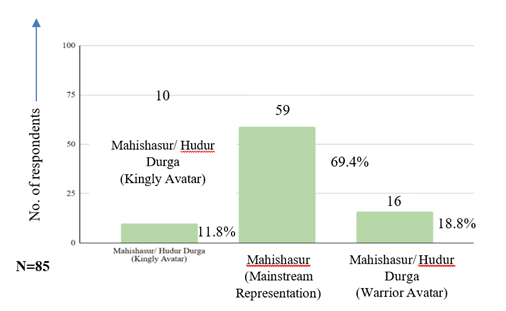
Figure 6 Demonstrates the Number of Bengali Hindus (With % Responses) Who Has Selected the Options- Mahishasur/Hudurdurga (Kingly Avatar), Mahishasur (Mainstream Representation) and Mahishasur / Hudur Durga (Warrior Avatar) Emphasizing Mahishasur (Mainstream Representation) As the Most Preferred
4. CONCLUSION
The basis of all human figurative imagination with highlighting characteristics is the human body. Any iconography born out of human perception occurs in relation to the human body. Any adjective attributed to the other body is in relation to the standard human body. Thus, it is no wonder that the representation of the Devas as beings of a higher realm transpires through the modification of human body through highlighting elements that renders qualities the designers perceived as other-worldly. On the body of the Asur, as the discussions with the idol-makers stated, the human designers portrayed the vices of the mortal world. Thus, the highlights applied were related to the physical realm. The character highlights rendered on a human anthropometric form alludes to two set of personalities dictated by body modification- the spiritual body of the Deva and the physical body of the Asur.
In the case of mainstream and alternate representations of Mahishasur, the alternate representations rendered identity by providing sameness of physical attributes as the populace he is representing- the Santhals. The differences in perception can be associated to the perception of the perceivers’ body- the mainstream strives to contrast the Asura (Demonic force) from the representation of the Devas (Godly force) while the alternate identified him as one of their own. This alludes to the questions of representation of local cultural identity as represented in Figure 7.
Figure 7

|
Figure 7 Demonstrates
A Visualization of Multiple Local Cultures Within a Broader Localized Culture
Through Colour. The Ring Outside Represents the Determining Perceptual
Boundary of a Culture That Renders a Local Culture Identity, Eg. Bengali
Culture, Assamese Culture, Etc. the Circles Inside Portray Different Cultures
Inside a Broader Culture Which Each Bear a Unique Identity and Cannot
Represent Each Other. Source: Original |
As Figure 7 represents through the usage of colour, multiple cultures simultaneously exist within a broader culture. A local culture can only be perceived only from outside as an individual inside a culture cannot view the extent of the culture. However, as Figure 7 shows, the multiple smaller cultures (smaller in terms of more specific identity- dialect, sub-group, demography, history, traditions, etc.) overlap each other creating confluence and mixture. The local cultures can be randomly placed but gets influenced by cultures in proximity in terms of history, religion, demography, traditions, geography, media transactions, financial transactions, etc. However, no matter how much impact each culture imparts on the other, even by creating dominant influence, none of the cultures can represent another, just like colours. The model in Figure 7 might be instrumental in understanding the differences in character representation among different cultures and the subsequent acceptance perception.
The responses of the perception study, as shown in Figure 6 showed that while the majority of Bengali Hindus still favour the mainstream representation, 30.6% (cumulative perception preferring the kingly avatar and the warrior avatar) have shown acceptance of a new alternate identity for Mahishasur which is a considerable percentage given the nature of the subject being dealt with.
In terms of acceptance of character representations, the Raj-rup of Hudur Durga resembles the representation of Hindu Devas. The difference has been attributed to differences in political positions of different positions in Dalit politics Sen (2022). From a designer’s perspective, the character highlights may have been influenced by the artisans working on the idol. Years of training in mainstream representations of Devas may have been an influential aspect in attributing heroic features to a new deity- this can be attributed to the lack of reference idol as the Santhals, following the Sari religion does not have temples or previous idol worshipping rituals Dey (2015). The alternate representations have primarily been derived from or as a reaction to the mainstream representation- from established character highlights prevalent for centuries. This temporal extent of such highlights and their recognizability may be a reason for their preference.
Construction of a new visual identity for Hudur Durga/ Mahishasur in resistance of the mainstream representation, consequently, creates an uncertain ground for cultural identity. Hudur Durga’s deitification, creates an identity of a cultural hero whereas, through the act of creation of the idol, the alternate indigenous culture evolves and takes over the instrument of the dominant mainstream. The employment of character highlights thus become instruments of character communication, creating contrast from the mainstream character representation yet aligning with it, rendering the character design with visibility and recognition among the mainstream public. The aspects of body dimensions and proportions amongst all the body parts renders highlighting to the character in context to the perception of the intended viewers. In today’s newer aesthetic representation thriving, such issues of value addition in expressive imagination can be further explored.
CONFLICT OF INTERESTS
None.
ACKNOWLEDGMENTS
The authors acknowledge filmmaker-photographers Suramya Dutta and Rittij Mazumdar, artist Sohan Soo and Deepanjan Bose for their help in the study.
REFERENCES
Adhikari, A., and Dash, K. (2020). Somatotype of Santal Tribal Women of West Bengal in India. Journal of the Anthropological Survey of India, 69(1), 93–101. https://doi.org/10.1177/2277436X20927229
Anderson, B. (2018). Opportunity in Crisis: Alternative Media and Subaltern Resistance. In T. H. Geelan (Ed.), From Financial Crisis to Social Change: Towards Alternative Horizons (115–128). Springer. https://doi.org/10.1007/978-3-319-70600-9_7
Baskey, S. (2020). Socio-Cultural Background and Changes of Santal Society in West
Bengal. International Bilingual Journal of Culture, Anthropology and
Linguistics (IBJCAL), 1(2–3), 55–60.
Bhowmick, P. K., and Jana, S. K. (2008). Community in Search of a New Identity: The Santal of West Bengal. In D. K. Behera and G. Pfeffer (Eds.), Contemporary Societies: Tribal Studies: Identity, Intervention and Ideology in Tribal India and Beyond (Vol. 7). Concept Publishing Company.
Census 2011. (n.d.). West Bengal Population, Sex Ratio, Literacy.
Dey, A. (2015, July–August). An Ancient History: Ethnographic Study of the Santhal. International
Journal of Novel Research in Humanity and Social Sciences, 2(4), 31–38.
Eftakhar, S. M. (2019,
January–June). Changing Pattern of Santali
Language: A Trilingual Situation and the Emerging Conflict. Jagannath
University Journal of Arts, 9(1), 141–152.
Gadjin, N., and Umeyo, H. (1973). On the Theory of Buddha-Body (Buddha-kāya). The Eastern
Buddhist, 6(1), 25–53.
Gaurav. (2020, July 6). The Six Enemies of the Mind (Arishadvarga/Shadripu). Medium.
Guha, S., and Ismail, M. (2015,
May–June). Socio-Cultural Changes of Tribes and
their Impacts on Environment. Global Journal of Interdisciplinary Social
Sciences, 4(3), 148–156.
Hawkes, J. (2001). The Fourth Pillar of Sustainability: Culture's Essential Role in
Public Planning. Common Ground Publishing.
Hembram, A. P. (2018, October
16). Durga Puja Marks a Period of Sorrow for
Kherwal Santhals: A Conversation with Ajit Prasad Hembram. GroundXero.
Ihlebæk,
K. A., Figenschou, T. U., Eldridge II, S. A., Frischlich, L., Cushion, S., and
Holt, K. (2022). Understanding Alternative News Media and its Contribution to
Diversity. Digital Journalism, 10(8), 1267–1282. https://doi.org/10.1080/21670811.2022.2134165
Joshi, D. K. (2013, October). Bijaya Dasami—The Victory of Good Over Evil. Odisha Review, 20–36.
Macdonell, A. A. (1916). The Development of Early Hindu Iconography. Journal of the Royal Asiatic Society, 48(1), 125–130. https://doi.org/10.1017/S0035869X00049091
Museum of Modern Art. (n.d.). The Body in
Art.
Paul, S. K., and Gupta, A. (2016). The Changing Cultural Pattern Among the Santals of Birbhum, West Bengal. South Asian Anthropologist, 16(1), 7–18.
Sen, M. (2022). From Demon to Deity: Forging a New Iconography for Mahishasur. Journal of Material Culture, 28(1). https://doi.org/10.1177/13591835221116708
UNESCO. (2012). Culture: A Driver and an
Enabler of Sustainable Development.
Wikipedia contributors. (n.d.). Hinduism in
West Bengal. Wikipedia.
Wikipedia contributors. (n.d.). Santal People. Wikipedia.
|
|
 This work is licensed under a: Creative Commons Attribution 4.0 International License
© ShodhKosh 2026. All Rights Reserved.