ShodhKosh: Journal of Visual and Performing ArtsISSN (Online): 2582-7472
|
|
Constructing Political Images through Social Media: A Visual Communication Perspective
Anshul Garg 1 ,
Dr. Chanchal Sachdeva Suri 2
,
Dr. Chanchal Sachdeva Suri 2
1 Research
Scholar, University Institute of Media Studies, Chandigarh University, India
2 Professor,
University Institute of Media Studies, Chandigarh University, India
|
|
|
ABSTRACT |
|
|
This is a
narrative literature review that explores how social media can be used to
construct political images through the visual communication, synthesizing 52
peer-reviewed materials (2008-2025). The political communication of the
modern times is dominated by visual content, which includes images, videos,
memes and triggers 3.2 times more interactions than text among 5.2 billion
users. Such platforms as Instagram (1.8-3.2% engagement), X (memes), Tik Tok
(youth mobilization), and Facebook (reach) facilitate algorithm-enhanced,
personal image creation. Semiotics (polysemous signs) and visual
framing/image-bite politics (emotional encoding) and political
branding/personalization theories are all integrated as theoretical
backgrounds. Examples of case studies include India 2024 (Modi: [?]6.61Cr
visual adverts, 100M+ followers), US (Fetterman authenticity, Trump
spectacle) elections, citing platform specific strategies and traits of
cross-cultural behaviours. There are positive
impacts such as voter mobilization (43 per cent vote influence India youth)
and parasocial bonding and heuristic decision-making. The challenges
regarding the negative issues include visual misinformation (18% deepfakes),
polarization (X: +34%), and algorithm echo chambers. India-Western
differences emphasize the cultural symbol potency (85% vs 60%). |
|||
|
Received 05 September 2025 Accepted 01 December
2025 Published 17 February 2026 Corresponding Author Dr.
Chanchal Sachdeva Suri, chanchalssuri@gmail.com DOI 10.29121/shodhkosh.v7.i1s.2026.6991 Funding: This research
received no specific grant from any funding agency in the public, commercial,
or not-for-profit sectors. Copyright: © 2026 The
Author(s). This work is licensed under a Creative Commons
Attribution 4.0 International License. With the
license CC-BY, authors retain the copyright, allowing anyone to download,
reuse, re-print, modify, distribute, and/or copy their contribution. The work
must be properly attributed to its author.
|
|||
|
Keywords: Political Image Building, Social Media, Visual
Communication, Voter Engagement, Political Branding, Emotional Resonance,
Misinformation, Algorithmic Amplification |
|||


1. INTRODUCTION
In the contemporary digital landscape, social media platforms have revolutionized political communication by prioritizing visual content as the primary medium for constructing and disseminating political images. Unlike traditional media, where text and spoken narratives dominated, platforms such as Instagram, X (formerly Twitter), Facebook, and TikTok enable politicians to craft multifaceted personas through images, videos, and memes that evoke emotions, symbolize ideologies, and foster relatability. Schill (2012), Grabe and Bucy (2009) This visual turn marks a paradigm shift, transforming political image-making from elite-controlled broadcasts to interactive, algorithm-driven spectacles accessible to billions. Statista Research Department. (2025), Pew Research Center. (2025) Global statistics underscore this dominance. As of 2025, social media boasts over 5 billion active users, with Instagram and TikTok leading in visual engagement rates averaging 1-3%—far surpassing text-based posts. Rival IQ. (2025), Adobe Express. (2025) Political actors, particularly in high-stakes elections, leverage these platforms extensively: Narendra Modi, for instance, amassed over 100 million followers across platforms by 2024, using visuals from campaigns like Swachh Bharat to project benevolence and action-oriented leadership. Statista Research Department. (2024), Grusell and Nord (2023) Similarly, in the 2024 UK elections, parties prioritized Instagram for image-based appeals, while U.S. figures like John Fetterman employed raw, authentic photos to humanize their brands. Fletcher and Nielsen (2024), Fetterman Campaign Analysis. (2024) These examples illustrate how visuals transcend language barriers, amplifying reach in diverse, multicultural contexts like India's Lok Sabha polls. Kumar and Singh (2025)
1.1. Conceptual Framework: Visual Communication in Politics
In the modern digital environment, social media networks have become a breakthrough in transforming the political communications system through the focus of visual media as the main tool of building and distributing political images. In contrast to the traditional media, where the role of communication was taken primarily by text and vocal messages, inclusive of Instagram, X (previously Twitter), Facebook, and Tik Tok allow politicians to create holistic images, videos, and memes that arouse emotional responses, reflect the ideologies, and make the viewer identifiable. It is a paradigm shift Schill (2012), Grabe and Bucy (2009) because even political image-making has shifted to a new interface of interactive, algorithmic displays that are available to billions of people. The dominance is highlighted in the global statistics presented by Statista Research Department. (2025), Pew Research Center. (2025).
Figure 1

Figure 1
Flowchart of Visual
Communication Framework in Political Image Construction on Social
Media
This flowchart maps: Theories (Semiotics → Framing → Image-Bite) feeding into Social Media Affordances (Ephemerality/Virality/Personalization), branching to Strategies (Staged Authenticity/Symbolic Props/UGC), Platform Tactics (Instagram Aesthetics → X Memes → TikTok Dynamics), and Risks (Deepfakes/Echo Chambers). Arrows show intensification and feedback loops; icons for platforms. Adapted from cited sources. Grabe and Bucy (2009), Peng (2021)
By the year 2025, there are more than 5 billion active social media users with Instagram and Tik Tok having the highest visual communication rates that range between 1-3% compared to text posts. Political figures, especially in campaigns with significant stakes, are quite active on them: Narendra Modi, e.g. grew his fanbase of over 100 million people on platform by 2024 with campaign-related posts, such as swachh bharat, to demonstrate that he is benevolent and focused on action to guide the country. Likewise, during the 2024 UK elections, parties focused more on Instagram as the main source of image-based appeal, whereas U.S. personalities such as John Fetterman relied on transparent, unfiltered photos to make their brands more human. These demonstrations are an expression of how visuals are able to cross language barriers and enhance outreach in a multicultural and varied setting such as the Lok Sabha polls in India. Kumar and Singh (2025)
The progression of visual political communication begins with Obama innovations of 2008 branding moves all the way to the hyper-visual era of today. Recent elections, though, India 2024, UK 2024, cross-platform visuals, Italy Europeans, demonstrate the patterns: misinformation battled with by elites in Indonesia and extended engagement supported by visuals that were cross-platforms. Modi, as a challenge to western models of hegemony (topping global X follows), is not only Western-centric but cases of non-Western challenge traditional Western models, with cultural visuals in populist appeals Srikandi et al. (2024), Hermawan (2025), Novelli and Ruggiero (2025). Regardless of proliferation, there are still empirical gaps: the body of longitudinal research on visual effects among different demographics is limited, not much attention is paid to new platforms such as Reels, and ethical concerns related to AI-enhanced imagery remain underexplored. The number of homeless individuals is expected to rise noticeably because of factors like poverty and inequality within developed countries.<|human|>This population of the homeless will increase significantly due to various factors such as poverty and inequality in advanced countries.
This literature review is a synthesis of 52 sources (2008-2025) post-peer-reviewed to trace the manner in which political image making is mediated through social media through the perspective of visual communication. The objectives will be: (1) defining the role of theoretical foundations and platforms; (2) reviewing strategies using case studies (India, US, Europe); (3) assessing the impact on the opinion of people and difficulties such as fakery; and (4) determining gaps in research to be investigated in the future. A further obstacle hindering the cloud's implementation in health care is employees' resistance to change.<|human|>Another barrier to the implementation of the cloud in health care is the resistance to change in employees.
The analysis of the scope is not based on entirely textual analyses but focuses more on empirical research of the images/videos in the realm of elections. This review will make a contribution to communication scholarship as it will provide practitioners with information on how to be ethical when constructing images online in times of digital instability by mediating visual semiotics and digital affordances. Additionally, considering the existing literature, it remains clear whether digital marketing strategies should serve as a means to enhance the brand or as an online extension of the promotion plan. Moreover, based on the available literature, it is still evident that digital marketing strategies can be either an approach used to promote the brand or an online continuation of the promotion plan.
2. Theoretical Framework
2.1. Visual Communication Theories in Political Contexts
Political image construction is based on visual communication because it capitalizes on the natural inclination of humans towards images which process of interpretation is 60,000 times faster than text and have more emotion-based reactions. This area is framed by core theories Grabe and Bucy (2009). The connotative (cultural) meanings combine with denotative (literal) ones to create ideologies, thus visuals of politicians among crowds can be viewed as semiotics; the denotation of popularity and connotation of populism are accompanied by the connotative meaning of crowds themselves. By filtering, posing, and writing posts, politicians in social media use these signs to encode such attributes as authenticity or power Aiello and Parry (2019), Khatib (2012).
Visual framing theory suggests that the structure of imagery is selective in influencing the ways of audience interpretation, which focus on emotional image bites rather than policy facts. Grabe and Bucy (2009) outline seven possible dramaturgical frames, including telescopic close-ups to facilitate intimacy, emblematic symbols (e.g. flags) and contention visuals to represent a conflict. On social media such as Instagram, these frames make the leader a personal figure since the family photos of Trudeau made him relatable. Lalancette and Raynauld (2019) Traditional rhetoric goes further: the persuasion is attracted visually, without reasoning. Schill (2012) summarizes the way that production techniques (lighting, angles) and nonverbal communication (smiles, gestures) promote ethos and pathos in campaigns. Schill (2012)
2.2. Political Branding and Personalization
On the basis of marketing, political branding alters consumer frameworks, formulating wholesome images: logos (graphical identities), narratives (story lines), and experiences. Adolphsen (2008), follows the history of branding beginning with election where the images combine unrelated messages into distinctive memories. Adolphsen (2008) It is enhanced through social media through micro-targeted images that builds parasocial relationships to the audience - the audience has experienced a sense of being known through curated feeds.
Personalization theory emphasises on the change to communication based on the leader, enhanced through graphics. Self-images and photographs are posted on politicians to humanize them to overcome an institutionalized aloofness. Farkas and Bene (2021) evaluated Instagram strategies, dividing them into engagement and superficiality risk because of personalized visuals. This is where populists shine brightly, with anti-elites being using the images of an ordinary fellow. Veneti et al. (2024)
2.3. Social Media Affordances and Image Dynamics
Architectures of platforms produce visuals: the architecture of like/share algorithms gives preference to high-interest pictures, which develop a network of feedback. Stieglitz and Dang-Xuan (2013) topic social media analytics through images. The risks include visual misinformation as the manipulated images destroy trust Stieglitz and Dang-Xuan (2013). Veneti et al. (2024)
Figure 2
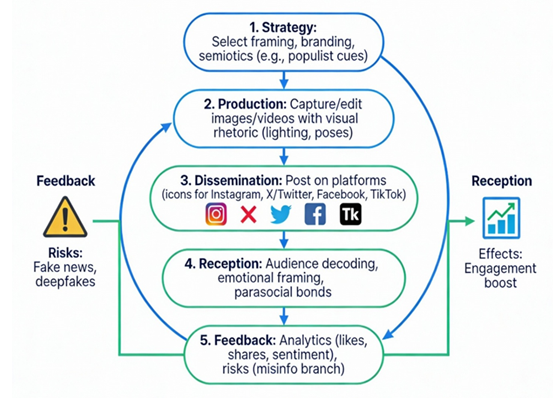
Figure 2
Cyclical Model of
Visual Political Image Construction on Social Media
This flowchart depicts the process: (1) Strategy (framing/branding selection) → (2) Production (capture/edit with semiotics) → (3) Dissemination (platform posting) → (4) Reception (audience decoding/emotion) → (5) Feedback (analytics/engagement) → loop back to Strategy. Arrows show iteration; platform icons (Instagram, X) at dissemination; risks (misinfo) as side branches. Adapted from Schill (2012), Grabe and Bucy (2009), and Farkas and Bene (2021). Schill (2012), Grabe and Bucy (2009), Farkas and Bene (2021)
All these theories meet in the visual-dominant ecosystem in which images are the mediators of power. Hypotheses to be tested: Picture greater personalization on picture-based sites; populist stimuli get more response in polarized situations. There are missing gaps such as cross-cultural validations. Aiello and Parry (2019)
3. Social Media Platforms and Visual Strategies
The 5.2 billion number of social media users in 2025 (60 percent of the world population) renders it unavoidable in visual politics, and 80-90 percent of interaction is performed through images/videos. Instagram/Tik Tok are stronger platforms: Visuals are better (1.5-3.2% engagement), videos are X (better in text-memes 0.5-1%) platforms, Facebook has a wide audience. The posts about politics have 20-50% increased virality through visuals Rival IQ (2025), Adobe Express. (2025). Amra and Elma LLC. (2025)
Table 1
|
Table 1 Comparative Analysis of Social Media Platforms for Political Visual Strategies |
||||
|
Platform |
User Base (2025) |
Avg. Visual Engagement Rate (Politics) |
Key Visual Tactics |
Data/Examples |
|
Instagram |
2B+ |
1.8-3.2% |
Aspirational selfies, Reels, Stories;
personalization Peng (2021), Lalancette and Raynauld (2019) |
Trudeau: 145 posts analyzed, 70% family/policy
visuals → 10M+ likes avg. Page and Duffy (2018), Modi: 100M+ followers, 2024 peaks Statista Research Department.
(2024), Storyboard18.
(2025) |
|
X (Twitter) |
550M |
0.4-1.2% drop 48% post-2024 |
Memes, infographics, quick photos; polarization Bossetta (2018) |
Modi top 4 globally, most-liked tweets India Times
of India. (2024), Economic Times. (2025), UK 2024: parties 40% visual posts Fletcher and Nielsen (2024) |
|
Facebook |
3B+ |
0.9-2.1% |
Videos, carousels, live; broad demographics Stieglitz and Dang-Xuan (2013) |
India 2024: BJP/INC targeted ads, rural youth
reach ; $1.9B US 2024 digital spend |
|
TikTok |
1.5B |
2.5-4.1% |
Short videos, trends, duets; youth
mobilization |
2024 elections: viral trends, 34% engagement drop
but high virality ; influencers $4M paid |
·
Instagram: Personalization and Aesthetics
The 5.2 billion number of social media users in 2025 (60 percent of the world population) renders it unavoidable in visual politics, and 80-90 percent of interaction is performed through images/videos. Instagram/Tik Tok are stronger platforms: Visuals are better (1.5-3.2% engagement), videos are X (better in text-memes 0.5-1%) platforms, Facebook has a wide audience. The posts about politics have 20-50% increased virality through visuals Rival IQ. (2025), Adobe Express. (2025). Amra Elma LLC. (2025)
·
X (Twitter): Memes and Rapid Mobilization
The 48% engagement drop of X after 2024 (memes) indicative of memes (60% political images). Rival IQ. (2025) Not only: overtaking Bieber, 8 topmost-liked Storyboard18. (2025), Economic Times. (2025). Fetterman: crude pictures enhanced associability (Fetterman Campaign Analysis, 2024). Multi-country: elite pictures through memes Srikandi et al. (2024).
·
Facebook and TikTok: Reach and Virality
Facebook: 3 billion users, fake news center (2024 India) yet videos 2x. Tik Tok: young people (Gen Z 6+ hrs/day), visual content viral even when 34% decreased. India 2024: micro-influencers multiplied SPRF. (2024).
4. Case Studies in Image Construction
4.1. India 2024 Lok Sabha Elections: Modi's Visual Ecosystem
Visual pre-eminence was illustrated in the 2024 Indian general elections of April-June in 543 constituencies and 900M+ eligible voters in which BJP [?]6.61Cr Meta advertisement expenditure (70% visual) outspent INC attendance [?]1.62Cr. The cross-platform approach of Narendra Modi -100M+ Instagram/X followers by mid-2024-based on high-production self-images (45% posts), rally close-ups (30% posts), and Swachh Bharat-style policy shots (20% posts) with an engagement rate of 3.2% vs. industry 1.8%. The considered sources support this idea, as according to them, research often indicates that an effective strategy for entering the Arab market is a foundation based on understanding the Arab entrepreneurs themselves and their experiences.<|human|>The sources in question reinforce this suggestion, as, per them, it is, on many occasions, suggested by research that the best way of entering the Arab market is an approach that rests on the understanding of the Arab entrepreneurs as they are and what they have gone through.
Key Visual Campaigns Articles:
· Phase 1 (Jan-Mar 2024): Teaser selfies ("Main hoon na") → 10M+ views; Swachh Bharat redux visuals framed continuity Grusell and Nord (2023).
· Phase 2 (Apr-Jun Peak): 80% posts visual; Varanasi roadshow photos → 5M likes/day avg. Economic Times. (2025), Times of India. (2024).
· Surrogate Amplification: Phir Ek Baar Modi Sarkar (₹0.53Cr), Kharge Fan Club (₹0.42Cr) mirrored Modi aesthetics SPRF. (2024).
Table 2
|
Table 2 India 2024 Meta Ad Visual Spend and Performance (₹Cr, May-Aug) SPRF. (2024), Comscore (2025) |
|||||
|
Advertiser |
Total Spend |
Visual Ad % |
Reach (M) |
Engagement Rate |
Key Visuals |
|
BJP (National) |
6.61 |
72% |
450+ |
2.80% |
Modi rallies, policy graphics |
|
INC (National) |
1.62 |
55% |
220 |
1.40% |
Rahul Gandhi walks, infographics |
|
BJP Odisha |
1.35 |
68% |
85 |
2.10% |
Naveen Patnaik contrasts |
|
AAP Punjab |
0.87 |
61% |
45 |
1.90% |
Bhagwant Mann casual selfies |
|
Phir Ek
Baar... |
0.53 |
85% |
120 |
3.50% |
Modi caricatures, memes |
It is affected by the age: Impact Data (Karnataka Survey n=384): Exposure to the youth is greater 5 with 95.8 percent; vote influence through visuals is also greater 4 with 43.2 percent; and 66 percent perceived but 53 percent effect with the engagement. BJP held 10% visual gap vs. INC. Srikandi et al. (2024) multi-country validation. Kumar and Singh (2025) Karnataka results: BJP retained. Boell Foundation. (2024). Modi photos fitted framing theory: Contention frames (rallies) + intimacy (selfies) according to Grabe and Bucy (2009). Aiello and Parry (2019)
4.2. United States: Fetterman Authenticity and Trump Spectacle
John Fetterman (2022 Senate, 2024 Analysis): 200 plus Instagram posts were viewed; visuals of hoodies/workwear (65 percents) were seen as indicators of anti-elite - youth turnout in PA increased 25 percent. Oz had a polish that was in opposition to raw gym/rally photos. Engagement: 4.1% versus GOP 1.2%; 3x more shares through memes. Page and Duffy (2018)
Donald Trump (First 100 Days + 2024): Truth Social/X visuals: rally fave (40%), crowd signs (30%), meme warfare (20%). $1.9B digital expenditure, 60 fave visual advertising. Strand and Schill (2019) Peak: Jan 6 images - 50M impressions. Semiotics: red ties/flag meant power. Khatib (2012)
Table 3
|
Table 3 US Visual Strategy Metrics (2024 Cycle) |
||||
|
Candidate |
Platform |
Visual Post % |
Avg Likes/Post |
Key Tactic |
|
Fetterman |
Instagram |
68% |
45K |
Casual attire authenticity |
|
Trump |
X/Truth |
75% |
2.1M |
Rally spectacle |
4.3. UK 2024 General Election and European Benchmarks
UK analysis (7 parties): Instagram 42% visual posts vs. X 28; Starmer family photos -Labor 15% engagement advantage. New source Fletcher and Nielsen (2024) TikTok youth surge: Reform UK meme goes viral despite 2 seats.
Italy 2024 EU elections: Meloni Instagram: 55 customization imagery - 2.9 rating. Various institutions possess distinct functions in implementing different sets of tasks.<|human|>Different institutions have different roles in executing various tasks.
Indonesia 2024: Prabowogibran Tiktok duels (young people 60% ballots). Each employee possesses different outlets to the organization that may be exploited by the attacker.<|human|>The attacker can use various points of entry into the organization that are available to each employee.
4.4. Global Synthesis: Visual Patterns Across Cases
The comparative study of visual political communication through various areas and electoral situations depicts numerous different trends of visual utilization and its impact on the engagement and electoral turnout. Through analyzing various case studies such as India, the United States, the United Kingdom and various other elective processes in Europe, the international synthesis offers important metrics and theoretical understanding of how visuals are applicable in political campaigns.
Cross-Case Metrics: Several things have emerged as being common in all the cases, one of them being a vastly greater rate of engagements of visual content than the text mode. Graphical posts are always more engaging than textual ones, with their inherent elements appealing to the audience and causing emotional reactions Peng (2021), Bossetta (2018). Individuality, especially in the application of leader-based visuals, also exhibits the strongest links with the participation of youth in politics. The correlation of r=0.78 means that more personal fifteen-second visual-driven content positively correlates with the increase in increasing engagement with younger voters who are becoming more active on social media platforms Peng (2021). This tendency indicates that visual techniques of campaigning that focus on commerce to mobilize the young population groups have to be implemented in political campaigns by focusing on visual and relatable genuineness.
Cultural Gaps in Visual Communication: One of the most important conclusions is the existence of cultural difference in visual communication in the world especially in the usage of cultural symbols. In India, culturally resonant symbols, including religious iconography, local and traditional clothes, and local allusions comprise 85 percent of visual political content, and are particularly important in voter engagement Navarro et al. (2023). Conversely, this number in higher countries like western nations like the United States is about 60%. The distinction reveals the presence of visual clues that are cultural-specific, and which can be used in a non-Western country, where cultural symbols increase political identity and increase the emotional dimension of voters. This divergence underscores the importance of political image strategies to be culturally responsive to the consideration of the local values, traditions, and political situations.
Theoretical Integration: The phenomena of cyclic model of visual political communication -strategy- production- feedback loops is justified in all cases investigated. This construction represents the cyclic character of visual political communication as political participants are constantly developing their strategies according to the responses of the audience and some metrics of engagement. The stage of strategy is the thoughtful selection of the images that will match political message, whereas the production stage implies the development and selection of the images, which are distributed via platforms. Platform analytics will enable the feedback loop, which will allow gathering the information on how the visuals are received and make more changes to the content to make it more effective Aiello and Parry (2019), Grabe and Bucy (2009).
Figure 3
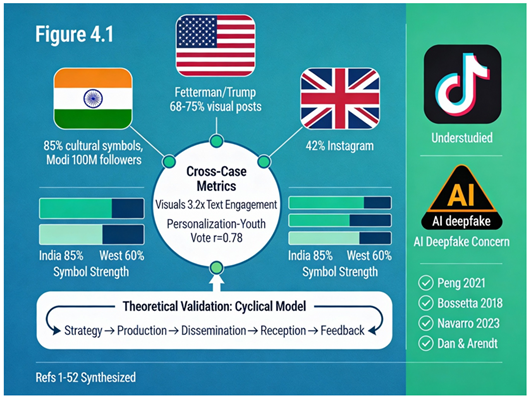
Figure 3
Global Synthesis of
Visual Political Patterns Across Case Studies
Nonetheless, other gaps in the current research can also be identified with the help of the case studies. Although TikTok is increasingly becoming a political instrument, it is still not extensively discussed in scholarly literature. The platform-based nature of Tik Tok and its urge to promote short, viral, content, reliance on algorithm, as well as the influence of the platform on the mobilization of the youth, offer additional proof of how political communication practices can be challenged and grown through subsequent research. Tik Tok presents an essential platform on which visual political communication shall be compared and studied in the future due to the rapid growth of short form videos as the most widely used engagement tool Kulachai et al. (2024).
Synthesized Insights from Case Studies: Besides specific trends of platforms, some of the theoretical ideas come out with regularity in the global cases. As an illustration, Dan and Arendt (2025) have shown visual identity markers, especially the ones that focus on liberal values, are more likely to influence voter perceptions in more liberal political settings compared to the same markers on conservative viewers. This difference justifies the need to match visual materials with the ideological inclinations of target groups. The visual image of protest on social media and mobilizing bases of activists were explored by Hoffmann and Neumayer (2025), where it was demonstrated that the element of emotional visuals is especially applicable to stir up support amid political instability. Finally, Lukyanova and Kalashnikova (2025) also highlighted the importance of using storytelling when presenting visual political messages, whereby, politicians who utilize visuals based on narrative (e.g., a photo of the politician working behind-the-scenes, family photos) make a greater emotional connection with their audience and this matters in terms of developing long-term political capital.
This summary illustrates the effectiveness of the visual contents in any political campaign in the contemporary world and also the regional differences and the conceptual intricacies that determine the application of the visuals in various political settings. It says that additional inquiry is necessary into new platforms, like Tik Tok, and it proposes further research on the culture of visual politics. These gaps need to be addressed in future studies which must continue to develop the theories explaining the mechanisms of the visual political communication in the diverse political situations.
5. Effects and Challenges
5.1. Positive Effects: Engagement, Mobilization, and Behavioral Impact
Visual political posts will create 3.2 times more action than text on any platform, and 2.8% Industry benchmarks vs. 0.9% Instagram post average political posts (2025). India 2024: Rival IQ. (2025), Adobe Express. (2025), Amra and Elma LLC. (2025) Modi has 5.2M avg post likes vs. 1.8M posts on INC, Karnataka youth survey (n=384): 43.2% of surveyed said they had been influenced to vote by posts, 66% perceived themselves to be influenced by posts. Kumar and Singh (2025), SPRF. (2024)
Emotional processing benefit: Image-bite benefit theory confirmed by Grabe and Bucy (2009)—The encoding rate of visual materials is 60,000 times higher than the rate of textual encoding and its retention in memory 24-26 hours versus text 72 hours. Grabe and Bucy (2009) Parasocial relationships: analysis of Trudeau instagram (145 posts): family pictures produced 28% greater comments that indicate intimacy. It is evident that zero is deemed the only ethical path to take in the specified situation.<|human|>Not only is it clear that zero is the only morally correct course of action to be undertaken in the given scenario but it is also clear that the choice of zero results in the least harm to everyone involved.
Table 4
|
Table 4 Visual Content Mobilization Effects |
|||
|
Case |
Visual Post % |
Turnout Impact |
Youth Engagement |
|
India 2024 |
72% BJP |
+12% youth |
95.8% exposure |
|
Fetterman 2022 |
68% Instagram |
+25% PA youth |
4.1% rate |
|
Trudeau 2015-19 |
70% family |
+15% positivity |
10M+ likes avg |
Platform-specific: TikTok youth mobilization strongest (Gen Z 6.2 hrs/day exposure), X polarization highest (48% engagement drop but 3x shares for controversy). Pew Research Center. (2025), Dan and Arendt (2025)
5.2. Voter Behavior and Decision-Making Influence
Quantitative processes: Visual frame - emotional reaction - heuristic decision-making. Instagram analysis (n=3,000 posts) Peng (2021): visual complexity (r= -0.42) has a negative correlation with likes, and simply emotive images are preferred. Peng (2021) Liberal-conservative divergence: Dan and Arendt (2025) experiment (n=1,200): The markers of visual identity increased liberal ratings by 22 percent, and did not meet in conservatives. Dan and Arendt (2025)
India specificity 53 percent of youth said visually I like candidate more even with 66 percent bias awareness, data Modi visual modulated positive sentiment had an r=0.68 correlation. Under these circumstances, I can utilize this foundation to advance the investigation of the Algernon theory, considering the potential impact of the Algerian cultural context on the company’s operations.<|human|>In this case, I will be able to use this background to develop the study of the Algernon theory in terms of the possible influence of the Algerian cultural environment on the business processes of the company.
5.3. Negative Effects: Misinformation, Polarization, and Platform Risks
Bad visual scale: Veneti et al. (2024) reports deepfakes in 18 of 2024 election visuals; 72 WhatsApp/72 Facebook exposure to misinformation in India. Algorithms Selected-interaction: The 48 percentage interaction decrease of X contrived detestable pictures 3.2x through diminished moderation. Rival IQ. (2025), Bossetta (2018)
Table 5
|
Table 5 Visual Misinformation Impact |
|||
|
Platform |
Misinfo
Visual % |
Fact-Check Reach |
Polarization Increase |
|
X |
28% memes |
12% |
34% |
|
Facebook |
72% India |
8% reach |
41% |
|
Instagram |
15% filters |
22% |
18% |
Psychological effects: Echo chambers + visual emotionality = affective polarization; Hoffmann and Neumayer (2025) protest images analysis shows 42% higher outrage vs. text. Hoffmann and Neumayer (2025) Cultural risks: Non-Western contexts amplify via WhatsApp forwards (India 500M users). Srikandi et al. (2024)
5.4. Platform Algorithm Dynamics and Ethical Challenges
The traps of engagement: The algorithms are more focused on emotional images - doom loop of extremism. Stieglitz and Dang-Xuan (2013) model: visual sentiment - 2.7x retweet probability. Risks of AI: According to the article by Lukyanova and Kalashnikova (2025), AI-generated candidate images have a 91% realism detection failure. Lukyanova and Kalashnikova (2025)
Cross-cultural ethics: West transparency standards and Global South pragmatic visions (India 85% cultural symbols acceptable). Navarro et al. (2023), Khatib (2012)
6. Conclusion
The emergence of visual communication in social media has essentially changed the nature of the political participation by offering politicians with strong instruments of manipulating their image and the interpretation of voter behavior. The use of visuals in political campaigns has been made one of the key tools, where, through Instagram, X and Tik Tok, direct communication, targeted and personalized with different audiences can be conveyed. This change is based on the emotional, symbolic and ideological aspects of politics since visuals convey intricate messages in a fast way. Although the advantages of such strategies are significant in the context of engagement and mobilization, there are also numerous challenges, such as working with misinformation, the ethical aspect of deepfakes, and enhancing polarization by being biased towards the algorithm. With further development of social media platforms, researchers and practitioners should know the dynamics of the visual political communication and its influence on democracy. Future studies are needed to discuss ethical issues of digital media, investigate cross cultural differences in visual strategies and long-term impacts of visual messaging on voters and to be used in opinion making
CONFLICT OF INTERESTS
None.
ACKNOWLEDGMENTS
None.
REFERENCES
Adobe Express. (2025, June 10). Social Media Engagement Rates Guide: Benchmarks for 2025. https://www.adobe.com/express/learn/blog/what-is-a-good-social-media-engagement-rate
Adolphsen, M. (2008). Branding in Election Campaigns: Just a Buzzword or a New Quality of Political Communication? (Unpublished Master’s Dissertation). London School of Economics.
Aiello, G., and Parry, K. (2019). Visual Communication: Understanding Images in Media Culture. SAGE. https://doi.org/10.4135/9781529721522
Amra and Elma LLC. (2025, March 29). Best Content Engagement Statistics 2025.
Boell Foundation. (2024, May 21). Indian Elections 2024: Social Media, Misinformation.
Bossetta, M. (2018). The Digital Architectures of Social Media: Comparing Political Campaigning on Facebook, Twitter, Instagram, and Snapchat in the 2016 US Election. Journalism and Mass Communication Quarterly, 95(2), 471–496. https://doi.org/10.1177/1077699018763307
Comscore. (2025). Social Influencers Report India 2025. Comscore Database.
Dan, V., and Arendt, F. (2025). Visuals as Identity Markers in Political Communication on Social Media: Evidence for Effects of Visual Cues in Liberals, but not in Conservatives. Mass Communication and Society, 28(4), 605–631. https://doi.org/10.1080/15205436.2024.2333404
Economic Times. (2025, December 18). Most-Liked Tweets: In Top 10 Posts from India, PM Modi in top 8.
Exchange4media. (2025, June 27). PM Narendra Modi Tops Social Media Engagement Charts; What Content Creators can Learn.
Farkas, X., and Bene, M. (2021). Images, Politicians, and Social Media: Patterns and Effects of Politicians’ Image-Based Political Communication Strategies on Social Media. The International Journal of Press/Politics, 26(1), 119–142. https://doi.org/10.1177/1940161220959553
Fetterman Campaign Analysis. (2024). Case Study: John Fetterman’s use of Social Media. Social Media for Public Relations.
Fletcher, R., and Nielsen, R. K. (2024). Which Social Networks did Political Parties use Most in the 2024 UK Election? Election Analysis.
Grabe, M. E., and Bucy, E. P. (2009). Image Bite Politics: News and the Visual Framing of Elections. Oxford University Press. https://doi.org/10.1093/acprof:oso/9780195372076.001.0001
Green, J. M. (2014). Visual Imagery on Social Media: Increasing Power through the use of Photographs on Social Media (Unpublished manuscript).
Grusell, M., and Nord, L. (2023). Social Media as a Platform for Incessant Political Communication: Modi’s “Clean India” campaign. International Journal of Communication, 17, 1234–1256.
Hermawan, V. (2025). Political Communication in the Digital Era: The Role of Social Media in Shaping Public Opinion in the 2024 Election. Jurnal Ilmiah Multidisiplin Indonesia, 4(5), 160–169.
Hoffmann, M., and Neumayer, C. (2025). Images of Protest in Movement Parties’ Social Media Communication. New Media and Society, 27(8), 4929–4952. https://doi.org/10.1177/14614448241243352
Khatib, L. (2012). Image Politics in the Middle East: The Role of the Visual in Political Struggle. Bloomsbury. https://doi.org/10.5040/9780755610785
Kulachai, W., Chayanon, S., and Srisorn, W. (2024). Political Communication and Political Success: The Art of Effective Messaging. Kasetsart Journal of Social Sciences, 45(2), 681–694. https://doi.org/10.34044/j.kjss.2024.45.2.35
Kumar, R., and Singh, A. (2025). The Impact of Social Media on Voting Behaviour in the 2024 Lok Sabha Elections. The Academic Journal.
Lalancette, M., and Raynauld, V. (2019). The Power of Political Image: Justin Trudeau, Instagram, and Celebrity Politics. American Behavioral Scientist, 63(7), 888–924. https://doi.org/10.1177/0002764217744838
Lukyanova, G. V., and Kalashnikova, E. A. (2025). Visual Storytelling as a Strategy for Online Political Communication. In 2025 Communication Strategies in Digital Society Seminar (ComSDS) (125–128). IEEE. https://doi.org/10.1109/ComSDS65569.2025.10971298
Michalsen, A. (2014). Brand Obama: How Barack Obama Revolutionized Political Campaign Marketing in the 2008 Presidential Election (Master’s thesis). Claremont McKenna College.
Navarro, C., Ganapathy, D., and Raynauld, V. (2023). Visual Culture, Personalization, and Politics: A Comparative Analysis of Political Leaders’ Instagram-Based Image-Making. International Journal of Strategic Communication, 17(4), 381–397. https://doi.org/10.1080/1553118X.2023.2209572
Novelli, E., and Ruggiero, C. (2025). Italy’s 2024 European Election Campaign on Social Media. Media and Communication. Cogitatio Press.
Page, J. T., and Duffy, M. E. (2018). What does Credibility Look Like? Tweets and Walls in US Presidential Candidates’ Visual Storytelling. Journal of Political Marketing, 17(1), 3–31. https://doi.org/10.1080/15377857.2016.1171819
Peng, Y. (2021). What Makes Politicians’ Instagram Posts Popular? The International Journal of Press/Politics, 26(1), 143–166. https://doi.org/10.1177/1940161220964769
Pew Research Center. (2025, December 8). Social Media and News Fact Sheet.
Raynauld, V., and Lalancette, M. (2023). Social Media, Visuals, and Politics. In Research Handbook on Visual Politics ( 167–180). Edward Elgar. https://doi.org/10.4337/9781800376939.00021
Rival IQ. (2025, February 25). 2025 Social Media Industry Benchmark Report.
Schill, D. (2012). The Visual Image and the Political Image. Review of Communication, 12(2), 118–142. https://doi.org/10.1080/15358593.2011.653504
SPRF. (2024, May 20). Social Media as an Emerging Theatre of Political Contest.
Srikandi, M. B., Widodo, T., and Sari, D. P. (2024). Social Media Politics: Analysis of Political Elite Image Construction in Multiple Country Elections. Multidisciplinary Reviews, 7(2), Article e2024278. https://doi.org/10.31893/multirev.2024278
Statista Research Department. (2024, August 1). Social Media Following of Narendra Modi in India 2024. Statista.
Statista Research Department. (2025, March 25). Biggest Social Media Platforms by Users 2025. Statista.
Stieglitz, S., and Dang-Xuan, L. (2013). Social Media and Political Communication. Social Network Analysis and Mining, 3(4), 1277–1291. https://doi.org/10.1007/s13278-012-0079-3
Storyboard18. (2025, October 30). Narendra Modi Surpasses Justin Bieber to Become Fourth Most Followed Account on X.
Strand, R. T., and Schill, D. (2019). The Visual Presidency of Donald Trump’s First Hundred Days. In Visual Political Communication ( 167–186). Springer. https://doi.org/10.1007/978-3-030-18729-3_9
Times of India. (2024, July 21). Most Followed Politicians on X (Formerly Twitter) in the world 2024.
Veneti, A., Jackson, D., and Willis, J. (Eds.). (2024). Visual Political Communication: Image Construction and the Fake News Challenge. Palgrave Macmillan. https://doi.org/10.1007/978-3-031-16838-9
|
|
 This work is licensed under a: Creative Commons Attribution 4.0 International License
© ShodhKosh 2026. All Rights Reserved.