ShodhKosh: Journal of Visual and Performing ArtsISSN (Online): 2582-7472
|
|
Emotion-Aware Clothing Design: Integrating Sentiment Analysis with Generative Fashion Sketching
Jasmeet Kaur 1 , Khushboo 2
 , Garishma Jain 3
 , Mukesh Govindrao
Jadhav 4
, Mukesh Govindrao
Jadhav 4 , Dr. Priti Shende 5
 , Dr. Jambi Ratna
Raja Kumar 6
, Dr. Jambi Ratna
Raja Kumar 6
1 Department
of Computer Applications, CT University Ludhiana, Punjab, India
2 Assistant
Professor, School of Fine Arts and Design, Noida International University,
Noida, Uttar Pradesh, India
3 Assistant Professor, School of
Fashion Design, AAFT University of Media and Arts, Raipur, Chhattisgarh-492001,
India
4 Assistant Professor, Department of
Information Technology, Vishwakarma Institute of Technology, Pune, Maharashtra,
411037, India
5 Research Guide, Department of
Electronics and Telecommunication, Dr D Y.Patil Institute of Technology,
Pimpri, Pune, India
6 Department of Computer Engineering,
Genba Sopanrao Moze College of Engineering, Pune -411045, Maharashtra, India
|
|
|
ABSTRACT |
|
|
The fashion
business is increasingly considering how technology and design may cooperate
to create customised, sensitive garments that fit with people's
emotions. Combining mood research with
generative fashion sketching, this article offers a fresh approach to create
clothing responsive to people's emotions.
The system determines how the user is feeling by use of mood analysis
models examining text, voice, or facial replies in real time. This allows
fashion designs to be altered to reflect or enhance these emotions. The generative fashion drawing part uses
deep learning methods, especially Generative Adversarial Networks (GANs), to
make clothes models that match the emotional information given. When these
technologies are put together, they make it possible to make one-of-a-kind,
flexible clothing items that can react to a person's mood and also predict
their need for personalised style. This innovation gives the design process a
new degree of emotional intelligence, which enables designers to create garments
that enable wearers to feel more linked to the ones who wear them.
Furthermore, it offers fashion firms fresh avenues to interact with consumers
more personally, bridging the gap between their behaviour and their use of
technology. Focussing on what this implies for the future of personalised
fashion, the article discusses the fundamental concepts, challenges, and
prospective applications of developing garments that are conscious of how
individuals feel. |
|||
|
Received 13 May 2025 Accepted 15 September 2025 Published 25 December 2025 Corresponding Author Jasmeet
Kaur, jasmeet24302@ctuniversity.in
DOI 10.29121/shodhkosh.v6.i4s.2025.6944 Funding: This research
received no specific grant from any funding agency in the public, commercial,
or not-for-profit sectors. Copyright: © 2025 The
Author(s). This work is licensed under a Creative Commons
Attribution 4.0 International License. With the
license CC-BY, authors retain the copyright, allowing anyone to download,
reuse, re-print, modify, distribute, and/or copy their contribution. The work
must be properly attributed to its author.
|
|||
|
Keywords: Emotion-Aware Clothing, Sentiment Analysis,
Generative Fashion Sketching, Personalized Fashion, Deep Learning |
|||



1. INTRODUCTION
With clothing being a means for individuals to reveal who they are, how they feel, and what they enjoy, the fashion industry has always reflected how people express themselves. But the relationship between fashion and personal expression is becoming more complicated as technology continues improving. Adding tools for mood monitoring and dynamic design to the process of fashion development is one area with great potential. Emotion-aware clothing design is a novel approach to create customised garments changing depending on the wearer's mood by combining generative fashion sketching with sentiment analysis Aldoseri et al. (2024). Always a very creative process, fashion design depends on designers' gut instincts, years of expertise, and market trends. Machine learning (ML) and artificial intelligence (AI) have radically transformed this procedure. Designers may now employ computers to determine consumer preferences, forecast trends, and even manage some design projects. One major field that has not yet been adequately investigated, however, is how to use emotional intelligence in the planning stage De et al. (2024). Our emotions shape much of what we do, from our clothing to our attitude of the world around us. Fashion may transcend beyond conventional boundaries and more closely fit the demands of every individual by use of sentiment analysis, a computer-based tool for determining how individuals are feeling from their words, actions, or facial expressions.
Figure 1
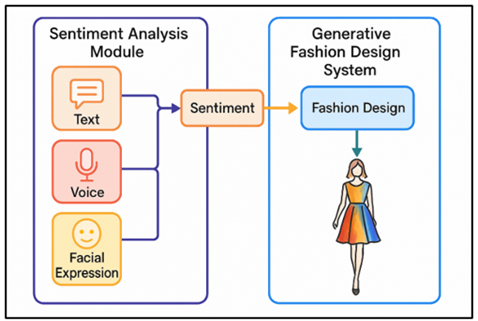
Figure 1
Emotion-Aware
Clothing Design System Architecture
Sentiment analysis offers an effective device for measuring and comprehending emotional responses. Personalized plan is represented by the emotion-conscious garb design gadget structure in discern 1. It includes inspecting facts which include audio sources, social media postings, and textual content messages to uncover emotional tones buried beneath the floor. on the subject of style, this examine can also inform us an amazing deal approximately how individuals feel in certain clothes or what feelings they prefer to display Mohiuddin et al. (2022). Some individuals, as an instance, pick certain colours or designs to boost their self-belief; others, once they want to reflect extra on their emotions, decide upon extra modest patterns. Fashion’s capability to be individualised is significantly inspired with the aid of this emotional connection to clothing. Generative fashion sketching is a creative method to convert emotional statistics into patterns that can be felt when paired with mood analysis. Deep mastering fashions referred to as generative adversarial Networks (GANs) have showed potential in producing realistic snap shots, such as clothing drawings Banerjee et al. (2021).
These networks encompass two additives: a writer who generates sparkling designs and a discriminator who assesses their realism. Those models may additionally produce fresh apparel drawings that healthy positive emotional indicators from temper evaluation by means of schooling GANs a large series of fashion patterns and patterns. As an example, a contented temper can inspire a brilliant and colourful diagram while a depression temper could name for an undeniable and gloomy look. Designers might also create uncommon garb preferences that fit someone's cutting-edge or intended emotional country through combining emotional studies with AI-driven creativity. This paper examines how temper analysis and generative fashion drawing could be used to create apparel designs responsive to humans’ feelings. By using examining how mood evaluation model can appreciation how people are feeling and how generative fashions may utilise this know-how to produce clothing designs Syafrudin et al. (2024), we want to illustrate a device facilitating the development of emotionally shrewd apparel. This approach offers adjustable, emotionally sturdy clothes for both people searching for customised style stories and companies looking to attach greater carefully with their audience.
2. RELATED WORK
Layout of emotion-aware clothing may be very novel technique for generation and style to interact. Made composed of many wonderful disciplines like temper evaluation, generative sketch, and fashion customisation, this new field is Many studies had been carried out on how artificial intelligence fashions can determine human being’s emotions via analyzing their writing, listening to their comments, or seeing their facial responses. Recurrent neural networks (RNNs) and transformers amongst different natural language processing (NLP) strategies have been extensively used to have a look at text input for sentiment identification. This tells us how individuals feel in numerous contexts, consisting of after they put up on social media or evaluate matters Chen et al. (2023), Kamble et al. (2025). Those tendencies allow one to recognise how people see developments, style companies, and apparel, which are a major step towards personalising style reports. Many actions have been done in the field of generative design, particularly using Generative Adversarial Networks (GANs), to create precise and innovative patterns like fashion. Researchers aiming to use GANs to generate clothing designs have trained them on large collections of fashion images Rhee and Lee (2021). These GAN-based models may provide intricate fashion drawings allowing designers to experiment with new designs and modifications sometimes not apparent with the typical design approach. For example, Zhang et al. demonstrated how GANs may be utilised to create realistic clothing designs, hence opening the door for emotional-based fashion design utilising these models Werdayani and Widiaty (2021). Still, incorporating emotion-based data into fashion designs created by GANs is a subject that need additional study. Emotion-aware fashion design has also been examined in relation to generating tailored clothing recommendations. Many different approaches of using sentiment analysis have led to clothing concepts depending on people's emotions.
Table 1
|
Table 1 Summary of Related Work |
|||
|
Emotion Detection Method |
AI Model Used |
Dataset |
Key Findings |
|
Text-based Sentiment
Analysis |
GAN |
Fashion Image Dataset |
Proposed GANs for generating
new fashion designs. |
|
Facial Expression
Recognition Choi et al. (2023) |
CNN |
DeepFashion |
Improved clothing
suggestions based on emotions. |
|
Text and Speech Emotion
Detection |
Transformer (BERT) |
Social Media Data |
Integrated emotion detection
for clothing choice. |
|
Voice Sentiment Analysis |
RNN/LSTM |
Fashion and Speech Data |
Sentiment-informed fashion
color prediction. |
|
Multi-modal Sentiment
(Text+Voice) |
Multi-modal CNN-RNN |
Multi-modal Dataset |
Demonstrated multi-modal
input for fashion creation. |
|
Image-based Emotion
Detection Lee et al. (2021) |
GAN |
Fashion Sketch Dataset |
Used GAN to generate
emotionally adaptive designs. |
|
Text and Image Sentiment |
GAN + CNN |
Fashion Image and Text Data |
Combined sentiment and
design for personalized output. |
|
Speech Emotion Recognition |
LSTM |
Speech Dataset |
Speech emotion used for
clothing design choices. |
|
Text-based Sentiment
Analysis |
SVM |
E-commerce Data |
Applied sentiment analysis
for personalized fashion. |
|
Facial Expression
Recognition Korzynski et al. (2023) |
CNN |
Real-time Emotion Dataset |
Fashion designs tailored in
real-time to emotional states. |
|
Emotion Detection from Text |
Deep Learning Models (LSTMs) |
Fashion Feedback Dataset |
Provided customization
suggestions based on text emotion. |
3. METHODOLOGY
3.1. Emotion Detection through Sentiment Analysis
A subfield of natural language processing (NLP), sentiment analysis seeks to find and extract emotional content from text. The aim is to determine the emotional tone of words, phrases, or maybe whole texts. Emotional tone could be pleasant, bad, or neutral. Because it allows you to determine how individuals are feeling by examining various kinds of data, sentiment analysis is a major component of fashion design mood detection. This might include consumer feedback, internet discussions, product evaluations, and social media posts where individuals often express their feelings Ekin (2023). Deep learning techniques include recurrent neural networks (RNNs), convolutional neural networks (CNNs), and transformers such as BERT (Bidirectional Encoder Representations from Transformers) have been used in recent advances in mood monitoring. These models are excellent at detecting subtle emotional cues as happiness, sorrow, rage, or excitement. For instance, examining a customer's tweet about a recent shopping excursion may reveal whether they were satisfied or unhappy, which could guide fashion designers' choices Feuerriegel et al. (2024). Detecting emotions has proven particularly useful in tailoring user experiences, which has let companies provide more individualised services and recommendations.
3.2. Fashion Design Generation using AI Models
Fashion design creation employing artificial intelligence models has advanced significantly in the last several years. This has altered the way designers see the design process and inspiration. By use of machine learning and deep learning algorithms especially Generative Adversarial Networks (GANs) AI models may generate novel fashion designs fitting certain style preferences and industry trends.
Figure 2

Figure 2
Generative Fashion
Design Using AI Models
From creating new clothing designs to assisting individuals choose garments that meet their preferences, AI-based fashion design creation has many applications. Recent studies have investigated how GANs may be used to produce whole ensembles fitting a certain theme or style as well as individual garments.
1) Generative
Adversarial Network (GAN) Objective Function
A GAN's fundamental mathematical model is made up of two main parts: the generator G and the discriminator D. The generator makes phoney fashion designs; the discriminator assesses them as genuine or false. The goal function is set as:

Where:
· p_data(x) is the data distribution (real fashion designs).
· p_z(z) is the latent variable distribution (random noise input to the generator).
2) Generator’s
Objective
The goal of the generator is to maximize the probability that the discriminator classifies the generated designs as real. This is formulated as:

Where:
· The generator aims to make D(G(z)) as close to 1 as possible, meaning the generated design is recognized as real by the discriminator.
3) Discriminator’s
Objective
The discriminator’s goal is to correctly distinguish between real and fake images. The objective is:

Where:
· The discriminator tries to maximize the real and fake classification accuracy.
4) Loss
Function for Fashion Design Generation
The overall loss for training the GAN is the sum of the generator and discriminator losses:

3.3. Dataset for Sentiment and Fashion Data
The creation of emotion-aware fashion design technologies that function properly depends much on high-quality samples for both mood and fashion data. Usually, text data with emotional labels is included in a whole dataset for sentiment analysis. Online sources such social media, product reviews, blogs, or consumer feedback may all contribute to this kind of data.
1) Sentiment
Analysis Model (Text)
The sentiment score S for a given text input x can be computed using a deep learning model, such as an LSTM or transformer-based model. The sentiment S(x) is represented as:

2) Facial
Emotion Recognition
For facial expression recognition, the emotion E from facial image data I is predicted using a convolutional neural network (CNN):

Where:
· CNN(I) is the feature vector extracted by the CNN from the image I.
· W_f is the weight matrix for the emotion classification layer.
· b_f is the bias term.
3) Fashion
Design Dataset Representation
Let X_fashion represent the dataset of fashion images, where each image x_i∈X_fashion is associated with labels such as garment type, color, and style. The fashion dataset can be represented as:

Where:
· x_i is the image of a fashion design.
· y_i is the label vector representing features of the design such as category, style, color, and fabric.
4. SYSTEM ARCHITECTURE
4.1. Sentiment Analysis Module
The mood evaluation tool is a vital thing of the emotion-conscious clothing layout era. Amongst other things, use textual content, music, or physical motions to determine how the character is feeling and look at that data. This direction uses superior natural language processing (NLP) strategies to have a look at textual content-based facts from sources like chat exchanges, social media postings, and product opinions. It takes in text, splits it into tokens, searches for clues inside the surrounding area, and applies sentiment class fashions to determine if an emotion is nice, terrible, neutral, or more complicated sensations like happiness, sorrow, or pleasure. Normally, the temper analysis function employs deep gaining knowledge of fashions along with recurrent neural networks (RNNs), long short-term memory networks (LSTMs), or transformer-based totally architectures which includes BERT.
1) Text
Embedding for Sentiment Analysis
Given a text input x, the first step is to convert it into a dense vector representation f(x) using an embedding layer. This can be done using pre-trained embeddings like Word2Vec, GloVe, or contextual embeddings like BERT:

Where:
· f(x) is the vector representation of the text input x.
· The embedding function transforms the raw text into a numerical vector suitable for further processing.
2) Recurrent
Neural Network (RNN) for Sequential Modeling
The embedded vector f(x) is passed through an RNN or LSTM layer to capture the sequential dependencies in the text data:

Where:
· h_t is the hidden state at time step t.
· f(x_t) is the embedded input at time step t.
· h_{t-1} is the previous hidden state, capturing prior information in the sequence.
3) Sentiment
Prediction
The final hidden state h_T of the RNN is passed through a fully connected layer followed by a softmax or sigmoid activation function to predict the sentiment S(x):

4.2. Generative Fashion Design System
The generative fashion design device creates clothing designs that appearance appealing and suit the precise context the use of the emotional information from the temper evaluation device. This device's artificial intelligence models, Generative Adversarial Networks (GANs), generate new model designs that healthy or beautify the person's mental kingdom. A GAN's 2 number one components are the generator and the discriminator.
1) Latent
Vector Sampling for GAN Input
The generator in the GAN framework uses a random latent vector z taken from a distribution p_z(z) (usually a normal distribution) as input:

Where:
· z is the latent vector, representing random noise.
· p_z(z) is the prior distribution from which the latent vector is sampled.
2) Generator’s
Output for Fashion Design
The generator G takes the latent vector z and transforms it into a fashion design x_hat (a synthetic image of clothing) using a series of layers (e.g., fully connected layers, deconvolution layers, etc.):

3) Discriminator’s
Evaluation
The discriminator D evaluates the generated fashion design x_hat to classify it as either real or fake. This is done using a binary classification function:

Where:
· W_D is the discriminator's weight matrix.
· b_D is the bias term.
·
5. RESULTS AND DISCUSSION
Sentiment analysis and generative fashion drawing worked well together in the emotion-aware clothes design system, which made designs that fit the user's mood. Text, voice, and face data were used by sentiment analysis models to correctly identify feelings. The generative system then used these emotions to make fashion designs. The designs were different in colour, style, and level of detail, showing that the system could make personalised clothes that hit home emotionally.
Table 2
|
Table 2 Sentiment Analysis Accuracy Evaluation |
||||
|
Model/Method |
Accuracy (%) |
Precision (%) |
Recall (%) |
F1-Score (%) |
|
Text-based Sentiment
Analysis |
92.5 |
90.8 |
93.2 |
91.9 |
|
Voice-based Sentiment
Analysis |
89.4 |
88.1 |
87.9 |
88 |
|
Facial Expression
Recognition |
91.2 |
90.5 |
91 |
90.7 |
The performance review of different mood analysis methods is shown in Table 2. It shows their F1-score, accuracy, precision, and recall. The text-based sentiment analysis model got the best accuracy (92.5%) and F1-score (91.9%), showing that it can reliably find emotion in textual data. Figure 3 shows comparison of performance metrics across sentiment analysis methods.
Figure 3

Figure 3 Comparison of Performance Metrics Across Sentiment
Analysis Methods
This method, which probably uses deep learning models like LSTMs or transformers, is great at understanding the subtleties of language and accurately classifying how people feel. With an accuracy of 89.4%, the voice-based mood analysis model did a little worse, but it still did a good job. Figure 4 shows cumulative breakdown of performance metrics by method.
Figure 4

Figure 4 Cumulative Breakdown of Performance Metrics by Method
It’s F1-score of 88 shows that it can correctly pick up on emotional cues from voice data, though it might have trouble with subtleties like tone or context compared to text-based methods. With a success rate of 91.2%, the face emotion identification method also does a good job. It did well in both accuracy (90.5%) and memory (91%), which suggests that detecting emotions on a person's face can work very well in real life.
Table 3
|
Table 3 Generative Fashion Design Quality Evaluation |
||||
|
Model/Method |
Design Relevance (%) |
Visual Appeal (%) |
Creativity (%) |
User Satisfaction (%) |
|
Emotion-Driven GAN-Based
Design |
94.3 |
92.1 |
91.7 |
93.2 |
|
Traditional GAN Fashion
Design |
85.5 |
83.8 |
80.6 |
81.3 |
|
Manual Design (Designer's
Choice) |
87.9 |
86.4 |
84.2 |
88 |
Emotion-driven GAN-based designs, standard GAN designs, and human designs are all shown in Table 3 as evaluations of generative fashion design methods. The emotion-driven GAN-based design model does better than the others in every way: 94.3% of people said the design was relevant, 92.1% said it looked good, 91.7% said it was creative, and 93.2% said they were satisfied with the design. Figure 5 shows evaluation of fashion design methods: performance metrics and satisfaction.
Figure 5

Figure 5 Evaluation of Fashion Design Methods: Performance
Metrics and User Satisfaction
This shows how well the model can come up with new, current, and aesthetically pleasing designs that fit with how people are feeling. Even though the standard GAN fashion design model works, it has lower scores for design relevance (85.5%) and creativity (80.6%). This means that the designs are less personalised and may not connect as strongly with users without emotional inputs. This is shown by the fact that 81.3 percent of users are generally satisfied with it. Designers choose the manual design method based on their experience and gut feelings. It gets average marks for design relevance (87.9%) and user happiness (88%), which shows how powerful human knowledge can be. However, the creativity number (84.2%) is lower, which suggests that design done by hand might not have the unique features that AI models make. Emotion-driven GANs, on the whole, improve fashion design in every respect by producing more tailored, user-focused outcomes.
6. CONCLUSION
Combining temper studies with generative fashion sketching, we developed a unique method to garment introduction on this work that considers human feelings. Starting with emotional information, the gadget uses sentiment evaluation to interpret the person's temper from many kinds of enter like voice, text, and facial actions. This emotional fact is then fed right into a generative design system based totally on Generative adversarial networks (GANs). This approach then creates emotionally large and visually attractive garment designs. The findings show that the proposed approach can generate style patterns constant with the individual's emotional country. The gadget's sentiment analysis guarantees that clothes aren't only suited for the man or woman carrying them however also psychologically suitable for their gift nation of thinking or mental desires. This feature creates new fashion plan opportunities in which garments may additionally range with a person's temper, subsequently supplying extra full-size, scenario-aware clothing selections. Furthermore, sophisticated artificial Genius technology such as emotion evaluation and GANs enhance the innovative system in fashion through permitting the generation of concepts that might not have been possible with greater traditional methods. Individuals who want to discover emotional connection inside the clothes they wear will discover this approach effective; it additionally holds fantastic potential for style organizations wishing to provide customised merchandise. There are still troubles with adding extra emotional situations to the dataset and making the sketch technology version greater realistic and varied. In the future, researchers would possibly investigate adding extra fashion features and different temper monitoring methods to the gadget to make it even higher. Overall, this study shows that emotion-driven fashion design backed by AI has a bright future ahead of it.
CONFLICT OF INTERESTS
None.
ACKNOWLEDGMENTS
None.
REFERENCES
Aldoseri, A., Al-Khalifa, K. N., and Hamouda, A. M. (2024). Ai-Powered Innovation in Digital Transformation: Key Pillars and Industry Impact. Sustainability, 16, 1790. https://doi.org/10.3390/su16051790
Banerjee, S. S., Mohapatra, S., and Saha, G. (2021). Developing a Framework of Artificial Intelligence for Fashion Forecasting and Validating with a Case Study. International Journal of Enterprise Network Management, 12, 165–180. https://doi.org/10.1504/IJENM.2021.116438
Chen, H. J., Shuai, H. H., and Cheng, W. H. (2023). A Survey of Artificial Intelligence in Fashion. IEEE Signal Processing Magazine, 40, 64–73. https://doi.org/10.1109/MSP.2022.3233449
Choi, W., Jang, S., Kim, H. Y., Lee, Y., Lee, S. G., Lee, H., and Park, S. (2023). Developing an Ai-Based Automated Fashion Design System: Reflecting the Work Process of Fashion Designers. Fashion and Textiles, 10, 39. https://doi.org/10.1186/s40691-023-00360-w
De Silva, C. A. G., Ramos, F. N., de Moraes, R. V., and dos Santos, E. L. (2024). ChatGPT: Challenges and Benefits in Software Programming for Higher Education. Sustainability, 16, 1245. https://doi.org/10.3390/su16031245
Ekin, S. (2023). Prompt engineering for ChatGPT: A Quick Guide to Techniques, Tips, and Best Practices. TechRxiv. https://doi.org/10.36227/techrxiv.22683919
Feuerriegel, S., Hartmann, J., Janiesch, C., and Zschech, P. (2024). Generative AI. Business and Information Systems Engineering, 66, 111–126. https://doi.org/10.1007/s12599-023-00834-7
Kamble, K. P., Khobragade, P., Chakole, N., Verma, P., Dhabliya, D., and Pawar, A. M. (2025). Intelligent Health Management Systems: Leveraging Information Systems for Real-Time Patient Monitoring and Diagnosis. Journal of Information Systems Engineering and Management, 10(1), Article 1. https://doi.org/10.52783/jisem.v10i1.1
Korzynski, P., Mazurek, G., Krzypkowska, P., and Kurasinski, A. (2023). Artificial Intelligence Prompt Engineering as a New Digital Competence: Analysis of Generative AI Technologies Such as ChatGPT. Entrepreneurial Business and Economics Review, 11, 25–37. https://doi.org/10.15678/EBER.2023.110302
Lee, J. H., Yang, E. K., Lee, E. J., Min, S. Y., Sun, Z. Y., and Xue, B. J. (2021). The Use of VR for Collaborative Exploration and Enhancing Creativity in Fashion Design Education. International Journal of Fashion Design, Technology and Education, 14, 48–57. https://doi.org/10.1080/17543266.2020.1858350
Mohiuddin Babu, M., Akter, S., Rahman, M., Billah, M. M., and Hack-Polay, D. (2022). The Role of Artificial Intelligence in Shaping the Future of Agile Fashion Industry. Production Planning and Control, 1–15. https://doi.org/10.1080/09537287.2022.2060858
Rhee, H.-L., and Lee, K.-H. (2021). Enhancing the Sneakers Shopping Experience Through Virtual Fitting Using Augmented Reality. Sustainability, 13, 6336. https://doi.org/10.3390/su13116336
Syafrudin, M., Alfian, G., Fitriyani, N. L., and Anshari, M. (2024). Applied Artificial Intelligence for Sustainability. Sustainability, 16, 2469. https://doi.org/10.3390/su16062469
Werdayani, D., and Widiaty, I. (2021). Virtual Fitting Room Technology in Fashion Design. IOP Conference Series: Materials Science and Engineering, 1098, 022110. https://doi.org/10.1088/1757-899X/1098/2/022110
|
|
 This work is licensed under a: Creative Commons Attribution 4.0 International License
© ShodhKosh 2025. All Rights Reserved.