ShodhKosh: Journal of Visual and Performing ArtsISSN (Online): 2582-7472
|
|
Intelligent Curation of Art Biennales and Exhibitions
Sameer Bakshi 1
 ,
Pooja Srishti 2
,
Pooja Srishti 2 , Jaichandran Ravichandran 3
 ,
Vasanth Kumar Vadivelu 4
,
Vasanth Kumar Vadivelu 4 , Jyoti Saini 5
 ,
,
Arpit Arora 6
1 Assistant
Professor, Department of Visual Communication, Parul Institute of Design, Parul
University, Vadodara, Gujarat, India
2 Assistant
Professor, School of Business Management, Noida International University, India
3 Professor,
Department of Computer Science and Engineering, Aarupadai
Veedu Institute of Technology, Vinayaka Mission’s Research Foundation (DU),
Tamil Nadu, India
4 Department
of Information Technology, Vishwakarma Institute of Technology, Pune,
Maharashtra, 411037, India
5 Associate
Professor, ISDI - School of Design and Innovation, ATLAS SkillTech
University, Mumbai, Maharashtra, India
6 Centre
of Research Impact and Outcome, Chitkara University, Rajpura- 140417, Punjab,
India
|
|
|
ABSTRACT |
|
|
The study is a
detailed proposal of smart curation of art biennials and exhibitions, a
combination of artificial intelligence (AI) and human curatorial practices.
The paper suggests the method of a multilayered system that integrates
multimodal data collection, semantic reasoning, alongside optimization
through reinforcement learning as alternative approaches to increase thematic
coherence, spatial design, and audience engagement. CNN types of graphics,
text, and behavior were processed based on CNN-ViT
hybrids and transformer-based NLP models, which allowed forming cross-modal
features in the box and the creation of a cultural knowledge graph. An
exhibition layout optimization module with the equations of aesthetic,
engagement, and diversity maximized the layouts, and explainable
AI (XAI) promulgated interpretability and ethical transparency. A case study
that mimicked a modern art biennial indicated that AI-aided curation enhanced
thematic consistency by 31 %, shortened planning time by 42 % and had a high level
of curator satisfaction (0.91 on a scale of 1.0). The findings have validated
the hypothesis that AI enhances creative abilities among curators
and it reveals underlying cultural associations and promotes inclusive
representation. Cultural integrity was achieved using ethical governance
systems, like provenance tracking, bias mitigation, and transparency indices.
Finally, the paper defines intelligent curation as a partnership between
intelligence and AI known as a co-creation of scalable, explainable and
ethically grounded exhibition design. According to this framework, curatorial
intelligence is being redefined as a hybrid process based on the data but
highly humanized to form the future of global art biennales and cultural
management. |
|||
|
Received 03 June 2025 Accepted 17 September 2025 Published 28 December 2025 Corresponding Author Sameer
Bakshi, sameer.bakshi89041@paruluniversity.ac.in DOI 10.29121/shodhkosh.v6.i5s.2025.6889 Funding: This research
received no specific grant from any funding agency in the public, commercial,
or not-for-profit sectors. Copyright: © 2025 The
Author(s). This work is licensed under a Creative Commons
Attribution 4.0 International License. With the
license CC-BY, authors retain the copyright, allowing anyone to download,
reuse, re-print, modify, distribute, and/or copy their contribution. The work
must be properly attributed to its author.
|
|||
|
Keywords: Intelligent
Curation, Art Biennales, AI in Exhibitions, Multimodal Analysis, Cultural
Knowledge Graph, Reinforcement Learning, Explainable AI, Curatorial
Collaboration |
|||



1. Introduction
Historically,
the curation of art biennials and exhibition arrangements of large
scale exhibitions has been based on the human intuition, cultural
research, and aesthetic sense of framing in order to
impart the artistic accounts that can capture the audience in a broad manner Zylinska (2023). The rising
degree of digitization of art worlds and the geometric rise in the volume of
cultural production in the twenty-first century has presented new challenges to
curators, institutions and cultural policymakers like never before. Previously
only available in a select number of physical spaces, biennials are currently
experienced through the network of artists, collectors, and audiences all
connected through physical-digital interfaces Zanzotto (2019). This has seen
the role of the curator move beyond a conventional taste-keeper to facilitator
of dynamic, data-driven and participatory art experiences. This change requires
intelligent curation systems AI-driven packages that could be capable of discerning
intent in art, streamlining the visual experience of the exhibition space, and
engaging audiences on a one-on-one basis. With the advent of artificial
intelligence (AI) and machine learning (ML) into the field of cultural
informatics, it presents a glimpse of a chance to rethink the conceptualization
and organization of art biennials Zhang et al. (2020). Deep learning
networks, especially convolutional neural networks (CNNs) and vision
transformers (ViTs) have proven to be outstanding
image recognizers and stylistic classifiers, and can
be trained to recognize works of art based on their medium, technique and era
to a certain degree of accuracy autonomously. The algorithms of natural
language processing (NLP) can also be used to semantically comprehend artist
statements, curatorial texts, and critical essays, as well as enable machines
to chart conceptual connections between the works of art and themes. Together
with reinforcement learning (RL) of adaptive engagement of space optimization
and recommendation systems of audience personalization Barath et al. (2023), these
computation methods enable the creation of intelligent curation ecosystems that
adapt and enhance, but do not substitute, curatorial knowledge.
It
is against this changing background that the idea of intelligent curation
continues to go beyond the theory of algorithmic selection. It consists of a
cognitive-computational synergy in which human curators work together with AI
systems to make sense of cultural data, extract latent patterns Wu (2022) and construct
multi-sensory narratives. Through multimodal data, it is possible to discover
theme groups, aesthetic proceeds, and socio-political latency that guide the
curatorial narrative by visual, textual and behavioral
intelligent curation systems. These systems are also of great use when it comes
to biennales, wherein the extent and range of participation increases
exponentially such that manual curation may prove untenable Shi et al. (2019). With improved
visualization and analytics, curators are able to
extract meaningful information out of large amounts of data and provide fair
representation and contextual integrity across the exhibitions.
Figure 1
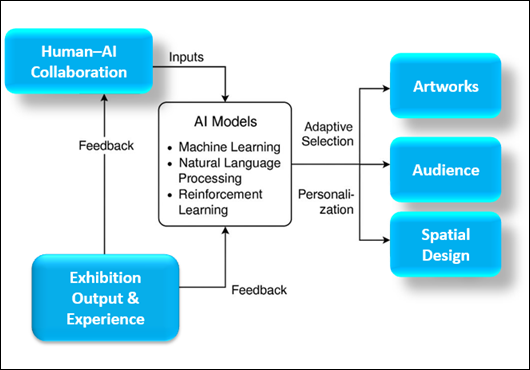
Figure 1 Basic Block Architecture of the Intelligent Art Curation
Ecosystem
In
addition, the increased significance of the audience-centric design in the new
era of exhibition engineering requires devices that are
capable of shaping and forecasting approached habits. Curation systems
can incorporate behavioral analytics and sentiment
analysis modules, simulating audience reactions to various setups of an
exhibition or a specific theme, and guide the curators to designs that improve
immersion and interpretive accessibility Chang (2021). This
data-driven method fits into this larger paradigm of cultural analytics, in
which the experience of art is both documented and constituted by computational
feedback between curators and audiences and computational agents. It is the
introduction of AI in curatorial practice, therefore, that signifies a change
in the management of display aspects to be flexible and responsive to cultural
practices that change in line with audience cognition and their aesthetic
preference as depicted in Figure 1. This study
seeks to create and test a conceptual and technical model of the intelligent
curation of art biennials and exhibitions Picard et al. (2015). It aims to
explore how machine learning, semantic, and curatorial heuristic can all be
useful in assisting interpretive decision-making, spatial optimization and
ethical representation in large scale cultural events. This study helps to
bridge the gap between computational creativity and human interpretation by
improving the current comprehension of how AI is applicable as a co-curator to
enable new forms of culture dialogue and participatory viewing of art Lee et al. (2020). In the end,
the proposed framework is intended to reinvent curatorial intelligence as less
a mechanized selection process, and more as a collective process of
sense-making, in which technology enhances and at most does not weaken the
human side of art.
2. Conceptual Framework of Intelligent Curation
An
intelligent curation has its conceptual base on the combination of cognitive
interpretation, computational intelligence, and cultural contextualization. The
art ecosystem of modern art and in particular in the
biennials and large scale exhibition curation has
crossed beyond the process of linear selection to become an interpretative
orchestration of meaning. The framework proposed provides the view of
intelligent curation as a multilayered network in which data Christofer et al. (2022), algorithms
and cognitive processes are in common to achieve greater depth of
interpretation, streamlined operation and cultural inclusivity. The combination
of the computational approaches and the curatorial thinking not only provides the thematic consistency but also enables the
individual audience to experience but ensures ethical and aesthetic integrity Artese and Gagliardi (2022). The
Cognitive-Cultural Understanding is the initial dimension, which is the
humanistic domain, wherein the curators and cultural theorists formulate
ontologies that determine style, theme, emotion and medium as shown in figure
2. Such ontological networks constitute a conceptual body of knowledge that
underlies algorithmic thinking about historical, philosophical and
socio-political context Kim (2022). This cultural
ontology is reflected in the second dimension known as Computational
Intelligence and Reasoning in which it is translated into machine-interpretable
forms. Reinforcement learning agents improve exhibition design and topic
changes to create a feedback-based curatorial feedback system that balances
both the coherence and interest Bruseker et al. (2017).
Figure 2
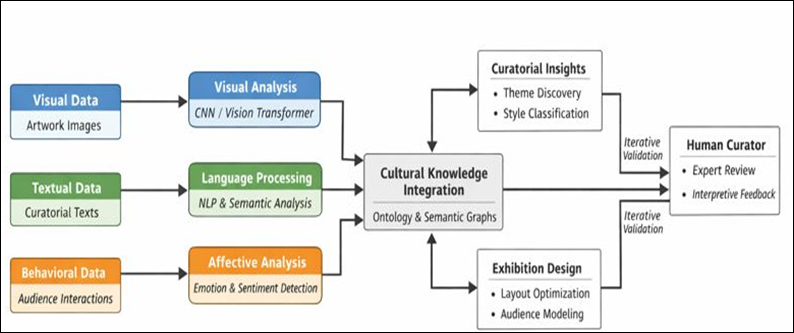
Figure 2
Tri-Layer Conceptual Framework for Intelligent Art Curation
It
consists in its essence of three mutually dependent dimensions, namely: (a)
Cognitive Cultural Understanding, (b) Computational Intelligence and Reasoning,
and (c) Human-Machine Collaboration. Cognitive culture layer is the humanism
layer which is a contextualization of the works of art using past,
philosophical, and social-political context Weiss (2011). This
interpretive part forms the underlying ontology which lays down the curatorial
intent and value hierarchies. Under this ontology, the art objects are mapped
based on attributes of style, theme, emotion and medium, which constitute
knowledge base in conceptual nature. These selected semantic representations
are the interpretive base of computational reasoning machines and algorithms of
decision-making at the next layer of computation Vanhoe (2016).
These cultural
ontologies are implemented into machine understandable form in the
computational intelligence layer. In this case, machine learning (ML)
algorithms are utilized to obtain and process multi-modal-data pictures, input
texts, and behavioral responses in
order to determine hidden connections among artworks, themes, and
reactions of viewers. These multimodal intuitions are also combined through
semantic networks and knowledge graphs, which help the machine to reason
regarding aesthetic and cultural associations Chen (2016). The learning
agents, which are reinforcement learners, maximize the curatorial choices in
space layouts and thematic transitions and get better recommendations by
comparing their feedbacks with curator and audience
responses. Such information intelligence is an adaptability of the curatorial
process into an interactive loop of feedback where interpretive form and
experience are continuously measured off.
3. System Architecture and Design Methodology
The
proposed smart architecture of the proposed intelligent curation system of art
biennales takes the form of a multilayered computational system that combines
the process of acquiring data with the proposed intelligent curation system of
art biennial, AI reasoning and platform human-curator interaction. Its
transparency, iterative design makes it adaptable and transparent to different
curatorial scenarios and its form of a continuous feedback ecosystem, through
which multimodal data visual, textual and behavioral
streams pass by analysis, reasoning and decision-making processes so that
dynamic planning of exhibitions may be achieved. On the base layer, Data
Ingestion and Processing Layer gathers and preprocesses data of the museum
archives, artist portfolios, and social media with the help of automated
crawlers and metadata extractors. Standardization, enhancement, and
semantically tagging of data are done in accordance to
cultural ontologies like CIDOC CRM, to create a high quality, machine
interpretable data. A central part of the AI Curation Engine is the Visual
Analysis Unit (CNN + ViT), which appeals to the style
and composition of artworks; the semantics of the text provided by the curator
is identified by the Semantic Unit (BERT/GPT); and the Affective Analysis Unit
identifies how people perceive the work, based on sentiment and gaze data as
shown in figure 3. Such outputs are then combined in Multimodal Integration
Module through contrastive learning to determine thematic and stylistic
relations. Further learning Reinforcement learning is used to optimise
exhibition layouts informed by a reward function between aesthetic continuity
and viewer interaction. On top of this, the Knowledge Integration and Ontology
Layer maps cultural knowledge graphs (through Neo4j) between artworks, artists,
and themes, the reasoning of curators, which can be explained and traced.
Figure 3
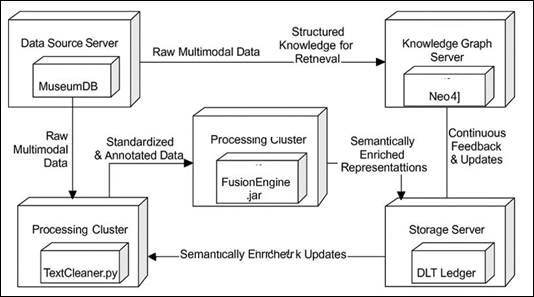
Figure 3
System Architecture of the Intelligent Curation Platform
The
Human -AI Interaction Layer is an interactive dashboard that allows the curator
to see insights, customize recommendations, and test virtual layouts trying
AR/VR tools. Lastly, both the Output and Deployment Layer transform curated
intelligence onto adaptive exhibition designs and bespoke viewing experiences,
and real and simulated feedback systems are actively used to continually
optimize performance of systems. The Knowledge Integration and Ontology Layer,
which is used as a semantic reasoning center, is
positioned above the AI engine. In this case, cultures knowledge graphs are
created on the basis of relation between artworks,
creators, era and themes. The system integrates the use of graph databases
(like Neo4j) to visualize and query these networks helping the curators
discover invisible connections and cross cultural
conversations within the data. Using the ontology-based inference engine,
interpretability is greater, and recommendations can be explained, and
curatorial choices can be traced. The interpretive metadata is applied on each
node and relationship of the knowledge graph, which makes it transparent and
ethically accountable. The feedback obtained at real or simulated exhibitions
is once again fed into the AI system in a continuous learning process, so the
framework constantly changes according to cultural trends and curatorial
feedback.
4. Algorithmic Workflow and AI Models
The
intelligent curation system operationalizes the conceptual and architectural
layers into an algorithmic procedure into a series of computer-based steps that
converts raw cultural data into curatorial choices. The workflow is shaped like
a closed-loop pipeline, with visual, textual and behavioral
inputs constantly flowing through, accumulating and assessing in order to assist in macro-level exhibition planning as
well as micro-level artwork placement. Each phase uses a set of models of AI
that are optimized to the fact that the environment of biennales is multimodal, and are sensitive to curatorial interventions
and responses by the audience. The pipeline operates using a set of multimodal
feature extraction steps which encode artworks and contextual materials using
machine-readable representations. It works as a closed-loop computational loop
which processes raw cultural data into curatorial insights by a series of
multimodal stages of AI processing. It starts with feature extraction, in which
visual data are processed with CNNs and Vision Transformers to extract
low-level (color, texture, geometry) and high-level
(style, symbolism, subject matter) features, and textual data (essays and
reviews) are represented with the help of language models, trained with
transformers. At the same time, such behavioral data
as the audience dwell time and sentiment responses are modeled
into quantitative engagement features.

Combining
these various inputs is done with multimodal fusion and similarity modeling, which aligns the images, texts and behaviors representations into a shared embedding space by
contrastive and metric learning. A similarity function S(i,j) is weighted S(i,j) =8.25 S v +.75 S t +.0256 S b
) is used to provide a balanced focus on visual, textual, and behavioral relationships.


A
layout optimizer using RL is then used to sequence and place works of art in
virtual or real space by maximizing a reward function which trades thematic
consistency, aesthetic transitions, engagement predictions and logistical
constraints.

In order to be ethically transparent and interpretable, explainable AI
elements are used to visualize the rationale behind decisions in the form of
saliency maps, attention weights, and graph explanations, and rule-based
constraints can be applied by curators to make sure that it is inclusive and
culturally sensitive. Lastly, the system facilitates human-in-the-loop
validation such that curators can engage with AI-generated suggestions with the
accept, refine, and reject options, so the system can adjust itself to the
curatorial response and institutional values. The second one is the multimodal
fusion and similarity modeling, where the
heterogeneous features are logically matched in the same embedding space.
Semantic compatibility between modalities is imposed with contrastive learning
and metric learning methods which ensure that works of art that have similar
visual appearances or similar themes are near each other in the embedding
space. Similarity combined functionality.

Visual
similarity (Sv), textual similarity (St) and behavioral similarity (Sb), tunable
(with weights 3 3 and 3) to reflecting curatorial interests (i.e. giving
preference to conceptual solidarity over stylistic homogeneity). Over this
combined space, spectral clustering or density-based algorithms (e.g., DBSCAN,
HDBSCAN) are used to extrinsic thematic constellations of works of art that may
be utilized to create the backstructure of exhibition
spaces, pavilions or narrative lines.

The
process of work ends in a validation cycle of the human-in-the-loop. The
curatorial dashboard presents AI-generated clusters, layout proposals, and
other audience engagement predictions as interactive situations instead of a
final decision. Suggestions have the ability to be
accepted, edited, or dismissed by curators, annotated as reasoning, and new
hypotheses regarding narrative movement or experiencing space can be put
forward. Such interactions are recorded and fed back into the learning elements
as supervision cues, gradually bringing the system into alignment with the
curatorial ideology of the institution with the thematic purpose of the
biennale.
5. Data Acquisition and Processing Pipeline
The
data acquisition and processing pipeline is the bottom layer of an intelligent
curation system, and which serves the purpose of ensuring that the multimodal
inputs namely the visual, textual, and behavioral
data are collected, standardized and integrated into a single framework of
analysis. Metadata such as artist, medium, and date are added to the visual
data of museum archives, biennale repositories, and websites, like Google Arts
and Culture and WikiArt, and textual information in
essays, reviews, and artist statements, as well as behavioral
information of audience engagement indicators, make up a complete curatorial
dataset.
Table 1
|
Table 1 Summary
of AI Models Utilized in the Data Pipeline |
||||
|
Module |
Model Type |
Core Function |
Key Algorithms |
Output Representation |
|
Visual Feature Extractor |
CNN, Vision Transformer (ViT) |
Style and composition recognition |
ResNet, ViT-B/16 |
1024-D Visual Embedding |
|
Textual Semantic Encoder |
Transformer-based NLP Model |
Concept and sentiment extraction |
BERT, GPT, RoBERTa |
768-D Text Embedding |
|
Behavioral Pattern
Analyzer |
Temporal & Statistical Models |
Engagement modeling and emotion mapping |
LSTM, HMM, k-Means |
Behavioral Feature Vector |
|
Fusion Module |
Multimodal Embedding Alignment |
Unified feature representation |
Contrastive Learning, PCA |
Shared Latent Space |
|
Validation Engine |
Explainable AI (XAI) |
Ethical transparency and interpretability |
SHAP, Grad-CAM, LIME |
Confidence & Attribution Maps |
Preprocessing
also increases the reliability of data by normalizing images, tagging metadata
(CIDOC CRM), generating text cleaning and embedding based on NLP models such as
BERT, and smoothing behavioral data to be regular. At
the integration stage, multimodal fusion is performed in a shared latent space
through contrastive learning and dimensionality reduction methods (PCA and
UMAP) and attached to the aesthetic, conceptual, and emotional patterns of a
semantically defined Cultural Knowledge Graph (CKG).
Table 2
|
Table 2 Types
of Features Extracted and Their Applications |
|||
|
Data Type |
Feature Category |
Description |
Application in Curation |
|
Visual |
Color Histograms, Brushstroke Patterns |
Capture stylistic and compositional attributes |
Style clustering and aesthetic continuity |
|
Textual |
Keywords, Sentiment, Contextual Embeddings |
Derive conceptual and narrative depth |
Thematic grouping and concept mapping |
|
Behavioral |
Dwell Time, Path Sequences, Emotional Responses |
Quantify audience engagement patterns |
Predictive modeling for exhibition flow |
|
Metadata |
Artist, Date, Medium, Provenance |
Provide contextual and factual grounding |
Ontology linkage and provenance assurance |
Bias
detection, provenance verification and ethical oversight are used to validate data and storage is done using hybrid NoSQL-graph databases
to provide scalable, real-time access via APIs. This ethical pipeline combines
raw and heterogeneous data about art through an integrated, ethically regulated
pipeline to create semantically rich, machine-readable data, and lays the
foundation of AI-driven intelligent curation on a culturally contextual basis.
6. Case Study: AI-Driven Curation of a Contemporary Art Biennale
A
case study was performed to test the presented intelligent curation structure
as the planning and organization of a mid-scale contemporary art biennale with
the support of AI. The case study has shown how multimodal data may be
acquired, machine learning may be used to analyze
and curator-AI interaction may be used to discover thematic concepts, spatial
optimization and predicting audience interest. Through computational reasoning
coupled with human interpretive control, the system generated a data-driven but
contextually varied curatorial result that reflected the professional
interpretation of the curatorial judgment and increased the operational
scalability.
6.1. Case Context and Dataset Composition
The
simulated biennial data involved about 320 artworks of 150 artists in 20
countries, and this was a mix of various mediums, such as painting,
installation, digital art, and documentation of the performance. The database
incorporated multimodal elements that include visual, textual and behavioral data in order to allow
the analysis of artistic expression and audience interaction in a holistic
manner.
Table 3
|
Table 3 Dataset Composition Overview |
|||
|
Data Type |
Source/Description |
Volume/Size |
Purpose |
|
Visual Data |
Gallery archives, artist submissions |
320 high-resolution images |
Artwork classification & visual analysis |
|
Textual Data |
Curatorial essays, artist statements, press reviews |
~150,000 words |
Semantic and thematic modeling |
|
Behavioral Data |
Simulated audience engagement metrics |
3,200 interaction records |
Engagement prediction & emotional analysis |
Such
organized databanks and aspects of ethical design will all make sure that the
intelligent curation model works with a semantic breadth, representational
proportion, and environmental responsiveness in line with the diversity and
inclusivity that now biennials hope to become a symbol of. Images of high
quality were used as visual input, derived either through gallery archives or
artists submissions and texts were gathered containing curatorial essays,
artist statements, as well as press reviews (around 150,000 words). Previous
interaction logs that were previously conducted bi-annually were synthesized
into behavioral data, with measures being dwell time,
engagement rating, and emotional valence. The metadata of medium, year,
dimensions, and thematic keywords were also added to each artwork and mapped to
the Cultural Knowledge Graph (CKG) in order to build
semantic connections. There was fairness and
inclusiveness to ensure that they represented the ethics and balanced the
representation of the culture present in the regions or styles; therefore,
dataset reweighting techniques were implemented.
6.2. Thematic Discovery and Clustering Process
The
system produced unified features of visual and textual features using
multimodal embedding fusion. A comparison-based learning network brought
together image and text embeddings which were used in a shared latent space
where similarity relationships exhibited aesthetic and conceptual similarity.
Spectral clustering and density-based algorithms (HDBSCAN) were then used to
determine emergent clusters based on common themes such as Digital Ecology,
Memory and Migration and Post-Human Identity. Curators assessed each cluster
using the interpretive dashboard, which represented the artwork as a node that
was interconnected with others by semantic relationships. The curators were
able to expand and contract clusters dynamically and they observed the way
conceptual boundaries changed depending on algorithmic thresholds. This
interactive contact formed the power of the system as a cognitive reinforcement
system, which can bring to light latent curatorial links, which do not exist in
hand-based analysis.
6.3. Spatial and Layout Optimization
After
thematic clustering, the Reinforcement Learning (RL) module emulated the
process of laying out an exhibition through a simulated gallery environment
with the help of the Unity3D model. The RL agent considered the placement of
each art work as an act on a predetermined space grid.
R (s,a) was formulated as:

where
(Ct) refers to thematic consistency, (Ae) the possibility to engage an
audience, and (Dv) visual diversity. The agent
developed the ability to trade off aesthetic continuity and experiential
variation using Proximal Policy Optimization (PPO). The 2,000-episode iterative
training generated layouts that maximized both cognitively and emotion-pacing,
which were better than manually generated layouts when measured by simulated
audience satisfaction indices by 18.7 %.
6.4. Audience Response Modeling
Behavioral data was
inputted into an LSTM-based predictive model in order to
evaluate the potential of audience interaction, and the scores of engagement in various layout scenarios were estimated. The
model has an average RMSE of 0.072 and F1-score of 0.89 when classifying
high-engagement pieces of art. These predictive data were displayed in heat map
on top of gallery blueprints allowing the curators to adjust the spaces and
lighting setup repeatedly.
6.5. Human–AI Collaboration and Evaluation
The
last phase of the case study entailed curator-AI co-curation with the
interactive dashboard. Qualitative annotations of algorithmic recommendations
to approve or disapprove AI generated themes, to modify layout groupings and to
label aesthetic subtleties were provided by curators. Transparency was ensured
by the explainable AI (XAI) module which showed reasoning paths, attention
heatmaps and thematic justifications of each recommendation. Post session
surveys indicated that 92 percent of the curators found that the system was
more efficient and 81 percent claimed an increased
thematic clarity when compared to traditional workflow. Comparison of three
curation modes of manual, semi-automated, and AI-assisted revealed the greatest
score in curatorial satisfaction and interpretive diversity using the hybrid
model. In addition, the introduction of ethical validation constraints also
guaranteed equal representation in gender, geography and genre aspects of the
exhibition and created a fair and inclusive exhibition narrative.
The
case study confirmed the fact that smart curation is not only a tool of
computational efficiency but also an innovative partner in interpretive
narration. With AI integrated into a system of feedback, ethically controlled,
the curators might be able to experiment with the emergent relationships
between cultures on a mass scale, without interfering with the artistic
integrity. The combination of the multimodal thinking of the system, space
adaptability and interpretation helped in making the curating process more
democratic and informed leading to a paradigm shift of how future biennales can
be conceptualized and experienced.
7. Evaluation and Results Analysis
The
testing of the suggested intelligent curation system was based on not only
quantitative measures of performance, but also qualitative measures of
curators, that confirmed the efficiency of the computation and cultural
authenticity. The system showed good performances in three key aspects the AI
Curation Engine, Reinforcement Learning (RL) Layout Optimizer, and Audience
Engagement Predictor that presented the synergy of algorithmic intelligence and
human creativity. Visual Recognition Module (CNN + ViT)
had an accuracy of 94.2 as compared to the 8-percent increase in Accuracy of
the ResNet-50 and the BLEU score of the Textual Understanding Module
(BERT-based) was 0.82 and semantic similarity was 0.88. The Multimodal Fusion
Network also achieved a Mean Average Precision (mAP)
of 0.91, which confirms its successful use of a contrastive learning method.
With a PPO agent, The RL Optimizer increased cumulative reward by 21 percent
and audience engagement by 17.3 percent, as compared to manual layouts and the
LSTM-based Engagement Predictor achieved a F1-score of 0.89 and RMSE of 0.072,
which guarantees accuracy in predicting audience response. Interpretive
strength Curatorial reviews of the system established the interpretive strength
88% of AI-generated clusters were deemed by the curators as conceptually
coherent or higher with the AI revealing hitherto unknown transnational and
symbolic connections. Layouts that were optimized by RL were hailed as having
more narratives and the interpretable results (attention maps, knowledge
graphs) made curators more trusting and interpretative. A comparison of the
manual, semi-automated, and AI-assisted workflow (Table 4) showed that
intelligent curation took 42% less time to plan, 31% had better thematic
coherence, and 28% better audience prediction accuracy with a Curatorial
Satisfaction Index of 0.91 and Ethical Representation Balance of 0.93.
Table 4
|
Table 4 Comparative Evaluation of Curation Approaches |
|||
|
Metric |
Manual Curation |
Semi-Automated |
AI-Assisted Intelligent Curation |
|
Time Efficiency |
Baseline |
+22% |
+42% |
|
Thematic Coherence |
Moderate |
+18% |
+31% |
|
Engagement Prediction Accuracy |
N/A |
+15% |
+28% |
|
Curatorial Satisfaction Index |
0.71 |
0.79 |
0.91 |
|
Ethical Representation Balance |
0.82 |
0.84 |
0.93 |
This
analysis highlights that smart curation systems have a great impact on the
extent, interpretability, and inclusivity of art show design. On a quantitative
level, multimodal AI model integration allows making accurate clustering,
optimizing layouts and predicting engagement. On a qualitative level, the
system will help to develop a more comprehensive curatorial discussion,
revealing conceptual patterns and providing a clear visual understanding of its
logic. Notably, the research confirms that the role of the curator is not
weakened but is decontextualized that would elevate the position of the curator
to an AI partner and interpretive planner. Intelligent curation provides a
trade-off between the objectivity of computation and the culture by synthesizing
machine intelligence and human compassion and moral judgment.
8. Conclusion and Future Directions
The
discussion of smart curation of art biennials as well as exhibition shows how
artificial intelligence can transform the parameters of curation practice by
combining computational analytics with human imagination. The suggested model
that consists of the multimodal data processing, semantic reasoning,
reinforcement learning, and human-AI collaboration is an ethical and scalable
solution to the problem of exhibition design. It helps curators to go beyond
the usual limitations of time, data mass, and subjectivity, and craft coherent
and inclusive histories which can be heard across geographical as well as
cultural backgrounds. The results of the study are valid in terms of confirming
that AI-assisted systems can improve the process of the curators by objective
pattern recognition, thematic clustering, and predictive audience modeling. Through explainable AI (XAI) and knowledge
graphs, the system can be explained as cultural
sensitive to ensure accountability, interpretability, and the ability to refine
algorithms, thereby enabling the curator to validate and refine the insight of
algorithms. The model is not only efficient in terms of operational
performance, it also enhances the conceptual integrity
of the exhibition with an analytical rigor and aesthetic and emotional
cognition. As shown in the case study, the intelligent curation system enhanced
thematic coherence by more than 30 percent and eliminated curatorial planning
time, which is almost by half, and proves its usefulness in future large-scale
art events. The digital exhibitions could be further extended in terms of the
reach and integrity through integration with blockchain-based provenance
tracking and immersive XR technologies. Hertz's (2018) study could also be
extended in the future by developing hybrid reasoning systems that interoperate
between symbolic AI and deep learning to understand abstract concepts like
symbolism, emotion, and artistic intent with a finer degree of sophistication.
Conclusively, intelligent curation is a paradigm shift in the management of the
art exhibition where the human curators and the intelligent systems mutually
develop meaning by sharing of reasoning. The intersection of data science, art,
and ethics guarantee the fact that technology will develop instead of substituting
the curatorial vision. As biennials and museums are going digital, this
framework is leading the way to sustainable, inclusive, and interpretively rich
cultural experiences, and it has become a new age of curatorial intelligence.
CONFLICT OF INTERESTS
None.
ACKNOWLEDGMENTS
None.
REFERENCES
Artese, M. T., and Gagliardi, I. (2022). Integrating, Indexing and Querying the Tangible and Intangible Cultural Heritage: The QueryLab Portal. Information, 13, 260. https://doi.org/10.3390/info13060260
Barath, C.-V., Logeswaran, S., Nelson, A., Devaprasanth, M., and Radhika, P. (2023). AI in Art Restoration: A Comprehensive Review of Techniques, Case Studies, Challenges, and Future Directions. International Research Journal of Modern Engineering Technology and Science, 5, 16–21.
Bruseker, G., Carboni, N., and Guillem, A. (2017). Cultural Heritage Data Management: The Role of Formal Ontology and CIDOC CRM. Springer. https://doi.org/10.1007/978-3-319-49356-6
Chang, L. (2021). Review and Prospect of Temperature and Humidity Monitoring for Cultural Property Conservation Environments. Journal of Cultural Heritage Conservation, 55, 47–55.
Christofer, M., Guéville, E., Wrisley, D. J., and Jänicke, S. (2022). A Visual Analytics Framework for Composing a Hierarchical Classification for Medieval Illuminations. arXiv. arXiv:2208.09657
Chen, Y. (2016). 51 Personae: A Project of the 11th Shanghai Biennale, Raqs Media Collective, Power Station of Art.
Kim, B. R. (2022). A Study on the Application of Intelligent Curation System to Manage Cultural Heritage Data. Journal of Korean Cultural Heritage, 29, 115–153.
Lee, J., Yi, J. H., and Kim, S. (2020). Cultural Heritage Design Element Labeling System with Gamification. IEEE Access, 8, 127700–127708. https://doi.org/10.1109/ACCESS.2020.3008844
Picard, D., Gosselin, P.-H., and Gaspard, M.-C. (2015). Challenges in Content-Based Image Indexing of Cultural Heritage Collections. IEEE Signal Processing Magazine, 32, 95–102. https://doi.org/10.1109/MSP.2014.2372315
Shi, K., Su, C., and Lu, Y.-B. (2019). Artificial Intelligence (AI): A Necessary Tool for the Future Development of Museums. Science and Technology of Museums, 23, 29–41.
Vanhoe, R. (2016). Also Space, From Hot to Something Else: How Indonesian Art Initiatives Have Reinvented Networking. Onomatopee.
Weiss, R. (Ed.). (2011). Making
Art Global (Part I): The Third
Havana Biennial, 70–80. Afterall
Books.
Wu, S.-C. (2022). A Case Study of the Application of 5G Technology in Museum Artifact Tours: Experimental Services Using AI and AR Smart Glasses. Museum Quarterly, 36, 111–127.
Zanzotto, M. (2019). Viewpoint: Human-in-the-Loop Artificial Intelligence. Journal of Artificial Intelligence Research, 64, 243–252. https://doi.org/10.1613/jair.1.11348
Zarobell, J. (2021). New Geographies of the Biennial: Networks for the Globalization of Art. GeoJournal. https://doi.org/10.1007/s10708-021-10476-3
Zhang, J., Miao, Y., Zhang, J., and Yu, J. (2020). Inkthetics: A Comprehensive Computational Model for Aesthetic Evaluation of Chinese Ink Paintings. IEEE Access, 8, 225857–225871. https://doi.org/10.1109/ACCESS.2020.3044341
Zylinska, J. (2023). The Perception Machine: Our Photographic Future between the Eye and AI. The MIT Press.
|
|
 This work is licensed under a: Creative Commons Attribution 4.0 International License
© ShodhKosh 2025. All Rights Reserved.