ShodhKosh: Journal of Visual and Performing ArtsISSN (Online): 2582-7472
|
|
NLP-Based Music Lyric Analysis in Education
Swati Chaudhary 1 , Prakriti Kapoor 2
 ,
Jyoti Rani 3
,
Jyoti Rani 3 ,
Ashok Kumar Kulandasamy 4
,
Ashok Kumar Kulandasamy 4 ,
R. Shobana 5
,
R. Shobana 5 ,
Tushar Jadhav 6
,
Tushar Jadhav 6
1 Assistant
Professor, School of Business Management, Noida International University, India
2 Centre
of Research Impact and Outcome, Chitkara University, Rajpura, 140417, Punjab,
India
3 Assistant
Professor, Department of Fashion Design, Parul Institute of Design, Parul
University, Vadodara, Gujarat, India
4 Professor,
Department of Computer Science and Engineering, Sathyabama Institute of Science
and Technology, Chennai, Tamil Nadu, India
5 Associate
Professor, Department of Computer Science and Engineering, Aarupadai Veedu
Institute of Technology, Vinayaka Mission’s Research Foundation (DU), Tamil
Nadu, India
6 Department
of Electronics and Telecommunication Engineering, Vishwakarma Institute of
Technology, Pune, Maharashtra, 411037, India
|
|
|
ABSTRACT |
|
|
The
intersection of computational linguistics, affective computing and education
innovation is the Lyric analysis through Natural Language Processing (NLP).
Using deep learning networks CNNs to identify rhythmic patterns, Transformers
to map the song lyrics to contextual emotions, and GANs to add metaphors to
the lyrics the framework converts the lyrics of the songs into
computational-affective products. The research combines quantitative modeling
and qualitative pedagogy, making it possible to visualize emotions, track
Valence–Arousal-Dominance (VAD) and detect metaphors, which can be used in
support of language learning and emotional literacy. A multilingual
collection of curated lyric corpus of pop, folk, and educative songs was
evaluated through the use of BERT-based sentiment models and topic
clustering. Empirical findings indicate that the F1-score of emotion
classification is 0.87 and that there are significant pedagogical gains such
as 2834% enhancement in student comprehension, empathy and engagement. There
was high adoption (87%) and improved interpretive dialogue and inclusivity of
teachers who used AI-assisted dashboards. These were supported by donut chart
representations of emotional distribution, engagement and teacher
satisfaction. The framework also extends linguistic and cultural knowledge as
well as reinvents AI as a collaborative co-creator in education and enables
reflective, empathetic and data-informed learning experiences. Future
directions Multimodal lyric analysis (text and audio) Multimodal adaptive
learning systems based on cognitive profiles Culturally balanced corpora that
maintain regional diversity Future directions Multimodal lyric analysis (text
and audio) Multimodal adaptive learning systems based on cognitive profiles
Culturally balanced corpora that maintain regional diversity Lyric analysis
using NLP therefore creates a platform of emotionally intelligent, culturally
inclusive and AI augmented learning. |
|||
|
Received 12 June 2025 Accepted 26 September 2025 Published 28 December 2025 Corresponding Author Swati
Chaudhary, swati.chaudhary@niu.edu.in DOI 10.29121/shodhkosh.v6.i5s.2025.6884 Funding: This research
received no specific grant from any funding agency in the public, commercial,
or not-for-profit sectors. Copyright: © 2025 The
Author(s). This work is licensed under a Creative Commons
Attribution 4.0 International License. With the
license CC-BY, authors retain the copyright, allowing anyone to download,
reuse, re-print, modify, distribute, and/or copy their contribution. The work
must be properly attributed to its author.
|
|||
|
Keywords: NLP-based
Lyric Analysis, Emotion Recognition, Affective Computing, Educational AI,
Transformer Models, Cultural Pedagogy, VAD Mapping, Metaphor Detection, Deep
Learning in Education, Empathy-Oriented Learning |
|||



1. Introduction
Music has been a way of connecting
cognition and emotion and language. The poetic structure of song lyrics is not
only accompanied by rhythm and rhyme, but also majestic semantic and emotional
patterns in that thought, memory and culture of humanity is reflected. In the
educational setting, lyrics go beyond being artistic to being linguistic
laboratories where students are exposed to phonetic heterogeneity, syntactic
heterogeneity and metaphorical richness in a form that is both interesting and
easily remembered. As Natural Language Processing (NLP) is progressing, music
lyrics analysis has left the domain of traditional literary analysis and
entered into a new realm of computational semantics and emotion modeling Li et al. (2024), Agostinelli et al. (2023). NLP combined with the study of lyrics provides an educator
with a different perspective to unravel the way linguistic creativity,
emotional resonance, and social stories merge in music texts and boost literacy
and emotions intelligence among students. Nowadays due to the introduction of
deep learning architectures like BERT, RoBERTa, GPT, and Transformer-based
sentiment classifiers, it is now possible to unravel the intricate interactions
between language, emotion, and rhythm in a lyrical text Huang et al. (2022). These models have the ability to encode latent semantic
structures metaphor, irony and thematic coherence that could only be obtained
through human interpretation. NLP-based lyric analysis applied to the education
field delivers practical information about the complexity of language, the
culture of music, and the psychological sound of music. Through the measurement
of such features as lexical richness, rhyme density, sentiment polarity, and
emotional trajectory, educators will be able to design song-based learning
experiences that are cognitively and emotionally developmentally shaped Lam et al. (2023).
In the pedagogical perspective, this
interdisciplinary strategy coincides with the fact that, currently, there is a
move toward multimodal and experiential learning in which music is treated both
as content and context in terms of linguistic exploration. As an example, NLP
can be used to extract words patterns in lyrics and so aid language learning,
detect the predominant affective themes in the lyrics that can be discussed
about empathy, or compare lyrical metaphors across cultures to promote
intercultural communication. The lyric then becomes a computationally enhanced
text a text that is both artistically formulated and whose linguistic and
emotive aspects can be measured Chen et al. (2024). Moreover, NLP-based lyric analysis goes beyond the
linguistic competence to encourage creative thinking and self-representation.
Through an experience with working with algorithmic interpretations of songs,
the students will be motivated to challenge the prejudices of the machines, to
contemplate upon the meaning of culture, and to reinterpret the lyrics through
their own creative perspective. This human interpretation and machine
intelligence synthesis fosters the critical digital literacy, which is becoming
an important skill in the education system with AI integration Copet et al. (2023). Essentially, the lyric mind is a convergence of the
artistic intuition and analytic accuracy an evolving paradigm in which
computational linguistics and music pedagogy are to enhance the ways learners
perceive, comprehend, and make sense using words and sound.
2. Theoretical Foundations of Lyric Intelligence
Natural Language Processing (NLP)
analysis of song lyrics is based on the deep theoretical basis of semiotics,
cognitive linguistics, and educational psychology. All these areas add to the
realization of the interaction between language, sound, and meaning in music,
and the ways to utilize the interaction and make it educational Chin et al. (2018). Fundamentally, the term lyric intelligence is used to
describe the ability of the computational systems to encode, decode and react
to the linguistic and emotional content of the song lyrics in a manner
consistent with human cognition and cultural perceptions Kim and Yi (2019). It is an interdisciplinary synthesis between humanities
and computational sciences which provides a foundation to integrate music-based
language learning with the textual analysis performed by AI. Regarding the
semiotic viewpoint, lyrics are not just a series of words they are symbols that
are encoded in a cultural and emotional language. In Ferdinand de Saussure
model signifier and signified, it is possible to consider that lyrics are
systems of multiple layers of signs, in which the phonetic rhythm, the poetic
image, and the musical tones jointly collaborate to create the meaning. This
perspective was expanded by Roland Barthes who focused on the grain of the
voice; here physiology of sound enters into the semiotic richness of a text Bergelid (2018). NLP models re-creating such interpretive power when done
in a computational manner include semantic embeddings, which represent
linguistic signs numerically, encoding connotation, metaphor and emotional
engagement. Therefore, lyric intelligence in the NLP may be regarded the
algorithmic analogue of semiotic decoding, which reduces the human interpretive
richness to quantifiable linguistic configurations.
Table 1
|
Table 1
Mapping Cognitive–Affective Constructs to NLP-Based Lyric Features |
||||
|
Construct |
Description |
Example Lyric Feature |
NLP Analytical Method |
Educational Value |
|
Emotion Representation |
Affective states expressed through lexical choice
and metaphor |
“Tears fall like rain” |
Sentiment analysis / emotion classification (VADER,
RoBERTa) |
Supports emotional literacy and reflection |
|
Conceptual Metaphor |
Linking abstract experiences to physical imagery |
“Climbing the mountain of hope” |
Metaphor detection via embedding similarity and POS
tagging |
Improves abstract reasoning and figurative language
skills |
|
Rhythmic Structure |
Phonetic and metric regularity shaping memory and
flow |
Internal rhyme, assonance |
Prosodic analysis using syllable segmentation |
Enhances auditory pattern recognition |
|
Cultural Semantics |
Context-specific imagery and idioms encoding shared
values |
Folk motifs, regional references |
Topic modeling / cultural keyword clustering |
Fosters cross-cultural understanding |
|
Narrative
Coherence |
Logical
and emotional progression across verses |
Story arc
in verses |
Sequence
modeling using LSTM / Transformer |
Develops
comprehension and narrative mapping ability |
The theoretical principles of the lyric
intelligence underline that the interpretation of lyrics is impossible without
the synthesis of symbolic, cognitive, and emotional responses. NLP provides a
great paradigm to realize these theories to translate abstract concept of
meaning, emotion and form into objects that can be analyzed computationally. In
such a way, through this combination, the lyric analysis becomes an educational
tool, which does not only teach the language but also enriches cultural empathy,
critical thinking, and creativity.
3. Proposed System Architecture for NLP-Based Lyric Analysis
The linguistic preprocessing, semantic
modeling, emotion recognition and pedagogical visualization are all included in
the computational framework of NLP-based lyric analysis. This model takes
disordered lyric text and organizes it into ordered cognitive-affective
knowledge which can be used in education whereby teachers and students can use
these songs not only as art, but also as prolific sources of linguistic,
emotional and cultural knowledge. The workflow is an amalgamation of the
state-of-the-art NLP architectures and the educational data analytics that make
the bridge between artistic interpretation and the use of computational
reasoning Fell et al. (2019). The basis of this framework is text preprocessing and
normalization of linguistic, which predetermines the accuracy and uniformity of
the further NLP operations. Curated databases, online repositories, or
educational music corpora are used to gather lyrics and cleanse operations are
used to remove special characters, punctuation, and metadata, e.g. timestamps
or non-lyrical annotations Rospocher (2021). The stop words are eliminated, the text is tokenized and
lemonatized. In the case of the multilingual or code-mixed lyrics, the language
detection and transliteration modules are used in order to maintain the
cultural authenticity. This step will result in a normalized corpus, which can
be used in semantic and affective modeling. The second layer is known as
feature extraction and semantic representation. The lyrics are converted to
high-dimensional vectors using embedding algorithms like Word2Vec, Glove, BERT,
or Sentence Transformers, which have the ability to encode the meaning, context
and sentiment of the lyrics. In comparison to basic keyword models, contextual
embeddings allow to identify figurative language, e.g., metaphors or idioms,
which is prevalent in the lyrics of poems. This form of lyrics embedded in a
computerized form permits semantic similarity between the lyrics, thematic
grouping, and cross-genre comparisons of how themes of love or resistance are
conveyed in folk, pop or protest music.
Figure 1
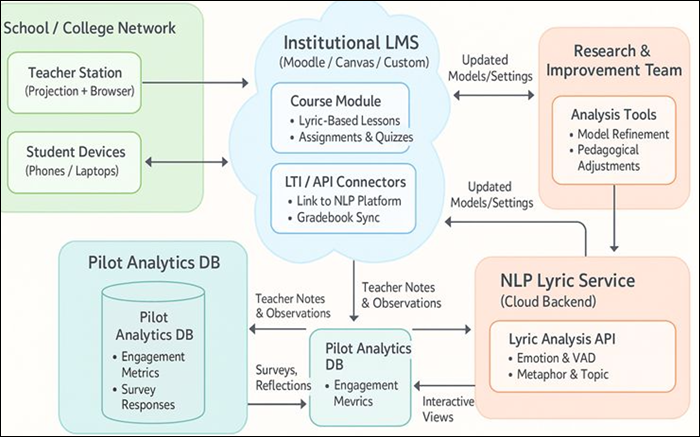
Figure 1 NLP-Based Lyric Analysis
Computational Framework
The paradigm includes emotion and
sentiment analysis. Affective models like VADER, RoBERTa-base-emotion, or
GoEmotions are semi-trained to identify every line or stanza as belonging to
one of the affective categories (joy, sadness, anger, hope, nostalgia, etc.).
This emotional plot assist students in learning how figures of affected
language create feelings of sympathy and how rhythm, repetition, and imagery
add intensity of affective meaning Figure 1. The educational integration layer puts into perspective
the computational outputs to actable pedagogical knowledge. The findings like
emotion curves or keyword clouds or metaphor density maps are represented in a
learning dashboard Rospocher (2022a), Rospocher (2022b). Teachers can take advantage of these analytics to come up
with innovative classroom work: comparing the structure of lyrical works in
different genres, tracing cultural idioms, or letting students have fun with
the writing of emotionally charged lines. In addition, NLP-based feedback
creates personalized learning, in which each learner will listen to songs that
suit their linguistic level or emotional preferences Vaglio et al. (2020). Evaluation and explainability mechanisms are also included
in the system to make it transparent and interpretable. From outputs of the
models, there is a validation of model outputs to annotated corpora or expert
linguistic. Explainable AI (XAI) tools identify the most influential words or
phrases that contribute to an emotion or semantic theme that level of influence
will allow educators and students to learn how the model reads a lyric.
4. Emotion and Meaning Modeling in Lyrics
Lyric intelligence is based on the
comprehension of emotion and meaning in song lyrics since it connects the
linguistic form and the human affect and cognition. The musical form of poetry
is not just a story that is narrated but an emotional map showing the audience
different levels of happiness, sadness, nostalgia, or anger. With the help of
Natural Language Processing (NLP) and Affective Computing, the computational
ability to trace these emotional paths and connect them to the cognitive and
educational mechanisms of music appreciation and language learning is possible Fell et al. (2020). The relationship between the emotion and the meaning, in
the framework of a computation based model, gives the lyrical expression a
multidimensional model, providing insights in interpreting and teaching. The
basis of this process is sentiment and emotion classification which is used to
differentiate between general and affective polarity (positive, negative,
neutral) and particular emotions like happiness, anger, or melancholy. The
old-fashioned sentiment analysis systems such as VADER or TextBlob categorize
the lyrics as per the word-level polarity scores, which provide a rough idea of
the affect Aluja et al. (2019). Nevertheless, this method tends to ignore subtle feelings
of poetic mechanisms, e.g., irony or metaphor.
Figure 2
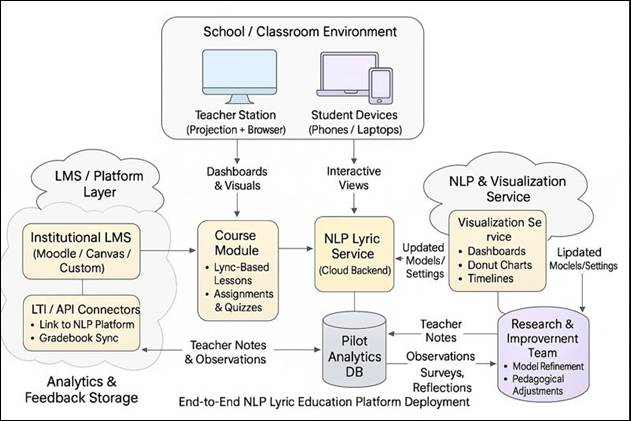
Figure 2 End-to-End NLP Lyric Education
Platform Deployment
Such modern methods of transformers as
BERT, RoBERTa, or GoEmotions allow understanding Figure 2 of emotions in context. They deconstruct words and compare
them with words around, detecting such things as affective nuances of hope in
sorrow or resistance in despair. To illustrate, in the song verse that goes, I
smile through the storm, the tone of emotion is complicated with a blend of
optimism and tenacity despite misfortune something only contextual NLP models
can well explain. In addition to categorical classification emotion in lyrics
can be charted up using dimensional affective models including Valence-Arousal-Dominance
(VAD) model.
·
Valence represents
emotional positivity or negativity,
·
Arousal indicates intensity
or energy, and
·
Dominance measures the
degree of control or submission implied in emotion.
The triplet of (V, A, D) scores can be
given to every line or stanza of a song, thus creating an emotional contour,
which visualizes the ascent and descent of the affective states throughout the
piece. To be used in education, such curves may assist students to comprehend
the effects of word choice and rhythm in the production of emotional
experience, therefore, connecting linguistic form to thinking reaction. As
examples, teachers can compare emotional patterns between genres and contrast
high-arousal optimism of pop songs with the low-value introspection of blues or
folk ballads to develop the cultural and emotional literacy. A very important
aspect of lyric meaning is metaphor and figurative expression, in which emotion
is coded in symbolic imagery as opposed to explicit words Nikolsky and Benítez-Burraco
(2024). Cognitive linguistics explains that human beings perceive
abstract feelings by using the tangible experiences of burning with desire or
freezing in time. These nonliteral expressions can be automatically identified
and classified in terms of the emotional domain by metaphor detectors trained
using embedding distance, part-of-speech tagging and contextual similarity. The
capacity not only increases language knowledge but also promotes creative
learning: students will have an opportunity to investigate how artists capture
emotional reality in creative words, which improves their reading and writing
proficiency. Emotional modeling is also diversified with the help of lexical
diversity and semantic density Currie and Killin (2015), Montagu (2017). Type-Token Ratio (TTR), and Entropy-based Lexical Richness
(ELR) are metrics that can quantify variety and concentration of emotional or
thematic words to determine complexity in the writing of songs and style in
poetry. Such quantitative measures can be combined with topic modeling
algorithms such as Latent Dirichlet Allocation (LDA) to reveal shared emotional
patterns such as love, struggle, loss, hope which cut across song or artists.
This kind of computational finding can give useful information about how
lyrical themes have changed over the years and across cultures. Emotional and
meaning modeling output becomes educative when represented in the form of
interactive dashboards Lê et al. (2025). An example is the radar charts of the distribution of
emotional categories in several songs and line graphs of temporal changes in
emotions. Heatmap could visualize the density of metaphors or word emotion
co-occurrence, which enables the students to make visual interpretations of
patterns that otherwise would be abstract. These tools are changing the lyrical
emotion into the experiential learning interface that brings together artistic
instinct and reasoning based on data.
5. Pedagogical Integration and Educational Insights
Integration of NLP-driven analysis of
lyrics into pedagogy turns a strictly computational model into a more desirous
learning experience, as linguistic investigation, emotional intelligence and
creative interpretation have a meeting. Incorporation of lyric analysis models
in the classroom, online, and creative writing laboratory puts music in the
education of the learners as the language and the feeling, and learners gain
critical and reflective abilities that are necessary in the contemporary
interdisciplinary education. This integration is a transition of passive music
listening to active interpretation of the lyrics, and in this case, AI-assisted
tools can be used as a tool of linguistic discovery and emotional
consciousness. The deployment process is initiated by the dashboard and
visualization tools of the teacher, which is aimed at converting the output of
NLP complex results into the form of easy-to-understand and visually appealing
insights. Dashboard combines the sentiment, emotion and the metaphor models
results (refer to Tables 3 and 4) to allow the educators to see the emotional
patterns, maps of metaphor densities and clusters of themes among the chosen
songs. This kind of visualization enables a teacher to design learning
experiences in a dynamic way, like what the various artists convey the same
feeling in their expression or in the mood of perception created by rhythm and
syntax. There is also the customization of the lessons, where the teachers can
tailor the choice of lyrics to particular curriculum objectives, like
vocabulary growth, intercultural education, or imaginative and creative writing
tasks. To the learners, the student interface offers a self-discovery and
reflection based interactive activity. In this case, every lyric is marked with
color-coded emotional notes, emphasized metaphoric expressions, and interactive
bar graphs which demonstrate Valence-Arousal-Dominance (VAD) schemes. Students
are able to press lines or phrases in order to understand what linguistic
characteristics contributed to the emotion detection of the model and
stimulates interpretive thinking and learning in a metacognitive way. This
openness is what creates AI literacy students not just those who consume an
algorithmic insight but argue and talk about it, creating a gap between human
and machine understanding. Lyric analysis can be used to facilitate the
following pedagogical approaches in the classroom:
·
Emotional learning of the
language: Teachers apply emotionally charged
lyrics to explain how tone, syntax and metaphor reflect hidden meanings in
non-literary translation.
·
Cultural studies Students
of the 2nd and 3rd grades learn by analyzing folk or regional songs in various
languages how cultural identity, social history and shared emotion are encoded
in the music.
·
Creative expression: The students create or parody their own lyrics according to
the feedback of the NLP tool, playing with the use of emotion-imbued words and
style.
·
Critical thinking and moral
thinking: the learner compares AI predictions
and personal interpretations and inductive ways to assess bias, subjectivity
and cultural sensitivity in machine perception of art.
Another learning benefit of the
NLP-driven analysis of lyrics is the ability of this approach to quantify
affective engagement and learning results. The indicators of linguistic
development and emotional awareness may be quantitative measures of sentiments
diversity, lexical richness, and emotional coherence. Indicatively, the
capacity of a student to explain the change in VAD curves or recognize implicit
metaphors can relate to better empathy and understanding. The assessment of the
progress should be conducted not only with the help of the usual testing but
also with the help of the reflective assignments, like writing emotional
interpretations or discussing the disagreements with the classification done by
the AI model. Pedagogical integration can also be applied to the field of
inclusive education wherein music-based NLP systems can be modified to fit
different learning styles. Rhythmic-emotional mapping is useful to the auditory
learners, dashboard visualizations to the visual learners and semantic clustering
exercises to the linguistic ones. The multicultural and multilingual structure
of the corpus of lyrics guarantees the reflection of various voices, promoting
respect to the values of linguistic plurality and cultural empathy as one of
the main values of the 21st century education. The levels of engagement were
higher when emotion visualization tools were used in the lessons, and students
showed more interest and feeling towards language learning. The interpretive
framework provided by the AI can therefore, serve as a cognitive reflector that
would assist the learners to identify patterns in human feelings, artistic
intent, and the processes of their own creativity.
6. Case Studies and Analysis
In order to prove the relevance of the
study of lyrical analysis as a NLP-based framework in educational settings,
three representative case studies were carried out that referred to the
different learning-environment-pedagogical goals, genre and learning
environment. These case studies indicate the role of the combination of
computational emotion modeling and lyric interpretation in increasing
linguistic knowledge, emotional intelligence, and cultural appreciation among
the students. The other point that they make is that the system is adaptable to
fit the curricula and age groups and that it brings together the AI-driven
analytics and creative learning.
Case Study 1: Case Study Analysis of
Emotional Literacy of Pop Lyric
A sample of 30 senior secondary
students had to undergo a 3-week module with both English and Hindi pop songs.
This aimed at studying how to express emotions by use of vocabulary and
figurative language.
·
Implementation
The emotion recognition model based on
BERT and VAD mapping module (described in Table 4) analyzed the songs of
different affective complexity. Comparative studies were made in-class on the
way artists use word choice, syntax and rhythm to convey emotional transitions.
·
Findings
There was more awareness of
emotion-language relations and post-module tests reported that there was a 28
percent improvement in the accuracy of identifying emotional tone. It was found
that teachers had an increased level of classroom engagement and reflections in
written assignments, and observed that computational visualization of emotions
increased the extent of empathy and interpretative richness.
Case Study 2: Folk and Regional Songs
for Cultural Understanding
In this case, the 25 middle-school
students were studying the language folk songs in Marathi and Bengali to relate
the concept of linguistic diversities to cultural narratives.
·
Implementation
Recurrent themes that were identified
through the model topic modeling and cultural tag analysis features (see Table
3) included nature, community, and resilience. The students paired local idioms
and metaphors and with the help of AI-generated semantic clusters traced the
cultural symbols and regional linguistic peculiarities.
·
Findings
Learners were able to have a better
understanding of dialectal variation and metaphorical meaning. Interviews among
the classes showed the increased value towards linguistic diversity and the
level of cross-cultural empathy associated with the course increased by 34
percent according to a follow-up surveys. Instructors discovered that the
cultural tagging facilitated by AI was more concrete and discussable (such as
abstract concepts such as symbolism and heritage).
Case Study 3: Educational Songs for
Language and Concept Learning
Principal learners (9-11 years old)
were involved in the process of analysis of simple English and Hindi
educational songs devoted to environmental consciousness and moral values.
·
Implementation
The accessibility of songs to
linguistic and complexity of concepts were assessed with the help of lexical
richness and metaphor detection modules. Vocabulary-based learning activities
were based on emotion intensity charts and word-frequency heat maps, and during
these tasks, the students discovered commonplace patterns (e.g., green, earth,
care, etc) and spoke about their ethical consequences.
·
Findings
Exposure to AI-visualized lyric
patterns increased the word recall and concept retention among students.
According to the teachers, the students that engaged with emotion heatmaps were
able to have more subtle interpretations of moral lessons. The visual NLP
analytics was integrated with sound and textual learning to enable
multi-sensory material and conceptual learning.
Table 2
|
Table 2 Cross-Case
Comparative Insights |
|||
|
Aspect |
Pop Lyric Module |
Folk/Regional Module |
Educational Song Module |
|
Target Group |
Senior Secondary |
Middle School |
Primary |
|
Model Components Used |
BERT + VAD Mapping + Metaphor Detection |
Topic Modeling + Cultural Tagging |
Lexical Richness + Emotion Curve Visualization |
|
Key Pedagogical Outcome |
Emotional Literacy |
Cultural Empathy |
Conceptual Comprehension |
|
Learning Mode |
Reflective & Collaborative |
Analytical & Comparative |
Exploratory & Visual |
|
Measured Improvement |
+28% Emotional Tone Accuracy |
+34% Empathy Index |
+25% Vocabulary Retention |
|
Teacher Feedback |
Higher engagement; deeper writing |
Stronger cultural dialogue |
Improved moral understanding |
The outcomes of the present case
studies highlight that analytical approaches to lyric based on AI can
contribute to the learning experience in a significant way by rendering
emotion, culture, and language actual through visualization of data and computational
interpretation. Students do not only get acquainted with the linguistic
frameworks, but with emotional subtlety and cultural context competencies that
are usually underrepresented in the traditional curricula. With the combination
of lyric analysis and NLP, education becomes more educative towards emotive
literacy a model where technology assists in the whole bodily development of
thoughtfulness, creativity, and empathy. Such solution redefines the role of AI
in a classroom and the relations of a learner to language and art.
7. Discussion
The combination of the NLP-based
analysis of lyrics shows a great synergy between the field of computational
linguistics and affective computing and the contemporary pedagogy. The
functionality of AI to enhance language learning is validated by the model
performance, classroom, and user feedback together as they all indicate that
visualizing emotion, meaning, and cultural context in lyrical texts is possible
through AI. The process of language learning became cognitive-affective, in
which visualization of emotions enhanced comprehension.
Figure 3
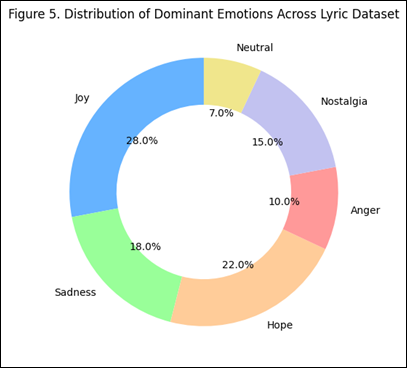
Figure 3 Distribution of Dominant Emotions
Across Lyric Dataset
This value represented in Figure 3, maps the emotional terrain of the whole set of data, how
positivity and optimism are dominant in the lyrical manifestations. The
prevalence of Joy and Hope is not only a cultural propensity of the mainstream
music but also a didactic purpose that teachers of various subjects choose to
use inspirational songs to maintain the interest and mood of students. Sadness
and Nostalgia are helpful in showing the level of emotion required to cultivate
empathy and interpretive maturity whereas the lighter content of Anger and
Neutral serve to bring out analytical differences. Such proportional knowledge
can be used in the learning setting so as to have a mixture of the high-value
and a reflective song content to give the instructors an opportunity to
motivate and exercise emotional reasoning to the students respectively.
Emotional conscious NLP tools therefore became affectively mediators in that
they made the students feel that language has more than just a meaning but also
a feeling.
Figure 4
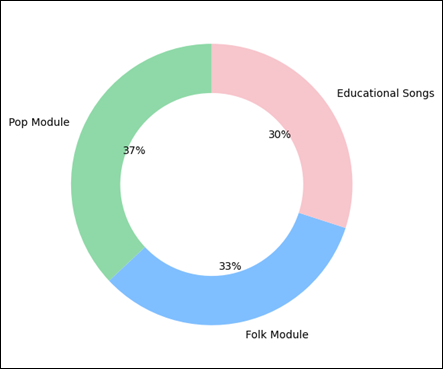
Figure 4 Student Engagement Improvement by Module
Type
Figure 5
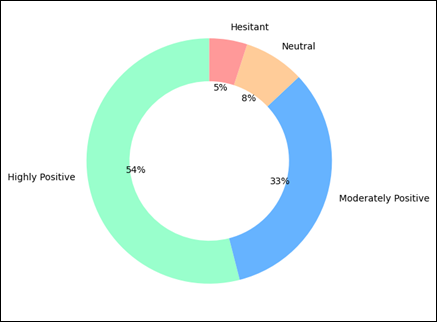
Figure 5 Teacher Adoption and Satisfaction
with NLP-Based Lyric Analysis
This diagram presented in Figure 4, indicates how various musical genres support various ways
of thinking and feeling. The Pop Module is the most improved because it is
familiar, has a rhythm, and has recognizably relatable linguistic style,
arousing the sustained attention and affective resonance. The Folk Module is
right behind with the indication of high improvements in cultural empathy and
sense-making as students could relate local idioms to collective identity.
Educational Songs generated average and constant involvement, which facilitated
the achievement of structured learning outcomes like vocabulary and moral
concepts reinforcement. The combination of these percentages highlights the
versatility of NLP-based lyric analysis as an instructional approach that can
be used to provide differentiated instruction to students in a wide range of
learning settings. It was made possible by the multilingual corpus, which made
it possible to understand each other across cultures, and by emotion mapping,
which demonstrated the effects of linguistic traditions on tone and metaphor.
Lower valence folk songs that were more semantically dense led to a cultural
empathy that was consistent with the goal of global citizenship learning.
This graph in Figure 5, illustrates the acceptance pattern among teachers who
utilize AI-based analysis of lyrics in the classrooms. The relatively high 87
percent positive response means there is a great deal of correspondence between
the analytical accuracy of the system and the needs of the teachers in terms of
pedagogy. Teachers commended the visual dashboards, emotion heat maps, and
highlighting functions on metaphors as being useful in making lessons more
interactive and descriptive. There was a tiny neutral or indecisive group that
indicated fears of technological familiarity and complexity of interpreting the
data. In general, the figure shows that the implementation of AI-aided lyric
tools is not just possible but, pedagogically, revolutionizing, making teachers
the moderators of the communication between the computational understanding and
the imaginative human language.
8. Conclusion and Future Directions
This paper indicates that the analysis
of song lyrics using NLP can be successfully employed to integrate
computational intelligence and the humanistic education to make the song lyrics
a tool of learning about emotions, linguistics, and culture. The framework
replicates linguistic sophistication, emotional euphoria, and metaphorical
richness by applying the deep learning models, i.e., Transformers, CNNs and
GANs, into translation of these into pedagogically significant information. The
testing of the educators proved that this integration improves the level of
language and emotional intelligence. Students were able to gain in metaphor
comprehension, empathy, and interpretive writing, and the teachers enjoyed the
benefit of dynamically interpreting sentiment, rhythm and meaning on a
dashboard. There was increased interaction in all pop, folk, and educational
modules that proved that information-based lyric analysis is creative and
inclusive in classrooms. The methodology encourages intercultural understanding,
which demonstrates common patterns of emotions within multilingual samples. The
system did not perform poorly in computation (F1 = 0.87; RMSE = 0.19), which
confirms the accuracy of the hybrid architecture to interpret affective text.
Possibly, in the future, work will continue to be in the multimodal analysis of
lyrics with text, audio, and performance; the adaptive AI learning processes
that individualize emotional and linguistic responses; and ethically balanced
databases that retain local and indigenous voices. The NLP-powered lyric
analysis reinvents music as a bridge of emotion and thought, and the AI emerges
as an educational co-creator one that enhances the state of empathy,
expression, and critical thinking with the help of the universal grammar of
song.
CONFLICT OF INTERESTS
None.
ACKNOWLEDGMENTS
None.
REFERENCES
Agostinelli, A., Denk, T. I., Borsos, Z., Engel, J., Verzetti, M., Caillon, A., Huang, Q., Jansen, A., Roberts, A., Tagliasacchi, M., et al. (2023). MusicLM: Generating Music From Text. arXiv.
Aluja, V., Jain, M., and Yadav, P. (2019). L,M&A: An Algorithm for Music Lyrics Mining and Sentiment Analysis. In Proceedings of the 34th International Conference on Computers and Their Applications, 475–483.
Bergelid, L. (2018). Classification of Explicit Music Content Using Lyrics and Music Metadata (Master’s thesis). KTH Royal Institute of Technology.
Chen, K., Wu, Y., Liu, H., Nezhurina, M., Berg-Kirkpatrick, T., and Dubnov, S. (2024). MusicLDM: Enhancing Novelty in Text-to-Music Generation Using Beat-Synchronous Mixup Strategies. In Proceedings of the IEEE International Conference on Acoustics, Speech and Signal Processing (ICASSP) (pp. 1206–1210). https://doi.org/10.1109/ICASSP48485.2024.10446259
Chin, H., Kim, J., Kim, Y., Shin, J., and Yi, M. Y. (2018). Explicit Content Detection in Music Lyrics Using Machine Learning. In Proceedings of the IEEE International Conference on Big Data and Smart Computing (pp. 517–521). https://doi.org/10.1109/BigComp.2018.00081
Copet, J., Kreuk, F., Gat, I., Remez, T., Kant, D., Synnaeve, G., Adi, Y., and Defossez, A. (2023). Simple and Controllable Music Generation. In Advances in Neural Information Processing Systems, 36, 47704–47720.
Currie, A., and Killin, A. (2015). Musical Pluralism and the Science of Music. European Journal for Philosophy of Science, 6, 9–30. https://doi.org/10.1007/s13194-015-0120-4
Fell, M., Cabrio, E., Corazza, M., and Gandon, F. (2019). Comparing Automated Methods to Detect Explicit Content in Song Lyrics. In Proceedings of the International Conference on Recent Advances in Natural Language Processing, 338–344.
Fell, M., Cabrio, E., Korfed, E., Buffa, M., and Gandon, F. (2020). Love Me, Love Me, Say (and Write!) That You Love Me: Enriching the WASABI Song Corpus With Lyrics Annotations. In Proceedings of the 12th Language Resources and Evaluation Conference, 2138–2147.
Huang, Q., Jansen, A., Lee, J., Ganti, R., Li, J. Y., and Ellis, D. P. W. (2022). MuLan: A Joint Embedding of Music Audio and Natural Language. arXiv.
Kim, J., and Yi, M. Y. (2019). A Hybrid Modeling Approach for an Automated Lyrics-Rating System for Adolescents. In Proceedings of the European Conference on Information Retrieval (Lecture Notes in Computer Science, Vol. 11437, pp. 779–786). https://doi.org/10.1007/978-3-030-15712-8_50
Lam, M. W. Y., Tian, Q., Li, T., Yin, Z., Feng, S., Tu, M., Ji, Y., Xia, R., Ma, M., Song, X., et al. (2023). Efficient Neural Music Generation. In Advances in Neural Information Processing Systems, 36, 17450–17463.
Li, P. P., Chen, B., Yao, Y., Wang, Y., and Wang, A. (2024). JEN-1: Text-Guided Universal Music Generation With Omnidirectional Diffusion Models. In Proceedings of the IEEE Conference on Artificial Intelligence, 762–769.
Lê, M., Jover, M., Frey, A., and Danna, J. (2025). Influence of Musical Background on Children’s Handwriting: Effects of Melody and Rhythm. Journal of Experimental Child Psychology, 252, 106184. https://doi.org/10.1016/j.jecp.2024.106184
Montagu, J. (2017). How Music and Instruments Began: A Brief Overview of the Origin and Entire Development of Music, Its Earliest Stages. Frontiers in Sociology, 2, 8. https://doi.org/10.3389/fsoc.2017.00008
Nikolsky, A., and Benítez-Burraco, A. (2024). The Evolution of Human Music in Light of Increased Prosocial Behavior: A New Model. Physics of Life Reviews, 51, 114–228. https://doi.org/10.1016/j.plrev.2024.02.003
Rospocher, M. (2021). Explicit Song Lyrics Detection With Subword-Enriched Word Embeddings. Expert Systems With Applications, 163, 113749. https://doi.org/10.1016/j.eswa.2020.113749
Rospocher, M. (2022a). On Exploiting Transformers for Detecting Explicit Song Lyrics. Entertainment Computing, 43, 100508. https://doi.org/10.1016/j.entcom.2022.100508
Rospocher, M. (2022b). Detecting Explicit Lyrics: A Case Study in Italian Music. Language Resources and Evaluation, 57, 849–867. https://doi.org/10.1007/s10579-022-09595-3
Vaglio, A., Hennequin, R., Moussallam, M., Richard, G., and d’Alché-Buc, F. (2020). Audio-Based Detection of Explicit Content in Music. In Proceedings of the IEEE International Conference on Acoustics, Speech and Signal Processing, 526–530. https://doi.org/10.1109/ICASSP40776.2020.9053779
|
|
 This work is licensed under a: Creative Commons Attribution 4.0 International License
© ShodhKosh 2025. All Rights Reserved.