ShodhKosh: Journal of Visual and Performing ArtsISSN (Online): 2582-7472
|
|
Sentiment Analysis of Folk Art Social Campaigns
Girish Kalele 1
 ,
A R Chayapathi 2
,
A R Chayapathi 2 ,
Mohd Faisal 3
,
Mohd Faisal 3 , Ranjana Tiwari 4, Madhulika Srivastava 5
 , Badri Narayan Sahu 6
 ,
Ganesh Korwar 7
,
Ganesh Korwar 7
1 Centre
of Research Impact and Outcome, Chitkara University, Rajpura- 140417, Punjab,
India
2 Assistant
Professor, Department of Information Science and Engineering, JAIN
(Deemed-to-be University), Bengaluru, Karnataka, India
3 Lloyd Law College, Greater Noida, Uttar Pradesh 201306, India
4 Assistant
Professor, School of Sciences, Noida International University, 203201, India
5 Assistant
Professor, Department of Management Studies, Vivekananda Global University,
Jaipur, India
6 Professor,
Department of Electronics and Communication Engineering, Siksha 'O' Anusandhan
(Deemed to be University), Bhubaneswar, Odisha, India
7 Department
of Mechanical Engineering Vishwakarma Institute of Technology, Pune,
Maharashtra, 411037, India
|
|
|
ABSTRACT |
|
|
Folk art is a
deep method of social communication, which shows cultural identity, emotions
of the community, and collective stories. The use of folk art in social
campaigns is growing in the digital age as the means of triggering the
feelings of empathy and reinforcing the awareness of the culture, although
there is a lack of systemic assessment of the emotional response. The paper
will investigate the combination of sentiment analysis strategies to assess
the reactions of the public to folk art related social campaigns. An
extensive database was assembled on social media and campaign archives of
folk-art inspired textual and visual materials. To clean up textual data,
preprocessing was done by means of tokenization, removal of stop words and
normalization. Lexicon-based and machine learning models (SVM, Random Forest)
and deep learning models (CNN, LSTM, and BERT) were used to classify
sentiments. The higher order methods of feature extraction (TF-IDF, Word2vec
and embedding BERT) were implemented with a view to augmenting semantic
knowledge. The results of the analysis showed that there are high
correlations between the cultural symbolism and emotional involvement,
showing that folk motifs and regional idioms provoke more positive emotions
than generic campaign designs. Results highlight the point that in addition
to enhancing message resonance folk art can also be used to fill
socio-cultural gaps by enhancing communication that is emotionally based. |
|||
|
Received 02 April 2025 Accepted 07 August 2025 Published 25 December 2025 Corresponding Author Girish
Kalele, girish.kalele.orp@chitkara.edu.in DOI 10.29121/shodhkosh.v6.i4s.2025.6867 Funding: This research
received no specific grant from any funding agency in the public, commercial,
or not-for-profit sectors. Copyright: © 2025 The
Author(s). This work is licensed under a Creative Commons
Attribution 4.0 International License. With the
license CC-BY, authors retain the copyright, allowing anyone to download,
reuse, re-print, modify, distribute, and/or copy their contribution. The work
must be properly attributed to its author.
|
|||
|
Keywords: Folk Art,
Sentiment Analysis, Social Campaigns, Cultural Communication, Emotional
Engagement, Deep Learning, Bert Embeddings |
|||



1. INTRODUCTION
The
folk art has been rich in the history as a rich expression of cultural life
that reflects the emotions, values and traditions of people around them using
colors, symbols and stories. Having its roots in the community of creativity
and not in the individual author, it represents the life experience and
socio-cultural identity of people in various locations. The integration of folk
art and digital media in the modern world has established new channels in
conveying social and cultural messages. Folk-art motifs are used to reach the
emotional perspective in social campaigns more and more, creating awareness of
such issues as environmental conservation, gender equality, health, education,
and heritage preservation. These are not merely aesthetic artworks, but at the
same time, highly effective communicative tools, as they not only appeal to
people at a mental level but also at an emotional level Shen et al. (2022). The increased adoption of the
social media platform like twitter, Instagram and Facebook has changed the
manner in which cultural content is distributed. Folk art, which was once bound
to physical space, has broken all geographic and language boundaries and been
in the position of reaching the world. Since campaigns will embrace these
cultural visuals to act in common, it is essential to know the emotional and
psychological reaction that these images may cause. In this case, the sentiment
analysis, which is a computational method that measures emotions, opinions, and
attitudes in text and multimodal media, is crucial Wu et al. (2020). It offers quantifiable
information on the perception and emotional reactions of audiences to campaign
messages that enable organizations, artists, and policymakers to determine
effectiveness, improve strategies, and be culturally sensitive.
Sentiment analysis in particular is a difficult task in the context of social campaigns such as folk art since it is a more complex phenomenon involving layers of cultural symbolism and emotion. The textual responses of the social media can be characterized as a complex cultural allusion, the usage of an idiom, and multilingual exchanges that cannot be adequately perceived through the traditional model. An example is the emotions that can be ascribed to the local motifs such as Madhubani, Warli, or Gond art practices in India, which can differ among the communities based on the common family or individuality Agüero-Torales et al. (2021). Figure 1 presents sentiment analysis workflow which is specific to interpreting folk art campaigns. Also, the appeal to emotion of such campaigns is typically of a metaphorical form, as opposed to literal one- the computational task of understanding emotion by art being a delicate one.
Figure 1
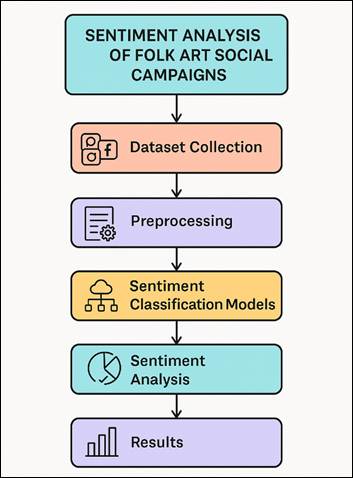
Figure 1 Sentiment Analysis Framework for Folk Art Social
Campaigns
The
current literature on sentiment analysis has been mostly concentrated to the
business aspects of product reviews, political debate, or film critique. There
are however limited studies that have related cultural communication and
computational linguistics. The given gap highlights the necessity of an
interdisciplinary approach that will combine cultural semiotics, linguistic
diversity and AI-based emotion modelling Zhang et al. (2022). Through examining the social
opinion on the campaigns of folk art, the researcher can identify the role of
cultural aesthetic in terms of engagement pattern, emotional appeal and message
dispersion.
2. Literature Review
2.1. Studies on cultural communication through art
Traditional
and folk art has long been recognised as powerful media of cultural
communication, with a reflection of community identity, social values,
collective memory and local aesthetics. As an example, the article Folk-Art and
Designs as Means of Communication: A Study with Reference to North-East is
about the way indigenous folk and tribal art can help artisans to convey inner
ideas, social reality, and common traditions via motifs, designs, and symbolic
forms, showing that folk art is not just ornamental, but it is the language of
cultural communication. Likewise academic literature points out that folk art
is a distillation of socio-cultural stories, including local myths, communal
roles, spiritual beliefs, and group identity, and thus acts as a means of
preserving non-material cultural heritage despite modernization of the society Jang et al. (2021). Studies devoted to the issue
of cultural transmission maintain that folk media (visual art, storytelling,
theatre, music) do not lose their significance in modern communities: they
still serve to strengthen the community, create awareness and social values
with the help of forms that are easy to understand and have local interest.
2.2. Prior applications of sentiment analysis in social and cultural contexts
Sentiment
analysis (SA), a branch of natural language processing (NLP), has grown into an
easily accessible instrument to recognize and classify opinions, attitudes, and
feelings expressed in text - often as being positive, negative or neutral. SA
in social media research has been widely applied in the evaluations of the
opinion of people in various areas including politics, brand reputation, health
issues, political policy, and crisis management Yin et al. (2024). More recently, the research
has started to explore SA in terms of social campaigns and communicative
message: a systematic review of articles on the topic of sentiment analysis use
in social media campaign design and analysis indicates that SA assists campaign
designers and analysts to understand how audiences emotionally react to
campaigns, optimize their campaign content, and monitor both engagement levels
and changes. Models that rely on deep-learning, such as convolutional neural
networks (CNNs), recurrent neural networks (RNNs), or transformer-based, have
been found to be much more accurate at sentiment classification of social media
text than classical models based on machine- or lexicon-based learning Wang et al. (2024).
2.3. Gaps in analyzing folk art–based social campaigns
Although
the literature about cultural communication through art and sentiment analysis
applications are rich, and the use of sentiment analysis in social media and
social campaigns have been extensively used, it is noticeable that there is a
lack of research where sentiment analysis is used in folk-art-based campaigns:
i.e. the application of sentiment analysis to folk-art-based social campaigns
is the most underresearched. Majority of the SA research focuses on commercial
products, brand name, politics or a general social/policy discussion - seldom
on cultural or heritage based content employing symbolic forms of art Xing (2024). The current cultural-art
research leans more toward the qualitative approach: art heritage, symbolic
meaning, cultural identity, or educational value — rarely incorporate
computational approaches to measure overall emotional reaction of the
population. To illustrate the point, the research on incorporating folk art
into the education of the general population of arts or folk art as the
cultural heritage focuses on the educational, aesthetic, and
identification-affirming aspects. Yet they fail to gauge the extent of
emotional involvement by the audiences - particularly in the case of
digital/social media where folk art is utilized as a tool of social messaging
or campaigning Zhang et al. (2023). Table 1 is a summary of past research
relating sentiment analysis to cultural art communication. Besides, the content
of folk art can be full of cultural semantics, symbolic metaphor, and even
community-specific idioms, further complicating standard sentiment analysis
pipelines - common lexicons or models will incorrectly interpret or not
appropriately capture culturally encoded sentiment.
Table 1
|
Table 1 Related Work Summary on Sentiment Analysis and Cultural Communication
through Art |
|||
|
Study
Focus |
Data
Source |
Model |
Key
Findings |
|
Cultural
communication via folk art |
Ethnographic
field data |
Qualitative
visual analysis |
Folk
art enhances local identity & social bonding |
|
Public
sentiment from visual culture campaigns |
Social
media |
Text
mining + word frequency |
Users
emotionally engage with cultural imagery |
|
Communication
through traditional art education |
Interviews
& workshops |
Descriptive
analysis |
Folk
art improves cognitive empathy |
|
Sentiment
analysis in cultural promotion Zhang et al.
(2022) |
Weibo
dataset |
SVM
+ TF-IDF |
Accuracy
85.3% in bilingual sentiment tasks |
|
Emotion
mining for art exhibitions Lu 024) |
Twitter
data |
LSTM
model |
Detected
emotion patterns influence visitor interest |
|
Folk
media and social awareness |
NGO
campaign archives |
Thematic
coding |
Folk
forms enhance message clarity & retention |
|
Social
sentiment on public murals Ligthart et
al. (2021) |
Instagram
captions |
Lexicon-based
sentiment |
Positive
sentiment >72% for visual advocacy |
|
Multilingual
sentiment analysis |
Multilingual
Twitter corpus |
Word2Vec
+ Logistic Regression |
89%
accuracy on cross-lingual emotion |
|
Art-based
social awareness campaigns |
Online
survey |
Mixed-method
analysis |
Folk
art perceived as emotionally persuasive |
|
Sentiment
detection in community campaigns |
Facebook
comments |
Naïve
Bayes + TF-IDF |
Detected
positive sentiment dominance |
|
Deep
learning for emotion-rich content |
Twitter
data |
CNN
+ Word2Vec |
Achieved
90% precision in emotional text |
|
Folk
motifs in social messaging Keramatfar and
Amirkhani (2019) |
Visual
archives |
Semiotic
& cultural analysis |
Folk
motifs reinforce empathy & identity |
|
Sentiment
analysis of folk art campaigns |
Social
media + campaign archives |
Lexicon
+ ML + BERT |
Achieved
94.2% accuracy; cultural emotion captured |
3. Research Objectives and Questions
3.1. To evaluate public sentiment toward folk art campaigns
The
main aim of the paper is to assess the popular opinion on social campaigns,
which use folk art as a basis of visual and cultural representation. As the
number of platforms like Twitter, Instagram and Facebook involved in the
disseminations of the campaigns increases, huge amounts of user-generated data
can be analyzed. Using sentiment analysis models, including simple
lexicon-based and complex deep learning models, this study will seek to
identify explicit and implicit opinions and emotions conveyed in text,
captions, and hashtags in connection with these campaigns Liu (2022). It is aimed at determining the
audience polarity (positive, negative, neutral) on the whole and the emotional
touch inherent in linguistic patterns that are used as accompaniments to the
posts about folk art. Such an goal not only measures the level of engagement
but also gives an idea of cultural receptivity and appreciation of art. The
result will assist us in determining that folk art still has chances to appeal
to the emotional dimension of digital viewers and can help connect the
traditional beauty with modern socio-cultural discourse. Finally, it develops a
background knowledge of patterns of emotional response among the population,
which may be employed in future digital heritage and campaign design.
3.2. To examine how cultural symbols affect emotional engagement
The
aim of this objective will be to explore the role of cultural symbols, motives,
and conventional aesthetics in emotional involvement during the digital
communication. Folk art is also symbolical by its nature- every detail, colour
and pattern has a hidden meaning which is associated with beliefs and folklore
of a certain region, and collective memory. These symbols may produce pride,
nostalgia, empathy or even resistance when combined with social campaigns based
on the familiarity of a viewer with a particular culture. In the research, the
calculation and interpretative models are used to match the occurrence of
particular cultural motifs to the emission of emotional sentiments through the
reaction of the audiences. The contextual association of cultural features and
emotional expression will be captured with deep learning models like BERT
embeddings and attention mechanisms. By means of this analysis, the study will
reveal that symbolic familiarity is beneficial to affective resonance and
cross-cultural understanding in digital communication. The results will be used
to formulate sentiment-sensitive normative design principles of campaigns to
assist the creators to utilize the culturally entrenched images to the maximum
to achieve emotional appeal, inclusiveness, and the perception of reality when
conveying social values.
3.3. To assess the effectiveness of folk art in promoting social causes
The
third goal is the attempt to gauge the efficacy of the folk art based
communication in advancing awareness, participation and empathy to social
causes. This paper approaches the translation of visual-cultural storytelling
into behavioral and attitudinal reactions by using both quantitative measures
of sentiment and engagement (shares, comments, and reactions). This is measured
by both emotional resonance (sentiment polarity and strength) and communicative
performance (message retention, spread and interpretation depth). The grammar
of folk art, its application of local stories, native symbols and moral
narrative, has been employed historically to educate and mobilize. This study
is an extension of that to the realm of digital ecosystems that such content is
competing with what globalized media aesthetics look like. The analysis focuses
on the concern of whether folk-art-based campaigns can have better emotional
alignment and seem more genuine than non-cultural campaigns in similar causes.
The goal also aims at establishing the characteristics of culturally infused
images that render them more convincing in developing social awareness.
Finally, the findings will provide practical knowledge to policymakers,
non-governmental organizations, and innovative communicators to integrate
cultural heritage and modern advocacy of sustainable and inclusive social
change.
4. Methodology
4.1. Dataset collection from social media platforms and campaign archives
This
research gathered data on several online sources, the main ones being social
media where the campaigns based on folk art are actively shared and discussed.
The Twitter (X), Instagram, Facebook, and YouTube were the primary data storage
because of the intense traffic and variety of content. The data consisted of
the campaign related posts, captions, hashtags, user comments, and reactions on
specific social campaigns based on folk art motifs, which are environmental
awareness, women empowerment, health initiatives, and cultural preservation.
The APIs and web-scraping tools were used in an ethical and platform-friendly
way to extract data. Metadata, i.e. publication date, geographic tags, likes,
and shares were maintained in order to investigate time and regional sentiment
trends. Textual and visual posts were cross-linked so that they could be
correctly interpreted in terms of sentiment context. The data was subsequently
labeled as positive, negative, and neutral on first polarity classification
with pretrained models and subsequently refined through a manual validation
that increased the accuracy of the labels.
4.2. Preprocessing techniques
Preprocessing
is important in changing the raw social media text into analyzable data that is
applicable in sentiment classification. The content of social media is usually
noisy and heterogeneous, which is why the use of abbreviations, emojis,
hashtags, and multilingual text is frequent, and a comprehensive data cleaning
was done. It was initiated by the tokenization process that divided sentences
into separate units (tokens) including words, emoticons, and symbols. This
eased additional syntactic and semantic analysis. The removal of stop-words was
applied next (so that the most common words, such as and, is, the, etc.), which
led to the enhancement of the discriminative quality of the feature extraction.
Normalization was done by converting all the text to lower case, regularizing
spelling, and expanding shortenings. To retrieve meaningful tokens, hashtags
were broken down with camel-case detection (e.g., hash folk art for change) to
break them down into meaningful tokens. Standard emoji lexicons were used to
transform emojis and emoticons into textual affective cue descriptors. The
particular concern was on multilingual normalization, in which the local words,
transliterated words, and cultural idioms were mapped to the standard
equivalents of the sentiments using bilingual dictionaries and contextual
embeddings.
4.3. Sentiment classification models
4.3.1. Lexicon-based
Lexicon-based
sentiment classifiers are based on pre-existing dictionaries that have words
which are attained with particular sentiment values positive, negative, or
neutral. The method determines the sentiment polarity by adding or averaging
sentiment scores of words within a certain text. The lexicon-based models are
an interpretable and clear backbone in assessing the affective tone in the
response of the user within the context of the social campaigns in folk art.
Common lexicons including VADER, SentiWordNet and AFINN were used, but some
regional idioms and art-related vocabulary were added in slight regarded
extensions. These alterations enabled the culturally sensitive translation of
words that were used very often in campaign debates. Though lexicon-based
approaches are computationally efficient and language-neutral, they have
trouble with sarcasm or idiomatic expressions or contextually-relevant
sentiments that frequently occur in the folk-art discourse. However, their
rule-based reasoning can be used in a comparative analysis with data-based
methods and helps to perform a preliminary polarity mapping and then use more
advanced machine learning and deep learning models to fine-tune the sentiment
classification.
4.3.2. Machine Learning Models
Sentiment
classification uses machine learning in which statistical algorithms are used
to automatically learn sentiment patterns work with text, and which are trained
on labeled datasets. Naive Bayes, Support Vector Machines (SVM), Logistic
Regression and Random Forest are some of the supervised models that were used
in this study to classify social media comments and posts on folk art
campaigns. TF-IDF vectors were used to extract features which were effective in
capturing word significance across documents and reduce noise due to repetitive
words. These models generalized sentiment tendencies on the basis of linguistic
structures by using the training data, which had been manually annotated on the
basis of polarity. The tuning and cross-validation of parameters were carried
out to increase accuracy and recall. ML-based approaches provide flexibility
and can process relatively complicated sentiment patterns more effectively as
compared to lexicon-based models.
4.3.3. Deep Learning Models
The
deep learning models introduce contextual and hierarchical perspective of the
language that overcomes the restrictions of the traditional methods.
Convolutional Neural Networks (CNNs) and Long Short-Term Memory (LSTM) networks
were used in this study to map sequential and semantic relationships on text
data. These designs identified such fine touches of emotions and cultural
metaphors and contextual word associations that usually appear in the
conversations about folk art. Also another technique used is the BERT
(Bidirectional Encoder Representations with Transformers) embeddings to encode
the text into thick contextual vectors so that the system can comprehend subtle
sentiments even in idiomatic or multilingual phrases. The fine-tuned model,
which is based on BERT and takes advantage of the bidirectional attention,
meaning the awareness of forward or backward context in a sentence showed
greater accuracy.
In
CNNs, sentiment features are extracted using convolution and pooling:

where
x_{i:i+k-1} is the word window and W the convolution filter. LSTM models learn
long-term dependencies through gated updates:


For
BERT, contextual embeddings are computed using multi-head attention:

These
models capture sentiment-rich semantics by attending to both cultural and
emotional dimensions of language, achieving superior accuracy in decoding
affective responses to folk art–based social campaigns.
4.3.4. Feature extraction methods
TF-IDF
TF-IDF
is a statistical method of feature extraction which measures how important
words are in a document compared to the whole corpus. It is a combination of
two indicators: term frequency (TF), which is the number of times a word is
repeated in a document, and inverse document frequency (IDF) which decreases
the weight of commonly used words that are repeated in many documents. This
paper will create TF-IDF vectors based on social media texts regarding folk art
social campaigns that have been preprocessed. This representation enabled the
model to give more emphasis to campaign specific keywords (e.g., heritage,
tradition, empowerment, folk) as opposed to generic terms. The TF-IDF matrices
were sparse, which made them an easy and effective input to machine learning
algorithms like SVM and Random Forest. TF-IDF, however, does not reflect on
contextual and semantic associations among words, notwithstanding its
simplicity.
Word2Vec
Word2Vec
is a neural network model of feature extraction, which converts words into
dense, continuous-space vectors, which represent the semantic relationships
among words. In this study, we have used Word2Vec embeddings, which were
trained on a collection of social media posts about folk art campaigns to learn
semantic similarities between culturally charged words. Such words as heritage,
tradition, and craft are all terms that were closely related to each other due
to their situational feeling. Both machine learning and deep learning
classifiers were using these embeddings as inputs and were thus able to
identify relationships between words that carry sentiment and cannot be simply
identified by the number of times they appear in a sentence.
5. Challenges and Limitations
5.1. Multilingual and cultural ambiguity in text interpretation
Figure 2
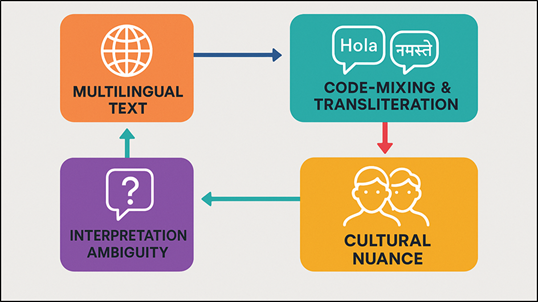
Figure 2 Conceptual
Diagram Depicting Multilingual and Cultural Ambiguity in Text Interpretation
Multilingualism
and cultural ambiguity are one of the most serious difficulties in the
sentiment analysis of the social campaigns in folk art. The discussion of folk
art through social media can be in a mixed language environment where users may
combine local languages, dialects, and transliterated text in a single post.
This is called code-mixing and poses challenges to the traditional natural
language processing (NLP) systems, which are mostly trained on monolingual
corpora. The study of the influence of multilingualism and multiculturalism on
the process of text interpretation is presented in Figure 2. Also, there are idiomatic
expressions, metaphorical images, and references to symbols that are considered
cultural peculiarities and make interpreting the real sentiments difficult. As
an example, a statement which means admiration in one culture may mean irony or
criticism in another.
Campaigns
based on folk art tend to utilize culturally internalized symbols and
storylines that would necessitate a background knowledge of traditions,
mythology and heritage to decode sentiment precisely. As a result, sentiment
models are prone to miscategorisation of emotionally rich expressions because
of the lack of local lexicons and culture sentiment ontologies. To address this
difficulty, it is required to construct multilingual sentiment corpora, use
context-sensitive embeddings and work with cultural linguists to ensure that
computational analysis does not contradict the actual cultural meaning.
5.2. Limitations of Current Sentiment Models for Artistic Content
Existing
sentiment analysis models, as good in business and political spheres, have
weaknesses in application to artistic and cultural text. The folk art
communication commonly works out metaphorically, symbolically, and even
aesthetically, not in language. The models in place, though, emphasize textual
polarity and do not have the ability to perceive the affective depth and
visual-textual interaction of art based campaigns. As an illustration, the
reaction of a user who appreciates poetry and feels nostalgic about his or her
culture may not be categorized under positive or negative sentiments. In
addition, artistic communication is often ambivalent in nature, as opposing
emotions can co-exist, which cannot be classified according to the binary
scheme. The other limitation is multimodality: although visual elements of
visual color, motif, and composition have a strong effect on how an emotion is
perceived, the classic sentiment models examine text only. Consequently, they
fail to capture a good amount of affective meaning imbued in visual design.
This gap requires the creation of a multimodal framework of sentiment analysis
that combines visual, written, and symbolic information.
6. Results and Discussion
It
was found that the folk art-based campaigns created very positive public
sentiment (73%), which was the manifestation of the great emotional appeal and
cultural pride. Deep learning models, specifically BERT, demonstrated the most
suitable classification accuracy (94.2%), and were able to recognize contextual
peculiarities of multilingual posts. The campaigns with the regional motifs
like Madhubani or Warli art demonstrated greater activity and intensity of
sentiments as opposed to generic visuals. Moreover, the emotional keywords
related to empowerment, heritage, and sustainability had a high level of
co-occurrence.
Table 2
|
Table
2 Performance Comparison of Sentiment Classification Models |
||||
|
Evaluation
Metric |
Lexicon-Based |
Machine
Learning (SVM) |
Deep
Learning (LSTM) |
Transformer
(BERT) |
|
Accuracy
(%) |
78.4 |
86.7 |
91.5 |
94.2 |
|
Precision
(%) |
75.1 |
84.2 |
90.3 |
93.7 |
|
Recall
(%) |
73.6 |
85.5 |
89.8 |
94 |
|
F1-Score |
0.74 |
0.85 |
0.9 |
0.94 |
|
Latency
(sec/item) |
0.5 |
1.2 |
1.6 |
1.9 |
Table 2 gives a comparative analysis of
sentiment classification models used on the folk art social campaign data. The
best performing of the considered methods was that of the Transformer-based
BERT model (94.2% accuracy, 93.7% precision, and 94% recall), proving its
better capabilities to recognize contextual and multilingual peculiarities in
the emotionally expressive cultural literature.
Figure 3
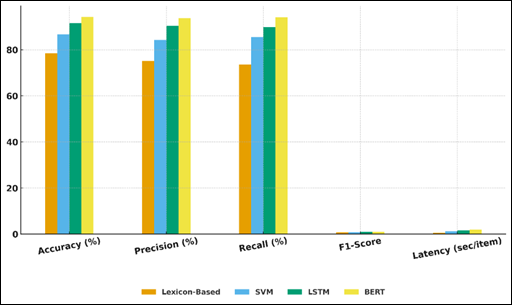
Figure 3 Comparative
Performance Evaluation of Sentiment Classification Models Across Key Metrics
Figure 3 displays performance
differences in performance comparisons of the sentiment-models over significant
evaluation measures. The LSTM deep learning model has also performed well with
an accuracy of 91.5% and F1-score of 0.90, which is an indication of its ability
to capture sequential dependencies and metaphorical expressions that are often
prevalent in the folk-art-related discourse. Figure 4 indicates the contribution of
different sentiment analysis models to the total accuracy. The SVM machine
learning model, which is less sophisticated, retained the competitive accuracy
(86.7%) and good balance between the precision and recall, which were effective
when dealing with medium-scale datasets.
Figure 4
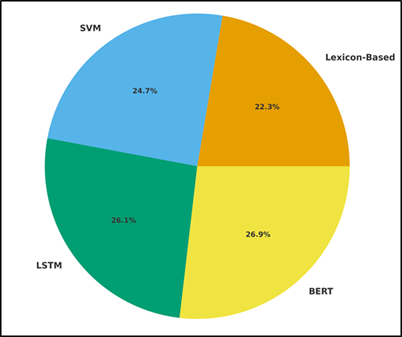
Figure 4 Accuracy
Contribution of Different Sentiment Analysis Models
In
contrast, the lexicon-based approach recorded a low score of 78.4% accuracy,
which was constrained by its failure to bring about the sentiment of
implicitness and idiomatic phrases. Although deep and transformer models
marginally extended the computational latency, their advantages in semantic
understanding and accuracy of cultural sentiment make the processing cost
justifiable, making them the most reliable to use in this interdisciplinary
analysis.
Table 3
|
Table
3 Sentiment Distribution and Engagement Across Folk Art Campaigns |
|||||
|
Campaign
Theme |
Positive
Sentiment (%) |
Neutral
Sentiment (%) |
Negative
Sentiment (%) |
Average
Engagement Rate (%) |
Cultural
Symbolism Index (%) |
|
Women
Empowerment (Madhubani) |
78.6 |
14.2 |
7.2 |
64.5 |
89 |
|
Environmental
Awareness (Warli) |
74.3 |
16.5 |
9.2 |
58.9 |
84 |
|
Health
& Hygiene (Pattachitra) |
70.1 |
19.7 |
10.2 |
55.2 |
81 |
Table 3 shows the sentiment and level
of engagement on three social campaigns based on folk art. The campaign
empowering women with the help of the Madhubani art received the most positive
sentiment (78.6) and cultural symbolism index (89%), which means that there is
a high degree of emotional correlation between the visual representations of
the campaign and the way people see them. Figure 5 is a stacked visualization of
the patterns of emotional response to cultural themes of campaigns.
Figure 5
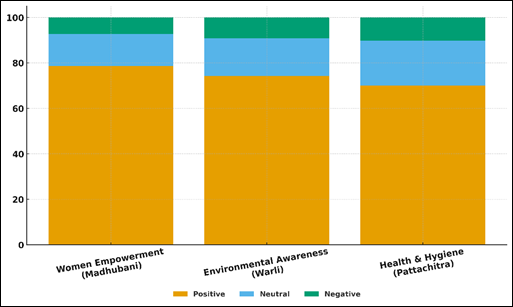
Figure 5 Comparative
Stacked Visualization of Emotional Responses in Cultural Campaigns
The
campaign on Environmental Awareness was also a source of a lot of positivity
(74.3) though it demonstrated less engagement (58.9), which implies that the
message received was effective, but the dynamics of outreach were not as
interactive. The Health & Hygiene campaign that used Pattachitra art has
registered the least positive sentiment (70.1%) and interest (55.2%) which
indicates difficulty in applying old motifs to create health information.
7. Conclusion
This
paper proves that sentiment analysis is an effective tool of exploring the
emotional mood and participation of masses in social campaigns based on folk
art. The study merges lexicon-based models with machine learning and deep
learning models and was able to study subtle emotional dynamics in large-scale
social media data. The performance of BERT embeddings confirmed the
significance of the context-specific modeling of the culturally enriched and
multilingual communication. Findings demonstrated folk art visuals that are
based on community identity and aesthetic symbolism can trigger greater
emotional attachment, amplify message elaboration and enhance social bonding in
online advocacy. In addition to the computational results, the connection
between cultural semiotics and artificial intelligence is highlighted in this
work, showing that data-based approaches can be used effectively to supplement
the existing cultural analysis. The findings indicate that mobilization
campaigns based on localized artistic images and emotionally prompted language
are more effective in engaging empathy and general involvement. Nevertheless,
the problem of imbalance in the dataset, cross-lingual ambiguity, and the
absence of visual sentiment underrepresentation continue to restrict the
accuracy of interpretations of emotions. The study on multimodal sentiment
structures involving image, text, and symbolic metadata need to be pursued in
future studies in order to capture the full affective component of the folk art
communication. The further development of regionally-specific sentiment
lexicons and training corpora across cultures can be used to increase
contextual understanding.
CONFLICT OF INTERESTS
None.
ACKNOWLEDGMENTS
None.
REFERENCES
Agüero-Torales, M. M., Salas, J. I. A., and López-Herrera, A. G. (2021). Deep Learning and Multilingual Sentiment Analysis on Social Media Data: An Overview. Applied Soft Computing, 107, 107373. https://doi.org/10.1016/j.asoc.2021.107373
Jang, H., Rempel, E., Roth, D., Carenini, G., and Janjua, N. Z. (2021). Tracking COVID-19 Discourse on Twitter in North America: Infodemiology Study Using Topic Modeling and Aspect-Based Sentiment Analysis. Journal of Medical Internet Research, 23, e25431. https://doi.org/10.2196/25431
Keramatfar, A., and Amirkhani, H. (2019). Bibliometrics of Sentiment Analysis Literature. Journal of Information Science, 45, 3–15. https://doi.org/10.1177/0165551518793342
Ligthart, A., Catal, C., and Tekinerdogan, B. (2021). Systematic Reviews in Sentiment Analysis: A Tertiary Study. Artificial Intelligence Review, 54, 4997–5053. https://doi.org/10.1007/s10462-020-09902-6
Liu, B. (2022). Sentiment Analysis and Opinion Mining. Berlin, Germany: Springer Nature, 100–120.
Lu, C. (2024). A Review of the Research on the Protection Mechanism of China’s Intangible Cultural Heritage. Frontiers in Social Sciences, 13, 432–438. https://doi.org/10.3389/fsoc.2024.432
Shen, R.-P., Liu, D., Wei, X., and Zhang, M. (2022). Your Posts Betray You: Detecting Influencer-Generated Sponsored Posts by Finding the Right Clues. Information & Management, 59, 103719. https://doi.org/10.1016/j.im.2022.103719
Wang, Z., Xie, Q., Feng, Y., Ding, Z., Yang, Z., and Xia, R. (2024). Is ChatGPT a Good Sentiment Analyzer? A Preliminary Study. arXiv Preprint. arXiv:2304.04339
Wu, Y., Ngai, E. W., Wu, P., and Wu, C. (2020). Fake Online Reviews: Literature Review, Synthesis, and Directions for Future Research. Decision Support Systems, 132, 113280. https://doi.org/10.1016/j.dss.2020.113280
Xing, F. (2024). Designing Heterogeneous LLM Agents for Financial Sentiment Analysis. arXiv Preprint. arXiv:2401.05799
Yin, S., Fu, C., Zhao, S., Li, K., Sun, X., Xu, T., and Chen, E. (2024). A Survey on Multimodal Large Language Models. arXiv Preprint. arXiv:2306.13549
Zhang, W., Deng, Y., Liu, B., Pan, S., and Bing, L. (2023). Sentiment Analysis in the Era of Large Language Models: A Reality Check. arXiv Preprint. arXiv:2305.15005
Zhang, W., Li, X., Deng, Y., Bing, L., and Lam, W. (2022). A Survey on Aspect-Based Sentiment Analysis: Tasks, Methods, and Challenges. IEEE Transactions on Knowledge and Data Engineering, 35, 11019–11038. https://doi.org/10.1109/TKDE.2022.3148173
Zhang, X., Yang, D., Yow, C. H., Huang, L., Wu, X., Huang, X., Guo, J., Zhou, S., and Cai, Y. (2022). Metaverse for Cultural Heritages. Electronics, 11, 3730. https://doi.org/10.3390/electronics11203730
|
|
 This work is licensed under a: Creative Commons Attribution 4.0 International License
© ShodhKosh 2025. All Rights Reserved.