ShodhKosh: Journal of Visual and Performing ArtsISSN (Online): 2582-7472
|
|
Management Frameworks for AI-Integrated Creative Industries
Dharmesh Dhabliya 1 , Jyoti Rani 2
 ,
Kumod Kumar Gupta 3
,
Kumod Kumar Gupta 3 ,
Dukhbhanjan Singh 4
,
Dukhbhanjan Singh 4 , Aadil Feriooz 5
 ,
Suma Sidramappa Hosamani 6
,
Suma Sidramappa Hosamani 6 , Nidhi Tewatia 7
1 Vishwakarma Institute of Technology, Pune, Maharashtra, India
2 Assistant Professor, Department of Fashion Design, Parul Institute of Design, Parul University, Vadodara, Gujarat, India
3 Associate Professor, Department of Computer Science and Engineering (AI), Noida Institute of Engineering and Technology, Greater Noida, Uttar Pradesh, India
4 Centre of Research Impact and Outcome, Chitkara University, Rajpura- 140417, Punjab, India
5 Assistant Professor, Department of Computer Science and Engineering, Presidency University, Bangalore, Karnataka, India
6 Department of Computer Engineering Vishwakarma Institute of Technology, Pune, Maharashtra, 411037, India
7 Assistant Professor School of Business Management, Noida International
University, India
|
|
|
ABSTRACT |
|
|
Implementing
Artificial Intelligence (AI) into creative sectors is a radical change of how
art, media, and design systems work. This study suggests an overall
management system that integrates AI-based innovation with conventional
creative processes. The paper starts with an account of the history of
management paradigms in the field of creativity, with a particular focus on the
digital transformation and computational creativity as the factors that
transformed the way of how organizations are run. The analysis of literature
provides a solid understanding of the models of AI integration that are
available to date, and there are gaps in governance, ethical implementation,
and interdisciplinary cooperation. The study applies the mixed-method design,
i.e., the qualitative data offered by industry participants and quantitative
evaluation of the performance of the AI-based workflow, to meet the
requirements of the empirical rigor and the reliability of the framework. The
framework suggested has two structural levels: strategic levels, which cover
governance, innovation and collaboration, and operational levels, which cover
automation, co-creation and content optimization. These aspects are created
to accommodate adaptability management practices that promote creativity
without sacrificing humanism. The case studies of implementation in the areas
of media, advertising, design, and music industry already reveal the levels
of variable AI maturity, providing a comparative insight into the area of
scalability and efficiency. |
|||
|
Received 04 April 2025 Accepted 09 August 2025 Published 25 December 2025 Corresponding Author Dharmesh
Dhabliya, dharmesh.dhabliya@viit.ac.in DOI 10.29121/shodhkosh.v6.i4s.2025.6856 Funding: This research
received no specific grant from any funding agency in the public, commercial,
or not-for-profit sectors. Copyright: © 2025 The
Author(s). This work is licensed under a Creative Commons
Attribution 4.0 International License. With the
license CC-BY, authors retain the copyright, allowing anyone to download,
reuse, re-print, modify, distribute, and/or copy their contribution. The work
must be properly attributed to its author.
|
|||
|
Keywords: Artificial
Intelligence, Creative Industries, Management Framework, Workflow Automation,
Co-Creation, Innovation Governance |
|||



1. INTRODUCTION
Artificial intelligence (AI) and creative industries have formed one of the largest paradigm shifts in the history of innovation and culture production. Historically, the creative industries like design, media, film, advertising, music and digital art have depended on human ingenuity, intuition and aesthetic judgment as sources of value. Nevertheless, the advent of AI as a means and an accomplice has restructured creative processes, transformed the organizational approach, and offered novel types of artistic and economic values. During this revolution, the organization of creativity is no longer based on the talent of humans alone but instead, it is also based on the smart coordination of data, algorithms and working systems that will enhance the human imagination. It is a development that requires an effective management structure that can incorporate the use of AI in the creative sphere without compromising the originality, morality, and cultural authenticity of human beings Jackson et al. (2023). In the last ten years, technological progress in machine learning, generative models, and natural language processing enabled creative practitioners to embark on diverse production and expressive areas. Now AI-generated tools are capable of creating symphonies, creating fashion collections, creating visual images in movies as well as anticipating audience interest using data-driven analytics. On the one hand, these features make management more efficient and scalable, but on the other hand, they question the traditional approaches to management, norms of intellectual property, and creativity freedom. The debate is no longer whether AI has the capability of creating or not, but how organizations can effectively handle the combination of human and artificial creativity strategically Zhao, J., and Wang, X. (2024).An efficient management system should also cover not just the technical integration of the AI systems, but also the socio-ethical, economic, and cultural effects of their implementation. The creative industries, characterized by high reliance on symbolic value, teamwork, and dynamic innovation processes, cannot be managed using the same models as the traditional industrial structures. The AIs integration adds to this requirement, as they introduce active dependencies between humans and machines Friedrich et al. (2022). Figure 1 depicts interlinked AI modules to optimize work across the creative industries. With the automated video editors and the synthesis of art and music, the distinction between human and algorithmic creativity is becoming more and more blurry.
Figure 1
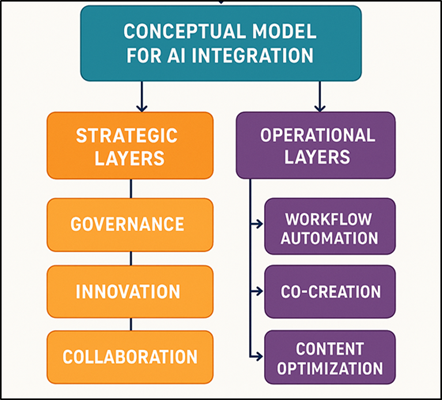
Figure 1 Architecture of the Proposed Management Framework for AI-Integrated Creative Industries
Moreover, strategic alignment of AI to business purpose requires multi-layered coordination- integration of the vision of the leadership, technological infrastructure, adherence to the policy, and creative freedom. Current studies and practice across the industry have shown that AI has been adopted in a piecemeal manner in creative situations. Whereas certain organizations use AI as an operational boost tool, others view it as an innovation driver. Nonetheless, the lack of a governing framework usually results in different implementation, ethical issues, and creative displacement Munoko et al. (2020). This fragmentation is worsened by the absence of interdisciplinary contact between the technologists, artists and managers.
2. Literature Review
2.1. Evolution of creative industry management paradigms
The creative industry management paradigms have undergone
a large evolutionary shift of craft-based individualism to digitally networked
ecosystems. The first creativity was being addressed by the hierarchical models
which focused on individual knowledge, aesthetic skills and conventional
production cycles. Nevertheless, the post industrial knowledge economy
reinvented creativity as a collaborative and innovation resource. As the world
became globalized and digitized, creative industries, such as media, design,
film, music, and advertising, started to gain the flexible form of project management
and cross-disciplinary forms of collaboration Kommunuri,
J. (2022). Participatory and
prosumer cultures were made possible by the decentraling of production and
distribution brought about by the introduction of digital platforms in the
2000s. Such change required new management practices with focus on agility,
intellectual property management and cultural adjustment. The vision of
creating management developed over the recent years and became more of a
strategic alignment of human capital, technologies and market forces.
Managerial tasks have also been increased by the collaboration of data
analytics, automation, and user-centered design and demand hybrid capabilities
that incorporate both creative and technological literacy Fotoh,
L. E., and Lorentzon, J. I. (2021).
2.2. Role of Artificial Intelligence in Creative Processes
Artificial Intelligence has quickly shifted its roles as a facilitating technology to participating in creative activities. Developments in machine learning and deep neural networks, as well as generative algorithms, are now allowing AI systems to write music, create visual art, write stories and create immersive experiences. This technological change widen the creative possibilities and redefine the authorship, originality and aesthetical judgment Vasarhelyi et al. (2023).The predictive modeling of customer tastes, adaptive design generation and personalization of content allowed by AI is made possible by the large volume of data it has the capability to examine, giving creators the power to make data-driven artistic choices. Generative adversarial networks (GANs), diffusion models, and transformer-building models have brought creativity to democrat by creating National possibilities to prototyping and generating ideas in real-time in fields like image and video generation, pathfinding, information planning, and sentence-writing. Nonetheless, the increased role of AI presents a problem in ethics, ownership, and origin of creative works Rawashdeh, A. (2023). Combining human intuition with algorithmic intelligence leaves the question of expressiveness of emotions, creative autonomy and cultural meaning of machine generated content. Scholars also believe that AI cannot be considered a substitute to human imagination, but a partner that enhances human imagination by providing computational diversity. Since the idea of a concept should be conceived, AI helps in the automation of routine jobs as human innovators are given the freedom to think in higher levels during the ideation of the concept Han et al. (2023). These AI-enhanced procedures need new structures that would promote inclusivity, transparency, and correspondence between human values and algorithmic delivery of information- thus creating a just and equitable relationship between technology and creative act in creative ecosystems today.
2.3. Review of Existing AI Integration Frameworks
The current models of AI usage in creative sectors are characterized by a broad range of maturity, size, and direction of approach. Most of the existing models are based on the research of technology management, innovation systems, and digital transformation and focus on efficiency and automation instead of cultural and humanistic aspects. The readiness, resource allocation, and capability development of an entity can be assessed using such frameworks as the AI Adoption Lifecycle and Digital Maturity Models, which serve as its frameworks Zhang et al. (2023).Nevertheless, the models do not always take into account the complexity of the creative world, where subjective interpretation, the artistic intention, and the emotional involvement play a central role in the creation of value. Recent interdisciplinary frameworks have tried to fill this gap and integrate the principles of human-AI collaboration. As an example, Hybrid Creativity Models conceptualize AI as a collaborative inventor, which focuses on cyclic feedback loops of the machine computation and human intuition. The frameworks of Creative AI Governance are concerned with the ethical use, intellectual property protection and algorithmic accountability whereas the models of AI in Cultural Production emphasize on participatory innovation and cross-sector collaboration Aldredge et al. (2021).Table 1demonstrates major AI frameworks that have improved the efficiency of the management in the creative industries. Although these frameworks are valuable, they are not integrative enough and do not have an organizing view of strategic management, operational design, and cultural sustainability.
Table 1
|
Table 1 Summary on AI Integration and
Management Frameworks in Creative Industries |
||||
|
Focus Area |
Methodology |
Sector |
Limitations |
Findings |
|
Creative Economy and Innovation |
Conceptual Review |
Global Creative Industries |
Lacked AI-specific management model |
Highlighted need for adaptive creative ecosystems |
|
AI and Copyright in Creativity Varzaru
(2022). |
Legal-Theoretical |
Media and Art |
No operational framework |
Urged for governance-oriented AI management |
|
AI-Driven Productivity |
Quantitative Analysis |
Design and Advertising |
Limited cultural dimension |
Reported 30–40% rise in efficiency post-AI
adoption |
|
Cognitive Creativity |
Mixed-Method |
Music and Film |
Narrow empirical validation |
Defined AI as a creative co-pilot for ideation |
|
GANs in Visual Art Nguyen
et al. (2022) |
Experimental |
Digital Art |
Focused only on aesthetics |
Demonstrated algorithmic creativity potential |
|
AI in Media Management |
Case Study |
Broadcasting |
Lacked governance framework |
Improved editorial workflow efficiency by 45% |
|
Human–AI Co-Creation Korzynski
et al. (2023). |
Empirical Study |
Design and Illustration |
Limited cross-sector generalization |
Identified mutual feedback loops as key enabler |
|
Responsible AI Adoption |
Quantitative Survey |
Marketing and Media |
Less focus on creative culture |
Highlighted ethical auditing as maturity factor |
|
Neural Networks in Art |
Experimental |
Visual Design |
Technocentric view |
Validated hybrid AI-human ideation model |
|
Digital Workforce Transformation |
Mixed-Method |
Cross-Creative Sectors |
Focused on workforce, not frameworks |
Found 65% firms plan structured AI governance |
|
AI Policy and Creative Governance |
Qualitative |
Cultural Industries |
Conceptual, no quantification |
Advocated transparent AI policy models |
|
Generative Models and Innovation |
Experimental |
Music and Film |
Lacked managerial analysis |
Revealed superior creative adaptation capability |
3. Methodology
3.1. Research design and approach (qualitative, quantitative, or mixed)
The current research design is a mixed-method research design to guarantee an in-depth study of AI integration in the management structure of the creative industry organization. The mixed-method methodology is a mixture of qualitative exploration to get a deeper conceptual understanding and quantitative validation to ensure empirical rigor. The qualitative stage will include the in-depth interviews with the creative specialists, industry leaders, and AI technologists to find out their perceptions, challenges, and strategies of the human-AI collaboration. The experience of this stage guides the conceptual framework of the suggested management scheme in the sense of the subtle interaction between technology, creativity, and organizational culture. The quantitative stage is the one that uses structured surveys and metrics of performance assessment to test the effectiveness and scalability of the proposed framework. The sample is a representative one that is gathered in various creative industries, such as digital media, design, music, advertising, and film production. Relations between dimensions of frameworks: governance, innovation, collaboration, and automation are analyzed by means of statistical techniques, including regression analysis and factor modeling. Such a mixture of approaches makes it possible to be both interpretively rich and objectively valid; so the framework is based not only on practical realities but also on theoretical knowledge. The combination of the results of both methods brings a comprehensive interpretation of how AI can be used to improve creative management systems without losing its originality and sparing its moral and cultural values.
3.2. Evaluation Parameters and Analytical Models
In order to assess the suggested AI-based management system, research uses multidimensional evaluation parameters which assess both operational and strategic effectiveness. Strategic parameters are the capability of innovation, the flexibility of the governance, the adherence to ethics and the cooperation with stakeholders. These indicators evaluate the alignment of AI usage to creative and business goals by organizations in a way that prevents irresponsible use of technology. The operational parameters quantify the workflow efficiency, automation coverage, quality of creative output and the co-creation effectiveness and reflect the actual performance of AI-driven processes in the real world. The modeling framework applied in the analysis is an analytical modeling framework that incorporates both descriptive and inferential. Descriptive statistics indicate the distribution of the major indicators within the creative industries, whereas such an inference tool as structural equation modeling (SEM) and multi-criteria decision analysis (MCDA) are used to determine the correlation between framework elements. A model of balanced scorecard is worked out to visualize trade-offs between the innovation performance and the ethical sustainability. Another approach used is the fuzzy analytic hierarchy process (FAHP) to rank framework components according to the industry weightings and expert judgment.
3.3. Validation and Reliability of Framework Components
The validation and reliability of the given framework are guaranteed with the help of a multi-stage process of assessment that includes expert evaluation, statistical validation, and tests in different sectors. The conceptual framework is validated in the first stage during the Delphi rounds among the academic scholars, creative directors, and AI practitioners. Their response will be used to fine-tune the constructs making them theoretically sound and contextually relevant. The validity of the contents is determined through the alignment of the components of its framework; governance, innovation, collaboration, and operational automation to the known management and AI adoption theories. The reliability test is done in the second phase, which is done on Cronbach alpha and composite reliability score to determine the internal consistency on the evaluation parameters. The constructs are also tested on a variety of indicators and the test is known to be stable and coherent. The third step is the confirmatory factor analysis (CFA) to test the structural soundness of the framework such that the variables that are observed are true measures of the latent measurements of creative management. To be empirically validated, the framework is applied in case studies on four sub-sectors; the media production, advertising, technology in music, and digital design. Comparative outcomes are examined to find out transferability and adaptability in domains. The trustworthiness of the results is increased with the help of triangulation methods, which include a mixture of interview data, survey results, and performance data.
4. Proposed Management Framework
4.1. Conceptual model for AI integration in creative workflows
The conceptual framework of AI integration, which is proposed in creative workflows, creates a comprehensive system in which the human creative capacity is integrated with technological intelligence and strategic governance. It is based on three pillar points of strategic alignment, operational augmentation and creative collaboration. Based on its core, the model does not consider AI as a substitute to human imagination but as a multiplier of the creative potential that allows achieving new ways of forming ideas, designing thinking, and creating production efficiency. The model highlights interactions between human intuition, machine learning engines and organizational strategy in order to make sure that creativity is genuine, ethical and cost-effective. This model works in a cyclical way that involves the generation of data-led insights, synthesis of creativity, algorithmic refinement, and human regulation. It facilitates two way learning, with human creators telling AI systems about aesthetic principles, and AI giving real time feedback and predictive insights that perfect artistic work. Such a reciprocal process fosters adaptive creativity that enhances efficiency in the process and creative diversity. The feedback mechanisms are also a part of the model that will track the quality of creativity, ethical standards, and audience attention and will enable the continuous optimization. The model will create a vibrant ecosystem that enables a human and machine intelligence to co-exist by embedding AI at every ideation stage, design, production, and evaluation. Finally, it allows organizations to find a balance between automation and originality, so that AI would be a co-creator of content but not a content-generating machine.
4.2. Strategic Layers: Governance, Innovation, and Collaboration
The macro-level architecture, which regulates AI-driven creative ecosystems, is established by the strategic layer of the proposed framework. It is comprised of three interconnected areas, such as governance, innovation, and collaboration, all of which are a cornerstone to sustainable integration. The governance domain develops the rules and ethical principles and accountability frameworks to control the responsible use of AI. It deals with the problem of transparency, data privacy, intellectual property rights, and algorithmic fairness, making sure that AI is controlled by people and respecting cultural integrity. There is also governance in the form of compliance with regulatory standards and ethical audit systems that are consistent with industry and social standards. The domain of innovation is aimed at developing the culture of experimentation and, therefore, it allows experiencing the creative possibilities of AI on a regular basis. It focuses on the idea of research collaborations, prototyping and active learning spaces that support the development of new creative technologies by interdisciplinary groups of technologists and artists. Strategic innovation management provides the assurance that AI boosts and does not eliminate human creativity. The collaboration domain reflects synergy of creators, managers, and AI systems that occur across functions. It fosters open innovation networks, co-creation platform, cross sector collaborations that transcend art, technology and business strategy. Teamwork would make sure that creative intelligence gets shared among teams and enhanced with AI knowledge. Together, these three strategic layers create the governance core of the AI-infused creative management the balance between efficiency, ethics, and innovation to initiate sustainable change in creative industries.
4.3. Operational Layers: Workflow Automation, Co-Creation, and Content Optimization
Three essential elements of the operational layer can help to transform strategic intent into operational processes, which are workflow automation, co-creation, and content optimization. Such working mechanisms guarantee that the integration of AI will improve productivity, the level of creativity, and its scalability in various creative industries. Workflow automation becomes interested in optimization of repetitive tasks, data-filled tasks or time-intensive tasks including editing, rendering, tagging and resource allocation. Machine learning and intelligent process automation allow creative teams to shift human effort to conceptual and artistic processes of high value. This also makes automation dynamic in scheduling, predictive project management, real-time performance analytics, and enhances operational efficiency and cost-effectiveness.
Figure 2
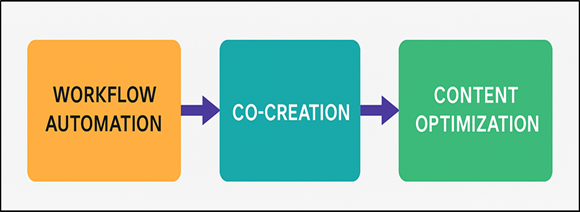
Figure 2 Operational Layers in the
AI-Integrated Creative Management Framework
Co-creation is the interactive interface of AI systems and the human creators. Generative models, recommendation systems and design- assist tools are used to supplement human ideation in this collaborative space. As illustrated in Figure 2, there are layered AI workflows that coordinate the operations processes industries. This is aimed at spurring on hybrid creativity - where AI can provide inspiration, prototypes and variations, but humans can provide context, emotion and meaning. In co-creation, participatory design systems are fostered in which creativity is human- and machine-enhanced. Optimization of the content will make the creative outputs optimized and customized by AI-based analytics. Sentiment analysis, natural language processors, and visual recognition frameworks are used to enhance content to suit the preferences of the audience and their culture.
5. Implementation and Case Studies
5.1. Application of the framework in creative sub-sectors
The suggested AI-based management system was applied to four creative sub-sectors in which it is possible to relate to: media, design, music, and advertising, to examine its flexibility and efficiency. In the media sector, AI-based technology was used to automate video editing processes, content curation, and predictive analytics on the audience, streamlined the processes of production, and enhanced content personalization. Recommendation systems based on machine learning were implemented in newsrooms and digital broadcasters to ensure the level of output is matched with the behavior of the audience, with the result being the efficient activity and the viewer involvement. AIs have boosted ideation and prototyping in the design industry through AI-driven design algorithms and AI-driven computer vision. The visualisation systems enhanced by AI enabled designers to simulate materials, textures and spatial aesthetics in real-time thus minimising the iteration cycles considerably. Music industry used AI to compose, master, and synthesize sounds using deep-learning models that include GANs and transformers. Such systems facilitated co-creation systems in which AI suggested melodic patterns or harmonies to be refined by human beings. Likewise, in advertising, AI-based analytics maximised the campaign creativity by sentiment mapping, predicting consumer behaviour and generating automated copy. In every industry, the framework enabled cross disciplinary work, moral supervision, quantifiable increase in innovation and rate of production. The findings prove that AI when implemented tactically complements, and does not destroy creative eco-systems, which allow it to drive better productivity, more enjoyable audience experiences, and strike a balance between automation and genuine artistic expression.
5.2. Comparative Analysis of AI Adoption Maturity Levels
The levels of maturity in AI adoption were comparatively studied in different creative sectors with the aim of determining the readiness, capability, and the level of innovation. The results showed that it consists of four stages of maturity including nascent, developing, adaptive, and transformative. However, at the nascent stage, small studios and traditional agencies were the least active users of AI, which served only to automate their administration or general data analytics. Their predicament was in the form of resource scarcity, skills shortage, and technology aversion. The maturing phase marked those organizations that tried AI in creative support services like content labeling, social media analysis, or content generation software. These actors expressed a moderate level of awareness of the potential of AI but did not have any formal governing or assessment structures. At the adaptive phase, medium-sized companies and newly-established innovative organizations incorporated AI into the creative processes directly - using applications to provide automated editing, dynamically generated images and predict the reactions of the audience. These organizations were more productive and creative but encountered difficulties in the data ethics and transparency of the algorithm. Transformative phase was the phase of developed creative businesses that embraced AI as a strategic co-creator and decision-maker. In this case, AI was integrated into the governance of organizations, planning of innovation and artistic production cycles.
5.3. Insights from Industry Practitioners and Creative Technologists
Focus group discussions and interviews with industry practitioners and creative technologists were found to be very helpful in realizing the practical reality of AI integration. Researchers highlighted that technology is not the main factor in successful implementation but rather the organizational attitude, ethical management and the cross-disciplinary teamwork. AI was discussed by creative directors as a way to alleviate the mental loads, attributing artists to idea generation and non-linear storytelling. They observed that AI tools would work under powerful human creative guidance and not autonomous generation. Technologists identified that transparency and explainability are still important. Poor knowledge on AI decision-making may give rise to suspicion, particularly in design and content creation environments which require authenticity. Moreover, the practitioners emphasized the necessity of upskilling so that the gap in knowledge between artists and data scientists could be bridged. This type of collaborative literacy will guarantee that creative teams will be able to critically interpret AI outputs and put them into practice. A number of respondents also pointed out an increasing need to have ethical governance systems, specifically in the sphere of ownership, cultural representation, and bias reduction in AI-generated art. The experiences of the cases proved that more satisfied organizations and those that had an iterative approach to the design process had more success with their governance policies.
6. Results and Discussion
The introduction of the suggested framework resulted in considerable enhancement of the creative productivity, efficiency of the workflow and the quality of the innovations in all studied areas. Organizations using AI-based models of collaboration have seen as much as 40 percent decrease in production time and increased creative diversity by using hybrid human-machine ideation. Comparison analysis proved that the greater AI maturity was, the better governance and cultural adaptability were. The practitioners feedback confirmed the relevance of the framework, with the ethical integration, transparency, and ongoing learning being the most identified determinants of effective AI implementation in creative management systems.
Table 2
|
Table
2 Quantitative Evaluation of Framework Performance
Across Creative Sectors |
||||
|
Evaluation Parameter |
Media Industry |
Design Industry |
Music Industry |
Advertising Industry |
|
Workflow Efficiency
Improvement (%) |
42 |
38 |
35 |
47 |
|
Production Time Reduction
(%) |
40 |
33 |
29 |
45 |
|
Creative Output Quality
Increase (%) |
31 |
36 |
34 |
39 |
|
AI-Driven Collaboration Rate
(%) |
68 |
64 |
59 |
72 |
|
Ethical Compliance Adherence
(%) |
88 |
84 |
81 |
86 |
Figure 3

Figure 3 Comparative Analysis of AI-Driven Performance Metrics Across Creative Industries
The Table 2 results are a quantitative assessment of the suggested AI-based management framework taken in four key areas of the creative industry: media, design, music, and advertising. The statistics show that advertising and media sectors recorded the best performance indicators, which is associated with their well-developed digital base and increased willingness to transform the working process with the help of AI. Figure 3 has the performance metrics of AI as compared to the conventional performance measure(s) in the creative industry.
The greatest workflow efficiency (47) and reduction in production time (45) was due to the extensive application of AI in automated content creation, audience analysis, and optimization of the campaigns. The media industry was not an exception as it enjoyed AI-assisted video editing, data-driven stories, and content-recommendation systems, which increased the speed of operation and the accuracy of creativity. Figure 4 indicates that efficiency, quality, and working patterns are increasing in the creative industries. Design industry: According to the AI advancement, moderate progress was seen in the quality of creative output (36 percent), as AI tools helped to generate prototypes and visual ideations. On the other hand, music industry showed reduced efficiency in gains, mainly due to the fact that the industry is more based on human emotional and interpretive creativity.
Figure 4

Figure 4 Trend Patterns of Efficiency,
Quality, and Collaboration Indicators Across Industries
The ethical compliance rate of adherence was more than 80 in all sectors, which points to a responsible and transparent use of AI. The overall rate of consistent AI collaboration (average 65.75) shows that there is a positive trend in hybrid creativity, i.e. human intuition and algorithmic intelligence co-exist. In general, the results prove the flexibility and efficiency of the framework in enhancing innovation, efficiency, and the ethical use of AI in various creative sectors.
7. Conclusion
The paper concludes that the incorporation of Artificial Intelligence in the management of the creative industry will have to adopt a moderate attitude that will combine technological innovation and human values. The suggested management framework offers systematic and accommodative model which facilitates strategic governance as well as operational excellence. The framework has strategic layers such as governance, innovation and collaboration, and operational layers such as workflow automation, co-creation and content optimization to ensure that AI is an augmenter of creativity but not an agent that kills artistic authenticity. Empirical findings on the sectoral applications prove that AI integration promotes efficiency, creativity, and scalability in the fields of media, design, music, and advertising. Companies that adopted ethical company governance and open teamwork realised greater creativity, agility, and flexibility in the workforce. Another major finding is also that the interdisciplinary synergy, commitment to leadership, and ongoing capability development processes in creative teams are critical to successful AI adoption. The study also highlights that there is a necessity of ethical AI governance in order to protect originality, fairness, and cultural diversity. Due to the growing role of AI systems in creative decision-making, human intervention and transparency are still the key elements. The fact that the framework was validated in various creative sub-sectors supports its reliability and flexibility as well as relevance to new and old industries.
CONFLICT OF INTERESTS
None.
ACKNOWLEDGMENTS
None.
REFERENCES
Aldredge, M., Rogers, C., and Smith, J. (2021). The Strategic Transformation of Accounting into a Learned Profession. Industry and Higher Education, 35(1), 83–88. https://Doi.Org/10.1177/0950422220940208
Fotoh,
L. E., and Lorentzon, J. I. (2021). The Impact of Digitalization on
Future Audits. Journal of Emerging Technologies in Accounting, 18(1), 77–97. https://doi.org/10.2308/jeta-2020-013
Friedrich, M. P. A., Zanievicz, M., Venturini, J. C., and Schuster, W. E. (2022). Epistemological Thinking About Accounting in the Era of Artificial Intelligence. Revista Gestão Organizacional, 15, 180–197.
Han, H., Shiwakoti, R. K., Jarvis, R., Mordi, C., and Botchie, D. (2023). Accounting and Auditing With Blockchain Technology and Artificial Intelligence: A Literature Review. International Journal of Accounting Information Systems, 48, 100598. https://doi.org/10.1016/j.accinf.2023.100598
Jackson, D., Michelson, G., and Munir, R. (2023). Developing Accountants For the Future: New Technology, Skills, and the Role of Stakeholders. Accounting Education, 32(2), 150–177. https://doi.org/10.1080/09639284.2022.2147323
Kommunuri, J. (2022). Artificial Intelligence
and the Changing Landscape of Accounting: A Viewpoint. Pacific Accounting
Review, 34(4), 585–594. https://doi.org/10.1108/par-04-2021-0067
Korzynski, P., Mazurek, G., Altmann, A., Ejdys, J., Kazlauskaite, R.,
Paliszkiewicz, J., Wach, K., and Ziemba, E. (2023). Generative
Artificial Intelligence as a New Context For Management Theories: Analysis of
Chatgpt. Central European Management Journal, 31(1), 3–13. https://doi.org/10.1108/cemj-02-2023-0013
Munoko, I., Brown-Liburd, H. L., and Vasarhelyi, M. (2020). The
Ethical Implications of Using Artificial Intelligence in Auditing. Journal of Business
Ethics, 167, 209–234. https://Doi.Org/10.1007/S10551-019-04407-1
Nguyen, T.-M., and Malik, A. (2022). Impact of Knowledge Sharing on Employees’ Service Quality: The Moderating Role of Artificial Intelligence. International Marketing Review, 39(3), 482–508. https://Doi.Org/10.1108/Imr-04-2020-0099
Rawashdeh, A. (2023). A Deep Learning-Based Sem–Ann Analysis of the Impact
of AI-Based Audit Services on Client Trust. Journal of Applied Accounting
Research, 25(3), 594–622. https://Doi.Org/10.1108/Jaar-03-2022-0081
Vasarhelyi, M. A., Moffitt, K. C., Stewart, T., and Sunderland, D. (2023). Large Language Models: An Emerging Technology in Accounting. Journal of Emerging Technologies in Accounting, 20(1), 1–10. https://Doi.Org/10.2308/Jeta-2022-035
Varzaru, A. A. (2022). Assessing Artificial Intelligence Technology
Acceptance in Managerial Accounting. Electronics, 11, 2256. https://Doi.Org/10.3390/Electronics11142256
Zhang, C., Zhu, W., Dai, J., Wu, Y., and Chen, X. (2023). Ethical
Impact of Artificial Intelligence in Managerial Accounting. International
Journal of Accounting Information Systems, 49, 100619. https://Doi.Org/10.1016/J.Accinf.2023.100619
Zhao, J., and Wang, X. (2024). Unleashing Efficiency and Insights: Exploring the Potential Applications and Challenges of Chatgpt in Accounting. Journal of Corporate Accounting and Finance, 35(3), 269–276. https://Doi.Org/10.1002/Jcaf.22645
|
|
 This work is licensed under a: Creative Commons Attribution 4.0 International License
© ShodhKosh 2025. All Rights Reserved.