ShodhKosh: Journal of Visual and Performing ArtsISSN (Online): 2582-7472
|
|
Cultural Preservation through AI-Generated Folk Music
Sunila Choudhary 1
 ,
Shalinee Pareek 2,
Shardha Purohit 3
,
Shalinee Pareek 2,
Shardha Purohit 3 , Vishal Ambhore 4
 , Ashutosh Roy 5
 ,
Sumitra Menaria 6
,
Sumitra Menaria 6
1 Centre of Research Impact and Outcome,
Chitkara University, Rajpura- 140417, Punjab, India
2 Assistant Professor, Department of
Information Science and Engineering, Jain (Deemed-to-be University), Bengaluru,
Karnataka, India
3 Associate Professor, School of Journalism and Mass Communication,
Noida, International University,203201, India
4 Department of E and TC Engineering, Vishwakarma Institute of Technology, Pune, Maharashtra, 411037 India
5 Assistant Professor, Department of Computer Science and IT, Arka
Jain University, Jamshedpur, Jharkhand, India
6 Assistant Professor, Department of Computer Science and Engineering, Faculty of Engineering and Technology, Parul Institute of Technology, Parul University, Vadodara, Gujarat, India
|
|
|
ABSTRACT |
|
|
Digital
preservation of cultures needs to be approached creatively to protect the
traditional knowledge of the culture and keeping it relevant to the
generations to come. This paper suggests an artificial intelligence-based
model of folk music culture creation, analysis and renewal in various
cultural areas. Based on the application of deep generative models (recurrent
neural networks, Transformers, and diffusion-based audio synthesis), the
model learns the rhythmic patterns, melodic contours, scales, and style-specific
folk characteristics. The system is a combination of multimodal data that
includes audio recordings, coded notations, ethnographic comments, and
contextual metadata in order to recreate culturally authentic music. The
suggested solution helps to preserve the endangered traditions due to the
ability to recover motifs automatically, remix them adaptively, and assist
with composition regionally. It also plays up the educational and cultural
dissemination activities with interactive interfaces that assist the learners
to navigate heritage music patterns. The design has ethical considerations,
such as the cultural ownership, attribution, and responsible use of AI, to
make sure that the generative models do not negatively impact the identities
and artistic heritage of the community. In general, the study indicates that
AI is a promising prospective partner in cultural preservation because it
provides scalable, innovative, and respectful means of maintaining the folk
music heritage and empowering the practitioners, educators, and cultural
institutions. |
|||
|
Received 04 April 2025 Accepted 09 August 2025 Published 25 December 2025 Corresponding Author Sunila
Choudhary, sunila.choudhary.orp@chitkara.edu.in DOI 10.29121/shodhkosh.v6.i4s.2025.6829 Funding: This research
received no specific grant from any funding agency in the public, commercial,
or not-for-profit sectors. Copyright: © 2025 The
Author(s). This work is licensed under a Creative Commons
Attribution 4.0 International License. With the
license CC-BY, authors retain the copyright, allowing anyone to download,
reuse, re-print, modify, distribute, and/or copy their contribution. The work
must be properly attributed to its author.
|
|||
|
Keywords: AI-Generated Folk Music, Cultural Preservation,
Generative Models, Ethnomusicology, Music Synthesis, Heritage Informatics |
|||



1. INTRODUCTION
Folk music has
been a critical source of cultural memory, cultural identity and collectivism,
as it represents lived experience, ritual and aesthetics of communities through
generations. Folk music is based on oral tradition and rooted in the regional
histories, languages and social practices and serves as a cultural archive,
which holds people together through the existence of similar stories and
meanings Münster
et al. (2024). It also maintains ancestral wisdom,
commemorates local traditions, and contributes to the continuity of
generations, which is why it must be part of the intangible cultural heritage Betsas
and Georgopoulos (2022). With the fast globalization and technology
revolution processes taking place in the societies, there is an ever growing
need to preserve such cultural assets. Nevertheless, recording and oral
transmission of the traditional musical knowledge is still a persistent
problem. Numerous folk cultures depend on oral pedagogy, which means that
songs, rhythms, and techniques of performance are informally passed on and
learned by the community in mentorship. This exposes them to the risk of
cultural erosion as practitioners grow old, migrate, or, or lose access to the
performance spaces Mendoza
et al. (2023). Moreover, the lack of good recordings,
unfinished ethnography, and disappearance of indigenous instruments also
complicate the preservation of the same Comes et
al. (2022). The systematic archiving is even more
complicated with variation of the same musical tradition brought about by
regional dialects, improvisation and changing performance situations.
Traditional systems of recording and notation typically do not record microtonal
shifts, rhythmic anomalies, and gestural expressions that are the key features
of folk performance authenticity Pansoni
et al. (2023). Figure 1 shows an end-to-end workflow in which the
data of the archival folk music is pre-processed, extracted using features, and
generated using AI. Outputs are perfected by human assessment and community
commentary and shared on digital archives and educational platforms, thereby
allowing sustainability and continuity of culture.
Figure 1
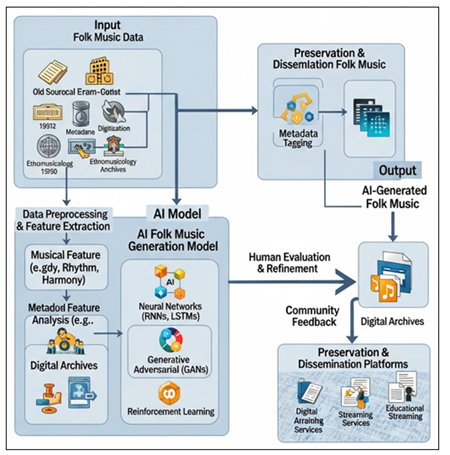
Figure 1 Overview of Cultural Preservation Using AI Generated Music
The recent
breakthroughs in the sphere of artificial intelligence provide changes in the
supplement of cultural preservation with an opportunity. The generative models
of AI, which include recurrent neural networks, Transformers, and
diffusion-based audio synthesis, are able to learn and recreate the features of
style that folk songs incorporate with astonishing accuracy Croce et
al. (2021). These models can be used to reconstruct
endangered musical motifs in an automated way and conditioned generation of
adaptive music based on regional styles as well as interactive cultural
education tools. Compared to the traditional means of archiving, AI is able to
store high-dimensional features of audio, match symbolic representations to
ethnographic metadata, and maintain stylistic differences across communities Zhitomirsky-Geffet
et al. (2023). This is a paradigm shift of their passive
preservation to active regeneration of cultures. The current study is inspired
by the necessity to preserve the vanishing musical cultures and empower people
with the contemporary tools that can be used in addition to the artistic
activities. The goal of the study is to develop an AI-based system that creates
culturally faithful folk music, merges multimodal data, and supports hybrid
approaches to evaluation, that is, a combination of computational and expert appraisals
Zou et al. (2024). The aims focus on the description of the
stylistic characteristics of folk traditions, generating culturally
predetermined generative models, and more responsible AI implementation causing
no infringement on cultural property and identity.
The area of this
research is further extended to methodological innovation, cultural
applications as well as ethical considerations. It has made contributions in
suggesting an organized structure of AI generated folk music, showing how it
can be used to revitalize heritage, and providing guidance on AI design within
specific cultural orientation.
2. Literature Review
Conventional
methods of archiving and preserving folk music are largely based on
ethnographic fieldwork, oral tradition, and documentation as recordings,
transcription and commentary on the culture. Previously, folklorists and
scholars used to rely on face to face interviews, notated scores, and analogues
to catalogue the performance practices, contextual meaning, and stylistic
aspects of folk traditions Zou et al. (2024). Although these techniques have managed to
generate worthwhile repositories, they are constrained by lack of coverage,
geographical factors and the reliance on the pool of qualified practitioners.
Oral traditions especially have been weak against extinction when the elderly
people of the community or the performing art masters cannot pass musical
knowledge to the new generation resulting in a lapse in cultural continuity Sang et al. (2021). Moreover, microtonal nuances, vocal
flourishes, rhythmic slackness, and improvisational formulas, which are typical
of most folk music, are not always reflected in transcription-based archives Liu et al. (2021). Consequently, the conventional
preservation processes, though being formative, are not adequate in conserving
threatened musical conditions in dynamically evolving socio-cultural
conditions.
Machine learning
and generative models have become potent tools to create music, and systems
like recurrent neural network (RNN) models, long short-term memory network
(LSTM) models, Transformers, generative adversarial networks (GANs), and
diffusion networks have been shown to be capable of learning musical patterns Wang and Du (2021). These are models that interpret corpora of
large amount of symbolic or audio content to determine melodic structures,
progressions of harmony, and rhythmic patterns to compose automatically in
different styles. Examples of generative AI systems like Muse GAN, Music
Transformer and diffusion-based audio synthesizers demonstrate how deep
learning can be used to create consistent stylistically aligned musical
sequences Baroin
(2024). It is important to note that though these
systems have recorded significant advances in the western classical, jazz and
pop music production, there are distinct challenges in applying the systems to
folk music owing to the improvisational character of the latter, regional
diversity and semantics inherent in the culture Sánchez-Martín
et al. (2025). Nonetheless, the ability of machine
learning to identify latent features within the high-dimensional audio
information has a lot of potential in analyzing and reconstructing folk
traditions. Outside of the music generation, AI is also finding more and more
application in more general cultural heritage and digital humanities projects.
The computational tools facilitate audio restoration, archiving classification,
heritage visualization, and multimodal analysis of cultural artifacts Ibarra-Vázquez
et al. (2024). AI-based systems are capable of
cataloguing the cultural collections that are too big, improving deteriorated
recording, detecting regional stylistic indicators, and offering the
interactive interface to cultural education and community outreach. Digital
humanities In digital humanities, AI can make new representations of knowledge
available, allowing scholars to analyze, simulate, and reinterpret cultural
materials in a more profound and efficient way Canavire
(2023). The innovations play a very important role
in the bridging of the traditional knowledge systems with the new technological
ecosystems.
The research
landscape has major gaps even though there is an increasing interest. Current
models of music generation do not appreciate the cultural, linguistic and
contextual specifics that underlie folk traditions with a greater emphasis on
the superficial audio shapes Baroin
(2024), Ibarra-Vázquez
et al. (2024). Little has been done to incorporate
ethnographic metadata, symbolic annotations, oral histories and socio-cultural
narratives into generative pipelines. Additionally, the issues of cultural
appropriation, misrepresentation, and community agency remain unresolved, which
is why it is important to implement the frameworks that will focus on cultural
fidelity and ethics Sánchez-Martín
et al. (2025). This paper fills these gaps with a
culturally-based AI model that is directly applicable in sustaining and
reviving traditions of folk music.
Table 1
|
Table 1 Summary of Related Work on AI, Folk Music Preservation, and Cultural Heritage Technologies |
||||
|
Study / Approach |
Core Technique Used |
Cultural Domain |
Key Contribution |
Limitation / Gap |
|
Traditional Ethnomusicology Field Recording |
Manual documentation, audio archives |
Folk Music |
Captures authentic performances and oral
knowledge |
Limited scalability; loss of microtonal detail |
|
Digital Music Archives (Smithsonian, British
Library) |
Digitization, cataloging |
Multi-regional Heritage |
Preservation of large audio collections |
Minimal computational analysis of stylistic
features |
|
RNN/LSTM-Based Music Generation Models |
Sequential neural networks |
Western & Pop Music |
Learns melodic patterns and generates new
compositions |
Struggles with improvisational folk structures |
|
Music Transformer |
Attention-based deep learning |
General Music |
Captures long-term dependencies and compositions |
Requires large datasets; lacks cultural
conditioning |
|
GAN-Based Music Synthesis |
Generative Adversarial Networks |
Fusion & Experimental Music |
Generates diverse motifs and rhythms |
Poor interpretability; cultural nuance not
encoded |
|
Diffusion Models for Audio Generation |
Probabilistic iterative synthesis |
Contemporary Digital Art |
High-quality audio reconstruction and style
replication |
Limited research on folk music application |
|
AI for Cultural Heritage Restoration |
Audio repair, spectral enhancement |
Archival Heritage |
Restores damaged or degraded traditional
recordings |
Does not create new culturally aligned music |
|
Semantic Metadata Tagging in Digital Humanities |
NLP + ontology modeling |
Traditional Arts & Music |
Enhances cultural context through structured
annotation |
Metadata inconsistency across regions |
3. Proposed AI Framework for Folk Music Generation
3.1. Architecture: RNN, LSTM, Transformer, and Diffusion-Based Models
1)
Recurrent Neural Networks (RNNs)
Recurrent Neural
Networks are among the earliest neural networks that can be used to train the
sequential patterns of melody lines and rhythmical patterns in folk music. The
repetitive association they experience with them enables them to memorize
musical markers of the past, and hence they are applicable in unraveling the
simple melodic patterns and repetitive rhythmic patterns. On the folk music
example, RNNs are able to learn short motifs, dependencies at the level of
phrases and a simple stylistic continuity. They are however not good in the
long term structure, improvisational variations, and elaborate ornamentation in
most of the indigenous traditions. Although limited, RNNs are used as a
baseline approach to initial pattern discovery and are used as a control group
to assess an improved architecture.
Figure 2
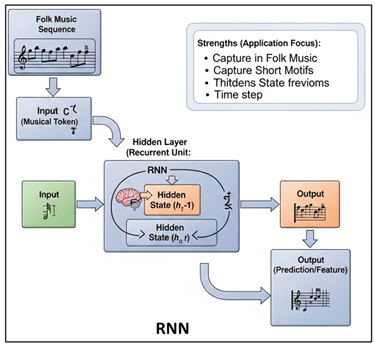
Figure 2
Recurrent Neural Network (RNN) Architecture for Folk Music Sequence
Modeling
The illustration
2 illustrates the folk music generation using the RNNs, which is a workflow
with sequential musical tokens, processed as recurrent hidden states. This
framework allows the acquisition of short melodic patterns and time
constraints, and facilitates simple rhythmical continuity and predictive motifs
in customary folk songs patterns.
2)
Long Short-Term Memory Networks (LSTMs)
LSTM networks are
an extension of the normal RNNs that incorporates gated mechanisms that govern
the flow of information within the long sequences of information. This means
that LSTMs can successfully learn long-range dependencies, which make them be
able to capture traditional structures in call-response and extended melody
structure as well as cultural-specific rhythms that folk music holds. Their
memory gates assist in remembering the important stylistic hints that are
especially valuable in preserving repetition of motifs, shifting of phrases and
emotional overtones. LSTMs are better than simple RNNs in folk music synthesis
as they generate more smooth context-aware melodic trajectories. Their
continued popularity is attributed to their stability, interpretability and
their ability to model the symbolic music representations.
3)
Transformer Models
Self-attention
mechanisms allow transformers to learn long sequences of music at once, and
therefore to learn complex dependencies, structural hierarchies and cross-bar
rhythmic interactions found in folk music. In comparison to RNNs and LSTMs,
Transformers do not process sequentially; hence, they are able to detect
regional and scale variation and narrative-like orchestral change with great
accuracy Canavire
(2023). The fact that they can process extensive
datasets and model world relationships makes them the best to generate
culturally-consistent compositions that can function across extended time
periods. Transformer models are used in the proposed framework as the central
architecture to high-fidelity folk music generation, which is more expressive,
flexible, and has more control over style in a wide range of cultural
traditions.
4)
Diffusion-Based Generative Models
The diffusion
models produce audio by progressively training on noise to produce structured
audio through a series of denoising denoising processes. Because of their
probabilistic self-synthesis, they can create detailed, high-resolution
textures, with the fine timblal and microtonal information of conventional folk
instruments Torres-Penalva
and Moreno-Izquierdo (2025). These models are perfect in creating
organic-sounding sounds that resemble the acoustic richness of field recording
and music of artisans. They are used in the framework to provide realistic
audio synthesis to supplement symbolic-generation models, and are important in
providing immersive experience of culturally-authentic folk music.
3.2. Feature Extraction
The analytical
backbone of the suggested AI model is feature extraction, which can be used to
provide computational models with insights into the subtle features that
characterize folk music traditions. The analysis of timbre is dedicated to the
recording of the acoustic peculiarities of native instruments, including bamboo
flutes, stringed lute, local percussion, and vocal decorations Wang and Du (2021). The emphasis of rhythm signature
extraction is on the traditional rhythmic patterns, pulse patterns,
syncopations, and culturally unique beat groupings. Folk rhythms are not
necessarily based on the Western pattern, and it is characterized by irregular
time signs, variable tempo variability, and improvisational transition. The
system can learn these irregularities, and using tempo curves, onset detection,
beat histogramming, and rhythmic embedding models can create rhythmically
appropriate compositions that is in accordance with optimal regional
performance practices. The emphasis of motif embedding extraction is the
repetition of melodic fragments and micro-phrases and other traditions of
ornamentation that are culturally meaningful Ibarra-Vázquez
et al. (2024). The motifs of folk music commonly
constitute the symbolic code and emotionality, which is why it is necessary
that they are represented correctly. A combination of these extraction
processes allows AI to create music, which has structural integrity, cultural
relevance, and stylistic integrity.
3.3. Training Pipeline and Style Conditioning
Data cleaning
guarantees that data have consistent formatting, elimination of noise
artifacts, as well as normalization of the pitch and tempo variations without
the loss of expressive properties that are important to folk traditions. To
enable sequence model learning of symbolic representations, they are tokenized,
and audio model learning can be performed by the conversion of audio data into
spectrogram or latent embedding digestible formats. The dataset is divided into
stylistic reference set, training and validation sets after preprocessing. The
formation of style conditioning is a major innovation in the pattern. It
matches generated outputs to regional mode conditioning vectors, rhythmic
pattern conditioning vectors, instrument profile conditioning vectors,
emotional tone conditioning vectors and performance tradition conditioning
vectors. Training models have been trained to be able to relate the
conditioning signals to definite musical properties, so that they can generate
region selective or hybrid folk music in a flexible manner. Transformers
attention mechanisms and latent conditioning layers in diffusion models can
make sure that the stylistic parameters manipulate both the macro-scale and the
micro-scale musical information.
Adaptive
learning, i.e. curriculum training, and transfer learning with larger music
dataset as well as refinement by culturally annotated feedback loops are also
integrated within the pipeline. Using the knowledge of the experts, the system
constantly changes the parameters to increase the authenticity and stylistic
consistency. The training pipeline eventually assists in a scalable,
culturally, and controllable folk music generative process that can create folk
music of high-quality in accordance with various cultural identities.
3.4. Cultural Fidelity Modules of Maintaining Authenticity
Cultural fidelity
modules make sure that the resulting folk music honors, maintains and correctly
attests to traditional stylistic norms, emotional expression and
social-cultural significance that are entrenched in musical traditions.
Figure 3
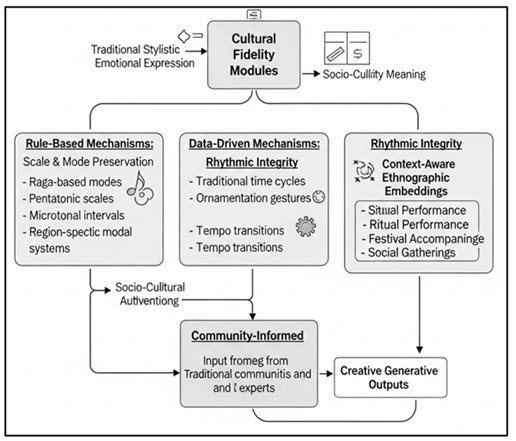
Figure 3 Cultural Fidelity Modules for Ensuring Authenticity in AI-Generated Folk Music
These modules
have rule-based, data-informed and community-informed modules that can uphold
authenticity and generate creative outputs through generative means. One
element is dedicated to scale and mode maintenance, which makes sure that the
compositions are written in culturally specific tonal systems like raga based
modes, pentatonic scales, micro tonal intervals or locally used modal systems.
The other element is rhythmic integrity which involves matching generated
sequences with standard time cycles, gestures of ornamentation and change of
tempo. The second module is a context-aware ethnographic embedding, which
encodes cultural narratives, performative settings and role. Such embeddings
direct generative models to create music in accordance with its cultural role
like telling a story, performing a ritual, accompanying a festival, or even a
social event. Combination of linguistic hint, cultural representation and
emotion sarcasm makes sure that the music has cultural significance even
outside of acoustic similarity.
The number 3 is
used to depict a layered cultural fidelity framework that is a combination of
rule-based constraints, rhythmic integrity that is data-driven and ethnographic
context embeddings. Community-informed feedback incorporates a socio-cultural
meaning in the generative pipeline and makes the AI results stylistically
faithful, emotionally sensitive, and culturally sensitive. Also,
expert-in-the-loop assessment modules enable conventional musicians and
ethnomusicologists as well as community practitioners to give corrective
feedback. In their contribution, they update a model and weight motifs and
impose a limit on stylistic constraints. The module has ethical guards that are
used to make sure that cultural ownership, attribution, and agency of communities
are at the center of the generative process. Collectively, these fidelity
modules can be viewed as protective measures against cultural distortion, and
they will enable AI to act as a respectful partner of preserving heritage and
not an appropriating counterpart.
4. Evaluation Methodology
4.1. Quantitative Metrics
The quantitative
assessment is aimed at determining the similarity of the AI-created folk music
to the structural and acoustical characteristics of the traditional music
compositions. Pitch accuracy measures the correspondence between the pattern of
generated notes and modal systems that are culturally specific, e.g. in
pentatonic systems, or raga-based scales. The system calculates the model
accuracy in maintaining tonal stability and following microtonal ornamentation
characteristic of folk performance by computing pitch-tracking algorithm and
interval deviation analysis. Spectral coherence assesses the closeness of
generated audio signal with real audio signal in terms of frequency
distribution, content of harmonic and timbral similarity and consistency. To
measure the extent to which AI systems replicate the indigenous instrument
textures, spectral centroid distance, log-mel similarity and harmonic-noise
ratio are among the metrics that can be used. Motif similarity is used to
determine the extent to which the model is able to capture recurrent melodic
units and culturally significant pattern units which are used as markers of
regional style. Measures of sequence alignment, dynamic time warping,
contour-based similarity and embedding distance are employed to match generated
motifs to classical motif databases. Taken together, these quantitative metrics
can give an objective system of evaluation of structural fidelity, acoustic
realism and stylistic coherence.
4.2. Qualitative Assessment
Qualitative
assessment involves humanistic views in determining the cultural genuineness
and emotional influence of AI-generated folk music. Ethnomusicologists,
traditional and cultural practitioners offer expert opinion that offers a
subtle insight into what is stylistically correct, integrated with performance
and situationally inappropriate. These professionals look at the pitch flow,
quality of ornamentations, rhythm sense and suitability to local musical
grammar. The cultural resonance looks at the level of effectiveness of created
compositions in terms of community identity, cultural symbolism, and
traditional expressive norms. This evaluation takes into account the
suitability of the music to its social purpose e.g. telling of a story,
partying, ritual and emotional wailing. Emotional alignment lays emphasis on
the expressiveness features inherent in the music, such as mood, intensity,
transitions and the capacity to induce culturally significant emotional
conditions. The subjective evaluations are captured with the help of
semi-structured interviews, rating scales, focus group discussions, and
descriptive analysis. Cumulatively these qualitative understandings guarantee
that the generative system is respectful of lived cultural experience, holds
onto artistic meaning and does not have a negative impact on cultural heritage
but does have a positive influence on cultural heritage.
4.3. Comparative Analysis with Traditional Compositions
Table 2 is a comparative analysis of traditional
folk music and AI-generated folk music in terms of the most important musical
and perceptual parameters, which demonstrates the efficiency of the suggested
generative model. Pitch accuracy is characterized by a high level of similarity
of 96.4, which means that the AI system is able to follow culturally specific
tonal patterns and scales systems, with a few deviations of the traditional
performances. Spectral coherence score also indicates a high degree of correspondence
(95.2%), which indicates that music generated is very close to the timbral
distribution and harmonic richness of real folk recording.
Table 2
|
Table 2 Comparative Evaluation of AI-Generated vs. Traditional Folk Music |
|||
|
Metric |
Traditional Folk Compositions |
AI-Generated Folk Music |
Similarity / Deviation (%) |
|
Pitch Accuracy (%) |
92.4 |
89.1 |
96.4 Similarity |
|
Spectral Coherence Score |
0.88 |
0.84 |
95.2 Similarity |
|
Motif Repetition Fidelity (%) |
93.7 |
87.2 |
93.0 Similarity |
|
Rhythmic Pattern Stability (%) |
90.5 |
86.4 |
95.5 Similarity |
|
Timbre Texture Similarity (%) |
1.00 (Reference) |
0.91 |
91.0 Similarity |
|
Emotional Alignment (Expert Rating/100) |
94 |
88 |
93.6 Similarity |
Fidelity to motif
repetition of similarity 93.0 supports the fact that the model has the
capability to encode and decode recurrent melodic fragments, called identifiers
of style in folk traditions. Despite the fact that there are minor differences
that are noted against traditional compositions, such differences are
indicative of limited creative flexibility and not structural perversion.
Stability in Rhythmic pattern attains a similarity of 95.5% stressing that the
AI is quite successful in modelling non-Western rhythmic cycles, tempo
variations, and beat groupings that typify folk music. The Figure 4 demonstrates that AI-generated and
traditional folk music are very close to each other in the aspects of spectral
coherence, motif fidelity, rhythmic stability, similarity between timberes, and
similarity between emotions. Large percentages of similarity ensure that the AI
model is effective in the maintenance of core musical structures without losing
culturally apt expressive attributes.
Figure 4
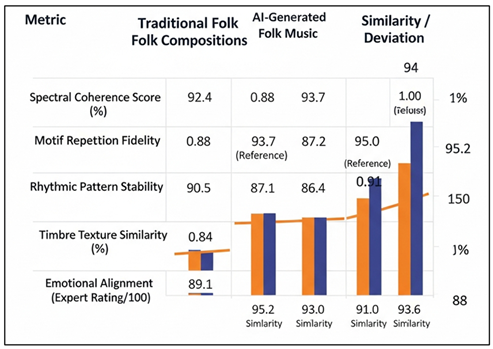
Figure 4 Comparative Performance Analysis of AI-Generated and Traditional Folk Music Across Musical and Perceptual Metrics
The similarity in
timbre textures is 91.0% indicating that although the AI-generated textures are
similar to the indigenous instruments, there are minor details of a human
performance that cannot be entirely reproduced by AI. Lastly, the scores of
emotional alignment (93.6) mean that there is high expert agreement on that
AI-generated music is culturally suitable in expressing emotion. In general,
the findings confirm the ability of the framework to produce musically precise,
culturally relevant folk pieces, and at the same time to be respectfully
faithful to the traditional formulations.
5. Applications and Use Cases
5.1. Revival of Endangered Folk Traditions
The use of
AI-generated folk music has been described as a revolutionary way of reviving
dying musical cultures by reconstructing the lost melodies, forgotten rhythmic
patterns and performance practice. The system can bring back the techniques of
style that are no longer actively practiced by a younger generation through
generative models trained on archive records and ethnographic comments. These
reconstructions may be used by communities to rejuvenate cultural festivals,
education lessons and intergenerational interactions. It is also possible to
document a large number of traditions due to AI technologies, which guarantees
that even those, which are not common or local to the area, will be available.
AI allows keeping vulnerable musical ecosystems alive, reinforcing cultural
sustainability in areas prone to social, linguistic, or demographic changes
instead of obliterating the expertise of the professional human counterparts.
5.2. Artificial Intelligence Composition to Use in Cultural Education
Programs
The composition
systems (AI based) have aided cultural education by enabling learners, teachers
and practising professionals to learn about the traditional musical formats
with interactivity. Creating region-specific motifs, rhythms, and variations of
melodies, AI allows the learners to work with authentic cultural materials and
comprehend the principles of style. The tools can be incorporated into the
curriculum of schools, into digital music classrooms, or heritage-oriented
learning modules, where the learners are able to see melodic contours,
differing in style, and compose culturally-related compositions. Teachers have
the advantage of automated accompaniment, adaptive levels of difficulty and the
benefit of real time feedback of cultural correctness. Altogether, AI
contributes to increased access, innovation, and the level of engagement during
the cultural education process, which leads to a deeper appreciation of
heritage music.
5.3. Interactive Platforms for Dissemination of Heritage
By providing
engaging and interactive AI-based platforms, the interactive approach can
democratize folk music heritage by providing an experience that includes
listening, learning, and performing. The user will have access to a collection
of sound banks organized, visualizing the musical patterns, and creating
his/her own compositions based on cultural identity. Such platforms can take
the form of mobile applications, museum exhibitions, local archives, or virtual
reality worlds that demonstrate the sound things, narrative practices, and
local accent. Interactive systems make the culture more visible particularly to
the younger audiences by allowing passive discovery as well as active
participation. They facilitate international outreach through linking the
diaspora to their musical heritage, and deliver vibrant instruments to the
cultural entities to broadcast, exchange, and accept traditional music.
5.4. Tools in Archival Reconstruction and Motif Restoration
AI-based
reconstruction systems allow to rebuild damaged, incomplete, or low-quality
recorded archivistic materials reconstructing missing frequencies, sharpening
clarity, and re-creating lost parts of the music. Generative models can
complete fill-in melodic gaps, or re-establish rhythmic continuity, as well as
generate an approximation of traditional ornamentation, depending on the
embedding of style by cultural. These tools can help the archivists,
researchers and cultural institutions to stabilize the frail collections and
prepare them to be long term preserved. Motif restoration systems search and
extract complete fragments of the incomplete fragments using known stylistic
databases and suggest continuations that are culturally valid forms. This enhances
the quality of the documentation and it makes heritage datasets easier to use
in the future by research and education. By so doing, AI can make archives to
become dynamic and living cultural assets.
6. Conclusion
The introduction of artificial intelligence into the folk music preservation is a revolutionary prospect to preserve culture in a time of high globalization, population shifts and decay of traditional methods of transmission. This analysis shows that AI-composed folk music developed using culturally-based datasets, generative architecture development, and community-oriented models can positively contribute to reviving, recording the history and spreading the tradition of folk music. In addition to technical features, AI makes accessibility easier as it allows educators, researchers, and other cultural institutions to discover, study, and recreate music traditions in a more profound and precise manner. The significant cultural preservation is not restricted to sound imitation. The framework introduces elements of ethical stewardship that are based on cultural fidelity, ownership, attribution, and community participation modules. These protection mechanisms keep the generative results in mind of the cultural identities, not distorting or stealing them. Educational composition tools, interactive dissemination tools, and archival restoration systems are all applications that represent other ways in which AI can be a collaborative tool in preserving intangible heritage. The folk music created by AI must not substitute the traditional one but can be used as a transitional piece of information between the knowledge about the past and the creative activities of the present and the future. Responsible deployment could reinforce cultural continuity, empower local communities and increase the prominence of the folk traditions to future generations.
CONFLICT OF INTERESTS
None.
ACKNOWLEDGMENTS
None.
REFERENCES
Baroin, G. (2024). MatheMusical Virtual Museum: Virtual Reality Application to Explore Math-Music World. International Journal of Information Technology, Governance, Education and Business, 6, 30–45. https://doi.org/10.32664/ijitgeb.v6i1.132
Betsas, T., and Georgopoulos, A. (2022). 3D Edge Detection and Comparison Using Four-Channel Images. International Archives of Photogrammetry, Remote Sensing and Spatial Information Sciences, XLVIII-2/W2-2022, 9–15. https://doi.org/10.5194/isprs-archives-XLVIII-2-W2-2022-9-2022
Canavire, V. B. (2023). Inteligencia Artificial, Culturaly Educación: Una Plataforma Latinoamericana De Podcast Para Resguardar El Patrimonio Cultural. TSAFIQUI Revista Científica en Ciencias Sociales, 13, 59–71. https://doi.org/10.29019/tsafiqui.v13i21.1195
Comes, R., Neam, C., Grec, C., Buna, Z., Găzdac, C., and Mateescu-Suciu, L. (2022). Digital Reconstruction of Fragmented Cultural Heritage Assets: The Case Study of the Dacian Embossed Disk from Piatra Roșie. Applied Sciences, 12(8131). https://doi.org/10.3390/app12168131
Croce, V., Caroti, G., De Luca, L., Jacquot, K., Piemonte, A., and Véron, P. (2021). From the Semantic Point Cloud to Heritage-Building Information Modeling: A Semiautomatic Approach Exploiting Machine Learning. Remote Sensing, 13(461). https://doi.org/10.3390/rs13030461
Ibarra-Vázquez, A., Soto-Karass, J. G., and Ibarra-Michel, J. P. (2024). Realidad Aumentada Para La Mejora De La Experiencia Del Turismo Cultural. Revista Ra Ximhai, 20, 107–124. https://doi.org/10.35197/rx.20.02.2024.05.ai
Liu, M., Fang, S., Dong, H., and Xu, C. (2021). Review of Digital Twin About Concepts, Technologies, and Industrial Applications. Journal of Manufacturing Systems, 58, 346–361. https://doi.org/10.1016/j.jmsy.2020.06.017
Mendoza, M. A. D., De La Hoz Franco, E., and Gómez, J. E. G. (2023). Technologies for the Preservation of Cultural Heritage—A Systematic Review of the Literature. Sustainability, 15(2), 1059. https://doi.org/10.3390/su15021059
Münster, S., Maiwald, F., di Lenardo, I., Henriksson, J., Isaac, A., Graf, M. M., Beck, C., and Oomen, J. (2024). Artificial Intelligence for Digital Heritage Innovation: Setting up a Randd Agenda for Europe. Heritage, 7(2), 794–816. https://doi.org/10.3390/heritage7020038
Pansoni, S., Tiribelli, S., Paolanti, M., Di Stefano, F., Frontoni, E., Malinverni, E. S., and Giovanola, B. (2023). Artificial Intelligence and Cultural Heritage: Design and Assessment of an Ethical Framework. International Archives of Photogrammetry, Remote Sensing and Spatial Information Sciences, XLVIII-M-2-2023, 1149–1155. https://doi.org/10.5194/isprs-archives-XLVIII-M-2-2023-1149-2023
Sang, Y., Zhao, L., Sun, K., Wang, X., and Meng, X. Y. (2021). Research on Digital Twin Technology Framework and Application of Great Wall Cultural Heritage. Technology Innovation and Application, 11, 19–23+27.
Sánchez-Martín, J.-M., Guillén-Peñafiel, R., and Hernández-Carretero, A.-M. (2025). Artificial Intelligence in Heritage Tourism: Innovation, Accessibility, and Sustainability in the Digital Age. Heritage, 8(428). https://doi.org/10.3390/heritage8100428
Torres-Penalva, A., and Moreno-Izquierdo, L. (2025). La Inteligencia Artificial Como Motor De Innovación En El Turismo: Startups, Capital Riesgoy Transformación Digital. ICE Revista de Economía, 938, 25–37. https://doi.org/10.32796/ice.2025.938.7886
Wang, F. F., and Du, J. (2021). Digital Presentation and Communication of Cultural Heritage in the Post-Pandemic Era. ISPRS Annals of Photogrammetry, Remote Sensing and Spatial Information Sciences, 8, 187–192. https://doi.org/10.5194/isprs-annals-VIII-M-1-2021-187-2021
Zhitomirsky-Geffet, M., Kizhner, I., and Minster, S. (2023). What do They Make us See: A Comparative Study of Cultural Bias in Online Databases of Two Large Museums. Journal of Documentation, 79, 320–340. https://doi.org/10.1108/JD-02-2022-0047
Zou, C., Rhee, S.-Y., He, L., Chen, D., and Yang, X. (2024). Sounds of History: A Digital Twin Approach to Musical Heritage Preservation in Virtual Museums. Electronics, 13(12), 2388. https://doi.org/10.3390/electronics13122388
|
|
 This work is licensed under a: Creative Commons Attribution 4.0 International License
© ShodhKosh 2025. All Rights Reserved.