ShodhKosh: Journal of Visual and Performing ArtsISSN (Online): 2582-7472
|
|
AN INTERPRETATIVE STUDY OF VISUAL REPRESENTATIONS IN NCERT TEXTBOOKS FOR ECOLITERACY
Abinaya Renganathan 1
 ,
Dr. M. Angkayarkan Vinayakaselvi
2
,
Dr. M. Angkayarkan Vinayakaselvi
2
1 Project Assistant-CMRG, Department of English, Bharathidasan University, Tiruchirappalli, Tamil Nadu, India
2 Professor, Department of English Studies, Central University of Tamil Nadu, Thiruvarur, Tamil Nadu, India
|
|
|
ABSTRACT |
|
|
The paper
examines the role of visual representations in the National Council of
Educational Research and Training (NCERT) Social and Political Life textbooks
for middle school students, to foster ecoliteracy.
Employing visual analysis, the study analysed
selected images to interpret their aesthetic, intellectual propositions and
cognitive and affective abilities in understanding the fundamental knowledge
of ecology and their sociocultural relations and empathy towards
environmental sustainability among young learners. The interpretive framework
draws on the theoretical arguments of Newbury (2011) for visual analysis, while the conceptualisation
of ecoliteracy is informed by the theoretical
insights of Kahn (2008), McBride et al. (2013) and Goleman et al. (2012). The findings reveal that NCERT textbooks’ visual representations
function as powerful mediating tools that situate environmental issues within
broader sociocultural contexts, fostering ecological interdependence, ethical
responsibility and sustainable practices. The study highlights the potential
of visual narratives as educational and critical literacy resources for
environmental education. The paper recommends a more deliberate and
systematic integration into curricular design and classroom pedagogy. |
|||
|
Received 20 December 2026 Accepted 13 February
2026 Published 03 April 2026 Corresponding Author Dr. M. Angkayarkan Vinayakaselvi, vinayakaselvi@cutn.ac.in DOI 10.29121/shodhkosh.v7.i3s.2026.6827 Funding: This article draws on research supported by the Chief Minister’s Research Grant. Copyright: © 2026 The
Author(s). This work is licensed under a Creative Commons
Attribution 4.0 International License. With the
license CC-BY, authors retain the copyright, allowing anyone to download,
reuse, re-print, modify, distribute, and/or copy their contribution. The work
must be properly attributed to its author.
|
|||
|
Keywords: Ecoliteracy, Visual
Scholarship, NCERT, Environmental Sustainability, Middle School Curriculum |
|||



1. INTRODUCTION
The visual medium is an innovative site for ecoliteracy among school students. The aim of the paper is to conduct an analytic study of visual representation in the middle school (VI, VII and VIII) Social and Political Life (SPL) textbooks of the National Council of Educational Research and Training (NCERT) to identify and interpret the representation of ecoliteracy. This paper carries out a visual analysis to evaluate the design, content and message of visual representations. The illustrations selected are connected to ecological themes, including biodiversity, human-nature relationships and sustainable practices. The research outcome is to inform that ecoliteracy and the visual medium, and how they contribute to cognitive, empathetic and affective learning among school students and, thus, to promote the concepts of ecoliteracy. the scope of the paper includes innovations for sustainable curriculum framing and the promotion of interdisciplinary interventions at the middle school level. In the diversified classrooms of India, socio-cultural and politico-economic awareness is necessary to understand society, and such a complete societal understanding is possible through ecoliteracy content in the curriculum. NCERT is an autonomous body founded by the Government of India that publishes textbooks for school subjects and assists the Central and State Governments in school education towards policy making and functions. The paper hypothesises that ecoliteracy can be perpetuated among school students through visual representations such as figures, visual illustrations, charts, maps, photographs, cartoons, posters and photo essays as they contribute to the effective cognition of the learners.
Newbury (2011) comments on the methodology of visual scholarship, emphasising images’ aesthetic and intellectual dimensions. Based on this approach, an image has its own right, and visual analysis begins with examining its origin, form and agency. Hence, images become dynamic entities capable of engaging the viewer’s attention, shaping arguments and fostering critical reflections. Newbury suggests that visual analysis researchers should consider the impact of images and acknowledge their origins, honouring the context of their subjects. Moving beyond the descriptive uses that visuals offer. They should also be analysed for their construction, narrative, and effects on fostering reflective consciousness. The visual scholarship recognises the agency of images to captivate and provoke empathy and actions, challenging viewers to engage with sociocultural, ethical and ecological issues. Through the integration of visual analysis, illustration, and argument, this approach to visual representation broadens the scope of academic inquiry, as images are used as a primary means of achieving social and ecological objectives.
2. Dimensions of Ecoliteracy: Concepts and Frameworks
The paper adopts the framework of Kahn (2008) to provide the components of ecoliteracy. Kahn extends his idea by mentioning three forms of ecoliteracy, which are complementary to each other –
1) Functional or technical ecoliteracy is to “understand basic scientific ecology, geology, biology and other scientific insights to the degree that they are relevant to social life” (2008, p. 9),
2) Cultural ecoliteracy is “knowing how societies can affect ecological systems for better or worse” (2008, p. 9) and
3) Critical ecoliteracy “ultimately attempt[s] to mobilize diverse peoples to engage with culturally appropriate forms of ecological politics and to engage in movement building on these issues through critical dialogue and constructive alliances” (2008, p. 11).
All three major components of ecoliteracy are notable and necessary towards sustainable development. A fundamental aspect of ecoliteracy is understanding ecology in relation to social life. Capra (2007) points out that the sustenance of the human species in the contemporary period will “depend on our ability to understand the basic principles of ecology and to live accordingly” (p. 10). Hence, understanding the organisation and evolution of the ecosystem is essential for creating sustainable communities. To solve the problem, it is pertinent to bring the people in “addressing parts of the problem together” (p. 14).
This paper uses the model of Richard Kahn and establishes 1. ecological knowledge, 2. socio-cultural relations of humans and the environment and 3. empathy as the three major components of ecoliteracy and collective environmentalism. Besides, this paper substantiates the findings with a supportive theoretical and critical perspectives of the exponents of eco-pedagogy and ecoliteracy.
1) In order to develop ecological knowledge, the following foundational knowledge is needed:
· Understanding basic ecology towards social concern Capra (2007), Kahn (2008), Okur-Berberoğlu (2018)
· To identify names, uses, and related stories of living organisms (such as flora, fauna and animals) and natural phenomena (like soil, water, and land) Kim et al. (2017), Majumdar and Chatterjee (2022)
· The range of place-based and cumulative knowledge about local ecosystems Pilgrim et al. (2007)
· Understanding how nature sustains life through examining the ecosystem Goleman et al. (2012)
· Sense of place and respect Lam (2014) and reverence for the earth McBride et al. (2013) are important factors in appreciating nature.
· Understanding the literary and cultural landscapes through ecocritical concepts Dobrin (2020)
2) To know the fundamentals of the Socio-Cultural relations with the natural environment, it is important to understand the following
· Knowing how societies can affect ecological systems for better or worse Kahn (2008)
· Interactions of ecological knowledge within socio-ecological systems Kim et al. (2017) and internalise sustainable ecological relationships in nature Okur-Berberoğlu (2018)
· Understanding sustainable resource management practices sociocultural, political interactions and observations of the ecosystem Pilgrim et al. (2007)
· Human impacts on the ecosystem through the values of connection Lam (2014) and comparing the practices of societies and using sustainable societies as models to design a sustainable community Capra (2007)
· Integrating social intelligence with ecological intelligence Goleman et al. (2012) for social equity McBride et al. (2013) through concepts such as Hegemony and power relations
· Making the invisible visible Goleman et al. (2012) through knowing slow violence Nixon (2011) for anticipating unintended and unvoiced consequences.
3) For empathy for collective environmental action and awareness, the following aspects are necessary:
· Identify and understand ecologically related symbols, concepts and behaviours Kirmani and Khan (2016) and develop systems thinking Capra (2007)
· Embracing sustainability as a community practice Goleman et al. (2012) and transferring a sustainable lifestyle to daily life Okur-Berberoğlu (2018)
· Oral transfer of Traditional Ecological Knowledge (TEK) and behaviours Kim et al. (2017)
· Expansion of the soul McBride et al. (2013) by appreciating and enhancing TEK, cultural practices and community values Lam (2014)
· Integrating ecological knowledge with emotional intelligence and developing empathy for all forms of life Goleman et al. (2012)
· Participatory action within and with the environment McBride et al. (2013) and mobilise diverse peoples to engage with culturally appropriate forms of ecological politics and to engage in movement building on these issues through critical dialogue and constructive alliances Kahn (2008).
· Offer solutions for continued human sustenance Pilgrim et al. (2007)
3. Reading Images: An Analytical Perspective on Visual Ecoliteracy
The NCERT syllabi and the textbooks follow the National Curriculum Framework (NCF) 2005 recommendation “that children’s life at school must be linked to their life outside the school” Sutar (2022). The chosen textbooks use graphic narratives, visual illustrations, paintings, photographs taken from indigenous art forms across India, and drawings by children. All these forms of multimodal additions are aligned with the colourful presentation of the text with diagrams, typography, indigenous designs and framing towards effective perception intended for young students. Social and Political Life-I (SPL-I) contains four sections with individual chapters on diversity – understanding diversity; diversity and discrimination, government – what is government; key elements of a democratic government, local government and administration – panchayati raj; rural administration; urban administration and livelihoods – rural livelihoods; urban livelihoods. The SPL-I textbook uses various elements to convey the concepts. They are,
1) Introductory box for inducing curiosity in questioning about the text and their individual experiences, and the text supports scope for flexible teaching strategies, facilitating an open-ended classroom.
2) Boxes with in-text questions, discussion boxes, or exercises to assess comprehension and provide space for student interactions based on their individual experiences.
3) End-text questions of varied types help the students understand the chapter and assist the teacher in assessing their cognition. The text also encourages teachers to ask a similar set of questions.
4) Narratives are used in fictional and non-fictional forms to instigate introspection and discussion towards a clear understanding. The students are asked to narrate similar stories with subjective experiences for creativity and relatability. The teachers are encouraged to associate concepts with other subjects to improve learning.
5) The text includes several visual illustrations and photographs to support the content and help the students visualise any situation. Teachers are encouraged to use additional visual materials.
6) Motivate the students to seek sources outside the texts by using snippets from magazines, newspapers, and so on, with in-text and end-text or discussion questions.
Figure 1
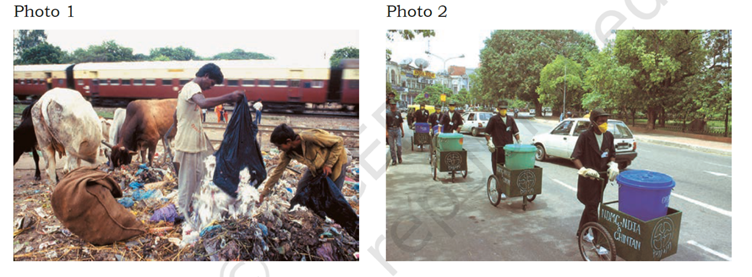
Figure 1 Sutar (2022). Social and Political Life – I: Textbook for Class VI (0658). (Revised edition). National Council of Educational Research and Training (NCERT). pp. 56. Copyright, 2006, 2022, by NCERT.
The two photos in Figure 1 compare the condition of workers in waste handling and the significance of safety and hygiene. Photo 1 shows unregulated waste dumping where animals and people forage for trash, making them susceptible to health risks and toxic and harmful wastes. This highlights the issues of pollution and the need for eco-friendly and safe waste processing, as shown in photo 2. The figure is followed by a series of questions to prompt discussion on waste management, from collecting and dispatching them safely for treatment and recycling. In addition to informing, these images help the learners to reflect upon individual waste production, sustainable management and community responsibility. Through the juxtaposition of informal and organised waste management, the images highlight a contrast through aesthetic and intellectual engagements. The image also reveals the importance of the informal sanitation workers’ sidelining their contributions while the organised waste collection with necessary safety and hygiene equipment becomes an aspirational vision, exposing the gaps of marginalised labourers despite their reasons for collecting the waste. The duality of the two images underscores the agency of the image, which is to critically evaluate both the aesthetics of cleanliness and the socioenvironmental ethics behind waste segregation. Looking into the people inside the image, the viewers are encouraged to use moral imagination to question systemic inequities within environmental issues, such as waste management.
Visual representations foster ecoliteracy through cognitive and affective properties. The visuals transform abstract ecological concepts into concrete, accessible forms for the students to comprehend and emotionally connect with the concepts. Visuals simplify complex environmental data by breaking it down into manageable parts. Visual illustration provides a scaffold for mental image construction models of ecosystems. The dynamic layouts and visual storytelling facilitate logical reasoning. Emotional engagement of the visual narratives through relatable imagery creates emotional resonance, evoking empathy, responsibility and environmental stewardship. This combination of cognitive learning of ecological processes with affective learning and nature appreciation enhances holistic learning. Additionally, the authenticity provided by NCERT and the National Curriculum Framework’s monitoring helps prevent misinformation and misinterpretation of the visuals. Using visual indicators of ecological information aligns with contemporary research and pedagogical trends.
Figure 2
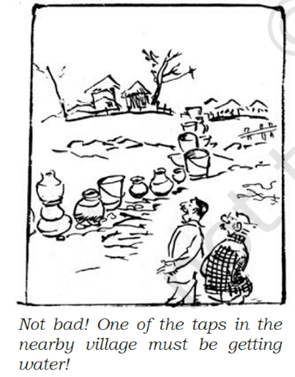
Figure 2
Sutar (2022). Social and Political
Life – I: Textbook for Class VI (0658). (Revised edition). National Council
of Educational Research and Training (NCERT). pp. 25. Copyright, 2006, 2022, by
NCERT.
The cartoon in Figure 2 depicts numerous water containers queued in long lines, suggesting a limited water source and the challenge of fetching water from shared taps. The comment, ironically, suggests the village’s position, prompting questions and evoking emotional responses among the students, such as, Why is the water scarce in some areas? How difficult would it be for the people to wait long to get water? What can be done to conserve water individually and as a community? The cartoon simplifies water scarcity and the interdependence of human activities and the environment without a detailed explanation. This motivates the learners to critically analyse the causes, impacts, and solutions to any ecological problem. The cartoon encourages the viewers to critically engage in the cause-and-effect debate of overuse and mismanagement of resources like water, leading to environmental injustice.
Figure 3
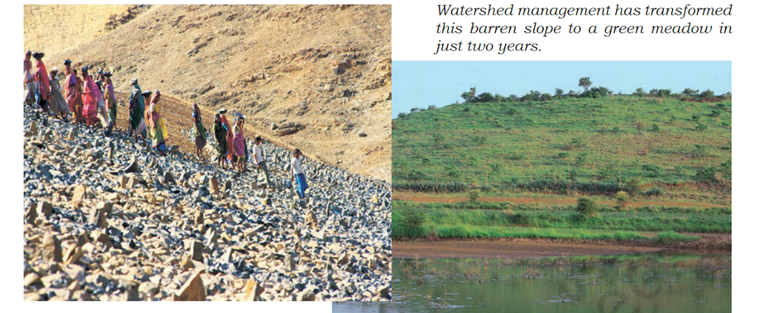
Figure 3
Sutar (2022). Social and Political
Life – I: Textbook for Class VI (0658). (Revised edition). National Council
of Educational Research and Training (NCERT). pp. 40. Copyright, 2006, 2022, by
NCERT.
The two images in Figure 3 illustrate the tangible benefits of watershed management, showcasing the positive intervention of humans with ecology. The first picture depicts a barren, rocky slope with no vegetation, symbolising land degradation, water scarcity, and the adverse effects of neglecting ecological conservation. The second picture shows the same area transformed into a lush green meadow with a water body. This demonstrates how sustainable practices like watershed management and community-driven efforts can restore ecosystems and enhance biodiversity. The immediate contrast evokes emotions like hope, pride, and a sense of responsibility for believing in the potential of ecological change. The number of people working in the first image and the emphasis on “in just two years” (Figure 3) in the caption reinforce the significance of community involvement in sustainable environmental management. This inspires collective dialogue on sustainable land use practices and resource management. The aesthetic appeal of the images lies in their vivid depiction of the transformation of the landscapes juxtaposed. The image foregrounds structured interventions like watershed management that can alter landscapes and livelihoods through temporal aspects in human stories reflecting societal values, perseverance, collective action on ecological development and resilience.
Social and Political Life-II textbook contains an introductory note for teachers that rectifies the shortcomings of the SPL-I, like the use of storyboards to indicate the fictionalised sections for easy understanding, unit pages as Teacher’s Notes before every chapter pointing out the main points, Teacher’s Notes on evaluation is added with the procedures to assist teachers in providing critical learning; glossary for each chapter are included to create clarity on the usage within; the in-text and end-text questions of the textbook uses visual material and experiential analysis to facilitate assimilation of the contents effectively.
Figure 4
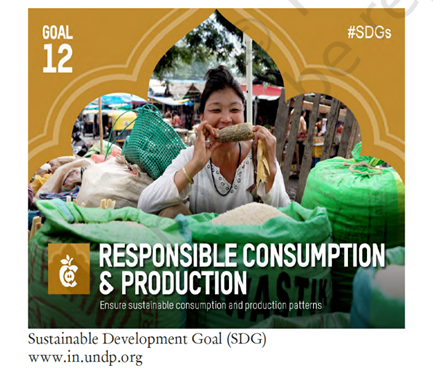
Figure 4 Sutar (2022). Social and Political Life – II: Textbook for Class VII (0764). (Revised edition). National Council of Educational Research and Training (NCERT). pp. 84. Copyright, 2007, 2022, by NCERT.
SPL-II discusses equality in Indian democracy, state government, gender, media and markets, enhancing the significance of a holistic understanding of the sociocultural notions of equity. The textbook demonstrates the fundamental aspects and the significance of individual and community behaviours in shaping production and consumption towards sustainability. This is summed up with the poster of Goal 12 of the United Nations Sustainability Goals, as in Figure 4. SPL-II uses various visual narratives from illustrations, photographs and cartoons to represent equality and resource management, helping to understand global consumption patterns and highlighting the importance of aligning personal choices with sustainable community growth and ecological wellbeing. The use of bright colours and smiling subjects demonstrates the individual agency in achieving systemic change of sustainability. The aesthetic choice of the place, vibrant market, and positive picture of the subject highlight the interconnectedness of consumption, production and community. The image foregrounds individual choices, like reducing waste and embracing local produce, which can contribute to broader sustainability objectives reflecting the concepts within the textbook. The official UN SDG 12 image in the text serves as a comprehensive visual material, reinforcing the curriculum’s position in line with the global sustainable development index.
Figure 5
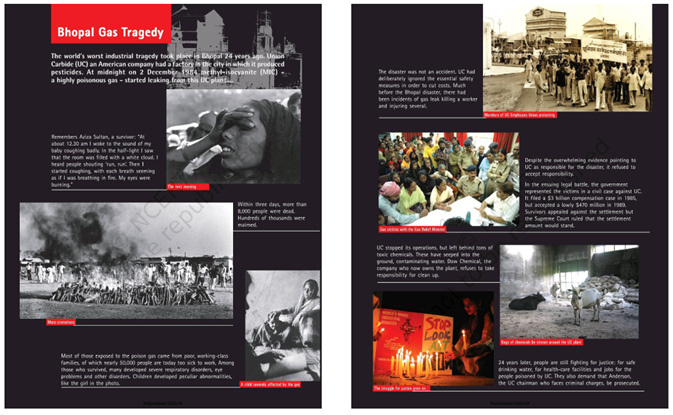
Figure 5 Sutar (2022). Social and Political Life –I II: Textbook for Class VIII (0860). (Revised edition). National Council of Educational Research and Training (NCERT). pp. 104-5. Copyright, 2008, 2022, by NCERT.
The Social and Political Life-III textbook has presented enhanced use of the elements already used based on feedback received from previous textbooks. For example, the storyboards are based on actual events towards critical thinking. A photo essay on the Bhopal gas tragedy is added with an elaboration on the chronology of the issue, highlighted with visuals for better understanding. The textbook discusses the Indian constitution, secularism, parliament and making laws, judiciary, understanding and confronting marginalisation, public facilities, law, and social justice. All these concepts converge and are represented in the two-page visual essay on the Bhopal gas tragedy. The photo essay in Figure 5 depicts the catastrophic event of 1984, capturing the devastating aftermath of the industrial disaster caused by the leakage of methyl isocyanate gas from the Union Carbide pesticide plant. The visual covers the survivors recounting their horror, illustrating the immediate effects of the gas on the human body. The visual of the mass cremation of a physically affected child captures the tragedy’s overwhelming toll and intergenerational impact. The photo essay provides emotional and factual context, demonstrating the scale of suffering and the socioeconomic vulnerabilities of the affected people. In addition, the visuals also focus on the long-term consequences and ongoing struggles for human and environmental justice. A haunting image of toxic waste left behind by the factory reveals the lasting damage, environmental slow violence, and pollution. The black and white background of the visuals exemplifies the content, highlighting the sufferings and guiding the learners to reflect on the consequences of environmental disasters and their emotional impact. The visual serves as documentation and critique through its arrangement and choice of images, sensitising the learners through holistic understanding, critical thinking, empathy, and encouraging emotional response. This visual narrative helps the learners understand the confluence of societal practices, law, social justice, industrial accountability, questions of marginalisation, compensation, and rehabilitation with ecoliteracy.
4. Conclusion
The study critically analysed the visual representations in the middle school NCERT Social and Political Life books to explore their role in fostering ecoliteracy. The text provides awareness and empowers the students to recognise and seek ecoliteracy and environmental sustainability. The analysis revealed that visual representations shape learners’ understanding of environmental issues, sociocultural interactions of humans and nature, ecological accountability, the significance of individual and communal behaviour and sustainable practices towards a holistic ecoliteracy. The selected images from the textbooks exemplify the interplay of fundamental knowledge of ecology, its sociocultural relations, empathy for collection action, and environmental awareness, which frame the components of ecoliteracy. This research scope also highlights the transformative role of visual scholarship, which provides compelling imagery and emotional and intellectual engagement through its affective and cognitive abilities. The visuals encourage critical thinking, providing context for understanding complex ecological relationships and inspiring sustainable practices.
CONFLICT OF INTERESTS
None.
ACKNOWLEDGMENTS
The University Grants Commission funded this research under the Junior Research Fellowship scheme.
REFERENCES
Capra, F. (2007). Sustainable Living, Ecological
Literacy, and the Breath of Life. Canadian Journal of
Environmental Education, 12, 9–18.
Dobrin, S. I. (2020). EcoComix: Essays on the Environment in Comics and Graphic Novels.
McFarland.
Goleman, D., et al. (2012). EcoLiterate: How Educators Are Cultivating Emotional, Social, and Ecological Intelligence. Jossey-Bass.
Kahn, R. (2008). From Education for Sustainable Development to Ecopedagogy: Sustaining Capitalism or Sustaining Life? Green Theory and Praxis: The Journal of Ecopedagogy, 4(1), 1–15. https://doi.org/10.3903/gtp.2008.1.2
Kim, G., Vaswani, R. T., and Lee, D. (2017). Social-Ecological Memory in an Autobiographical Novel: Ecoliteracy, Place Attachment, and Identity Related to the Korean Traditional Village Landscape. Ecology and Society, 22(2). https://doi.org/10.5751/ES-09284-220227
Kirmani, M. D., and Khan, M. N. (2016). Environmental Concern to Attitude Towards Green Products: Evidences From India. Serbian Journal of Management, 11(2), 159–179. https://doi.org/10.5937/sjm11-9241
Lam, M. E. (2014). Building Ecoliteracy With Traditional Ecological Knowledge: Do, Listen, and Learn. Frontiers in Ecology and the Environment, 12(4), 250–251. https://doi.org/10.1890/1540-9295-12.4.250
Majumdar, K., and Chatterjee, D. (2022). Ecoliteracy Among Tribals in Eastern India. South Asia Research, 42(1), 76–92. https://doi.org/10.1177/02627280211056838
McBride, B. B., et al. (2013). Environmental Literacy, Ecological Literacy, Ecoliteracy: What Do We Mean and How Did We Get Here? Ecosphere, 4(5), Article 67. https://doi.org/10.1890/ES13-00075.1
Newbury, D. (2011). Making Arguments With Images: Visual Scholarship and Academic Publishing. In E. Margolis and L. Pauwels (Eds.), The SAGE Handbook of Visual Research Methods (651–664). Sage. https://doi.org/10.4135/9781446268278.n34
Nixon, R. (2011). Slow Violence and the Environmentalism of the Poor. Harvard University Press. https://doi.org/10.4159/harvard.9780674061194
Okur-Berberoğlu, E. (2018). Development of an Ecoliteracy Scale Intended for Adults and Testing an Alternative Model by Structural Equation Modelling. International Electronic Journal of Environmental Education, 8(2), 15–34.
Pilgrim, S., et al. (2007). A Cross-Regional Assessment of the Factors Affecting Ecoliteracy: Implications for Policy and Practice. Ecological Applications, 17(6), 1742–1751. https://doi.org/10.1890/06-1358.1
Sutar, B. (Ed.). (2022). Social and Political Life - I: Textbook for Class VI (0658) (Revised ed.). National Council of Educational Research and Training.
|
|
 This work is licensed under a: Creative Commons Attribution 4.0 International License
© ShodhKosh 2026. All Rights Reserved.