ShodhKosh: Journal of Visual and Performing ArtsISSN (Online): 2582-7472
|
|
Strategic Management of AI Art Exhibitions
Dr. J. Refonaa
 ,
Dr. Satish Upadhyay 2
,
Dr. Satish Upadhyay 2 ,
Tanya Singh 3
,
Tanya Singh 3 , Divya Sharma 4
 ,
Dr. Nitin Ajabrao Dhawas 5
,
Dr. Nitin Ajabrao Dhawas 5 , Prateek Aggarwal 6
 ,
Dinesh Shravan Datar 7
,
Dinesh Shravan Datar 7
1 Assistant Professor, Department of
Computer Science and Engineering, Sathyabama Institute of Science and
Technology, Chennai, Tamil Nadu, India
2 Assistant
Professor, UGDX School of Technology, ATLAS Skill Tech University, Mumbai,
Maharashtra, India
3 Professor, School of
Engineering and Technology, Noida International University, 203201, India
4 Centre of Research Impact and Outcome, Chitkara University, Rajpura- 140417, Punjab, India
5 Professor, Department of Electronics and Telecommunication Engineering, Nutan Maharashtra Institute of Engineering and Technology, Pune, Pin 410507, India
6 Chitkara Centre for Research and Development, Chitkara University, Himachal Pradesh, Solan, 174103, India
7 Department of Artificial Intelligence and Data Science, Vishwakarma Institute of Technology, Pune, Maharashtra, 411037, India
|
|
|
ABSTRACT |
|
|
The art of AI
exhibitions management is an emerging area of frontier by the array of
technology, imagination, and culture administration. The emergence of
artificial intelligence as a driver in the production of art has introduced
new issues and opportunities to curators and managers regarding how to
conceptualize, organize and maintain exhibitions dealing with the issue of
algorithmic creativity. This study indicates that AI art exhibitions should
be managed in a comprehensive manner that addresses the strategic management
of art exhibitions, their curation, operations, and the audience. It begins
by defining the scope of AI art and contextualising
it within the context of bigger conversations on digital culture and
innovation management. The framework focuses on creating effective visions,
missions, and goals that outline the value and the meaning of AI-based
experiences of art. Through market and audience analysis, institutions will
be in a better position to have a clear vision of the new demands and position
themselves in the competitive arena of the cultural sector. The essence of
successful exhibition curation consists in the developed concept of AI-based
works selection principles including ethical considerations, aesthetic
characteristics, collaboration trends that can unite artists, technologists,
and curators. The operational strategies prove the need of the good
technological foundation, the effective resource allocation, and the active
risk management, particularly taking into account the fact that AI systems
can be described as dynamic and experimental. The marketing strategies such
as the narrative based branding and the cooperation
with the digital media and the immersion of the audiences also precondition
the rise of the degree of the public interest. |
|||
|
Received 12 March 2025 Accepted 17 July 2025 Published 20 December 2025 Corresponding Author Dr. J. Refonaa, refonna.cse@sathyabama.ac.in DOI 10.29121/shodhkosh.v6.i3s.2025.6818 Funding: This research
received no specific grant from any funding agency in the public, commercial,
or not-for-profit sectors. Copyright: © 2025 The
Author(s). This work is licensed under a Creative Commons
Attribution 4.0 International License. With the
license CC-BY, authors retain the copyright, allowing anyone to download,
reuse, re-print, modify, distribute, and/or copy their contribution. The work
must be properly attributed to its author.
|
|||
|
Keywords: AI Art Exhibition, Management of Culture, Strategic
Planning, Digital Curation, Interactions with Audience, Technological
Innovation |
|||



1. INTRODUCTION
The rapid growth of artificial intelligence (AI) has significantly altered the contemporary creative practice that expanded the definition and the limits of the art. Generative adversarial networks (GANs) have made images appear hyper-realistic, whereas interactive stories have been generated using large language models, meaning that AI has ceased to be an aid but can now be utilized as a source of inspiration as well. This nexus of computational innovation and art has given rise to AI art exhibitions, curated art shows which anticipate machine-generated art or machine-enhanced art in culture and the general public. As these exhibitions continue to become popular across the globe, these exhibitions need a strategic approach to management, which is in control of the distinct conceptual, operational, ethical and experience values of such exhibitions. Unlike the traditional art exhibits, AI art exhibits suggest dynamic systems, algorithmic procedures and in most instances, dynamic interactions between works of art and technologies and viewers Wen and Ma (2024). This complication poses special challenges between the curators, cultural managers and institutions. Exhibitions are supposed to consider the ever-growing technologies, technical specific infrastructures, interdisciplinary collaboration, and concern of authorship, openness and data ethics at a higher level.
Moreover, as the market of AI-created art grows (digital galleries, NFT, and immersive virtual worlds, etc.), overall cultural institutions are under pressure that clarifies their value proposition and distinguish their products in an ever-growing competitive environment Yang and Wang (2022). These issues can be interpreted through strategic management and analyzed in order to overcome these challenges successfully. It involves the long term planning, decision making and evaluative processes that help cultural institutions within the context of defining mission, allocating resources as well as adapting to external and internal changes. In the framework of AI art exhibitions, strategic management means to design a consistent vision that enables technological innovation to be consistent with the intent of the curators, such that the exhibitions are not only aesthetically engaging but also purposeful, morally based and operationally sustainable Zhao and Yezhova (2024). Figure 1 presents a strategic plan that can be used to plan and manage AI art exhibitions. In the center of such a strategic process is the necessity of the one-dimensional analysis of the market and audience.
Figure 1
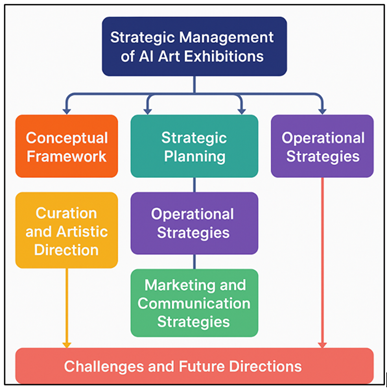
Figure 1 Strategic
Management Framework for AI Art Exhibitions
Popular culture has created an increased exposure to algorithmic creativity with the emergence of AI in popular culture through social media filters, machine-generated music and AI-assisted design. However, the audiences are diverse in their perceptions and expectations and worries about the art created by AI. Proper audience segmentation and analysis helps the organizers of the exhibition to create experiences that appeal to the various categories of people, including the ones who are fascinated by the new aesthetics and the ones who are interested in the mechanism behind machine learning, the ones who are doubtful about the authenticity or legitimacy of AI as a creative engine Kim and Lee (2022). Curation and artistic direction are both very important to the making of the exhibition story.
2. Conceptual Framework
2.1. Definition and scope of AI art exhibitions
AI art exhibitions are curated shows of works of art generated, enhanced, or otherwise influenced by artificial intelligence systems like machine learning models, neural networks, and generative algorithms, or autonomous computational processes. These displays demonstrate the artistic abilities of AI, either in terms of visual art, interactive environments, soundscapes, or in digital environments. The applications of AI art are not merely presented through the exhibition of outputs generated by machines, but it is the larger ecosystem where people and algorithms relate to each other in determining artistic experiences Jiang et al. (2022). Such exhibitions are typically multi-level production processes, such as dataset preparation, training of models, the refinement of the models, and the incorporation of real-time computational behavior into the final form of the artwork. Besides presenting the works of art, AI art exhibits are also used as spaces of social and cultural discussion regarding the cultural, social, and ethical impacts of artificial intelligence. They encourage the discussion of the issues of algorithmic authorship, the democratization of creativity, and the transformation of the role of human artists in an increasingly automated world Shi et al. (2019). AI art can be presented in physical galleries, museums, online, or the hybrid of physical and online space.
2.2. The Intersection of Technology, Creativity, and Management
The exhibitions of AI art are in a distinct place on the intersection of technological excellence, creative expression, and management approach. Technology is both an instrument and an impetus of artistic production as artists are able to experiment with forms, behaviors, and aesthetics never imagined before. Generative algorithms, neural networks and interactive systems provide possibilities of artworks that grow, respond, and adapt - making the creative process a collaborative interaction between human intention and computation by a machine Chang (2021). On the other hand, creativity is the focus of the conceptual and artistic orientation of AI-driven exhibitions. Artists and curators have to use and employ technological resources in a manner that spurs imagination, critical thinking as well as emotional stirring Barath et al. (2023). Nevertheless, artistic intentions should be combined with practical aspects of management, which guarantees transformation of ideas in practical, properly implemented exhibitions. Managerial tasks involve the ability to predict the resource requirements, organize inter-disciplinary teamwork, develop the audience experiences, and align the exhibitions with institutional missions. The overlap of these spheres promotes the significance of the strategic thinking Adahl and Träskman (2024). Managers have to establish connections between technical and artistic viewpoints, establish communication between different functional areas, and predict issues related to the quick changes in technologies.
2.3. Theoretical Perspectives on Cultural Management and Innovation
The AI art exhibition strategic management is based on the various theoretical approaches of cultural management, innovation research, and organizational theory. The cultural management models focus on how institutions influence the aesthetic experiences, mediate the cultural value, and help people engage. These attitudes identify the art exhibitions not only as an act of creativity but as an intricate form of social and organizational actions that are to be regulated with a fine balance and leadership in terms of resources and interpretation Pietroni (2025). Exhibitions focused on AI disrupt the traditional assumption about the authorship, authenticity, and artistic work that introduces the need to be more flexible and adaptive on the part of cultural managers. Another source of knowledge in technological change and innovative experimentation processes is the innovation theory. Some of the concepts that allow the explanation of how AI tools can change the artistic practice and influence the institutional strategies include disruptive innovation, open innovation, and technological diffusion Ivanov and Velkova (2025). AI art exhibitions can be viewed as innovation ecosystems to some extent: they unite different stakeholders, such as artists, engineers, curators, funders, audiences, and so forth, which collaboratively produce knowledge and cultural output. This co-creation and interdisciplinary innovation theoretical models are consistent with this collaborative environment. Table 1 is a summary of the literature that informs research in organizing AI art exhibitions. Organizational theories also help in understanding how organizations survive the uncertainty and complexity especially in the technologically intensive environment. The models of dynamic capabilities, systems thinking, and strategic alignment confirm the importance of agility, learning, and long-term planning Wang (2021).
Table 1
|
Table 1 Overview of Key Literature Relevant to AI Art Exhibitions |
||||
|
Study Focus |
Domain |
Methodology |
Key Concepts |
Limitations |
|
Creative Adversarial Networks (CAN) |
AI Art Generation |
Neural Networks |
Novelty, Artistic Styles |
Limited interpretability |
|
Autonomous Creativity Research Furferi et al. (2024) |
Human–AI Collaboration |
Experimental Systems |
Co-creation, Evolutionary Art |
Lacks exhibition context |
|
"Computers Do Not Create Art" |
Philosophy of AI Art |
Theoretical Analysis |
Authorship, Intentionality |
Non-technical |
|
Interactive Digital Installations |
Digital Art & HCI |
Case Studies |
Interactivity, Immersion |
Not AI-specific |
|
Algorithmic Culture Theory |
Media Studies |
Conceptual Review |
Algorithmic Mediation |
Abstract, non-operational |
|
AI Aesthetics Villaespesa and Murphy
(2021) |
Digital Humanities |
Critical Analysis |
Dataset Aesthetics |
Limited operational guidance |
|
Latent Space Interpretability |
Machine Learning |
Technical Experiments |
Latent Editing |
Very technical |
|
Ethics of Machine Learning Art |
Ethics & Technology |
Applied Ethics |
Bias, Transparency |
No exhibition strategies |
|
AI and Surveillance Aesthetics Münster et al. (2024) |
Art Theory |
Critical Inquiry |
Data Politics |
Highly conceptual |
|
"Computational Curation" |
Curatorial Studies |
Case Studies |
Algorithmic Curation |
Limited focus on infrastructure |
|
Exhibition: "Art in the Age of AI" |
Practical Exhibition |
Exhibition Review |
Immersive Installations |
Limited documentation |
|
"Machine Learning for Artists" Fiorucci et al. (2020) |
Museum Education |
Pedagogical Research |
Public Literacy |
Not focused on strategy |
|
Interactive Narrative Systems |
Computational Art |
System Design |
Agency, Procedurality |
Pre-deep learning |
|
"Love Songs: AI & Emotion" |
Photography & AI |
Exhibition Catalogue |
Emotion Modeling |
Limited long-term analysis |
3. Strategic Planning for AI Art Exhibitions
3.1. Vision, mission, and goal setting
The strategic planning of the AI art exhibitions is created through the development of clear vision, mission and set of goals. The vision defines the long-term goals of the exhibition what it aims to achieve in terms of cultural influence, what it hopes to contribute to the artistic progress, and how it will influence the formation of the popular perception of the creative possibilities of AI. An excellent vision is an inspirational compass, which makes stakeholders focus their efforts on the common target and ranks the exhibition in the context of the larger discussion on the digital culture and technological change Bonacini and Giaccone (2022). The mission statement on the other hand dwells on the practical and philosophical aspects of the exhibition. It determines the overall goals of the exhibition, its target audiences, and principles. In the case of AI art exhibitions, a mission can focus on encouraging interdisciplinary collaboration, critical thought on the new technologies or broadening access to digital creativity. The mission will help in ensuring that the operational decisions, curatorial decisions, and audience engagement strategies are based on the essential values of the exhibition. Setting of goals converts the vision and mission into action.
3.2. Market and Audience Analysis
The AI-generated art market is developing fast as the online gallery space, cultural institutions driven by technology, online creators, and new commercial platforms like NFT markets are now the various factors shaping the industry. The knowledge of this ecosystem enables exhibition planners to find their competitive possibilities, possible collaborations, and niche customers who want to experience innovative art. The analysis of the audience is also a critical aspect because of the diversity of the expectations and familiarity rates of the visitors and their motivations. It is to attract technologically curious, digital art lovers, media and culture scholars and general audiences seeking to experience something interactive or immersive that AI art exhibitions appeal to. This segmentation of audiences leads to the interpretation of clients by their demographic, psychographic, and behavioral patterns, which helps curators to create a more engaging experience with the interpretive materials, interactive, and educational programs. The surveys, social media analytics and post-exhibition feedback will be used as a means to gain hard information about interests of visitors, their perception and patterns of participating. Also, it is beneficial to know what social groups feel about AI, including problems with bias, transparency, and authorship to plan how to overcome possible obstacles to audience acceptance. Figure 2 shows elements that are implemented to organize the market and audience analysis. Market research also points to the larger cultural developments, such as the increased role of experience-based art and the need to create spaces that are, in some way, both digital and physical and changing perceptions of sustainability and accessibility.
Figure 2

Figure 2 Component-Based
Framework for Market and Audience Analysis
By incorporating these pieces of knowledge into strategic planning, the exhibitions of the AI art will be kept relevant, socially responsive, and competitive.
3.3. SWOT Analysis and Competitive Positioning
A SWOT analysis, the investigation of the strengths, weaknesses, opportunities, and threats is an important part of strategic planning when showcasing AI art. Examples of strengths can involve curatorial expertise that is unique in some way, access to state-of-the-art AI solutions or other interdisciplinary collaborations or the capability to create interactive and dynamic art. The identification of these assets enables the organizations to utilize them in the process of exhibition design and communication plans. The weak points can include insufficient technical infrastructure, financial limitations, lack of skills between employees, or the uncertainty about the reliability of AI-generated content. Awareness of these limitations helps institutions to come up with mitigation strategies and to allocate resources in a more effective way. Expansive cultural and technological changes are more likely to create opportunities.
4. Curation and Artistic Direction
4.1. Criteria for selecting AI-generated artworks
A calm and rigid code of rules that would balance the artistic quality, technological advancement, and the level of thought should be developed and cherry-pick the works of AI-generated works. One of such criteria is the articulateness of the artistic vision of the work. The curators must accept the decision of whether the art work tells an engaging story, emotion or message and whether the piece of art could be enhanced by AI to increase its value. High degree of technical sophistication is also an important factor; curators look at the algorithms, models and datasets used to render the piece and ensure that the technological procedures enhance the artistic purpose and do not overpower it. Novelty and innovation remain important factors of selection. The art created by AI ought to exhibit different aesthetics or behaviours that are beyond the scope of computational creativity. It might encompass new forms of emergent pattern, adaptive systems or new visual languages that sets the artwork apart among the traditional digital works. Relevance is another important criterion another one, both to the modern cultural debates and to the thematic focus of the exhibition. The pieces that touch upon the idea of data ethics, human-machine cooperation, identity, or environmental issues have been especially close to the AI-related exhibitions. There is also the influence of feasibility.
4.2. Ethical and Aesthetic Considerations
Curating AI art exhibitions entails ethical and aesthetic aspects, as these construct the knowledge about algorithmic creativity among the population, as well as affect the cultural legitimacy of AI-generated art. Curators should also look at provenance and integrity of datasets applied in the production of works of art, ethically. Such problems include copyright violation, scraping of data without authorization and biased and harmful training information are serious problems. Openness in the presentation of data sources and data gathering techniques boosts the ethical credibility of the display and it allows the viewer to be informed. As well as, there are authorship and attribution issues at the centre: curators are forced to pursue the intricate dynamics between artists, programmers, models and machines when attributing credit to a creative act. AI-based art works aesthetically criticize the perceived concept of beauty, shape, and expression. The curators need to consider whether the visual, auditory or interactive aspects of the work provide any meaningful experiences to the viewers. This involves evaluating compositional integrity, response to emotions and interaction of human will and the rule of chance. AI aesthetics tend to be random, generate patterns, or vary through iteration, and it is possible that they need new interpretive paradigms to be presented and analyzed.
4.3. Collaboration between Artists, Technologists, and Curators
Effective AI art shows are based on effective collaboration between artists, technologists and curators, who can bring to the creative and organizational process specific expertise in their area. Artists will supply some conceptual insight, creative instinct, and aesthetic sensitivity and they may often jump start ideas that take AI tools in a new direction. Technologists such as data scientists, machine learning engineers and software developers bring these visions to life by creating algorithms, training models and optimizing technical workflows. Curators are the intermediaries between creative and technical realms. They situate the artworks, influence the narratives of the exhibition and decide strategically on how to present and interpret the works and engage the intended audiences. The proper teamwork should involve dialoguing, the use of common words and respect among disciplines. Ongoing workshops and prototyping, combined with planning field trips and meetings are beneficial to keep artistic will and technological ability in line with one another. The interdisciplinary collaboration creates innovativeness through a combination of different points of views so that the artworks produced are conceptually deep as well as technologically advanced.
5. Operational Strategies
5.1. Exhibition design and technological infrastructure
The design of exhibition of AI art work needs to be dynamic and able to be adapted to meet the aesthetic presentation of the art work as well as the technical needs of the algorithmic art piece. In contrast to conventional exhibitions where typically the works are fixed in place, AI art installations can engage real-time data processing, interactivity or interfaces, projection, or immersive environments. Curators and designers have to then develop space plans that assist in a smooth technological application and clear circulation and compelling visual narratives. The use of lighting, sound, and display formats have to be properly planned, as they should be designed to improve visual, auditory, and other senses involved in the experience of AI-generated work without disrupting the technical elements. The AI art exhibitions rely on the technological infrastructure. Algorithms processes may need reliable computers, high-performance servers, GPUs, and network connections. In works which depend on live data or interacting with user, strong sensors, camera and interface devices should be installed and thoroughly tested. It is important that it is stable and scalable; systems should be in a position to perform continuously during the period of the exhibition without any reduction in performance.
5.2. Resource Allocation and Budgeting
The success of the AI art exhibitions in the operational perspective depends on the effective allocation and budgeting of resources as they have special technological and logistic requirements. The budget planning is started with the identification of all the cost areas, which include equipment purchases, licenses of the software, computing resources, installation material, exhibition design, employee salaries, and marketing costs. The exhibitions, which are based on AI usage, usually demand specific hardware, including GPUs, servers, and high-resolution displays, and prior cost estimation is a necessity. Moreover, the cost of the works, which is based on real-time calculation, can require constant energy and maintenance expenditures, which will have to be considered during the exhibition. Another significant budget item is the human resources. Interdisciplinary teams of artists, curators, designers, data scientists, software engineers, technicians, and educators are usual participants of AI art exhibitions. Compensation, training, and collaboration should be allocated enough to facilitate easy execution of a project. The institutions can also require to engage external consultants, workshop facilitators or guest speakers as well to enhance the educational programs of the exhibition. Resource allocation does not only rely on financial aspects. Space, time and infrastructure should also be strategically distributed.
5.3. Risk Management and Contingency Planning
In AI art displays, risk management is critical because they are based on sophisticated technologies and are dependent on random algorithms. First of all, it is necessary to determine possible risks, which can be malfunctions of hardware, software bugs, failures of the network, data security, or environmental disturbances of sensitive equipment. There are some AI artworks that can be dependent on real-time feeds or even interaction with the user, which raises the risk of system instability. An in-depth analysis of risk enables the teams to foresee the vulnerability during early stages of planning. Figure 3 illustrates the decision flow that helps in conducting risk assessment and contingency planning. After risks are produced, mitigation measures have to be put in place.
Figure 3
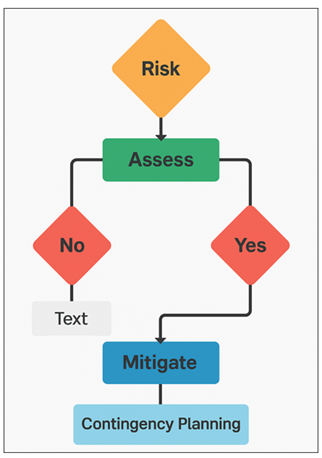
Figure 3 Decision
Flowchart for Risk Evaluation and Contingency Planning
Such preventive measures as stress-testing software, system diagnostics, cybersecurity procedures, and verification of all technical elements according to safety standards are possible. Regular maintenance schedules and monitoring systems enable the technicians to identify and fix the problems even before they affect the experiences of the visitors. The other primary factor is staff training, the team members must know the steps involved in troubleshooting and how to react to an unforeseen issue in the shortest possible time.
6. Challenges and Future Directions
6.1. Ethical dilemmas and intellectual property issues
One of the hottest concerns of strategic management of AI art exhibitions is ethical dilemmas and intellectual property (IP) issues. The ethical issue of the provenance and transparency of training data is one of the significant ones. AI models usually rely on large data sets which can contain copyrighted images, personal information or culturally sensitive content. Unless explicitly revealed, AI-generated artworks are likely to continue perpetrating bias, infringing on privacy or stealing artistic styles. The curators and the institutions should then make sure that artists and technologists undertake responsible data practices and make these processes transparent and accessible to the general audience. These issues always concern intellectual property as AI-generated art calls into question the traditional concept of authorship and ownership. The issue of who has the rights to creative work raises questions about whose rights they are the artist, the programmer, the developer of the AI system, or the institution in which the exhibition takes place. The lack of similar legal systems in various jurisdictions makes licensing, reproduction rights and commercial use difficult. Exhibitions should also develop effective contractual agreements defining the rights and responsibilities of the stakeholders.
6.2. Sustainability and Digital Preservation of AI Art
The exhibitions of AI art present some special challenges related to sustainability and digital preservation given the complexity of the technologies and the computational costs of the algorithmic artworks. Most works based on AI are sensitive to high-energy processing, live data, or specialized devices, which makes them questionable in terms of environmental impact. The institutions should explore energy-saving solutions as to optimizing the models performance, using renewable energy sources, or low-power hardware option. Figure 4 demonstrates the elements of the environment and preservation that are necessary to support AI art. Other areas of sustainable practices are also in the lifecycle of the exhibition; material selection, equipment reuse, and responsible disposal. Another problematic issue is digital preservation.
Figure 4
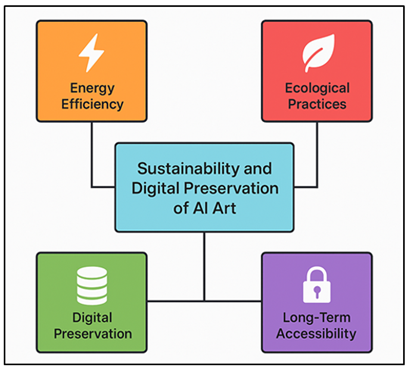
Figure 4 Visual
Model of Environmental and Preservation Components for AI Art
The field of AI art is usually relying on new technologies that can become irrelevant in several years. The integrity of the artwork would need to be preserved by documenting code, datasets, model architectures, system configurations and interaction designs. The institutions should formulate long term archiving plans that consider the compatibility of software, availability of hardware and data preservation quality. There might be a need to emulate obsolete systems or keep the hardware in the legacy that will guarantee future access to the artwork. Another aspect of preservation is the preservation of the experiential and interactive aspects of AI art. In the case of dynamic or adaptive works the archivists might have to capture behavior logs, user interactions or representative outputs to describe the original functioning of the artwork. Close cooperation between curators, artists, and digital preservation professionals is essential in order to solve such problems.
7. Conclusion
The AI art exhibition management is a significant project in manipulating the flourishing technology that encounters the creativeness and cultural practice. As the artistic products and relationships with people continue to evolve according to the influence of artificial intelligence, the cultural institutions should deploy multiple and forward-thinking strategies that take into account the conceptual, functional, and ethical insights of art-based on artificial intelligence. This paper has highlighted the need to purposefully set the vision, be skeptical of market placement and restraining curatorial paradigms that enable artistic integrity and internalize the technical complexity of algorithmic production. Development of the operational plans including careful planning of the exhibitions and having sustainable distribution of resources and holistic control of risks are of great essence in delivering reliable and efficient visitor experiences. The visibility and relevance of AI art exhibitions are further enhanced by marketing strategies, which are premised on the utilization of an attractive storytelling and engagement with digital platforms. These efforts all contribute to institutes building the credibility of the citizens, generating the incentive to appeal to the audience, and becoming the pioneers of the active realm of digital art. In the meantime, the issues of serious concern remain, in particular, the ethical questions, the property rights, and the sustainability of the works created by AI over the long term.
CONFLICT OF INTERESTS
None.
ACKNOWLEDGMENTS
None.
REFERENCES
Adahl, S., and Träskman,
T. (2024). Archeologies
of Future Heritage: Cultural Heritage, Research Creations, and Youth. Mimesis Journal, 13, 487–497.
Barath, C.-V., Logeswaran, S.,
Nelson, A., Devaprasanth, M., and Radhika, P. (2023). AI in Art Restoration: A Comprehensive Review of Techniques, Case Studies,
Challenges, and Future Directions. International Research
Journal of Modern Engineering and Technology Science,
5, 16–21.
Bonacini, E., and Giaccone, S. C. (2022). Gamification and Cultural Institutions in Cultural Heritage
Promotion: A Successful Example from Italy. Cultural Trends, 31, 3–22. https://doi.org/10.1080/09548963.2021.1910490
Chang, L. (2021). Review and Prospect of Temperature
and Humidity Monitoring for Cultural Property Conservation Environments.
Journal of Cultural Heritage Conservation, 55, 47–55.
Fiorucci, M., Khoroshiltseva, M., Pontil, M.,
Traviglia, A., Del Bue, A., and James, S. (2020).
Machine Learning for Cultural Heritage: A Survey. Pattern Recognition Letters,
133, 102–108. https://doi.org/10.1016/j.patrec.2020.02.017
Furferi, R., Di Angelo, L., Bertini, M., Mazzanti,
P., De Vecchis, K., and Biffi, M. (2024). Enhancing
Traditional Museum Fruition: Current State and Emerging Tendencies. Heritage
Science, 12, 20. https://doi.org/10.1186/s40494-024-01139-y
Ivanov, R., and Velkova, V. (2025). Analyzing Visitor Behavior to Enhance Personalized Experiences in
Smart Museums: A Systematic Literature Review. Computers, 14, 191. https://doi.org/10.3390/computers14050191
Jiang, T., Gan, X. E., Liang, Z., and Luo, G. (2022). AIDM: Artificial Intelligence for Digital Museum Autonomous System
with Mixed Reality and Software-Driven Data Collection and Analysis. Automated
Software Engineering, 29, 22–45. https://doi.org/10.1007/s10515-021-00315-9
Kim, H., and Lee, H. (2022). Emotions and
Colors in a Design Archiving System: Applying AI Technology for Museums.
Applied Sciences, 12, 1467. https://doi.org/10.3390/app12052467
Münster, S., Maiwald, F., di Lenardo, I., Henriksson, J., Isaac, A.,
Graf, M. M., Beck, C., and Oomen, J. (2024).
Artificial Intelligence for Digital Heritage Innovation: Setting up a RandD
Agenda for Europe. Heritage, 7, 794–816. https://doi.org/10.3390/heritage7020038
Pietroni, E. (2025). Multisensory Museums,
Hybrid Realities, Narration, and Technological Innovation: A Discussion Around
New Perspectives in Experience Design and Sense of Authenticity. Heritage, 8,
130.
https://doi.org/10.3390/heritage8040130
Shi, K., Su, C., and Lu, Y.-B.
(2019). Artificial
Intelligence (AI): A Necessary Tool for the Future Development of Museums. Science
and Technology Museums, 23,
29–41.
Villaespesa, E., and Murphy, O. (2021). This is not an Apple! Benefits and Challenges of Applying Computer
Vision to Museum Collections. Museum Management and Curatorship, 36, 362–383. https://doi.org/10.1080/09647775.2021.1873827
Wang, B. (2021). Digital Design of Smart
Museum Based on Artificial Intelligence. Mobile Information Systems, 2021,
4894131.
https://doi.org/10.1155/2021/4894131
Wen, J., and Ma, B. (2024).
Enhancing Museum Experience Through Deep Learning and Multimedia Technology.
Heliyon, 10, e32706. https://doi.org/10.1016/j.heliyon.2024.e32706
Yang, K., and Wang, H. (2022). The Application of Interactive Humanoid Robots in the History
Education of Museums Under Artificial Intelligence. International Journal of
Humanoid Robotics, 19, 2250016. https://doi.org/10.1142/S0219843622500165
Zhao, J., and Yezhova, O. (2024). Strategy of Design Online Museum Exhibition Contents from the
Perspective of Artificial Intelligence. Art Design, 2, 80–89. https://doi.org/10.30857/2617-0272.2024.2.8
|
|
 This work is licensed under a: Creative Commons Attribution 4.0 International License
© ShodhKosh 2025. All Rights Reserved.