ShodhKosh: Journal of Visual and Performing ArtsISSN (Online): 2582-7472
|
|
AI-Generated Virtual Sculptures and Their Educational Value
Dr. Varalakshmi S 1
 ,
Siddharth Sriram 2
,
Siddharth Sriram 2 , Avishi
Mohta 3, Ashu
Katyal 4
, Avishi
Mohta 3, Ashu
Katyal 4
 , Mona
Sharma 5
, Mona
Sharma 5 , Milind
Patil 6
, Milind
Patil 6
1 Professor,
Department of Management Studies, JAIN (Deemed-to-be University), Bengaluru,
Karnataka, India
2 Centre
of Research Impact and Outcome, Chitkara University, Rajpura- 140417, Punjab,
India
3 Assistant Professor, Department of Design, Vivekananda Global
University, Jaipur, India
4 Chitkara Centre for Research and Development, Chitkara University,
Himachal Pradesh, Solan, 174103, India
5 Assistant Professor, School of Business Management, Noida
international University 203201, India
6 Department of EandTC Engineering Vishwakarma
Institute of Technology, Pune, Maharashtra, 411037, India
|
|
|
ABSTRACT |
|
|
Because of the
rapid evolution of the sphere of artificial intelligence, the new direction
of digital creativity has been introduced, namely, the production of the
virtual sculptures made with the help of AI. These computing generated forms
are generated through computational synthesis of machine learning, 3D
modeling, and artistic experimentation and offer an individual with the
distinct opportunities in the field of teaching art. The article is a study
on the learning value of AI-generated virtual sculptures to establish their
contribution to the learning process, stimulating creativity, and revaluating
the role of digital technologies in the creation of art. The study examines
the possibility of using artificial intelligence to create sculptures to aid in
enhancement of engagement, perception, and skill-building within the academic
environment using a case study, a survey, and a group interview with both
students and teachers. The literature review puts the background of
AI-generated art into context of the larger history of digital creativity,
with the transition of the early algorithmic graphics to intelligent
generative systems which are used in contemporary creative practices. Virtual
sculptures are not merely visual or conceptual hints in learning environment
as virtual sculptures may also be applied as an interactive learning
experience where students may interact with shapes, explore form, and
experiment with artistic ideas in the virtual worlds. These applications
facilitate critical thinking, experimenting and the collaborative learning
that improves the use of the old forms of sculpture to the new forms of
technological literacy. According to the findings, AI-generated virtual
sculptures can improve the learning process since it provides flexible and personalizable and creative learning tools. Students also
state that they feel more motivated and are more confident in their
creativity and teachers state that they are more involved and that the
complicated artistic concepts are more open. |
|||
|
Received 16 March 2025 Accepted 20 July 2025 Published 20 December 2025 Corresponding Author Dr.
Varalakshmi S, varalakshmi@cms.ac.in DOI 10.29121/shodhkosh.v6.i3s.2025.6784 Funding: This research
received no specific grant from any funding agency in the public, commercial,
or not-for-profit sectors. Copyright: © 2025 The
Author(s). This work is licensed under a Creative Commons
Attribution 4.0 International License. With the
license CC-BY, authors retain the copyright, allowing anyone to download,
reuse, re-print, modify, distribute, and/or copy their contribution. The work
must be properly attributed to its author.
|
|||
|
Keywords: AI-Generated Art, Virtual Sculpture, Art Education, Machine
Learning Creativity, Immersive Learning Environments |
|||



1. INTRODUCTION
The adoption of the new digital trends in the art practice has altered the gateway of creation and production and interpretations in the modern art. The artificial intelligence (AI) is one of these innovations, and it has emerged as an efficient creative collaboration capable of designing, changing, and enhancing any type of art in new ways that were previously unavailable to that. In this technological change, one of the notable tendencies relates to the development of the virtual sculptures, i.e. the three dimensional digital art, being created with the machine learning algorithms, neural networks and procedural modeling. Between the computational design and the art, these are the virtual sculptures which allow dynamic possibilities of experimentation, visualization and engaging. As AI systems become increasingly complex and, at the same time, more affordable, the question of the effect of the latter on the art industry and the educational process in particular becomes significant. The concept of traditional sculpture that traces back to the manipulation of the contents through touch (the stone, clay, or metal) has been the goal of the art education because it is concerned with the reasoning of space, the construction of the form and the perception of materials Sorooshian et al. (2024). However, these days due to virtual sculpting tools and AI-assisted generative processes, the field has gone way beyond those limitations. The virtual sculptures fail to reflect the limitations on the cost, physical space, and material availability and as such, the artists and the students are able to experiment with complex structures, brainstorm and visualize the results using immersive digital spaces. Moreover, AI algorithms have the ability to produce novel sculptural forms, determined by a pattern, the data set, or other stylistic parameters set by the user, and it has never been previously feasible to provide such an amount of cooperation between human intention and computer-generated creativity Longlands and North (2023). These developments have the potential to transform in education. Traditional art education is aimed at nurturing the fundamental skills, creative problem-solving, and critical inquiry.
The involvement of AI-created virtual sculptures has been discussed in relation to these purposes and has brought some new aspects of digital literacy, interdisciplinary learning, and technological fluency. Learners who apply AI-assisted technologies will have access to the understanding of the algorithmic mechanisms, the logic of machine learning, and the development of human and machine creativity Anderson and Charteris (2023). In addition, virtual sculptures enhance the various learning styles through offering interactive, customized, and rich resources. Teachers can apply AI-generated models when it comes to illustrating the concept of proportion, symmetry, anatomy, architecture, or abstract form. These forms can be manipulated in real time by the students so that they have a deeper understanding by making use of direct engagement. This experience is further enhanced by virtual learning environments, which can be described as augmented reality (AR), virtual reality (VR), or as a mixed reality (MR), where learners can see, criticize, and edit sculptures in groups and inside three-dimensional spaces Lim et al. (2020), Bellacicco and Demo (2023). This change of passive observation to active participation is a major step in the pedagogical practice. Although there has been increased acceptance of AI use in creative fields, little studies have been conducted to explicitly define how AI-generated virtual sculptures are used in learning. Available literature covers digital art, co-creation between human and the AI, and the integration of technology into the classroom, however, the specific pedagogical significance of the virtual sculpture is not properly explored. It is imperative that institutions understand their influence as the way to become more modern, to promote creative thinking, and to increase access to more sophisticated artistic tools Kovačević and Radovanovic (2023).
2. Literature Review
2.2. Overview of Digital and Virtual Art Forms
Digital and virtual art works are a broad category of creative works of expressive exercises that employ computational technology, interactive systems, and immersive environments. These forms were in response to the expanding possibilities of the digital because artists could now experiment with representation, simulation and interactivity with audiences. Digital art first took the form of simple systems of algorithmic graphic and computer-aided drawing systems, but gradually evolved into more powerful generative models, visualization in 3D, and interactive installation Lindner et al. (2023). It has become a part of digital art, and virtual reality (VR) art, augmented reality (AR), motion graphics, digital painting, 3D animation, and virtual sculptures are all areas that can be applied to it. A virtual art, in particular, is more concerned with creation of space-rich sphere and objects, which are entirely digitalized [8]. Virtual art, unlike the traditional one, is marked by flexibility, modifiability and by the ability to interact in real time. Online sculptures, such as those, enable artists and viewers to experiment with form, scale, and space without having to use material resources. Such artworks are frequently available in a VR platform, an immersive gallery, or an interactive simulation space, allowing the viewer to interact with them in various perspectives.
2.3. Historical Development of AI in Creative Practices
The history of AI development in creative practice can be traced back to a lengthy history of experimentation, technology, and altered artistic attitudes. The concept of machine-generated art dates back to the mid 20 th century, when mathematicians and computer scientists started employing algorithms and creating geometric shapes and basic digital drawings Gülsün et al. (2023). The emergence of neural networks and machine learning in the 1990s and early 2000s made AI creative as a possibility that had greatly diversified. Procedural models, evolutionary art systems and genetic algorithms allowed computers to produce more and more complex visual forms. The creation of deep learning, and the Generative Adversarial Networks (GANs) in 2014 was a radical change Khalil et al. (2024). GANs enabled the learning of patterns by machines on massive datasets and generated images, textures, and structures which are very realistic and often rival those created by humans. Lately, AI creativity has been applied in the 3D modeling, virtual environments, sound art, and interactive installations. Neural style transfer, diffusion models, and 3D generative systems are tools which have enabled artists to work with AI as a creative partner as opposed to a tool Bellacicco and Demo (2023). These innovations have transformed the way creative work is done and it enables artists to repeat quickly, experiment with new aesthetics and recreate complex forms with relatively little manual effort. Historical evolution of AI in the creative practice demonstrates that there is a tendency toward hybrid creativity with resistance to integration of human imagination and computational intelligence towards creating innovative artwork.
2.4. Existing Studies on AI Art Education Integration
Studies of AI application in art education emphasize the potential changes in the learning process, increased creativity, and increasing access to digital tools as some of the transformative opportunities of intelligent technology in art education. Multiple researches point to the fact that AI-based art websites offer experimentation, allowing students to create designs, evaluate visual aesthetics, and discuss aesthetic principles using automated feedback mechanisms. These platforms enable learners to practice and apply the ideas of composition, form, and color theory in interactive online platforms to facilitate the active learning process and creative investigation Bulathwela et al. (2024). The current literature also reports that AI may act as a creative partner in creative work. Research shows that the process of human will and machine generated suggestions that occur in an iterative manner may be beneficial to students in arousing originality and expanding artistic thinking. This collaborative creation practice promotes critical thinking in learners on the topic of authorship, making decisions and the function of algorithms in the creation of artifacts Yang et al. (2021). Moreover, 3D modeling and virtual sculpture environments that are aided by AIs have gained significance in art education studies. The application of AI to produce a dynamic virtual form, which can be manipulated and studied by the students, has been documented in several case studies that help learners to reason spatially and to understand concepts. The summary of previous studies on AI-generated art and its application to education is found in Table 1 The teachers allege that AI software improves the engagement with students through the provision of customized learning opportunities, automatically generated guides, and the availability of resources to learners with different levels of skills.
Table 1
|
Table 1 Summary of Related Work on AI-Generated Art and Educational Integration |
||||
|
Study Focus |
AI Method Used |
Educational Context |
Key Findings |
Limitations |
|
Early AI art generation |
Rule-based AI |
General art creation |
Demonstrated autonomous machine art |
Limited creativity, no 3D modeling |
|
Computational aesthetics Montagud et al. (2022) |
Evolutionary algorithms |
Art theory |
Showed algorithmic creativity potential |
Not student-centered |
|
Creative AI frameworks |
Generative systems |
Higher education |
Highlighted co-creation benefits |
No VR/3D sculpture use |
|
Style and AI creativity |
Style transfer |
Digital arts |
Provided basis for AI-assisted learning |
Focused on 2D art only |
|
Creative GAN outputs Schvirck et al. (2024) |
GANs |
Art exhibitions |
Introduced novel generative aesthetics |
Not applied to education |
|
Digital sculpture pedagogy Trust et al. (2023) |
3D modeling |
Sculpture classes |
VR enhances spatial learning |
No AI integration explored |
|
Human–AI co-creation |
Generative RNNs |
K–12 and higher education |
Encourages experimentation |
Limited 3D form generation |
|
VR art learning |
Immersive VR |
Art education |
Improved engagement and motivation |
No AI-generated objects |
|
Teaching creativity with AI Atanga et al. (2020) |
ML-based tools |
University |
AI boosts creative thinking |
Lacks sculptural studies |
|
AI design workflows |
Diffusion models |
Design courses |
Faster ideation and iteration |
Mostly 2D design tasks |
|
Digital fabrication education |
3D neural modeling |
Engineering and arts |
AI helps visualize complex forms |
Requires high computational skills |
|
AI art in blended learning |
GANs and CNNs |
Higher education |
Supports personalized learning |
Limited 3D object focus |
|
VR sculpting tools |
AI-supported VR |
Art institutions |
Enhanced spatial reasoning |
Small sample sizes |
|
AI in creative pedagogy |
Mixed ML tools |
Multidisciplinary |
AI improves engagement and creativity |
Need for teacher training |
3. Methodology
3.1. Research Design and Approach
In this research, the mixed-method research design will be adopted to investigate the educational worth of the AI-generated virtual sculptures in the context of art-learning environments. The combined qualitative and quantitative approach is the mixed-methods strategy that combines them to obtain a complex picture of the evolution of AI-assisted virtual sculpture tools in terms of their role in creativity, engagement, and pedagogical results. The design is an ideal way of investigating the dynamic relationship between technology and practice of art because the triangulation of information based on the experiences of the students, the views of teachers, and the observable results in various situations of learning is possible through this design. The study starts with a qualitative investigation based on the case studies of art schools and digital media courses that use AI-based sculpting tools as part of their curriculum. These case studies aid in finding the trends of implementation, classroom practice, and technology issue. As the addition to the provided qualitative analysis, the measurement of student engagement, skill development, and attitudes toward AI-assisted creativity are conducted with the help of the quantitative approach. Surveys and structured tests offer numerical data that can be used to further fall into comparative analysis between groups of participants. The approach of the study is an interpretivist approach to qualitative elements, which focuses on individual experiences and interpretations of learners and teachers.
3.2. Data Collection Methods
The data to be collected in this study will be through the use of case studies, surveys, interviews, and observation to obtain a variety of data on the application of AI-generated virtual sculptures in learning settings that is both diverse and well-founded. Case studies will be utilized as a qualitative base approach, the approach which will be concentrated on selected art institutions, digital courses in learning, and experimental classrooms where AI-assisted sculpting tools already exist. These case studies involve the curriculum materials analysis, projects of students, instruction methods, and classroom interactions, which provide a detailed perspective of the practical realization. Students and educators are provided with surveys to complete in order to obtain quantitative data regarding the perceptions, the level of engagement, and technological proficiency. The surveys, which have both closed and open-ended questions, measure the level of familiarity of the participants with AI tools, the benefits of learning, creative satisfaction, and challenges faced by the participants. The quantitative replies assist in recognizing the general tendencies whereas the qualitative descriptions add more insights to the data, with the personal ones. The educators, digital artists and several students are interviewed to get more in-depth accounts about their experiences.
3.3. Tools and Technologies Used
1) Machine
Learning
The machine learning plays a significant role in the creation of AI-generated virtual forms of sculptures because by teaching systems to identify patterns, shape and respond creatively to user-generated inputs. The technology of machine learning when applied to the interpretation of large volumes of sculptural work, artistic styles, and 3D structures is used in this work. The applications are algorithms, such as Generative Adversarial Networks (GANs), variational autoencoders (VAEs), and diffusion models, which would be applied to create new sculptural works and could be regarded as both a creative source of inspiration and an interactive learning process. These are models that are trained and generate outputs that have stylistic heterogeneity, structural complexity and artistic consistency. Machine learning also helps in procedural generation, allowing users to enter parameters (such as texture, curvature, density, or symmetry) to provide the generated virtual sculpture with its shape. It is a group activity, therefore enabling students to game in real time with form and visual qualities. It can also be combined with reinforcement learning as algorithms can be adjusted to user behavior and offer a personalized helper or design recommendation. In education, the machine learning tools would increase creativity by providing an infinite number of variations and by directing users through the process of refinement.
2) 3D
Modeling Software
The creation, visualization, and mode of manipulation of AI-generated virtual sculptures cannot be done without 3D modeling software. These platforms offer the online space where the results of machine learning are translated into the interactive three-dimensional forms. Some of the common tools that are employed in this study are Blender, Autodesk Maya, ZBrush, and Unity, each possessing unique functions of sculpting, texturing, simulation, and real-time rendering. This type of software enables the user to refine AI-generated models as well as manipulate the structural aspects and use traditional artistic methods, which have been attributed to physical sculpture.
Figure 1

Figure 1 Functional Framework of 3D Modeling
Tools
A lot of current 3D models systems include AI-based features, including automated topology, procedural modeling, and real-time shape prediction. The basic functions and workflow of 3D modeling tools are described in Figure 1 These are tools which allow students to edit complicated forms easily, experiment with different design options, and learn the spatial relationship of digital elements. The 3D modeling software is also interactive, which is why it supports immersive learning, and when coupled with virtual reality extensions, learners are able to interact with digital sculptures on a full-scale model and three-dimensional space. In learning, 3D modeling systems are applied practically and conceptually.
4. Applications in Education
4.1. Virtual Sculptures as Learning Aids in Art Education
Virtual sculpture generated by AI recognize as effective learning tools in art education and can be useful in fulfilling a variety of instructional objectives by offering dynamic, interactive, and accessible learning resources in art education. In contrast to the sculptures in traditional sense, where educators have to work with the physical resources and space and time, virtual sculptures enable the latter to showcase the intricate artist ideas in real-time. Form, balance, symmetry, proportion, and texture can be investigated and researched in a flexible digital space where changes can be easily made. This instantaneity allows scholars to demonstrate theoretical concepts on-the-fly, improving the understanding of the basics of sculpture in students.
4.2. Enhancing Creativity and Critical Thinking
Learners do not have to worry about wasting resources when dealing with AI-assisted tools because they are not bound to the traditional material as they can take creative risks. This freedom helps open-ended experimentation whereby the students are able to swiftly test ideas, in terms of how the results are going to be, and in terms of refining their artistic intentions. The creative powers of AI give surprising shapes and forms and encourage learners to redefine possibilities and expand their creativity. The critical thinking is also cultivated in the co-creative relationship between humans and AI. The students will have to interpret the results of the algorithm and give evaluative judgement and determine the means of changing parameters to arrive at desired results. This decision making process enhances abilities of solving problems and promotes more serious consideration of the process of art making. Students have an opportunity to train to recognize patterns, recognize cause-and-effect relationships within the program, and explain the logic behind their decisions.
4.3. Interactive Learning through Immersive Virtual Environments
Virtual reality and augmented reality environments (VR and AR) are forms of immersive virtual learning that would greatly improve the interest of students in the virtual sculptures created with AI. These spaces enable students to engage with digital objects in their entire size, stroll around these objects, touch their parts, and see the relationships in space. This degree of immersion resembles the tactile experimentation of the traditional sculpture studios with a further level of flexibility and experimentation that would be impossible in the physical space. In the virtual learning process, it is important to note that there are several characteristics that make it possible to engage in the process in an immersive and interactive manner Figure 2 In the immersive setting, students are allowed to adjust sculptural features by making spatial gestures and change the learning process into more embodied and experiential.
Figure 2

Figure 2 Essential Features of Immersive and Interactive Virtual Learning
This kind of interaction enhances spatial reasoning, aids students to learn by using a kinesthetic approach and learners gain a greater comprehension of volume, depth and proportion. The speed of feedback in VR or AR stimulates quick iteration and helps a learner to see the result of the choice and improve his or her work until it is perfect. Learning is also promoted through collaborative platforms.
5. Case Studies and Examples
5.1. Use of AI Sculptures in Art Institutions
Multiple schools of art have started to use AI-generated virtual sculptures in their programs, and such tools can be seen as an opportunity to extend artistic practice and improve its learning outcomes. As an illustration, the sculpting systems powered by AI are used in the leading digital art academies and university media departments to teach students modern creative technologies. Virtual sculptures in such environments can be used as teaching aids and also as a place where students can experiment. Members of the faculty are incorporating AI models into lectures to demonstrate the structural concepts, design principles, and style variations so that students can examine multiple forms without using hard copy resources. Certain schools have opened specialized digital fabrication studios and virtual reality studios in which students can work together in creating AI-generated sculptural models. It has these spaces, where they have access to machine learning tools, 3D modeling software and immersive visualization systems where students can interact with virtual sculptures in real time. Sculptures supported by AI are increasingly being exhibited and student exhibits, which can be considered a sign of the increased acceptance of computational creativity in formal art education.
5.2. Educational Projects Integrating AI-Generated Art
Some educational projects in schools, colleges and local community programs have examined the possibilities of incorporating AI-generated art, especially virtual sculptures, into the learning process. Usually, such projects are a combination of inventive studies and the familiarity of technology since they offer students the chance to operate with machine studying programs and 3D modeling frameworks. To illustrate this fact, you can run unique generative algorithms using students to build sculpture structures in a group workshop and refine them using digital sculpting software. It is also the process that imparts in the creative theory and creativeness of computational skills, a concentration on the interdisciplinary aspect of modern art education. Other projects are thematic learning where students use AI generated sculpture to uncover problems concerning who they are, their environment or culture. Existing themes and producing digital forms grounded on these themes, students discuss them in a reflective form and come up with works of art that blends individuality and technological creativity. Others also use immersive technologies where participants are given the opportunity to design and manipulate AI-generated sculptures in VR settings as part of experiential learning modules.
6. Result and Discussion
The results show that virtual sculptures produced using AI positively affect the learning process, as they help to engage students more, facilitate creative discovery, and get a better sense of the space. The students also reacted favorably to generative tools, saying that AI-assisted forms helped students feel freer to experiment and fewer creative obstacles were present. Teachers have stated that they have seen better visualization of the sculpture ideas and that there were more inclusion oriented learning conditions. The issues such as the necessity of training and the problem of excessive dependence on automation were a challenge.
Table 2
|
Table 2 Student Responses to AI-Generated Virtual Sculptures (N = 60) |
|||
|
Parameter |
Mean
Score (1–5) |
Standard
Deviation |
%
Agree/Strongly Agree |
|
Increased engagement during
lessons |
4.6 |
0.52 |
88% |
|
Boosted creative confidence |
4.4 |
0.6 |
82% |
|
Improved spatial
understanding |
4.2 |
0.67 |
78% |
|
Encouraged experimentation
and iteration |
4.5 |
0.55 |
85% |
|
Easy to use AI–sculpting
tools |
4.1 |
0.73 |
72% |
|
Reduced fear of material
waste |
4.7 |
0.48 |
90% |
Table 2 results demonstrate an excessive amount of positive student perception of using AI-generated sculptures in art education. The fact that the means of the parameters are high suggests that students did not only adjust to the use of AI-assisted tools successfully but they also felt the impact in a significant way in their creative and cognitive processes. The results of the survey revealed the educational effects of AI-assisted learning tools, which are shown in Figure 3.
Figure 3
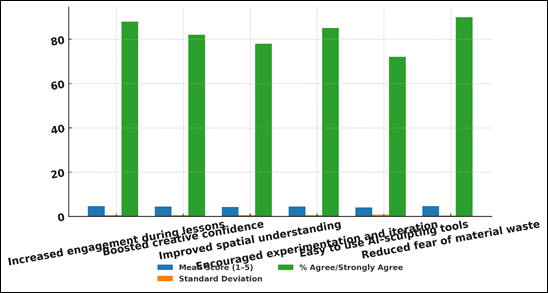
Figure 3 Survey Insights on the
Impact of AI–Assisted Learning Tools
The high rating (M = 4.6, 88% agreement) of the Intrigued during lessons can be seen as the evidence that AI-based sculpting systems are effective in getting students interested, probably because they are interactive, visually dynamic, and exploratory.
Figure 4

Figure 4 Trend Analysis of Participant Feedback on AI–Enhanced Education
Figure 4 presents the trends in the participant feedback to demonstrate the changes in the perception of AI-enhanced education. On the same note, the fact that, in contrast to traditional forms, the AI can be used in a co-creative role is pointed out by the phrase, Boosted creative confidence (M = 4.4, 82%). The favorable score of the item of “Improved spatial understanding-M= 4.2) is related to the usefulness of working with 3D digital models, in which the learner can perceive the depth, proportion, and structure better. The results also demonstrate that AI tools encourage experimentation with 85 per cent people saying that these tools promote iterative creativity.
Figure 5
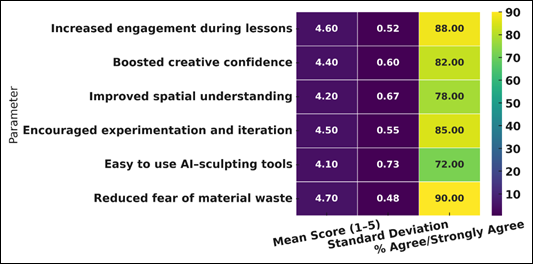
Figure 5 Heatmap of User Agreement and Engagement Metrics in AI–Learning Study
Even though the score of easy-to-use AI -sculpting tools was somewhat smaller (M = 4.1), most of them found the interface to be available. Figure 5 represents heatmap of the user agreement and engagement indicators. Particularly, the highest score was achieved on the level of Reduced fear of material waste (M = 4.7, 90%), which proves that virtual environments reduce creative risk and allow uninhibited exploration.
7. Conclusion
Virtual sculptures created by AI can be defined as a new stage of art education in the 21 st century, which opens new possibilities of creativity, interaction, and interdisciplinary studies. As was shown in the course of this paper, AI-enhanced sculpting devices give learners adaptable, interactive, and engaging methods to comprehend structure, form and artistic expression. Such technologies eliminate the old boundaries of materials, studio space, and technical constraints so that learners are free to experiment in searching more complicated concepts than ever before. By engaging in play with generative algorithms, the students can have a deeper understanding of the relationship between human will and machine computation and their views on the authorship of art and digital innovation are expanded. Major pedagogical advantages are also shown by the findings. Virtual sculptures contribute to different learning styles in that they enable the real-time capabilities to manipulate them, high visualization, and customization of feedback. They facilitate trial and error, and also help students to master their creative choice and acquire the capacity to solve challenges and think critically. The teachers also receive improved teaching resources, which allow them to deliver abstract concepts in an elastic and coherent manner. Besides, online student communities promote communication, cooperation and shared artistic research.
CONFLICT OF INTERESTS
None.
ACKNOWLEDGMENTS
None.
REFERENCES
Anderson, J., and Charteris, J. (2023). Including Students with Disabilities in Innovative Learning Environments: A Model for Inclusive Practices. International Journal of Inclusive Education, 27(15), 1696–1711. https://doi.org/10.1080/13603116.2021.2008399
Atanga, C., Jones, B. A., Krueger, L. E., and Lu, S. (2020). Teachers of Students with Learning Disabilities: Assistive Technology Knowledge, Perceptions, Interests, and Barriers. Journal of Special Education Technology, 35(4), 236–248. https://doi.org/10.1177/0162643420901570
Bellacicco, R., and Demo, H. (2023). Students with Disabilities in Initial Teacher Training and the Dilemma of Professional Competence. Alter: European Journal of Disability Research, 17(1), 5–27. https://doi.org/10.1016/j.alter.2022.12.001
Bulathwela, S., Pérez-Ortiz, M., Holloway, C., Cukurova, M., and Shawe-Taylor, J. (2024). Artificial Intelligence Alone will not Democratise Education: On Educational Inequality, Techno-Solutionism and Inclusive tools. Sustainability, 16(2), 781. https://doi.org/10.3390/su16020781
de Bruin, K. (2019). The Impact of Inclusive Education Reforms on Students with Disability: An International Comparison. International Journal of Inclusive Education, 23(8), 811–826. https://doi.org/10.1080/13603116.2019.1623327
Gülsün, İ., Malinen, O.-P., Yada, A., and Savolainen, H. (2023). Exploring the Role of Teachers’ Attitudes Towards Inclusive Education, their Self-Efficacy, and Collective Efficacy in Behaviour Management in Teacher Behaviour. Teaching and Teacher Education, 132, 104228. https://doi.org/10.1016/j.tate.2023.104228
Khalil, M., Slade, S., and Prinsloo, P. (2024). Learning Analytics in Support of Inclusiveness and Disabled Students: A Systematic Review. Journal of Computing in Higher Education, 36(2), 202–219. https://doi.org/10.1007/s12528-023-09364-9
Kovačević, J., and Radovanovic, V. (2023). Social Distance Towards Students with Disabilities in Inclusive Education. International Journal of Disability, Development and Education, 70(1), 106–119. https://doi.org/10.1080/1034912X.2021.2003861
Lim, S. (2020). The Capabilities Approach to Inclusive Education: Re-Envisioning the Individuals with Disabilities Education Act’s Least Restrictive Environment. Disability and Society, 35(4), 570–588. https://doi.org/10.1080/09687599.2019.1647150
Lindner, K.-T., Schwab, S., Emara, M., and Avramidis, E. (2023). Do teachers favor the inclusion of all students? A Systematic Review of Primary Schoolteachers’ Attitudes towards inclusive education. European Journal of Special Needs Education, 38(6), 766–787. https://doi.org/10.1080/08856257.2022.2145270
Longlands, H., and North, A. (2023). Education, Equality and International Development. In R. J. Tierney, F. Rizvi, and K. Ercikan (Eds.), International Encyclopedia of Education (4th ed.,65–73). Elsevier. ISBN: 9780128186299
Montagud, M., Cernigliaro, G., Arevalillo-Herráez, M., García-Pineda, M., Segura-Garcia, J., and Fernández, S. (2022). Social VR and Multi-Party Holographic Communications: Opportunities, Challenges and Impact in the Education and Training sectors. arXiv preprint arXiv:2210.00330. https://doi.org/10.48550/arXiv.2210.00330
Rapp, A. C., and Corral-Granados, A. (2024). Understanding Inclusive Education—A Theoretical Contribution from System Theory and the Constructionist Perspective. International Journal of Inclusive Education, 28(4), 423–439. https://doi.org/10.1080/13603116.2021.2008398
Schvirck, E., Lievore, C., Rubbo, P., Cantorani, J., and Pilatt, L. (2024). Invisible Publications: A Study of Academic Productivity in the Web of Science Database. Revista Española De Documentación Científica, 47(1), E375. https://doi.org/10.3989/redc.2024.1.375
Sorooshian, S. (2024). The Sustainable Development Goals of the United Nations: A Comparative Midterm Research Review. Journal of Cleaner Production, 453, 142272. https://doi.org/10.1016/j.jclepro.2023.142272
Trust, T., Whalen, J., and Mouza, C. (2023). Editorial: ChatGPT: Challenges, opportunities, and implications for teacher education. Contemporary Issues in Technology and Teacher Education, 23(1), 1–23.
Yang, H. (2021). Explore how Artificial Intelligence and VR Technology will Change the Development of Future Education. Journal of Physics: Conference Series, 1744 (1), 042146. https://doi.org/10.1088/1742-6596/1744/4/042146
|
|
 This work is licensed under a: Creative Commons Attribution 4.0 International License
© ShodhKosh 2025. All Rights Reserved.