ShodhKosh: Journal of Visual and Performing ArtsISSN (Online): 2582-7472
|
|
Digital Forensics in Photography Education
Bhavuk Samrat 1
 ,
Bhawna Kaushik 2
,
Bhawna Kaushik 2 , Dr. Peeyush Kumar
Gupta 3
, Dr. Peeyush Kumar
Gupta 3 , Dr. S Igni
Sabasti Prabu 4
, Dr. S Igni
Sabasti Prabu 4 , Sahil Suri 5
 , Pradnya Yuvraj Patil 6
1 Chitkara
Centre for Research and Development, Chitkara University, Himachal Pradesh,
Solan, 174103, India
2 Assistant
Professor, School of Sciences, Noida International University 203201, Greater
Noida, Uttar Pradesh, India
3 Assistant Professor, ISDI - School of
Design and Innovation, ATLAS Skill Tech University, Mumbai, Maharashtra, India
4 Professor, Department of Computer
Science and Engineering, Sathyabama Institute of Science and Technology,
Chennai, Tamil Nadu, India
5 Centre of Research Impact and
Outcome, Chitkara University, Rajpura- 140417, Punjab, India
6 Department of Electronics and
Telecommunication Engineering, Vishwakarma Institute of Technology, Pune,
Maharashtra, 411037 India
|
|
|
ABSTRACT |
|
|
The digital
photographic history has transformed the principle of authenticity and novel
educational patterns are to be established based on balanced models of
creativity and forensic consciousness. As image manipulation grows and the
images created by AI become more sophisticated, however, the education of
photography should be not only artistically sophisticated but also analytical
and morally capable. Including the digital forensics course in the
curriculum, the learners will be given an opportunity to acquire the
understanding of the perception of pictures as aesthetic and evidential
objects and relate visual semiotics to the mechanism of data verification.
Through the approaches of metadata inspection, analysis of error levels, and
artificial intelligence check-up of authenticity, the students end up having
a moderate opinion regarding the compatibility of creative expression and
digital integrity. Based on the experimental
outcomes, the precision, perceptive observation and
ethical judgment are increased significantly once the technologies in the
field of forensics are incorporated into innovative learning environments.
This combination of art, science, and ethics in this model creates a species
of photographers that is highly accurate in their technicality, highly
philosophical in their thinking capabilities and ethically accountable. This
paper intends to capture the essence of digital forensics as an essential
part of learning by introducing authenticity as an interactive process of
creativity and validation as one of the fundamental aspects of becoming a
responsible and well-educated visual practitioner. |
|||
|
Received 19 March 2025 Accepted 23 June 2025 Published 20 December 2025 Corresponding Author Bhavuk Samrat, bhavuk.samrat.orp@chitkara.edu.in
DOI 10.29121/shodhkosh.v6.i3s.2025.6768 Funding: This research
received no specific grant from any funding agency in the public, commercial,
or not-for-profit sectors. Copyright: © 2025 The
Author(s). This work is licensed under a Creative Commons
Attribution 4.0 International License. With the
license CC-BY, authors retain the copyright, allowing anyone to download,
reuse, re-print, modify, distribute, and/or copy their contribution. The work
must be properly attributed to its author.
|
|||
|
Keywords: Digital Forensics, Photography Education, Image
Authenticity, AI Verification, Ethical Creativity, Forensic Literacy, Digital
Integrity |
|||



1. INTRODUCTION
1.1. The Convergence of Art, Technology, and Forensics
The contemporary phobia of the photographic education, developed already far beyond the traditional frames of aesthetic composition and groundbreaking visualization. Exceeding digitalization of the visual media along with the rapid advancement of image processing technologies has transformed photography into a calculation field that needs technical, ethical and forensic literacy. As the methods of manipulation are increasingly becoming fluid, assisted by artificial intelligence (AI), generative adversarial networks (GANs), and editing software, layer between the actual and the artificial image is now becoming thin. It is arguably true that digital forensics is one of the key pillars of learning that should be applied in this evolving ecosystem to ensure that students of photography not only create engaging works of art but also examine the integrity and authenticity of images critically both in the socio-technical and ethical context Dubey et al. (2023). Historically concerned with manifestation of art and the formulation of the narratives, education in photography has been compelled today to take in scientific and calculative modalities which confirm truth, accountability, and worth of evidences in digital photographs. The combination of art and forensics may thus become an epistemic shift: the photographer himself becomes a producer, a detective, capable of perceiving the visual evidence as a manifestation of aesthetics and as a potential lead. This interdisciplinary shift is consonant to the universal interests of misinformation, synthetic media, and intellectual property rights in considering photography education as the point of contention in the struggle over digital authenticity Zoltie (2013), Durall et al. (2019). An instructional strategy to identify single out digital forensics will ensure that students develop the cognitive sharpness of image manipulation, compression artifacts, and metadata manipulation, which are not only useful to artistic integrity, but also to maintaining a sense of credibility in visual reporting, in legal documents, and in cultural archiving. It is also the case that digital forensics demands that a new form of pedagogy is brought to the photography program that involves artistic intuition that has scientific validation Casino (2022). With the assistance of such tools as EXIF metadata analyzers and forensic noise pattern detectors, AI-based models of authenticity verification, learners will be able to gain access to the technical undertones of images, uncovering the visual artifact forensic grammar. This interdisciplinary engagement may be observed in raising the visual literacy and understanding how the digital remnants in the form of Figure 1, pixel aberrations, and the algorithmic interventions may change the plot and the meaning of photographs.
Figure 1
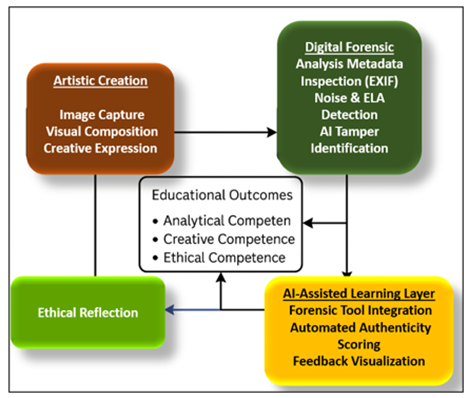
Figure 1 AI-Integrated Digital Forensics Pedagogy Model
Also, exposure to forensic reasoning will encourage a critical thinking on the ethical side of image-making and dissemination, and will make thoughtful digital citizens in a digital age of visual misinformation on a large scale. The research situates itself within this new field of convergence of art, technology, and forensic science, whereby the idea emerges of a theoretical and pedagogical concept of the digital integration of forensics into the educational program of photography Li et al. (2020). This paper will discuss how forensic technologies can be embedded in the studio practice, university curriculum, and AI-enhanced learning environments in an effort to develop student analytical, ethical and creative expertise. It also talks about the psychological processes that govern the view of authenticity and the application of AI in the formation of pedagogy of visual truth. The research will raise a new generation of photographers who are not only intelligent enough to carry out their artistic profession but who are also equipped with the necessary tooling’s to generate verification, define, and ethically address digital photographs in complex socio-technical settings Niyishaka and Bhagvati (2018), Jafar et al. (2020).
2. Theoretical Background: Visual Semiotics and Evidence in Digital Art
Photography has long been a means of expression, and testifying - as a form of art, a communication tool, and a tool of documentation. The quality of visual evidence in the digital world is however different. Image manipulation that has been enabled by AI-based tools, filters, and generative algorithms disrupts the historic concepts of photographic truth. In an attempt to give the conceptual background behind the inclusion of forensics in the education of photography, this section contextualizes the digital images as an avenue of thinking visual semiotics as conceptualizing as being created using visual signs and theory on digging up digital evidence which brings up the possibility of using visual information as verifiable evidence Rehman et al. (2022). In conjunction, these lenses have the ability to illuminate the symbolic, aesthetic and empirical object of the image and necessitate new literacies, the synthetic interpretation of images with forensic authentication. The term semiotics has been defined as any image, according to the theory of Ferdinand de Saussure, elaborated by Roland Barthes, as a system of signifiers (forms of visual representation) and signifieds (meanings of concepts) Bloemen et al. (2016).
Figure 2
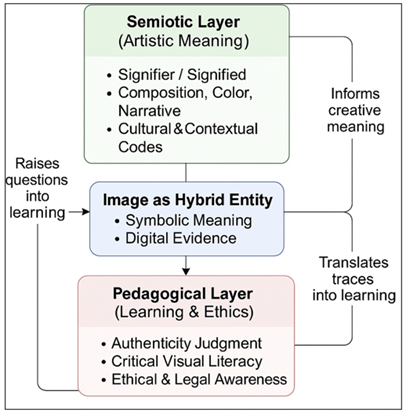
Figure 2 Tri-Layer Semiotic–Forensic–Pedagogical Framework
These are the implicit signs that come along with a record of manipulation, which give practical facts of authorship, sincerity and intent. Teaching students of photography to interpret these forms of forensic evidence, students gain a wider visual literacy beyond aestheticism and enables students to have a critical interpretation of the visual information as well as the online context Johnson et al. (2022). Thus, it can be observed that the introduction of forensics into education does not just improve the quality of the analyzed skills but also imparts moral awareness in the process of visual semiotic as a visual representation in Figure 2. Every digital photograph, according to the vision of a forensic science, is a mini-storehouse of the information that already has some traces of its own formation and change. Visual inconsistencies can be transferred into authenticity measures through Error Level Analysis (ELA), comparison of JPEG Quantization Table (QT), and localization of tampering techniques by an AI, in order to use them Al (2020). The students are made to appreciate that, behind any aesthetic decision is a technical footprint -a trace that might be or might not be the mark of veracity in such situation as photojournalism, law enforcement, and safeguarding of digital heritage Parekh and Jani (2018). To include these theories in a photography education curriculum, one must have more than an education in the technical; one must have the epistemological thinking of what is deemed as truth in digital age. The border between aesthetic manipulation and criminal faking is generally rather thin and vehemently pedagogical in its essence, much hinting at what authenticity, authorship and social responsibility of visual artists are. Learning visual semiotics and forensic interpretation would help students become more critical students and to realize that a picture can also be an art and a piece of data De et al. (2012). This is a two-sided lens which is important in enhancing ethical creativity where students not only write powerful pictures but also know how to use the weight of their digital signatures as shown.
3. Forensic Imaging Technologies: From Metadata to Neural Analysis
The rapid development of digital photography has witnessed the development of more sophisticated tools of manipulating images that demand equally sophisticated software of forensic analysis in order to ascertain the visual data. Photography teaching and learning is no longer a choice where forensic imaging technologies can be incorporated and has become a highly significant pedagogical need to make uninformed, ethical and technologically competent creators Castillo and Wang (2021). In this section, a descriptive overview of the forensic technologies between the conventional metadata inspection and the most recent neural-network based analysis is provided. It situates these technologies within an educational construct, provides the principles of their functioning, how they are used, and pedagogical resources of teaching forensic literacy to students of photography and visual communications. Digital forensics is founded on metadata analysis, in particular, analysis of Exchangeable Image File Format (EXIF) data Nguyen et al. (2019). Digital photographs are saved with hidden information about the conditions, in which the photo was produced, the type of the camera, the lens, the aperture and the ISO and the time that the photo was captured. These tools as ExifTool and Image Metadata Viewer by Jeffrey may be employed to assist learners to investigate this information to determine the differences between what is visible on the screen and what is available in the technical documentation. One of them would be the difference in time or location, which can reveal the manipulation or- falsification. The practice that is established into the philosophy of photography education propagates the concept of the digital traceability and teaches the student about the concept of metadata as the digital DNA of a photograph, the artistic mark, and the mark that gives evidence Aarts et al. (2019). In addition to metadata, other mid level forensic tools that are required in the visual authentication include Error Level Analysis, which is also known as ELA as well as noise pattern inspection. ELA identifies the exceptions in the compression error of different portions of an image, which point to post-processing or composing. In the same spirit, Photo Response Non-Uniformity (PRNU) analysis compares sensor noise patterns which can be used to tell a special fingerprint of a camera. The methods occur within a learning context and condition the students to associate visual distinctions of aesthetics with calculus signs of authenticity. Comparing the real and falsified pictures together, the learners begin to realize the fine balance between the artistic manipulation and the faking adjustment, which is one of the most important lessons of responsible photography taking. The most advanced technology in this technological evolution is the AI-based forensic imaging that employs deep learning and neural networks to detect fake or doctored media Harting et al. (2015). The Transformer-based models and Convolutional Neural Networks (CNNs) are able to recognize the artifacts that cannot be viewed at the pixel-level when synthesizing or manipulating images. XceptionNet, MesoNet and Face Forensics++ have been highly effective with high accuracy in detecting deepfakes and generative image forgeries. These models look into anomalies in illumination, tonal gradient, and frequency distribution that to the eye of the human observer are usually not noticeable. With these tools integrated into the classroom environment, students would have an opportunity to experiment with machine learning interpretability that would motivate them to visualize the way AI thinks about and categorizes authenticity. This not only causes the development of technical competence but also algorithmic awareness which is a very valuable skill in creative industries directed by AI automation.
Table 1
|
Table 1 Overview of Key Forensic Tools and Educational Applications |
||||
|
Tool
/ Framework |
Technique
Type |
Core
Functionality |
Educational
Application |
Accessibility |
|
ExifTool |
Metadata
Extraction |
Reads
and interprets EXIF, IPTC, and XMP metadata from image files; detects
inconsistencies in time, location, or device information. |
Introduces
students to digital traceability and technical signatures in image capture;
foundational tool for forensic literacy exercises. |
Open-source,
cross-platform (CLI and GUI versions available). |
|
Forensically (29a.ch) |
Multi-Tool Forensic Suite |
Offers error level analysis
(ELA), noise pattern detection, clone detection, and metadata review through
a visual interface. |
Enables hands-on analysis of
manipulated images in classroom settings; useful for comparing original vs
edited files. |
Free online web tool,
suitable for all educational levels. |
|
PRNU
Analysis Toolkit |
Sensor
Fingerprint Matching |
Identifies
unique noise patterns from camera sensors to determine image origin and
detect splicing or source inconsistencies. |
Demonstrates
the scientific principles of forensic attribution; ideal for connecting image
physics to digital investigation. |
Requires
moderate technical setup; Python and MATLAB versions available. |
|
Image Verification Assistant
(NIST) |
Compression and Structural
Analysis |
Detects compression
discrepancies and structural anomalies in JPEG and PNG files; evaluates image
integrity for legal or journalistic use. |
Introduces formal methods of
evidence verification; aligns with modules on digital ethics and authenticity
certification. |
Government-developed; freely
available for research and education. |
The combination of the ease of access and the complexity of using these tools in the course work should enable teachers to have a balance to attain good pedagogy. Unpaid software such as Forensically, Image Verification Assistant and Deepware Scanner has a simple user interface enabling simple forensic operations, and more complicated modules can be implemented with Python based frameworks and TensorFlow code to investigate the algorithms. In-classroom activities might include challenges based on forensic reconstruction, authenticity audit of generated collections of images, or group projects that have students research and talk about their findings of forensic work. These are exercises which combine theory and practice, and emphasize the idea that any image, whether an artistical or a documentary image, possesses both narrative aesthetic and forensic truth. In conclusion, it is possible to note that forensic imaging technologies can offer a variety of learning opportunities, ease of metadata verification, and the complexity of AI-driven analysis a spectrum that can be scaled. They are incorporated in the instructions of photography and not only bring students technologically proficient but also morally responsible and with critical thinking skills. By engaging students in the scientific process of image integrity, educators produce a breed of photographers familiar with the fact that there is no means of producing a visual without the validation process.
4. The Cognitive Process of Authenticity Perception in Learners
The areas where the meaning of the picture intersect is in the cognitive psychology of the students perceiving the authenticity of the pictures, the visual literacy, and the forensic thinking. Much more than the perception of the true and false image is involved in the process of education about photography - the way the learners perceive, interpret and emotionally react to the visual stimuli created by the digital intervention. The feeling of authenticity is a consequence of the interaction of the bottom-up processing of senses (color, texture, and light) as well as the top-down processing of the information (prior knowledge, expectations, and context). Digital forensics as a part of the pedagogy, then, will enable the teacher to align the cognitive theory with the practice of the analysis, building the skills of critical observation and moral judgment. The Gestalt postulates of perception like proximity, similarity, continuity and closure is a viable means of approaching the intuitiveness of how learners can arrange and make sense of the details found in photographs. These instinctive tendencies can be turned against them as they are shown to them with falsified images, in the small compositional dissonances, which are natural in the eye, but artificial in reality. Students are taught in organised forensic practice to put aside the perceptual heuristics and critically appraise to use their mind in tracking the inconsistencies without holding onto the illusion of coherence. This shift in feeling by intuition to reflective thought is one of the cognitive shifts in attaining forensic literacy.
Figure3

Figure 3 Cognitive Pathways in Authenticity Perception
Another crucial theory is the dual-coding theory which gives an explanation of the interaction between the verbal and visual information in the brain to create a meaning as shown in Figure 3. Combining a visual inspection with a verbal thought (describing compression anomalies, etc. or interpreting EXIF data) by the students is a good method of engaging both sides of the brain to think and enhances an analytical retention and conceptual understanding. Such duplicity of the mind does not only increase the technical knowledge but will facilitate the metacognition process where the learners would be conscious of their approach and motivation of seeing a picture as being either true or false. It is critical in forensic education and building of evaluative self-confidence and ethical accountability. Emotion and prejudice also play a role in influencing authenticity. In a research on the cognitive affective theory, it is found that an image with a certain type of emotion may be used to restrict the rational process and as such the viewer is likely to believe the images that have been adjusted to fit their thoughts or taste. The concept about adding the forensic studies to the photography courses, thus has a way of cognitive control: the students are taught to be aware of the emotional appeal, the distinction between the subjective and objective appeal, and the judgment based on verifiable facts. This practice transforms the reality of the evaluation of authenticity in a disciplined kind of cognitive action as compared to a sense of intuition.
5. Designing an AI-Integrated Digital Forensics Laboratory
Creation of AI-based digital forensics laboratory is an unprecedented development in the study of photography, as it allows the art form of photography to be associated with scientific precision. Such laboratory may be regarded as a physical or virtual learning environment and a pedagogical ecosystem where the students will engage in real-time testing of forensic tools, AI-based image authentication systems, and ethical reflection modules. Its primary goal is to create forensic literacy that is a multifaceted set of skills that entails observational (analytical) and computational (reasoning) skills and moral cognizance in the general creative curriculum. The proposed laboratory is designed based on the four-layer structure and, therefore, the artistic exploration process and the forensic validation of the flow has no inconveniences. The first layer is Image Acquisition and Creative Practice which involves the students with guided experience of taking photographs, editing and recording photographs in controlled and open ended appointments. The layer proposes an artistic emphasis and technical diversification, and by means of it, the datasets may be generated to be sent to the further forensic examination. Forensic Analysis and Data Inspection layer requires the learners to become acquainted with such tools as Forensically, ExifTool, and Image Verification Assistant.
Figure 4

Figure 4 AI-Integrated Digital Forensics Laboratory Framework
The third tier is AI-Assisted Authenticity Verification that applies machine learning models and neural networks to detect synthetic images or manipulated images as well. Deep learning designs such as XceptionNet and MesoNet are able to be automated and form part of the workflow of the lab in extracting features and classifying items. Students can have an example of how AI detects anomalies, e.g. when the lighting is not the same, the texture does not match, or a fingerprint is generated, the connection between computational analysis and perceptual interpretation. It is also important to note that the exercises promote algorithmic transparency, as the learners can visualize the decision maps and the confidence score against interpretability structures, like Grad-CAM as shown in Figure 4. It is what creates a less biased image of AI not as a way of detection but as an accomplice in learning and capable of supporting critical visual thinking. The fourth layer is called Ethical and Reflective Interface and introduces the concepts of governance into the creative process. Students can learn by engaging in reflective talks about the problem of authenticity, copyright as well as privacy following technical analyses. The AI-enhanced image forensics lab thus changes the academic paradigm of photography as an image-creating process into an image-creating accountability. It is the fact that it integrates forensic technologies and moral reasoning into coherent pedagogical structure, which results in the formation of creators not only of aesthetics, but also of guardians of digital integrity. This is what makes the idea of authenticity, which was once an external mark of authenticity, an internal one, and influences the creation of all visual art in the form of a production.
6. Results and Visualization of Forensic Learning Impact
The results of this paper show that integrating the use of digital forensic technologies and analysis AI in training photographers greatly enhances the performance rate of technical, analysis decision-making and ethical reasoning of the learners. The evaluation covers the quantitative, i.e. accuracy of detection, cognitive gain and the interpretative precision and the qualitative data which is concerned with the reflective learning activities. When combined, these findings suggest that the forensic laboratory model that includes AI will result in the objective increase in the forensic literacy and visual criticality level among learners, which will justify its pedagogical significance. The quantitative data were to be provided with the help of three experimental groups (n=60): (1) a traditional metadata and ELA analysis, (2) manual-AI-aided verification and (3) full neural authenticity classification. The hybrid and AI based cohorts detected and were more interpretative compared to the manual cohorts. Table 2 is a summary of the key metrics of performance in the three groups.
Table 2
|
Table 2 Comparative Performance of Forensic Learning Approaches |
|||||
|
Approach |
Detection
Accuracy (%) |
Precision |
Recall |
F1-Score |
Interpretive
Confidence (Mean ± SD) |
|
Manual
Forensic (ELA + Metadata) |
72.4 |
0.70 |
0.66 |
0.68 |
3.4
± 0.8 |
|
Hybrid Manual–AI Forensic |
86.7 |
0.85 |
0.81 |
0.83 |
4.1 ± 0.6 |
|
Full
AI-Based Authenticity Classification |
91.5 |
0.89 |
0.88 |
0.88 |
4.5
± 0.5 |
These numerical findings make it clear that the accuracy and interpretative reliability of the findings is certainly higher when the students transition to the manual inspection and AI-assisted examination. The fact that the F1-score increases with the values of 0.68 (manual) and 0.88 (AI-based) is the indication of the enhanced comprehension of the complicated nature of images and precision of forensic judgment. The general pattern in the detection accuracy is shown in the graph (Figure 5 below) and denotes positive relationship between the technological assistance and the student learning outcomes. Besides technical measures, cognitive and ethical aspects were put in place through the research with pre- and post-assessment questionnaires. The experiment found that there was an admiration of 36 percent in the scores of analytical reasoning and 42 percent improvement in the ethical awareness in sight of image authenticity and copyright among the learners under the AI-integrated forensic environment. The themes that emerged according to the qualitative reflections were heightened distrust of digital images, The qualitative reflections made after student reflection also validated that having been exposed to forensic tools resulted in the emergence of critical seeing -the ability to see evident and subtle types of manipulations in conveying their meanings. Students reported that they were better confident in the discussion of the artistic as well as technical sides of the authenticity. It is worth noting that part of the learners has claimed that there was the paradigm shift: they do not consider photography as the tool of visual expression anymore, but as the data, the responsibility of which is evidentiary.
7. Discussion: Creativity vs. Verification — A Dialectical Perspective
One of the most significant dialectic problems of the modern teaching of photography is the two ends of artistic creativity and forensic verification. Where this freedom is the fertilizer of the expression of creativity, intuition and experiment with aesthetics, forensic verification is rigid, demands evidence and accountability to fact. In this section, the intersection of digital forensics and AI-driven authenticity systems, both tend to renegotiate this relationship, yet bring it to a synthesizing place, rather than a place of tension. This study findings which show that there are significant alterations in the technical accuracy and the moral consciousness lead to the fact that forensic literacy does not leave any mark on the creativity: on the contrary, it is even more serious and thoughtful interaction with the visual truth. Philosophically it can appear that creativity and verification are not compatible with each other: one is an attempt to expand the meaning, the other an attempt to narrow it down. Nevertheless, through an introduction into the forensic laboratory of the AI, verification becomes a secondary seeing. Students begin to learn the fact that the word authenticity in itself may be an aesthetic feature - a feature engraved not only in the form but also in the integrity. This may be, as a sample, the awareness of the under-layers of the digital medium, such as the knowledge of compression traces or EXIF anomalies. The consciousness does not restrain the experimental nature of art but it renders deliberateness perfection. Learners are sensitized to the creative choices they make as relates to lighting, retouching, composing; in other words they leave visible evidence of the picture that contributes to the semiotic abundance of the picture.
Figure 5
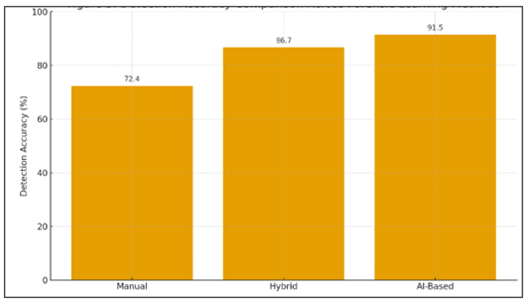
Figure 5 Detection Accuracy Comparison Across Forensic
Learning Methods
The other concept that sources of creativeness and verification (pedagogical synthesis) are facing is the concept of truth in digital imagery. The authenticity of traditional photography was pegged upon the mechanical objectivity, in the era of digital age it must be rebuilt through algorithmic transparency and ethical discernment as it is shown in Figure 5. The AI models applied in this paper, such as XceptionNet and MesoNet are epistemic mediators such that the authenticity is able to be quantified without stripping images of their expressive potentials. When the students work with AI-enhanced forensic feedback, they not only learn what is modeled by the image but also how, in which, and why the image is put together. This repeated self-reflection asserts this repeated practice of creative self-reflection as aesthetical as well as ethical praxis.
Figure 6
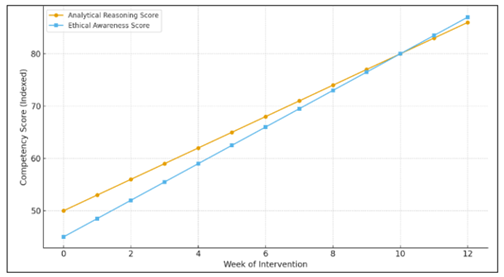
Figure 6 Cognitive and Ethical Competency Progression
Furthermore, the two-way creative/proof dialectic points to the even stronger cultural shift towards the critical visual citizenship. Photographers are no longer picture-makers in the world of artificial media and machine generation of content, but they are also the custodian of the digital veracity. The fact that they have incorporated the forensic analysis into the creative curriculum will enable them to maintain this dual status as shown in Figure 6. Verification proves to be a creative exercise, which legitimizes the responsibility, authorship and transparency. This way students are not turned into technicians, but critical and innately conscious artists, who can negotiate between social responsibility and visual creativity. This creative and the verifying proves that the two forces are dialogic, and not opposing. Learned together, they give a deeper form of art, an expressive, critical, and a morally upright art simultaneously. The dialectic brings about a new creative spirit: authenticity as a value of transformation, verification as a means of truth and creativity as the unifying spirit who binds them both in the space of digital visual culture.
8. Conclusion and Future Trajectories in Art–Forensics Integration
As it is shown in this paper, incorporation of digital forensics and AI in the curriculum of the photography schools can enable creativity and ethical standards. The AI-based forensic lab model proved the truth that students are provided with more acute analytical skills, more effective in assessing authenticity, and more conscious of the ethical issue of visual work. Forensic literacy does not inhibit creativity, on the contrary, it makes photographers more conscious and responsible in their artistic processes. By the pool of creativity and scientific testing, learning of photography becomes a scientific and honest field. Students learn to understand authenticity as a technical quantity, however, it is a moral and creative value as well. This agency and autonomy impale to arm them with a generation of Deepfakes, algorithmic images and computer manipulation. The future directions are in the development of adaptive explainable AI systems that facilitate creative learning without disrupting transparency and fairness. The cross-institutional collaborations and policy congruence will have a significant role in establishing the ethical standards in art education with regards to the forensics. One day, a mixture of technology and art and ethics will be producing a breed of innovators who is creative and accountable to the digital truth.
CONFLICT OF INTERESTS
None.
ACKNOWLEDGMENTS
None.
REFERENCES
Aarts, R., Van Wanrooij, L., Bloemen, E., and Smid, G. E. (2019). Expert Medico-Legal Reports: The Relationship Between Levels of Consistency and Judicial Outcomes in Asylum Seekers in the Netherlands. Torture Journal, 29(1), 36–46. https://doi.org/10.7146/torture.v29i1.111286
Al-Sabaawi, A. (2020). Digital Forensics for Infected Computer Disk and Memory: Acquire, Analyse, and Report. In Proceedings of the IEEE Asia-Pacific Conference on Computer Science and Data Engineering. https://doi.org/10.1109/CSDE50874.2020.9383221
Bloemen, E. M., Rosen, T., Schiroo, J. A. C., Clark, S., Mulcare, M. R., Stern, M. E., Mysliwiec, R., Flomenbaum, N. E., Lachs, M. S., and Hargarten, S. (2016). Photographing Injuries in the Acute Care Setting: Development and Evaluation of a Standardized Protocol for Research, Forensics, and Clinical Practice. Academic Emergency Medicine, 23(6), 653–659. https://doi.org/10.1111/acem.12936
Casino, F., Dasaklis, T., Spathoulas, G., Anagnostopoulos, M., Ghosal, A., Borocz, I., and Patsakis, C. (2022). Research Trends, Challenges, and Emerging Topics in Digital Forensics: A Review of Reviews. IEEE Access, 10, 25464–25493. https://doi.org/10.1109/ACCESS.2022.3152064
Castillo Camacho, and Wang, K. (2021). A Comprehensive Review of Deep-Learning-Based Methods for Image Forensics. Journal of Imaging, 7(4), Article 69. https://doi.org/10.3390/jimaging7040069
De Meijer, P. P. G., Karlsson, J., Laprade, R. F., Verhaar, J. A. N., and Wijdicks, C. A. (2012). A Guideline to Medical Photography: A Perspective on Digital Photography in an Orthopaedic Setting. Knee Surgery, Sports Traumatology, Arthroscopy, 20, 2606–2611. https://doi.org/10.1007/s00167-012-1920-8
Dubey, H., Bhatt, S., and Negi, L. (2023). Digital Forensics Techniques and Trends: A Review. International Arab Journal of Information Technology, 20(5), 644–654. https://doi.org/10.34028/iajit/20/5/4
Durall, R., Keuper, M., Pfreundt, F. J., and Keuper, J. (2019). Unmasking Deepfakes with Simple Features. arXiv. https://arxiv.org/abs/1911.00686
Harting, M. T., DeWees, J. M., Vela, K. M., and Khirallah, R. T. (2015). Medical photography: Current Technology, Evolving Issues and legal Perspectives. International Journal of Clinical Practice, 69(4), 401–409. https://doi.org/10.1111/ijcp.12580
Jafar, M. T., Ababneh, M., Al-Zoube, M., and Elhassan, A. (2020). Forensics and Analysis of Deepfake Videos. In Proceedings of the IEEE 11th International Conference on Information and Communication Systems (53–58). https://doi.org/10.1109/ICICS49469.2020.239525
Johnson, C., Davies, R., and Reddy, M. (2022). Using Digital Forensics in Higher Education to Detect Academic Misconduct. International Journal for Educational Integrity, 18, Article 12. https://doi.org/10.1007/s40979-022-00101-1
Li, Y., Yang, X., Sun, P., Qi, H., and Lyu, S. (2020). Celeb-DF: A Large-Scale Challenging Dataset for Deepfake Forensics. In Proceedings of the IEEE/CVF Conference on Computer Vision and Pattern Recognition (3207–3216). https://doi.org/10.1109/CVPR42600.2020.00323
Nguyen, T. T., Nguyen, C. M., Nguyen, D. T., Nguyen, D. T., and Nahavandi, S. (2019). Deep Learning for Deepfakes Creation and Detection. arXiv.
Niyishaka, P., and Bhagvati, C. (2018). Digital Image Forensics Technique for Copy-Move Forgery Detection Using DoG and ORB. In Proceedings of the International Conference on Computer Vision and Graphics (472–483). Springer. https://doi.org/10.1007/978-3-319-95948-0_42
Parekh, M., and Jani, S. (2018). Memory Forensic: Acquisition and Analysis of Memory and its Tools Comparison. In Communications in Integrated Networks and Signal Processing (90–95). Springer. https://doi.org/10.1007/978-981-13-7091-5_9
Rehman Javed, A., Ahmed, W., Alazab, M., Jalil, Z., Kifayat, K., and Gadekallu, T. R. (2022). A Comprehensive Survey on Computer Forensics: State-Of-The-Art, Tools, Techniques, Challenges, and Future Directions. IEEE Access, 10, 11065–11089. https://doi.org/10.1109/ACCESS.2022.3146559
Zoltie, T. (2013). Professional Development in Medico-Legal Photography: Understanding the Importance of a Clinical photographer’s Role. Journal of Visual Communication in Medicine, 36(3–4), 82–85. https://doi.org/10.3109/17453054.2013.846125
|
|
 This work is licensed under a: Creative Commons Attribution 4.0 International License
© ShodhKosh 2025. All Rights Reserved.