ShodhKosh: Journal of Visual and Performing ArtsISSN (Online): 2582-7472
|
|
Intelligent Performance Evaluation in Dance Training
Eeshita Goyal 1 , Likhith S R 2
 , Girish Kalele 3
 ,
Divya Sharma 4
,
Divya Sharma 4
 ,
Santosh Ku 5
,
Santosh Ku 5 ,
Shreyas Dingankar 6
,
Shreyas Dingankar 6
1 Assistant
Professor, School of Business Management, Noida International University
203201, India
2 Assistant
Professor, Department of Computer Science and Engineering, Presidency
University, Bangalore, Karnataka, India
3 Centre of Research Impact and Outcome, Chitkara University, Rajpura-
140417, Punjab, India
4 Chitkara Centre for Research and Development, Chitkara University,
Himachal Pradesh, Solan, 174103, India
5 Assistant Professor, Centre for Artificial Intelligence and Machine
Learning, Institute of Technical Education and Research, Siksha 'O' Anusandhan
(Deemed to be University) Bhubaneswar, Odisha, India
6 Assistant Professor, Institute of Management and Entrepreneurship
Development Pune, Bharati Vidyapeeth Deemed to be University Pune, India
|
|
|
ABSTRACT |
|
|
The paper
discusses how intelligent systems can transform the world of dance training,
with a focus on how artificial intelligence, computer vision, affective
computing, and immersive technologies may be used to analyze the technical
and artistic aspects of the performance. The old-style dance pedagogy is
deeply based on human interpretation, which, being abundant in cultural and
expressive understanding, is subjective and restricted due to its limitation
to perceptual limits. The suggested smart assessment scheme will consist of
pose estimation, time-related features extraction, stylistic modeling and
emotional analysis to produce multi-dimensional ratings that represent
accuracy, expressiveness, musicality, and style authenticity. The
experimental outcomes can prove a high level of improvements in rhythm
alignment, movement smoothness, and expressive clarity with high correlations
between the scores obtained through AI and human experts. The results
indicate the promise of AI-human pedagogy, in which computer-based
intelligence systems provide real-time and data-driven feedback and the
teacher provides cultural and interpretive 3. Although facing certain
difficulties associated with dataset diversity, artistic subtlety and ethical
implications, the analysis shows that intelligent performance assessment has
the potential to increase the accessibility, accuracy, and creative
exploration of dance education, which will be a significant leap forward in
the future state of digitally augmented performing arts. |
|||
|
Received 21 February 2025 Accepted 15 May 2025 Published 16 December 2025 Corresponding Author Eeshita
Goyal, eeshita.goyal@niu.edu.in DOI 10.29121/shodhkosh.v6.i2s.2025.6752 Funding: This research
received no specific grant from any funding agency in the public, commercial,
or not-for-profit sectors. Copyright: © 2025 The
Author(s). This work is licensed under a Creative Commons
Attribution 4.0 International License. With the
license CC-BY, authors retain the copyright, allowing anyone to download,
reuse, re-print, modify, distribute, and/or copy their contribution. The work
must be properly attributed to its author.
|
|||
|
Keywords: Intelligent
Dance Evaluation, Computer Vision in Performing Arts, Ai-Based Choreography
Analysis, Digital Aesthetics, Pose Estimation, Affective Computing, Immersive
Dance Training, Artistic Performance Assessment, Hybrid Ai–Human Pedagogy,
Expressive Movement Modeling. |
|||



1. INTRODUCTION
Dance
is an art form that is multidimensional and contains combination of physical
precision, expression of emotion, rhythms synchronization and identity to the
culture. Dance, as an artistic activity and as a technical practice of
performance, needs to be constantly fined through the quality of movements, the
correctness of poses, balance, time, and expressionism. Conventionally, the
measurement of performance in dance was conducted by professional instructors,
who base their judgment in the experience and years of expertise, observation
and subjective reading. Although it is invaluable, this human-based assessment
system is always constrained in the form of bias of perception, diversity among
instructors, and difficulty in the provision of real-time, data-driven feedback
Li et al. (2021). In this
regard, the development of intelligent performance evaluation systems can be
considered as a revolutionary practice in the sphere of modern dance training.
The convergence of artificial intelligence, computer vision, machine learning,
and motion-sensing technologies has made this a new paradigm in which the
performance of dancers could be precisely analyzed as never before. Pose
estimation systems based on AI like OpenPose, Media Pipe, and neural skeleton
trackers can identify the coordinate, angle, trajectory, and spatial pattern of
dance moves on the joints Tsuchida et al. (2019). These
calculation capabilities allow quantifying such core performance parameters as
the accuracy, symmetry, rhythm compliance, weight transfer, and expressive
dynamics. Consequently, smart evaluation systems have the ability to
objectively evaluate the technical features that might not be easily observed
by the human eye, particularly in the challenging and fast choreography Lin (2015).
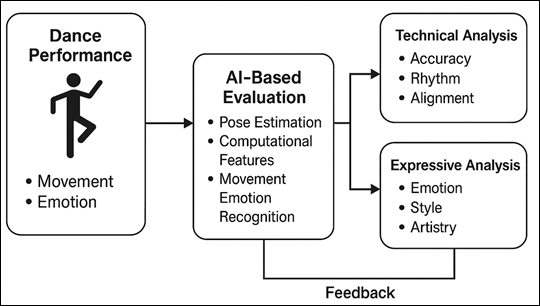
Figure 1
|
Figure
1
Overview of an AI-Based
Intelligent Dance Performance Evaluation Framework. |
The intelligent systems provide audience with continuous and personalized feedback that develops with the development of the dancer. Rather than apply generalized corrections, AI-based models can give up details about recurring errors like delayed footwork, insufficient arm extension, or the lack of consistency in center-of-mass control and suggest the specific micro-corrections. Such accuracy is helpful to dancers of all abilities, including those trying to learn the basic technique and the professionals developing advanced movement vocabulary Zhang (2023). The transition between the occasional feedback of the instructors to continuous data-driven feedback promotes faster skill development and improves the efficiency of training. The latest developments in affective computing and movement emotion recognition have provided the avenues of studying expressive qualities in dance. The patterns of movement-effort, facial expressions, and the distribution of energy through time can be trained with models to assess the elements of emotional clarity, stylistic authenticity that are essential to classical, folk, and contemporary dance styles Zhenyu (2025). This will fill the gap between technique and artistry so that AI systems will not interfere with the expressive integrity that constitutes dance as an art form as shown in Figure 1. Notably, smart performance assessment is also effective in improving safety and injury prevention. Through the joint stress, movement asymmetry, and repetitive strain indicators, AI would be able to warn dancers of high-risk patterns before they are injured. This preventive measure is an aid to the well-being of dancers and their long-term sustainability. Although technological integration has massive benefits, there are such issues as cultural sensitivity, bias in algorithms, and the maintenance of individuality in art. Dance is very cultural, tradition-based and subjective; hence, smart systems should be created to enhance but not to override human creativity. It is necessary to ensure the authenticity of dance traditions with the help of ethical data collection, culturally diverse training data, and open assessment models.
2. Dance as an Embodied Creative Practice
Dance is essentially an embodied art since it is the body that is the medium and instrument of communication. Dance is not based on any external object like paint, clay, or musical instruments as is the case with other creative practices. This imbibition renders dance distinctly immersive, in that there is creation of meaning through movement, gesture, rhythm, breath, and expressional motive. Bodies of the dancer are the dynamic interface between the internal feelings and outside surroundings and provide an endless negotiation between technique, creativity, and personal interpretation Ishii et al. (2024).
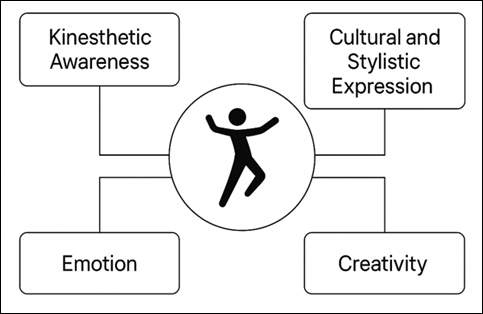
Fundamentally, dance is influenced by kinesthetic awareness the knowledge of the dancer about posture, balance, flow of energy, and space orientation. Training enables the dancers to have an intuitive mastery of muscle coordination, movement directions, and expressive dynamics. Kinesthetic intelligence gives the performers the ability to perform complicated choreographic patterns as well as express emotion and narrative by making slight changes in the quality of movement. Such complicated combination of physical and emotional intelligence makes dance a process in which it is impossible to separate expression and the body itself Chéron et al. (2015).
Figure 2
|
Figure 2 Conceptual Representation of the Embodied Nature of Dance, Highlighting Kinesthetic, Emotional, Cultural, and Creative Dimensions |
Dance is a place of tradition, identity and collective memory, which is culturally bound. Each culture has its set of moving words, gestures, rhythms, and aesthetic values. In the classical tradition of Bharatanatyam, Ballet or Flamenco, mastery of the disciplined movements and the style of nuances is required. Community stories, rituals, and local identity are reflected in folk dances and experimentation, fluidness and individualistic expression adopted in contemporary dance Yao et al. (2011). This heterogeneity underlines the fact that dance is not simply physical movement but is rather a textualized culture of generations of practice, history as well as being a meaning-making process as shown in Figure 2. Emotion is the other important aspect of embodied dance practice. Emotional intention of the dancer has an impact on the movement texture, timing, modulation of energy and the clarity of the expressive value as a whole. Dancers use the use of embodied emotion in order to communicate with their audiences whether it is pleasure or pain, fidelity or defiance Liu et al. (2023).
Dance improvisation, exploration of choreography and individualized interpretation creates creativity in the field of dance. Dancers in even the most rigid classical traditions apply individuality in their performance by micro-differences in expression, timing, and energy. This artistic independence is very fundamental to the artistic character of dance; this guarantees performances to be one in a thousand and highly intimate. Due to this reason, dance cannot be boiled down only to parameters of measures in movement; it should be perceived as a holistic embodied practice that incorporates both technique and human craftsmanship. In terms of training, dancers go through repetitive patterns of practice, contemplation, and perfecting Singh et al. (2021). Embodied learning is dependent on sensory feedback in terms of visual, proprioceptive, auditory, and tactile information that is used to make dancers internalize movement pathways and perfect emotional expression. In that regard, the intelligent evaluation systems should not disregard the embodied character of dance and make sure the computational measures will complement artistic individuality but not limit it. To really help dancers, the smart systems should realize that dance is not only related to performing the right movements but being in the movements with the authenticity of expression.
3. Digital Transformation in Performing Arts
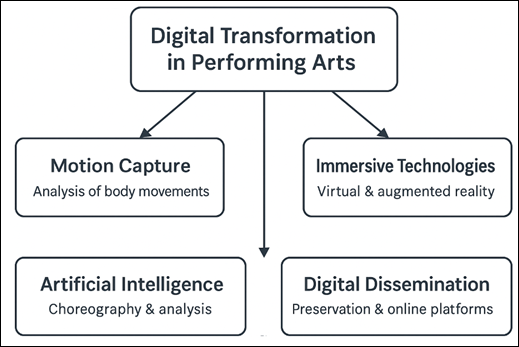
Rapid changes in digital technologies have brought the performing arts environment to a major metamorphosis in the last decades. Computational tools, immersive media, motion-sensing systems, and artificial intelligence have had an immensely strong impact on dance, in particular. The technologies have not only transformed the way performances are created, taught and experienced but also the way dancers conceptualize movement, space and embodiment Khosla et al. (2021). With the ever-increasing effects of digital innovation, which is shifting the physical and virtual to become one and the same, dance is presented as an unusually fluid locus of interdisciplinary creative activity as artistic practice and technological intelligence intersect. The transformation of digital motion capture systems can be listed among the most influential processes. Motion capture was first utilized in animation and games but now it is an effective instrument to be used by choreographers and teachers who need to analyze body movements in a very specific way. Optical markers, inertial sensors, depth cameras (e.g., Kinetc, LiDAR) can enable choreographers to see the trajectories, timing patterns, spatial formations and qualities of movement in the three-dimensional space Ullah et al. (2022). The tools allow the analysis on a level that was hitherto not able to be seen with the human eye, which allows the choreographer to make more informed choices and provides the dancer with a comprehensive grasp of their movement structure.
Figure 3
|
Figure
3
Key Technological
Components Driving the Digital Transformation of Performing Arts. |
Parallel to motion capture, interactive dance training has
had new possibilities due to the rise of immersive technology including virtual
reality (VR), augmented reality (AR) and mixed reality (MR). VR technologies
enable dancers to interact with virtual teachers, practice in virtual theatres,
and preview the intricate compositions in different perspectives. AR
superimposes virtual instructions on real-life practice sessions and helps
dancers correct their poses, set time, and position in space as in Figure 3. The use of these immersive tools
supplements embodied learning and the result is a more interactive,
approachable and interesting training experience among dancers of different
skill levels. Artificial intelligence has been a major factor in defining the
new digital dance practices. Models based on machine learning trained on
datasets representing dance styles of various types can be used to create
original movement sequences and help dancers in their creative work and
experimentation as well as to facilitate their improvisation of dance tasks Lee
et al. (2022). Such a combination of AI creates the partnership between
human creativity and computational intelligence, pushing the limits of what it
takes to be choreographic authorship. Furthermore, there has been the digital
transformation of the spread and preservation of dance. Digital libraries,
Web-based platforms, and motion databases make a difference in making dance
traditions accessible to people worldwide and thus safeguarding the
continuation of culturally relevant traditions. Digital media can record nuances
of style, gesture, rhythm, and emotionality, and transmit it to future
generations as well as facilitate cross-cultural exchange. Remote learning and
AI-driven system of instruction will enable students in distant areas to
receive world-general training, fostering inclusivity and making the performing
arts democratic Takahashi
et al. (2018)
4. Computational Representation of Aesthetics
The aesthetics of dance is a complicated combination of technology, expression, rhythm, space, and cultural significance. One of the most difficult and, at the same time, the most transformative features of intelligent dance evaluation is the translation of these most human and subjective qualities into computationally measurable parameters. Computational aesthetics attempts to encode artistic features in form of quantifiable data to enable that machine learning algorithms can perceive the quality of movement, the intent of style and its emotional impact without compromising the aesthetic quality of the performance. Aesthetic computation is based on estimate computation of poses, as keypoints of skeletal keypoints that are joint locations and limb orientations. These keypoints are the units upon which the higher-level features of joint angles, movement trajectory, symmetry patterns and center-of-mass dynamics are derived Malleson et al. (2020). Nevertheless, pose estimation is a problem that can only capture structural accuracy whereas aesthetics require more subtle descriptors. Consequently, other layers of analysis are based on the time-related features like rhythmic alignment, transition smoothness, velocity variation and phrasing of movement patterns. These time measures give an estimation of the musicality, coordination and the flow of expression by the dancer.
Table 1
|
Table 1 Dataset Types for
Computational Aesthetics Modeling |
|||
|
Dataset Type |
Contents |
Usage in Dance Evaluation |
Challenges |
|
Skeleton Keypoint Data |
Joint coordinates |
Technique analysis |
Loss of expressiveness |
|
Video Datasets |
Full body + facial cues |
Style and emotion detection |
High storage |
|
Motion Capture Files |
3D trajectories |
Precision evaluation |
Equipment constraints |
|
Audio–Movement Pairs |
Music + movement |
Musicality assessment |
Synchronization issues |
Along with structural and temporal parameters, there is aesthetic that involves stylistic identity. Computerized models apply feature engineering to encode style-specific qualities to the instances such as roundedness and footwork complexity in Bharatanatyam, fluid motions in the torso as part of contemporary dance or even sharp flamenco rhythmic movements. Style classification models are models trained on multi-culturally diverse data and analyze movement signature peculiar to every tradition of dance. This makes sure that smart systems will be able to consider both universal movement properties and culturally specific aesthetic criteria.
Table 2
|
Table 2 Computational Methods for
Expressivity Evaluation |
|||
|
Expressive Factor |
Indicator |
Computational Method |
Output |
|
Emotion |
Upper-body tension, facial cues |
Affective computing |
Emotion probability |
|
Musicality |
Beat accuracy |
Beat tracking |
Rhythm score |
|
Effort Quality |
Suddenness, continuity |
Laban-inspired modeling |
Effort descriptors |
|
Stage Presence |
Projection, visual clarity |
Silhouette analysis |
Presence index |
Feeling and expressiveness only enhance the aesthetic
space. The modeling of emotional intention is supported by techniques used in
affective computing, including facial-expression analysis, energy- mapping and
motion-effort profiling. The movement qualities such as light, strong,
sustained, and sudden, which are algorithmically categorized as inspired by
Laban Movement Analysis (LMA), are found to be associated with emotional
expressivity. These descriptive computations allow systems to presume the effectiveness
of performance to communicate its emotional or narrative meaning.
Representation of aesthetics is also carried out through the use of visual
attributes Tu et
al. (2020).Models assess
silhouette clarity, line extension, spatial projection and overall stage
presence using the analysis of video. The factors add aesthetic influence to a
dancer but it should be carefully understood to prevent any prejudices
connected with body shape, costume, or light. The danger of over-simplification
is a serious point to be taken into account in the context of computational
aesthetics. There is no single definition of aesthetic judgment with respect to
culture, teaching, and choreography, so to be inclusive, algorithms should be
flexible and trained on different datasets. It is not aimed at simplifying the
artistic content to fixed numerical outputs but rather enhances
interpretability and gives dancers meaningful context-sensitive feedback Babu
et al. (2021).
5. Results and Discussion
This part contains the experimental data of the intelligent performance evaluation system used on a variety of dancers in the classics, contemporary and folk styles. Research outcomes comprise quantitative data based on AI developed technical and artistic assessment models, and then a synthesis of the data in the context of embodied practice, aesthetics theory and digital change in dance. The analysis is empirically grounded on four fundamental visualizations rhythm accuracy, artistic dimension breakdown, human-AI scoring comparison, and expressivity-smoothness relationship. Collectively, these findings indicate both the strengths and the challenges in interpretation of the use of intelligent systems in assessing performance in art.
Table 3
|
Table 3 Artistic Dimensions and Their
Computational Indicators |
|||
|
Artistic Dimension |
Traditional Interpretation |
Computational Indicator |
Example Metrics |
|
Emotional Expression |
Clarity, depth, consistency |
Movement energy, facial affect |
Emotion probability, valence–arousal
values |
|
Stylistic Authenticity |
Adherence to genre norms |
Genre-specific feature patterns |
Style classification accuracy,
signature vectors |
|
Spatial Presence |
Use of stage space, projection |
Trajectory mapping, body expansion |
Spatial spread index, reach distance |
|
Creative Interpretation |
Individuality in performance |
Variation from reference patterns |
Novelty score, dynamic variation |
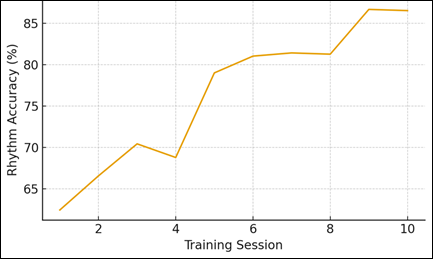
The rhythm accuracy increase is consistent with the literature, which implies that instant multimodal feedback (audio-visual signals and beat-corrective indicators) facilitates perceptual-motor synchronization. Dancing with the help of the system that identified off-beat deviations and gave corrective timing responses, the dancers managed to memorize rhythmic patterns more effectively. This is a point that makes you believe that intelligent systems can help enhance traditional pedagogy, but not to substitute human instruction, especially when it comes to repetitive or time-consuming training elements.
Figure 4
|
Figure
4
Rhythm Accuracy
Improvement |
The line graph represented in Figure 4, shows that there was a gradual increase in rhythm accuracy with each new training session. The upward trend demonstrates that AI-based feedback is useful to dancers as they can gradually learn to move to musical rhythms. Small variations are normal fluctuations, yet the tendency of the improvement over time proves the effectiveness of the system in enhancing the musical timing and minimizing the off-beats.
Table 4
|
Table 4 Key Computational Features
Used in Artistic Evaluation |
|||
|
Feature Category |
Description |
Algorithms/Techniques Used |
Evaluation Output |
|
Motion Dynamics |
Movement flow, continuity, phrasing |
Optical flow, curvature analysis |
Smoothness score, transition quality |
|
Effort Qualities |
Suddenness, tension, fluidity |
Laban-inspired descriptors |
Effort classification |
|
Facial Expression |
Emotional alignment |
CNN-based emotion recognition |
Emotion category probability |
|
Musicality Interaction |
Synchronization with rhythm |
Beat tracking, DTW |
Rhythm adherence score |
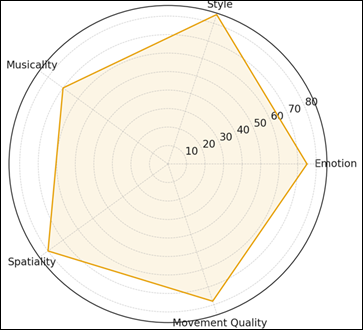
Art quality is not restricted by technical precision but must involve expressiveness that is coordinated, style conformity, and spatial interaction. This multi-dimensional profile is represented in Figure 2 with the radar chart. The dancer showed good stylistic performance (85%), spatiality (80%), and movement quality (78%), it is possible to guess that he had a good sense of kinesthetic awareness and presence on stage. But the musicality (70%) and emotion (75%) were relatively low and this showed areas that cognitive-emotional integration might be enhanced.
Figure 5
|
Figure
5
Artistic
Performance Breakdown |
The radar chart represented in Figure 5 gives a global picture of the strengths and weaknesses of the dancer in terms of artistry. The high scores in style and spatiality underline high genre fidelity and coverage of the stage, whereas musicality is moderately lower, which indicates the opportunity to tune the rhythm. The visualization would be of great use when it comes to determining dimension-specific training requirements, so that expressive and technical areas could be specifically improved.
Table 5
|
Table 5 Integrated Framework for
Artistic Evaluation |
|||
|
Evaluation Layer |
Input Data |
Processing Method |
Artistic Output Generated |
|
Structural Layer |
Skeleton keypoints |
Pose estimation, feature engineering |
Technique score, alignment accuracy |
|
Expressive Layer |
Video frames, energy profiles |
Emotion recognition, Laban features |
Expressive clarity, emotional
consistency |
|
Contextual Layer |
Audio, stage movement |
Beat alignment, spatial mapping |
Musicality score, spatial aesthetics |
|
Interpretive Layer |
Cross-layer fusion |
Weighted scoring models |
Final artistic evaluation score |
The allocation supports the fact that aesthetics can be partially measurable and yet remain subjective to the artist. The capacity of the system to rate artistic attributes is based on the calculation of expressive features of motion dynamics, effort qualities, energy curves, and affective markers. Notably, according to the radar chart, it shows not only the performance results but also the training opportunities. To illustrate, a decrease in musicality implies the necessity of the exercises that entail the association of phrasing with breath-work or dynamic weighting, whereas moderate emotional clarity implies possible focus on characterizing and narrative phrasing. These results support the multi-layered evaluation model, indicating that the computational indicators of various dimensions of aesthetics are capable of representing the separate aesthetic dimensions without sacrificing the artistic uniqueness of the dancer.
Figure 6
|
Figure
6
Comparison of Artistic
Evaluation Scores Assigned by Human Experts and AI Models. |
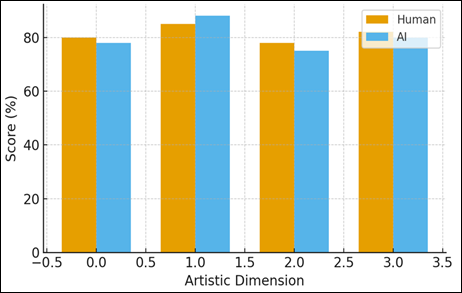
As illustrated in Figure 6, comparison indicates that there were areas of compatibility and discrepancies in human and AI assessors. The two are similar in their scoring patterns, which means that AI obtains key aesthetic cues. Minor disparities particularly in the style recognition indicate that AI can be better at recognizing patterns consistently whereas humans can emphasize more on emotional interpretation. This analogy proves the accuracy and supplementary essence of AI assessment. The critical element of the system validation is the extent of the correspondence between human experts and AI scores of the works of art. Figure 3 is a comparison of scores in emotion, style, musicality, and spatiality. The trend is very consistent with human and AI assessors with the difference falling within +-3-5%. It is important to note that AI was a little more sensitive to genre specific geometric and temporal cues than human assessors, with a higher score in style. On the other hand, human assessors rated more emotion which is in line with holistic and intuitive perception of human affect.
Figure 7
|
Figure
7
Scatter Plot
Showing the Relationship Between Movement Smoothness and Expressive Quality. |
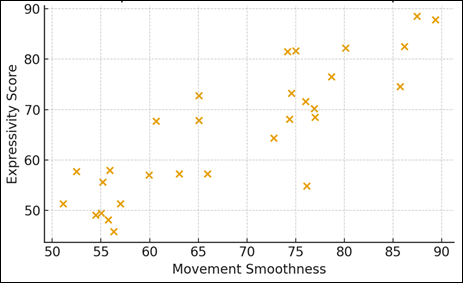
The scatter plot provided in Figure 7, shows that there is a positive relationship between movement smoothness and the expressivity. Dancers who have smoother motions paths have a higher score in expressive clarity. Although the correlation is not ideal to show that expressive performance also consists of the emotional intention and style subtlety the overall tendency is in favor of the hypothesis that the fine motion control increases the artistic effectiveness. This correspondence represents the ability of the model to emulate the most significant aspects of art and still have a decent level of interpretability. The minor difference in human judgment and AI judgment points to the successful hybrid strategy: AI is a master at objective stylistic evaluation, whereas a human is more capable of gauging narrative and emotional complexity. Making these two views work together may result into deeper evaluation and more detailed feedback. The intelligent evaluation model is also reliable and construct valid based on these findings. The small difference in the mean score of human and AI indicates a possibility of standardising assessment criterion and still allow expert judgment. Expressive quality can be referred to as the capacity of a dancer to put life into motion. This is studied in Figure 4 by a scatter plot between smoothness and expressivity. The affirmative relationship shows that the more dancers showed the use of controlled, fluid transitions, the more expressive they were. This is in line with the Effort Theory developed by Laban where flowing movement is usually linked to an expression of openness and a clarity of emotions. Non-linear dispersion of certain data points however also points to the fact that expressivity does not solely rest on the technical smoothness. Emotions intention, story setting, and culture style play an important role in expressive output. Indicatively, abrupt shifts, tension or roundedness are used deliberately as a tool of conveying meaning in some folk and contemporary styles. Therefore, such violations highlight the necessity of culturally sensitive AI models that will be able to identify the difference between technical roughness and an intentional style.
6. Conclusion
This study has analyzed the dynamic nature of the intelligent performance evaluation in the training of dance where there is a convergence of the bodily artistry, the computational modeling and the digital innovation. Taking a comprehensive approach to the embodied practice, digital transformation, computational aesthetics, and AI-driven assessment of art, the study showed how technology could help dancers to perfect their technical accuracy and expressiveness. The experimental findings depicted significant changes in the accuracy of rhythm, clarity of style, and consistency of expressive features showing the possibility of intelligent feedback systems to improve the process of acquiring skills and creativity exploration. AI-based pose estimation, affective computing, immersive interfaces, and multi-modal analytics provide an excellent set of tools that can be used to understand movement quality in fine and culturally adequate terms. Although the system offers objective and data-driven information, it has value but it is supplementary to, rather than substitutive of human expertise. Human teachers introduce fundamental interpretative, emotional, and cultural knowledge which can never be replicated completely by AI. The consistency between human and AI rating also augers well the effectiveness of hybrid assessment systems which is a combination of both computational and artistic sensitivity. Simultaneously, the study also recognizes the difficulties concerning the bias of the dataset, the cultural variety, emotional interpretation, and the ethical accountability. These shortcomings will need to be tackled in order to create non-biased, culturally oriented assessment frameworks that would consider the diverse diversity of world dance cultures. Finally, it can be concluded that intelligent performance evaluation is not only a technological innovation but also a paradigm shift in the field of dance pedagogy. Through the adoption of cooperative AI-human methods, the future of dance training has the possibility of increasing access, accuracy, and creative possibilities of dancers around the world.
CONFLICT OF INTERESTS
None.
ACKNOWLEDGMENTS
None.
REFERENCES
Babu, P. A., Nagaraju, V. S., and Vallabhuni, R. R. (2021). Speech Emotion Recognition System with Librosa. In Proceedings of the IEEE International Conference on Communication Systems and Network Technologies, IEEE.
Chéron, C., Laptev, I., and Schmid, C. (2015). P-CNN: Pose-based CNN Features for Action Recognition. In Proceedings of the ACM International Conference on Multimedia, ACM.
Ishii, R., et al. (2024). Let’s Dance Together! AI Dancers Can Dance to Your Favorite Music and Style. In Proceedings of the 26th International Conference on Multimodal Interaction Companion, 88–90. ACM.
Khosla, P., et al. (2021). Supervised Contrastive Learning (arXiv:2004.11362). arXiv.
Lee, S.-E., Shibata, K., Nonaka, S., Nobuhara, S., and Nishino, K. (2022). Extrinsic Camera Calibration from a Moving Person. IEEE Robotics and Automation Letters, 7, 10344–10351. https://doi.org/10.1109/LRA.2022.3194027
Li, R., Yang, S., Ross, D. A., and Kanazawa, A. (2021). AI Choreographer: Music Conditioned 3D Dance Generation with AIST++. In Proceedings of the IEEE/CVF International Conference on Computer Vision (ICCV), IEEE.
Lin, J. H. (2015). “Just Dance”: The Effects of Exergame Feedback and Controller use on Physical Activity and Psychological Outcomes. Games for Health Journal, 4, 183–189. https://doi.org/10.1089/g4h.2014.0100
Liu, Y. Z., Zhang, T. F., Li, Z., and Deng, L. Q. (2023). Deep Learning-Based Standardized Evaluation and Human Pose Estimation: A Novel Approach to Motion Perception. Traitement du Signal, 40, 2313–2320. https://doi.org/10.18280/ts.400621
Malleson, C., Collomosse, J., and Hilton, A. (2020). Real-Time Multi-Person Motion Capture from Multi-View Video and IMUs. International Journal of Computer Vision, 128, 1594–1611. https://doi.org/10.1007/s11263-020-01288-7
Singh, A., et al. (2021). Semi-Supervised Action Recognition with Temporal Contrastive Learning (arXiv:2102.02751). arXiv.
Takahashi, K., et al. (2018). Human Pose as Calibration Pattern: 3D Human Pose Estimation with Multiple Unsynchronized and Uncalibrated Cameras. In Proceedings of the IEEE/CVF Conference on Computer Vision and Pattern Recognition Workshops 1856–1867. IEEE.
Tsuchida, S., Fukayama, S., Hamasaki, M., and Goto, M. (2019). AIST Dance Video Database: Multi-Genre, Multi-Dancer, and Multi-Camera Database for Dance Information Processing. In Proceedings of the 20th International Society for Music Information Retrieval Conference.
Tu, H., Wang, C., and Zeng, W. (2020). VoxelPose: Towards Multi-Camera 3D Human Pose Estimation in Wild Environment (arXiv:2004.06239). arXiv.
Ullah, I., Manzo, M., Shah, M., and Madden, M. G. (2022). Graph Convolutional Networks: Analysis, Improvements and Results. Applied Intelligence, 52, 9033–9044. https://doi.org/10.1007/s10489-022-03387-3
Yao, B., Jiang, X., Khosla, A., Lin, A. L., Guibas, L., and Fei-Fei, L. (2011). Human Action Recognition by Learning Bases of Action Attributes and Parts. In Proceedings of the IEEE International Conference on Computer Vision (ICCV), IEEE.
Zhang, X. (2023). The Application of Artificial Intelligence Technology in Dance Teaching. In Proceedings of the 1st International Conference on Real-Time Intelligent Systems, 23–30.
Zhenyu, S. (2025). Gamified Learning Experience Based on Digital Media and the Application of Virtual Teaching Robots in Dance Teaching. Entertainment Computing, 52, Article 100785. https://doi.org/10.1016/j.entcom.2024.100785
|
|
 This work is licensed under a: Creative Commons Attribution 4.0 International License
© ShodhKosh 2025. All Rights Reserved.