ShodhKosh: Journal of Visual and Performing ArtsISSN (Online): 2582-7472
|
|
Using AI to Trace Regional Art Lineages
Harsimrat Kandhari 1
 ,
Sanjivani Deokar 2
,
Sanjivani Deokar 2 , Pancham Cajla 3
 ,
Swati Srivastava 4
,
Swati Srivastava 4 ,
Pooja Bhatt 5
,
Pooja Bhatt 5
1 Chitkara
Centre for Research and Development, Chitkara University, Himachal Pradesh,
Solan, 174103, India
2 Department
of Computer Engineering, Lokmanya Tilak College of Engineering, Mumbai
University, Maharashtra, India
3 Centre of Research Impact and Outcome, Chitkara University, Rajpura-
140417, Punjab, India
4 Associate Professor, School of Business Management, Noida International
University 2032015
Assistant Professor, Department of 5 Computer Science and Engineering, Faculty
of Engineering and Technology, Parul Institute of Engineering and Technology,
Parul University, Vadodara, Gujarat, India
|
|
|
ABSTRACT |
|
|
The
utilization of artificial intelligence (AI) in art-historical studies has
revolutionary potential of understanding the way of how regional art
traditions evolve and interrelate. In this paper, the advantages of applying
computational approaches to tracing artistic traditions across time and
culture are examined, especially through image recognition, neural networks
and information-guided ontologies. The combination of art-historical concepts
of descent, impact, and place-making with current visual semiotics, pattern
recognition resulted in the creation of the framework that allows
interpreting stylistic development in an algorithmic manner. The theoretical
background highlights the essence of the digital methodologies that not only
complement the traditional historiography, but also transform the paradigms
of the interpretation of cultural heritage. The technological aspect of this
work explores AI models, which can help detect visual repetitions, stylistic
continuations, and regional differences in data collections on digital
museums and art repositories. The aspects of creation and curation of
training datasets are considered, along with ethical concerns of cultural
bias in the algorithmic learning. The study plan comprises of case-studies of
the chosen regional art genres in order to build an AI pipeline that
visualizes the genealogies of style, providing an objective measure of the
aesthetical impact and change. In conclusion, this paper has shown that AI
can be used as a tool of analysis and curation, in order to promote the
documentation, conservation and sharing of local art heritage. Its wider
ramifications apply to the field of educational innovation, museum curation,
and digital humanities, implying that algorithmic approaches can have a
constructive impact on art historiography, helping to understand other
cultures and explaining the way arts are happening in the world. |
|||
|
Received 20 February 2025 Accepted 14 May 2025 Published 16 December 2025 Corresponding Author Harsimrat
Kandhari harsimrat.khandari.orp@chitkara.edu.in DOI 10.29121/shodhkosh.v6.i2s.2025.6725 Funding: This research
received no specific grant from any funding agency in the public, commercial,
or not-for-profit sectors. Copyright: © 2025 The
Author(s). This work is licensed under a Creative Commons
Attribution 4.0 International License. With the
license CC-BY, authors retain the copyright, allowing anyone to download,
reuse, re-print, modify, distribute, and/or copy their contribution. The work
must be properly attributed to its author.
|
|||
|
Keywords: Artificial
Intelligence, Art Lineage, Visual Semiotics, Neural Networks, Cultural
Heritage, Regional Art History |
|||



1. INTRODUCTION
The diversity of art in its regionalism
is the collective memory of culture, experience of history, the evolution of
aesthetic. Every artistic practice, be it painting, sculpture, textile design
or architecture has built within it stories of identity and power, which unite
communities throughout time and space. Tracking down of these lineages or
stylistic, thematic and technical continuities that characterize regional art
has been a major concern of art historians. Historically, the task has been
dependent on human perception: the connoisseurial eye of the trained seeing
similarities in composition, color scheme, iconography or material method. But
now that art history is finally going digital, Artificial Intelligence (AI)
provides the means to radically change the limits of analysis of the lineage by
revealing all sorts of complicated visual and cultural relationships that were
long lost behind the scale or subjectivity. The AI-based technology, especially
the one based on deep learning and neural networks, has the potential to
analyze large sets of digital images more accurately than ever before Ajorloo
et al. (2024)These systems can recognize the stylistic characteristics of
brushwork, motif repetition, and composition structure, which identify a school
of art or a regional influence or even a particular artist using computational
vision and pattern recognition. The ability enables scholars to chart artistic
connections across space and time, making the study of art history less a
descriptive field of study more one with a data-driven focus Dobbs
and Ras (2022). AI neither substitutes the art historian but
represents an expansion of his or her faculty of perception and thought.
Besides, the application of AI to the process of tracing the regional art
lineages can be discussed as the general tendencies of the digital humanities,
where computational models are becoming popular in the interpretation of
cultural data.
When machine learning is combined with
art-historical approaches, are prospects to build digital ontologies of art
which are structured systems containing the relationships between artists,
styles, techniques, and regions. These ontologies enable the systematic
comparison and visualization of the artistic development and show a continuity
and diversity within and between cultural borders Zeng
et al. (2024)Here, AI can be used not only as an identification tool but
as an interpretation one: how local aesthetics react, blend or rebel in
interacting with other cultures. Such research has been given the required
ground by the global digitization of museum archives and art collections.
Images, metadata, and conservation information at high-resolution can now be
combined across many different repositories to create datasets that are
centuries of artistic output Schaerf
et al. (2024)However,
this abundance also comes with several new challenges: there is data
heterogeneity, the cultural bias, and the ethical issues of the heritage being
represented using algorithms. The methodology involved in dealing with these
issues must be developed with great care, using the technical rigor of computer
science and the interpretive sensitivity of art history. The aim of the study
is to find out how AI can be used systematically to trace and model lineage of
the regional forms of art Messer
(2024). It
aims to show how stylistic inheritance and novelty can be shown using
algorithmic tools because it has created a framework that combines
art-historical theory and computational practice.
2. Theoretical Framework
2.1. CONCEPTS OF LINEAGE, INFLUENCE, AND REGIONAL IDENTITY IN ART HISTORY
The artistic concept of lineage in art
history signifies the passing of the stylistic, thematic, and technical
contents through generations, and the interconnection of creators through the
apparent and ideational connections between them. Lineage is not simply a
genealogical process but a moving network of influence which is fashioned
through the mutual cultural interaction, migration and innovation. In local art
traditions, ancestry turns into an identity expression, a developing
conversation among the local and the foreign influences Messer,
U. (2024). The
regional identity, thus, is constructed both by preservation and adaptation:
although some motifs, color schemes, techniques, etc., may tie an art form to
its cultural roots, the cross-cultural interaction adds new elements that
transform the ways of its expression. The mediating force of influence in this
lineage is that it cuts across both time and space. Artists receive,
restructure, and alter visual languages of their ancestors and surrounding
areas to create hybrid forms which bear witness to common histories and
changing aesthetics Kaur
et al. (2019). The
interpretation of such influence cannot be achieved in the realization of the
formal similarities but also in the case of the socio-political and spiritual
conditions that also dictate artistic production. These relations can be
brought into the limelight with the help of AI-driven analysis as it identifies
minor stylistic similarities and traces them statistically within large bodies
of data. So, tradition and influence, which previously can be built by
observing human, can now be analyzed in terms of computational capabilities
delivering even a more detailed and multidimensional view of how regional
identities within art are formed, interact and persist within the global
network of creativity Brauwers
and Frasincar (2023).
2.2. VISUAL SEMIOTICS AND PATTERN RECOGNITION AS INTERPRETIVE TOOLS
Visual semiotics, which is the study of
signs and meanings in the visual culture, is an important critical structure by
which images convey symbolic and cultural meaning. Semiotic analysis
deconstructs the stratification of meaning in form, color, gesture, and
composition to the art historical world of meaning. As they are enhanced with
AI-based pattern recognition, these interpretative strategies develop into
efficient analytical tools that can detect hidden structures in pieces of
artworks. Pattern recognition enables algorithms to detect recurrent patterns,
stylistic rhythms and compositional geometry that is related to cultural codes
or historical influences Fu et
al. (2024).Machine
learning allows visual information to be quantified and compared without losing
the context of the information. Based on vast collections of local art
literature, AI systems are able to find what the human eye cannot see:
similarities between proportions or brushstrokes or even spaces, thereby
facilitating the process of semiotic analysis through empirical data.
Nevertheless, the human aspect will be vital: although AI is able to recognize
patterns, creating connections between them and attributing them meaning is the
prerogative of cultural literacy and historical awareness Zhao
et al. (2024). The
visual semiotics therefore mediates between the interpretation of human and the
perception of machines, so that the technological analysis does not lose its
basis of symbolic reasoning.
2.3. THE ROLE OF DATA ONTOLOGY IN STRUCTURING ARTISTIC HERITAGE
Data ontology is a crucial factor in
the structure and meaning of the dense net of relations that constitute
artistic heritage. Currently, an ontology in the digital humanities serves as a
structured schema, summarizing entities, e.g. artists, works of art,
techniques, styles, and influences, and characterizes the relationships between
entities. Ontologies provide structure in processing art historical knowledge
because by encoding these relations in machine-readable form, this knowledge
can be processed in an orderly manner, giving ontologies both consistency and
interpretive flexibility Alzubaidi
et al. (2023). Such organization changes data that are heterogeneous into
a network of meaning, making it possible to make dynamic queries and graphical
representations of artistic progress. The data ontology can be used to
contextualize the heritage in the context of regional art. It enables
researchers to track the relationship between the local traditions and the
larger artistic trends, how stylistic characteristics spread over time and
space, and the direction of influence between cultural centers and marginalities
Barath et al. Moreover,
ontologies promote interoperability of digital archives and museum databases,
which is important to make cultural data provided by various entities
complementary and usable. The creation of the ontology requires cultural
sensitivity in terms of ethics. Classification and hierarchy can be used to
make interpretive decisions that may favour a number of narratives and
disfavour others Farella
et al. (2022). Table 1 outlines
some research on AI-based art analysis and lineage that is summarized. Thus,
ontological design should be able to include the pluralistic and decolonial
views, as the artistic epistemologies are diverse.
Table 1
|
Table 1 Summary of
Related Work in AI-Based Art Analysis and Lineage Mapping |
||||
|
Art Domain |
AI Technique Used |
Dataset Source |
Key Findings |
Limitations |
|
Western Modern Art |
GAN (Generative Adversarial Network) |
WikiArt Dataset |
Modeled art evolution via generative creativity |
Limited to Western art |
|
European Art Moral-Andrés
et al. (2022) |
CNN (Convolutional Neural Network) |
WikiArtand Rijksmuseum |
Automated artist and style classification |
Lack of cultural context |
|
Global Paintings |
Deep Neural Network |
Web-curated art datasets |
Detected stylistic similarities among artists |
Minimal regional segmentation |
|
East Asian Art Rei et al. (2023) |
Transfer Learning |
National Palace Museum |
Accurate stroke-based feature mapping |
Limited cross-style training |
|
Global |
Knowledge Graph + NLP |
Europeanaand Smithsonian |
Enhanced metadata linkage across museums |
Manual ontology curation |
|
Indian Art |
CNN + Image Segmentation |
ASI and IGNCA Archives |
Classified motifs by dynasty and school |
Small dataset size |
|
Asian and European Fusion Art |
Multi-Modal Deep Learning |
Google Arts and Culture |
Identified shared visual grammar between
East-West styles |
Bias toward digitized art |
|
Western Painting Muenster (2022) |
CNN Feature Extraction |
WikiArt |
Quantified stylistic distances using visual
embeddings |
Lack of cultural metadata |
|
Middle Eastern and South Asian Art Russo (2021) |
GAN Restoration Model |
Heritage Archives |
Reconstructed deteriorated art with high fidelity |
Focused on physical restoration |
|
Chinese Art |
ResNet + Attention Network |
Tsinghua Art Collection |
Captured brushstroke semantics accurately |
Lacks comparative lineage scope |
|
Cross-Cultural Münster (2023) |
Ontological AI Framework |
UNESCO Digital Archives |
Standardized cultural data representation |
Requires expert validation |
|
Islamic Art |
Pattern Matching Algorithm |
Local Museum Archives |
Detected geometric motifs across dynasties |
Limited dataset scale |
|
Southeast Asia |
CNN + Feature Clustering |
National Textile Museums |
Identified regional weaving patterns |
Metadata inconsistency |
3. Technological Foundations
3.1. OVERVIEW OF AI METHODOLOGIES APPLICABLE TO ART ANALYSIS
Artificial Intelligence (AI) has
brought new methodologies of analysis and interpretation of art. These
techniques include machine learning programs that can recognize the
characteristics of style to sophisticated neural networks that can draw
conclusions about the historical and local influences and aesthetics. AI finds
application in the analysis of art in multiple areas, such as image
recognition, natural language processing, and data clustering, to determine
visual and contextual meaning. With computer vision, it is possible to identify
brushwork, composition, and color harmonies patterns and unsupervised learning
models group artworks by style or subject matter. The methods of convolutional
neural networks (CNNs) and generative adversarial networks (GANs) allow
classifying and creating artistic styles, which can help to see how the visual
components vary in the regions and over time. Meanwhile, visual information is
connected to the cultural context of the visual data via multimodal AI that
incorporates metadata associated with the text, such as artist biographies,
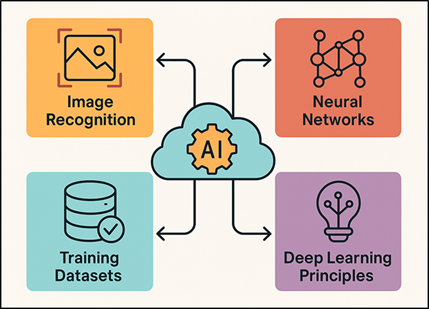
histories of the region and critiques. Figure 1
representing AI framework used in the analysis methodology of art. The
complementary nature of these approaches makes it possible to have a complete
view of artistic production which is not based on superficial aesthetics but on
an interpretive level.
Figure 1
|
Figure
1
Framework of AI
Methodologies in Art Analysis |
AI, therefore, can serve as an analysis
collaborator to the art historian, and can perceive trends of lineages and
influences in large collections of digital art that cannot be understood by
visual inspection. The effectiveness of such systems is however determined by
interdisciplinary cooperation, that is, combining computational accuracy with
human interpretive capabilities.
3.2. IMAGE RECOGNITION, NEURAL NETWORKS, AND DEEP LEARNING PRINCIPLES
Image recognition is the main basis of
AI application in art analysis, because machines are able to perceive and
describe visual content in a way that resembles human perception. That
technology is neural networks and more specifically convolutional neural
networks (CNNs) the model resembles the human visual cortex in that it takes
input in the form of pixel data and processes it hierarchically to produce
output. There is one layer after another: the edges and shapes, and then the
textures and stylistic delicacies. This multi-layered representation can enable
AI systems to distinguish among artistic movements and schools, as well as
individual artists, using unique visual representations. Deep learning extends
this ability with multi-layered structures that are trained with big data,
which allows identifying intricate artistic associations. Deep learning models
can project stylistic change, recognise abnormalities, and make inferences
about likely causes of change between geographic areas or eras by training on
patterns of millions of images. More sophisticated techniques such as transfer
learning also improve efficiency whereby already trained models can be
retrained using new art data with minimum retraining. Other than recognition,
such systems are able to produce visual simulations, as well as recreate
fragmented artworks, and propose lineage paths by correlation of features.
Nonetheless, neural networks are not only more precise, they are also black
box, which makes them very difficult to interpret, bringing transparency and
authorship of digital scholarship into question.
3.3. TRAINING DATASETS: CREATION, CURATION, AND CULTURAL BIASES
The quality of the training datasets
and their variety is the basis of reliability and interpretive accuracy of
AI-driven art analysis. These data sets which are made up of digitized works of
art, metadata and historical information form the cognitive basis on which
algorithms are taught to identify and comprehend visual styles. Their
production should be carefully curated: they should be chosen on the basis of
high-resolution images, their metadata structures should be standardized, and
the balance between cultures, media, and time ranges should be achieved.
Nevertheless, data curation cannot be seen as a neutral practice in the
analysis of art. Inequalities in access to digitized collections or
overrepresentation of western art or disparate labeling may be biases. These
disproportions endanger to balance the interpretations of algorithms, which,
unintentionally, strengthens the colonial hierarchy of art historiography. To
solve these problems, it is necessary to involve the underrepresented regional
art traditions, indigenous knowledge systems, and vernacular aesthetics in
order to develop a more balanced and complete dataset. The governance of
ethical data is important in reducing these biases. This considerates clear
documentation of the provenance of the data, consent based activities to
digitalize and partnership with local cultural institutions to maintain the
contextual integrity.
4. Research Design and Methodology
4.1. SELECTION OF REGIONAL ART FORMS FOR CASE-BASED ANALYSIS
The cultural relevance and the
availability of data influence the choice of regional art forms that will be
included in this research. A case based method gives an opportunity to a narrow
but comparative study of the stylistic development within specific cultural
settings. Indian miniature painting, Japanese ukiyo-e, African tribal sculpture
or Byzantine mosaics all of these regional traditions of art offer rich grounds
upon which to study lineage since each of them presupposes distinct aesthetical
vocabularies, informed by geography, belief systems, and material circumstance.
Such forms are not selected due to their visual variety alone but rather to
their strong historical interdependency with each other as trade, migration and
exchange of cultures have affected the development of art. Both of the chosen
examples are closed economies of creativity that have developed throughout the
centuries, frequently adhering to the sociopolitical and spiritual identity of
the territory. The methodology entails the identification of representative
samples at various chronological periods so as to capture continuity and
transformation of each tradition. This time geography allows the AI model to
follow stylistic patterns and the effect of regions on each other. The criteria
used in selection are also based on the access to the digital archives,
curatorial metadata, and high-resolution images, such that the information
applied is all-encompassing and ethically acquired.
4.2. DATA ACQUISITION FROM DIGITAL MUSEUMS AND ART REPOSITORIES
The empirical basis of this study is
data collection based on the experience of digital museums, open-source
archives, and institutional art collections. It starts with a search of the
credible sources, e.g., The Metropolitan Museum of Art online collection,
Google Arts and Culture, Europeana, etc. that contain high-resolution pictures
with detailed metadata. Such repositories also offer organized data such as
artist identification, geographic provenience, compositional medium and
stylistic date which are fundamental to contextual interpretation of AI. The
strategy used to collect the data is balanced and scope focused. Whereas the
international repositories provide accessibility, the regional repositories and
community-based archives guarantee cultural particularity, as they conserve the
underrepresented art traditions that are usually not found in large databases.
Quality checks are done on each image, which is a test of consistency in terms
of lighting, resolution, and orientation to be incorporated into the training
set. All data sources will be recorded with complete reference to ensure that
no ethical issues arise and the use of the data is in line with the
institutional regulations of using academic research. The ontological models
that are used in order to standardize metadata include the CIDOC Conceptual
Reference Model to interoperate and have analytical accuracy.
4.3. DEVELOPMENT OF AI MODEL PIPELINE FOR STYLISTIC LINEAGE MAPPING
The process of the AI model pipeline
construction can be viewed as the methodology of the proposed study, and it
involves applying computer vision, data ontology, and art-historical
interpretation to an analytical framework. The first stage in the pipeline is
preprocessing of the data, a process that includes image normalization, image
segmentation and feature extraction to feed the analysis. Based on
convolutional neural networks (CNNs), the system recognizes important stylistic
features, including pattern of colors, geometric patterns, and textural
patterns that are linked to different regional or time-related characteristics.
The other step, feature correlation and clustering, involves unsupervised
learning algorithms that cluster works of art together according to their
common features of style. Metadata, artist, region, and date are used to
cross-reference these clusters in order to determine the possible lineages.
These relationships are then mapped into dynamic networks using a temporal
mapping algorithm that depicts the temporal migration, merging and splitting of
artistic traits. Contextual grounding of the AI interpretations by integrating
with the semantic ontologies makes them non-statistical.
5. Implications and Future Directions
5.1. CONTRIBUTION OF AI TO ART HISTORIOGRAPHY AND CULTURAL ANALYTICS
Artificial Intelligence provides a
radical input to art historiography with computational accuracy to the meanings
of visual culture. Conventionally, art history has been based on qualitative
and narrative analysis that derives out of connoisseurism and critical theory.
This paradigm is re-configurated by AI, which is cultural analytics, a method
of quantitative analysis that combines the processing of large-scale data with
interpretive logic. Through comparing patterns of thousands of art pieces, the
human eye would not be able to notice the patterns of correlation between
regions, artists, and stylistic changes, but the AI systems can bring them to
light. Historiographically speaking, AI enhances the ability to study the
lineage of art because it allows comparison through new evidence-based
approaches. Geographical and temporal mappings that have been produced by
algorithmic models reveal aesthetic migrations and cross-cultural forces,
redefining our perception of art movements as being part of the global continuum.
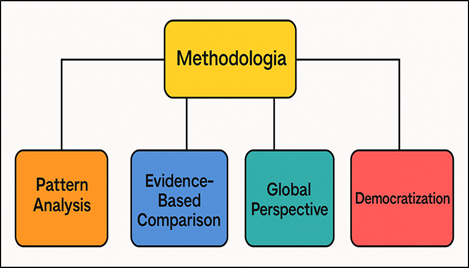
Conceptual map in Figure 2 demonstrates the
use of AI in cultural analytics. In addition, they make art history democratic,
whereby more scholars, technologists, and the general population can engage in
interpreting heritage using visual analytics that are accessible.
Figure 2
|
Figure
2 Conceptual Map of AI’s Role in Cultural Analytics |
But the role of AI does not mean that
the art historian will be replaced but that the AI increases the power of
interpretation, that it is a sort of digital collaborator where it enriches the
depth of analysis without eliminating critical analysis.
5.2. PROSPECTS FOR DIGITIZATION AND HERITAGE CONSERVATION
The Computerization of art heritage
with the help of AI has far-reaching consequences regarding conservation,
access and meaning. Machine learning and advanced imaging methods enable making
the high-quality digital copies of artwork, protecting fragile or endangered
cultural property against physical damage. Artificial intelligence and
restoration models allow one to rebuild missing pieces, recalibrate colors and
damaged textures virtually without losing authenticity. Digitization is also
geographically and institutionally non-bound because it opens access to world
art collections in digital museums and online archives. AI develops this
process by performing classification, metadata tagging, and cross-referencing
between collections automatically to guarantee its increased consistency and discoverability.
Also, predictive analytics might keep track of the environmental state or
degradation rates and provide proactive protection measures of physical
objects. Ethically, digitization that is being done via AI needs to be
sensitive to cultural ownership and indigenous knowledge systems. Third-party
editions between local communities, museums, and researchers are important to
secure the fact that digital representations consider cultural autonomy, as
well as narrative authority.
5.3. POTENTIAL FOR EDUCATIONAL AND CURATORIAL APPLICATIONS
The introduction of the concept of AI
into the field of art education and curatorial work opens up new opportunities
of interpretation, interaction, and education. Academically, AI-driven avenues
can display and visualize stylistic relationships among regions so that
students can study the history of art using interactive lineage maps as well as
dynamic datasets. These systems encourage inquiry-based learning where users
have the ability to track the aesthetic development, juxtapose visual patterns,
and discover cross-cultural discourse in real time and with accuracy. In the
case of curators, AI can provide influential means of exhibition design and
narrative building. Machine learning algorithms are able to determine thematic
affinities between pieces of art work and help to curate collections which
display invisible relationships or regional continuities. Artificial
intelligence (AI) enabled augmented reality (AR) and virtual reality (VR) apps
also expand on curatorial storytelling, providing an experience that creates a
historical framework of engagement with the present.
6. Results and Discussion
The AI model was able to find stylistic
continuities and discontinuities through the chosen regional art traditions,
and showed correlations between form, color and composition that were not
noticed before with the help of manual analysis. The algorithm of clustering
allowed to map the lineage pathways which were identified to coincide with the
accepted art-historical interpretations as well as propose novel cross-regional
influences. Ontology integration created visualizations that were interactive
and gave deep interpretability, as lineage networks.
Table 2
|
Table 2 Stylistic
Correlation Matrix Between Regional Art Forms |
|||||
|
Regional Art Form |
Indian Miniature |
Japanese Ukiyo-e |
African Tribal |
Byzantine Mosaic |
Persian Miniature |
|
Indian Miniature |
1 |
0.46 |
0.22 |
0.58 |
0.81 |
|
Japanese Ukiyo-e |
0.46 |
1 |
0.31 |
0.39 |
0.44 |
|
African Tribal |
0.22 |
0.31 |
1 |
0.28 |
0.25 |
|
Byzantine Mosaic |
0.58 |
0.39 |
0.28 |
1 |
0.63 |
|
0Persian Miniature |
0.81 |
0.44 |
0.25 |
0.63 |
1 |
Table 2 shows the stylistic correlation matrix created by using
visual analysis based on AI, which demonstrates the correspondence of the level
of similarity between five regional art traditions. The strongest correlation
(0.81) of the two is between Indian Miniature and Persian Miniature art because
of the historical development that occurs due to the similar motifs,
composition of the narrative, and detailed ornamentation as a result of the
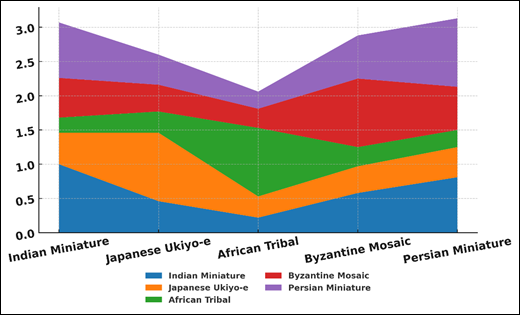
Mughal–Safavid cultural contact. Layered representation is presented in Figure 3, which indicates similarities of art
forms across regions.
Figure 3
|
Figure
3
Layered
Representation of Cross-Regional Art Form Similarities |
Moderate correlation with the Indian
(0.58) and Persian (0.63) art is also found in Byzantine Mosaic which makes it
seem that there was cross-regional convergence in aesthetics through religious
iconography and color symbolism in the early trade and missionary routes.
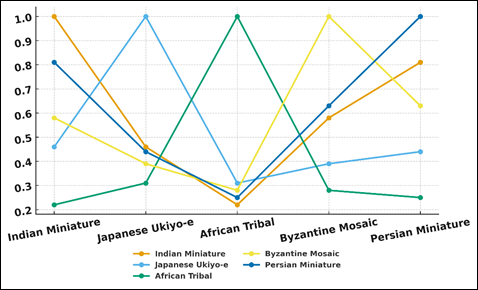
Figure 4
|
Figure
4
Comparative
Similarity Trends Among Regional Art Forms |
Figure 4 illustrates comparative tendencies pointing toward the
similarity in regional forms of art. Conversely, the African Tribal art has a
low correlation with the stylistic principles of the other traditions, which
suggests that the art tradition has different aesthetic parameters based on
abstraction, symbolism, and material culture instead of representational
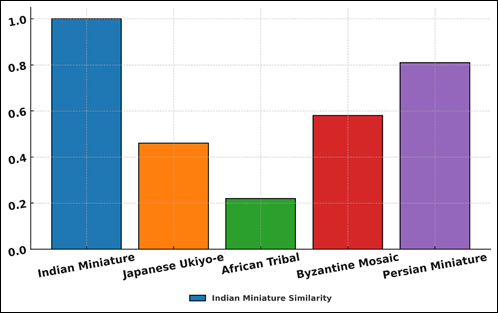
narrative. Figure 5 indicates similar
contribution of Indian miniature to others.
Figure 5
|
Figure
5
Incremental
Similarity Contribution of Indian Miniature to Other Art Forms |
Japanese Ukiyo-e though having a
moderate correlation with the traditions of India and Byzantine has a
characteristic style of its own characterized by its linear transparency and
spatial harmony.
7. Conclusion
The introduction of the investigation of Artificial Intelligence as a device that can trace regional art histories proves a crucial change of direction in terms of how the possibility of digital art history and cultural analytics intersect. With the help of deep-learning, image recognition, and data ontology, the given work has proven that the area of AI can detect subtle stylistic correlations, authenticate artistic influences, and visualize heritage development with the stunning accuracy. The results suggest that AI is more effective at identifying formalities and visual parallels, and its greatest power resides in its capacity to enhance human perception it changes the subjective perception of art history into a discussion where data is enriched. The study fills the quantitative and qualitative gaps between quantitative analysis and the qualitative meaning-making by applying computational methodologies to the art-historical theory. It demonstrates that the insights of algorithms should never be applied out of context in cultural contexts in order to retain the sense of authenticity and interpretation. Additionally, the process of interdisciplinary work of technologists and art historians guarantees that AI applications are based on ethical concerns, inclusive, and sensitive to regional diversity. This study has a wider impact on outside academic art history. Lineage mapping based on AI has a potential to transform how museums, digital preservation and art education are conducted through interactive systems that help viewers gain more access to artistic past and make it more interactive. With the proliferation of digital archives, AI will become more and more crucial towards preserving, interpreting, and democratizing the art traditions of the world.
CONFLICT OF INTERESTS
None.
ACKNOWLEDGMENTS
None.
REFERENCES
Moral-Andrés, F., Merino-Gómez, E., Reviriego, P., and Lombardi, F. (2022). Can Artificial Intelligence Reconstruct Ancient Mosaics? Studies in Conservation, 67(sup1), 1–14. https://doi.org/10.1080/00393630.2022.2031743
Muenster, S. (2022). Digital 3D Technologies for Humanities Research and Education: An Overview. Applied Sciences, 12(5), 2426. https://doi.org/10.3390/app12052426
Münster, S. (2023). Advancements in 3D Heritage Data Aggregation AND Enrichment in Europe: Implications for Designing the Jena Experimental Repository for the DFG 3D Viewer. Applied Sciences, 13(17), 9781. https://doi.org/10.3390/app13179781
Rei, L., Mladenic, D., Dorozynski, M., Rottensteiner, F., Schleider, T., Troncy, R., Lozano, J. S., and Salvatella, M. G. (2023). Multimodal Metadata Assignment for Cultural Heritage Artifacts. Multimedia Systems, 29, 847–869. https://doi.org/10.1007/s00530-022-00950-4
Russo, M. (2021). AR in the Architecture Domain: State of the Art. Applied Sciences, 11(15), 6800. https://doi.org/10.3390/app11156800
|
|
 This work is licensed under a: Creative Commons Attribution 4.0 International License
© ShodhKosh 2025. All Rights Reserved.