ShodhKosh: Journal of Visual and Performing ArtsISSN (Online): 2582-7472
|
|
Ethical Management of AI-Produced Digital Works
Dr. Avinash Dhavan 1 , Yuvraj Parmar 2
 ,
Shikha Gupta 3
,
Shikha Gupta 3 , Ashish Verma 4
 , Dr. Varsha Agarwal 5
 , Dr. Thangaraja T 6
1 Assistant
Professor, Bharati Vidyapeeth Institute of Management Studies and Research, Specialization:
HR and O.B, Navi Mumbai, India
2 Chitkara
Centre for Research and Development, Chitkara University, Himachal Pradesh,
Solan, 174103, India
3 Assistant Professor, School of Business Management, Noida International
University 203201, India
4 Centre of Research Impact and Outcome, Chitkara University, Rajpura- 140417, Punjab, India
5 Associate
Professor, ISME - School of Management and Entrepreneurship, ATLAS Skill Tech
University, Mumbai, Maharashtra, India
6 Assistant Professor Grade -II, Department of Management, Aarupadai
Veedu Institute of Technology, Vinayaka Mission’s Research Foundation (DU)
Tamil Nadu, India
|
|
|
ABSTRACT |
|
|
The high rate
of artificial intelligence (AI) innovation into the creative industries has
transformed the creation of digital productions, upsetting the standard views
of creativity, authorship, and ownership. The paper is an academic discussion
on managing AI-generated digital literature on a multidisciplinary platform
by looking at the convergence between technology, ethics, law, and society.
It starts with its definition of AI-generated digital works and describes the
existing technologies that allow machine-based artistic and intellectual
works. Ethical issues that are core are examined, such as authorship,
information privacy, disclosure, and responsibility. The paper also explores
the legal loopholes in intellectual property rights, licensing, and regulatory
differences in different countries, and suggests that there is an urgent
necessity to harmonize the frameworks to apply the specifics of AI.
Socioeconomic consequences are also evaluated, which includes the influence
of AI on creative employment, the process of democratizing and monopolizing
digital creativity, and the change in perception of authenticity and value in
the population. In order to have ethical governance, the paper suggests
elaborate frameworks that focus on ethical design, institutional
responsibility and clear mechanisms of auditing. It proposes the implication
of ethical factors in the lifecycle of AI developments, including data
collection and implementation. |
|||
|
Received 28 January 2025 Accepted 19 April
2025 Published 16 December 2025 Corresponding Author Dr.
Avinash Dhavan, av.dhavan@gmail.com DOI 10.29121/shodhkosh.v6.i2s.2025.6720 Funding: This research
received no specific grant from any funding agency in the public, commercial,
or not-for-profit sectors. Copyright: © 2025 The
Author(s). This work is licensed under a Creative Commons
Attribution 4.0 International License. With the
license CC-BY, authors retain the copyright, allowing anyone to download,
reuse, re-print, modify, distribute, and/or copy their contribution. The work
must be properly attributed to its author.
|
|||
|
Keywords: AI Ethics, Digital Creativity, Authorship and Ownership, Intellectual Property, Accountability, Policy Frameworks |
|||


1. INTRODUCTION
The
advent of artificial intelligence (AI) as an imaginative co-worker is a radical
shift in the nature of the conception, creation, and consumption of digital
works. Visually, writing, and design prototypes are becoming more and more
closer to the edges of human and machine creativity, through algorithmically
generated paintings and music compositions, to the creation of virtual
influencers and design prototypes. This change presents enormous ethical,
legal, and social issues requiring proper consideration and appropriate
handling. The emergence of the AI-created digital content is not only a
technological event but also a cultural and ethical change that forces society
to re-evaluate some of the primary questions about authorship, ownership,
creativity and responsibility. In the center of this change is the fact that AI
systems can be used to mimic human creativity. With sophisticated machine
learning, natural language processing and generative adversarial networks
(GANs), AI is capable of generating original and in many cases unpredictable
results that can compete with and sometimes outperform human imagination in
specific fields Casalone (2020). Yet, this
ability leads to one of the urgent questions: what or who is the author of the
work created by AI? Conventional models of authorship are based on human will,
ethical action, and creative representation something the AI cannot possess in
the traditional meaning. This means that the need to assign AI systems
ownership and moral responsibility puts ethical and legal principles of
creative industries to the test. Along with authorship, there are also
complicated ethical implications of AI creative ability in the context of
transparency, consent and fairness Benanti (2023). Countless AI
systems are trained with large volumes of data that contain copyrighted,
sensitive, or culturally valuable information and in many instances it is not
clearly stated and or recognized that the original creators were involved. This
makes some questions concerning the ethical validity of AI training practice
and the possibility of using human creativity. Also, the black box problem,
also known as AI decision-making transparency, makes it difficult to hold
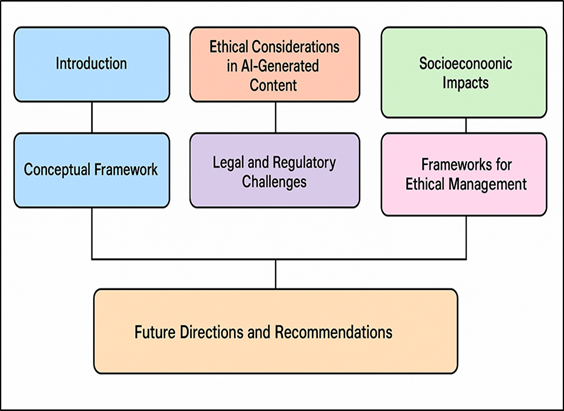
AI-generated works responsible and accountable Bartlett et al. (2022). According to Figure 1, there are
interrelated ethical, legal, and social aspects of AI creativity. In the
absence of clear mechanisms, it is hard to establish the ways the AI systems
come up with their results or whether they reproduce bias, plagiarism or
misinformation.
Figure 1
|
Figure 1 Comprehensive Framework for the Ethical Management of AI-Produced Digital Works |
Besides, the spread of AI-generated
content has enormous consequences on creative labor markets, as well as
cultural production. On the one hand, AI creates an unprecedented chance to
democratize the creative process, and this means that people with no official
artistic education can create sophisticated pieces using the available tools.
Conversely, it poses a threat to oust the creative professionals and shift
creative power to large technology companies that can afford the most
sophisticated AI systems and data Hill et al. (2022) This is where the tension of democratization and
monopolization arises, necessitating ethical guidelines to allow a fair
involvement and avoid exploitation. The current legal and regulatory frameworks
have a hard time keeping up with the fast-developing AI creativity globally.
The current intellectual property (IP) regulations have been tailored towards
human authors and are not readily adaptable to non-humans or machine-aided
generation Krishnapriya et al. (2020). Consequently, loopholes in law, licensure, and attribution
remain to create confusion and probable inter-jurisdictional clashes. These
problems can only be resolved by law reform but also a moral obligation of
fairness, inclusiveness and accountability.
2. Conceptual Framework
2.1. DEFINITION OF AI-PRODUCED DIGITAL WORKS
AI-generated digital art is any
creative work of art produced wholly or in part by artificial intelligence
systems by way of analyzing data, recognizing patterns, and modeling creative
work. Such works can consist of pictures, sound, literature, film script, and
even digital interactivity. As compared to the traditional creative processes,
where the human imagination and manual work are the only tools available,
AI-generation works are created based on the algorithms, which may learn on a
huge amount of data available and independently generate new works Rhim et al. (2021). The
creations produced by AI can be divided into three main categories: fully
autonomous creations, in which AI can create outputs by itself; semi autonomous
creations, in which human creators interact with AI tools in an iterative
process; and AI-assisted creations, where AI is simply considered a supplement
to human creativity and/or provides technical services or optimization. This
range points to the intricate interaction of the intent of humanity with the
results of the machine. Such works are not described simply as technical but
rather as philosophical since they blur the line between machine automation and
human expression. With AI, its creativeness is not the result of intuition and
experience but probabilistic modeling since it cannot be characterized as
conscious, intentional, and emotive Tang et al. (2023). Hence,
AI-generated digital works are not unique due to the cognition of AI but rather
reproduce and mimic creative behaviors by the use of trained associations
between data. Such controversies transform the definition of art production and
art enjoyment in the online era Acquaviva et al. (2024).
2.2. OVERVIEW OF CURRENT AI TECHNOLOGIES IN
CREATIVE INDUSTRIES
Artificial intelligence technologies
have entered many fields of creativity and transformed the concept of artistic
creation, music, and literature, and design perception and distribution.
Generative adversarial networks (GANs), state-of-the-art text-to-image models
like DALL•E, Midjourney, and Stable Diffusion, and similar visual art systems
generate very detailed and stylistically varied images based on textual input.
Using huge datasets these systems are able to learn visual patterns so that
they can create realistic portraits, surreal compositions, and even imitate
classical styles [9]. Applied in the field of music, AI software such as AIVA,
Jukebox, and Amper Music create music of various genres based on learning
harmonic and rhythmic rules and assists the composers and content creators. NLP
(natural language processing) models, like GPT-based systems, have been applied
in literature and journalism, to produce articles, poetry, and screenplays that
are written in a human linguistic structure and style of narration.
Correspondingly, in motion pictures and animation, AI will be used to help in
scriptwriting, scene creation, voice synthesis, and visual effect improvement.
The fashion and design industries utilize AI to forecast trends, optimization
of production, and the development of new product designs, whereas the gaming
industry is making use of AI to develop adaptive storytelling and procedural
world-building Morley et al. (2021). All these technologies democratize the means
of creative expression since they reduce entry barriers and at the same time
concentrate creative power in the hands of those who have control over data and
computational resources.
2.3. RELATIONSHIP BETWEEN AI, CREATIVITY,
AND AUTHORSHIP
The connection between AI, creativity
and authorship is one of the most complicated and controversial intersections
in the modern ethics and aesthetics. The emergence of generative AI systems is
recalibrating creativity, a long-held human quality that is based on
imagination and emotional intelligence and intentionality. Such technologies
are able to simulate creative behavior through analyzing patterns, recombining
data, and producing some novel outputs. Nevertheless, the creativeness of AI is
not original- it develops through computational learning as opposed to
conscious creation Li et al. (2023). This
is in contrast with philosophical and legal definitions of what can be
considered true creative authorship. Traditional models of authorship include
moral and intellectual property of a thought, based on personal will and
expression. AI systems, in turn, do not have agency, consciousness and moral
responsibility. Hence, putting AI as the author of any work of art confuses the
distinction between a tool and a creator Van Wynsberghe (2021). Authorship can be attributed to the human programmer, who
worked on the data, the data curator, who worked on the data, or the user, who
worked on the data, but there is no agreed way of distributing credit or blame.
This imprecision goes further to the cultural and ethical realms. When AI
creates art that triggers an emotional or meaning response, audiences can think
of it as creative but its roots in algorithmic synthesis bring up the issue of
authenticity and artistic value. Table 1 presents major research on ethical, legal and creative
implications De Mauro and Pacifico (2024). With the further development of AI, the correlation
between human intent and machine production needs to be redefined, not as the
substitution of human imagination but as the novel enhanced version of
collaborative authorship, which incorporates human imagination and the
innovation of computation.
Table 1
|
Table 1 Related Work on Ethical
Management of AI-Produced Digital Works |
|||
|
Focus
Area |
Methodology |
Ethical
Concerns Highlighted |
Relevance
to Present Study |
|
Ethical
principles in AI governance |
Theoretical
analysis |
Lack
of accountability |
Forms
the conceptual basis for ethical AI design |
|
AI
creativity and authorship |
Case
study and literature review |
Authorship
ambiguity |
Supports
hybrid authorship perspective |
|
AI’s
moral and legal status |
Philosophical
inquiry |
Agency
and accountability |
Frames
moral responsibility discourse |
|
Human–AI
collaboration Giudici etal. (2024) |
Experimental |
Creative
displacement |
Aligns
with ethical human-centric AI |
|
Legal
ownership of AI works |
Legal
analysis |
Ownership
vacuum |
Guides
legal section of study |
|
Dataset
ethics |
Empirical
review |
Data
exploitation |
Informs
data ethics framework |
|
Accountability
in AI systems |
Normative
study |
Black-box
opacity |
Supports
governance recommendations |
|
Social
implications of AI art Ricciardi Celsi (2023) |
Comparative
study |
Loss
of authenticity |
Strengthens
cultural perspective |
|
Public
perception of AI art |
Media
analysis |
Authenticity
and trust |
Informs
cultural impact discussion |
|
Regulation
and risk classification |
Policy
review |
Lack
of global harmonization |
Guides
international regulation section |
|
IP
and innovation |
Policy
paper |
Unclear
ownership |
Directly
relevant to IP challenges |
|
Cross-country
ethical policies |
Comparative
analysis |
Inconsistency
across nations |
Supports
global governance discussion |
|
Socioeconomic
impact Novelli et al. (2024). |
Review |
Job
displacement |
Backs
socioeconomic impact analysis |
|
Global
ethical framework Feuerriegel et al. (2024) |
International
consensus report |
Digital
inequality |
Guides
final recommendations section |
3. Ethical Considerations in AI-Generated Content
3.1. AUTHORSHIP AND OWNERSHIP DILEMMAS
Authorship and ownership of
AI-generated content is still one of the most controversial ethical issues of
the digital age. Conventional conceptions of authorship are based on the human
imagination, purpose, and ethics, all of which are absent in artificial
intelligence by definition. Despite their high originality and aesthetic
output, AI systems do not work based on the conscious choice, but on the basis
of algorithmic learning. This is the main difference that makes it difficult to
assign ownership in the creative act Kshetri (2024). When a work of art, literature, or music is generated by
an AI system, it is possible that many different people will be considered the
creators of the work: the developer that made the algorithm, the user that gave
prompts or input data, or the company that owns the technology and data used.
In the absence of clear structures, such competing claims cause conflict about
moral rights, profit distribution and credit due diligence. Moreover, copyright
regulations in most countries limit them to human authors, making AI-created
works either belong to the public domain or be not covered by the traditional
standards. This ambiguity is ethically questionable because it can take away
the creativity of humans because creators will be deprived of credit to the machines.
3.2. ISSUES OF TRANSPARENCY AND
ACCOUNTABILITY
The two essential elements of the
ethical governance of AI-generated content are transparency and accountability.
Even current AI systems, especially those based on deep learning and generative
models tend to be black-box in that they can be difficult to understand how a
particular output is generated even by their creators.
Figure 2

|
Figure 2 Framework Illustrating Transparency and Accountability Issues in AI-Generated Content |
Such opaque nature is an ethical
challenge of traceability as it becomes hard to determine the fairness, lack of
bias and intellectual property theft in the content generated. In AI, Figure 2 indicates the biggest transparency issues and
accountability systems. Absence of transparency compromises the faith in the
population and poses some concern to accountability. In case an AI-created work
of art violates copyright, disseminates false information, or reinforces
negative stereotypes, it is not clear who is to be held accountable the
developer of AI, the data supplier, or the direct user. This proliferation of
responsibility provides loopholes in ethical and legal terms, making it
possible to utilize/misuse or exploit this without consequences. Besides, these
risks are intensified by AI-generated deepfakes and artificial media, which
erodes authenticity in digital communication by obliterating the difference
between reality and fake.
3.3. DATA PRIVACY AND CONSENT IN AI TRAINING
DATASETS
The quality and the integrity of the
training datasets is fundamental to AI-generated content. Nevertheless, these
data collections frequently include massive volumes of copyright, personal or
culturally sensitive information gathered online without express consent. This
comes with serious ethical issues of data privacy, consent, and ownership. By
being trained on such data, an AI model is, in a way, recycling human
creativity and labor into novel outputs, which is uncompensated or not
accredited at all, which is almost akin to digital appropriation. Privacy wise,
the face of those whose information, be it in the form of pictures, voices, or
texts, is used to train generative models, can be reproduced without their
approval. Such unnecessarily use of personal data may cause reputational
damage, identity theft, or emotional trauma. Moreover, any biases in the
training data may carry repeat thematic patterns in AI results which undermine
fairness and inclusivity. The development of AI should be ethically responsible,
which means that it should be transparent in sourcing data, informed consent,
and respect the intellectual property rights. The developers are encouraged to
use licensed, open-source or ethically-reviewed datasets that adhere to the
standards of privacy and cultural attentiveness.
4. Legal and Regulatory Challenges
4.1. INTELLECTUAL PROPERTY AND COPYRIGHT
IMPLICATIONS
The advent of AI-created content has
revealed some deep cracks in the current intellectual property (IP) and
copyright regulations. The conventional copyright law is based on the
assumption concerning human authorship, according to which creative expression
is produced through personal intellect and will. But AI is not conscious, has
no emotional experience, and is not a legal person, which is why it is
challenging to attribute authorship and ownership to the machine itself. This
means that AI-generated content is not usually covered by the regular laws and,
therefore, there is always a gray area on who owns it. Most jurisdictions only
offer copyright to human creators. This puts the works that are produced by AI
unsecured or owned by the human or organization that did the programming, the
running or the deployment of the AI system. As an example, the copyright
legislation of the United States expressly refuses to grant registration to
works that are created by a machine without human contribution. In a similar
manner, the UK and the EU recognize the existence of computer-generated works,
but the rights are vested in the individual who set the creative process. This
contradiction makes it more difficult to issue rights internationally and
enforce them. Such loopholes, morally, threaten to discourage human innovation
and allow companies to exploit humans by using AI platforms that have been
trained on the intellectual property of others. Anonymity is another impediment
to accountability because AI reproduces or changes copyrighted work without
authorization.
4.2. LICENSING AND ATTRIBUTION REQUIREMENTS
The issues of licensing and attribution
of AI-generated works are controversial in terms of legal and ethical aspects,
and they are mostly associated with copycatting and collaboration of AI
creativity. Generative AI systems are trained on large collections of
copyrighted, open-access and public domain content. Whenever these models
reproduce/remix their training data, there are issues of who should be credited
with distribution of credit. Devoid of explicit licensing, the creators of work
that is used to train a dataset do not receive any payment or credit, even
though they have an indirect role in the final output. During the
commercialization of AI tools licensing is also a controversial issue. As an
example, when the artist applies an AI model that was trained on thousands of
pieces of art, does he/she/they or the developers of the AI model license the
original creators? Lack of standard frameworks has resulted into conflict and
lawsuits especially in visual arts and music. On the ethical level, fair attribution
would be ensuring the integrity of creative work and acknowledging human
involvement in the basis of the generative force of AI. Some of the solutions
can be the introduction of transparent systems of data provenance, the creation
of the ethics AI license, and the disclosure in the case of AI contribution to
the creative work.
4.3. INTERNATIONAL DIFFERENCES IN AI
REGULATION
The regulation of AI is diverse,
depending on the approach to the regulation of technologies in various
jurisdictions and their cultural, legislative, and ethical aspects. Such
discrepancies produce discrepancies in the treatment of AI-generated works according
to the intellectual property and data protection laws. By way of example, the
European Union has taken a holistic approach by passing various laws such as
the AI Act that focuses on transparency, accountability, and risk based
categorization of AI systems. The EU contemplates AI also in its General Data
Protection Regulation (GDPR), which guarantees the privacy and agreement in AI
training. The US, on the other hand, is more decentralized and innovativeness
based. Although the U.S. Copyright Office does not protect non-human works, it
permits the registration of copyright on the works that entail adequate human
authorship in AI-assisted creation. This case-by-case analysis, nevertheless,
is not uniform and puts AI-generated works in legal uncertainty. In the
meantime, the flexible policy promoting AI development and trying out adaptive
copyright models has been adopted in countries like Japan or South Korea.
China, in its turn, is creating AI-specific legislation, which focuses on state
regulation and control over the content.
5. Socioeconomic Impacts
5.1. EFFECTS ON CREATIVE PROFESSIONALS AND
LABOR MARKETS
The adoption of AI by creative sectors
has impacted creative practitioners and the employment sector greatly. On the
one hand, AI is efficient, lowers the cost of production, and expands the
creative options, but, on the other hand, it endangers the traditional
occupations in the art, design, journalism, music, and entertainment industry.
Much of the individuals in the profession are scared of being made obsolete
because the generative AI systems are capable of creating content within
minutes that would have taken humans skills and effort. To give a few examples,
the artists and copywriters, as well as composers, have an increasing
competition with the AI tools that can produce similar results at a minimum
price. Nevertheless, the impact of AI is not at all negative. It opens up new
job opportunities in AI art direction, prompt engineering, digital ethics and
algorithm design. Those creative professionals that accept AI as a working tool
can enhance their output and experiment in the area of creativity. However, the
unequal access to and literacy in technology worsens disparities- in favor of
the persons with resources to utilize AI effectively. Outdated creativity-based
jobs are not done away with, but instead the labor market is restructured
broadly. The management of AI is thus a must to make sure it is used to provide
a complement to human creativity and not to substitute it. Displacement can be
reduced by policies to facilitate fair labor transitions and reskilling, as
well as protecting the creative rights.
5.2. DEMOCRATIZATION VS. MONOPOLIZATION OF
DIGITAL CREATIVITY
AI technologies can make creativity
democratic by making the barriers to entry less significant, allowing people
with no formal knowledge to create professional-quality art, music, and design.
The platforms like ChatGPT, Midjourney, and Runway are accessible and allow
people without artistic background to explore the type of artistic work, which
helps to establish inclusivity and innovation. This democratization increases
the involvement in creative culture and diversification of the world artistic
scene. On the other hand, the identical technologies are a threat of
intensifying monopolization of digital creativity. The vast majority of the
most powerful AI models are operated by massive technological corporations with
special access to data, computing resources, and algorithms. This is the
concentration of creative tools and datasets that strengthens corporate
domination, reduces transparency and access by independent creators. Further,
AI-generated content conditioned on open-source information tends to sell off
the creativity of the masses without any fair payment, which is the essential
values of the fair cultural exchange. The conflict between democratization and
monopolization puts the dissimilarity between the creation and the control of
AI to the forefront, demonstrating a very important socioeconomic gap.
Open-source innovation, equal sharing of data, and equal access to the platform
should therefore be given a priority in ethical governance. Incentives To
encourage decentralized AI ecosystems, creative centralization can be avoided
and global participation encouraged. Finally, to maintain a thriving digital
culture, it is necessary to find a balance between inclusivity and
responsibility so that AI becomes a shared creative commons and not an instrument
of corporate concentration.
5.3. PUBLIC PERCEPTION AND CULTURAL
INFLUENCE OF AI WORKS
There is fascination, skepticism, and
moral concern that influence the way AI-generated works are perceived by the
general population. The fact that AI can create art that is capable of
replicating human emotion and cleverness astonishes the eyes of many viewers,
who consider AI to be a revolutionary combination of technology and art. Yet,
some consider AI-driven production as the fake copies that do not possess any
form of authenticity, emotion, or cultural relevance. This ambivalence is open
to the wider social issues of originality, meaning and significance of human
experience in art. The cultural production and consumption is also transformed
by the increasing power of AI. Algorithms creativity complicates the
hierarchies of taste of the traditional approach which makes artistic creation
more commodified yet more available. The spread of AI-generated media is a
potential threat to overcrowding the audience with homogenized or derivative
content, with the boundary between a real expression of a person and an
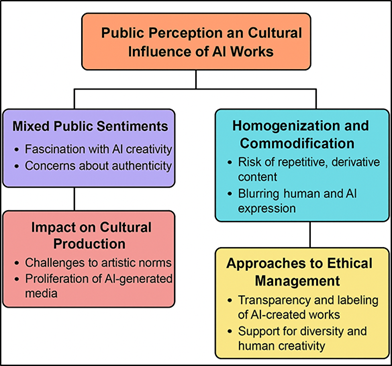
automated synthesis becoming unclear. The way AI creativity is perceived by
society and how it is affected by culture is illustrated in Figure 3. Moreover, AI application to the cultural heritage
reproduction and digital restoration evokes ethical concerns regarding
authenticity and ownership, as well as historical interpretation.
Figure 3
|
Figure 3 Model of Cultural and Public Responses to AI Creativity |
AI can be culturally used as a
reflector and a generator, as on the one hand, it reflects all the values of
society in the training data, and on the other hand, it creates new aesthetic
standards. It has an effect on creativity that goes beyond art into politics,
education, and entertainment and changes the perception of creativity itself.
Ethical AI use in culture should thus strive to enhance transparency,
inclusivity and respect to diversity whereby technology should not take the
culture away but should enhance it.
6. Frameworks for Ethical Management
6.1. ETHICAL DESIGN PRINCIPLES FOR AI
DEVELOPERS
The ethical management of digital works
created with the help of AI starts with the responsible design practice at the
developmental stage. The developers of AI have a central role in ensuring that
the systems they develop have moral values and social responsibility.
Principles of ethical designs should act as guiding principles and these
include fairness, accountability, transparency, and respect to human autonomy.
The value sensitive design should be an important consideration of developers
so that the algorithms capture ethical considerations and cause minimal harm.
Human-centricity is a key concept in the design of AI systems, and AI systems
must support human creativity rather than destroy it. The developers need to
have measures against bias to curate and represent the data and perform
fairness tests. Also, the traceability and accountability are encouraged by
clear documentation of the data sources and model behavior. The
interdisciplinary teams, which are made up of ethicists, artists and social scientists,
in the development process will also guarantee that technical innovation is not
lightened by ethical reasoning. Creative applications of AI must have built-in
consent-informed systems to confirm the authenticity of the training data to
avoid using copyrighted or personal data. It is also the responsibility of
developers to create AI-based systems that would be sensitive to cultural
diversity and not to homogenize the expression of creativity.
6.2. ROLE OF TRANSPARENCY, AUDITING, AND
ACCOUNTABILITY SYSTEMS
Ethical governance on the foundation of
AI-generated creativity lies in the system of transparency, auditing, and
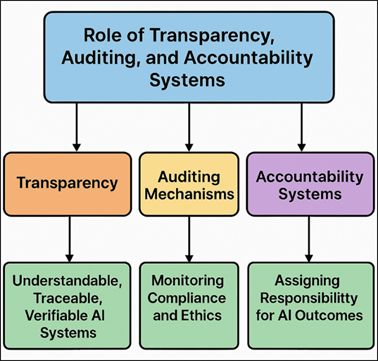
accountability. Transparency will mean that the AI systems are operated in a
way that is understandable, traceable, and verifiable which will enable
stakeholders to understand how outputs are generated and on what data they are
based. Users and audiences are able to make judgments of authenticity and
trustworthiness when they are aware that a particular piece of content is
AI-generated. Extensive auditing systems are also important to ensure that
ethical and legal practices are adhered to.
Figure
4
|
Figure 4
Multilayered
Structure for Transparent and Accountable AI Practices |
Algorithms audits may produce biases,
copyright infringements, or unethical data practices in AI systems that can be
detected through regular algorithmic audits. Developers and independent
third-party evaluations of the internal audits serve to keep the credibility
and trust of the population. Figure 4 illustrates the built layers of
transparency, auditing and accountability in AI. Furthermore, the transparency
of information about the source of data, the updating of the model, and risk
analysis should be provided in the form of transparency reports that will
increase accountability and social responsibility. The accountability systems
specify the responsibility owners of AI-generated results. Having distinct
roles defined between developers, platform providers and users would guarantee
that liability may be shared equally in case of misuse or damage. Ethical
responsibility ought to be taken to a higher level and that is the level of
moral responsibility, which is based on adhering to justice, respect, and human
dignity.
7. Future Directions and Recommendations
7.1. ETHICAL STANDARDS FOR AI CREATIVITY
It is important to develop ethical
guidelines that will regulate AI creativity to make sure that technological
innovation should be aligned with human values and cultural integrity.
Increasing the involvement of AI in the production of art, literature, and
media, it is necessary to have universal ethical standards governing the
design, implementation, and use of AI. These standards must be independent of
falsehood and bias, and should respect humanity and authorship, as well as
encourage inclusiveness and social accountability. A set of ethics should
underline the anthropocentricity of creativity- it should be made clear that AI
is not to substitute human imagination but to enhance it. Data integrity is
also a subject of standards required of AI systems which must be based on the
legally and ethically obtained material, the consent and copyright of which is
respected. There should be standardized mechanisms of proper attribution and
recognition of human and machine input in the creative sectors. International
community bodies like UNESCO, WIPO and ISO can be at the forefront of codifying
international ethical standards to facilitate international cooperation and
harmonization of the law.
7.2. POLICY SUGGESTIONS FOR FAIR AND
RESPONSIBLE INNOVATION
Policy frameworks are very important in
creating a responsible and fair environment of AI-driven innovation.
Governments and other international organizations should implement progressive
policies that balance innovative freedom and responsibility as well as
protection of human rights. Meanwhile, one of the priorities of the policy
should be to make the intellectual property laws clearer to accommodate
AI-generated works and ensure that the human authorship is not violated and
that the creators are not exploiting the data. Ethical data governance should
also be promoted by the policy makers, requiring that the collection of the
data, consent mechanism, and the decision-making with the help of the
algorithms are made transparent. The democratization of access to the
innovative technologies by the large corporations can be achieved through
incentivizing open-source AI projects and equal-footing data-sharing platforms.
Moreover, the governments ought to invest in ethical AI and creative workforce
displacement and cultural protection research. Accountability AI regulations
defining the responsibility of developers, users, and organizations will allow
responsible AI usage and avoid misuse, including the production of plagiarism
or deepfakes. Having public labeling of AI-generated material would also serve
to increase transparency and awareness of the audience.
7.3. RESEARCH NEEDS AND INTERDISCIPLINARY
COLLABORATION
The ethical management of AI-generated
digital art in the future relies on the high-quality research and collaboration
between disciplines. The art, technology, ethics, and law have an intersection
that requires a comprehensive approach that cannot be accomplished by any
individual discipline. To create the frameworks that would focus on the moral,
cultural, and societal implications of the AI creativity, the cooperation of
computer scientists, ethicists, legal scholars, social scientists, and artists
is crucial. Research must be focused on the explainable and interpretable AI
which would allow transparency in creative processes and accountability.
Research of bias reduction, data ethics, and cultural representation in
AI-generated content is also essential. Additionally, equitable and inclusive
policy formulation can be made based on sociological studies on how AI changes
creative identity, perception by the audience, and artistic work. The
innovation that should be encouraged in academic and industry partnerships must
be in line with the moral values that is, with the help of joint laboratories,
grants, cross-sector think tanks directed at responsible AI. International
cooperation can be used to create common standards and best practices
especially in intellectual property reform and in ethical use of data.
8. Conclusion
One of the most significant challenges and opportunities of the twenty-first century is the ethical management of the AI-produced version of digital works. With the continued development of artificial intelligence as a creative partner and a technological disruptor, humanity will also have to redefine the traditional concepts of authorship, creativity, and ownership. Although the ability of AI to produce art, literature, and design helps broaden the scope of human imagination, it also reveals the weaknesses of human law, ethics, and society that were never intended to accommodate the non-human creator. The challenges that are being faced need to be addressed in a multidimensional approach, based on fairness, transparency, accountability and respect of the human dignity. Making AI responsible, meaning designing it to be value-sensitive, practicing data ethically by consent, and creating equitable relationships with creative technologies should be ethical management. The legal changes are necessary to enlighten the ownership and attribution of AI-generated works, between innovation and safeguarding human creators. Organizations and companies need to develop a system of governance that would be transparent, audited, and accountable in terms of ethics throughout the lifecycle of AI. No less significant are cultural and societal aspects. The artificial creativity produced by AIs must add value to human creativity, not substitute it, and inclusivity and diversity of digital art should be promoted
CONFLICT OF INTERESTS
None.
ACKNOWLEDGMENTS
None.
REFERENCES
Acquaviva, V., Barnes, E. A., Gagne, D.
J., McKinley, G. A., and Thais, S. (2024). Ethics
in climate AI: From Theory to Practice. PLOS Climate, 3, e0000465.
Benanti, P. (2023). The Urgency of an Algorethics. Discover Artificial Intelligence, 3, 11.
Bartlett, R., Morse, A., Stanton, R., and Wallace, N. (2022). Consumer-lending Discrimination in the FinTech era. Journal of Financial Economics, 143, 30–56.
Casalone, C. (2020). Una Ricerca Etica Condivisa Nell’era Digitale. La Civiltà Cattolica,
2, 30–43.
De Mauro, A., and Pacifico, M. (2024). Data-Driven Transformation: Maximise Business Value with Data
Analytics (The FT Guide). FT Publishing.
Feuerriegel, S., Hartmann, J., Janiesch,
C., and Zschech, P. (2024). Generative AI. Business
and Information Systems Engineering, 66, 111–126.
Giudici, P., Centurelli, M., and
Turchetta, S. (2024). Artificial Intelligence Risk
Measurement. Expert Systems with Applications, 235, 121220.
Hill, D., O’Connor, C. D., and Slane, A.
(2022). Police Use of Facial Recognition
Technology: The Potential for Engaging the Public Through Co-Constructed
Policy-Making. International Journal of Police Science and Management, 24,
325–335.
Kshetri, N. (2024). Economics of Artificial Intelligence Governance. Computer, 57,
113–118.
Krishnapriya, K. S., Vítor, A., Kushal, V., Michael, K., and Kevin, B. (2020). Issues Related to Face Recognition Accuracy Varying Based on Race and Skin Tone. IEEE Transactions on Technology and Society, 1, 8–20.
Li, F., Ruijs, N., and Lu, Y. (2023). Ethics and AI: A Systematic Review on Ethical Concerns and Related Strategies for Designing with AI in Healthcare. AI, 4, 28–53. https://doi.org/10.3390/ai4010003
Morley, J., Elhalal, A., Garcia, F., Kinsey, L., Mokander, J., and Floridi, L. (2021). Ethics as a Service: A Pragmatic Operationalisation of AI Ethics. Minds and Machines, 31, 239–256. https://doi.org/10.1007/s11023-020-09531-3
Murphy, K., Di Ruggiero, E., Upshur, R., Willison, D. J., Malhotra, N., Cai, J. C., Lui, V., and Gibson, J. (2021). Artificial Intelligence for Good Health: A Scoping Review of the Ethics Literature. BMC Medical Ethics, 22, 14. https://doi.org/10.1186/s12910-021-00589-0
Novelli, C., Casolari, F., Rotolo, A., Taddeo, M., and Floridi, L. (2024). Taking AI Risks Seriously: A New Assessment Model for the AI Act. AI and Society, 39, 2493–2497. https://doi.org/10.1007/s00146-023-01772-4
Ricciardi Celsi, L. (2023). The Dilemma of Rapid AI Advancements: Striking a Balance between Innovation and Regulation by Pursuing Risk-Aware Value Creation. Information, 14, 645
Rhim, J., Lee, J.-H., Chen, M., and Lim, A. (2021). A Deeper Look at Autonomous Vehicle Ethics: An Integrative Ethical Decision-Making Framework to Explain Moral Pluralism. Frontiers in Robotics and AI, 8, Article 2021. https://doi.org/10.3389/frobt.2021.702843
Tang, L., Li, J., and Fantus, S. (2023). Medical Artificial Intelligence Ethics: A Systematic Review of Empirical
Studies. Digital Health, 9, 20552076231186064. https://doi.org/10.1177/20552076231186064
Van Wynsberghe, A. (2021). Sustainable AI: AI for Sustainability and the Sustainability of AI. AI and Ethics, 1, 213–218. https://doi.org/10.1007/s43681-021-00024-1
|
|
 This work is licensed under a: Creative Commons Attribution 4.0 International License
© ShodhKosh 2024. All Rights Reserved.