ShodhKosh: Journal of Visual and Performing ArtsISSN (Online): 2582-7472
|
|
Impact of AI Tools on Artistic Skill Development in Sculpture
Rashmi Manhas 1 , Dr. Aarti Suryakant Pawar 2
 ,
Prateek Aggarwal 3
,
Prateek Aggarwal 3 ,
Ish Kapila 4
,
Ish Kapila 4 ,
Sunitha B J 5
,
Sunitha B J 5 , Dr. Yogesh
Jadhav 6
, Dr. Yogesh
Jadhav 6
1 Assistant
Professor, School of Business Management, Noida International University
203201, India
2 Department,
Electronics and Telecommunication, Pimpri Chinchwad College of Engineering, Pune,
Maharashtra, India
3 Chitkara Centre for Research and Development, Chitkara University,
Himachal Pradesh, Solan, 174103, India
4 Centre of Research Impact and Outcome, Chitkara University, Rajpura- 140417, Punjab, India
5 Assistant
Professor, Department of Computer Science and Engineering, Presidency
University, Bangalore, Karnataka, India
6 Associate Professor, UGDX School of Technology, ATLAS Skill Tech
University, Mumbai, Maharashtra, India
|
|
|
ABSTRACT |
|
|
The swift
development of artificial intelligence (AI) has brought about revolutionary
possibilities to sculpture practice transforming how artists conceptualize,
design, and make three-dimensional pieces. The paper explores how AI-related
devices are affecting the development of artistic skills in the field of
sculpture and how they are affecting the established artisanal abilities as
well as the new digital skills. The research analyzes the application of the
current sculptural workflow through the integration of technologies into it,
including generative design, 3D model, and robotic fabrication. The results
have emphasized that the conceptual skill development through AI tools is
increased because of the ability to prototype more quickly, visual experimentation
is extended, and complex geometries that are hard to build manually can be
explored. Nevertheless, there is a growing concern about the practice of
maintaining tactile skills, material sensitivity and embodied knowledge that
is believed to be part of sculptural practice as a result of the growing
dependence on digital assistance. According to the interviews and case
studies, a significant portion of artists do not consider AI as a substitute
but as a partner that enables a person to expand creativity and facilitates
the decision-making process. The research has also established significant
consequences to the art education field in that it is necessary to update the
curricula to include a balance between digital literacy and manual skills. On
the one hand, AI is a chance of innovation and, on the other hand, a
challenge that emerging artists have to adapt to the fast-changing
technologies. |
|||
|
Received 29 January 2025 Accepted 20 April 2025 Published 16 December 2025 Corresponding Author Rashmi
Manhas, rashmi.manhas@niu.edu.in DOI 10.29121/shodhkosh.v6.i2s.2025.6719 Funding: This research
received no specific grant from any funding agency in the public, commercial,
or not-for-profit sectors. Copyright: © 2025 The
Author(s). This work is licensed under a Creative Commons
Attribution 4.0 International License. With the
license CC-BY, authors retain the copyright, allowing anyone to download,
reuse, re-print, modify, distribute, and/or copy their contribution. The work
must be properly attributed to its author.
|
|||
|
Keywords: Artificial Intelligence in Art, Sculpture, Skill Development, Generative Design, Robotic Fabrication, Digital Art Tools |
|||



1. INTRODUCTION
Creativity,
materiality and craftsmanship have always characterized the sphere of
sculpture. Historically, the art of sculpture has posed great dependence on the
hands-on abilities and tactile instincts with a close knowledge of the material
of sculpture like clay, stone, metal and wood. The identity of the sculptors
was achieved by several years of strict training as they not only perfected
their technical skills but also their conceptual ones. Nevertheless, with the
fast development of digital technologies, especially artificial intelligence
(AI), the field of modern art is changing, with new tools, processes, and means
of expression, questioning established standards. Over time, with the rising
role of AI in practice in the creative sector, the impact of these technologies
on sculptural practice is an increasingly significant topic of scholarly
discussion, given that they challenge both the way creative abilities are
exercised and the overall creative process. Artificial intelligence can now
assist in a full variety of sculptural tasks, including initial idea
generation, through to intricate production. Machine-learned generative design,
algorithmic modeling, robotic milling, and automated 3D printing have created
new possibilities and opportunities to artists in creating complex forms
previously unimaginable or impossible to create by hand Chen (2024). The formal
possibilities of sculpture have been expanded by these digital interventions as
well as the skills sets of contemporary sculptors have been transformed. The
artists are no longer expected to operate using the manual hand dexterity but
rather come out more digital and be able to achieve the skill of computing and
be able to work together creatively with the smart tools. This transformation
brings up some of the most basic questions of how artistic skill is changing,
how people attach importance to the skills of being a traditional craftsman,
and how human agency is a part of the process of creating something through
technology Li et al. (2024).
Simultaneously,
the introduction of AI into the sculpture has made the question of the
authenticity and authorship of art controversial. Other critics claim that the
use of automated or algorithmically generated work can reduce the role of the
artist, possibly substituting the use of touch with machine work. On the other
hand, the advocates of the use of AI in sculpture claim that they can be
creative collaborators that enhance the imagination of the artist and allow
them to express themselves in novel ways instead of eliminating old talents.
These opposing views are important in assessing the true role of AI in the
growth of artistic abilities especially at the time the technology is still in
its progress and becoming more sophisticated Li and Zhang (2022). Furthermore,
AI is important in modern sculpture not just in professional practice but also
in the learning and teaching environment. Schools of art, training programs,
and universities are looking at incorporating digital tools into their
curriculum that raises the question of what sculptural training should be all
about in the twenty-first century. Following the engagement between students
and AI-driven systems, the process of learning, skill acquisition, and creative
independence is formed in new ways. This educational change is an indicator of
the necessity of a middle ground between the maintenance of manual skills that
are traditional and the novel possibilities of new technologies Wang et al. (2024). Since the
aspects of AI are spreading fast in creative sectors, it is urgent to conduct
systematic research that looks at the effects these tools have on the
development of artistic skills in the field of sculpture.
2. Literature Review
2.1. HISTORICAL EVOLUTION OF SCULPTURAL ART AND TECHNOLOGY
Sculptural
art has a strong history of change in line with the technological progress that
has influenced the expression of art and material options in history. The
sociocultural and spiritual values of the ancient societies manifested in the
early forms of sculptural practices which resulted out of the primitive tools
that were used to cut stone, bone and wood. Since the colossal stone figures of
Mesopotamia and Egypt, to the fine marble figures of Classical Greece,
sculpture advanced along with advances in metallurgy, quarrying, and toolmaking
Xu (2024). The
Renaissance period saw the advancement of technology in the fields of
perspective, casting, and study of the anatomy to create very realistic and
expressive forms made by the artists such as Michelangelo and Donatello, which
are the crucial step towards the humanistic depiction. The Industrial
Revolution also changed sculpture with mechanization, the appearance of new
alloys and mass-production, greatly increasing the scope of experimentation
with materials Hafiz et al. (2021). During the
twentieth century, there was the emergence of modernist and postmodern in art
whereby artists adopted industrial materials like steel, plastic, and found
objects, redefining boundaries between art, engineering, and design. The end of
the twentieth and the beginning of the twenty-first centuries brought a novel
paradigm to the sculptural practice due to the advent of digital technologies:
specifically, computer-aided design (CAD), 3D modeling, and additive
manufacturing. Such tools enabled form-making precision, scaling and intricacy
never before seen Niu et al. (2021).
2.2. OVERVIEW
OF AI APPLICATIONS IN VISUAL AND PERFORMING ARTS
The
concept of artificial intelligence has quickly evolved into a disruptive
element in visual and performing arts, offering opportunities to communicate
and express oneself in new ways and reinventing the culture of art. Artificial
intelligence (AI) in visual arts Generative adversarial networks (GANs), neural
style transfer, and machine-learning-based image synthesis AI-driven tools can
enable artists to create new compositions in visual arts, reinterpret old
works, and experiment with intricate visual patterns Brauwers and Frasincar (2021). These systems
examine vast collections of artistic image material and train to learn
stylistic elements which can be rearranged in novel manners. Through this,
artists will be able to play with aesthetics that is not tied to the
limitations of the manual methods and combine human imagination and computer
abilities. Artificial intelligence is also applied in performing arts to design
choreography, produce sound, create interactive installations, and augment
real-time performance Rodriguez et al. (2019).
Machine-learning algorithms have the potential to generate movement patterns,
aid dancers to discover new choreographic opportunities, or dynamically respond
to motions made by performers by changing lighting and sound. In music, AI
helps to compose, improvise and arrange music, allowing people to collaborate
with intelligent systems in music. Also, AI-based motion tracking and VR have
pushed theater and dance limits and offered immersive experiences and
physical-digital experiences Liu et al. (2021).
2.3. PRIOR
STUDIES ON DIGITAL TOOLS IN SCULPTURE
Digital
tools in sculpture have been studied in greater depths within the last 20
years, as the use of computational technologies in the creation of sculptures
has been increased. Initial research was done on computer-aided design (CAD)
and 3D modeling, investigating the effectiveness of this technology in
increasing accuracy, simplifying complex geometry, and making prototyping
faster. Researchers pointed out that digital modeling allowed sculptors to
abandon the physical process of work to a hybrid process of experimentation in
a computer and fabrication in reality Cai and Wei (2020). This change
brought about research into the manner in which artists bargain between digital
and manual abilities in developing modern sculptures. Further work was done on
additive and subtractive methods of manufacturing including 3D printing, CNC
milling, which have been overtaken as the focus of a number of studio
practices. Research emphasized that these technologies enable high-levels of
customization and scalability and can be used to create sculptures that were
once overly complex or labour intensive to make by hand Zhao et al. (2021). Scientists
also studied the impact of digital fabrication on the art authorship which
provokes a controversy regarding the place of machines in the creative process.
Table 1 is an overview of the major research
describing the changing impact of AI on sculpture. The newer research examines
AI-based tools, including generative design algorithms and robotic sculpting
systems. The research articles highlight how machine learning can be
transformative with regard to ideation, form generation, and automation.
Table 1
|
Table 1 Summary of Literature Review |
||||
|
Technology
Used |
Methodology |
Domain |
Limitations |
Relevance
to Sculpture |
|
AI
generative algorithms |
Case
study |
Digital
artists |
Limited
to digital forms |
Shows
potential for generative sculpture |
|
Machine
learning Xue et al. (2020) |
Experimental |
Media
artists |
Requires
high computational resources |
Demonstrates
AI’s aesthetic influence |
|
Robotic
arms |
Practice-based |
Hybrid
artists |
High
learning curve |
Relevant
for robotic sculpting integration |
|
AI
+ 3D printing Walczak and Cellary (2023) |
Mixed-method |
Design
labs |
Not
sculpture-specific |
Suggests
new fabrication workflows |
|
Neural
modeling tools |
Survey
+ testing |
Designers |
Reduces
manual engagement |
Supports
conceptual skill enhancement |
|
CAD
modeling |
Interviews |
Sculptors |
Less
tactile experience |
Bridges
digital + manual skills |
|
CNC
robotic tools |
Field
study |
Stone
sculptors |
High
equipment cost |
Direct
application in stone carving |
|
Adaptive
learning systems |
Experimental |
Art
students |
Limited
artistic nuance |
Shows
educational impact |
|
3D
scanning + AI Kalniņa et al. (2024) |
Practice-based |
Contemporary
artists |
Tools
require training |
Relevant
for traditional–AI integration |
|
Digital
tool adoption |
Survey |
Early-career
artists |
Reduced
manual skill focus |
Supports
skill adaptation analysis |
|
AI
material prediction |
Lab
testing |
Sculptors
and designers |
Not
expressive-focused |
Useful
for material experimentation |
|
AI
suggestion tools |
Experimental |
Students |
Risk
of dependency |
Links
to conceptual development |
|
Generative
AI |
Qualitative |
Professional
artists |
Ambiguity
in authorship |
Supports
autonomy vs replacement debate |
3. Methodology
3.1. RESEARCH
DESIGN (QUALITATIVE, QUANTITATIVE, OR MIXED METHODS)
This
paper will use a mixed-methods research design because it will study the
effects of AI tools on the development of artistic skills in the field of
sculpture. The mixed-methods approach is a specifically appropriate method
since it combines the richness of qualitative understanding with the
quantifiable trends that can be achieved through quantitative data. To study
the live experience of sculptors, perceptions, and creative processes when they
operate with AI-driven tools, qualitative methods are appropriate. Interviews,
case studies and observed data offer deeper insights into the way artists are
striving to find the balance between using traditional craftsmanship and the
digital innovation. Simultaneously, quantitative data collection techniques, including
structured surveys and the rating scale, provide the possibilities of
evaluating more extensive trends in the usage of tools, the development of
skills, and attitudes towards AI among different groups of sculptors and
digital artists. The statistical data and a thorough narrative description
allow approaching the conceptual analysis of the impact of AI on conceptual
thinking, craftsmanship, and decision-making in the art of sculptures as a
whole. Triangulation can also be supported by this type of hybrid design, which
will increase the validity of the results obtained because the results will be
compared across various data sources. The mixed-methods framework is also
explained by the fact that the topic of the research is interdisciplinary
because it lies on the boundaries of art, technology, and education. The role
of AI in the development of art is multi-sided, which is why the methodological
openness of mixed methods makes it possible to delve into the issue
exhaustively and comprehensively.
3.2. DATA
COLLECTION METHODS
In
order to explore the impact of AI technologies on the development of artistic
skills in the sphere of sculpture, the research utilizes four main data
gathering techniques: the interviews, surveys, case studies, and direct
observation. These complementary techniques make sure that there is depth,
accuracy and richness of the context. The interviews with sculptors, digital
artists, educators, and developers of AI-tools give a thorough description of
the personal experience, creative issues and changing skills demands. The
semi-structured types of interviews will provide these participants with an
opportunity to discuss their artistic process and allow the researcher to
discuss certain topics concerning the integration of AI. A larger group of
participants is selected to complete surveys to provide a general attitude,
regularity of using AI tools, perceived benefits, and concerns. Surveys enable
the gathering of measurable information that can identify trends and
distinctions between the various groups of demographics, skills, and artistic
backgrounds. Case studies are dedicated to some artists who already use AI
technologies in their sculptures: generative design or robotic fabrication.
Their descriptions of their workflows, project results and reflective experiences
give real-world illustrations of how AI is changing the process of creating and
developing skills, both creative and technical.
3.3. SAMPLE SELECTION: SCULPTORS AND DIGITAL ARTISTS
The group of participants in this research is
sculptors, digital artists, and hybrid practitioners who use AI tools of
different degrees of expertise. Purposive sampling strategy is used to ensure
that participants with experiences directly relating to the research objective
are used. In this way, the study will be able to focus on the different views
of artists who operate in the traditional, digital, and interdisciplinary
environments.
Participants
include:
Traditional
sculptors moving to the digital process will offer their perspectives on how AI
transforms the established craftsmanship.
·
Digital modelers and sculptors who mostly use computer software
and computer-generated methods.
·
Artists who actively incorporate AI, e.g. through generative
design algorithms, machine-learning-supported modeling or robotic fabrication.
·
Educators of art and workshop teachers who know how to train the
upcoming artists in both relative and digital methods.
The
sample is expected to be balanced between depth and diversity, and it is
usually 12 to 20 interview participants and 50-100 respondents in surveys. It
is also claimed that geographic diversity is used to indicate international
differences in access to digital technologies.
4. The Role of AI Tools in Sculpture
4.1. TYPES OF AI TOOLS USED IN SCULPTURAL PROCESSES
4.1.1. 3D modelling
One
of the most popular AI-enhanced tools of the sculptural practice in the
present-day context is 3D modeling. These systems enable artists to model and
manipulate complicated forms in a virtual space and then transfer them into the
physical sculptures. Through artificial intelligence-based 3D modeling
applications, including Autodesk Fusion 360, Blender combined with AI plug-ins,
and ZBrush with machine-learning-based added functionalities, sculptors receive
assistance in repetitive computations, forming a design anticipating change,
and refining a shape intuitively with smart programming.
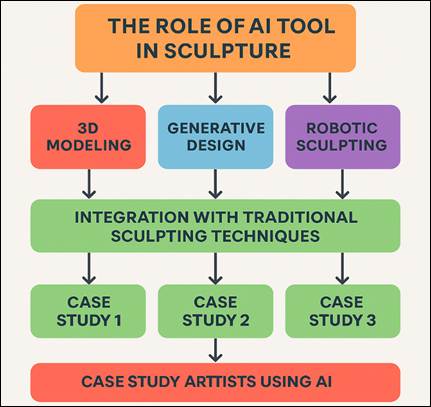
Figure 1
|
Figure 1 System Architecture of AI Applications in Sculptural Art |
AI-powered
models help artists to experimnt with iterative changes faster, save time on
manual adjustments and increase the accuracy on the whole. In sculpture, AI
combines design, fabrication, and creative as illustrated in Figure 1. Among the main benefits of AI-aided 3D
modeling, one may note the possibility to create a high-resolution mesh,
identify weak points of the structure, and streamline forms to be fabricated.
This is especially useful in creating complex or geometrical complex sculptures
that would otherwise be hard to imagine and carve by hand.
4.1.2. Generative Design
Generative
design is an artificial intelligence design technique that allows artists to
model sculptural form by exploring algorithmic designs instead of hand
modeling. Generative design systems, which are developed with the help of
machine-learning techniques, include generative design instruments, such as
Autodesk Generative Design, Grasshopper plug-ins, and neural networks that
generate a variety of design options, provided that the user sets the
parameters, which can be shape constraints, material behavior, structural
needs, and aesthetic objectives. This gives sculptors a lot of room to
experiment and many can be even beyond the means of human imagination or
craftsmanship. Generative design is primarily optimized, and its main asset is
that it generates a very high level of optimization as well as novel
geometries. The system is able to take into consideration baselines ideas and
improve them repeatedly by enabling artists to provide solutions that expose
new space relationships, flow schemes or organic shapes. The resulting
collaborative process changes the role of the artist to one of creative
decision-maker rather than manual form-maker and is selective and evaluative of
the results of the computationally generated output.
4.1.3. Robotic Sculpting
Robotic
sculpting is a technique of physically creating sculptures using high degrees
of accuracy and uniformity through the use of AI-controlled robotic arms, CNC
milling machines and automated carving systems. Such systems read the digital
models and convert them into material-removal or additive techniques and allow
the creation of complicated forms that can be either labor-intensive or even
impossible to do by hand. The improvements of robotic sculpting with AI allow
making changes in real time, optimizing toolpath, and making decisions based on
material response. Modern-day robotic sculpture is applied with numerous
substances such as stone, wood, foam, and clay. Sensors and machine-learning
algorithms can be installed on robots that monitor the changes in material
density, avoid structural weaknesses and be very precise in refining the
details. This both saves on human manpower and enhances the practicality of
large projects or highly detailed projects. Robot systems can increase the
scale, speed, and precision of artists, which gives them time to concentrate on
the development of concepts and the final details.
4.2. INTEGRATION OF AI WITH TRADITIONAL SCULPTING TECHNIQUES
By combining AI and traditional sculptural
techniques, a new artistic environment has emerged with manual crafts and
computer intelligence existing in harmony. Instead of superseding the classical
processes, AI tools are frequently augmented to the creative process of the
sculptor to allow the sculptor to think, sharpen ideas and execute them more
efficiently and accurately. Sculptors more often than not start with hand-drawn
sketches or clay maquettes, which are digitized through 3D scanning technologies.
These forms are then developed by AI-generated modeling software that gives
these forms alternative forms, better structure, or refined surface details.
This virtual refinement is a complement to the feel intuition that the
sculptors achieve after many years of material interaction. When a digital
model is complete, artists can use robotic fabrication or 3D printing to create
crude forms, and then work on them by hand. The repetitive process ensures the
sculptor is important in determining the final aesthetic and uses AI to perform
complex or repetitive tasks. Conservative processes like chiseling, carving,
patination and surface finishing are also at the heart of the creative identity
of the piece of art, as the human touch has been maintained.
5. Impact on Artistic Skill Development
5.1. Enhancement of conceptual and design skills through AI
AI tools can also greatly improve the
conceptual and design abilities of sculptors by broadening the cognitive and
creative structures in which artists would be operating. More conventionally,
the concept stage of sculpture had always been one of sketching, modelling, and
material exploration, which was time consuming and creative. These initial
phases are speeded up and enriched with AI by providing quick prototyping,
iterative visualization, and generative opportunities, which are not
constrained by the scope of manual ideation. With the use of AI-based modeling
platforms, artists can experiment with their form, structure, and the use of
space freely to create hundreds of design variants within a few minutes.
Moreover, AI as a tool of analyzing patterns, recreating physical actions, and
offering alternative solutions stimulates artists to be thinking critically and
strategically about their work. This promotes an insight into structure logic,
geometry, and interaction of materials. To young sculptors, AI is an effective
learning platform where they can experiment with new sophisticated idea-like
parametric design, organic form driven by data, and aesthetics based on data.
They do not need the technical constraints traditionally linked to these
approaches. With less cognitive load on complicated calculations and repetitive
modeling processes, AI frees sculptors to be able to explore creatively and
focus on narrative purpose. Conceptual thinking becomes, therefore, broader in
scope, experimental and interdisciplinary.
5.2. Changes in Manual Craftsmanship and Tactile Engagement
The introduction of AI technology into the
practice of sculpture cannot but have a certain impact on handcrafting and
haptic experience, which are two elements of the traditional sculpture.
Although AI can make the process more precise and efficient, it can take away
the time artists spend on the actual use of materials. Sculptural processes
like robotic milling, AI-assisted modeling, and automated 3D printing remove
much of the traditional sculptural process and interaction with tools by hand.
Consequently, there is a notion among some artists that the dependence on
digital tools will reduce the richness of material knowledge, embodied skill,
and sensual awareness accrued by practicing something through physical means.
But the shift does not always mean that the craftsmanship is lost but it is
changed instead. Modern sculptors tend to resurrect manual methods when
finishing - sanding, beat beating, or assembling pieces created by AI. This
mixed process of work preserves the tactile experience of the work and
redistributes the human or manual labor to shape expression instead of the
laborious formulation. Also, artists note that AI will be able to work on
technical aspects and, therefore, give them greater opportunities to devote
more time to aesthetic decisions, experiment, and details of craftsmanship.
5.3. Influence on Creative Decision-Making and Artistic Autonomy
The use of AI tools in the creative
decision-making process of sculptors is becoming an even more significant
issue, which also leads to critical questions concerning the autonomy of art.
Historically, the choices of sculpture; be it the form creation, or the choice
of material, were all born out of the intuitiveness, artistry, and esthetic
judgment of the sculptor.
Figure 2
|
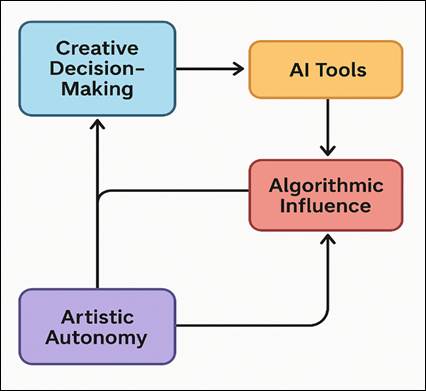
Figure 2 Interaction Between AI Tools, Decision-Making, and Artistic Autonomy |
The decision-making space will be more
participatory yet more complicated with the possibility of AI systems to
produce design alternatives, propose optimizations, and forecast the outcomes. Figure 2 indicates that AI impacts creative
decisions and defines artistic freedom. AI opens up new avenues which might not
have been discovered by hand research alone and artists reconsider, refine or
remake computational proposals.
5.4. Incorporation of AI tools in art education curricula
The
inclusion of AI technologies in art education programs is gaining more and more
importance as the modern sculptural process is becoming oriented towards hybrid
digital-physical processes. It is now understood in the art institutions that
training students to be prepared in the future of the creative industries is by
not only imparting traditional craftsmanship, but also by imparting digital
literacy. When the AI is being introduced in the sculpture programs, the main
issue is not the mere addition of new software, but the need to redesign the
pedagogy so that conceptual exploration, technical mastery, and critical
approach to the new technologies are balanced. It is possible to add courses
about AI-assisted 3D modeling, generative design principles, applications of
machine-learning, and robotic fabrication processes so that students could
learn how a computational system can affect the design-to-production pipeline.
The educators should also deal with ethical and theoretical aspects of AI in
arts such as authorship, originality, and human agency. Figure 3 demonstrates that the AI tools can be incorporated
into the art education systems. Through the establishment of a discourse over
these topics, the students would be taught how to critically examine the
relationship that they have with technology.
Figure 3

|
Figure 3 Structure of AI Tools Implementation in Art Education |
Moreover, the process of curriculum
development cannot take place without interdisciplinary cooperation, where the
knowledge of computer science, engineering, and digital media is involved to
enhance the learning process of students. In-person studio activities, where AI
generated designs are presented in conjunction with more conventional sculpting
methods, contribute to a more all rounded skill set of students as well.
Incorporating such tools into the institutions, accessibility must also be
evaluated by making the use of sufficient software, fabrication equipment, and
technical support.
5.5. Challenges and Opportunities for Emerging Artists
New artists face certain threats and
prospects in a new phase in the development of AI technologies because they
transform the sculptural environment. A technical barrier to entry can be
identified as one of the primary issues: the learning process to apply
AI-assisted modeling, use generative systems as well as robotic fabrication
takes time, resources, and the availability of specialized tools. Learners and
novices in the field can be encountering institutional or economic obstacles
that inhibit access to sophisticated equipment. The danger of excessive
dependence on AI is another risk that can decrease the building of basic manual
skills or homogenization of artistic styles due to the tendency towards
algorithms. Nevertheless, AIs can benefit the young sculptors despite these
challenges. The use of AI allows young artists to rapidly prototype,
experiment, and visualize ideas without large physical resources because this
technology makes it fast, effortless, and painless to develop. They are also
showing them new forms of aesthetics and structural innovations, opening up
their creative horizons as shown by generative design platforms.
6. Result and Discussion
The
findings show that AI tools play an important role in developing sculptural
skills because they increase the ability of concepts and redirect more of the
time-honored craftism towards more hybrid digital-manual processes. The artists
claimed to have better design efficiency, design structural exploration, and
explored creativity with the help of AI-assessed modeling and generative
algorithms. Nevertheless, the issue of loss of physical interaction and
possible reliance on computer-generated recommendations appeared. In general,
the discussion points out to a reciprocal relationship where AI becomes the
source of innovation and the challenge in which artists have to be able to
balance digital tools and manual skills.
Table 2
|
Table 2 Usage of AI
Tools in Sculpture Workflow (%) |
|||
|
AI
Tool / Process |
Low
Use (%) |
Moderate
Use (%) |
High
Use (%) |
|
AI-Assisted
3D Modeling |
12% |
35% |
53% |
|
Generative
Design Algorithms |
27% |
42% |
31% |
|
Robotic
Milling/Fabrication |
40% |
38% |
22% |
|
Material
Simulation Tools |
18% |
46% |
36% |
Table 2 data points out the unique trends in the usage of AI tools by
sculptors at various points of the creativity process. AI-based 3D modeling has
the greatest adoption rate with 53% of artists indicating that they frequently
use it. This shows that 3D modeling is now a ubiquitous element of contemporary
sculpture, probably because of its affordability, user-friendly features, and
the possibility to quickly visualize complicated shapes. Figure 4 indicates the difference in the use of AI
tools in the stages of sculpture workflow.
Figure 4

|
Figure 4 Usage Distribution of AI Tools Across Sculpture Workflow Stages |
Generative
design algorithms on the other hand have a more balanced distribution with 31%
high use and most (42%) reporting moderate use. This implies increased
curiosity about algorithmic creativity, but there are sculptors who could be
experimenting or learning on these tools. The use of AI tools layering during
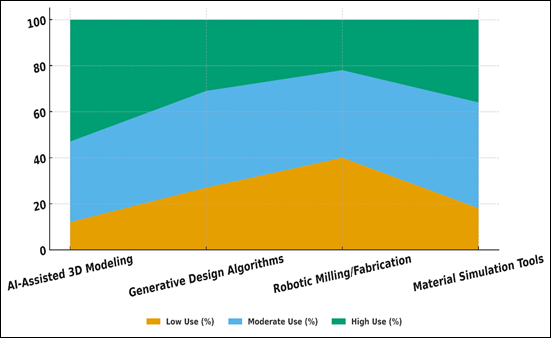
sculpture production is represented in Figure 5.
The lowest percentage of high-use (22%) is shown in robot milling and
fabrication, which have barriers in the form of cost, technical complexity and
lack of robotic equipment.
Figure 5
|
Figure 5 Layered Visualization of AI Tool Utilization in Sculpture Production |
Most
of the artists might use the conventional fabrication processes or outsource
robotic manufacturing. In the meantime, material simulation tools are highly
used (36% moderate, 46% high), which also demonstrates their importance in the
ability to predict structural behavior and minimise material wasteage.
7. Conclusion
The introduction of artificial intelligence into the modern sculptural art is a turning point in the history of the development of the artistic skills. The technical and conceptual possibilities of artists have been expanded due to the AI tools, including generative design systems, and robotic fabrication. This study shows that AI contributes to creative ideation, speeding up the work of prototyping, and enabling the creation of more complex shapes than was possible before. Consequently, sculptors can challenge the conventional boundaries, experiment with new aesthetic words, and use experimental processes that debrief the conventional ideas of artistry. Concurrently, the research has shown that such technological innovations should be adapted carefully. On the one hand, AI is truly beneficial; however, on the other hand, it confronts sculptors to keep their skills and the sense of materials and touch, which are the main aspects of sculptural identity. The equilibrium between the digital and offline approaches proves to be a decisive element in preserving the autonomy of art. Instead of replacing craftsmanship, AI transfers the role of a sculptor to the role of creative direction, critical assessment and hybrid practice. The school and workplaces will need to be adjusted and change towards a more AI literate training where the previously existing manual skills would not be lost, but would be included in the training programs. On the one hand, AI offers a great opportunity to new artists: it can be used as a potent innovation engine, and it asks them to constantly learn both in the artistic and technological arena.
CONFLICT OF INTERESTS
None.
ACKNOWLEDGMENTS
None.
REFERENCES
Brauwers, G., and Frasincar, F. (2021). A General Survey on Attention Mechanisms in Deep Learning. IEEE Transactions on Knowledge and Data Engineering, 35(4), 3279–3298. https://doi.org/10.1109/TKDE.2021.3126456
Cai, W., and Wei, Z. (2020). Remote Sensing Image Classification Based on a Cross-attention Mechanism and Graph Convolution. IEEE Geoscience and Remote Sensing Letters, 19, 1–5. https://doi.org/10.1109/LGRS.2020.3019755
Chen, Z. (2024). HTBNet: Arbitrary Shape Scene Text Detection with Binarization of Hyperbolic Tangent and Cross-entropy. Entropy, 26(7), 560. https://doi.org/10.3390/e26070560
Hafiz, A. M., Parah, S. A., and Bhat, R. U. A. (2021). Attention Mechanisms and Deep Learning for Machine Vision: A Survey of the State of the Art. arXiv. https://arxiv.org/abs/2106.07550
Kalniņa, D., Nīmante, D., and Baranova, S. (2024). Artificial Intelligence for Higher Education: Benefits and Challenges for Pre-service Teachers. Frontiers in Education, 9, 1501819. https://doi.org/10.3389/feduc.2024.1501819
Li, J., and Zhang, B. (2022). The Application of Artificial Intelligence Technology in Art Teaching Taking Architectural Painting as an Example. Computational Intelligence and Neuroscience, 2022, Article 8803957. https://doi.org/10.1155/2022/8803957
Li, J., Zhong, J., Liu, S., and Fan, X. (2024). Opportunities and Challenges in AI Painting: The Game Between Artificial Intelligence and Humanity. Journal of Big Data Computing, 2, 44–49.
Liu, Y., Shao, Z., and Hoffmann, N. (2021). Global Attention Mechanism: Retain Information to Enhance Channel-Spatial Interactions. arXiv. https://arxiv.org/abs/2112.05561
Niu, Z., Zhong, G., and Yu, H. (2021). A Review on the Attention Mechanism of Deep Learning. Neurocomputing, 452, 48–62. https://doi.org/10.1016/j.neucom.2021.03.091
Rodriguez, P., Velazquez, D., Cucurull, G., Gonfaus, J. M., Roca, F. X., and Gonzalez, J. (2019). Pay Attention to the Activations: A Modular Attention Mechanism for Fine-Grained Image Recognition. IEEE Transactions on Multimedia, 22(2), 502–514. https://doi.org/10.1109/TMM.2019.2928732
Walczak, K., and Cellary, W. (2023). Challenges for Higher Education in the Era of Widespread Access to Generative AI. Economic and Business Review, 9(1), 71–100. https://doi.org/10.15458/ebr.126
Wang, J., Yuan, X., Hu, S., and Lu, Z. (2024). AI Paintings vs. Human Paintings? Deciphering Public Interactions and Perceptions Towards AI-generated Paintings on TikTok. arXiv. https://arxiv.org/abs/2409.11911
Xu, X. (2024). A Fuzzy Control Algorithm Based on Artificial Intelligence for the Fusion of Traditional Chinese painting and AI Painting. Scientific Reports, 14, Article 17846. https://doi.org/10.1038/s41598-024-17846-3
Xue, Y., Gu, C., Wu, J., Dai, D. Y., Mu, X., and Zhou, Z. (2020). The Effects of Extrinsic Motivation on Scientific and Artistic Creativity Among Middle School Students. Journal of Creative Behavior, 54(1), 37–50. https://doi.org/10.1002/jocb.346
Zhao, Q., Liu, J., Li, Y., and Zhang, H. (2021). Semantic Segmentation with Attention Mechanism for Remote Sensing Images. IEEE Transactions on Geoscience and Remote Sensing, 60, 1–13. https://doi.org/10.1109/TGRS.2021.3090655
|
|
 This work is licensed under a: Creative Commons Attribution 4.0 International License
© ShodhKosh 2025. All Rights Reserved.