ShodhKosh: Journal of Visual and Performing ArtsISSN (Online): 2582-7472
|
|
Predictive Algorithms for Structural Integrity in Sculptures
Dr. Pragati Pandit 1 , Damanjeet Aulakh 2
 , Dr. S Nithya 3
 ,
Sudhanshu Dev 4
,
Sudhanshu Dev 4
 ,
Neha 5
,
Neha 5 , Dr. Hradayesh Kumar 6
1 Assistant
Professor, Department of Information Technology, Jawahar Education Society's
Institute of Technology, Management and Research, Nashik, India
2 Centre
of Research Impact and Outcome, Chitkara University, Rajpura- 140417, Punjab,
India
3 Assistant Professor, Department of Computer Science and Engineering,
Presidency University, Bangalore, Karnataka, India
4 Chitkara Centre for Research and Development, Chitkara University,
Himachal Pradesh, Solan, 174103, India
5 Assistant Professor, School of Business Management, Noida International
University 203201, India
6 Assistant Professor Department of Arts, Mangalayatan University,
Aligarh, India
|
|
|
ABSTRACT |
|
|
In
computational modeling has provided avenues to evaluate and maintain the
structural integrity of sculptures, especially those that are exposed to
environmental factors or aging materials, or complicated distributions of
loads. Finite-element analysis, machine learning, and sensor-based data
collection together in predictive algorithms provide a proactive approach of
determining the risk of failure before it can be seen to be deteriorating.
These algorithms create probabilistic models and simulate stress propagation,
micro-fracture development and deformation at different conditions by
combining high-resolution 3D scans with material performance data of the
past. The ability to predict stability of the sculptures over a long period
of time, without any invasive processes, enables the conservators, engineers,
and artists to make the sculptures safer and more accurately preserved. The
use of predictive algorithms is not restricted to the field of diagnostics
but can also be used in decision-making during restoration and preventative
maintenance. The adaptive models are fed by real-time monitoring systems
which have accelerators, strain gauge, and
environmental sensors which continuously feed the data into this adaptive
model, which in turn improves its predictions with time. Anomaly detection
and regression-based forecasting are methods of machine-learning that can
subsequently categorize high-risk areas and predict schedules of possible
structural failure. This information-driven modeling and conservation practice
synergy does not only reduce the cost of restoration, but
also aids to keep artistic integrity of sculptures low as well by minimizing
cases of unwarranted interventions. Due to the development of predictive
algorithms, their great potentials lie in the fact
that sculpture conservation can be made a more precise, efficient, and
scientifically based discipline. |
|||
|
Received 27 January 2025 Accepted 17 April 2025 Published 16 December 2025 Corresponding Author Dr.
Pragati Pandit, drpragatipandit@gmail.com DOI 10.29121/shodhkosh.v6.i2s.2025.6715 Funding: This research
received no specific grant from any funding agency in the public, commercial,
or not-for-profit sectors. Copyright: © 2025 The
Author(s). This work is licensed under a Creative Commons
Attribution 4.0 International License. With the
license CC-BY, authors retain the copyright, allowing anyone to download,
reuse, re-print, modify, distribute, and/or copy their contribution. The work
must be properly attributed to its author.
|
|||
|
Keywords: Predictive Algorithms, Structural Integrity,
Sculpture Conservation, Finite-Element Analysis, Machine Learning, Material
Degradation Modeling |
|||



1. INTRODUCTION
Sculpture
conservation has been a fragile and interdisciplinary practice, and it needs an
interpretation of artistic intentions, material behavior, and environmental
forces that determine long-lasting stability. The inherent vulnerability of
sculptures to structural deterioration due to weathering, stress due to
mechanical forces, pollution, biological growth, and fatigue of inner material,
make sculptures, whether implemented of stone, casted in metal, modeled in clay
or made of modern composite materials, prone to deterioration by structural
factors Aziz et al. (2025).
Those conventional technique of conservation are more based on visual
observation, hand examination and periodic condition evaluation, which, still
useful, tend to fail in detecting subtle or internal damage until it is in a
critical phase. These responsive methods restrict the conservation of the
conservators to act in a strategic manner, often leading to expensive
restorations or permanent losses Jayasinghe et al. (2025).
To these challenges, the predictive modeling has been introduced as some kind
of revolution in preservation of art. The accuracy of predictive algorithms,
especially those that integrate machine learning, predictive technology, and
real-time sensing technologies, is unprecedented to predict the vulnerability
of structures before they actually occur physically Yang and Huang (2025).
These models can be used to proactively, data-driven address sustainability of
sculpture by analyzing complex stress distributions, simulating the crack
propagation, and adding environmental and historical data to sculpture
conservation and improve safety and conservation planning. Nevertheless, the
conventional forms of assessment remain predominant, as access to digital
infrastructure, lack of technical training of conservators, and apprehension
about the intrusiveness or cost-effectiveness of monitoring technologies still
mitigate the potential of other technologies Latif et al. (2022).
The proposed research will fill this gap by describing a unified paradigm of
predictive algorithm development that is highly specific to structural
integrity assessment of sculptures. The research is centered on three
fundamental aims: enhancing the accuracy of the forecasting mechanical and
environmental failure modes; creating the workflows that combine the 3D
scanning, sensor data, and the material behavior in the past; and assessing the
performance of the algorithms using the case studies of various materials and
environmental conditions. Moreover, the study aims at providing the principles
of the working implementation so that the predictive modeling instrument would
be non-invasion, accessible, and ethically in line with conservation
principles. Offering an introduction to modern predictive algorithm methods
such as FEA-based simulation methods, unsupervised and supervised machine
learning methods and hybrid systems that adjust on-the-fly via sensor feedback
this paper highlights the sheer importance of computational methods when
protecting the heritage of sculptures Rashidi Nasab and Elzarka (2023).
With the cultural sector becoming more and more open to the digital
technologies, predictive algorithms can be seen as the future of conservation
as it becomes less of a reactive practice and more of a scientifically
grounded, proactive practice.
2. Literature Review
Traditional
methods of structural analysis of art objects have always been based on
qualitative observation, material knowledge, and physical investigation, and
the conservators have used empirical knowledge to diagnose the object,
determine patterns of stress distribution, and prescribe restoration strategies
Rashidi Nasab and Elzarka (2023).
The early conservation practices did not use standardized tools of analysis, so
their evaluations were usually subjective, extremely variable, and lacked
predictive power, particularly when applied to sculptures with complicated
internal geometries or internal defects of structure Gao and Elzarka (2021).
The introduction of scientific methodologies into the conservation sector saw
the scholars starting to use engineering-oriented methods of analysis in the
conservation field, and quantitative analysis of the structural system became a
fundamental transition to a qualitative assessment of the conservation problem.
Among them, one of the most powerful methods to calculate stress distribution,
load responses, and deformation and fracture behavior of cultural heritage
artifacts was the so-called finite-element analysis (FEA) Hu et al. (2023).
FEA was demonstrated to be useful in conservation of sculptures and other
objects of interest to conservators by studies that used FEA to determine the
mechanical stability of stone statues, bronze casts, wooden carvings, and
modern installations, and provided conservators with a more insight into the
effects of long-term environmental influences on structural integrity (humidity
changes, thermal expansion, wind load, vibration, etc.). Although the FEA has
its advantages, it needs specific material data and finer geometries, which may
be hard to get on old or heterogeneous objects, and scientists have sought
alternative computational methods to FEA.
Over the past few
years, machine learning has diversified the scope of tools of analysis that can
be used in material science and structural monitoring to allow automatic
pattern recognition, anomaly detection, and predictive modeling using past data
and sensor data streams Siahpour et al. (2022).
The support vector machines, neural networks, and clustering techniques are
machine learning algorithms that have been effectively utilized to forecast the
crack propagation, identify the early signs of corrosion, identify the patterns
of deterioration, and determine the material fatigue in the field of
engineering and adaptation to the conservation domain is increasing Zhao et al. (2024).
These methods are used to address certain limitations of deterministic models
since they can learn incomplete or uncertain data hence are especially helpful
in artworks with material properties which change with age, craftsmanship, and
environmental exposure Ao et al. (2025).
In line with machine learning innovations, sensor-based monitoring systems have
been on the rise as viable tools to conduct real-time structural evaluation.
Strain gauges, RFID-based stress sensors, accelerometers, fiber optic sensors,
and environmental temperature, humidity, and air quality modules are some of
the technologies that give continuous data that enable conservators to identify
emerging risk factors and confirm the simulations models Esteghamati and Flint (2021).
Sculpture conservation Sculpture conservation has been applied to monitor
micro-cracks, stress caused by vibration, internal moisture migration, and
surface displacement, and has been highly successful in both indoor museums and
outdoor heritage environments Ko et al. (2021).
Sensors networks combined with machine learning and FEA can also be utilized to
enable the hybrid predictive frameworks, which change with time to enhance the
accuracy and reliability of structural predictions Abdelmalek-Lee and Burton (2023).
Taken together, the current literature has shown considerable improvements in
the field of computational conservation, but there are still issues with
implementation cost, interoperability of data and interdisciplinary expertise
is required. With the further development of research, the intersection of
engineering simulation, artificial intelligence, and sensor technology is an
attractive trend to create powerful predictive systems that will be able to
provide preservation of sculptural artworks to future generations Jin et al. (2023).
Table
1
|
Table
1 Related Work
Summary Table |
|||||
|
Study / Approach |
Focus Area |
Methodology Used |
Materials / Sculptures Analyzed |
Key Findings |
Limitations |
|
Early Visual Inspection Methods |
Historical approaches |
Manual observation & documentation |
Stone, bronze, wood |
Effective for detecting visible damage |
Cannot detect internal weaknesses |
|
Traditional Mechanical Testing |
Historical approaches |
Physical probing, stress tests |
Aged stone sculptures |
Provided baseline understanding of material fatigue |
Invasive and potentially damaging |
|
Early FEA in Conservation |
FEA applications |
Basic finite-element modeling |
Marble and limestone statues |
Improved understanding of stress concentrations |
Required simplified geometries |
|
Advanced FEA for Complex Forms |
FEA applications |
High-resolution FEA simulations |
Multi-material installations |
Accurately predicted deformation and fracture zones |
High computational cost |
|
Environmental FEA Studies |
FEA applications |
Coupled thermal–mechanical modeling |
Outdoor stone monuments |
Showed strong influence of humidity & temperature cycling |
Relies heavily on precise material data |
|
ML for Degradation Classification |
Machine learning |
Classification & clustering models |
Corroded bronze surfaces |
Automated detection of deterioration patterns |
Requires large, labeled datasets |
|
ML-Based Crack Prediction |
Machine learning |
Neural networks & SVM |
Ceramic and stone artifacts |
Improved predictive accuracy for crack growth |
Black-box model interpretability issues |
|
ML for Material Fatigue Analysis |
Machine learning |
Regression-based fatigue models |
Metal and composite sculptures |
Useful for long-term failure estimation |
Sensitive to data noise |
|
Basic Sensor Monitoring Systems |
Sensor-based monitoring |
Strain gauges & humidity sensors |
Indoor museum sculptures |
Detected early micro-fractures |
Limited to point-based measurements |
|
Wireless Monitoring Networks |
Sensor-based monitoring |
Wireless IoT sensor arrays |
Outdoor installations |
Enabled real-time, remote monitoring |
Power and weather-related limitations |
|
Fiber Optic Sensor Systems |
Sensor-based monitoring |
FBG (Fiber Bragg Grating) sensors |
Large stone monuments |
High precision for strain & vibration |
High installation cost |
|
Hybrid Systems (FEA + ML + Sensors) |
Integrated approaches |
Combined simulations & data-driven models |
Multi-material heritage sculptures |
Most accurate prediction framework |
Requires interdisciplinary expertise |
3. Methodology
3.1. DATA ACQUISITION
3.1.1. 3D Scanning Techniques
The basis of the
development of predictive models with integrity assessment of sculptures is the
scanning in 3D. Laser scanning involves high precision LiDAR beams to scan the
geometry of the sculpture in dense point clouds with accuracy down to sub-millimeters.
This method is particularly useful to record complicated surface data,
complicated carvings, and uneven shapes that affect the distribution of stress.
Laser scanners can also be acquired at high rates and
this makes them suitable in the indoor and the outdoor environment with minimum
physical contacts. On the other hand, photogrammetry is based on the
acquisition of high-resolution images in different angles and processing them
with computer vision algorithms to create a three-dimensional representation of
the sculpture. Photogrammetry is flexible, less expensive and highly movable
thus suitable to remote location or whereby the conventional scanning devices
cannot be moved to. Whereas laser scanning is more geometrically accurate,
photogrammetry is better at textural fineness, color gradient, and surface
damage, and material heterogeneity. All these techniques form a rich digital
twin of the sculpture, which is necessary to make structural simulations
reliable and predictive modeling.
3.1.2. Material Characterization and Historical Degradation Data
Characterization
of materials is also important in developing the right predictive algorithms
because sculptures are usually made of heterogeneous materials which change
with time. This step implies determining the main composition of the sculpture,
i. e. stone, bronze, marble, wood, or composite materials, and examining its
mechanical, thermal and chemical characteristics. Micro-XRF, ultrasound
testing, and micro-indentation are some of the techniques used to measure
density, porosity, elasticity, hardness, and internal flaws. The parameters are
directly into simulation models so that predicted responses to stress are
realistic of material behaviour in the real world. Besides the current
characterization, historical degradation data will give an understanding of the
deterioration trends over a long period of time. The historical and past
restorations, climatic records, and photographic documentation of the sculpture
indicate how it reacted to aging, exposure to the environment, and the
mechanical loads over the decades. This kind of data increases the predictive
accuracy of such data by enabling algorithms to learn trends of deterioration
as opposed to using only short term data. The
influence of previous environmental conditions like freeze-thaw or exposure to
pollution or a seismic event could also be captured with historical data and
this could have created hidden structural weaknesses. Material analysis can be
utilized together with historical degradation datasets to provide a robust
model calibration that can provide predictive algorithms with high-precision
crack propagation, deformation and material fatigue. This is a holistic
solution so that the modeling framework only reflects not the current state of
the structure but the dynamic ageing process of the sculpture.
3.1.3. Environmental and Mechanical Load
Data Collection
Environmental and
mechanical loading information is necessary to know the external forces which
cause structural degradation. Parameters of environmental data are temperature
changes, humidity cycles, solar radiations, precipitation, and wind pressures which
determine diffusion of moisture, thermal expansion and surface erosion.
Mechanical load data, in its turn, records vibrations, constant loads, human
interaction dynamic forces and installation-induced stresses. Accelerators,
hydro sensors, thermocouples, and load sensors can be used to monitor
continuously, which is a valuable time-series data to be used in predictions.
These inputs are used to test the simulated stress conditions of the real world
and validate long-term predictive algorithms of the structural integrity.
3.2. ALGORITHMIC FRAMEWORK
3.2.1. fFINITE-ELEMENT MODELING
PROCEDURES
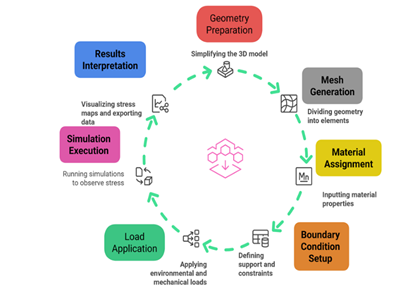
1)
Geometry Preparation: Import of the
3D-scanned model, and simplification of it to eliminate noise and unwarranted
detail.
2)
Mesh Generation: Subdivision of the geometry into small finite elements (tetrahedral or
hexahedral), which is highly mesh-dense in stress prone areas.
3)
Material
Assignment: Consenting characterized material characteristics including the Youngs
modulus, the Poisson ratio and density.
4)
Boundary Condition
Set-up: The support points, fixed constraints, and free movement areas.
5)
Load Application - Subjecting environmental and mechanical load environments, such as
temperature change, vibration and gravity.
6)
Simulation Run: Static, Dynamic and Thermal stress Simulations are run to monitor
deformation, strain distribution and possible areas of failure.
7)
Results Interpretation Visualization of stress maps,
risk region identification and export data to integrate with machine learning
models.
Figure
1
|
Figure 1 Finite-Element Modeling Cycle |
The Figure 1 shows the work flow of finite-element modeling
sculpture integrity analysis. It starts with the preparation of geometry then
mesh generation and assigning the material. Limit conditions and loads are
introduced and the simulation is simulated. The cycle is completed with the
help of stress visualization and data export. The color scheme and symbols make
it easier to read and comprehend, and difficult stages of the simulation become
understandable to both researchers and conservators.
3.2.2. Machine Learning Models
Machine learning
improves predictive accuracy by distilling patterns of data which are perhaps
not entirely represented by the traditional models.
Linear regression,
random forest regression and gradient boosting predictors have been used as
regression tools to predict quantitative measures of deterioration such as
crack growth rate, moisture accumulation or structural displacement. These
models are effective in the estimation of long-term material behavior utilizing
both historical and sensor based data.
Isolation forests
and autoencoders are anomaly detection models that are specialized at detecting
unusual deviation of normal structural behavior and can be used to detect
micro-fractures or abrupt environmental stress early. Such models have an added
advantage when the number of labeled datasets is scarce.
Deep learning and
their neural networks are effective at handling nonlinear associations and high
dimensional data. Surface imagery (convolutional neural networks or CNNs) can
be used to identify early signs of structural instabilities such as erosion or
corrosion, whereas time-serial sensor readings (recurrent neural networks or
RNNs and LSTMs) are used to predict them. Collectively, these models form a
holistic system of analysis that is able to predict various modes of failure
with a high level of accuracy.
3.3.
MONITORING SYSTEM DESIGN
3.3.1. Types of Sensors
The range of
sensors used in monitoring systems is immense and each sensor has a particular
diagnostic use. Strain gauges detect micro-deformations and determine the
location of stress concentrations which could be the precursor of crack
formation. Accelerometers record vibration patterns due to the wind, traffic or
a mechanical interaction, and so are vital in the dynamic load analysis.
Humidity and temperature sensors monitor changes in the environment that can
cause expansion and contraction of materials as well as weathering on the
surface. These sensors form a continuous feedback system together which
captures the response of the sculpture to environmental exposure as well as
mechanical forces.
3.3.2. Data Transmission, Sampling
Frequency, and Storage
The transmission
of the data is usually based on the wireless protocols: Wi-Fi, LoRaWAN, or the
Bluetooth Low Energy, based on the local conditions and power supply. The
sampling frequency depends on the parameter to be measured: Vibration
measurements can be sampled with high frequency whereas thermal measurements
can be sampled with low frequency. Information is stored on edge devices or
sent over cloud servers where it is analyzed over a long period, thus providing
safety in long-term archiving and accessibility to predictive modelling.
3.3.3. Real-Time Processing Pipelines
The real-time
pipelines is used to filter the incoming data, look at
the anomalies, and update prediction models in real-time. Edge computing
devices are used to have rapid initial analysis solving the latency and
bandwidth consumption. At the same time, centralized processing systems
summarize long-term data sets, improve machine learning forecasts and send
notifications in case of the critical thresholds. This real time responsiveness
is an improved measure of early intervention and proactive measures in
conservation.
Figure
2
|
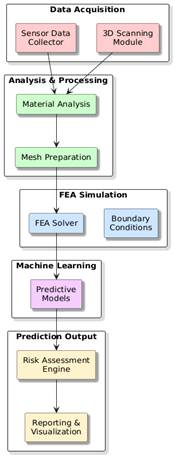
Figure 2 System architecture model for Structural Integrity in Sculptures |
4. Predictive Modeling and Analysis
4.1.
STRESS DISTRIBUTION AND
FAILURE MODE SIMULATIONS
The
key part of a predictive modeling process is represented by stress distribution
and failure mode simulations that allow assessing the load behavior in the
sculpture structure. Stress maps under different conditions of environmental
and mechanical loads are produced using the finite-element analysis, such as
gravitational stress, thermal expansion, moisture swelling, and vibrational
forces. These simulations show areas of critical stress concentration, which
points to areas prone to cracking, deformation, or fatigue of material.
Differences in temperature, e.g., generate expansion-contraction cycles that
cause concentration of stresses in joints and thin-sections, whereas mechanical
vibrations cause temporary stress peaks which can build up with time. Possible
failure modes including buckling, surface flaking, shear cracking or tensile
rupture are determined at a very early stage through iterative simulations and
therefore the conservators can prioritize interventions. Changes in
environmental conditions or installation support also can be analyzed using the
simulation platform to determine the effect of changes on stress behavior of a
particular system on a what-if basis. The given predictive ability allows
developing a more advanced strategy of conservation planning and offer
quantitative resources to justify structural reinforcements, material
stabilization, or display changes.
5. Result and Analysis
The crack
propagation and deformation prediction outcomes refer to how the micro-cracks
that are present develop with time as a result of an interaction between the
environmental and mechanical effects. The length of the initial crack as
indicated in the table is a significant factor in the propagation rate as well
as the long-term failure time. Cases whose initial cracks are larger like Case
3 (3.1 mm) have significantly higher propagation rates (0.40 mm/month)
resulting in higher ultimate deformation and reduced time to failure. This
trend shows that crack detection at an early-stage is
very important since the rate of crack propagation increases as stress is built
up at the end of the crack. The risk index is highly related with the
propagation rate and the magnitude of deformation: the cases in which the
tendency towards deformation is higher (1.12 to 1.47 mm) possess a higher level
of risk that surpasses 50 percent meaning that the structural deterioration is
imminent. There is also the phenomenon of environmental load interactions
enhancing crack evolution with swelling due to humidity augmenting the
displacement of crack openings, and vibration accelerated propagation due to
fatigue. The model is used to determine these interactions with time-dependent
simulations and a clear insight into nonlinear degradation patterns is
realized. The deformation values in the table can be used to show how the
displacement is spread beyond the immediate area in the crack, which influences
the stability of the sculpture as a whole. In high-risk cases final deformation
exceeds 1 mm which is a level that may be linked with visible instability in
heritage material.
The predictions of
failure time demonstrate the actual applicability of this model. The highest
rate and risk of case 3 indicate that the failure window is only 11 months,
which is the reason why an urgent intervention is necessary. On the other hand,
less hazardous cases such as Case 2 offer greater timeframes, and the
conservation can be planned and preventive. Taken together, this analysis
provides a predictive perspective in a wholesome manner so that conservators
can group the threats, ranking the intervention areas, and institute specific
reinforcement measures in line with the available empirical evidence.
Table
2
|
Table 2
Sensitivity Analysis Results |
||||
|
Parameter Tested |
Variation (%) |
Impact on Max Stress (%) |
Impact on Deformation (%) |
Stability Rating |
|
Young’s Modulus |
±10 |
18 |
14 |
Medium |
|
Density |
±8 |
6 |
9 |
High |
|
Thermal Expansion Coefficient |
±12 |
22 |
27 |
Low |
|
Humidity Absorption |
±15 |
25 |
31 |
Low |
|
Boundary Constraints |
±5 |
11 |
8 |
Medium |
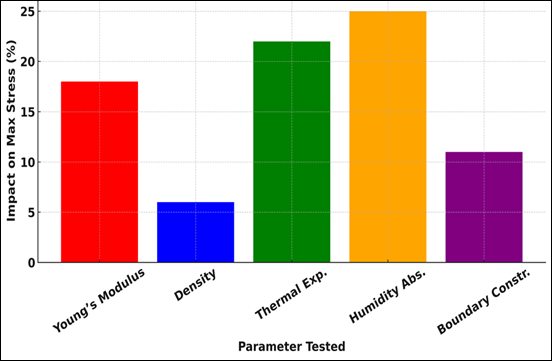
The results of the sensitivity
analysis are shown in Table 2, and they demonstrate the effect of the changes
in the main parameters on the results of the stress and deformation. The
modulus of Young and boundary constraints has moderate effects
so it is possible to conclude that the mechanical stiffness and support
conditions have a strong impact on stress distribution. Density has small
effect, since it has constant effects on structural response as is shown in Figure 3 in sensitivity analysis. On the other hand, the effect on the thermal
expansion coefficient and the ability of the substance to absorb humidity are
the most powerful, which proves that the environmental factor has an enormous
effect on deformation and long-term weakening. The stability ratings also point
to the parameters that need closer characterisation in order to gain predictive
modeling reliability and sound structural simulations.
Figure
3
|
Figure 3 Sensitivity Analysis – Impact on Max Stress |
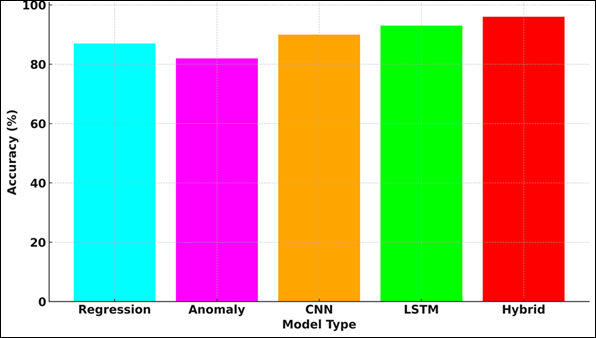
Table 3 is the evaluation of predictive model performance based on accuracy,
RMSE, prediction intervals and metrics of error reduction. The regression and
anomaly detection models have a good performance and have more scattered
prediction ranges due to less trust in small scale deterioration predictions.
The CNN and LSTM models perform better because they can capture both spatial
and time patterns leading to low errors.
Table
3
|
Table 3 Predictive
Model Evaluation Results Analysis |
||||
|
Model Type |
Accuracy (%) |
RMSE |
Prediction Interval (95%) |
Error Reduction (%) |
|
Regression Model |
87 |
0.42 |
±0.88 |
12 |
|
Anomaly Detection |
82 |
0.51 |
±1.02 |
9 |
|
CNN Surface Model |
90 |
0.36 |
±0.74 |
15 |
|
LSTM Time-Series Model |
93 |
0.29 |
±0.62 |
18 |
|
Hybrid Model (ML + FEA) |
96 |
0.21 |
±0.48 |
24 |
The hybrid ML+FEA model is the best as it has the highest accuracy and
minimum RMSE. Its large rate of error minimization shows the usefulness of
integrating physical simulation and machine learning, providing the most
accurate structural integrity forecasts, example of accuracy in Figure 4.
Figure
4
|
Figure 4 Predictive Model Evaluation Comparison of Accuracy |
6. Case Studies
6.1.
APPLICATION
TO HISTORICAL OR CONTEMPORARY SCULPTURES
Both past and
present sculptures were fed in predictive modeling to prove the flexibility of
the algorithmic structure. In ancient stone carvings especially those that have
been exposed to changes in the environment over centuries the models put emphasis on long-term stress corrosion and the
development of micro-cracks caused by the variation occurring in humidity and
thermal contraction. A large number of these sculptures had areas of critical
stress around the joints, excavation cuts, and slender projections, and this
evidence supports the usefulness of digital simulations in identifying
concealed weaknesses. In comparison, the modern metal and composite sculptures
had various degradation characteristics with vibrational fatigue, welding
residual stress, and corrosion-based thinning as the predominant. Predictive
algorithms were able to distinguish these material responses and provide custom
information on the predicted deformation, fatigue life and risk of failure. The
procedure confirmed the usefulness of a 3D scan, FEA, and machine learning
model integration to produce trusted structural predictions on artistic
periods, fabrication styles, and conditions.
6.2.
MODEL PERFORMANCE
COMPARE THE PERFORMANCE OF MATERIALS (STONE/METAL/WOOD/COMPOSITE)
The analysis of
the performance of various materials indicated that there were unique
computational behaviors related to the material stiffness, density, and
degradation mechanisms. In the case of stone sculpture, there was high
conformity in simulation and measured deformation, because of the
elastic-brittle behaviour of mineral substrates which are predictable. The
responses to vibrations were more dynamic with metals where algorithms were
required to be trained with vibration-awareness to gain an appropriate
interpretation of fatigue patterns.
Figure
5

|
Figure 5 Stress Response across Materials |
The sculptures
made in wood yielded more complicated forecasts due to anisotropic grain
patterns and sensitivity to moisture and needed hybrid sensor-ML combination to
make accurate forecasts. Real sculptures showed a consistent performance
because of homogeneous properties, which permit machine learning models to
provide a high accuracy with little tuning as presented in Figure 5.
In general, the predictive framework exhibited a strong cross-material
generalization, and hybrid FEA-ML systems performed better in comparison to
single-model based approaches.
7. Discussion
7.1.
MERITS AND WEAKNESSES OF PREDICTIVE
ALGORITHMS.
Predictive
algorithms have significant value in conservation of sculptures due to the
ability to identify structural weaknesses early, measure stress behavior, and
predict the dynamics of deterioration, which is impossible to track manually.
Their capacity to incorporate environmental information, the material
properties and historical degradation trends generate a comprehensive
information about the structural health. Nevertheless, there are some
disadvantages especially, the requirement of quality datasets, expert
calibration of simulation parameters and the cost of computation with high
density 3D-meshes. Also, machine learning models can have difficulties in
extrapolation when historical data is rare and lumpy or inconsistent and sensor
networks can create noise or gaps in long-term measurements.
7.2.
IMPLICATIONS
TO PRACTITIONERS, I.E. CONSERVATORS AND ENGINEERS.
Predictive
modeling integrated into the processes of conservation enables the conservator
and structural engineers to shift operations of restoration back to
maintenance. These algorithms are evidence-based reinforcement strategy
recommendations, environmental control modification, display configuration
modification and restoration priority. The conservation teams can more
effectively distribute resources by determining the timing when the failure
will take place. The better load simulations have been useful to engineers to
design safer mounting systems, supports and display structures (particularly to
fragile or full-sized artworks).
7.3.
ETHICAL AND PRESERVATION-RELATED ISSUES.
Predictive
modeling should be morally justified so that it does not affect the integrity
of art. The excessive use of intrusive sensors or unneeded support may change
the physical or aesthetic nature of a piece of art. The interpretation of data
should also be open and not based on automated research options without the
supervision of conservators. Ethical principles also favor minimal intervention, i.e. predictive insights ought to be used to
create preventive actions instead of taking excessive restoration. Fair access
to technology is another issue: smaller museums might have financial
limitations, and this will establish an imbalance in the ability to conserve.
7.4.
COOPERATION
WITH MUSEUM AND DISPLAY OUTDOOR PROTOCOLS.
The predictive
insights can be appropriately incorporated into museum and outdoor display
procedures by informing the decision-making process of light deployment, air
conditioning, and physical handling and installation procedures. In the case of
the indoor environments, models can be used to minimize the microclimate
settings, as well as the isolation of vibration to increase the lifewell of the
delicate sculptures. In the out-of-doors environment, the forecasted outcomes
guide preventive actions against weather, pollution and temperature extremes in
the choice of coating, sheltering buildings or seasonal movement. Algorithms
can be used to create alerts that are part of the daily monitoring of museums
and allow the staff to react to the noticed threats. This unification
guarantees the long-term preservation management that is driven by data and is
sustainable.
8. Conclusion
The advent of
predictive algorithms is a paradigm shift in the paradigm of structural
integrity measurement as well as maintenance of sculptures, and a scientific
and proactive addition to the classic forms of conservation undertaking. This
multidisciplinary framework can elucidate the current and future structural
behavior with high precision and accuracy due to the combination of
high-resolution 3D scanning, detailed material characterization, environmental
observations, the finite-element modeling, and sophisticated machine learning
models. Simulation of stress response, prediction of crack propagation and
quantification of deformation patterns help conservators and engineers to
identify emerging risk early before they are apparent, eliminating the invasive
solutions and prolonging the lifespan of artworks. The case studies reveal how
these predictive tools can be used in a wide range of various material,
including brittle stone and anisotropic wood to dynamic metals and modern
composite materials, which is indicative of the flexibility and consistency of
hybrid FEA-ML modeling strategies. Despite the fact that some of these issues
like high-quality datasets, computational requirements, and ethical
considerations that are to be maintained on an ongoing basis persist, the
prospects of predictive modeling provide a strong basis of data-driven
conservation decisions. With the further adoption of sensor-based monitoring
systems in museums and outside heritage sites, some real-time data streams will
enhance the accuracy of algorithms and risk prediction. Finally, predictive
algorithms not only allow contributing to the scientific integrity of
conservation policies but also assist in protecting cultural heritage by making
sure that sculptures are preserved in the least possible way and according to
their historical and artistic potential.
CONFLICT OF INTERESTS
None.
ACKNOWLEDGMENTS
None.
REFERENCES
Abdelmalek-Lee, E., and Burton, H. (2023). A Dual Kriging–Xgboost Model for Reconstructing Building Seismic Responses Using Strong Motion Data. Bulletin of Earthquake Engineering, 1–27.
Ao, Y., Li, S., and Duan, H. (2025). Artificial Intelligence-Aided Design (AIAD) for Structures and Engineering: A State-of-The-Art Review and Future Perspectives. Archives of Computational Methods in Engineering, 32, 4197–4224. https://doi.org/10.1007/s11831-025-10264-1
Aziz, M. T., Osabel, D. M., Kim, Y., Kim, S., Bae, J., and Tsavdaridis, K. D. (2025). State-of-the-Art Artificial Intelligence Techniques in Structural Engineering: A Review of Applications and Prospects. Results in Engineering, 28. https://doi.org/10.1016/j.rineng.2025.107882
Esteghamati, M. Z., and Flint, M. M.
(2021). Developing Data-Driven Surrogate Models for
Holistic Performance-Based Assessment of Mid-Rise RC Frame Buildings at Early
Design. Engineering Structures, 245, 112971.
Gao, C., and Elzarka, H. (2021). The Use of Decision Tree Based Predictive Models for Improving the Culvert
Inspection Process. Advanced Engineering Informatics, 47, 101203.
Hu, S., Wang, W., Alam, M. S., Zhu, S., and Ke, K. (2023). Machine Learning-Aided Peak Displacement and Floor Acceleration-Based Design of Hybrid Self-Centering Braced Frames. Journal of Building Engineering, 72, 106429.
Jayasinghe, S., Mahmoodian, M., Alavi, A., Sidiq, A., Sun, Z., Shahrivar, F., Setunge, S., and Thangarajah, J. (2025). Application of Machine Learning for Real-Time Structural Integrity Assessment of Bridges. Civil Engineering, 6(1), Article 2. https://doi.org/10.3390/civileng6010002
Jin, T., Cheng, X., Xu, S., Lai, Y., and
Zhang, Y. (2023). Deep Learning Aided Inverse
Design of the Buckling-Guided Assembly for 3D Frame Structures. Journal of the
Mechanics and Physics of Solids, 179, 105398.
Ko, H., Witherell, P., Lu, Y., Kim, S., and
Rosen, D. W. (2021). Machine Learning and Knowledge
Graph Based Design Rule Construction for Additive Manufacturing. Additive
Manufacturing, 37, 101620.
Latif, I., Banerjee, A., and Surana, M.
(2022). Explainable Machine Learning Aided
Optimization of Masonry Infilled Reinforced Concrete Frames. Structures, 44,
1751–1766.
Mousavi, M., Ayati, M., Hairi-Yazdi, M. R., and Siahpour, S. (2023). Robust Linear Parameter Varying Fault Reconstruction of Wind Turbine Pitch Actuator Using Second-Order Sliding Mode Observer. Journal of Electrical and Computer Engineering Innovations, 11, 229–241.
Rashidi Nasab, A., and Elzarka, H. (2023). Optimizing Machine Learning Algorithms for Improving Prediction of Bridge Deck Deterioration: A Case Study of Ohio Bridges. Buildings, 13(6), 1517. https://doi.org/10.3390/buildings13061517
Siahpour, S., Ayati, M., Haeri-Yazdi, M., and Mousavi, M. (2022). Fault Detection and Isolation of Wind Turbine Gearbox Via Noise-Assisted Multivariate Empirical Mode Decomposition Algorithm. Energy Equipment and Systems, 10, 271–286.
Yang, L., and Huang, E. (2025). Structural Health Monitoring Data Analysis Using Deep Learning Techniques. In Proceedings of the 2024 8th International Conference on Electronic Information Technology and Computer Engineering. Association for Computing Machinery, 913–927. https://doi.org/10.1145/3711129.3711286
Zhao, P., Liao, W., Huang, Y., and Lu, X. (2024). Beam Layout Design of Shear Wall Structures Based on Graph Neural Networks. Automation in Construction, 158, 105223.
|
|
 This work is licensed under a: Creative Commons Attribution 4.0 International License
© ShodhKosh 2025. All Rights Reserved.