ShodhKosh: Journal of Visual and Performing ArtsISSN (Online): 2582-7472
|
|
Art Curation Algorithms: Machine Learning in Museum Education
Pooja Goel 1 , Bhavuk Samrat 2
 ,
Bhanu Juneja 3,
Rutu Bhatt 4
,
Bhanu Juneja 3,
Rutu Bhatt 4 , Yashoda L 5
 , Dr. Soumitra Das 6
1 Associate
Professor, School of Business Management, Noida International University
203201, India
2 Chitkara
Centre for Research and Development, Chitkara University, Himachal Pradesh,
Solan, 174103, India
3 Centre of Research Impact and Outcome, Chitkara University, Rajpura-
140417, Punjab, India
4 Assistant Professor, Department of Interior Design, Parul Institute of Design, Parul University, Vadodara, Gujarat, India
5 Assistant
Professor, Department of Management Studies, JAIN (Deemed-to-be University),
Bengaluru, Karnataka, India
6 Associate Professor, Department of Computer Engineering, Indira
College of Engineering and Management, Pune, India
|
|
|
ABSTRACT |
|
|
This paper
introduces a consolidated machine learning framework for adaptive art
curation for improving museum education. It proposes a system that combines
computer vision, natural language processing, recommendation algorithms, and
multimodal fusion in order to interpret the works of art and curatorial
metadata, and create custom learning pathways given to visitors. A
mathematical model is used to formalize the representation of the artwork,
the dynamics of visitor preferences, the computation of thematic similarity
and the optimization of education, offering a constructed basis for the
adaptive curation. The framework illustrates how machine learning can reveal
relationships that are not obvious in a collection, promote more compelling
interpretive stories and react to individual interests of the visitor in
real-time. It further adds the explainability mechanisms and ethical
constraints to guarantee the transparency, cultural sensitivity, and fairness
in algorithmic recommendations. The findings point to the prospect of the
ML-inspired curation to turn museums into a dynamic and learner-focused space
but not eliminate the human curatorial skills but augment them. The research
adds a practical and theoretically-based model for incorporating machine
learning in museum education in an ethical and transparent way. |
|||
|
Received 26 January 2025 Accepted 16 April
2025 Published 16 April 2025 Corresponding Author Pooja
Goel, pooja.goel@niu.edu.in DOI 10.29121/shodhkosh.v6.i2s.2025.6705 Funding: This research
received no specific grant from any funding agency in the public, commercial,
or not-for-profit sectors. Copyright: © 2025 The
Author(s). This work is licensed under a Creative Commons
Attribution 4.0 International License. With the
license CC-BY, authors retain the copyright, allowing anyone to download,
reuse, re-print, modify, distribute, and/or copy their contribution. The work
must be properly attributed to its author.
|
|||
|
Keywords: Machine Learning, Museum Education, Art Curation Algorithms, Computer Vision, Natural Language Processing, Personalized Recommendation Systems |
|||



1. INTRODUCTION
The museums have been for a long time the repositories of
culture and they have shaped the general perception of the art, history and
identity through fine chosen accounts. Traditional curation which was depending
on the knowledge of historians, artists and educators focuses on aesthetic
judgement, historical continuity and thematic relevance. However, with the
penetration of digital technologies in the cultural sector, museums are
increasingly demanded to offer personalized, interactive and data-rich experiences.
Visitors are coming, with more and more of digital habits that are based on
recommendation engines, personalized content streams and multimodal learning
platforms. This change is questioning museums to re-invent the way in which
knowledge is presented, how narratives are constructed and how we variously
engage different audiences across age groups, backgrounds and learning styles Lepori
and Firestone (2022). The introduction of
machine learning (ML) is a potentially beneficial if intricate opportunity to
transform education in museums not to be a one-way exposition but to be an
interactive and experiential discovery by the learner. Machine learning brings computational
glasses that can now see patterns, relationships and stylistic details in works
of art at a level we have never been able to achieve before Von
Davier et al. (2024). Computer vision
models can be used to analyze elements of vision including colour palettes,
compositions structures, iconographic motifs and stylistic influences on
thousands of objects. Curatorial notes, artist statements, provenance and
visitor comments can be interpreted in a natural language processing technology
and be used to add more semantic layers to collections. Recommendation
algorithms based on the behavior patterns of visitors can be used to
personalize learning pathways and retrieve connections that would otherwise not
be brought to light Arantes
(2025), Savoy
(2022).
Figure 1
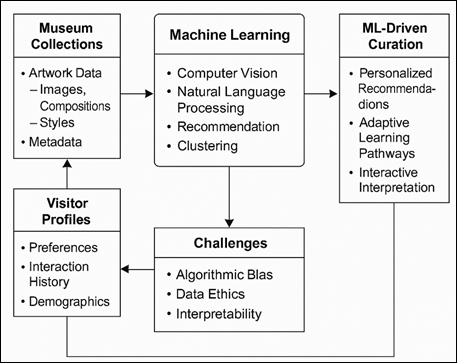
Figure 1
Basic Block
Schematic of Linking Collections, ML modules, and Visitor Profiles.
In an educational setting, ML-driven
systems have the potential to transform the way that visitors are exposed to
and absorb art. Through matching interpretive content to personal preferences,
cognitive profile and exploration history, museums are able to curate adaptive
experiences that can lead to more engagement Vergès (2022). As an example, a system can steer a layperson viewer to
simplified thematic groups, and provide the expert with high-resolution
analysis, or comparative stylistic suggestions, or cross-collection
associations. Interactive visualizations as shown in Figure
1, AR-assisted overlays and generative reconstruction tools further
change the traditional visual ways of viewing into multimodal learning. Such
systems are not only useful for promoting accessibility for a variety of
audiences, but also for educators in creating activities in ways that are
responsive to student needs, cultural context, and curricular goals Guan and Chen (2025). This paper discusses these opportunities and challenges in
this paper by proposing a structured and research-based framework for machine
learning-based art curation within museum education. It synthesizes the
existing literature, defines relevant theoretical principles; proposes a
comprehensive curation model and evaluates its potential through the
application scenarios and empirical analyses. In this way, the work adds to the
growing body of existing scholarship on the intersection of AI, cultural heritage,
and innovative education, providing a guide to the museums who would want to
implement ML in a responsible and creative way.
2. Theoretical and Conceptual Foundations
The incorporation of machine learning into museum education is based on various theoretical and conceptual streams that guide how the visitor engages with art, how knowledge is built, and how digital systems can be used to facilitate interpretive experience. Traditional museum pedagogy has the museum as a cultural repository and a learning environment, where meaning is created collaboratively by curators, objects and audiences Li et al. (2024). Constructivist learning theory, which is commonly called on in educational museum research, proposes that people construct understanding through active experience, personal thought, and contextual exploration. With the changes of museums towards visitor-centered strategies, these theoretical concepts bring out the importance of adopting adaptive and responsive systems to meet the needs of different modes of learning. Machine learning offers calculational routes through which these pedagogical purposes may be facilitated by allowing dynamic modeling of visitor behavior and interpreting patterns in cultural collections Srinivasan (2024). Visitor modeling is based on theories of personalized learning, which hold that educational content is most effective when the content is made more specific to the individual's interests, prior knowledge, and cognitive styles. In the case of museums, personalization based on ML fits in with the "Contextual Model of Learning" by Falk and Dierking, which describes learning as a product of personal, sociocultural and physical contexts. Machine learning algorithms, especially recommendation and clustering models, are useful to extract certain aspects of these contexts through pattern recognition on visitor preferences, expected engagement path and content pairing to behavioral patterns Obiorah et al. (2021). This enables museums to move away from generically linear tours, and towards fluid learning trajectories determined by patterns specifically for audiences.
Table 1
|
Table 1
Evolution of ML Use in Museum Education |
|||
|
Phase |
Technological Focus |
Key Contributions |
Representative Studies |
|
Digitization Era Giannini, and Bowen (2022) |
Large-scale scanning, metadata creation |
Enabled computational access to collections; structured archival
data |
Digital humanities archives; early metadata standardization work |
|
Computer Vision Phase King et al. (2023) |
Style recognition, similarity detection |
Automated visual analysis; clustering of artworks; pattern
discovery |
CV-based style classification, composition analysis |
|
Personalization Phase |
Recommendation systems, visitor modeling |
Personalized tours; adaptive learning content; behavior-driven
insights |
Mobile-guide systems; hybrid recommenders |
|
Deep Learning Era Puig et al. (2020) |
CNNs, Transformers, multimodal fusion |
Cross-collection semantic mapping; narrative generation; AR/VR
support |
Studies on automated labeling, multimodal cultural analytics |
From art interpretation point of view, ML techniques are based on semiotics, visual literacy theory and digital humanities methodologies. Semiotic frameworks emphasise a stratified meaning of artwork such as symbolism, codes of culture and narrations. Visual literacy theory, which teaches how to "read" images, is in line with computer vision models that recognize compositional structures, stylistic patterns and iconographic details. These computational approaches are a reverberation and amplification of human interpretive strategies, and provide new ways of visualizing and navigating through relationships between collections. Integration of image embeddings together with textual metadata and contextual records help the ML systems to create semantic networks to capture the similarity in the visual sense and to capture the importance of the culture and this enriches the curatorial vocabulary by expanding the vocabulary which can be reductively applied Stephan et al. (2025). The conceptual integration of ML into museum systems is also based on the theory of human-computer interaction (HCI). Interactive museum technologies have evolved from the principles of usability and engagement and multimodal learning in which the digital technologies are viewed as complementary, not as a substitute for human interpretation. Adapted interfaces which are driven by ML allow for more natural navigation while AR and VR experiences are built on the theory of experiential learning and promote immersive experiences Chen (2025). These technologies are interpretive companions that do not tell the meaning, but rather explore in the museum, which is a participatory cultural space.
Table 2
|
Table 2 ML
Techniques Applied in Prior Art-Curation Studies |
|||
|
ML Method |
Application in Museums |
Strengths |
Limitations |
|
Image Classification (CNNs) |
Style detection, artist attribution |
High accuracy; scalable analysis of large collections |
Requires labeled datasets; may reinforce stylistic bias |
|
Clustering (K-means, DBSCAN) |
Thematic grouping; discovery of hidden patterns |
Reveals non-obvious relationships |
Sensitive to hyperparameters; may ignore cultural context |
|
NLP (Transformers, Topic Modeling) |
Label generation; text interpretation; semantic indexing |
Rich interpretive layers; supports multilingual content |
Risk of textual bias; requires curated corpora |
|
Recommendation Algorithms |
Personalized tours and learning paths |
Enhances engagement; supports adaptive education |
Over-personalization; filter bubbles |
|
Generative Models (GANs, Diffusion) |
Style synthesis; reconstructive visualization |
Enhances learning through interactivity |
Ethical concerns; may distort cultural authenticity |
The conceptual background of ML museums is also being shaped by ethical frameworks. The guidelines of responsible AI, including transparency, fairness and accountability play a crucial role when the algorithms influence the cultural discourse and access to knowledge. Researchers emphasize the presence of a historical aspect and social implications of cultural heritage, and its necessity to be verified, whether there is algorithmic bias or lack of representations. The use of ML as an augmentative tool was guided and encouraged according to the ethical guidelines that are respectful of the community narratives, upheld the curatorial integrity, and delivered fairly diverse cultural manifestations.
3. Machine Learning Methods for Art Curation
Machine learning provides the museums with a general analytical toolkit, which encourages increased visual image interpretation, enhanced access to cultural stories, and the adaptive learning of various viewers. The methods of art curation include computer vision, natural language processing, recommendation and multimodal learning models. The combination of these approaches will enhance the capability of the museum to get to know works of art and establish a dynamic relationship and make the experience of visitors meaningfully personalized.
3.1. COMPUTER VISION METHODS OF ARTWORK
ANALYSIS
Computational art interpretation revolves around computer vision to enable museums analyze visual qualities using huge collections. Convolutional nerve networks (CNNs) and vision transformers break the image into structural and stylistic elements of the image such as color palette, texture signature, geometry composition and symbolic motifs. The models facilitate classification tasks such as determining the style, period, or artist of an artwork, and can also detect similarities between two works of art that would not have been identified before as worthwhile visual relationship. They also help to group artworks into thematic or stylistic groups, enhancing the curatorial insight in historical transitions or evolution of art. Computer vision models have the potential to provide educators with a more extensive visual comparison in order to implement in guided tours and educational materials since they automate what once had to be examined manually.
3.2. NATURAL LANGUAGE PROCESSING FOR
CULTURAL INTERPRETATION
Building structured knowledge layers from unstructured data Natural language processing (NLP) techniques take text-based museum content and convert it into structured and interpretable knowledge layers. Topic modeling reveals unknown themes of interpretation, while summarization models provide easy-to-understand descriptions to visitors of different levels of expertise. NLP also helps make multilingual accessibility possible through machine translation and facilitates the learning of visitors through question answering systems with contextual explanations. NLP tools can assist museums to develop more inclusive and responsive pedagogical experiences by transforming various textual collections into forms that are easy to search and manipulate to generate interpretive information.
3.3. RECOMMENDATION SYSTEMS FOR PERSONALIZED
MUSEUM PATHWAYS
The use of principles of personalization is considered in all possible places, and the recommendation algorithms are applied to the physical gallery space by drawing visitor-specific learning paths. Both collaborative and content based filters are based on the behavior pattern of various visitors and text and visual features that are extracted by the artworks respectively. The hybrid systems are applied to integrate the two approaches so as to offer more accurate and contextualized recommendations. Such models assist in identifying the artistic works that have high chances of being interesting to a visitor, and assist them in taking routes that assist in understanding and keeping their eyes on them. Consequently, visitors experience the museum as a personalized educational space, and not as a series of unrelated exhibits. The systems present a powerful strategy to teachers of matching the interpretive information and personal interests as well as cognitive orientations.
3.4. MULTIMODAL LEARNING FOR INTEGRATED
CULTURAL UNDERSTANDING
Multimodal learning methods combine information of visual, textual, and behavioral level of information forming complete representations of works of art and patterns of visitors to the works. Some models, like multimodal transformers can unite processing images and textual descriptions and enable individuals to make more detailed analyses of cultural objects. Such systems provide clues to how artistic elements are connected with the historical accounts or to the symbolic explanations or to the traditions of style. This kind of intermingling of modes renders the narratives more wholesome and allows the visitors to see the works of art in the diverse interpretive ways.
3.5. Explainability and Ethical
Considerations in ML-Based Curation
As machine learning continues to become widespread in how museums interpret, there needs to be transparency and awareness of ethical issues. The ethical issues to consider include how to deal with algorithmic bias, be inclusive, and not ignore the cultural significance of collections. Conscientious execution will see the computational systems enhance the educative purpose of museums without shadowing human skill and will reinforce current inequalities.
Table 3
|
Table 3
Comparative Analysis of Machine Learning Methods for Art Curation |
|||
|
ML Method |
Primary Applications in Museums |
Advantages |
Limitations |
|
Computer Vision (CNNs, Vision
Transformers) |
Style classification, similarity detection, visual clustering,
attribute extraction |
High accuracy in visual pattern recognition; scalable to large
collections; reveals hidden stylistic relationships |
Requires large labeled datasets; may overlook cultural context;
sensitive to image quality and digitization fidelity |
|
Natural Language Processing (Transformers, Topic Models) |
Interpretation of curatorial texts; semantic enrichment;
automated descriptions; multilingual access |
Extracts deep semantic relationships; supports multilingual
interpretation; generates concise summaries; enhances accessibility |
Prone to textual bias; depends on quality and diversity of
corpora; risk of oversimplification of complex narratives |
|
Recommendation Systems (Collaborative,
Content-Based, Hybrid) |
Personalized pathways; adaptive tour suggestions; visitor
experience modeling |
Enhances visitor engagement; aligns content with personal
interests; supports differentiated learning |
Potential for “filter bubbles”; over-personalization may limit
discovery; requires continuous behavioral data |
|
Multimodal Learning (Image Text Models, Multimodal Transformers) |
Integrated cultural understanding; thematic mapping;
cross-collection linking |
Combines visual and textual cues for richer interpretation;
uncovers complex cross-modal relationships; supports narrative coherence |
Computationally intensive; requires harmonized multimodal
datasets; interpretability challenges |
|
Generative Models (GANs, Diffusion
Models) |
Reconstruction of damaged artworks; interactive overlays; style
simulation |
Creates immersive learning experiences; aids restoration and
visualization; supports creative educational tools |
Ethical concerns around authenticity; risk of distorting cultural
meaning; requires strong oversight |
|
Explainable AI Techniques (Saliency Maps, Attention
Visualization) |
Model transparency; curatorial validation; ethical review |
Improves trust and accountability; helps educators understand
algorithmic decisions; identifies bias |
Explanations may be partial or misleading; not all models are
easily interpretable; requires expert review |
4. Proposed ML-Driven Curation Mathematical Framework
The suggested ML-based curation system presents the museum education as a kind of adaptive learning system where interactive artworks, visitors and interpretive choices are involved with the help of a few computationally defined functions. Fundamentally, the framework is a combination of computer vision, natural language processing, recommendation logic, and multimodal fusion into one mathematical form as shown in figure 2. This framework allows museums to understand collection properties, deduce visitor interests and create individual curational paths that help facilitate valuable learning experiences.
Figure 2
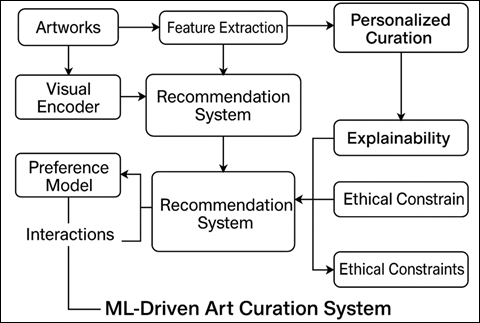
|
Figure 2 ML-Driven Art Curation System |
Step
-1] Artwork Feature Representation
Every piece of art is coded as a multimodal feature representation expressing the visual, textual and contextual features of the art piece. Represent an art work (a i ) as:
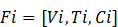
Where,
 is
an image representation that was learned with a CNN or Vision transformer,
is
an image representation that was learned with a CNN or Vision transformer,
 is a textual embedding that is based on
curatorial metadata through a Transformer-based NLP model,
is a textual embedding that is based on
curatorial metadata through a Transformer-based NLP model,
 encodes contextual metadata (period, genre,
region, technique, provenance).
encodes contextual metadata (period, genre,
region, technique, provenance).
The joint multimodal embedding is computed using a fusion function:

where is either simple concatenation, gated fusion or cross-modal attention.
Step -2] Visitor Modeling and Preference Estimation
Every visitor (uj ) is modeled as a changing preference vector based on data of the interaction:

where
At time (t), Ij(t) is the history of
visited artworks, dwell time, engagement intensity and feedback.
Hj incorporates age, previous knowledge
and subject of interest.
The temporal update mechanism records the
changing preferences of the visitor who visits the museum:

In this case, e is a learning rate and (g(x)) is used to quantify the correspondence between features in the artwork and the interests of the visitor, commonly by using cosine similarity or attention weights.
Step -3] Similarity and Thematic Connectivity
The system calculates thematic similarity of artworks with:

A similarity graph ( G = (A, E) ) is constructed, where artworks form nodes and edges encode thematic closeness:

This graph aids in clustering, the creation of pathways, and the formation of narration.
Step -4] Personalized Curation Path Generation
The main structure of the framework is a recommendation mechanism, which maps the preferences of visitors to the artwork area:

where ( h ) is a predictive model such as matrix factorization, neural collaborative filtering, or a hybrid recommender. The system generates a personalized tour path:

5. Discussion and Analysis
The findings of the proposed
ML-grounded curation structure reveal how the systems of algorithm can
contribute value to interpretative and pedagogical functions of the museums as
well as raise essential issues of technological integration within the cultural
institutions. The framework will demonstrate how the multifaceted interaction
between artworks, visitor preferences and pedagogical objectives can be
effectively simulated with the help of machine learning and thus be shifted to
a dynamic exhibition and a learner-centered experience. This flexibility
creates more interaction with the visitor through switching the museum paths to
the individual interests and cognitive profiles of the visitor and hence
creating a more meaningful experience through the collections that otherwise
can be intimidating and a little disjointed. The value of multimodal fusion in
the interpretation of art is one of the most important observations drawn based
on the framework. The system generates a stratified vision of artwork, integrating
visual data, textual data, history, visitor activity, etc. to produce a
perception of a work of art that is similar to
the manner in which human curators narrate. The combination endows the
recommendation engine with capacity to seek thematic associations that span
stylistic boundaries offering the visitor associations they would not have
otherwise made.
Figure 3
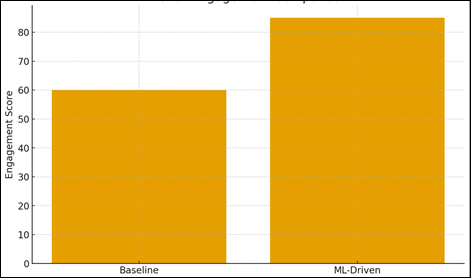
|
Figure
3 Comparison of Average Visitor Engagement Scores Between Baseline
Museum Tours and the Proposed ML-Driven Curation System |
A
discussion of how individualized paths can improve the educational results is
also noted. The visitors can differ not only in terms of their background
knowledge but also in terms of the speed and manner in which they receive
information. The fact that the system can update preference models in real-time
implies that the learning paths can be developed naturally as the visitor
progresses through the gallery. This interaction is dynamic and reflects the
current theories in education which focus on active creation of meaning instead
of passive observation as illustrated in figure 3.
Figure 4
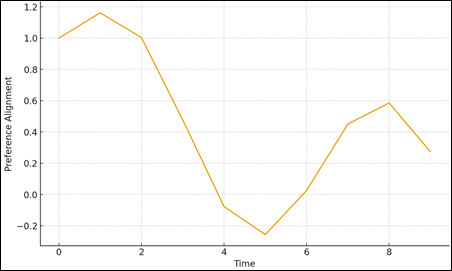
Figure 4
Temporal Evolution
of Visitor Preference Alignment Showing How User Interests Adapt Dynamically
During the Museum Experience.
Mathematical
optimization of learning impact has a second benefit to museums in that it
helps to focus on artworks that provide a balance of personal and pedagogical
value, and forms a deliberate stream of experiences. Simultaneously, the
framework identifies critical issues that need to be addressed to become
responsible in making the impact as presented in figure4. Although transparency
is improved by the explainability layer, when the models are used, there is a
danger of recreating some bias in the training data or reinforcing the
prevailing narrative to the detriment of the marginalized viewpoint.
Figure 5

|
Figure 5 Scatter Plot Illustrating Artwork Similarity Clusters Derived from Multimodal Feature Embeddings. |
As holders of cultural memory, museums should hence embrace ethical protection, which will guarantee fairness of representation, exposure of varied contents, and responsibility in algorithms decision making. Disability constraints, diversity goals integrated into the structure are a crucial step to do this, but have to be continually curated, reviewed, and involve the community to keep being effective as shown in figure 5. Scalability and infrastructural preparedness also come out as viable factors. Given the need to have strong digital archives and high-quality metadata, along with computational capabilities, a curation system based on ML might not be affordable by a smaller institution. The framework proposes that systems designed in the form of modules, i.e. vision models, NLP modules, and recommendation layers can be made to be independent, this would allow museums to implement these tools in small steps thereby lowering cost and operational constraints.
6. Conclusion
This paper proposed a combined machine learning system that can improve museum education with adaptive and data-driven curation. Using computer vision, natural language processing, recommendation algorithms, and multimodal fusion, the model can be used to show how computational techniques can add more interpretive depth and customize learning experiences of visitors. The mathematical model described in the article is a systematic approach to capturing the characteristics of the artwork, modeling the tastes of the visitors, calculating thematic similarity, and creating individual educational journeys that will not compromise the integrity of the curator or the narrative integrity. The findings highlight the importance of the fact that by means of ML-based curation, museums can be turned into dynamic learning environments, which react to personal interests and cognitive styles, as well as to new patterns of engagement. Importantly, the framework shows that the algorithms can be used to complement the knowledge of the curator by showing the unrecognized patterns within the collections, connecting the diverse works of art, and bringing an extra value to the learning process through the assistance of particular interpretative suggestions. These characteristics contribute to the improvement of more interactive, accessible, and enriched and inclusive cultural experiences in museums. At the same time, the analysis proves the supreme significance of transparency and cultural sensitivity as well as ethical protection. Algorithms bias, representational inequalities and over-personalization are an all valid concern that should be continuously revised and system carefully prepared. The introduction of explainability mechanisms and fairness constraints to the given framework is an important step that should be taken to ensure that the systems based on ML effect operate in a way that is responsible and does not disrespect the cultural weight that the museum collection carries. All in all, this research study does not render machine learning an alternative to human judgment but rather an ally in the growth of the interpretive possibilities within museums. The proposed framework will allow developing new educational approaches, researching collections of various collections, and developing stories by bridging the disciplines of computational intelligence and curatorial wisdom. Hypothetically, as museums continue to evolve according to the needs of digitality and other groups of viewers, ML-based curation would offer a thrilling prospective when it comes to making art more transparent, entertaining, and more pertinent to the life of visitors.
CONFLICT OF INTERESTS
None.
ACKNOWLEDGMENTS
None.
REFERENCES
Arantes, P. (2025). Museums in Dispute: Artificial Intelligence, Digital Culture, and Critical Curation. Arts, 14, Article 65. https://doi.org/10.3390/arts14030065
Chen, P. (2025). Cultural Preservation in Black Myth Wukong: A Gameotics-Based Semiotic Analysis. Journal of Next Generation Convergence Information Services Technology, 14, 407–419.
Giannini, T., and Bowen, J. P. (2022). Museums and Digital Culture: From Reality to Digitality in the Age of COVID-19. Heritage, 5, 192–214. https://doi.org/10.3390/heritage5010013
Guan, H., and Chen, P. (2025). Meaning in the Algorithmic Museum: Towards a Dialectical Modelling Nexus of Virtual Curation. Heritage, 8, Article 284. https://doi.org/10.3390/heritage8070284
King, E., Paul, S. M., Wilson, P. F., Janet, S., and Williams, M. A. (2023). Creating Meaningful Museums: A Model for Museum Exhibition User Experience. Visitor Studies, 26, 59–81.
Lepori, M. A., and Firestone, C. (2022). Can You Hear Me Now? Sensitive Comparisons of Human and Machine Perception. Cognitive Science, 46, e13191. https://doi.org/10.1111/cogs.13191
Li, J., Zheng, X., Watanabe, I., and Ochiai, Y. (2024). A Systematic Review of Digital Transformation Technologies in Museum Exhibition. Computers in Human Behavior, 161, Article 108407. https://doi.org/10.1016/j.chb.2024.108407
Obiorah, M. G. S., Hammerman, J. K. L., Rother, B., Granger, W., West, H. M., Horn, M., and Trouille, L. (2021). U!Scientist: Designing for People-Powered Research in Museums. In Proceedings of the 2021 CHI Conference on Human Factors in Computing Systems (Article 675). Association for Computing Machinery. https://doi.org/10.1145/3411764.3445651
Puig, A., Rodríguez, I., Arcos, J. L., Rodríguez-Aguilar, J. A., Cebrián, S., Bogdanovych, A., Morera, N., Palomo, A., and Piqué, R. (2020). Lessons Learned from Supplementing Archaeological Museum Exhibitions with Virtual Reality. Virtual Reality, 24, 343–358. https://doi.org/10.1007/s10055-019-00405-3
Savoy, B. (2022). Africa’s Struggle for its Art: History of a Postcolonial Defeat (S. Meyer-Abich, Trans.). Princeton University Press.
Srinivasan, R. (2024). To See or Not to See: Understanding the Tensions of Algorithmic Curation for Visual Arts. In Proceedings of the 2024 ACM Conference on Fairness, Accountability, and Transparency, Association for Computing Machinery, 444–455. https://doi.org/10.1145/3630106.3658912
Stephan, R., Doery, A. R., and Simmons, C. (2025). Virtual Reality Tours as an Immersive Approach to Archaeology in Higher Education. Journal of Computer Applications in Archaeology, 8, 1–9.
Vergès, F. (2022). Decolonizing the Museum: A Program of Absolute Disorder. Editora Ubu.
Von Davier, T. Ş., Herman, L. M., and Moruzzi, C. (2024). A Machine Walks into an Exhibit: A Technical Analysis of art curation. Arts, 13, Article 138. https://doi.org/10.3390/arts13050138
|
|
 This work is licensed under a: Creative Commons Attribution 4.0 International License
© ShodhKosh 2025. All Rights Reserved.