ShodhKosh: Journal of Visual and Performing ArtsISSN (Online): 2582-7472
|
|
AI for Accessibility in Digital Media Education
Murathoti Rajendra Nath Babu 1
 ,
Chumdemo Tungoe 2
,
Chumdemo Tungoe 2 , R. Vasanthan 3
 ,
Jagdish Pimple 4
,
Jagdish Pimple 4 , Kiran S. Khandare 5
 ,
Dr. Lohans Kumar Kalyani 6
,
Dr. Lohans Kumar Kalyani 6
1 Associate
Professor, Department of Education, Nagaland University (A Central University),
Kohima Campus, Meriema, Kohima Campus, Meriema, Nagaland, India
2 Research
Scholar, Department of English, Nagaland University, Kohima-797001, Nagaland, India
3 Associate Professor, Department of English, Nagaland University,
Kohima Campus, Meriema, Kohima, Nagaland, India
4 St. Vincent Pallotti College of Engineering and Technology, Nagpur, Maharashtra, India
5 Department of
Computer Technology, Yeshwantrao Chavan College of Engineering, Nagpur,
Maharashtra, India
6 Assistant Professor, Department of B.E.D., Shri Lal Bahadur Shastri
Degree College, Gonda, U.P., India
|
|
|
ABSTRACT |
|
|
Artificial
Intelligence (AI) is transforming the digital media education field to be
more accessible and inclusive to various learners. This paper discusses how
AI based technologies can be implemented in digital media learning
environment to help students with various types of physical, cognitive and
sensory disabilities. The study is based on the principles of Universal
Design of Learning (UDL) and the author is investigating the possibility of
breaking down the barriers to content delivery and participation through the
use of adaptive systems (-speech recognition, text to speech (TTS) and image
recognition) that assist students with disabilities in their learning
process. The study assesses the practical benefits and disadvantages of AI in
educational accessibility using a mixed-method approach, which is a
combination of classroom observation and comparative study of the AI
(accessibility tools) and non-AI (accessibility tools). The results point to
the role played by AI-driven applications in ensuring fair interaction
whereby they can be used to create more personalized learning experience,
enhance understanding and promote communication between students and
teachers. This paper highlights that it is necessary to have open AI systems
that consider fairness data protection and inclusivity in the design of
education. The current study can be added to the current discussion about
inclusive pedagogy in which responsible AI involves can improve access, as
well as creativity and innovation in digital media education. The paper ends
with policy suggestions on how policy makers, educators and technologists can
come up with sustainable AI access models in future learning environments. |
|||
|
Received 27 January2025 Accepted 18 April
2025 Published 16 December 2025 Corresponding Author Murathoti
Rajendra Nath Babu, mrnb.svu@gmail.com DOI 10.29121/shodhkosh.v6.i2s.2025.6704 Funding: This research
received no specific grant from any funding agency in the public, commercial,
or not-for-profit sectors. Copyright: © 2025 The
Author(s). This work is licensed under a Creative Commons
Attribution 4.0 International License. With the
license CC-BY, authors retain the copyright, allowing anyone to download,
reuse, re-print, modify, distribute, and/or copy their contribution. The work
must be properly attributed to its author.
|
|||
|
Keywords:
Artificial
Intelligence (AI), Accessibility, Digital Media Education, Universal, Design
for Learning (UDL), Inclusive Technology |
|||



1. INTRODUCTION
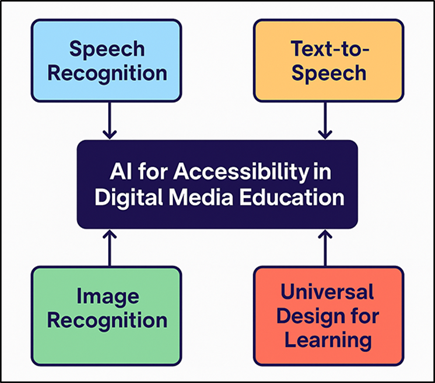
Over the past years, the interplay between Artificial Intelligence (AI) and education has created having never been seen before opportunities in enhancing accessibility, personalization, and inclusivity in learning contexts. Digital media education specifically has become a vibrant area that integrates technology, creativity, and communication, however, it has certain challenges on accessibility to learners with disabilities or other learning needs. Conventional digital media tools and platforms tend to be more visual, auditory, and motor-focused and, therefore, are also inadvertently marginalized to students with sensory disabilities, neurodivergent students, or those who have limited access to assistive technology. Following the growing adoption of online and blended learning in institutions, the need to make digital media education accessible to every learner has been of immediate concern. Artificial Intelligence has demonstrated a great potential of filling these gaps of accessibility. Intelligent tutoring models AI can customize the educational experience to the individual needs and preferences by incorporating adaptive learning systems, and assistive technologies Yan et al. (2024). As an illustration, speech recognition and voice interfaces allow physically challenged learners to use platforms without using their hands, whereas text-to-speech and speech-to-text technology can be used by students with visual or auditory disabilities. Likewise, visual media is more accessible to the visually impaired learner with the help of AI-powered image recognition and captioning software to enable equal access to digital media course materials and creative tasks. Not only do these innovations help to increase the accessibility but also other advantages are presented such as autonomy, engagement, and confidence among previously disadvantaged students in digital learning environments Abulibdeh et al. (2024). The applicability of AI to the field of accessibility is greater than that of assistive tools; it also applies to pedagogy. With the help of data-driven insights, teachers can learn more about student behavior, modify the lesson plans, and offer specific assistance depending on their learning patterns. The AI systems can be used to support the inclusion of people in digital media education, in which the creation of content, collaboration, and feedback is especially relevant; resources should be provided in multimodal format; feedback processes should be personalized González-Pérez and Ramírez-Montoya (2022). Figure 1 represents the AI augmenting access in adaptive, inclusive, interactive, personalized learning. In addition, AI can be used to guide teachers to create curriculum resources to be compatible with the principles of Universal Design to Learning (UDL) so that the content is flexible, accessible and meaningful to different learners.
Figure 1
|
Figure 1 Multicolor Block Diagram
of AI-Driven Accessibility Framework in Digital Media Education |
Nevertheless, as much as integration of AI technologies in education has the potential to transform education, it is not devoid of difficulties. Ethical issues on data privacy, biases in algorithms and the digital divide continue to exist. As an example, AI models that are trained on biased data will, unintentionally, perpetuate stereotypes or omit marginalized groups, which is the opposite of the objective that inclusivity aims to achieve. Also, expenses involved in implementation and insufficient technical expertise in educational facilities may act as a barrier to the use of AI accessibility tools, particularly in resource-restricted environments Tetzlaff et al. (2021). Therefore, there should be a delicate balance between the technology and moral accountability.
2. Literature Review
2.1. OVERVIEW OF AI APPLICATIONS IN EDUCATION
AI has been an essential part of contemporary education that has changed the teaching, learning, and evaluating activities in different fields. In education, AI applications include adaptive learning systems, intelligent tutoring, automatic grading, and natural language processing as well as predictive analytics. The technologies make the learning process more personal because they take the student data and analyze it to determine the strengths, weaknesses, and the learning styles and thus allow the educators to provide specific assistance Irish et al. (2025). As an illustration, the learning platforms such as Coursera and Duolingo put AI algorithms to suggest tailored learning journeys, which depend on the behaviors and performance indicators of the user. In teaching digital media, AI facilitates creativity and innovation by offering video editing, content creation and feedback analysis tools that are automated. Chatbots and intelligent tutoring systems (ITS) are also important in real-time support since they enhance student engagement and understanding Strielkowski et al. (2024). Moreover, AI-based analytics can assist teachers in measuring the learning outcomes in a more efficient way and improve pedagogical practices and curriculum design.
2.2. ACCESSIBILITY CHALLENGES IN DIGITAL MEDIA PLATFORMS
The digital media has transformed the way knowledge is produced and disseminated but this accessibility has continued to be a problem. Several systems are heavily dependent on the audio and visual feedback, making them very difficult to use by the visually or mentally challenged. As an example, students who follow the visual disability are challenged by the fact that digital interfaces do not have screen-reader support, alternative text explanations, and high-contrast design features Gibson et al. (2023). Likewise, people with hearing disabilities usually have problems because of the unrealistic captions or transcriptions in the multimedia contents. This is also true of the cognitive and neurodiverse learner such as those with dyslexia or attention disorders who find it difficult when digital media content is not organized in such a manner that understanding can be facilitated by clear navigation, adjustable speed, and multimodality of instruction Sperling et al. (2024). Also, inconsistency in the compliance with global standards, including the Web Content Accessibility Guidelines (WCAG), is likely to compromise accessibility. With regards to education, these accessibility constraints inhibit equitable participation and restrictive creativity of expression which are essential elements to digital media learning. Students might not be able to interact with complicated visual projects or collaborative tools that are not configured to assistive technologies Holmes and Tuomi (2022).
2.3. PREVIOUS RESEARCH ON INCLUSIVE LEARNING TECHNOLOGIES
The past studies of inclusive learning technologies focus on the impact of digital innovation in facilitating equity and access to education. The effectiveness of assistive technologies in improving the learning experiences of students with disabilities has been studied (screen readers, alternative input devices, and speech recognition systems). Some such researchers such as Rose and Meyer (2002) proposed the concept of Universal Design of Learning (UDL) framework that envisions the provision of flexible learning conditions that benefit various learners in diverse ways through numerous modalities of representation, engagement, and expression Saputra et al. (2023). The application of AI in assistive learning technology in recent years has become increasingly popular. Instructional materials can be automatically adjusted to different needs by AI-based systems, learning problems can be identified, and real-time feedback can be delivered to each learner. As an example, machine learning algorithms have been used to anticipate accessibility difficulties, whereas communication with learners with speech or language disabilities is supported using natural language processing tools Wang et al. (2024). Research has also proven that AI-enhanced captioning and text simplification systems can be very helpful in helping multilingual and neurodiverse students to better comprehend the content. But some researchers have warned of the excessive dependency on technology without ethical supervision Mao et al. (2024). In Table 1, there is a summary of research relating AI and accessibility in education. There are still concerns about data privacy, fairness and the usability of algorithms. Inclusive education, thus, requires not only a technological innovation, but must also be pedagogically aware and designed with human consideration.
Table 1
|
Table 1 Summary of Related Work on AI and Accessibility in
Education |
||||
|
Focus
Area |
AI
Technology Used |
Target
Group |
Research
Method |
Limitations |
|
Universal
Design for Learning |
Conceptual
Framework |
All
Learners |
Theoretical
Study |
Lacked
empirical validation |
|
Inclusive
Online Education |
Adaptive
Learning Algorithms |
Higher
Education Students |
Survey |
Limited
to online settings |
|
Speech
Accessibility Alier et al.
(2024) |
Speech
Recognition |
Visually
Impaired Students |
Experimental |
Small
sample size |
|
Text-to-Speech
Tools |
Neural
TTS Models |
Students
with Dyslexia |
Case
Study |
Language
dependency |
|
Image
Accessibility |
Computer
Vision |
Blind
and Low-Vision Learners |
Mixed
Method |
Contextual
misinterpretation |
|
Learning
Analytics Lim et al.
(2025) |
Machine
Learning |
Educators
& Institutions |
Quantitative |
Data
privacy concerns |
|
Digital
Media Education |
Adaptive
AI Tools |
Media
Students |
Comparative
Study |
Technical
infrastructure gaps |
|
Accessibility
in MOOCs |
NLP
& STT |
Global
Online Learners |
Survey
+ Analytics |
Limited
instructor training |
|
Cognitive
Learning Support Yim et al.
(2024) |
AI
Tutoring Systems |
Diverse
Learners |
Experimental |
High
development cost |
|
Ethical
AI in Education |
Bias
Detection Models |
Disabled
Learners |
Qualitative |
Lack
of real-world testing |
|
Visual
Learning Tools |
Augmented
Reality + AI |
Media
Design Students |
Experimental |
Hardware
limitations |
|
Inclusive
Curriculum Design Oubibi et al.
(2025) |
AI-based
Content Adaptation |
Educators |
Interview
Study |
Implementation
barriers |
|
Data
Security in EdTech |
Federated
AI Systems |
Institutions |
Analytical |
Limited
scalability |
3. Theoretical Framework
3.1. PRINCIPLES OF UNIVERSAL DESIGN FOR LEARNING (UDL)
Universal Design for Learning (UDL) is a general model that helps to establish an inclusive learning environment that can meet the needs of all schools. Developed based on the principles of architectural design that support the idea of accessibility towards persons with disabilities, UDL carries over these concepts into the sphere of pedagogy, focusing on the inability to be rigid in teaching techniques, materials, and evaluation. Rose and Meyer (2002) argue that UDL has three main principles, which include; multiple sources of representation, multiple sources of engagement, and multiple sources of action and expression. As applied to digital media education, UDL provides educators with opportunities to create learning opportunities that support a variety of sensory, cognitive, and physical needs. As an example, provision of multimedia materials in visual and auditory formats, the possibility to evaluate using alternative assessment forms, the use of assistive technologies fits the principles of UDL. These principles can be operationalized by AI technologies that dynamically alter the learning content, such as turning a text into speech or language translation or simplification of complex content. Learner autonomy is another feature of the UDL framework that enables one to select the method of engagement with the content and the way of expressing understanding.
3.2. AI MODELS SUPPORTING ACCESSIBILITY
Computer vision algorithms can also be used to help detect objects, identify faces and provide image captions which are valuable visual context to learners with a disability. Personalized learning is also provided by AI models in digital media education. Recommendation algorithms are founded on the analysis of a learner behavior and preferences to indicate corresponding materials or tools. The adaptive learning system works on predictive analytics to alter the difficulty of the content or change the delivery model so that the needs of learners with disabilities can be met. Moreover, AI models based on generative art are also used to produce multimedia content that is readily available, including automatic captioning or sign language translation. These AI-enhanced processes can be both accessibility-promoting and reflect the principles of Universal Design of Learning, as it makes the contents flexible and responsive.
3.3. COGNITIVE AND SOCIAL LEARNING THEORIES IN AI-BASED
EDUCATION
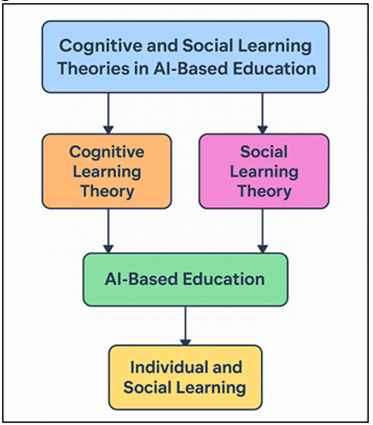
The cognitive and social learning theories offer fundamental backgrounds of how AI can help in ensuring accessibility and effective digital media learning. Basing on the theories of Piaget and Bruner, cognitive learning theory focuses on how the learners actively create knowledge by using their minds, as the ability to perceive, memorize, and solve problems. Cognitive learning can be improved by AI systems that respond to the needs of the individual learners (such as intelligent tutoring systems which provide personalized feedback, scaffold learning, and vary the difficulty of instruction depending on cognitive performance). According to the theory of social learning, which was developed by Bandura, people can learn by observing, learning, and interacting with others. The field of digital media education can be used to support these social aspects through AI, which creates the possibility of a collaborative and interactive atmosphere. Figure 2 demonstrates that AI involves the incorporation of cognitive and social learning theory processes. As an example, AI-based discussion boards, chatbots and recommendation systems can encourage peer-to-peer communication, group work, and participation despite physical or cognitive disabilities.
Figure 2
|
Figure 2 Flowchart of Cognitive and Social Learning Theories in AI-Based Education |
AI-based education facilitates individual and community-based learning by integrating both cognitive and social viewpoints. Adaptive AIs can model the behavior of learners, forecast the level of motivation, and propose social learning tasks that help generate interest and compassion.
4. Methodology
4.1. RATIONALE FOR CHOOSING THE RESEARCH DESIGN
This proposed research design is a mixed-method research, which combines qualitative and quantitative research methods to explore how Artificial Intelligence (AI) can be used to improve access in digital media education. This design choice has been justified by the fact that it will help record both quantifiable effects and background information about accessibility tools that are based on AI. The empirical evidence of the influence that AI technologies have on the outcomes of learner engagement, comprehension, and accessibility is obtained through quantitative data that are collected through surveys and performance measurements. Meanwhile, the qualitative data based on interviews, observations, and focus groups shows the experiences of the users, issues, and the perception of inclusiveness. A mixed-method design enables the possibility of triangulation, which makes the findings holistic and valid. Digital media education involves creative, technical, and interactive learning processes that cannot be entirely comprehended using numbers only. Thus, the integration of statistical data and human opinions helps to have a holistic representation of AI learning opportunities. The design of the study fits the paradigm of the constructivist, whereas knowledge and accessibility are socially constructed by communicating with technology and peers. Moreover, this method will take into consideration the diversity of the participants, who are students, educators, and institutions, and each possesses distinct knowledge on the integration of AI.
4.2. TARGET GROUP (STUDENTS, EDUCATORS, OR INSTITUTIONS)
The study focuses on three major audiences, namely; students, teachers and learning institutions that are engaged in education in digital media. The choice of these groups is based on the fact that they reflect as a whole ecosystem, where accessibility and integration of AI takes place. The main focus is the students because they are the primary beneficiaries of AI-based accessibility tools. The participants in the study will consist of learners with different backgrounds, including students with visual, auditory, and physical disabilities, neurodiverse learners, and so forth to analyze the impact of AI on their engagement, understanding, and involvement in digital media learning. Their feedback is used to evaluate the practical effectiveness of the technologies that include the speech recognition, text-to-speech, and automatic captioning systems. Teachers represent the second category of stakeholders because they are poised to be instrumental in utilizing and adopting AI tools to inclusivity in teaching. Their attitudes can be helpful in developing the instructional design, modifying the curriculum, and addressing the issue of introducing AI into creative and technical courses. Surveys and interviews with teachers will assist in assessing their views on the use of AI, the sufficiency of training, and the ethical issues. The administrative and infrastructural aspect of accessibility is represented by institutions.
4.3. OBSERVATION OF AI INTEGRATION IN DIGITAL MEDIA
CLASSROOMS
The observational aspect of the study explores the digital media classroom integration and use of AI technologies. This will be a phase of systematic classroom observations in various institutions where the digital media programs are provided. The aim is to record the experience in the interaction of AI-based tools, educators, and learners in the real-life learning settings. The tools that are observed are automated captioning systems, voice command interfaces, adaptive learning platforms, and visual assistance applications. The frequency, usage, and the effectiveness of the use of AI tools in lectures, project-based activities, and collaborative sessions are documented by researchers. The interaction of learners with disabilities with these technologies is compared and data is gathered concerning the interaction between the learners and their counterparts. The outcomes of accessibility are considered specially whether AI tools can be used to facilitate the participation, enhance the understanding, and lessen the communication barriers. The quantitative and qualitative indicators of accessibility are recorded by means of field notes, video recording, and observation checklists. As well, researchers mention their technical challenges, usability problems or ethical aspects like data privacy or consent in the implementation of AI.
4.4. COMPARATIVE EVALUATION OF AI VS NON-AI ACCESSIBILITY
TOOLS
The research is based on comparative assessment where AI-based accessibility tools are compared with the traditional, non-AI ones to determine their efficiency. This element determines the extent to which the two approaches influence the outcomes of engagement, comprehension, and accessibility of digital media education among learners. The speech recognition systems, adaptive text-to-speech technologies, and visual recognition applications are AI-based tools that are under evaluation. Other non-AI applications include manual captioning, fixed screen readers and simple assistive technology. The assessment will be based on quantitative measures like task completion rates, learning performance, and accessibility ratings and qualitative feedback gathered by the interviews with students and educators. Students are given similar learning activities with the use of AI and non-AI tools, and both materials and the level of difficulty are the same. Statistical analysis is performed to establish whether there is a significant difference between performance and user satisfaction.
5. AI Technologies Enhancing Accessibility
5.1. SPEECH RECOGNITION AND VOICE INTERFACES
The new voice interface technologies and speech recognition technologies have become the revolutionary tools in increasing the accessibility of digital media education. These AI-based applications translate speech into electronic instructions or text and enable customers to use learning platforms without using their hands. In students who do have physical disabilities or bang-up due to motor disabilities, the speech recognition will give another avenue of accessing the software, writing up assignments and even taking part in discussion without having to use the conventional input devices such as the keyboards and touch screens. The voice assistants used for education purposes are Google Assistant, Siri, and Amazon Alexa which are installed on the learning management system (LMS). Voice assistants offer the possibility to access the information in instant time and make the content. Furthermore, voice-based interfaces with added AI capabilities can be utilized for helping multilingual students by accepting different accents and dialects, which can make multicultural classes more inclusive. The systems also help educators to give interactive and adaptive instruction using voice-controlled applications and enhance interaction and access at the same time. Nevertheless, the difficulty still lies in the aspect of accuracy, background noise separation and bias in voice recognition models, particularly with users who have speech disorders or non-normal speech patterns.
5.2. TEXT-TO-SPEECH (TTS) AND SPEECH-TO-TEXT (STT) SYSTEMS
TTS systems read written materials aloud so that they sound natural and help a student with visual impairment, dyslexia or reading problems. These tools facilitate understanding and interaction among different learning requirements since they generate verbal delivery of digital text, including lecture notes, e-books and online materials. On the other hand, STT technologies transform speech to written text and this means that learners with speech difficulties or mobility problems can effectively communicate in the online world. Such systems are also useful in taking notes, lecturing transcription, and online discussions, which contribute to academic inclusion. Models based on AI and neural networks, in particular, keep gaining new parameters and enhance the precision and natural speaking of the TTS and STT tools through the tone, emotion, and linguistic context.
5.3. IMAGE RECOGNITION AND VISUAL ASSISTANCE
Visual assistance and image recognition technologies based on AI are critical towards increasing access to digital media education among educationally disadvantaged learners with visual impairments and cognitive challenges. The systems apply computer vision and deep learning algorithms to detect, describe and interpret visual data in real time. As an example, image recognition software can decode images, videos, and graphics and produce descriptive audio or text files, which visually impaired students can utilize to comprehend visual data inaccessible to them. The programs Microsoft Seeing AI, Google Lookout, and Be My Eyes are examples of visual assistance programs that are integrated into the educational platform to describe classroom images, diagrams, and multimedia projects. These tools enable students to be creative and analytical in digital media education in which imagery and visual storytelling are the key elements, thus making them feel included in traditionally visual subjects. Additionally, AIs used to generate captions on the images do it automatically, providing the image with text that should be displayed as the caption, which is compatible with the screen readers and accessibility requirements. They also assist the teachers by making the development of teaching materials more easily available.
6. Challenges and Ethical Considerations
6.1. Data Privacy and Security
Concerns
The privacy and security of data are significant in terms of the introduction of Artificial Intelligence (AI) into digital media education. AI systems are also dependent on massive data that can easily consist of sensitive personal data like student identities, performance data, and behavioral trends. Although this information serves to customize learning and improve accessibility, it also puts the learners and institutions at risk of information breaches, unauthorized access, or misuse. Artificial intelligence-driven educational solutions should be adapted to privacy laws like the General Data Protection Regulation (GDPR) and Family Educational Rights and Privacy Act (FERPA) to ensure that data stored, processed, and collected in such systems is done in an ethical manner. Nevertheless, most institutions do not have clear structures of addressing transparency and accountability of AI algorithms. Moreover, AI tools that are hosted on the cloud can have data stored on a third-party server, which can also raise the question of ownership, the cross-border information flows, and data storage risk long-term. To curb such problems, institutions will have to incorporate robust encryption, anonymization scheme and user consent interventions. The students also need to be informed on the usage of their data in learning analytics or accessibility improvement.
6.2. Algorithmic Bias and Fairness
Issues
An important ethical issue affecting accessibility systems based on AI is algorithmic bias. The training of AI models is likely to be based on high volumes of data which can be biased unintentionally due to the current social, cultural, or linguistic factors. In case of their application to education, the biases may lead to unequal access or discrimination, especially in case of marginalized or disabled learners. As an example, speech recognition systems might work less well at recognizing the speech of non-native speakers, those with speech disorders, or dialects, therefore, not allowing them to be fully involved. Biased algorithms may also be applied in digital media education with respect to the content recommendations, grading system, or the learning analytics, resulting in biased judgments of student performance. These prejudices increase the harmful effects of accessibility technologies, as well as promote structural inequalities.
6.3. Cost and Technical Barriers
The adoption of AI-driven systems including adaptive learning platforms, automated captioning systems, or visual recognition software costs a lot of money in terms of infrastructure, licensing, and maintenance. Most institutions especially in developing countries are constrained by budgetary constraints and are unable to implement and maintain such technologies. There is a further worsening of this gap by technical barriers. It is essential to ensure effective integration of AI which involves good internet connectivity, modern hardware and competent personnel with ability to manage and troubleshoot such systems. The use of AI tools and accessibility technologies is often a gap between the technological availability and the effective use, as educators are not always thoroughly trained on both. Moreover, smaller institutions might not be able to process the data or conform to the requirements of privacy and accessibility. The open-source and cloud-based AI solutions have a potential cost-efficient alternative, yet they also require technical knowledge and continuous maintenance. These barriers will only be overcome with policy interventions, funding programs, and partnerships between the academia, government, and the private sector.
7. Result and Discussion
The researchers found out that AI technologies made access and participation in online media education much better. Such assistive technologies as speech recognition, text-to-speech, and visual assistance helped disabled learners to engage in creative and academic tasks more actively. Teachers claimed increased inclusion, decrease in learning barriers and better content understanding of diverse learners.
Table 2
|
Table 2 Comparative Evaluation
of AI Accessibility Technologies |
||||
|
AI Technology Type |
Effectiveness Score (1–10) |
User Satisfaction (%) |
Error Rate (%) |
Implementation Cost |
|
Speech Recognition |
8.7 |
90 |
6 |
25 |
|
Text-to-Speech (TTS) |
9.1 |
92 |
4 |
20 |
|
Speech-to-Text (STT) |
8.4 |
88 |
5 |
22 |
|
Image Recognition Assistance |
7.8 |
85 |
8 |
30 |
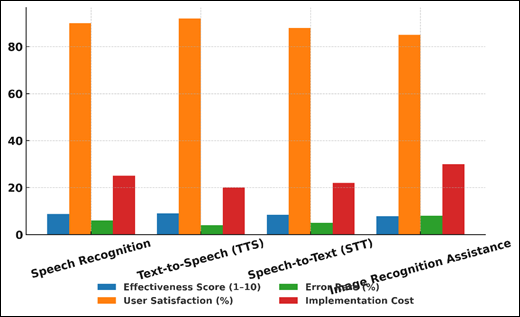
Table 2 reflects the relative efficacy of different AI-powered accessibility technologies that are applied in digital media education. Text-to-Speech (TTS) is the tool that was rated as the most effective (9.1) and most satisfied by the user (92%), which demonstrates its usefulness as a tool that can be used to help learners with visual or reading impairments. The comparative performance metrics as depicted in Figure 3 indicate efficiency of AI technologies.
Figure 3
|
Figure 3 Comparative Performance Metrics of AI Technologies |
The low error rate (4%) and cost efficiency also make it a solution that can be adopted widely. Next came Speech Recognition which showed good results (8.7 effectiveness, 90% satisfaction) and empowered students with motor impairments by allowing them to interact without using their hands as this was seen to be ineffective in noisy settings occasionally.
Figure 4
|
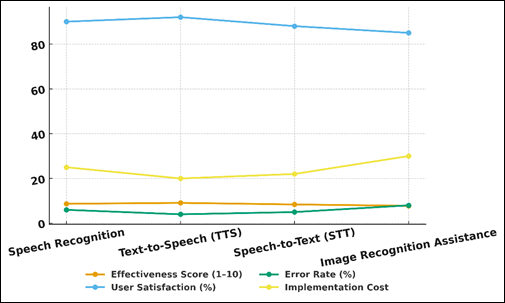
Figure 4 Trend Analysis of AI Technology Performance
Indicators |
Speech-to-Text (STT) was also useful (8.4) in assisting in taking notes and real-time transcription, but due to the accent differences and situational errors, it was not as accurate. Figure 4 presents trend analysis that indicates AI performance indicator improvement. On the other hand, Image Recognition Assistance was the lowest scoring (7.8 effectiveness, 85% satisfaction) with a higher error rate (8) and a higher cost of use because of the technical complexity involved. These problems notwithstanding, image recognition is also important to visually impaired learners.
8. Conclusion
The adding Artificial Intelligence (AI) into digital media education is a radical change towards achieving inclusive and equitable learning. Engineered technologies such as speech recognition, text -to-speech, image recognition, and adaptive learning systems close gaps for accessibility that previously were only available to learners with disabilities or different learning needs. The study proved that not only participation is made possible with the help of AI tools, but also understanding, creativity, and autonomy are improved, which is in good accordance with the ideals of Universal Design of Learning (UDL). The research shows, however, that the adoption of AI is not that easy. There are ethical and technical barriers to implementing in such a way that is equal such as data privacy, algorithmic bias and financial limitations. There are a lot of institutions that do not have the resources, infrastructure, or policy frameworks that would help in making sure that AI tools are not only accessible but also deployed ethically. In the absence of mitigating these systemic problems AI threatens to strengthen, and not decrease, educational inequalities. To go further, the institutions have to focus on ethical governance, digital literacy and interdisciplinary collaboration. Policy makers need to set the rules that would obtain integrity of data, increasing transparency of the algorithm, and investing in inclusive technology. Teachers, in turn, should be educated to successfully implement AI technologies into educational models that will place the emphasis on diversity and accessibility.
CONFLICT OF INTERESTS
None.
ACKNOWLEDGMENTS
None.
REFERENCES
Abulibdeh, A., Zaidan, E., and Abulibdeh, R. (2024). Navigating the Confluence of Artificial Intelligence and Education for Sustainable Development in the Era of Industry 4.0: Challenges, Opportunities, and Ethical Dimensions. Journal of Cleaner Production, 437, Article 140527. https://doi.org/10.1016/j.jclepro.2023.140527
Alier, M., García-Peñalvo, F.-J., and Camba, J. D. (2024). Generative Artificial Intelligence in Education: From Deceptive to Disruptive. International Journal of Interactive Multimedia and Artificial Intelligence, 8(5), 5–14. https://doi.org/10.9781/ijimai.2024.02.011
Gibson, D., Kovanovic, V., Ifenthaler, D., Dexter, S., and Feng, S. (2023). Learning Theories for Artificial Intelligence Promoting Learning Processes. British Journal of Educational Technology, 54(5), 1125–1146. https://doi.org/10.1111/bjet.13341
González-Pérez, L. I., and Ramírez-Montoya, M. S. (2022). Components of Education 4.0 in 21st Century Skills Frameworks: Systematic Review. Sustainability, 14(3), Article 1493. https://doi.org/10.3390/su14031493
Holmes, W., and Tuomi, I. (2022). State of the Art and Practice in AI in Education. European Journal of Education, 57, 542–570. https://dx.doi.org/10.29121/shodhkosh.v6.i2s.2025.6704
Irish, A. L., Gazica, M. W., and Becerra, V. (2025). A Qualitative Descriptive Analysis on Generative Artificial Intelligence: Bridging the Gap in Pedagogy to Prepare Students for the Workplace. Discover Education, 4, Article 48. https://doi.org/10.1007/s44217-025-00435-4
Lim, J., Lee, U., Koh, J., Jeong, Y., Lee, Y., Byun, G., Jung, H., Jang, Y., Lee, S., and Moon, J. (2025). Development and Implementation of a Generative Artificial Intelligence-Enhanced Simulation to Enhance Problem-Solving Skills for Pre-Service Teachers. Computers and Education, 232, Article 105306. https://dx.doi.org/10.29121/shodhkosh.v6.i2s.2025.6704
Mao, J., Chen, B., and Liu, J. C. (2024). Generative Artificial Intelligence in Education and its Implications for Assessment. TechTrends, 68(1), 58–66. https://doi.org/10.1007/s11528-023-00911-4
Oubibi, M., Hryshayeva, K., and Huang, R. (2025).
Enhancing Postgraduate Digital Academic Writing Proficiency: The Interplay of Artificial
Intelligence Tools and ChatGPT. Interactive Learning Environments, 1–19. https://dx.doi.org/10.29121/shodhkosh.v6.i2s.2025.6704
Saputra, I., Astuti, M., Sayuti, M., and
Kusumastuti, D. (2023). Integration of Artificial
Intelligence in Education: Opportunities, Challenges, Threats and Obstacles: A Literature
Review. Indonesian Journal of Computer Science, 12, 1590–1600. https://dx.doi.org/10.29121/shodhkosh.v6.i2s.2025.6704
Sperling, K., Stenberg, C.-J., McGrath, C., Åkerfeldt, A., Heintz, F., and Stenliden, L. (2024). In Search of Artificial Intelligence (AI) Literacy in Teacher Education: A Scoping Review. Computers in Education Open, 6, Article 100169. https://dx.doi.org/10.29121/shodhkosh.v6.i2s.2025.6704
Strielkowski, W., Grebennikova, V., Lisovskiy, A., Rakhimova, G., and Vasileva, T. (2024). AI-driven Adaptive Learning for Sustainable Educational Transformation. Sustainable Development, 33(2), 1921–1947. https://doi.org/10.1002/sd.3221
Tetzlaff, L., Schmiedek, F., and Brod, G. (2021). Developing Personalized Education: A Dynamic Framework. Educational Psychology Review, 33, 863–882. https://doi.org/10.1007/s10648-021-09576-0
Wang, D., Tao, Y., and Chen, G. (2024). Artificial Intelligence in Classroom Discourse: A Systematic Review of the Past Decade. International Journal of Educational Research, 123, Article 102275. https://doi.org/10.1016/j.ijer.2023.102275
Yan, L., Greiff, S., Teuber, Z., and Gašević, D. (2024). Promises and Challenges of Generative Artificial Intelligence for Human Learning. Nature Human Behaviour, 8, 1839–1850. https://doi.org/10.1038/s41562-024-02004-5
Yim, I. H. Y., and Su, J. (2024). Artificial Intelligence (AI) Learning Tools in K–12 Education: A Scoping Review. Journal of Computers in Education, 12, 93–131. https://doi.org/10.1007/s40692-023-00304-9
|
|
 This work is licensed under a: Creative Commons Attribution 4.0 International License
© ShodhKosh 2024. All Rights Reserved.