ShodhKosh: Journal of Visual and Performing ArtsISSN (Online): 2582-7472
|
|
A NAVARASA BASED LYRICAL ANALYSIS OF SONGS FROM THE MOVIE ANIMAL
R. Sailaxmy 1 , Dr. Prabakaran V. 2
1 Research
Scholar, Department of Journalism and Mass Communication, SRM IST, College of
Science and Humanities, Ramapuram, Chennai, India
2 Professor and Head - School of Media Studies, Faculty of Science and Humanitie, SRM Institute of Science and Technology, Ramapuram, Chennai, India
|
|
|
ABSTRACT |
|
|
There are
numerous forms of music in this world and film music is something that is
special to Indian Cinema. Be it the background score or the songs, Indian
Cinema is known for weaving in music into the script. The primary components
of a good album are catchy music and relatable lyrics. Intertwining these
songs into the story in order to enhance a scene’s emotional connect is not
new to Bollywood. Music along with appropriate lyrics project the emotions on
screen and draw the audience closer to the feelings of the characters. Lyrics
are the soul of a song. They are raw feelings that flow through tunes and
give us a sense of connectivity even if there are no visuals. In this paper,
we would like to study the lyrics from the music of a recent Bollywood movie
“Animal” through the perspective of Navarasa - an ancient Indian Aesthetic
theory. The main objective is to analyze how lyrical elements contribute to
the evocation of specific rasas/ emotion and to examine the emotional
alignment between the song lyrics and the narrative context of the film. |
|||
|
Received 22 February 2025 Accepted 16 May 2025 Published 16 December 2025 Corresponding Author R.
Sailaxmy, sr4180@srmist.edu.in DOI 10.29121/shodhkosh.v6.i2s.2025.6690 Funding: This research
received no specific grant from any funding agency in the public, commercial,
or not-for-profit sectors. Copyright: © 2025 The
Author(s). This work is licensed under a Creative Commons
Attribution 4.0 International License. With the
license CC-BY, authors retain the copyright, allowing anyone to download,
reuse, re-print, modify, distribute, and/or copy their contribution. The work
must be properly attributed to its author.
|
|||
|
Keywords: Bollywood, Hindi Cinema, Lyrical Analysis, Navarasa
Theory, Rasa, Metaphors |
|||



1. INTRODUCTION
Music is an integral part of daily life and songs are nothing but words/ texts roped into tunes. Lyrics are usually conversations happening between two people or a monologue or a soliloquy or simply some self-reflection. Especially in the Indian context, film songs add distinct character to the narrative and flow of the script. Film music merges different aspects of music into one. It maintains a gap between dialogue and entertainment. As film songs serve as a useful means for relaxation after a tedious or emotionally exhausting sequence. It is one of the major functions of the film music that gives relief to the audience after a load of dialogue or conversation Kaur (2021). Lyrics enhance the beauty of the tune thereby enhancing the scene that the song is picturised in. Some of the finest lyrics in India have been written for Indian film songs. The songs have been expressive of not just romance and lost love, but also of beauty, various deities, the nation and its natural bounties, as well as seasonal experiences like the onset of spring, monsoons and more Vijayakar (2013). Lyrics add layered meaning to the scene that is tailor made for the plot at any given point of time in the film.
1.1. ANIMAL MOVIE
“Animal” is a cinematic mischief by Sandeep Reddy Vanga. It is an attempt to weave together different narratives that fluctuates between daring and consequences Thomas (2023). Released in 2023, the movie stars Ranbir Kapoor, Rashmika Mandanna, Bobby Deol and Anil Kapoor in the lead. Ranbir Kapoor’s character, Ranvijay Singh, is deeply complicated and misogynistic. He struggles to have his father’s (Balbir Singh, played by Anil Kapoor) acceptance thus painting a complex relation with his father. This leads to him being a chauvinistic and violent character who strains all the relationships coming his way. He is in a constant battle with his vulnerable side and his violent side that puts him in odds with his wife Geetanjali, played by Rashmika Mandanna. In his goal to avenge his father’s accident that was caused by Abrar Ul Haque (played by Bobby Deol), he has adopted a path of brutal violence from where there is no turning around. He has become a criminal, killer, and gangster to protect the family. The character is gradually misogynist and criminal with the kind support of spectators Kamble (2025). The film was a commercial success and earned around nine hundred crores making it the third highest grossing Indian film of 2023. Wikipedia Contributors. (n.d.) The structural narrative and commercial success of the film “Animal” have been both intriguing and dividing since its release. On the one hand, the film’s storyline has sparked intense debate and critique, while on the other, it has managed to garner significant commercial success Chakravorty and Bera (2024). This movie has been a huge box office success and won the Best Music Album award in the 69th Filmfare Awards. Based on the above credentials, the movie Ánimal was selected for the study.
1.2. NAVARASA THEORY
The Navarasa Theory is a concept in Indian Aesthetics that originates from Natya Shastra, a Sanskrit text. Natya Shastra, a first-millennium BCE Sanskrit Literature on the arts that is credited to Bharata Muni, contains a chapter (Chapter 6) devoted to the rasa concept Khanam and Darkhasha (2024). The Navarasa, essentially translates to nine emotions and the concept is widely used in classical dance, drama and literature. The nine Rasas are: Śṛṅgāra (Love / Beauty), Hāsya (Laughter / Joy), Karuṇa (Compassion / Pathos), Raudra (Anger / Fury), Vīra (Heroism / Courage), Bhayānaka (Fear / Horror), Bībhatsa (Disgust / Aversion), Adbhuta (Wonder / Amazement), Śānta (Peace / Tranquility). Rasa has a twofold significance. It means both aesthetic content and aesthetic relish. Rasa arises from a proper combination of the stimulants (vibhav), the physical consequence (Anubhav), and the transient emotional state (Vyabhichari Bhav). It is called Rasa because it is capable of being tested or relished Bhosale (2016). Bharata Muni put forward eight Rasas initially, four primary and four secondary Rasas. Santa (Peace/Tranquility) is debated as the ninth Rasa and was given the position by Abhinavagupta, a Kashmiri philosopher and scholar who elaborated and expanded the understanding of the Navarasa theory postulated by Bharata Muni. Abhinavagupta extends the eight Rasas by adding the concept of the Santa Rasa which he regards as the essence of all Rasas. It is this 9th Rasa which according to Abhinavagupta lets the Rasika attain the aesthetic detachment and savour the essences of all other Rasas and therefore the true aesthetic delight Mukhopadhyay (2022).
1.3. SIGNIFICANCE OF LYRICAL ANALYSIS
Songs are a balanced combination of music and lyrics and film songs are no exception. While the importance of music is widely studied, lyrics play a pivotal role in setting the mood of the song that in turn enhances the scene on the screen. Lyricists play a very important role in song making as it is they who decide how one should feel about a particular situation or person. Words put in the right place with the right emotion could together create a beautiful meaning Hilmi et al. (2018). Lyrical analysis could enable researchers to understand how various styles of writing, figures of speech and cultural references are used to evoke emotions in the audience. Bollywood songs are written for diverse themes such as emotional relationships (of love, betrayal, friendship, parent- child, brother-sister, etc.), social events and functions (e.g., marriage, birthday, anniversary), festivals and rituals, devotion, songs for children and so on Behl and Choudhury (2011). Lyrics are also used as powerful narrative devices in films apart from entertainment. Hindi film music may be taken as a model to understand the function of soundtrack and songs in the larger cinematic contexts insofar as the creative extremes, as well as the uniqueness of the Hindi film soundtrack illustrate the ways in which cinema may use music to narrate the complexities of the plot Mukherjee (2012).
2. REVIEW OF LITERATURE
In order to have a deeper understanding of the topic, the following literatures were studied. Unlike Hollywood, a production in India does not begin with a story or a script. Nor does it begin with acquiring a successful director or with signing a superstar. Most producers start their productions by recording a song. Storywriters weave the lyrics of the songs into the stories as productions progress Rehman (2016). Rehman also elaborates on the process of composing film music and the advantage of internet in marketing the same. Punia talks about the role of music scores in the success of the movies by analysing the relations between the popularity of a song of a film and its success. While dialogue, action, and expression bear the burden of describing the plot and setting different scenes, it is often left unrecognised how in-built music scores set the mood, tone, and atmosphere for the particular scene, complimenting the expressions and ambience of what is displayed on screen Punia (2024). Bollywood songs have experienced a considerable change in terms of lyrics over the past decades. Long ago, bollywood songs contained mostly Hindi words, but nowadays lyricists use lots of English words to express themselves Shakoor (2017). Shakoor has given an in depth analysis of the use of foreign languages in Hindi lyrics over the last two decades.
According to Bharata, Natyashastra imitates the conduct of the world. Natyashastra will be the instrument of instruction for the world in addition to entertainment and pleasure. Natyashastra includes all knowledge, craft, art, lore, fine art, design, emotions, and acts of life Bhosale (2016). The primary goal of performance art, according to the Rasa theory of the Natya Shastra, is to take spectators into a different, perpendicular reality filled with wonder and delight where they are able to experience the core of their own perception and reflect on religious and ethical concerns Khanam and Darkhasha. (2024). Khanam and Darkshasha also give a detailed overview on various concepts of the Navarasa such as Bhava, Vibhava and Anubhava. Rasa is about human’s state of mind. It helps to understand the mind in showing the feeling which conveys the expression. Bharat Muni, in his book on the Natyashastra formulated the theory of Rasa in the 4th century A.D. According to the Natyashastra the major purpose of dance, drama, ritual and poetry is to raise an emotion that is already present in the audience Chatterjee (2021). Navaras in Indian Classical Music, again, can possess shades and meaning of these moods which can be described in a variety of ways. These descriptive words are called Bhavas (expressions) (MISRA, Sumantra; Chakravorty and Bera (2024).
3. OBJECTIVES
Following are the objectives of study:
1) To explore the representation of the Navarasas in the lyrics of songs from the film Animal.
2) To identify the dominant rasa(s) present in each selected song.
3) To analyze how lyrical elements such as metaphors contribute to the evocation of specific rasas.
4) To examine the emotional alignment between the song lyrics and the narrative context of the film.
4. METHODOLOGY
The qualitative method of Lyrical analysis was used by the researcher. The movie Animal has eight songs out of which five have Hindi lyrics. The researcher has picked only the Hindi songs for lyrical analysis. First the dominant Rasa in each song is identified followed by the study of metaphors and the situational context of the song. It is to be noted that the interpretation of the lyrics can be subjective to perspectives of individuals.
5. ANALYSIS
5.1. SATRANGA
Ranvijay Singh, the protagonist, played by Ranbir Kapoor informs his wife that he has cheated on her with another woman who had access to some vital information regarding his father’s attack. The breaking of this news coincides with Karwachauth, a ritual married women perform in the Northern parts of India, for their spouse’s well being and long life. Geetanjali, played by Rashmika Mandanna, is shocked to hear her husband's confession while Ranvijay justifies his actions by quoting his father’s safety as priority.
The song Satranga was rendered by Arijit Singh, composed by Shreyas Puranik and written by Siddharth – Garima. It is a breezy romantic number that is suffused with deep pain. The primary Rasas in this song are Shringara and Karuna. The bhava changes from the first stanza to the third stanza from Shringara to Karuna. The Sanchari Bhava or the fleeting emotions that bridge both the primary Rasa appears as Bhibatsa bhava or disgust in the second stanza. The word Satranga, meaning rainbow, is itself suggestive of the anticipated metaphors in the song.
The refrain of the song “Badrang mein Satranga hai yeh ishq re, Jogi main aur Ganga hai yeh ishq re” compares love to rainbows that colors and brightens a mundane and colorless life reflecting on Shringara Rasa through poetic romance. The second line of the refrain compares love to the holy Ganges and the subject to an ascetic thus reflecting on the purity of the aspects of Shringara Bhava. Just like how the ascetics and the banks of the Ganges are inseparable, so is the lover. Ranvijay’s deep love for his wife is portrayed through the first stanza where the refrain compares their to a rainbow that is colorful and bright. The sanctity of the bond that they share is highlighted through the comparison to the river Ganges and the lover being a saint who is inseparable from the banks of the Ganges that personifies purity.
The second stanza brings in a sense of helplessness and despair that pertains to Bhibatsa Bhava. The feelings stem out of the fact that separation is situational but the feelings are persistent. This leads to a sense of despair. The pre chorus lines give us an understanding of the same. “Rag rag mein malanga hai yeh ishq re, Kyun lahoo mein hi ranga hai yeh ishq re”. Love is compared to blood in this stanza where it playfully runs down the veins despite being questioned of its recklessness for being infused and colored with red. The stanza emphasizes on how despite the dissociation, the feelings are prominent and vital thus leading to a sense of despair or Bhibatsa. The second stanza brings despair, bringing in the shades of Bibhatsa as he is upset with his wife’s reaction despite seeking her forgiveness. He is in a helpless state of mind as his justification doesn't seem fair to his wife while she asks him for a divorce. Separation is situational but how is one supposed to stop feeling for the love of his life. The metaphors used in the second stanza compare love to blood that bleeds during a wound but is still inseparable from the veins as it is so basic for survival.
The last pre chorus nests the song in dejection and pain steering the Rasa to Karuna. The line “Main Samandar, parinda hai yeh ishq re” equates the lover with the ocean and love to a bird. The ocean is vast and deep but love is like the bird, free and unwilling to settle. The stanza beautifully conveys how love, despite being fleeting and elusive, has a lasting impact on the lover making his love unattainable and thus leaving the love story incomplete and sad. The third stanza drips Karuna Rasa as it deals with pain from the separation. Ranvijay wants to set things right with his wife but she refuses to give in. The presence is constant but there can be no meeting between the two foreshadowing how reconciliation between the two is nonviable.
The song ends on a low note as Ranvijay leaves to fight his father’s enemy, a fight that might even get him killed. The music of the song is a typical bollywood romantic number that deals with love and pain.
5.2. HUA MAIN
Ranvijay has returned to India for his father’s sixtieth birthday when he find sout that Geetanjali’s wedding has been fixed and is said to take place in two days. He shares a moment with her and rekindles past memories. After a heated argument with his father, Ranvijay is asked to leave his house when Geetanjali and her brother arrive along with their friends announcing that she has cancelled her wedding and come to Ranvijay. Ranvijay doesnt get an encouraging response from his father and thus he takes Geetanjali to get married on mountains in a private jet. This song is filmed on a private jet along with some intimate moments between the couple who get married on a snow filled mountain.
The song is rendered by Raghav Chaitanya, composed by Pritam Chakraborty and written by Manoj Muntashir. The dominant Rasa in this song is Shringara or love. The song depicts the flutters of the initial stages of love. It highlights the madness of attraction along with the magic of love. The lines “Tu hawa aur main tera baadal hua, Hawa mein, hawa mein main uda” compares the lover to the wind and the singer to clouds stating that the clouds move wherever the wind carries them. This depicts how the singer has surrendered and is totally dependent on his lover. Comparison to the clouds might also refer to how he feels weightless like the clouds because of love. Again, another feeling to cherish during the initial stages of romance.
5.3. PAPA MERI JAAN
This song is an absolute adoration of a son to his father. It is initially played at the beginning of the movie when Ranvijay rushes home to see his father from school and when he is distributing chocolates for his father’s birthday.
Figure 1
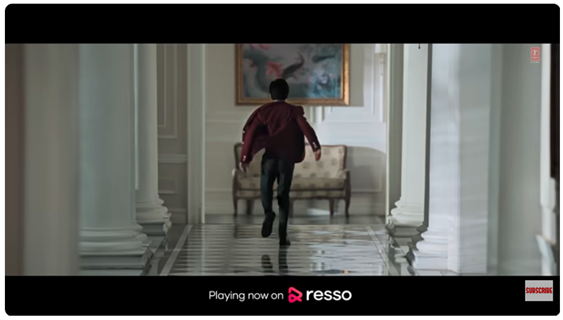
Figure 1
Young Ranvijay Running
to Wish His Father on His Birthday.
Source T Series, https://www.youtube.com/watch?v=dTZIa4BnpGE&list=RDdTZIa4BnpGE&start_radio=1
Tumhi pe toh theherte hai yeh raaste mere liye
My paths come to an end with you
The above line translates to stating that the end of this path is you and visually depicts how young Ranvijay is running to wish his father on his birthday.
The whole song is featured at last post the killing of his enemy, when Ranvijay finally returns home only to be informed that his father is suffering from cancer and has only six months left. This leaves him shattered as this is something that cannot be fought against. The first stanza shows him weeping along with his cousins for his father’s current state. The second stanza comes around when his son comes running towards him and hugs him. Geetanjali decides to head back to the US with her children and persists in getting a divorce from Ranvijay. Even as they boarded the car and move out, his son stops the car and comes back running towards his father.
The song is rendered by Sonu Nigam, composed by Harshvardhan Rameshwar and written by Raj Shekhar. The song reflects two primary Rasas predominantly. One happens to be Karuna or compassion, the other is Veerya in the sense of admiration. The song depicts the affection, love and admiration for one’s father. In the line “Papa meri jaan, mere sang chalna, har meel ka patthar tum” the father is compared to stones that are found every mile focusing on how the father is the guiding light at every significant step.
5.4. PEHLE BHI MAIN
Pehle Bhi Main comes into the film after Ranvijay’s surgery when he meets Zoya, the fiance of his heart donor. She comes to visit him post the heart transplant and they begin to share an intimate relationship outside of his wedlock as Ranvijay decides to comfort her. The song is rendered and composed by Vishal Msihra and written by Raj Shekhar. It is a romantic number and it pertains to Shringara Rasa. This song provokes the intimate aspect of love. The singer is ambiguous about his feelings but feels home when with his lover. The refrain “Badal Badal hai donon, khulke barse bheege aa zara” compares the lovers to clouds that is full and ready to give a downpour pertaining to how the lovers are unable to contain their love for each other. The song suggests them to let go of the vulnerability and inhibitions and embrace this crazy love. The song shows the two of them falling in love with each other slowly.
5.5. KASHMIR
The song is featured in the movie after Ranvijay’s near death incident during a massive fight with around three hundred armed men. He is on the threshold of death as he has multiple organ failure and loses a sense of smell and taste along with hearing. Despite that Ranvijay is up and about, back to his old ways to avenge his father’s accident. Apart from the physical exhaustion, there is mental exhaustion that surfaces in the form of vulnerability and insecurity to his wife. This song is like a reassurance from his beloved, Geetanjali, to his disturbed mind where she assures him of her constant love and support. The song drips with the essence of Shringara Rasa or love in the form of assurance and emotional security from one partner to the other. The song is written, composed and rendered by Manan Bhardwaj along with Shreya Ghoshal as the female playback singer.
6. CONCLUSION
It is evident that the songs in the movie Änimal have a great emotional depth and elaborate a great deal on the characters’ emotional complexities. They enhance the narratives of the plot and enable us to explore the emotional landscape of the concerned characters. The analysis reveals that the most dominant Rasa from the above studied songs is Shringara or love followed by Karuna either in the form of compassion or pain and Bhibatsa that is disgust. These emotions mirror the intense relational dynamics the hero has with his loved ones. Recurrence of Sringara Rasa is testimonial to how his relationship with his wife was the only reciprocal relationship with the same intensity. The hero who has been constantly seeking attention and validation from his father while the movie clocked is seen adoring his father through Karuna which can also be attributed to adoration. Rasas also co-exist in a song, merging with the feel and picturisation of the song.
The Navarasa theory has been aptly used for understanding and decoding another layer of meaning. It cannot be denied that the classical Indian aesthetic theories are relevant even today helping us to communicate human emotions to the audience. The ultimate purpose of the paper is also to ensure that researchers revisit and study ancient Indian theories that are applicable even in these contemporary times.
CONFLICT OF INTERESTS
None.
ACKNOWLEDGMENTS
None.
REFERENCES
Behl, A., and Choudhury, M. (2011). A Corpus Linguistic Study of Bollywood Song Lyrics in the Framework
of Complex Network Theory. In Proceedings of the 9th International Conference
on Natural Language Processing (ICON-2011).
Bhosale, B. (2016). Bharata’s Natyashastra: Fundamentals of Dramatics and Aesthetics (1–9).
Chakravorty, N., and Bera, S. (2024). Portrayal and Perception of Male Chauvinism and Gender Superiority in Hindi Cinema: A Case Study of the Film Animal. Journal of Communication and Management, 3(1), 83–91. https://doi.org/10.58966/jcm20243112
Chatterjee, A. (2021). Application of Nava Rasa in Advertisement: The Impact of Emotional Appeal on Visual Medium of Communication. Journal of Humanities and Social Science, 26(6), 4–10. https://doi.org/10.9790/0837-2606020410
Hilmi, R. Z., Hurriyati, R., and
Lisnawati. (2018). 共分散構造分析による在宅高齢者の健康関連指標の研究 (A Study of Health-Related Indicators in Elderly
People Living at Home Using Covariance Structure Analysis). Journal, 3(2),
91–102.
Kamble, C. (2025). Animal Reinforces the Patriarchy in India (pp. 1–5).
Kaur, B. (2021). Evolution and Cultural Impact of Hindi Film Music from the 1940s. 9(12), 1–6.
Khanam, B., and Darkhasha. (2024). Rasa: The Indian Aesthetic Theory—An Overview. 12(3), 136–144.
Misra, S., and Chakraborty, M. (2018). Application of the Navarasa Theory in Architecture. In Proceedings of the 5th International Conference on Arts and Humanities (ICOAH 2018). https://doi.org/10.13140/RG.2.2.28778.98241
Mukherjee, M. (2012). The Architecture of Songs and Music: Soundmarks of Bollywood, a
Popular form and its Emergent Texts. Screen Sound Journal, 3, 9–34.
Mukhopadhyay, D. (2022). Dancing with Nine Colours: The Nine Emotional States of Indian Rasa Theory.
Punia, R. (2024). Role of Music Scores in the Success of Movies. 10(1), 386–391.
Rehman, S. (2016). The Role of Music in Hindi Cinema. Synergy, 12(2), 314–329.
Shakoor, A. A. (2017). Exploring the Evolutionary Change in Bollywood Lyrics Over the Last Two Decades.
Thomas, V. (2023). Film Review: Animal. MediaSpace: DME Media Journal of Communication, 4(2), 37–38. https://doi.org/10.53361/dmejc.v4i02.06
Vijayakar, R. (2013). The Role of a Song in a Hindi Film. The South Asianist, 2(3), 48–73.
Wikipedia contributors. (n.d.). Animal (2023 Indian film). Wikipedia.
|
|
 This work is licensed under a: Creative Commons Attribution 4.0 International License
© ShodhKosh 2025. All Rights Reserved.